What's inside
- Where to buy
- Key Takeaways
- Quick Picks
- What makes the best affordable professional cameras at this price?
- Which affordable bodies can you actually build a business on?
- How do the six professional candidates stack up?
- What does a professional kit cost beyond the body?
- How should a new professional set up a body for paid work?
- Which body suits which trade, trade by trade?
- Why do handling and ergonomics decide professional satisfaction?
- Should a starting professional rent, buy new, or buy used?
- What mistakes do aspiring professionals make when buying?
- How does delivery — tethering, editing and turnaround — affect the choice?
- Final Recommendation
- Frequently Asked Questions
- Related Guides
As an Amazon Associate I earn from qualifying purchases. This post may contain affiliate links at no extra cost to you.
gizmoverdict.com is reader-supported. When you buy through links on our site, we may earn an affiliate commission.
Where to buy
Five bodies below carry Amazon links verified for this guide; one of them, the Canon EOS R7 outfit, is a multi-lens bundle whose contents we describe exactly as listed rather than assuming. The sixth camera, Panasonic’s Lumix S5 II, is covered in prose only, because no verified listing for it sits in our pool — it still earns its place in the argument, as you will see.
The best affordable professional cameras sound like a contradiction until you define professional by work rather than by price tag. A professional camera is one that does not become the reason a paid shoot failed: it focuses where the client is, writes to storage you can trust, survives the venue’s weather and lighting, and produces files a client can print, publish and pay for. By that definition, the professional tier no longer starts at flagship money. Full-frame bodies that were mid-range launches a few seasons ago, and the flagship APS-C models that brands build to near-professional standards, now cover weddings, portraits, products, sports and video production at prices a working photographer can amortise over a season rather than a career. This guide gathers the six strongest answers and is blunt about where each one’s professional credentials end.
Bluntness matters because the word professional gets abused in listings. Nothing here is a medium-format studio system, and nothing here is the flagship a national sports agency issues; those cameras exist at multiples of these prices, and a guide pretending otherwise would be selling fantasy. What these six offer is professional adequacy with specific, named ceilings — a single card slot here, cropped 4K there, an APS-C sensor where full-frame would be kinder. A working photographer can plan around a named ceiling. What ruins shoots is the unnamed one, which is why every pick below carries its limitations in the same breath as its virtues.
Notice the shape of the list: three full-frame bodies from the three great rival systems, two flagship crop-sensor cameras whose speed and reach make them professional tools in their own right, and one prose-only full-frame alternative that many videographers would rank first of all. The argument between them is not really about image quality — all six produce client-grade files — but about ecosystems, ergonomics and the kind of work you intend to sell. Read with your own bookings in mind: the wedding photographer’s ranking and the wildlife photographer’s ranking of this same six are almost opposite, and both are correct.
Key Takeaways
- Sony’s a7 III is the seasoned professional value: dual slots, stabilisation and a mountain of lenses at a price fallen pros keep recommending.
- Nikon’s Z 5 is the risk-manager’s full-frame — twin card slots and sealing for shoots that cannot be repeated or refunded.
- Canon’s EOS R8 brings current-generation autofocus and oversampled 4K to paid hybrid work, trading slots and stabilisation for lightness.
- Sony’s a6700 is the APS-C flagship for video-led professionals, with serious log tools in a body that travels in a jacket pocket.
- Canon’s EOS R7 is the speed-and-reach professional: flagship crop-sensor pace for sports and wildlife, here as a two-lens-plus-telephoto bundle.
- Panasonic’s Lumix S5 II, prose-only in this guide, is the videographer’s full-frame benchmark many would buy first with their own money.
Quick Picks
| Pick | Badge | Why it earns its place |
|---|---|---|
| Sony Alpha a7 III | Seasoned pro value | The full-frame workhorse whose reliability record and lens library made it the default first paid-work body. |
| Nikon Z 5 | Risk-manager’s full-frame | Backup card writing and weather sealing for the wedding and event work that offers no second take. |
| Canon EOS R8 | Hybrid pace-setter | Modern subject-tracking autofocus and detailed 4K in the lightest full-frame package a pro can buy cheaply. |
| Sony Alpha a6700 | Video-led APS-C flagship | Log recording, LUT handling and clever subject recognition for creators whose work is moving pictures. |
| Canon EOS R7 | Speed and reach specialist | Thirty frames a second and a crop sensor’s telephoto bonus, bundled with two zooms and a long third-party telephoto. |
| Panasonic Lumix S5 II | Videographer’s benchmark | Phase-detect focus and unlimited-feeling video manners — discussed in prose, absent a verified listing here. |
What makes the best affordable professional cameras at this price?
We applied the tests a working photographer applies at 2 a.m. before a booking. Can the camera write every frame twice, or at least protect the day’s work intelligently? Does its autofocus hold a walking bride, a talking chief executive, a diving winger — the moving subjects clients actually pay to have frozen? Do its files survive a client’s print deadline and a magazine’s reproduction standards? Can it be operated in the dark, in gloves, in rain, by muscle memory? And does its lens system contain the specific glass the work demands — the bright standard zoom, the portrait prime, the long telephoto — at prices the business can carry? A body passing most of those tests is a professional tool regardless of its launch price; a body failing them is an expensive hobbyist camera wearing a suit.
Two structural judgements shaped the final six. First, we let flagship APS-C bodies stand as professional picks in their own right rather than as consolation prizes. The a6700 and R7 shoot sports, wildlife and video at speeds and reaches the full-frame trio cannot match at this money, and working photographers in those fields choose crop sensors deliberately. Second, we capped the guide where professional adequacy ends: bodies with a single slot and modest sealing can be professional for portrait and product work, so they appear with their ceilings named; bodies aimed purely at casual use do not appear at all. The S5 II’s prose-only status is a listing technicality, not a ranking — its section argues its case at full strength.
Longevity completed the judging. A professional body is a business asset, so we favoured systems with deep service networks, abundant rental support in major cities, and lens catalogues that let a one-body starter grow into a two-body operation without changing mounts. Every system here passes that test, which is precisely why the choice between them should be made on the work you shoot and the handling you prefer — the variables no specification table can decide for you. We also asked a quieter question of each candidate: would a working photographer, shown the receipts in five years, feel the money was spent in the right order — body first, then the lens the diary demanded, then the second body? The six below are the ones whose ownership stories tend to answer yes, because none of them forces an early replacement, a mount change or an apology to a client along the way. Professional adequacy, it turns out, is mostly the absence of those three events.
Which affordable bodies can you actually build a business on?

Sony Alpha a7 III — Seasoned pro value
Ask a room of working photographers which affordable body they would trust with a wedding tomorrow and the a7 III collects the most nods, because its professional case is built from completed jobs rather than launch promises. The 24.2-megapixel full-frame sensor delivers files that print large, crop gracefully and behave in dim chapels and darker reception halls. Two SD slots write insurance copies of every frame. Five-axis stabilisation in the body steadies the fast primes wedding work runs on. And the E-mount lens library — Sony’s own glass plus a decade of Sigma, Tamron and Samyang alternatives — contains every lens a general practice needs, at every budget tier a business passes through on its way up.
On assignment the camera’s virtues are cumulative rather than theatrical. Eye autofocus keeps a processional sharp; the burst rate swallows a bouquet toss without breaking stride; battery endurance, a generational leap when this body arrived, covers a full wedding day with a spare resting in the bag rather than rotating in panic. Customisable buttons let an experienced hand build a personal control layout — back-button focus, a recall for reception settings, silent shooting for the ceremony’s quietest passages, where the electronic shutter spares the congregation the photographer’s noise. These are the unglamorous competencies clients never see and always pay for.
Its ceilings are equally well mapped by now. The menu architecture is the older Sony design, dense until customised. The finder and rear screen are outclassed by newer bodies at twice the price. Video, while detailed and clean in low light, lacks the frame-rate depth and focus sophistication of current hybrid flagships, so a video-led business should read the a6700 and S5 II sections before deciding. None of this displaces the a7 III from its role here: the most complete professional starter body money can buy at this level, with a used market deep enough to furnish a second body — the true mark of a working kit — for less than many photographers spend on a single lens.
- Sensor: 24.2MP full-frame, back-illuminated design
- Card slots: dual SD for backup writing
- Stabilisation: 5-axis in-body
- Autofocus: eye detection, wide-area coverage
- Video: 4K up to 30p
- Mount: Sony E, widest third-party support
Strengths
- Complete professional checklist — backup slots, stabilisation, low-light files — at a fallen price.
- Lens ecosystem spans budget primes to flagship zooms without leaving the mount.
- Proven reliability record across years of weddings, events and editorial work.
Trade-offs
- Older menus and modest displays feel dated beside current hybrid bodies.
- Video toolset is a generation behind video-first rivals in this guide.
- Single-function dials and smaller grip suit some hands less than Nikon’s layout.
Best for: general-practice professionals — weddings, portraits, events — building a first full-frame business kit. Not suited for: video-led studios needing the newest recording features, or specialists needing flagship burst speed.

Nikon Z 5 — Risk-manager’s full-frame
The Z 5’s professional argument can be summarised in one word: prudence. It is the full-frame body for photographers whose work cannot be reshot and whose clients cannot be told that a card failed. Two SD slots, both fast, write every image twice. The body is sealed against the dust and drizzle that outdoor ceremonies and location portraits specialise in. In-body stabilisation supports the photographer’s side of the bargain, and Nikon’s control layout — deep grip, clear dials, a top-plate display of the essentials — lets gloved or nervous hands work without looking down. A professional camera should lower the temperature of a shoot; the Z 5 is engineered calm.
Image quality fully supports the insurance architecture. The 24.3-megapixel sensor produces the natural colour and forgiving shadows Nikon shooters prize, with raw files that tolerate the exposure rescues real venues demand — a face against a blown window, a dress against a dark panelled wall. Eye-detection autofocus handles people and animals with composure, and while the continuous tracking and burst rate are measured rather than manic, portrait, wedding and corporate work rarely asks for more; the honest exception is sport, which the R7 below exists to serve. Z-mount glass, including Nikon’s own sensibly priced bright primes and the standard professional zoom trinity, completes a system a business can grow inside for a decade.
Video is where prudence turns into a boundary. The Z 5 records 4K with a heavy crop that complicates wide interior shots, and its filming toolset is a stills photographer’s accessory rather than a hybrid creator’s platform. A professional whose income is moving pictures should treat this body as a stills specialist and budget accordingly. For the stills-led practice — the wedding photographer who films nothing, the portraitist, the corporate and events shooter — the Z 5 may be the most rational purchase in this entire guide: not the fastest, not the flashiest, and the least likely to be the reason a client is disappointed.
- Sensor: 24.3MP full-frame CMOS
- Card slots: dual SD, both high-speed capable
- Stabilisation: 5-axis in-body
- Sealing: dust and drip resistant construction
- Video: 4K cropped; Full HD full-width
- Mount: Nikon Z
Strengths
- Dual-slot backup writing and sealing directly protect paid, unrepeatable work.
- Forgiving raw files and natural colour suit people photography under venue lighting.
- Settled, glove-friendly handling keeps operation calm under client pressure.
Trade-offs
- Cropped 4K limits its usefulness for professional video assignments.
- Burst rate and tracking pace trail the speed specialists in this guide.
- Third-party lens support, while growing, trails Sony’s catalogue depth.
Best for: wedding, portrait and corporate photographers who insure every frame and shoot stills first. Not suited for: hybrid businesses where billable video is half the income.

Canon EOS R8 — Hybrid pace-setter
The R8 is what happens when a manufacturer stops protecting its professional tier: a body priced for keen amateurs that carries the sensor and autofocus brain of Canon’s professional R6 Mark II. For paid work, that inheritance cashes out as subject detection that recognises people, animals and vehicles, eye tracking that holds through a conference crowd or a wedding party’s chaos, and a 24.2-megapixel full-frame sensor whose files stay composed in the miserable mixed lighting of real venues. Add oversampled 4K video up to 60p — the detailed, clean kind that clients notice without knowing why — and the R8 becomes the hybrid professional’s shortcut: one light body that covers the stills contract and the video contract on the same afternoon.
Its professional use has a working style. The vari-angle touch screen serves filming, overhead product shots and low ceremony angles; the light body rides a gimbal without exhausting the operator and travels in the small bag that location work prefers. Canon’s RF lens range, anchored by professional L zooms and sensible bright primes, supplies the glass, and the kit zoom in the listing for this guide — the compact RF 24-50mm — is best understood as a daylight walkaround while the business saves for the lenses the work actually bills for. Professionals stepping up from Canon DSLRs will find the transition eased by adapters that keep EF glass earning its keep.
The economies are the known ones, and a professional must price them honestly. One card slot means the backup discipline moves to workflow — shoot, offload, verify, twice — rather than living in the camera. No in-body stabilisation means stabilised lenses or support for slow work. The smaller battery means a pocket of spares on a full-day booking. Portrait, product, content and hybrid event professionals absorb those trades routinely in exchange for the autofocus and video quality; a wedding traditionalist who sleeps soundly only with dual slots should take the Nikon or Sony above. Judged as the modern, light, hybrid professional instrument, the R8 has no rival at its price in this guide.
- Sensor: 24.2MP full-frame CMOS
- Autofocus: subject detection inherited from professional siblings
- Video: 4K up to 60p, oversampled from 6K
- Stabilisation: provided by lenses; none in body
- Card slots: single SD
- Mount: Canon RF, EF adaptable
Strengths
- Professional-grade subject tracking transforms keeper rates on moving paid subjects.
- Oversampled 4K and a flip screen make it a genuine one-body hybrid solution.
- Featherweight body suits gimbal work, travel assignments and long handheld days.
Trade-offs
- Single card slot pushes backup responsibility onto the photographer’s workflow.
- No in-body stabilisation; slow handheld work needs stabilised lenses or support.
- Small battery demands a disciplined rotation of spares on full bookings.
Best for: hybrid professionals shooting stills and billable video for events, content and brands. Not suited for: dual-slot traditionalists or photographers working long days far from charging.

Sony Alpha a6700 — Video-led APS-C flagship
The a6700 is Sony’s flagship APS-C body, and its professional identity is unambiguous: this is the camera for people whose paid work moves. A 26-megapixel back-illuminated sensor with a dedicated AI processing unit powers subject recognition that extends beyond faces to insects, trains and aircraft, while the video specification reads like a small cinema camera’s — 4K oversampled from 6K, high frame rates for slow motion, 10-bit recording, log profiles with LUT preview so the footage you monitor resembles the footage you will deliver. The listing here is the body only, which professionals will read correctly: the lens budget is yours to aim at the glass your work bills for.
In production the details compound. Autofocus breathing compensation keeps a talking head’s frame steady as focus shifts; active stabilisation smooths the walk-and-talk grammar of commercial content; the vari-angle screen, heat management for long takes and a full set of ports make it a rig-friendly centre for a small crew’s camera bag. Stills are no afterthought — the same tracking intelligence, a mechanical shutter and burst speeds that embarrass older flagships cover events, sports and wildlife respectably, with the crop factor turning telephoto lenses longer, a free reach bonus field professionals exploit deliberately.
The APS-C ceiling is the honest counterweight, and this guide has promised named ceilings. In the darkest venues the full-frame bodies above gather light more generously, and the depth-of-field look of full-frame at the same aperture is a portrait aesthetic some clients expect. One card slot, again, asks workflow discipline. But weigh what the a6700 returns: cinema-grade video tools, flagship focusing and a lens ecosystem where professional APS-C zooms are smaller and cheaper than their full-frame equivalents. For the creator-economy professional — the brand filmmaker, the sports-content shooter, the travel documentarian — it is not the budget option. It is the correctly sized one.
- Sensor: 26MP APS-C, back-illuminated, AI processing unit
- Video: 4K oversampled, high frame rates, 10-bit log with LUT preview
- Autofocus: broad subject recognition including vehicles and insects
- Screen: vari-angle touch
- Card slots: single SD
- Mount: Sony E, full-frame glass compatible
Strengths
- Cinema-leaning video toolset with log and LUT handling in a pocketable pro body.
- AI-assisted subject recognition keeps obscure moving subjects in professional focus.
- APS-C professional zooms shrink the whole working kit’s size and cost.
Trade-offs
- Low-light ceiling sits below the full-frame picks when venues turn truly dark.
- Single card slot again requires an offload discipline on paid work.
- Body-only listing means the lens investment starts immediately.
Best for: video-led professionals, brand filmmakers and content studios travelling light. Not suited for: low-light stills specialists or dual-slot traditionalists.
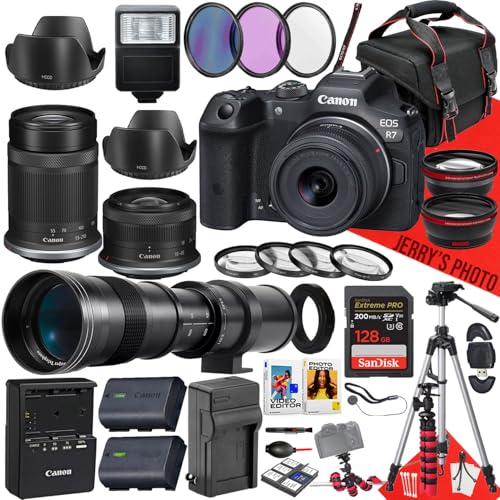
Canon EOS R7 — Speed and reach specialist
Professional photography has a wing where the subjects are fast, distant and uncooperative, and the R7 is built for that wing. Its 32.5-megapixel APS-C sensor sits behind in-body stabilisation and a mechanical shutter capable of fifteen frames per second — thirty electronically — with autofocus inherited from Canon’s professional line that detects people, animals and vehicles and tracks them across the frame. The crop sensor multiplies every telephoto’s reach, which is why sports and wildlife professionals treat APS-C flagships as tools rather than compromises: a 400mm lens frames like a much longer one, and the pixel density puts more detail on a distant subject than a full-frame sensor of similar count.
The listing attached to this guide is a bundle, and it deserves a transparent description: the R7 body with Canon’s RF-S 18-45mm and RF-S 55-210mm zooms, a third-party 420-800mm manual telephoto, and a memory card among the extras. Read that inventory the way a professional would. The two Canon zooms are the working heart — a standard range and a portrait-to-telephoto range that together cover events and field sports while the business saves for professional glass. The long third-party telephoto is a manual-focus specialist lens: a taste of extreme reach for patient wildlife work, not a substitute for an autofocus professional telephoto, and valued honestly it is a bonus rather than the reason to buy.
As a working body the R7’s credentials are thorough: dual card slots — the professional insurance the R8 omits — weather sealing matched to its class, a deep grip and dual dials for gloved operation, and 4K video both oversampled for quality and cropped for extra reach. Its ceilings are the APS-C pair shared with the a6700: low-light generosity a step below full-frame, and a lens catalogue whose professional RF-S glass is thinner than the full-frame RF shelf, though EF lenses adapt superbly and the used telephoto market is a wildlife shooter’s treasure chest. For the field-sports, wildlife and airshow professional starting a business, the R7 is the most capability per unit of money in this guide.
- Sensor: 32.5MP APS-C CMOS
- Burst: 15 fps mechanical, 30 fps electronic
- Stabilisation: in-body, coordinated with lenses
- Card slots: dual SD
- Video: 4K oversampled and cropped options
- Bundle: RF-S 18-45mm, RF-S 55-210mm, third-party 420-800mm manual telephoto, card
Strengths
- Flagship pace and tracking for sports and wildlife at an attainable professional price.
- Dual slots and sealing complete the working photographer’s insurance checklist.
- Crop reach and pixel density put distant subjects large in the frame.
Trade-offs
- Low-light performance concedes ground to the full-frame bodies in this guide.
- Bundled long telephoto is manual-focus — a specialist extra, not pro autofocus glass.
- Native professional RF-S lenses are fewer than full-frame RF options.
Best for: sports, wildlife and event professionals who need speed, reach and dual slots. Not suited for: low-light portrait specialists or video-first studios.
Panasonic Lumix S5 II — Videographer’s benchmark
The S5 II is the pick this guide most regrets covering without a link, because a strong case exists that it is the first body a video-led professional should buy. Panasonic rebuilt its full-frame line around phase-detection autofocus — answering the one criticism that dogged its earlier contrast-based systems — and wrapped it in a body whose video manners are the best in this article: open-gate recording that uses the whole sensor for flexible reframing, professional monitoring tools, LUT handling, and a cooling fan that lets long recordings run without the thermal anxiety compacts and smaller bodies carry. Its 24.2-megapixel sensor’s stills are fully professional too, with in-body stabilisation and the L-mount lens alliance behind it.
Why prose-only, then? Discipline, not doubt: our pool holds no verified listing for this camera, and this guide does not attach purchase links it cannot stand behind. The S5 II is bought from Panasonic dealers and the usual professional retailers, and its price sits squarely in this guide’s affordable-professional territory. Videographers should audition it head-to-head against the a6700 and R8 with their own work in mind: against the Sony it offers full-frame light gathering and superior long-form recording behaviour; against the Canon, a deeper video toolset at the cost of Canon’s autofocus charisma and lens shelf.
Its limitations complete the honest portrait. The L-mount alliance’s lens catalogue, while growing and shared across three brands, is thinner on the used market than Sony’s or Canon’s shelves. Autofocus, though transformed from Panasonic’s past, still trails the best Sony and Canon tracking in chaotic scenes. Stills burst speed is respectable rather than field-leading. None of this dents the verdict for its tribe: if your professional income is predominantly moving pictures shot in the real world — weddings filmed, documentaries, commercial content — the S5 II is the benchmark your shortlist starts from, and this guide says so without a link to sell you.
- Sensor: 24.2MP full-frame CMOS
- Autofocus: phase-detection hybrid system
- Video: open-gate recording, fan-cooled long takes
- Stabilisation: in-body
- Status: prose-only — no verified listing in our pool
- Mount: L-mount alliance
Strengths
- Long-form video behaviour with active cooling outclasses every rival here for ceremonies and interviews.
- Open-gate recording gives editors reframing freedom productions increasingly expect.
- Full-frame stills with stabilisation keep it a genuine hybrid, not a video-only tool.
Trade-offs
- Used lens market for its mount is shallower than Sony’s or Canon’s.
- Tracking autofocus, much improved, still cedes the chaos scenes to rivals.
- No verified listing in our pool, so pricing must be checked at professional dealers.
Best for: videographers and documentary professionals whose income is moving pictures. Not suited for: buyers wanting the deepest used lens market or the fastest sports burst.
How do the six professional candidates stack up?
| Camera | Sensor | Card slots | Stabilisation | Video ceiling | Professional home turf |
|---|---|---|---|---|---|
| Sony a7 III | Full-frame 24.2MP | Dual | In-body | 4K 30p | Weddings, general practice |
| Nikon Z 5 | Full-frame 24.3MP | Dual | In-body | 4K cropped | Events, portraits, insurance-first work |
| Canon EOS R8 | Full-frame 24.2MP | Single | Lens-based | 4K 60p oversampled | Hybrid stills and video |
| Sony a6700 | APS-C 26MP | Single | In-body | 4K high frame rates | Video-led production |
| Canon EOS R7 | APS-C 32.5MP | Dual | In-body | 4K oversampled | Sports and wildlife |
| Panasonic S5 II | Full-frame 24.2MP | Dual | In-body | Open-gate video | Film-led professional work (prose-only) |
Two columns decide most professional purchases. Card slots are the insurance column: dual-slot bodies — a7 III, Z 5, R7 and S5 II — write the day’s work twice inside the camera, while the single-slot pair demand a rigorous offload ritual that disciplined hybrid shooters accept in exchange for their other gifts. The home-turf column is the honest summary of this whole guide: professional is not a rank but a fit between a tool and a trade, and the same R7 that is overqualified for a pitch-side Saturday is the wrong purchase for a candlelit wedding where the a7 III’s sensor and slots were born to work.
What does a professional kit cost beyond the body?
New professionals consistently under-budget the system around the body, so let us price the shape of it in words rather than figures. The working zoom comes first: every trade has one — the standard-range bright zoom for events and weddings, the telephoto for field sports, the fast standard for video production — and it will cost a substantial fraction of the body and earn more. A fast prime follows, for darkness and for portraits. Then the unphotogenic essentials that clients indirectly pay for: cards in rotation, batteries in multiples, a calibrated monitor at home, backup drives in two locations, insurance, and a second body the moment the bookings justify it — because a professional with one body is a hobbyist with a deadline until the day it fails.
The bodies in this guide were chosen partly for how mercifully they treat that shopping list. Sony’s E-mount and Canon’s RF-with-EF-adaptation both offer professional glass at several price tiers, including third-party zooms that undercut the badges without embarrassing the work. Nikon’s Z shelf is smaller but complete at the professional core. The R7’s bundle defers the telephoto decision while covering the standard ranges from day one, and the a6700’s body-only listing is an honest invitation to aim the whole budget at one excellent lens rather than two mediocre ones. Whichever route you take, buy the lens your next three bookings need, not the lens your ambition admires; the business funds ambition in that order.
Travel and logistics deserve their line too: a professional kit must survive airlines, car boots and venue stairs, so weigh the packed system — bodies, zooms, batteries, support — and not the body alone, because the R8 and a6700’s lightness compounds across every lens and every mile, while the dual-slot bodies repay their grams in the only currency that matters at a wedding, which is certainty. Photographers who fly to work should also confirm that their system’s batteries and chargers comply with cabin rules and that a rental house at the destination stocks their mount.
One more line item deserves promotion from footnote to paragraph: the backup and verification workflow.
Dual-slot bodies halve the anxiety but not the responsibility — cards still get copied to two places before they are formatted, and the copies get opened and checked, because a backup you have never restored is a hope, not a backup. Single-slot professionals build the same safety with behaviour: offload at every natural pause, carry the day’s cards on your person rather than in the checked bag, and never format in the field. Clients forget your camera model within a week; they remember for a decade whether you delivered.
How should a new professional set up a body for paid work?
Configure before the first booking, in calm conditions, and write the configuration down. Set the dual slots to backup if your body offers them, or to overflow only if you have consciously accepted the risk. Record raw to the main card and a JPEG alongside if clients expect same-day previews. Build two custom modes — one for stills in available light, one for your video baseline — so a venue change is a dial turn rather than a menu expedition. Assign back-button focus, put exposure compensation under your thumb, and disable every beep and grid you do not use, because a professional camera should be quiet in both sound and interface.
Then rehearse the failures. Practise swapping a card and a battery in the dark until the motions are boring. Learn exactly how your autofocus behaves when the subject turns away, crosses another person, or drops into shadow, because each system in this guide has a personality in those moments and the time to meet it is a rehearsal, not a first dance. Format cards only in the camera that will shoot them, label batteries by purchase date, and keep a printed settings card in the bag for the day a borrowed or reset body needs rebuilding in ten minutes. None of this appears in a portfolio, and all of it is the difference between a talented amateur and a professional on the days when talent is not the variable being tested.
Which body suits which trade, trade by trade?
Weddings reward the complete checklist, which is why the a7 III and Z 5 lead this guide’s thinking: dual slots for the unrepeatable, low-light generosity for the unlit, stabilisation for the handheld, and silent-shooting options for the sacred. The R8 films a wedding beautifully and photographs it nearly as well, asking only that its owner run the backup workflow like a professional rather than relying on the camera to be one. Portraits and headshots reorder the field again: here the sensor’s look and the lens matter more than speed, the Z 5’s colour and the a7 III’s prime library shine, and the R7’s talents are simply pointed at the wrong problem — a truth about specialisation, not quality.
Product and commercial still-life work is the great leveller: on a tripod, in controlled light, every body in this guide produces files a client cannot tell apart, and the deciding factors become tethering behaviour, screen articulation for overhead angles and the macro and tilt lenses the system offers. The R8’s flip screen and the a6700’s compact rigging both serve studio benches well. Sports and wildlife invert the table completely, enthroning the R7’s burst, buffer behaviour and crop reach, with the a6700 as the video-leaning alternative for content teams; the full-frame trio watch from the stands, their virtues irrelevant at the far end of a telephoto.
Documentary and brand filmmaking close the survey with the S5 II’s name at the top — open gate, long-take composure, professional monitoring — pressed by the a6700’s production agility and the R8’s autofocus charisma. A hybrid wedding studio might rationally run an a7 III for stills and an a6700 for film, sharing E-mount glass between them; a Canon house might pair the R8’s stills with an R7’s reach for the sports contract. Systems thinking, again: the professional purchase is rarely a camera, it is the first brick of a wall.
Why do handling and ergonomics decide professional satisfaction?
Because a professional holds the camera for six hours in the rain while a hobbyist holds it for twenty minutes in the sun. Grip depth decides whether the R7’s substantial hold or the R8’s compact shell leaves your hand fresher at midnight; dial placement decides whether exposure compensation happens by instinct or by eyes-down fumbling during the vows. The Z 5’s top-plate information and Nikon’s dial logic suit photographers raised on that language; Sony’s customisable density rewards an owner who invests an evening in configuration; Canon’s touch-led interface flatters those who think in screens. None of these is a defect. All of them are fits, and a body that fits its owner’s hands disappears, which is the highest compliment professional equipment can earn.
Weather behaviour belongs in the same paragraph as grip, because the two meet in the field. Sealing standards across this guide are real but relative: the dual-slot full-frame bodies and the R7 are built to keep working through the drizzle and dust of location work, while every body here still deserves a rain cover in a downpour and a lens cloth within reach. Cold drains batteries and stiffens fingers; heat tests video bodies, which is the S5 II’s fan-cooled party trick and a genuine production advantage in summer venues. Professionals plan for the weather their diary guarantees, not the weather the brochure photographed.
There is also the matter of presence. A large body with a professional zoom reassures some clients and intimidates some subjects; the a6700’s small footprint films in sensitive places — hospitals, workshops, family homes — with a discretion that changes what people permit. Documentary professionals have always known that the camera’s social size is a feature. When you audition these bodies, hold them loaded, with the lens your work uses, for longer than feels polite in the shop. The one your hand forgets is the one your clients will thank you for.
Should a starting professional rent, buy new, or buy used?
Each route has a professional logic. Renting serves the exceptional job — the one weekend a year demanding a flagship or a specialist lens — and doubles as the finest audition process ever devised: a rented body on a real shoot reveals more than a month of reviews. Every body in this guide is rentable in major cities, and a rental that ends in a purchase decision has paid for itself in certainty. Buying new buys warranty, known history and the longest service life, and for a primary body that earns money weekly, that certainty is a business cost like any other.
Buying used is where this guide’s six become a strategy. The a7 III’s deep used market, graded by reputable dealers with shutter counts disclosed, lets a starter field two bodies for the price trajectory of one new flagship — and two competent bodies beat one magnificent body on every wedding day ever photographed. The same logic furnishes EF telephotos for the R7 and E-mount primes for the Sonys. The disciplines are the used buyer’s litany from our other guides: shutter count, sensor inspection, genuine batteries, returns honoured. Follow them and the used market is not a risk pool; it is the professional’s traditional ladder, climbed by generations before mirrorless existed.
What mistakes do aspiring professionals make when buying?
The flagship mirage leads: stretching for a top-tier body and pairing it with a slow kit zoom, when the same money buys a body from this guide plus the professional lens the work actually bills for. Clients have never once paid extra for a camera’s badge; they pay for the file, and the file is mostly lens, light and operator. Second comes the single-body gamble — booking overlapping or unrepeatable work with no backup body and no rental house relationship, a risk that costs nothing until the afternoon it costs everything. A used body from the same system is the cheapest insurance in the business.
Third, buying for the work you wish you had. The wildlife flagship helps nobody whose diary is full of corporate headshots; the video benchmark is wasted on a stills-only practice. Your last ten shoots are a better purchasing guide than your ambitions, and this guide’s home-turf column exists to enforce that honesty. Finally, neglecting the contract-side of professionalism that cameras cannot provide: written agreements, delivery timelines, file retention promises. The cameras here will not embarrass you in front of a client. Make sure the business around them is built to the same standard.
How does delivery — tethering, editing and turnaround — affect the choice?
Professional work is increasingly judged at the speed of delivery, and the camera is the first link in that chain. Studio and product photographers tether: the body feeds images straight to a computer where the client watches the shoot unfold, and here mature USB tethering support and reliable software ecosystems matter more than any sensor figure. All six systems tether competently with their makers’ or third-party software; the practical advice is to test your exact body-lens-software combination before the client arrives, because tethering failures are configuration failures, discovered in rehearsal or in humiliation. Event professionals face the opposite pressure — same-night highlights for social channels — where clean JPEGs straight from the camera, dependable Wi-Fi transfer and colour that needs little correction turn the R8 and the Sonys into deadline instruments.
Editing headroom is the quiet professional specification nobody lists. Files from every body here tolerate the exposure and colour rescues that real venues make necessary, but they tolerate them differently: full-frame files lift shadows with less protest, the R7’s dense sensor rewards careful exposure with extraordinary crop freedom, and 10-bit video from the a6700, R8 and S5 II grades in post in ways 8-bit footage resists. A professional choosing between two bodies should download sample files from their actual genre — not landscapes at noon, but a reception at midnight — and push them around in their own editor. Ten minutes of that tells the truth that a specification table spends pages avoiding.
Turnaround ends at the archive. Name files on ingest, back up to two locations before the memory of the day fades, and keep the raw files for the retention period your contract promises. The cameras in this guide all write standard formats that editing software will open for decades; the risk to a professional archive is never the format, it is the single hard drive and the good intention. Build the boring system now, while the business is small enough that building it is an afternoon’s work.
Final Recommendation
Match the body to the diary. General practice — weddings, portraits, events — belongs to the a7 III’s complete checklist or the Z 5’s prudent insurance, separated mainly by which lens shelf and handling you prefer. Hybrid creators should take the R8’s modern autofocus and video, or the a6700’s production depth if the work leans further into film. Field speed belongs to the R7, and the video-led professional owes the prose-only S5 II a dealer visit before deciding anything. What unites the six is that none of them will be the reason a client is disappointed, provided the lens in front of it and the workflow behind it are built with the same seriousness — professionalism, at this price, is a system you assemble, not a badge you buy. A last word on timing, because starting professionals agonise over it: buy the body when the bookings demand it, not when a launch tempts you, and buy it a month before the season rather than a week, so its menus and focus personality are old friends by the first paid morning. The photographers whose work you admire built their practices on bodies no better than these, and usually worse. What they had was a tool they trusted completely and knew completely — and every camera on this page can be that tool, in the hands of the professional willing to learn it before the client arrives.
Frequently Asked Questions
Do I really need dual card slots for paid work?
For unrepeatable work — weddings, events, ceremonies — dual slots writing simultaneous backups are the closest thing to insurance the industry offers, and many professionals treat them as non-negotiable. For repeatable work like product or portrait sessions, a single-slot body with a disciplined offload-and-verify routine is a defensible professional choice. Match the rigour to the reshootability of the job, and never let a client discover your policy after a failure.
Can an APS-C camera honestly be professional?
Yes — the a6700 and R7 in this guide are professional tools by any functional test: speed, focusing intelligence, file quality and system depth. Crop sensors are chosen deliberately for reach in sports and wildlife and for smaller, cheaper professional zooms in video production. Full-frame holds advantages in the darkest venues and in a certain portrait look; that makes the formats different specialisations, not different castes.
Is the long telephoto in the R7 bundle a professional lens?
No, and the article says so in its section: the 420-800mm is a manual-focus third-party lens offering a taste of extreme reach for patient, tripod-based wildlife attempts. The bundle’s working value is the body plus Canon’s two RF-S zooms. A professional telephoto with autofocus is a separate, significant purchase, and the R7’s used EF telephoto options are where many field professionals find it affordably.
Why is the Panasonic S5 II included without a purchase link?
Because our verified pool contains no listing for it, and this guide only links what it has verified. The camera’s professional case — phase-detect autofocus, open-gate recording, fan-cooled long takes — is strong enough that omitting it would mislead video-led buyers. It is sold through Panasonic’s normal professional dealer channels; treat its section as a direction to audition it, not as a lesser endorsement.
Which system has the most affordable professional lenses?
Sony’s E-mount, by depth: a decade of first-party glass plus extensive Sigma, Tamron and Samyang ranges at every tier, and the deepest used market. Canon’s RF professional glass is superb and its EF back catalogue, adapted, is a bargain reservoir. Nikon’s Z range is complete at the professional core and growing. Panasonic’s L-mount alliance shares lenses across brands, though its used shelf is the shallowest here.
Does megapixel count matter for professional work?
Less than clients assume and more than minimalists admit. The 24-megapixel class bodies here print superbly to large sizes and cover editorial and commercial reproduction with room to spare. The R7’s 32.5 megapixels earn their keep differently — crop freedom on distant subjects, which for sports and wildlife is a working feature rather than a luxury. What megapixels do not buy is low-light quality or focus intelligence, and a professional choosing between resolution and those should fund those, every time, unless the portfolio is built on cropping.
How important is weather sealing for paid work?
Important enough that this guide names it in every section, and limited enough that we refuse to oversell it. Sealing on the dual-slot bodies and the R7 resists the drizzle, dust and splashes of ordinary location work; it is not a licence to shoot unprotected in a storm, and a rain cover remains part of a professional bag. The honest hierarchy is: sealing plus care covers the weather your diary actually contains, and no specification replaces the judgement to protect the tool that earns your living.
When should a professional buy a second body?
When the bookings become unrepeatable or overlapping — typically the first full wedding season. The second body need not match the first: a used body from the same system, sharing batteries and lenses, is the standard economical answer, and it doubles as the second viewpoint at ceremonies. Until then, a standing relationship with a rental house covers breakdowns and exceptional weekends.
Related Guides
Building the business around the body continues in our companion reading: best professional lenses for wedding photography for the glass that bills, best full-frame cameras for working photographers for the step-up shelf, and how to build a two-body professional camera kit for the growth plan.



[…] developed, and returned to you. Shoppers weighing film against instant gratification should read our comparison of instant cameras for parties, anyone seduced by the vintage route can continue with the guide to buying used film gear safely, […]