What's inside
- Where to buy
- Key Takeaways
- Quick Picks
- How We Chose These Picks
- What Do Sensor Size and Zoom Really Trade Against Each Other in a Compact?
- How Does Canon’s Current Compact Family Divide by Photographer?
- How Should You Shoot Distant Subjects With a Compact Zoom?
- What Mistakes Do Canon Compact Buyers Make Most Often?
- How Does a Travel Day Actually Divide Between These Cameras?
- What Does a Sensible Video Workflow Look Like on a Compact?
- Which Accessories Deserve Money After a Canon Compact?
- Why Has the Compact Market Thinned, and What Does That Mean for a Buyer Now?
- How Should You Care for a Compact So It Lasts Like the ELPH Has?
- How Do Portraits, Landscapes and Family Events Split the Field?
- What Should You Verify on a Canon Listing Before Paying?
- A Word on Learning to See With a Fixed Lens
- How Do These Canons Handle the Photographs Families Actually Take?
- Before You Decide: The Two-Question Test
- Final Recommendation
- Frequently Asked Questions
- Related Guides
As an Amazon Associate I earn from qualifying purchases. This post may contain affiliate links at no extra cost to you.
gizmoverdict.com is reader-supported. When you buy through links on our site, we may earn an affiliate commission.
Where to buy
The Canon cameras below link to the listings we verified, with one deliberate exception explained in its own section. Read those pages slowly: Canon’s PowerShot line spans several generations sold side by side, bundles change what arrives in the box, and one famous long-zoom model currently reaches buyers as renewed stock rather than new. The best canon point and shoot digital cameras divide by sensor and zoom philosophy — a large-sensor portrait machine, a video-first hybrid, a travel zoom that reaches astonishingly far, an APS-C flagship in a compact body, and a slim veteran that still sells new — so this guide spends as much time on which Canon suits which photographer as on the cameras themselves.
Why buy a dedicated Canon compact at all, when phones photograph so well? Three honest answers recur. Optical zoom reaches subjects a phone’s digital crop merely gestures toward, from a child’s face on a stage to wildlife at a reserve fence. A larger sensor gathers light and renders skin, fabric and foliage with a depth that computational processing imitates unevenly. And a real camera separates photography from notifications: no messages arrive on a PowerShot’s screen, and its battery answers to photographs alone. Canon’s colour science, refined over decades, is the fourth answer owners give most often — skin tones and greens that look right without editing.
One warning frames the whole guide. The compact market has thinned, so some listings describe bundles assembled by sellers, some models date from earlier generations still sold new, and some beloved names survive mainly as renewed units. This guide names each situation plainly where it occurs, because a Canon bought with clear eyes serves for years, while a Canon bought on a misunderstood listing starts its life with an argument.
Key Takeaways
- The PowerShot G7 X Mark III remains the creator-friendly compact, with Canon colour and a fast lens for everyday carry.
- Canon’s PowerShot V1 is the video-first hybrid, built around 4K filming, vlogging and live streaming in a compact body.
- The PowerShot SX740 HS arrives here as a bundle listing; the camera itself is the 40x-zoom travel specialist with 4K video.
- The PowerShot G1 X Mark III carries an APS-C sensor and Dual Pixel autofocus in the most serious compact body here.
- The PowerShot ELPH 190 IS is an older, slim 10x-zoom model still sold new — honest value, dated expectations.
- The PowerShot SX70 HS is discussed without a link because the listing we verified is renewed stock; read its section before hunting one down.
Quick Picks
| Pick | Badge | Why it earns its place |
|---|---|---|
| Canon PowerShot G7 X Mark III Black | Everyday Creator Favourite | A fast lens, Canon colour and a pocketable body for stills with serious video manners. |
| Canon PowerShot V1 | Video-First Hybrid | An ultra-wide zoom and 4K pipeline aimed at vloggers and streamers who travel light. |
| Canon PowerShot SX740 HS Bundle | Travel Zoom, Ready Box | The 40x SX740 HS with a 64GB card and bag in the bundle listing, plus Wi-Fi and Bluetooth. |
| Canon PowerShot G1 X Mark III | Largest Sensor Here | APS-C imaging with Dual Pixel AF and a 3x zoom, bundled with card and shoulder bag. |
| Canon PowerShot ELPH 190 IS | Slim Veteran Value | A 10x zoom in a pocketable body with Wi-Fi and NFC, from an older generation still sold new. |
| Canon PowerShot SX70 HS | Long-Zoom, Renewed Route | The bridge-style reach champion, presented unlinked because verified stock is renewed. |
How We Chose These Picks
We organised the PowerShot range by the job each camera actually performs, because Canon’s naming alone will not guide a newcomer through a decade of overlapping models. Sensor size came first: the G1 X Mark III’s APS-C sensor plays a different sport from the smaller sensors in the travel zooms, and pretending otherwise would mislead everyone. Zoom philosophy came second — the SX740 HS and SX70 HS exist to reach distant subjects, while the G7 X Mark III and V1 exist to be carried everywhere and used constantly. Video intent separated the V1 from its stills-leaning siblings.
Listing integrity shaped the final list as much as optics. Where a camera reaches buyers as a seller-assembled bundle, the guide says so and names the extras the listing includes. Where a model is an older design still sold new, its age is stated in its section rather than hidden. And where the only verified route to a famous model is renewed stock, that pick appears without a purchase link, with a checklist for judging renewed listings instead. A guide that hides those realities to keep a table tidy would fail its readers precisely where money is at stake.
What Do Sensor Size and Zoom Really Trade Against Each Other in a Compact?
Every camera in this guide embodies a bargain between gathering light and reaching far. A larger sensor, like the APS-C inside the G1 X Mark III, collects more light per photograph, which buys cleaner images at dusk, softer backgrounds behind portraits and files that tolerate editing. The cost is zoom range: physics will not fold a long telephoto in front of a big sensor inside a small body, so the flagship compact carries a modest 3x zoom and expects its owner to move closer or crop with confidence.
Smaller sensors reverse the bargain. The SX740 HS pairs a compact sensor with a 40x optical zoom that frames a stage performer or a heron from distances where the flagship sees only scenery. In bright daylight, where light is plentiful, that reach produces photographs the big-sensor camera simply cannot take from the same spot. At night the equation flips: the small sensor strains, image stabilisation works overtime, and the large-sensor cameras walk away with the evening. Neither bargain is superior; they serve different days in a photographer’s life.
The G7 X Mark III and V1 sit between those poles, using capable mid-sized sensors with fast, wide lenses tuned for people, streets and self-filmed video. Understanding your own split — how often you photograph distant subjects versus dim rooms — predicts your satisfaction better than any single specification in this guide, and the pick sections below keep returning to that split deliberately.

Canon PowerShot G7 X Mark III Black — Everyday Creator Favourite
The G7 X Mark III is the compact that taught a generation of creators to leave the big camera at home. Its fast lens gathers light generously for a compact, which flatters skin in cafés and keeps evening street scenes clean, and Canon’s colour rendering gives faces a warmth that reduces editing to a pleasure rather than a rescue. The black body disappears into a jacket pocket, yet the controls include the ring-and-dial tactility that makes adjusting exposure feel like photography rather than menu administration.
Video made this camera famous beyond stills circles: it films the talking-to-camera format fluently, with a microphone input that respects creators who record real audio, and it can stream and share through Canon’s connected features. For a travel vlogger, a food writer or a parent who films as much as they photograph, it covers the day without a bag of accessories. Autofocus is confident for its class, burst shooting catches expressions, and the tilting screen handles both selfies and low-angle street work with equal grace.
Its honest limits are zoom and endurance. The lens range serves people and places, not distant wildlife or stage performers across a hall; for those, the SX models below exist. Battery life asks for a spare on heavy filming days. And its popularity means listings deserve a careful read to confirm exactly what configuration is being sold. None of this dents its standing: as the one Canon compact to carry everywhere for mixed stills and video, it remains the guide’s easiest recommendation to defend.
- Role: everyday stills and creator video
- Lens character: fast, wide-to-portrait range
- Handling: pocketable body, tilting screen
- Audio: microphone input for serious sound
Strengths
- Low-light stills shame most compacts its size.
- Creator video features are genuinely complete.
- Canon colour flatters people straight from camera.
Trade-offs
- Zoom reach is modest for sport and wildlife.
- Heavy filming days want a spare battery.
- Popularity invites confusing seller listings.
Best for: creators, travellers and parents who film and photograph people daily from pocket distance. Not suited for: distant-subject specialists or anyone needing a viewfinder-led, long-lens workflow.

Canon PowerShot V1 — Video-First Hybrid
The PowerShot V1 is Canon’s clearest statement that a modern compact can be a video camera first without apologising. Its listing describes a hybrid built around an ultra-wide-angle zoom, 4K video, vlogging, live streaming and content creation in a compact design — and the ultra-wide emphasis is the tell. Vloggers film themselves at arm’s length, where a wide lens includes the room, the market or the mountain behind the presenter; the V1’s range is chosen for that geometry rather than for distant subjects.
Streaming and connectivity are designed in rather than bolted on, suiting creators who broadcast from desks, kitchens and hotel rooms with the camera as their only production unit. Cooling and recording endurance matter in that world more than any stills specification, and the V1’s hybrid brief addresses the long-take reality of modern content. Stills remain entirely respectable for thumbnails, travel records and social sharing, so the camera does not punish its owner on photography days.
Choose it with the right self-knowledge. A stills-first photographer will find the G7 X Mark III’s lens character and handling more sympathetic, and a distant-subject shooter belongs with the SX line entirely. The V1 also assumes a creator’s ecosystem — a platform, an audience, a posting rhythm — and delivers most value when that ecosystem exists. For the vlogger upgrading from a phone who wants Canon colour, a real zoom and a body built for the format, it is the most purpose-shaped camera in this guide.
- Role: hybrid video, vlogging and streaming
- Lens character: built-in ultra-wide zoom
- Video: 4K pipeline for content creation
- Body: compact design for travel production
Strengths
- Ultra-wide framing suits arm’s-length presenting.
- Streaming features are native, not improvised.
- One compact body replaces a small video kit.
Trade-offs
- Stills-first shooters have better-matched siblings.
- Reach toward distant subjects is limited.
- Its value scales with an actual publishing habit.
Best for: vloggers, streamers and travelling creators filming themselves and their surroundings daily. Not suited for: wildlife, stage or sports photographers, or stills purists.

Canon PowerShot SX740 HS Bundle — Travel Zoom, Ready Box
Name this one precisely, as its listing does: this is the Canon PowerShot SX740 HS sold as a bundle, with a 64GB card and a bag included alongside the camera. The camera inside is the SX740 HS itself — a 20.3MP compact with a 40x optical zoom, 4K UHD video, Wi-Fi and Bluetooth — and the bundle simply means the box arrives ready for a trip rather than requiring a separate accessories order. For gift buyers and first-time travel photographers, that completeness is the listing’s real feature.
The SX740 HS earns its enduring popularity through reach in a pocketable body. Forty times optical zoom reframes a holiday: the lighthouse detail, the footballer’s expression, the moon over the harbour, the shy animal at the fence line. Image stabilisation keeps that long end usable, and 4K video lets the same reach serve filming. Connectivity moves photographs to a phone for sharing without a computer ceremony, which is how travel pictures actually get shared in the evenings of a trip.
Its compromises are the small-sensor travel-zoom classics. Dim interiors and night scenes stretch its sensor, the lens is at its happiest in daylight, and distant shots at full zoom demand a steady hand or a wall to lean on. Bundle contents should be verified on the listing at order time, since seller-assembled packages can vary. Judged as what it is — the reach camera for travellers who refuse to carry a system — the SX740 HS bundle is the most holiday-shaped purchase in this guide.
- Camera: PowerShot SX740 HS, 20.3MP
- Zoom: 40x optical, stabilised
- Video and links: 4K UHD, Wi-Fi and Bluetooth
- Bundle contents: 64GB card and bag, per the listing
Strengths
- Enormous reach from a pocketable body.
- Bundle arrives trip-ready with card and bag.
- Connectivity suits same-evening sharing.
Trade-offs
- Small sensor limits dim-light photography.
- Full-zoom shots need steadiness and patience.
- Bundle contents are seller-defined; verify them.
Best for: travellers, cruise and safari photographers, and parents filming school stages from the back row. Not suited for: low-light specialists or portrait shooters chasing soft backgrounds.

Canon PowerShot G1 X Mark III — Largest Sensor Here
The G1 X Mark III is the compact for photographers who measure cameras by sensor and shrug at zoom charts. Its listing states the essentials: a 24.2MP APS-C sensor — the size found in many interchangeable-lens cameras — with Dual Pixel autofocus and a 3x zoom, in a compact body for travel and everyday photography, here bundled with a 64GB card and shoulder bag. That sensor transforms what a fixed-lens camera can do at dusk, indoors and in any light where the travel zooms begin to smear detail into watercolour.
Dual Pixel autofocus gives it a responsiveness that flatters moving subjects and video alike, tracking faces with the calm assurance of Canon’s larger cameras. The built-in viewfinder matters to photographers who compose with an eye cupped against the world rather than at arm’s length, and the body’s sealing and heft communicate seriousness every time it is lifted. Files from the APS-C sensor reward editing, printing and cropping with a generosity no smaller-sensor compact here can match.
Its limits are the flagship-compact classics, stated plainly. A 3x zoom is a walk-around range, not a reach tool; the camera expects its owner to zoom with their feet and crop with its plentiful resolution. It is the largest and most deliberate body in this guide, and its price tier reflects the sensor rather than convenience features. For the photographer who wants one fixed-lens camera of genuine quality for travel, family and street work — and who accepts the modest zoom as the sensor’s honest price — nothing else in the PowerShot line makes the same argument.
- Sensor: 24.2MP APS-C, per the listing
- Autofocus: Dual Pixel AF
- Zoom: 3x optical, walk-around range
- Bundle contents: 64GB card and shoulder bag
Strengths
- Low-light quality leads this entire guide.
- Files tolerate editing and printing beautifully.
- Viewfinder and handling satisfy serious shooters.
Trade-offs
- Zoom range is modest by design.
- The body is the least pocketable here.
- Its tier prices the sensor, not convenience.
Best for: experienced photographers wanting a fixed-lens travel camera with real image quality. Not suited for: distant subjects, tight pockets or casual snapshot budgets.
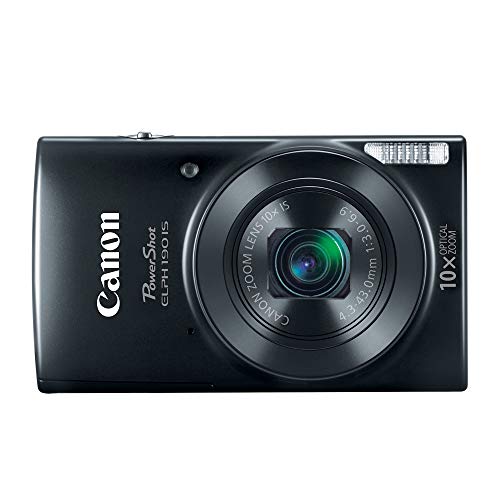
Canon PowerShot ELPH 190 IS — Slim Veteran Value
Date this camera honestly, because its value depends on it: the ELPH 190 IS is an older-generation model that remains on sale new, a slim compact with a 10x optical zoom, image stabilisation, Wi-Fi and NFC, per its listing. It predates the 4K era and the modern creator features elsewhere in this guide, and its price and simplicity reflect that vintage. Judged as a new-technology purchase it would disappoint; judged as a slim, simple, genuinely pocketable camera for daylight and family snapshots, it still makes a case no newer Canon bothers to contest.
The ELPH experience is radical simplicity. It slips into a shirt pocket or a small bag’s forgotten corner, wakes quickly, and asks almost nothing of its owner beyond framing and pressing. The 10x zoom covers the family-photography range — groups, portraits, the far end of a garden — and stabilisation keeps casual shots steady. Wi-Fi and NFC, forward-thinking in its day, still move pictures to a phone without cables. For a grandparent, a child graduating from a toy camera, or a household wanting a shared camera nobody fears breaking, that simplicity is a feature set.
Its age shows where age always shows. Video and low-light performance belong to its generation, the screen and controls feel dated beside the V1 or G7 X, and buyers expecting modern autofocus sophistication should spend more on its younger siblings. The listing’s continued availability as new stock is its quiet miracle: a simple camera, honestly priced by the market, for people whose photography is about presence rather than specifications. Buy it for what it is and it will serve cheerfully for years.
- Zoom: 10x optical with image stabilisation
- Connectivity: Wi-Fi and NFC, per the listing
- Body: slim ELPH pocket design
- Vintage: older generation, still sold new
Strengths
- Genuinely pocketable and unintimidating.
- Simple operation suits shared family use.
- 10x zoom covers everyday family range.
Trade-offs
- Features and video belong to its era.
- Low-light results trail younger siblings.
- No creator-era tools like modern streaming.
Best for: grandparents, young graduates from toy cameras and anyone wanting a fearless shared compact. Not suited for: video creators or buyers expecting current-generation performance.
Canon PowerShot SX70 HS — Long-Zoom, Renewed Route
The SX70 HS is the bridge-style reach champion of the PowerShot line — the camera shaped like a small DSLR, built around an enormous zoom for wildlife, sport and distant detail, with a viewfinder that keeps the sun off your composition. It belongs in any honest Canon guide. It appears here without a purchase link for one specific reason: the camera listing we verified is renewed stock, not new, and this guide does not present renewed goods as though they were new. The SX70 HS deserves consideration with that fact in the open, because a good renewed unit can be a rational purchase — made with eyes open and a checklist in hand.
Why would a buyer accept renewed here? Because the model’s combination — bridge ergonomics, viewfinder, and reach that embarrasses every pocket camera in this guide — has no exact new equivalent in the current line at a comparable spirit. Birders, school-sport parents and reserve-trip travellers feel that gap keenly. A renewed SX70 HS from a seller with a clear returns policy, inspected on arrival, can serve those photographers well. The camera’s stills and video capabilities remain what they always were; only the stock’s history differs, and history can be managed.
Manage it with this checklist. Read the renewed listing’s condition description word by word, noting what renewed means for that seller and what warranty or return window accompanies it. On arrival, test the zoom across its full range for smooth travel, fire the shutter at several settings, inspect the lens and viewfinder, and check that the battery holds a charge through an afternoon. Buy during a period when you can actually perform those tests before the return window closes. If any answer disappoints, return rather than rationalise. Handled that way, the SX70 HS is this guide’s honourable exception: a fine camera, an honest caveat, and no link pretending otherwise.
- Stock status: verified listing is renewed — unlinked here
- Style: bridge body with viewfinder
- Role: maximum reach for wildlife and sport
- Buying route: renewed, with inspection checklist
Strengths
- Reach and handling no pocket camera matches.
- Viewfinder shooting suits bright outdoor days.
- Renewed pricing can undercut newer alternatives.
Trade-offs
- It is not new stock; condition varies by unit.
- Warranty terms depend on the renewed seller.
- Bridge size ends any pocket ambitions.
Best for: birders and distant-subject photographers willing to inspect a renewed unit carefully on arrival. Not suited for: anyone insisting on a brand-new camera with a standard manufacturer’s warranty story.
How Does Canon’s Current Compact Family Divide by Photographer?
| Camera | Defining strength | Zoom character | Stock note |
|---|---|---|---|
| PowerShot G7 X Mark III | Fast lens, creator video | Everyday range | Standard listing |
| PowerShot V1 | 4K vlogging and streaming | Ultra-wide | Standard listing |
| PowerShot SX740 HS Bundle | Travel reach, ready box | 40x optical | Bundle with card and bag |
| PowerShot G1 X Mark III | APS-C image quality | 3x walk-around | Bundle with card and bag |
| PowerShot ELPH 190 IS | Slim simplicity | 10x optical | Older model, sold new |
| PowerShot SX70 HS | Bridge-style maximum reach | Very long zoom | Renewed stock — unlinked |
The table’s last column is as important as its first. Two of these cameras arrive as seller bundles, one is a veteran sold new, and one is renewed — a fair portrait of today’s compact market, where the wise buyer reads stock notes as carefully as specifications. Match the strength column to your photography, the zoom column to your subjects, and the stock column to your comfort, and the correct Canon usually names itself.
How Should You Shoot Distant Subjects With a Compact Zoom?
Reach is a technique as much as a specification. At long zoom settings, tiny hand movements become large frame movements, so brace elbows, lean on walls, or rest the camera on a bag before blaming the lens for softness. Use the viewfinder where one exists, since holding the camera against your face adds a third point of stability. Fire two or three frames of a distant subject rather than one; animals blink, athletes move, and the middle frame of a short burst is frequently the keeper.
Light governs the long end of any compact zoom. Small sensors and long lenses are happiest in daylight, so plan wildlife and stage photography around the brightest hours available, and accept higher sensitivity settings — with their grain — as the price of a sharp dusk shot rather than chasing cleanliness into blur. Keep the lens clean; a fingerprint that a wide lens forgives becomes a fog machine at full telephoto. Finally, practise the zoom at home before the safari, the match or the recital, because the day itself will not pause while you learn where the lever lives.
What Mistakes Do Canon Compact Buyers Make Most Often?
The classic error is buying zoom when your life is portraits, or buying a portrait lens when your life is distant subjects — a mismatch no brand loyalty can rescue. Second comes ignoring the stock story: assuming a bundle’s contents, assuming a veteran model is current, or assuming a renewed camera is new. Third is judging a compact by its worst photograph; every model here has a light it loves and a light it endures, and owners who learn that map get years more from the same hardware. Fourth, buyers neglect the spare battery and card, then meet the camera’s limits on the one day that mattered.
A quieter mistake is editing nothing. Canon’s colour is kind straight from the camera, yet a minute of cropping and straightening lifts compact photographs remarkably, especially the G1 X Mark III’s generous files. The camera does the capturing; a small finishing habit completes the photograph, and beginners who adopt it early outgrow the snapshot label quickly.
How Does a Travel Day Actually Divide Between These Cameras?
Picture a harbour town in bright morning light. The SX740 HS earns its breakfast first, framing fishing boats, gulls and the lighthouse detail from the promenade without a step forward. The G1 X Mark III takes over in the shaded old town, where its sensor keeps alley textures and church interiors clean at sensitivities that would trouble the travel zoom. By lunch, the G7 X Mark III is documenting food and faces at café distance, its lens drinking the window light, while the V1 has filmed the morning as a narrated walk its owner will edit on the train.
Afternoon belongs to whoever is still being carried, which is the ELPH 190’s quiet argument: the camera in the shirt pocket photographs the gelato stand, the sudden street performer and the group portrait outside the museum, while grander cameras rest in hotel rooms. Evening sorts the field by light. The big-sensor and fast-lens models own the blue hour and the restaurant; the zooms retire gracefully, their work — the distant, sunlit world — already done. A traveller who recognises their own day in one of those paragraphs has found their camera more reliably than any specification table can manage.
None of this requires owning several cameras. It requires honesty about which hours of the travel day matter most to you. The photographer who lives for dawn wildlife and distant architecture should forgive a zoom its evenings. The photographer whose memories are faces around tables should forgive a fast lens its modest reach. Regret in compact buying is almost always a day misdescribed to oneself, and the paragraphs above are this guide’s attempt to help you describe yours accurately.
What Does a Sensible Video Workflow Look Like on a Compact?
Compact video succeeds on preparation rather than improvisation. Start with audio: a camera’s built-in microphones serve ambient sound and casual clips, while voices that matter deserve the microphone input where a model offers one, or a quieter location where it does not. Frame wider than feels natural for anything destined for editing, because stabilisation and reframing both consume edges. Record a few seconds before and after the moment you actually want; compact cameras reward editors who give them handles.
Light and heat govern long takes. Bright rooms film kindly on every model here, while dim venues separate the fast lenses and larger sensors from the travel zooms just as they do for stills. For streaming and extended recording, the V1’s hybrid design brief speaks directly to endurance, but any compact appreciates airflow, a charged battery and a card with genuine capacity rather than a bargain card of doubtful honesty. Test your full setup — camera, card, battery, microphone — for one complete session at home before the event, the trip or the launch depends on it.
After filming, the workflow that survives is the simple one: copy the card the same evening, name the folder by date and place, and let the camera’s card be wiped only after the copy exists in two places. Creators who keep that discipline lose almost nothing; creators who treat cards as archives eventually lose the one clip that mattered. A compact’s charm is its lightness, and a light workflow honours it better than any elaborate production ritual.
Which Accessories Deserve Money After a Canon Compact?
The spare battery is the first accessory for every model in this guide, without exception, because compact batteries are small and great days are long. A second memory card follows, bought from a reputable source at an honest capacity, since counterfeit cards corrupt exactly the photographs you travelled for. A case that matches how you actually carry — belt, sling or bag organiser — protects the lens mechanism that is every compact’s delicate heart.
After those essentials, let your model direct the spending. Travel-zoom owners gain most from a mini tripod or a monopod for the long end of the zoom, where stability converts reach into sharpness. Creator models justify a compact microphone and a small light before any other upgrade, because audiences forgive soft video sooner than poor sound. G1 X Mark III owners who edit seriously may value a fast card reader that respects the sensor’s generous files. A wrist strap, humble as it sounds, has saved more compacts from harbour water and festival mud than any other object in photography.
Resist accessory systems that outweigh the camera. The moment a compact needs a rolling case of attachments, its founding bargain — serious photography without the system — has been quietly refunded. Add one piece at a time, in response to a photograph you failed to take, and every purchase will earn its place in the bag.
Why Has the Compact Market Thinned, and What Does That Mean for a Buyer Now?
Phones absorbed the casual end of photography so completely that compact cameras survived mainly where they offer something a phone cannot: real optical reach, larger sensors, dedicated controls and freedom from the notification stream. That is why this guide’s list looks the way it does — specialists rather than generalists, bundles assembled by sellers, a veteran model persisting because its simple niche never died, and a famous bridge camera circulating as renewed stock because new supply ended while demand did not.
For a buyer, the thinned market rewards decisiveness and punishes dithering. Models appear, sell through and sometimes vanish from listings between research sessions, so a camera that matches your described day deserves commitment when its listing is clean. It also rewards the stock literacy this guide keeps practising: read what the box contains, note whether the unit is new or renewed, and treat a clear listing from a reputable seller as part of the product. In a smaller market, the listing is half the purchase.
The hopeful reading is that every camera surviving in this market has a reason to exist. Nothing here is a generic compact; each pick is the answer to a specific photographer’s prayer — reach, light, video, simplicity or sensor quality. Buy the prayer that sounds like yours, and the thin market stops feeling like scarcity and starts feeling like editing done on your behalf.
How Should You Care for a Compact So It Lasts Like the ELPH Has?
The ELPH 190’s longevity in this guide is partly a care story: compacts die young from sand, drops and lens mechanisms forced or fouled, far more than from electronic failure. Keep the camera cased at beaches, never force a retracting lens, and let the camera close its own lens before it enters a pocket. A soft brush for the lens and a dry cloth for the body cover routine maintenance; compressed air near a lens mechanism does more harm than good in amateur hands.
Batteries appreciate being used rather than stored flat for years, and a compact that sleeps for a season deserves a charge and a test afternoon before it is trusted with a wedding. Memory cards should be formatted in the camera occasionally, which keeps their housekeeping aligned with the device writing to them. Store the camera somewhere dry and temperate, with the battery neither cooking in a car nor freezing in a garage.
Finally, insure the photographs rather than the camera. A compact can be replaced — even, as the SX70 HS shows, through the renewed market — but the card inside it cannot. Copy early, copy twice, and the camera becomes what it should be: a cheerful tool you carry into weather, crowds and water-adjacent adventures without flinching, which is where its best photographs were always going to happen.
How Do Portraits, Landscapes and Family Events Split the Field?
Portrait photographers should read this guide from the lens outward. Flattering faces want a fast lens and a sensor that separates a subject from its background, which points first to the G7 X Mark III at café range and then to the G1 X Mark III for anyone who prints or edits seriously. The travel zooms can photograph people perfectly well in daylight, yet their smaller sensors keep backgrounds busier and their lenses work hardest exactly where portraitists live — at the near, personal distances where a fast prime-style zoom feels intimate rather than observational.
Landscape shooters divide by itinerary. Walkers who compose slowly and print generously belong with the APS-C flagship, whose files reward patience and whose modest zoom matches the walk-around reality of most viewpoints. Travellers covering ground — viewpoints, wildlife, architecture across plazas — belong with the SX740 HS or, through the renewed route, the SX70 HS, because landscapes in travel practice include the distant church tower and the eagle over the gorge, subjects that punish a short lens without appeal. The V1’s ultra-wide view, meanwhile, gives interior and architectural photographers a room-embracing perspective the others cannot imitate.
Family events mix every demand at once, which is why the honest answer is a temperament match. The parent who films birthdays and photographs faces should carry the G7 X Mark III or the V1 and accept the back-row limits. The parent stationed at the back of school halls, filming stages and sports days, should carry the SX740 HS and accept its evening limits. The grandparent who wants one unintimidating camera for all of it, in daylight and with love, is precisely who the ELPH 190 continues to serve.
What Should You Verify on a Canon Listing Before Paying?
Begin with the exact model name, generation included, because Canon reuses names across years and a Mark in the title changes the camera. Confirm whether the offer is a body-only camera, a manufacturer’s kit or a seller-assembled bundle, and read the bundle’s contents literally — the two bundles in this guide name their card and bag plainly, and any listing that will not itemise its extras deserves to be passed over. Note the stock status with equal care: new, or renewed with its condition and returns described, as this guide modelled with the SX70 HS.
Then check the unglamorous essentials. Is a battery and charger included, and is the battery Canon’s own or a third-party substitute? Does the card, if bundled, come from a brand you recognise? Is the seller’s returns window long enough for you to test zoom travel, focus, screen, buttons and a full battery cycle in real light? Those tests take one afternoon and reveal nearly everything a listing cannot say. Photographers who perform them buy once; photographers who skip them sometimes buy twice.
Finally, photograph the unboxing and keep the serial number recorded with your household documents. In a market where models circulate through bundles and renewed channels, your own paper trail is the cleanest proof of what you bought and when — useful for warranties, insurance and the eventual day the camera is passed to a younger photographer with the same advice this guide gave you.
A Word on Learning to See With a Fixed Lens
Every camera here shares one quiet virtue: the lens does not come off. That constraint, which system-camera owners sometimes pity, is a famous teacher. With a fixed range, photographers learn to move, to anticipate, and to compose with the frame they have rather than shopping for the frame they imagine. Zoom models soften the lesson with range; the G1 X Mark III teaches it in its purest form, where a modest 3x span makes feet the primary zoom and anticipation the primary skill.
Give any of these cameras a month of daily carrying and a pattern emerges: you begin noticing light before subjects, backgrounds before faces, and moments a half-second before they peak. That noticing is photography itself, and it transfers to every camera you will ever own, including the phone in your other pocket. The Canon badge on the front matters less than the habit the camera builds — which is, in the end, the most defensible reason to buy a dedicated compact in a phone world.
How Do These Canons Handle the Photographs Families Actually Take?
Strip away the travel romance and most compact photographs are domestic: a child asleep in impossible light, a dog mid-shake, a cake before the candles surrender, a grandparent laughing at a story told badly. The fast-lens models flatter that world, gathering the lamp light and rendering faces kindly without a flash’s interrogation glare. The ELPH’s flash-and-simplicity approach documents the same scenes more plainly, which families often prefer to not documenting them at all because a grander camera was charging in another room.
Sport and performance remain the zooms’ domestic kingdom. School concerts, martial-arts gradings and Sunday football all place parents at a fixed distance with a moving subject, the exact geometry the SX740 HS was built for and the SX70 HS exaggerates gloriously. Daylight school sport flatters small sensors; evening halls test them, and the wise parent learns to shoot the bright passages and simply watch the dim ones, a compromise every generation of sports parents has made with whatever camera the era provided.
The deeper domestic truth is that the best family camera is the one a family member actually learns. One person in most households becomes the keeper of the camera — the one who knows where it charges, how the zoom behaves, which mode suits the hall. Choose the model that person finds inviting, hand them this guide’s relevant section, and the household’s archive improves more than any upgrade could achieve. Cameras do not take family photographs; designated photographers do, and they deserve a tool matched to their patience.
Before You Decide: The Two-Question Test
First question: where are your subjects — across the table or across the field? Across the table points to the fast lenses and the big sensor; across the field points to the zooms, new or renewed. Second question: what light do you live in — bright days out, or lamps, halls and evenings? Bright days forgive every camera here; lamplight separates the field ruthlessly in favour of the G1 X Mark III and the G7 X Mark III. Answer both honestly and the six names in this guide collapse, for most readers, into one obvious Canon and one respectable runner-up.
If the runner-up is the SX70 HS, reread its renewed checklist once more before hunting listings, not to dampen enthusiasm but to arm it. If the runner-up is a bundle, reread its contents line by line. Those two small disciplines — stock honesty and contents honesty — are the difference between this guide’s readers and the disappointed reviewers scattered under compact listings everywhere, and they cost nothing but attention.
One more consideration belongs to anyone buying for the long term: hand feel outlasts specification excitement. The camera whose grip, dial placement and screen you enjoy in week one is the camera still being carried in year three, while the technically superior model that annoyed your fingers retires to a drawer. If a local shop or a friend’s collection lets you hold any of these before ordering, take the opportunity; ergonomics is the one specification no listing can transmit, and it quietly governs every photograph that follows.
And keep the box, the receipt and the bundled extras together for the first season. Bundles in particular scatter — a bag adopted by another device, a card borrowed by a console — and the owner who keeps the kit intact owns a complete, lendable, eventually pass-on-able camera rather than a body with a biography of small losses.
It is worth saying plainly, in a guide full of distinctions, that none of these six is a mistake in absolute terms. Each has produced photographs their owners treasure, because treasure in photography is mostly timing and affection, and cameras merely assist. The distinctions in this guide exist to match the assistance to the affection — reach to the birder, light to the portraitist, simplicity to the grandparent — so that the assisting never becomes the obstacle it so easily becomes when a camera and a life are mismatched.
So order with the listing open and this guide’s stock notes beside it, charge the battery before the first outing rather than during it, and spend the camera’s first weekend learning its favourite light instead of its deepest menus. A Canon compact rewards that order of priorities for years, in photographs that look increasingly like they were taken on purpose — because, increasingly, they were.
Beyond that first weekend, keep a tiny ritual: empty the card monthly, glance back through the month’s frames, and notice which lens positions and which lights produced your favourites. That quiet review, repeated, is how compact owners grow into photographers without courses or clubs — the camera teaches, provided someone looks at the homework it sets.
And if a friend asks, months from now, whether a dedicated compact was worth it in the phone era, the honest answer will not be a specification. It will be a folder of photographs — faces lit kindly, distances conquered, evenings survived — that your phone, for all its brilliance, simply never got around to taking.
Choose the Canon whose compromises point away from your life rather than into it, and the purchase will keep justifying itself quietly, frame after frame, long after the comparison charts are forgotten.
That is the standard this guide applied to every model gathered here: not whether it wins a chart, but whether it will still be riding in someone’s pocket, bag or hand when the unrepeatable photograph finally happens in front of them.
Keep that image in mind while the listings compete for your attention with bundles, badges and bold type. The camera is a means; the photograph, years from now, is the entire point of the exercise.
Decide accordingly, and let the first roll of ordinary days — not the specification sheet — deliver the verdict.
Your future self, scrolling that folder of kept photographs, will not ask which zoom won. They will ask who took the picture, and be glad the answer was you.
Final Recommendation
Most readers should carry the G7 X Mark III: it is the Canon compact that fits the widest life. Choose the V1 when video is the main event, the SX740 HS bundle when travel reach matters and a ready box appeals, and the G1 X Mark III when image quality outranks pocketability in your personal arithmetic. Take the ELPH 190 IS for honest simplicity, and pursue the SX70 HS only through the renewed checklist above. Whichever name you choose, learn its favourite light during the first week and keep a spare battery in the bag — a Canon understood that well stops being equipment and becomes the camera your family reaches for, which is the only verdict that has ever really counted.
Frequently Asked Questions
Why does the SX70 HS have no purchase link in this guide?
Because the listing we verified for it is renewed stock rather than new. Rather than dress that up, the guide presents the camera unlinked with a checklist for judging a renewed unit carefully.
Is the SX740 HS in this guide the camera or a bundle?
Both, precisely: the listing is a bundle built around the SX740 HS camera, including a 64GB card and a bag. The camera itself remains the standard SX740 HS with 40x zoom and 4K video.
Which Canon compact is best for low light?
The G1 X Mark III, thanks to its APS-C sensor, followed by the G7 X Mark III with its fast lens. The travel zooms are daylight specialists by design.
Is the ELPH 190 IS too old to buy?
Not for its purpose. It is an older model still sold new, and for simple, slim, daylight family photography it remains charming. Buyers wanting modern video or autofocus should choose a younger sibling.
Which model should a vlogger choose between the G7 X Mark III and the V1?
The V1 if filming yourself and streaming dominate, thanks to its ultra-wide hybrid design. The G7 X Mark III if stills matter equally and its lens character suits your subjects.
Do these cameras need a phone to share photographs?
Most offer Wi-Fi, and the SX740 HS adds Bluetooth, for moving images to a phone. A card reader and computer work just as well for every model here.
Related Guides
Continue with our roundup of compact cameras chosen specifically for video, a guide to inexpensive point and shoot cameras for beginners, and our Fujifilm instant camera guide for a completely different kind of carry-everywhere photography.
Related guides
- Best Balancing Stabilizers for Mirrorless Cameras: Payload, Balancing and Native Vertical Shooting
- Best Basic Phones Camera Buyers Can Trust: Flip Phones and Simple Handsets That Still Take a Photograph
- Best Sony Full Frame Cameras for Astrophotography: Sensitivity vs Resolution
- Best Airbnb Security Cameras: Compliant Outdoor Cameras and Noise Sensors for Hosts


