What's inside
- Where to buy
- Key Takeaways
- Quick Picks
- How did we judge the best all around crop sensor cameras?
- Which crop sensor cameras cover the most ground?
- How do the six all-rounders compare?
- Why does the crop factor help more photographers than it hurts?
- How should a crop sensor owner build a three-lens kit?
- How does an all-around crop camera survive a whole week of real life?
- What should hybrid shooters know about video on crop bodies?
- Why is the used market a crop sensor owner’s secret weapon?
- What mistakes do crop sensor buyers make most often?
- Which settings turn a crop body into a true all-rounder?
- Final Recommendation
- Frequently Asked Questions
- Related Guides
As an Amazon Associate I earn from qualifying purchases. This post may contain affiliate links at no extra cost to you.
gizmoverdict.com is reader-supported. When you buy through links on our site, we may earn an affiliate commission.
Where to buy
Every camera in this roundup links to an Amazon listing checked for this guide, and the listings differ in ways that matter: one is a body only, one is a generous multi-lens bundle, and the rest are kits of the usual kind. Each section states plainly what its listing contains, so the price you compare is the kit you would actually receive.
The best all around crop sensor cameras make a case that the industry’s marketing keeps trying to bury: for most photographers, most of the time, an APS-C camera is not the smaller choice but the smarter one. The crop sensor — roughly half the area of full-frame, many times larger than a phone’s — sits at the sweet spot where image quality, lens size, reach and price balance. A crop system multiplies your telephoto’s reach for free, shrinks the lenses you carry all day, and leaves money in the budget for the second and third lens that turn a camera into a hobby. All-around is the operative phrase in this guide’s title: we ranked these six not by any single speciality but by how completely each one covers the whole of photography — family, travel, sport, video, low light and learning — without embarrassing itself anywhere.
Definitions first, because crop sensor covers more than one format. Every pick here is APS-C, the crop format shared by Canon, Sony, Nikon and Fujifilm in this list, with a crop factor around one and a half times. Micro Four Thirds, the smaller format from OM System and Panasonic, deserves an honourable qualitative mention: it shrinks lenses further still and its devotees photograph magnificently with it, but the six strongest all-around answers at the moment live in APS-C, and this guide spends its pages there. Within APS-C, the differences that matter are not the sensor — all six sensors are excellent — but autofocus intelligence, stabilisation, video depth, handling philosophy and the lens shelf behind each mount.
The six divide into generations and temperaments. Canon fields the speed-flagship R7 and the friendly R50; Sony fields the video-flagship a6700 and the evergreen a6400; Nikon fields the refreshed Z50 II, its most inviting beginner-to-enthusiast body in years; and Fujifilm fields the X-T30 II, a camera whose dials and film simulations make the strongest case in this guide that how a camera feels changes what its owner photographs. An all-around ranking must weigh all of that, so ours does — and the comparison table near the end shows the working.
Key Takeaways
- Canon’s EOS R7 is the all-around athlete: flagship speed, in-body stabilisation and dual slots under a sensor that stretches every telephoto.
- Sony’s a6700 is the all-around filmmaker, pairing AI subject recognition with the deepest video toolkit in the crop class.
- Canon’s EOS R50 is the all-around welcome mat — the friendliest route into interchangeable lenses for families who also film.
- Fujifilm’s X-T30 II is the all-around pleasure: analogue dials and beloved film simulations, sold here as a body that needs a lens.
- Nikon’s Z50 II is the all-around refresher, bringing modern subject detection and creator touches to Nikon’s compact Z line.
- Sony’s a6400 remains the all-around bargain, its autofocus brilliance now available at the friendliest prices in the class.
Quick Picks
| Pick | Badge | Why it earns its place |
|---|---|---|
| Canon EOS R7 | All-around athlete | Speed, reach, stabilisation and dual slots make it the crop body that refuses the fewest assignments. |
| Sony Alpha a6700 | All-around filmmaker | Cinema-minded video tools and AI focusing in the most complete hybrid package APS-C offers. |
| Canon EOS R50 | All-around welcome mat | The gentle learning curve, flip screen and subject smarts a family camera wants, in a bundle to check carefully. |
| Fujifilm X-T30 II | All-around pleasure | Dials you turn with your fingers and colours you will not want to edit, for photographers who shoot for joy. |
| Nikon Z50 II | All-around refresher | Nikon’s compact Z grows up: subject detection, brighter finder and creator conveniences in a travel-sized body. |
| Sony Alpha a6400 | All-around bargain | The autofocus that redefined the class, wrapped in a tough little body at prices that keep falling kindly. |
How did we judge the best all around crop sensor cameras?
We scored breadth, deliberately. A specialist camera can top one test and fail the guide; an all-around camera must post a respectable score in every column a general photographer keeps. Stills quality in daylight and in dim rooms. Autofocus for the subjects ordinary life supplies — children, dogs, cyclists, the occasional heron. Video good enough for the family archive and the ambitious hobbyist’s channel. Handling that a beginner survives and an enthusiast respects. A lens range that covers wide, standard and telephoto without exotic prices. And the carrying test: a camera too bulky for the school run or the city break fails the all-around brief no matter what its sensor does, because the most-used camera in any household is the one that was actually there.
Two judgements shaped the final order and deserve daylight. We rewarded in-body stabilisation and modern subject-detection autofocus heavily, because both rescue the photographs generalists actually lose — the dim interior blurred by handshake, the toddler who crossed the frame faster than a focus point could be moved. And we treated lens ecosystems as part of the camera, since an all-around body is a promise about the next five years: Canon’s RF-S shelf is young but growing with adaptation behind it, Sony’s E-mount is the deepest in the class, Fujifilm’s X-mount is a curated garden of excellent primes and zooms, and Nikon’s Z APS-C range is compact with full-frame Z glass above it. Every pick here keeps that five-year promise; they simply keep it in different accents.
We also weighed the upgrade path each body implies, because an all-around camera is often a first serious camera and its owner deserves an honest map of year three. On Canon, the R50’s owner grows toward the R7 without changing mounts; on Sony, the a6400’s owner steps to the a6700 or full-frame E-mount bodies with every lens still fitting; Nikon’s Z50 II shares its mount with the whole Z line; Fujifilm’s owner deepens within a complete APS-C ecosystem by design. No pick here is a dead end, and that, as much as any specification, is what makes a camera all-around: it grows in the direction its owner grows.
Bundle literacy formed the final filter.
The R7’s listing assembles a small system in one box, the R50’s bundle contents vary by seller, and the X-T30 II listing is a bare body — three different buying acts wearing the same word, camera. Each section below prices its pick as the listing actually stands, because an all-around recommendation that ignores what is in the box is only half a recommendation.
Which crop sensor cameras cover the most ground?
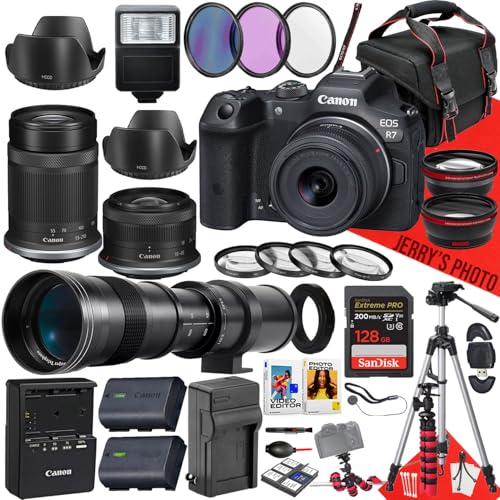
Canon EOS R7 — All-around athlete
The R7 is the crop camera for people who keep finding the edges of lesser bodies: the match that moves too fast, the bird that sits too far, the hall that lights too dimly. Its 32.5-megapixel sensor is the densest here, which in crop-land is a feature with a job — more pixels on a distant subject means more detail where the action is, and cropping freedom when the moment refused to come closer. In-body stabilisation rated among the strongest in the class works with the lens’s own system to steady handheld frames, and the autofocus — subject detection for people, animals and vehicles, with tracking that persists through clutter — is Canon’s professional thinking scaled into an APS-C shell. Dual card slots complete a specification that reads like a checklist of everything an all-rounder could ask.
The listing for this guide bundles the body with two Canon zooms — the RF-S 18-45mm for everyday ranges and the RF-S 55-210mm for portraits through field sports — plus a third-party 420-800mm manual telephoto and a memory card. Assess the bundle as a starter system: the Canon pair genuinely covers a beginner’s first year, from wide interiors to the far end of a football pitch, while the manual telephoto is a patient person’s moon-and-birding experiment rather than a tracking tool, since manual focus at that reach forgives nothing that moves. Valued that way, the box is generous; valued as though the long lens were professional glass, it would mislead, and this guide declines to mislead.
Video and handling sustain the all-around claim. Oversampled 4K up to 30p looks properly detailed, a cropped 4K mode adds reach for wildlife filming, and the deep grip, twin dials and joystick suit gloved, hurried operation. The honest costs are size — this is the largest body in the six, a small system camera rather than a pocket one — and the APS-C low-light ceiling it shares with the class, mitigated here by stabilisation and by Canon’s growing shelf of bright RF-S and adaptable EF glass. If one crop camera must do everything for years, the R7 is the one that keeps saying yes.
- Sensor: 32.5MP APS-C CMOS
- Burst: up to 15 fps mechanical, 30 fps electronic
- Stabilisation: in-body, coordinated with lens systems
- Card slots: dual SD
- Video: 4K oversampled; cropped 4K for reach
- Bundle: RF-S 18-45mm, RF-S 55-210mm, manual 420-800mm telephoto, card
Strengths
- Speed, tracking and dual slots cover sports and wildlife that defeat every rival here.
- In-body stabilisation rescues dim interiors and steadies unstabilised primes.
- Dense sensor delivers detail on distant subjects and generous cropping freedom.
Trade-offs
- Largest, heaviest body in this roundup — a small system, not a pocket camera.
- Bundled long telephoto focuses manually, limiting it to patient, static subjects.
- Native RF-S lens shelf is still maturing beside Sony’s and Fujifilm’s ranges.
Best for: enthusiasts whose photography spans sports, wildlife, travel and family without wanting two bodies. Not suited for: minimalists seeking the smallest possible kit, or low-light-first shooters.
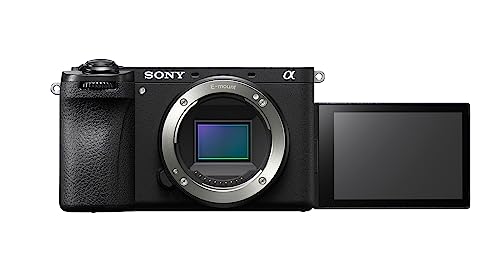
Sony Alpha a6700 — All-around filmmaker
Where the R7 leads with athleticism, the a6700 leads with intelligence. An AI processing unit dedicated to autofocus lets this 26-megapixel body recognise an unusually wide cast of subjects — people by body, head or eye, animals, birds, insects, even vehicles — and hold them through the messy, occluded movement of real scenes. For the all-around photographer whose subjects include a dog, a cyclist and a grandfather in the same afternoon, that breadth of recognition is the feature that quietly raises every keeper rate. The body-only listing suits its flagship status: buyers at this level choose their first lens deliberately, and E-mount offers them the deepest APS-C shelf in photography to choose from.
Video is where the a6700 separates itself from the entire class. Oversampled 4K, high-frame-rate options for slow motion, 10-bit colour, log profiles with LUT preview, focus-breathing compensation and active stabilisation compose a toolkit borrowed from Sony’s cinema line, in a body that fits a jacket pocket and rides a small gimbal without complaint. Hybrid shooters — the wedding guest filming speeches, the traveller cutting a film between photographs — will find no crop camera more fluent. Heat management for long recordings and a vari-angle screen complete a package designed by people who clearly film with their own products.
Balance requires naming the familiar costs. A single card slot asks the offload discipline this guide keeps recommending. The APS-C sensor, excellent as it is, concedes the darkest venues to full-frame. And the menu depth, while improved in this generation, still rewards an evening of setup. Set against the breadth — flagship stills tracking, cinema-leaning video, the class’s best lens shelf, pocketable size — the a6700 is the all-around pick for the photographer whose memories increasingly move, and whose stills refuse to be an afterthought.
- Sensor: 26MP APS-C, back-illuminated, AI unit for autofocus
- Video: 4K oversampled, high frame rates, 10-bit log with LUT preview
- Autofocus: wide subject recognition, people to insects
- Stabilisation: in-body 5-axis
- Card slots: single SD
- Listing: body only — lens chosen separately
Strengths
- Subject recognition breadth keeps improbable subjects — birds, bugs, trains — professionally sharp.
- Video toolkit outclasses every crop rival, with log and LUT workflows built in.
- Deepest lens ecosystem in the class, from budget primes to professional zooms.
Trade-offs
- Single card slot requires backup discipline for important occasions.
- Body-only purchase means the real starting cost includes a first lens.
- Low-light ceiling is the class’s, not full-frame’s, in the darkest rooms.
Best for: hybrid shooters and creators wanting one small body whose video and stills are both flagship-grade. Not suited for: dual-slot traditionalists or buyers wanting a complete kit in one box.

Canon EOS R50 — All-around welcome mat
Every category needs its doorway, and in crop-sensor land the R50 is the one with the welcome mat out. Canon designed it for the photographer upgrading from a phone who intends to grow: subject-detect autofocus that finds people, animals and vehicles without being asked twice, a vari-angle touch screen that flips forward for the self-filmed pieces modern family life includes, and guided interfaces that explain the camera’s decisions while it makes them. The 24.2-megapixel sensor and oversampled 4K video are the same core as Canon’s pricier crop bodies, so the photographs never feel like the beginner tier the price suggests.
The listing referenced here is a bundle built on the RF-S 18-45mm kit zoom, with extras that vary by seller — the recurring bundle sermon of this guide applies: inventory the box on the listing page, price the camera and lens as the value, and treat the rest as garnish. The kit zoom itself is a sensible teacher, covering wide-to-portrait ranges in a collapsing package that keeps the whole camera small enough for a coat pocket. From there the all-around path is well signposted: Canon’s little RF-S telephoto for the sports day, a bright prime for the evenings, and the EF back catalogue through an adapter when the used market tempts.
Growth limits exist and are honestly placed. There is no in-body stabilisation, so video walking shots and slow handheld frames lean on the lens’s stabilisation and the photographer’s elbows. A single card slot and a modest battery suit family duty perfectly and paid work less so. The electronic viewfinder is smaller than the flagships’. None of these will trouble the R50’s intended owner for years, because the camera’s all-around gift is sequencing: it teaches gently, films willingly, and reveals its ceilings only as its owner’s ambitions grow into them — at which point it becomes the household’s beloved second body rather than a discarded first one.
- Sensor: 24.2MP APS-C CMOS
- Autofocus: Dual Pixel AF II with subject detection
- Video: 4K oversampled to 30p; 4K 60p cropped
- Screen: vari-angle touch, forward-flipping
- Stabilisation: lens-based; none in body
- Listing: bundle around the RF-S 18-45mm — verify contents
Strengths
- Friendliest learning curve in the class, with autofocus that forgives beginner framing.
- Flip screen and strong 4K make family filming a pleasure rather than a project.
- Compact kit encourages the daily carry on which all-around cameras depend.
Trade-offs
- No in-body stabilisation, so handheld video needs lens help and steady hands.
- Bundle extras vary by seller; the box must be read before the price is judged.
- Single slot and small battery mark its ceiling for serious event work.
Best for: families and upgraders wanting one camera that photographs and films everything kindly. Not suited for: sports specialists or professionals needing dual slots and in-body stabilisation.

Fujifilm X-T30 II — All-around pleasure
The X-T30 II is the camera in this guide most likely to be described by its owner with affection rather than specifications. Fujifilm miniaturised its classic SLR-style design — real dials for shutter speed and exposure compensation on the top plate, an aperture ring on many of its lenses — around a 26.1-megapixel X-Trans sensor whose colour science is the brand’s legend. The film simulations are not filters in the phone sense; they are tuned renderings descended from Fujifilm’s film stocks, and they produce JPEGs that owners famously decline to edit. For the all-around photographer who shoots for the joy of the day rather than the archive’s perfection, that straight-out-of-camera pleasure is a feature no benchmark measures.
The listing here is the body only, and the article must be blunt: you cannot take a photograph with it until a lens arrives, so budget for one from the start. Fujifilm’s X-mount makes that a happy errand — the compact primes are beloved, the standard zooms are excellent, and a small two-lens kit keeps the whole system at a size the R7 cannot approach. Autofocus in this generation covers faces and eyes competently and tracks everyday movement well; it is not the chaos-proof system of the Sony or the R7, and sports at the highest tempo will find its edges, but family, travel and street work — the all-around core — are squarely in its competence.
Video records 4K with the same film simulations lending footage an unusually finished look, though the tilting rather than fully articulating screen and the absence of in-body stabilisation mark it as a stills-first design with video as a talented sideline. A small pop-up flash, a proper drive dial and that analogue handling complete a camera whose argument is emotional and entirely legitimate: the camera you love holding is the camera whose photographs exist. Enthusiasts who have watched technically superior cameras gather dust will understand exactly why the X-T30 II belongs in an all-around guide.
- Sensor: 26.1MP APS-C X-Trans CMOS 4
- Controls: analogue dials for shutter and compensation
- Colour: Fujifilm film simulations for JPEG and video
- Video: 4K up to 30p
- Screen: tilting touch; no in-body stabilisation
- Listing: BODY ONLY — a lens is a required second purchase
Strengths
- Film simulations deliver finished-looking colour that removes editing from the hobby.
- Analogue controls make settings tactile, teaching exposure by hand and eye.
- Compact X-mount primes build the smallest quality kit in this guide.
Trade-offs
- Body-only listing means day-one cost includes a lens, without exception.
- Tracking autofocus trails the newest Sony and Canon systems on chaotic subjects.
- No in-body stabilisation and a tilting-only screen limit video ambitions.
Best for: photography lovers who value colour, tactility and compact primes over spec-sheet warfare. Not suited for: fast-sports specialists or buyers wanting a ready-to-shoot box.

Nikon Z50 II — All-around refresher
Nikon’s original Z50 charmed reviewers and then waited years for its sequel; the Z50 II was worth the wait because it fixes the brief so completely. The 20.9-megapixel sensor carries over, but everything around it modernised: the EXPEED 7 processor brings Nikon’s flagship subject-detection autofocus — people, animals, birds, vehicles — into this compact body, the electronic viewfinder grows dramatically brighter for sunny-day composition, and the vari-angle screen plus a dedicated picture-control button and product-friendly features acknowledge that its owners film as well as photograph. It is the all-around Nikon that the first generation promised to become.
The size is the continuing delight. The Z50 II body is a traveller’s handful, and Nikon’s DX zooms — the collapsing 16-50mm above all — keep the carried kit closer to a compact camera’s footprint than a system’s. Pair it with the little DX telephoto and the two-lens holiday kit covers wide city mornings to distant wildlife with room in the bag for lunch. Image quality from the sensor is the known Nikon recipe: natural colour, files that edit forgivingly, and high-sensitivity behaviour that serves evening streets well within the class’s limits. A built-in flash survives here too, a small mercy for family gatherings that bigger siblings have abandoned.
Ceilings, as always, are named. No in-body stabilisation: Nikon’s DX zooms carry lens stabilisation, and the photographer’s technique covers the rest, but the R7 and a6700 hold an advantage for slow handheld work. A single card slot repeats the class’s familiar caveat. The DX lens shelf, while excellent at its core ranges, is the slimmest native range here — mitigated by full-frame Z glass mounting happily and by adapters for the F-mount archive. For the Nikon-loyal household, the travelling enthusiast and the beginner who wants room to grow inside a beloved system, the Z50 II is the most complete compact all-rounder Nikon has made.
- Sensor: 20.9MP APS-C CMOS
- Processor: EXPEED 7 with flagship-derived subject detection
- Viewfinder: notably bright electronic finder
- Screen: vari-angle touch
- Stabilisation: lens-based; none in body
- Mount: Nikon Z, DX and full-frame glass
Strengths
- Modern subject detection transforms Nikon’s compact line for family and wildlife subjects.
- Bright finder and vari-angle screen serve both bright days and filming duties.
- Collapsing DX zooms keep the travelling kit genuinely small.
Trade-offs
- No in-body stabilisation, where two rivals here steady every lens.
- Native DX lens range is the slimmest in this guide, though full-frame Z glass fits.
- Single card slot, the class’s recurring caveat for important events.
Best for: Nikon households and travellers wanting modern autofocus in the smallest Z system. Not suited for: photographers prioritising in-body stabilisation or the deepest native lens shelf.
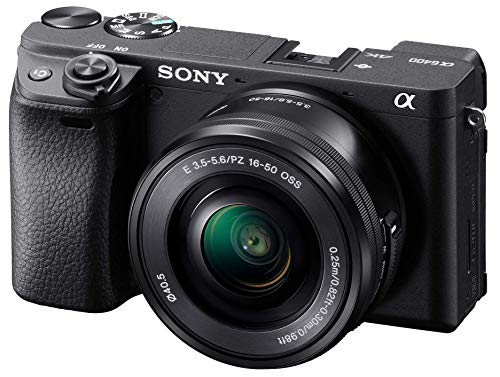
Sony Alpha a6400 — All-around bargain
Longevity is the a6400’s argument. Years after its launch, this 24.2-megapixel body remains on sale and in bags because its autofocus was so far ahead of its class that the class is still catching up: real-time eye detection for people and animals, tracking that adheres to a face through a crowded, dim hall, and acquisition speeds that make children’s sports feel fair. Around that brain sits a magnesium-alloy body with a screen that flips up for self-recording, 4K video with a detailed full-readout look, and the E-mount lens range — the deepest shopping shelf available to any camera in this guide, from pocket-money primes to professional zooms, new and used.
The all-around case writes itself from there. Fit the kit 16-50mm power zoom and the camera is a travel companion that retracts into a jacket. Fit one of the affordable fast primes and it becomes an evening portrait instrument whose eye focus flatters beginners into good habits. Fit the telephoto and the tracking earns its keep at the school match. Battery, cards and accessories are cheap and everywhere because the platform is mature, and the used market offers the same camera for less again — the all-around virtue of a design that sold in enormous numbers and broke rarely.
Age shows in specific, survivable places. There is no in-body stabilisation, the menu system is Sony’s older labyrinth, the viewfinder is modest, and touch operation is limited compared with the a6700’s fluency. Video, while sharp, lacks the newer body’s log depth and high frame rates. A buyer choosing between the two Sonys is really choosing between maturity at a bargain and modernity at a flagship price; for the all-around brief — a camera that does everything well for a household or a growing hobbyist — the a6400’s price-to-competence ratio remains the class’s most persuasive arithmetic.
- Sensor: 24.2MP APS-C CMOS
- Autofocus: real-time eye AF and tracking, class-defining at launch
- Video: 4K up to 30p, full pixel readout
- Screen: tilts up for self-recording
- Stabilisation: none in body
- Mount: Sony E, deepest shelf in the class
Strengths
- Autofocus that still embarrasses newer rivals at higher prices.
- Mature platform: cheap accessories, deep used market, endless lens choice.
- Tough compact body with a flip-up screen suits students and travellers.
Trade-offs
- No in-body stabilisation for slow handheld or walking video work.
- Older menus and limited touch control feel dated beside the a6700.
- Video lacks the log depth and frame rates of the newest generation.
Best for: value hunters and students wanting flagship autofocus habits at a mature platform’s price. Not suited for: video specialists needing modern log tools or stabilisation in the body.
How do the six all-rounders compare?
| Camera | Megapixels | Stabilisation | Card slots | Screen | Personality |
|---|---|---|---|---|---|
| Canon EOS R7 | 32.5MP | In-body | Dual | Vari-angle | The athlete |
| Sony a6700 | 26MP | In-body | Single | Vari-angle | The filmmaker |
| Canon EOS R50 | 24.2MP | Lens-based | Single | Vari-angle | The welcome mat |
| Fujifilm X-T30 II | 26.1MP | None | Single | Tilting | The pleasure |
| Nikon Z50 II | 20.9MP | Lens-based | Single | Vari-angle | The refresher |
| Sony a6400 | 24.2MP | None | Single | Tilt-up | The bargain |
Personality is doing real work in that final column, because at this level of competence the specifications have converged and the ownership experience has not. Stabilisation splits the field into the steady — R7 and a6700 — and the technique-dependent rest. Card slots crown the R7 alone among the six as the event-insured option. Megapixels mislead as usual: the Z50 II’s twenty-one are ample for family printing, while the R7’s thirty-two and a half buy cropping freedom rather than visible quality at normal sizes. Choose by the column that matches your failure mode — the shots you currently lose to blur, distance, darkness or friction — and the table becomes a recommendation engine.
Why does the crop factor help more photographers than it hurts?
The crop factor is usually introduced as a compromise — your lenses frame tighter than they would on full-frame — but for the all-around photographer it is better understood as a trade with winners on both sides of the ledger. On the winning side: a 200mm lens frames like a 300mm, so the school match, the garden bird and the distant tower come closer without a longer, heavier, pricier lens; depth of field at a given framing is deeper, which forgives focus in family chaos; and the lenses themselves shrink, because they need only cover the smaller sensor. The kit you carry all day is smaller in every dimension, and carried cameras take photographs that left-behind cameras do not.
The honest costs are two. In the darkest conditions a full-frame sensor gathers more light, as our low-light guide explores in depth; and the very wide, very shallow look — a fast wide lens melting a background entirely — is harder to reach on crop, though the bright wide primes now available for every mount here have narrowed that gap to a sliver for most subjects. The all-around verdict is arithmetic: most households photograph more distant children than candlelit ceremonies, and more daylight travel than midnight venues. For that distribution of real life, the crop’s gifts arrive weekly and its costs arrive rarely, which is why this format owns the middle of photography.
There is a budgeting corollary worth stating while the ledger is open. Money not spent reaching full-frame is money available for the second lens, the tripod, the course, the trip itself — the inputs that visibly improve photographs. A crop system with three lenses and a photographer who travels will out-photograph a full-frame body with one kit zoom in the same hands, on almost every subject except the darkest. Buy the system, not the sensor, is the all-around creed, and these six bodies are its finest current expressions.
How should a crop sensor owner build a three-lens kit?
Begin with what the box gave you and shoot until its edges itch. The kit zoom — or the X-T30 II owner’s first standard zoom or prime — covers the wide-to-portrait middle where most photographs live. The second lens answers the itch your own archive reports: if your favourites crowd the long end and still get cropped, the affordable telephoto for your mount is next, and crop’s reach bonus makes that lens punch far above its price. If instead your near-misses are dim rooms and smeared faces, a fast prime in the standard range is the transformative purchase, opening evenings that the kit zoom cannot enter.
The third lens is chosen by the photograph you dream about rather than the one you take. Wide-angle for the landscape and interiors devotee, in a compact native prime or zoom. A portrait-length prime for the family photographer who has discovered what a blurred background does for a face. A macro for the gardener and the product tinkerer. Every mount in this guide supplies all three at sane prices, with Sony’s shelf deepest and Fujifilm’s the most characterful. Buy them one at a time, used where the market is trustworthy, and give each a month of exclusivity before judging it — a lens learned deeply is worth two lenses owned shallowly.
Resist the collector’s drift that forums encourage. Three lenses that cover wide, standard and long, one of them fast, is a complete photographic education and a lifetime kit for most owners; the fourth lens should have to argue its way into the bag against the evidence of your archive. The all-around bodies in this guide were chosen partly for the discipline their ecosystems allow — enough choice to grow, not so much glitter that growing becomes shopping.
How does an all-around crop camera survive a whole week of real life?
Monday is the school run and the dog walk, where the all-around brief is mostly about presence: the R50 or Z50 II in a coat pocket, the a6400 in a jacket, ready for the heron on the pond that a left-at-home camera photographs never. Wednesday brings the indoor evening — a rehearsal, a training session, light the colour of weak tea — and the field separates by stabilisation and lens: the R7 and a6700 with a fast prime work calmly, the lens-stabilised bodies manage with care, and every owner learns the week’s most useful lesson, which is that the second lens decision is really a Wednesday decision.
Saturday is the examination: a child’s match in the morning, a family lunch, a friend’s gig in a small venue at night. The R7 tracks the match like it was built for it, because it was; the a6700 films the gig with a fluency the stills-first bodies admire; the X-T30 II makes the lunch look like a film still and reminds everyone that colour is a feature. Sunday is the walk and the garden, where the crop factor earns its keep on birds and details, and the week’s archive — sport, faces, music, weather — sits on one card from one body. That archive is the all-around argument made concrete. No single day crowned a winner; the week rewarded breadth, which is the quality this guide ranked. It also rewarded the format’s founding bargain in every frame: a smaller sensor carried everywhere, behind lenses a household can actually afford to multiply, producing a record of a real week that no specification-first purchase would have improved by enough to notice.
Notice what the week never asked for: a second body, a format apology, or a lens the ecosystems here do not sell. It asked for a charged battery on Wednesday, a formatted card on Saturday and the photographer’s presence throughout — logistics, not specifications. Buyers paralysed between these six should relax into that truth. The differences between them are real but they are differences of emphasis inside a shared competence, and a week of real life will flatter whichever one you carry daily.
What should hybrid shooters know about video on crop bodies?
Crop sensors film beautifully, and the reasons are structural. The smaller readout area lets cameras like the a6700 oversample 4K from a 6K window with less heat than full-frame equivalents, sustaining longer takes in smaller bodies; the R7 adds a cropped mode that turns the format’s reach into a filming feature for wildlife and stage work. Depth of field runs deeper at the same aperture, which documentary and family filmmakers often prefer — the room stays legible behind the speaker — while the bright primes available for every mount restore shallow focus when the shot wants it. Rolling shutter, the skewing of verticals on fast pans, is present in the class as in most of photography; the discipline of slower pans cures it more cheaply than any upgrade.
Audio and rigging decide working comfort more than resolution does. Check each body’s microphone input and monitoring arrangements against your ambitions before purchase — the flagship pair here are properly equipped, the friendlier bodies vary — and remember that a small cage, a handle and a microphone transform any of these into a production tool for less than the price step to the next body. Heat remains the honest constraint on long 4K takes in warm venues for the fanless bodies in this list; test your ceremony-length recording at home, in a warm room, before the day it matters. Hybrid competence is a rehearsal habit wearing a specification’s clothes.
The strategic point for buyers torn between formats: a crop hybrid kit — body, standard zoom, fast prime, telephoto — costs and weighs so much less than its full-frame equivalent that the saving buys the lighting, audio and support gear that audiences actually perceive as quality. Viewers forgive a sensor size instantly; they never forgive muffled vows or a shaking frame. For the creator building a channel or a small production practice on these bodies, that arithmetic is the whole argument, and it is a winning one.
Why is the used market a crop sensor owner’s secret weapon?
Because crop systems were the volume sellers of the mirrorless era, their used shelves are deep, graded and cheap in a way full-frame shelves are only beginning to match. Lenses are the headline: the standard zooms, fast primes and telephotos this guide recommends circulate in quantity, often from upgraders whose loss is your kit. Bodies follow the same curve — an a6400 bought used is this guide’s bargain squared — and the inspection disciplines are the familiar ones: shutter count where relevant, sensor and mount inspection, genuine battery, returns honoured by a dealer who grades honestly.
Adapted glass widens the field further. Canon’s EF and EF-S archive mounts to the R bodies with full autofocus manners; Nikon’s F archive adapts to Z; Sony’s E-mount accepts a decade of its own history natively. A crop owner willing to adapt owns a lens catalogue measured in millions of units, at prices that make experimentation painless. The one caution is proportion: adapt for the bargains and the special lenses, but build the everyday kit from native glass, whose size and focusing are designed for the body in your hand. Used wisdom is still wisdom: the cheapest lens is the one bought once, in the mount you keep.
What mistakes do crop sensor buyers make most often?
Apologising for the format is the first, and it is a mistake of confidence rather than equipment: photographers who treat their crop body as a placeholder shoot it carelessly and upgrade restlessly, while those who commit to it produce the work that makes full-frame owners quiet. The second mistake is lens illiteracy at purchase — buying the X-T30 II body-only listing without budgeting its lens, or valuing the R7 bundle as though its manual telephoto were autofocus professional glass. Both errors are cured by the same habit: read the box as an inventory, not an advertisement, a sermon this guide has preached in every bundle section because the listings reward it.
Third, starving the system: a fine body kept on its kit zoom for three years, its owner concluding that interchangeable lenses were a marketing story. The second lens is where the system’s promise cashes out, and the building section above exists to sequence it. Fourth, chasing full-frame as an upgrade reflex when the diary says otherwise — the sports parent who trades the R7’s reach for a full-frame body’s low-light generosity has upgraded the specification and downgraded the photographs. Know which column of the comparison table your failures live in, and spend only there.
Which settings turn a crop body into a true all-rounder?
Configure two personalities and save them if your body allows custom modes. The first is the family default: aperture-priority, auto sensitivity with a ceiling you have tested on your own dim-room files, subject detection on, single-point focus overridden by eye detection whenever a face appears. That quartet of choices, made once, covers eighty percent of a household’s photography without a menu visit. The second personality is the deliberate one: manual exposure, single-point focus placed by joystick or thumb, stabilisation matched to the lens — the setup for landscapes, products and considered portraits, where the camera should obey rather than suggest.
Learn your autofocus modes as subjects rather than as acronyms. Wide tracking for the playground and the pitch, where the subject owns the frame’s movement. Zone focus for the stage and the street, where you choose the neighbourhood and the camera finds the face inside it. Single point for the still life, the bird on the branch and the product on the bench, where precision outranks speed. Every body in this guide implements these ideas under its own names; an hour spent mapping them to your three commonest subjects is the highest-value hour in the camera’s first month, worth more than any accessory on the shelf.
Finally, manage the small logistics that all-around life depends on. Keep the camera’s clock honest so family archives merge cleanly with phone pictures. Set file numbering to continuous, so a decade of images sorts itself. Charge on a rhythm — Sunday night, say — rather than on a panic. And back the card up weekly to two places, because the all-around camera accumulates a family’s irreplaceable evidence faster than any device in the house. The photographers whose archives survive are not the ones with the best sensors; they are the ones with the dullest habits, proudly kept.
Final Recommendation
For the single-camera household that wants everything attempted and most things aced, the Canon EOS R7 is the all-around summit — speed, stabilisation, slots and reach in one body — with the Sony a6700 beside it for households whose memories move and whose films matter as much as their photographs. The R50 welcomes the beginner most warmly, the Z50 II refreshes Nikon’s faithful most completely, the a6400 bargains most shrewdly, and the X-T30 II loves its owner most visibly. That is not indecision; it is the shape of a healthy format, in which six honest cameras divide the all-around crown by temperament. Pick the temperament that resembles your Saturdays, buy its second lens within the year, and the crop sensor will repay you in the only currency that counts — photographs that exist. One reassurance for the buyer still glancing at the full-frame shelf: choosing crop is not choosing a waiting room. Photographers build whole careers and whole family archives inside these mounts, and if a distant year genuinely demands a larger sensor, the lenses discipline, the habits and the eye you built here transfer intact — several of these mounts even share their glass upward. The all-around camera is not the camera you settle for. Chosen with the honesty this guide has tried to practise, it is the camera you settle into, and there is a considerable difference — the difference between equipment endured and equipment loved.
Frequently Asked Questions
What does crop factor actually do to my lenses?
It narrows their field of view by about one and a half times, so a 50mm lens on these bodies frames like a 75mm lens on full-frame. Nothing about the lens changes — only how much of its image the smaller sensor records. Telephotos gain welcome reach; wide lenses become less wide, which is why crop systems offer specially designed wide zooms starting around 10mm or 11mm. Depth of field at the same framing and aperture is somewhat deeper on crop, a forgiveness most family photographers enjoy.
Is the Fujifilm X-T30 II listing really body only?
Yes — the verified listing for this guide is the camera body alone, with no lens in the box. That is common for enthusiast bodies and no defect, but it must be priced honestly: add a first lens, whether Fujifilm’s standard zoom or one of the beloved compact primes, to reach the true starting cost. Buyers wanting a ready-to-shoot package should compare against the kit listings of the R50 or Z50 II instead.
Which of these is best for sports and wildlife?
The Canon EOS R7, by design: the fastest bursts here, tracking autofocus bred from professional bodies, in-body stabilisation, dual slots and a dense sensor that puts the most detail on distant subjects. The a6700 runs it closest, especially where video matters. The R7 bundle’s two Canon zooms cover field sports credibly from day one; its bundled long telephoto is manual-focus and suited to patient, static subjects rather than tracking action.
Can crop sensor cameras handle professional work?
Our companion guide to affordable professional cameras argues the case at length: yes, in the fields where their strengths lie. The a6700 and R7 shoot paid sports, wildlife and video work routinely. Full-frame retains the edge in the darkest venues and for a particular portrait aesthetic, which makes format a specialisation choice. For all-around and most professional purposes, these sensors stopped being a limitation years ago.
Which lens mount has the best future?
All four mounts here are their makers’ committed systems, which is the real answer. Sony’s E-mount offers the deepest current catalogue and third-party support. Fujifilm’s X-mount is a complete, curated APS-C-only ecosystem. Canon’s RF-S range is youngest and growing, with the EF archive behind an adapter. Nikon’s Z mount shares glass between its crop and full-frame bodies, an upgrade path without a mount change. Choose by the lenses you want this year; every road here is open.
Which crop camera is best for a complete beginner?
The Canon EOS R50, for the reasons its section gives: autofocus that forgives, a screen that flips for the self-filmed parts of family life, guided menus that teach while they assist, and a kit that photographs well within the hour of unboxing. The Nikon Z50 II is the close alternative for households already fond of Nikon’s colours and handling. A beginner with photographic ambitions beyond the family will grow happily on either, and both remain useful as second bodies when ambition eventually buys a flagship.
Are crop sensor cameras good enough for large prints?
Yes, comfortably, for the print sizes homes and most exhibitions use. Every sensor in this guide resolves detail far beyond what a large wall print viewed at a sane distance can display, and the R7’s dense sensor adds cropping headroom for the print that needs a tighter frame than the moment allowed. Print quality is decided more by lens sharpness, exposure discipline and the file’s editing than by sensor dimensions; a well-made crop file printed large embarrasses a careless full-frame file at the same size, every time.
Do I need in-body stabilisation in a crop camera?
It depends on your light and your lenses. Stabilised zooms cover most daylight and travel work on the bodies without it. In-body systems — the R7 and a6700 here — steady every lens including bright primes, which transforms dim interiors and handheld video. If your photography leans toward evenings, concerts and filming, weight it heavily; if your days are bright and your zooms stabilised, technique and lens stabilisation serve perfectly well.
Related Guides
Crop owners tend to continue in three directions, and we have written for each: best lenses for APS-C mirrorless cameras for the second-lens decision, best crop sensor cameras for wildlife photography for the reach specialists, and best mirrorless cameras for hybrid photo and video for the filming road.
Related guides
- Best 1080p IP Cameras: PoE Domes, Turrets, Bullets and a PTZ That Earn Their Cable
- Best Basic Phones Camera Buyers Can Trust: Flip Phones and Simple Handsets That Still Take a Photograph
- Best Sony Full Frame Cameras for Astrophotography: Sensitivity vs Resolution
- Best Affordable Android Tablets: Five True Android Slates and One Fire OS Specialist, Clearly Labelled


