What's inside
- Where to buy
- Key Takeaways
- Quick Picks
- How did we sort the best affordable point and shoot cameras?
- Which point and shoot cameras earn a place in your pocket?
- How do the six compacts compare at a glance?
- When does a point and shoot beat the phone in your pocket?
- How do you get better pictures from a small camera?
- What should creators know about sound and stabilisation on compacts?
- How does a compact earn its keep across one whole travel day?
- Why do prints and albums change how you judge a compact?
- What mistakes do compact camera buyers repeat most?
- How do the two Canons and the two Sonys divide between themselves?
- Which settings suit a family event straight out of the box?
- Final Recommendation
- Frequently Asked Questions
- Related Guides
As an Amazon Associate I earn from qualifying purchases. This post may contain affiliate links at no extra cost to you.
gizmoverdict.com is reader-supported. When you buy through links on our site, we may earn an affiliate commission.
Where to buy
All six cameras in this roundup link to Amazon listings checked for this guide. Two arrive through renewed or bundle listings — the Canon G7 X Mark III package and the Sony RX100 VII — and we flag that in their sections, because what a bundle adds and what renewed means are part of the buying decision, not fine print.
The best affordable point and shoot cameras exist because of a paradox: phone cameras became magnificent, and yet a stubborn crowd of travellers, parents, concertgoers and creators kept asking for a small box that does nothing but photograph. The reasons survived every phone launch. A real optical zoom that reaches across a stadium or a safari plain. A sensor larger than a phone’s, gathering light a phone must fake. Physical controls that work with gloves, sunscreen or shaking hands. A battery you can swap when the day runs long. And perhaps most of all, a device whose photographs are not interrupted by notifications. The affordable end of this market splits into tribes — the creator compacts with bright lenses, the travel zooms with absurd reach, and the cheerful budget boxes that cost less than a phone case wardrobe — and this guide picks a champion for each tribe rather than pretending one camera serves them all.
Affordable needs defining before the arguments start, because point-and-shoot pricing spans from pocket money to serious money. Our line: a camera a keen hobbyist could buy without a savings plan, which in practice gathers the budget Kodak and the long-zoom Canon at one end, and the premium-but-discounted Sony compacts at the other. The RX100 VII tests that line hardest; it appears because its renewed listing pulls a flagship compact into reach, and because it remains the yardstick every other pick is quietly measured against. Where a camera’s video stops at 1080p in a 4K world, we say so plainly — the Kodak FZ55’s honesty about its ceiling is part of its charm, but buyers deserve to hear the ceiling named before money moves.
One more framing note, since this category attracts spec-sheet inflation. Zoom ranges are quoted as optical throughout; digital zoom is cropping with confidence and we treat it as such. Megapixel counts on small sensors matter less than sensor size itself, which is why the one-inch models in this list photograph evenings that the smaller-sensor models should not be asked to. Read each pick for the job it was built to do, and the ranking sorts itself: bright lens for people and video, long lens for distance, tiny price for spontaneity.
Key Takeaways
- Canon’s PowerShot G7 X Mark III is the creator compact to beat — a bright lens, a microphone input and streaming-friendly video, here in a renewed bundle to price-check carefully.
- Sony’s ZV-1 was designed for video first, and its product-showcase focus and superb microphone make it the vlogger’s affordable default.
- The PowerShot SX740 HS carries a 40x zoom into a shirt pocket, trading low-light muscle for reach no phone can honestly match.
- Sony’s RX100 VII is the premium compact standard — tracking autofocus and a 24-200mm range — made affordable here through a renewed listing.
- Kodak’s PIXPRO FZ55 is the cheerful budget box: simple, tiny, 1080p only, and priced for gloveboxes and grandchildren.
- Panasonic’s 4K point-and-shoot is the generalist value play, with long zoom and 4K recording for family travel duty.
Quick Picks
| Pick | Badge | Why it earns its place |
|---|---|---|
| Canon PowerShot G7 X Mark III | Creator favourite | Bright 24-100mm lens, clean 4K and a microphone socket in a pocket body, offered as a renewed value bundle. |
| Sony ZV-1 | Video-first pick | Built around filming yourself: reliable face priority, a proper three-capsule microphone and a screen that flips sideways. |
| Canon PowerShot SX740 HS | Travel zoom champion | Forty times optical zoom in a pocketable body for safaris, stadiums and school stages across the hall. |
| Sony RX100 VII | Premium compact standard | System-camera autofocus and a 24-200mm zoom in the smallest serious package, renewed to fit this guide. |
| KODAK PIXPRO FZ55 | Budget box of joy | A 16-megapixel, 5x zoom runabout for casual days, honest about its 1080p video and all the better for it. |
| Panasonic 4K Point and Shoot | Generalist value | Long zoom reach with 4K video in an affordable travel body for families who want one camera for everything. |
How did we sort the best affordable point and shoot cameras?
We sorted by job before judging by specification, because a point-and-shoot is a compromise you choose, and the right compromise depends on the photographs you actually take. Four jobs dominate. Filming yourself and your life asks for a bright wide lens, trustworthy face autofocus, a screen you can see while standing in front of it, and audio that does not embarrass the picture. Travelling asks for zoom reach and a body that survives being carried daily. Family duty asks for simplicity, honest colour and video good enough for the big television. Spontaneity asks only for smallness and a price that removes worry. Each pick below leads one of those jobs and concedes the others gracefully, which is exactly what a good compact should do.
Sensor size formed the second sort. The one-inch class — G7 X Mark III, ZV-1, RX100 VII — gathers enough light to photograph restaurants, evening streets and indoor birthdays without the waxy smearing of small-sensor compacts, and supports genuinely shallow depth of field at the wide end. The smaller sensors in the SX740 HS, FZ55 and the Panasonic trade that evening ability for zoom range or price, a fair exchange for daylight travellers and casual shooters, and a poor one for anyone whose life happens after dark. We weighted autofocus by use: tracking systems matter for children and pets, face priority matters for creators, and simple, decisive centre focus is honestly sufficient for landscapes and landmarks.
Finally, we interrogated the listings themselves. Bundle and renewed offers can be excellent value, but only when the buyer reads what is actually in the box and what condition grade applies; we flag both cases in their sections rather than laundering them into the headline price. Video ceilings are stated without varnish. And every camera here had to clear a bar phones set: if it does not beat a good phone at something specific — reach, darkness, audio, endurance, or the simple pleasure of a dedicated shutter button — it does not belong in a guide that asks you to carry a second device.
Which point and shoot cameras earn a place in your pocket?

Canon PowerShot G7 X Mark III — Creator favourite
Canon’s G7 X line became the default camera of the vlogging era by understanding one thing early: creators need a lens that is wide enough for an arm’s-length monologue and bright enough for a kitchen at night, in a body that disappears into a jeans pocket between takes. The Mark III pairs a one-inch 20.1-megapixel stacked sensor with a 24-100mm equivalent zoom opening to f/1.8 at the wide end, which is why faces shot on it carry that pleasing separation from the background that phones imitate with software. The listing for this guide is a renewed bundle assembled with a memory card, a stabilising grip, software and extras; treat the camera as the value and the accessories as a bonus to verify line by line, since bundle contents are the seller’s choice, not Canon’s.
Filming is where this generation grew up. It records 4K video, offers a microphone input — the single feature creators asked for loudest — and supports vertical video and live streaming through Canon’s software, acknowledging where footage actually ends up. The screen tilts up for self-framing, touch focus works as your thumb expects, and Canon’s colour renders skin kindly under the mixed bulbs of real homes. Autofocus is contrast-based with face detection rather than the phase-detect systems of the Sonys here, so it breathes a little when a subject moves erratically; for the seated review, the walking tour and the family gathering, it holds its nerve perfectly well.
As a stills camera it is quietly capable: raw files for editors, a pop-up flash for emergencies, fast bursts for a child’s unpredictable sprint, and controls — a proper exposure compensation dial and a lens ring — that reward photographers who like deciding things themselves. The renewed status deserves its sentence: renewed units are inspected and graded rather than factory-fresh, so confirm the warranty and returns position on the listing before purchase, and inspect the lens and screen on arrival. Do that diligence and the G7 X Mark III remains what it has been for years — the compact creators recommend to each other, now at a bundle price that suits this guide’s brief.
- Sensor: 1.0-type stacked CMOS, 20.1MP
- Lens: 24-100mm equivalent, f/1.8-2.8
- Video: 4K up to 30p, microphone input fitted
- Screen: tilts up for self-framing, touch-enabled
- Extras: live streaming support via Canon software
- Listing note: renewed bundle — verify contents and grade
Strengths
- Bright wide lens flatters faces and copes with indoor evenings better than most compacts.
- Microphone socket and streaming support answer the two requests creators repeat most.
- Real photographic controls, including an exposure dial, reward deliberate shooters.
Trade-offs
- Contrast-based autofocus can hesitate with fast, erratic subjects compared with the Sonys.
- Renewed bundle contents vary by seller, so the box needs a careful listing read.
- No electronic viewfinder, which bright midday shooting sometimes makes you miss.
Best for: vloggers, streamers and social creators who want one pocket camera for faces, food and travel. Not suited for: distant wildlife or sports, where its 100mm reach runs out quickly.

Sony ZV-1 — Video-first pick
Most cameras are stills machines that learned to film; the ZV-1 is the reverse, a video camera that happens to take excellent photographs, and every design decision confesses it. The lens is a 24-70mm equivalent opening to f/1.8 at the wide end, chosen for arm’s-length framing. The screen flips out to the side so a microphone or light mounted on top never blocks your view of yourself. A three-capsule microphone with a windscreen sits where your voice actually is, and the camera’s face-priority exposure adjusts brightness for skin as you move between shade and sun, instead of leaving your face to the mercy of the background. A dedicated background-defocus switch and a product-showcase mode — which snaps focus to an object held up to the lens, then returns to your face when you lower it — solve the two shots every reviewer films weekly.
Underneath the creator furniture sits serious imaging: a one-inch 20.1-megapixel stacked sensor, real-time eye autofocus that finds a presenter’s eye and refuses to wander, and 4K recording with the detailed, full-readout look that made Sony’s compacts famous. Slow-motion and time-lapse modes cover the creative extras, image stabilisation smooths walking shots adequately for vlog pacing, and a microphone input plus headphone-free monitoring compromises are the known trade of the class. Photographers are not forgotten — raw capture, a capable burst and Sony’s colour profiles are all present — but the control layout keeps filming one button away at all times, which tells you where the design team’s heart was.
The ZV-1’s honest limitations are reach and weather. Seventy millimetres is a presenter’s zoom, not a traveller’s; a distant stage or a shy animal will defeat it, and that is what the SX740 HS and RX100 VII below exist for. The body is not sealed, and battery life during long 4K sessions asks for spares in the bag. Within its brief, though, it is close to perfectly judged: the affordable compact a beginning creator can grow on for years, whose second-hand and sale prices keep it the value anchor of the one-inch class.
- Sensor: 1.0-type stacked CMOS, 20.1MP
- Lens: 24-70mm equivalent, f/1.8-2.8
- Microphone: built-in three-capsule with windscreen; input fitted
- Screen: side-flipping vari-angle, touch focus
- Video: 4K up to 30p with eye autofocus
- Special modes: product showcase, background defocus switch
Strengths
- Purpose-built creator features remove the friction that makes beginners abandon filming.
- Eye autofocus and face-priority exposure keep presenters looking right without attention.
- Built-in microphone quality embarrasses most rivals, delaying the need for accessories.
Trade-offs
- Zoom ends at 70mm, far too short for wildlife, stages or sports from the stands.
- No viewfinder and no weather sealing; bright sun and bad weather both challenge it.
- Long 4K sessions drain the small battery, so spares are a working necessity.
Best for: YouTubers, reviewers, teachers and anyone whose camera work is mostly themselves, talking, on the move. Not suited for: travellers needing long zoom reach or photographers wanting a viewfinder.

Canon PowerShot SX740 HS — Travel zoom champion
The SX740 HS answers a question phones still cannot: what is happening over there, far away, right now? Its lens zooms optically to forty times, reaching a 960mm equivalent that pulls a lighthouse, a lion or a lead singer out of the distance and into the frame, from a body that slips into the same pocket as the compacts above. That reach is the entire proposition, and Canon built the rest of the camera to support it: optical stabilisation to tame the shake that telephoto magnifies, a zoom-framing assist that pops out to help you relocate a subject you lost at full stretch, and a 20.3-megapixel sensor that performs best exactly where travellers use it — in daylight.
Supporting features are chosen with a traveller’s realism. It records 4K video, a headline the previous generation lacked, and its bursts are quick enough for a whale’s brief surfacing. Wi-Fi and Bluetooth feed a phone for the evening’s sharing, the screen tilts up for selfies at landmarks, and the whole camera charges by USB, which matters more on a long trip than any specification above it. Controls are simple and automatic modes are competent, because the SX740’s owner is looking at the view, not the dials — a design humility this guide appreciates.
The compromises are the physics of the class, stated plainly. The small sensor needs light: dusk and indoor shots grow noisy sooner than the one-inch picks, the lens aperture narrows at full zoom, and there is no raw mode for serious editors or a viewfinder for bright glare. Autofocus is dependable in good light and slower to decide in poor light. None of this dents the camera’s purpose. For safari vehicles, cruise decks, school concerts from the back row and airshows, the SX740 HS delivers photographs that no phone and no bright-lens compact can take at all, at an affordable price, in a pocket. Reach is a feature; here it is the feature, executed well.
- Sensor: 1/2.3-type CMOS, 20.3MP
- Lens: 24-960mm equivalent, 40x optical zoom
- Stabilisation: optical, with zoom framing assist
- Video: 4K up to 30p
- Screen: tilts up 180 degrees
- Charging: USB, traveller-friendly
Strengths
- Enormous optical reach in a pocket body captures subjects every rival here must surrender.
- Stabilisation and framing assist make the long end genuinely usable handheld.
- USB charging and easy phone transfer suit long trips away from sockets and laptops.
Trade-offs
- Small sensor softens and noises earlier as light falls; evenings belong to the one-inch picks.
- No raw capture and no viewfinder limit editing ambition and bright-day composition.
- Autofocus slows in dim conditions, so indoor action is a stretch too far.
Best for: travellers, safari and concert-goers, and parents filming stages from distant seats. Not suited for: low-light specialists or photographers who edit raw files seriously.

Sony RX100 VII — Premium compact standard
If the other compacts in this guide each chose a tribe, the RX100 VII declined to choose and simply tried to be a professional’s second camera that happens to fit a coat pocket. Its zoom runs from 24mm to 200mm equivalent — the range a travel photographer actually uses — in front of a one-inch stacked sensor, and its autofocus is transplanted from Sony’s flagship system bodies: hundreds of focus points, eye detection for people and animals, and tracking that follows a cyclist across the frame with a persistence that feels unreasonable at this size. This listing is a renewed example, which is how a premium compact earns a seat in an affordable guide; renewed grading and returns terms deserve the same careful reading we advised for the Canon bundle.
Speed defines the experience. Continuous shooting pours out frames with the viewfinder staying live and blackout-free, so tracking a moving subject feels like watching rather than guessing. A pop-up viewfinder serves bright days and discreet street work, the screen tilts for low and selfie angles, and 4K video with microphone input covers the creator bases the ZV-1 specialises in, albeit without that camera’s presenter-first furniture. The lens aperture, f/2.8 opening and narrowing with zoom, is the design’s bargain with size: less bright than the G7 X at its wide end, repaid by more than double the reach.
Ownership realities are those of a precision instrument. The menu system is deep and demands an hour of setup to tame; the small body asks small fingers in winter gloves to be patient; and battery life, shared with every ambitious compact, means a spare is standard kit. Renewed purchase diligence applies in full — confirm the condition description, check the pop-up finder and lens mechanism on arrival, and keep the returns window sacred. What you receive for that diligence is the compact against which the category is judged: the one photographers carry when the big camera stays home and the photographs still matter.
- Sensor: 1.0-type stacked CMOS, 20.1MP
- Lens: 24-200mm equivalent, f/2.8-4.5
- Autofocus: real-time tracking, eye detection for people and animals
- Viewfinder: pop-up electronic
- Video: 4K up to 30p, microphone input fitted
- Listing note: renewed unit — verify grade and returns
Strengths
- Flagship-class tracking autofocus in a pocket body, unmatched for moving subjects here.
- The 24-200mm range covers travel, street and portrait work without lens changes.
- Pop-up finder and fast blackout-free bursts make it a serious photographer’s compact.
Trade-offs
- Lens is less bright than the G7 X Mark III’s, conceding some evening advantage.
- Deep menus and small controls reward setup time and punish gloves.
- Renewed status requires inspection diligence; new units sit above this guide’s budget line.
Best for: serious photographers wanting a pocketable second camera that never feels like a compromise. Not suited for: buyers wanting the simplest possible controls or a brand-new unit at this price.
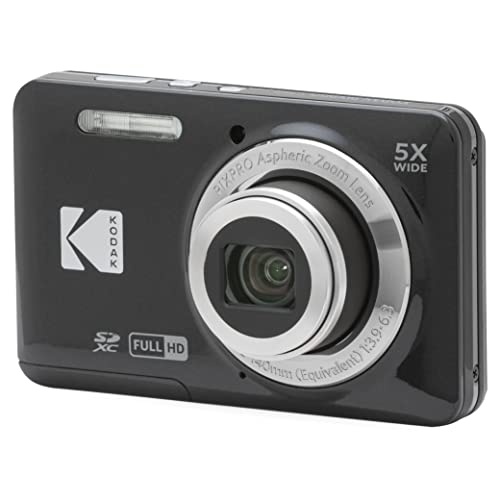
KODAK PIXPRO FZ55 — Budget box of joy
The FZ55 belongs to a species many declared extinct: the simple, inexpensive compact you hand to a grandparent, a child or your own carefree self on a beach day, without a whisper of anxiety. Sixteen megapixels, a 5x optical zoom starting at a genuinely wide 28mm, a 2.7-inch screen and controls that explain themselves — that is the whole specification, and it is enough for the camera’s actual job, which is being present and uncomplicated. It runs on a rechargeable pack, slips into any pocket ever sewn, and produces bright, cheerful colour in daylight that social feeds and family albums welcome without editing.
Honesty about ceilings is this guide’s house rule, so here it is in one sentence: the FZ55 records video at 1080p Full HD and no higher, and its small sensor expects daylight or flash, not candlelight. Within those borders it behaves admirably — face detection for family groups, scene modes that handle beaches and snow without your intervention, and a macro mode for flowers and details. There is no viewfinder, no raw, no manual labyrinth to get lost in; the camera’s philosophy is that the photograph in front of you matters more than the settings behind it, and for its audience that philosophy is correct.
Consider who thrives with an FZ55. The grandparent who wants grandchildren’s visits recorded on something simpler than a phone’s thousand distractions. The parent who would rather a child learn framing on a real shutter button than on glass. The traveller who wants a backup that costs less than the insurance excess on their main camera. Judged against flagship compacts it is a toy; judged against its price and purpose it is a small, honest pleasure, and the only pick here you can buy on a whim without the purchase following you home.
- Sensor: 16MP CCD-class compact sensor
- Lens: 28-140mm equivalent, 5x optical zoom
- Video: 1080p Full HD — the stated ceiling
- Screen: 2.7-inch fixed LCD
- Modes: scene selection, face detection, macro
- Power: rechargeable lithium pack
Strengths
- Genuinely inexpensive, so it can be lent, gifted and risked without worry.
- Simple controls and helpful scene modes suit children and technophobes perfectly.
- Wide 28mm starting point fits groups and interiors better than many budget rivals.
Trade-offs
- Video stops at 1080p, which large modern televisions will reveal.
- Small sensor and modest lens struggle after dark or indoors without flash.
- No viewfinder, raw mode or manual depth for growing photographers.
Best for: casual family duty, first cameras for children, and a worry-free glovebox or beach companion. Not suited for: evening events, large prints, or anyone expecting 4K video.

Panasonic 4K Point and Shoot — Generalist value
Panasonic’s affordable 4K point-and-shoot occupies the sensible middle of this guide: a travel body with a long zoom — the listing describes sixty times optical reach — 4K video recording and image stabilisation, aimed at families who want one camera to cover the holiday, the school play and the garden wildlife without a system camera’s cost or ceremony. It is the generalist pick, and generalists live or die by balance: nothing here is the best in the guide, and almost everything a family asks for is present and working.
The 4K video is the headline for good reason, since family archives age better at higher resolution, and Panasonic’s experience with video shows in stable, pleasing footage for a camera of this class. The long zoom serves the same school-stage and safari-vehicle duties as the Canon SX740, while the body remains a simple point-and-shoot in operation — automatic modes for the reluctant, scene guidance for the curious. For households upgrading from an elderly compact or rescuing events from a phone’s digital zoom, the step up in reach and video quality is immediately visible on the television.
Set expectations with the class, as this guide does for every pick. The sensor is a compact unit, so evenings and interiors will not match the one-inch trio; the lens’s reach is bought with aperture, so full zoom belongs to daylight; and buyers should read the listing’s own detail for the exact configuration and accessories, as value-line models vary in their packaging. None of that prevents a clear recommendation: as the affordable one-camera answer for family travel and events, this Panasonic undercuts the premium compacts while covering more ground than the budget Kodak, which is a respectable definition of value.
- Sensor: compact-class CMOS
- Lens: long optical zoom, listed at 60x
- Stabilisation: optical image stabilisation
- Video: 4K recording
- Operation: automatic and scene-guided modes
- Role: family travel generalist
Strengths
- Combines long zoom reach with 4K video at a family-friendly price.
- Simple automatic operation suits households where several people share one camera.
- Stabilised telephoto makes stage and wildlife framing realistic from the back rows.
Trade-offs
- Compact sensor concedes low-light quality to the one-inch models in this guide.
- Full zoom reach is a daylight tool; aperture narrows as you extend it.
- Listing configurations vary, so accessories and exact contents need confirming.
Best for: families wanting one affordable camera with real reach and 4K video for trips and events. Not suited for: low-light purists or photographers planning serious raw editing.
How do the six compacts compare at a glance?
| Camera | Sensor | Zoom reach | Video | Finder | Defining strength |
|---|---|---|---|---|---|
| Canon G7 X Mark III | 1-inch 20.1MP | 24-100mm | 4K 30p | None | Bright lens, creator features |
| Sony ZV-1 | 1-inch 20.1MP | 24-70mm | 4K 30p | None | Video-first design |
| Canon SX740 HS | 1/2.3-type 20.3MP | 24-960mm | 4K 30p | None | 40x pocket zoom |
| Sony RX100 VII | 1-inch 20.1MP | 24-200mm | 4K 30p | Pop-up EVF | Tracking autofocus |
| KODAK PIXPRO FZ55 | 16MP compact | 28-140mm | 1080p | None | Price and simplicity |
| Panasonic 4K P&S | Compact CMOS | Long zoom, 60x listed | 4K | None | Generalist value |
The table’s story is a trade triangle: brightness, reach and price, choose two. The G7 X and ZV-1 chose brightness and pocket size, surrendering reach. The SX740 and Panasonic chose reach and price, surrendering the evenings. The RX100 VII reaches for all three corners and pays with a premium that only its renewed listing tames, while the little Kodak chose price and simplicity and never pretended otherwise. Video separates the modern field from the budget box — everything except the FZ55 records 4K — and the finder column shows how completely this class has become a screen-based way of shooting, with Sony’s pop-up the lone exception.
When does a point and shoot beat the phone in your pocket?
Reach is the clearest victory. Optical zoom moves glass; digital zoom discards pixels, and at the distances where concerts, wildlife and ceremonies live, the difference is not subtle — it is the difference between a face and a smudge. Any parent who has filmed a nativity play from the back of a hall with both devices owns this knowledge in their bones. The SX740 HS, the Panasonic and even the RX100 VII at its long end photograph a world the phone can only gesture at, and for many buyers that single capability justifies the second device entirely.
Darkness is the second victory, reserved to the one-inch trio. A larger sensor behind a bright lens captures the restaurant, the evening street and the birthday candles with a naturalness that computational night modes approach but announce as processed — skin stays skin, and movement stays sharp instead of being averaged into watercolour. The third victory is endurance and intent: a compact’s battery is swappable, its card is removable, its shutter button is a physical commitment, and it never interrupts a frame with a message about anything. Families rediscovering printed albums and creators protecting their focus both cite that separation as the real feature. The phone remains the better computer; the compact, chosen well, remains the better camera for these specific hours.
How do you get better pictures from a small camera?
Start by respecting the light you have. Small sensors forgive less, so give them the best of the day: face your subject toward a window rather than away from it, step into shade at noon instead of squinting into glare, and at events move two rows closer rather than zooming into darkness. On the zoom models, remember that the middle of the range is the sharpest and brightest territory; full stretch is for daylight and distant wonders, not for a dim stage. Half-press to focus, pause, then shoot — the compact’s rhythm is a heartbeat slower than a phone’s, and honouring it doubles your keeper rate within a week.
Then learn the three controls every pick here offers in some form. Exposure compensation is the photographer’s veto: brighten a face against a dark hall, darken a sunset to keep its colour, one tap at a time. Scene modes are not cheating — the sports, portrait and night settings encode real decisions about shutter and sensitivity that beginners can borrow while learning. And the self-timer on a mini tripod or a steady wall turns any of these cameras into a night tool, holding still for the long exposures that transform city lights and fairgrounds. Finally, empty the card and charge the battery the night before the day that matters; small cameras fail their owners almost exclusively through logistics, not optics.
What should creators know about sound and stabilisation on compacts?
Video quality seduces buyers; audio quality decides whether anyone watches. A compact’s built-in microphone sits close to handling noise and far from a presenter’s mouth in a reverberant kitchen, which is why the microphone input on the G7 X Mark III and RX100 VII matters so much to serious creators, and why the ZV-1’s three-capsule array — engineered to favour the voice in front of the camera and supplied with a furry windscreen — is such a thoughtful exception. The working rule is simple: if you film people talking, plan the sound before the picture. A small lavalier or shotgun microphone costs less than the price difference between these models and improves perceived quality more than any resolution step.
Stabilisation is the second creator reality. Optical systems in these lenses smooth the tremor of handheld framing and make slow pans presentable, and the one-inch models add electronic assistance for walking shots at the cost of a slight crop. None of it replaces a small gimbal for deliberate cinematic movement, but all of it suffices for the vlog grammar of walking, turning and talking, provided you shoot at the wide end where shake is least visible and walk like you are carrying a full cup of coffee. Practise the technique on a dull street before the trip of a lifetime; stabilisation rewards rehearsed hands far more than expensive settings.
Heat and duration form the third, least glamorous truth. Compact bodies recording 4K continuously in a warm room approach thermal limits that stills never approach, and a camera that stops mid-interview teaches an unforgettable lesson. Creators filming long-form should test their exact settings at home for the full duration they intend, keep a second battery and card ready, and consider whether 1080p — kinder to heat, storage and battery alike — serves the audience just as well. The FZ55’s modest ceiling, reframed this way, is partly a feature: it never pretends to be a cinema camera, and it never shuts down mid-sentence either.
How does a compact earn its keep across one whole travel day?
Dawn first. The one-inch trio photograph a harbour at first light with a richness the small-sensor models cannot match, and the RX100 VII’s pop-up finder helps you compose against the brightening sky. The zoom tribe waits for the day to begin: by mid-morning the SX740 HS is picking out church towers and cliff colonies, the Panasonic is framing fishing boats from the pier, and both are doing it from the same pocket the phone lives in, which is the entire travel-compact thesis — the camera that is with you defeats the camera that is better.
Midday belongs to nobody and everybody: harsh light flatters no sensor, and the wise compact owner photographs interiors, markets in shade and details, saving the grand views for later. This is also when the FZ55 shines in its own register — handed around the table, risked at the beach, present for the photographs that are about memory rather than quality. Afternoon excursions test batteries; the traveller who charged overnight and carries one spare stops thinking about power entirely, which is the correct amount of thinking about power on holiday.
Evening returns the crown to brightness. The G7 X and ZV-1 take the restaurant and the old town’s lamplit lanes; the ZV-1 films the street musician with sound worth keeping; the RX100 VII does a little of everything at a slightly dimmer aperture. The zoom models retire gracefully to flash-lit group shots or an early night. A day like this is why this guide refuses to crown a single winner: the tribes take turns being right, and the buyer’s own itinerary — dawns or distances, faces or facades — should cast the deciding vote.
Why do prints and albums change how you judge a compact?
Because screens forgive what paper exposes. Viewed on a phone, nearly every photograph in this guide looks wonderful; printed at album size, the daylight work of all six cameras still pleases, and it is only at large enlargements that the hierarchy asserts itself — the one-inch files hold their detail and tonal smoothness, the small-sensor files soften, and the zoom models’ full-stretch shots reveal the compromises their reach required. None of this is a scandal. It is a calibration: if your photographs live on screens and in standard albums, buy by reach and price with a clear conscience; if you dream of a wall-sized print from the trip, the bright-lens trio is where that dream is stored.
Albums also reward the compact’s oldest virtue, consistency of colour. A dedicated camera renders a whole holiday in one palette, where a phone’s computational moods shift scene by scene; families assembling a book notice the coherence without naming it. So does the humble discipline of a single card per trip, emptied and backed up each evening — the compact workflow, unglamorous as it sounds, is why grandparents’ compact archives survive intact while phone libraries scatter across clouds and upgrades. Buy the camera whose files you will still be able to find in ten years, and keep the boring backup habit that makes finding them possible.
What mistakes do compact camera buyers repeat most?
Buying by megapixels leads the parade. A 20-megapixel small sensor does not out-resolve a 20-megapixel one-inch sensor in any way that survives an evening, and a 16-megapixel budget box like the Kodak makes perfectly happy daylight photographs. Sensor size and lens brightness are the honest numbers; the megapixel count is the loud one. The second mistake is its mirror image — buying a bright-lens creator compact for a safari, then discovering that 70mm or 100mm of reach cannot frame a lion. Match the zoom to the subject distance of your real life before falling for any lens’s aperture.
Bundle blindness follows close behind. A renewed or value bundle can be a bargain, but only the camera is the camera; grips, cards and software packs vary in quality and usefulness, so price the offer as if the extras were worth little, and let any genuine usefulness arrive as a pleasant surprise. Fourth, neglecting the spare battery: compacts sip power until video starts, whereupon they drink, and the school play does not pause for a recharge. And the final, saddest mistake is leaving the compact at home because the phone is easier — a habit defeated by carrying the camera in the same pocket for one full week, after which the hand reaches for it by itself.
How do the two Canons and the two Sonys divide between themselves?
Buyers often narrow to a brand and then stall, so let us separate the pairs directly. Between the Canons: the G7 X Mark III and the SX740 HS share a badge and almost nothing else. Choose the G7 X when your subjects are near, your rooms are dim and your camera doubles as a filming tool; choose the SX740 when your subjects are distant, your days are bright and your stills outnumber your clips. The price gap between them is the price of the one-inch sensor and the bright lens, and it is honestly charged — but it buys nothing at a safari, where the SX740’s reach humiliates its expensive sibling. Brand loyalty should never override that geometry.
Between the Sonys: the ZV-1 is the specialist presenter, the RX100 VII the generalist photographer. The ZV-1’s screen, microphone and product-showcase mode make filming yourself easier in ways the RX100 does not attempt; the RX100’s finder, tracking, burst and 200mm reach make photographing the world better in ways the ZV-1 does not attempt. A creator who occasionally travels will be happier on the ZV-1; a photographer who occasionally films will be happier on the RX100 VII. The renewed status of the RX100 listing narrows the price distance between them, which makes the functional question — am I the subject, or is the world? — the true decider.
And the remaining pair divide by budget philosophy. The Kodak asks for almost nothing and returns simplicity; the Panasonic asks for a moderate sum and returns coverage. A household buying its first dedicated camera in years should start from the Panasonic’s completeness unless the money genuinely pinches, in which case the Kodak’s cheerful competence beats the paralysis of saving for a premium model while the children grow unphotographed. Cameras are bought against time as much as against each other.
Which settings suit a family event straight out of the box?
Arrive with the unglamorous basics done: battery charged, card formatted in the camera, date and time correct so the archive sorts itself for a decade. Set image quality to the largest JPEG, plus raw on the models that offer it if your card is roomy. Choose the camera’s intelligent automatic or program mode without shame — on modern compacts these modes read a hall’s light better than a beginner’s manual guesses — then take personal control of exactly two things: where the focus point sits, and whether the flash is allowed. Focus on the child, the couple, the speaker; never let the camera choose the brightest background object instead.
Flash discipline transforms family archives more than any other single habit. Indoors, try the available light first on the bright-lens models, raising sensitivity and accepting a little grain to keep the room’s warmth; reserve flash for the posed group at the end, when honesty matters more than atmosphere, and step back so its light falls evenly. On the small-sensor models, flash is a legitimate tool rather than a failure — use it, and soften its harshness by zooming your feet backward and letting the lens reach instead. Outdoors at midday, reverse the instinct: force the flash on for portraits, filling the eye-socket shadows that noon sun carves, a professional trick that costs one menu dive.
Video at family events asks for restraint and gets rewarded. Film in the resolution the television deserves — 4K where the camera offers it and the clips are short, 1080p for the long ceremony where heat and storage matter — and hold each shot for a count of ten before moving, because future viewers need time to live inside a moment. Pan slowly or not at all. Capture the room’s sound for a few seconds with the lens cap of your attention on the scene rather than the screen. These habits, applied on any pick in this guide, produce the footage families actually rewatch, which is the only metric that survives the decade.
Final Recommendation
Let your dominant subject choose. If it is you, talking to a lens, buy the ZV-1 for its presenter-first design or the G7 X Mark III for its brighter lens and streaming manners — the renewed bundle deserves a careful read and rewards it. If your subjects are far away, the SX740 HS owns the affordable reach crown, with Panasonic’s 4K generalist as the family alternative. If photography itself is the hobby and the pocket is non-negotiable, the renewed RX100 VII is the connoisseur’s answer. And if the brief is joy without anxiety, the little Kodak is waiting. The compact camera survived the phone by being specific; honour that specificity, pick the one whose strength matches your Saturdays, and it will earn its pocket every week. Then do the one thing specifications cannot do for you: carry it daily for the first month, charged and empty-carded, until reaching for it becomes reflex rather than decision. Every photographer in this guide’s audience has a phone full of almost-photographs; the compact’s promise is a smaller set of deliberate ones, and that promise is kept by pockets and habits, not by sensors.
Frequently Asked Questions
Is a point and shoot still worth it when phones are this good?
For specific jobs, decisively yes. Optical zoom reach, a larger sensor behind a bright lens, swappable batteries and cards, and a device that only photographs — each is a real advantage a phone cannot replicate. If your photography is casual daylight snapshots at arm’s length, the phone suffices. If your subjects are distant, dim or filmed at length, a compact chosen for that job pays for itself in keepers.
What does renewed actually mean on the Canon and Sony listings?
Renewed describes units that have been inspected, tested and graded for resale rather than sold as factory-new, typically with a defined warranty and returns route through the programme selling them. Function should match a new unit; cosmetic grade and included accessories are the variables. Read the specific listing’s condition notes, confirm what is in the box, and inspect the camera on arrival while returns remain simple.
Why does the Kodak FZ55 only record 1080p video?
Because it is built to a budget brief where simplicity and price outrank resolution. Its 1080p footage is perfectly serviceable for phones, laptops and family sharing, but it will look softer on a large 4K television than the 4K footage from every other pick here. Buyers whose films live on big screens should step up to the Panasonic or Canon models; buyers sharing to small screens will never miss what they did not pay for.
Which of these cameras is best for concerts?
It depends where you sit and what the venue allows. Near the stage, the one-inch models — G7 X Mark III or RX100 VII — handle the darkness and movement best. From distant seats, the SX740 HS’s reach frames the performer, provided the light is stage-bright. Note that many venues restrict cameras with long zooms or detachable lenses; compacts are usually welcomed, but check the venue’s policy before the night.
Can a point and shoot take good portraits of people?
The bright-lens trio can, genuinely. At the wide end with the aperture open, the G7 X Mark III, ZV-1 and RX100 VII separate a face from its background in a way that flatters and that phones simulate less convincingly each year. Use window light, step close, and focus on the nearer eye. The zoom models and the Kodak take fine daylight portraits too, with the background kept pleasantly simple by distance rather than blur.
Are these cameras good for a child’s first photography steps?
The FZ55 was practically designed for the role — inexpensive enough to survive being dropped from the curriculum, simple enough that a child learns framing and patience rather than menus. Older children ready for more will grow into the SX740 HS’s zoom, which turns a school trip into a wildlife expedition. What matters is that the camera is theirs to carry and risk; a flagship compact guarded by parental anxiety teaches a child that photography is precious, when the first lesson should be that it is plentiful.
How many spare batteries should a traveller carry?
One spare covers most stills days on any pick here; two spares is the honest number for video-heavy days, long zoom sessions or cold weather, all of which drink power faster. Compacts charge by USB in many cases, so a power bank you already carry for your phone doubles as the emergency reserve. Rotate the spares rather than saving one untouched, so all of them age evenly.
Related Guides
Compact owners usually read next about the creator models and the travel zooms in more depth: see best compact cameras for vlogging beginners for the filming side, best travel zoom cameras for holidays for the long-lens tribe, and best budget cameras for family photography for the household angle.
Related guides
- Best Balancing Stabilizers for Mirrorless Cameras: Payload, Balancing and Native Vertical Shooting
- Best 1080p IP Cameras: PoE Domes, Turrets, Bullets and a PTZ That Earn Their Cable
- Best Basic Phones Camera Buyers Can Trust: Flip Phones and Simple Handsets That Still Take a Photograph
- Best Sony Full Frame Cameras for Astrophotography: Sensitivity vs Resolution


