What's inside
- Key Takeaways
- Quick Picks
- How Did We Choose Replacements for a One-Inch Ghost?
- What Actually Happened to the 39-Inch Television?
- One Inch Up: What Changes Between 39 and 40 in Practice?
- The Heirs Apparent: Six Sets Around a Missing Inch
- Side by Side: The 40-Inch Heirs and the 43-Inch Boundary
- What Goes Wrong When People Shop for This Size?
- How Do You Set Up a 40-Inch Replacement in an Old 39-Inch Spot?
- Does 1080p Still Make Sense at This Size?
- Where Do Sets This Size Actually Live, and What Does Each Home Demand?
- How Long Will the 40-Inch Class Itself Survive?
- What Should You Spend, and Where Does Extra Money Go at This Size?
- How Do You Verify a Small TV Listing Before Believing It?
- Can a Set This Size Handle Games and Sport Properly?
- Why Do Listings in This Class Keep Changing Their Names?
- Final Recommendation
- Frequently Asked Questions
- Related Guides
As an Amazon Associate I earn from qualifying purchases. This post may contain affiliate links at no extra cost to you.
gizmoverdict.com is reader-supported. When you buy through links on our site, we may earn an affiliate commission.
Where to buy: Amazon carries every set named below, and each link was matched to this site’s verified pool before it earned a place here. Read the size printed in each heading as gospel: this guide sells one inch of honesty with every television, because the size in the title is the size that barely exists.
The best 39 inch TVs are a rumour with a few honourable exceptions, and it is kinder to say so in the first paragraph than in the last. Shoppers hunting for the best 39 inch TVs in 2026 will find search results full of the size and shops almost empty of it. A small number of 39-inch sets were produced into the late 2010s — mostly value-brand models aimed at bedrooms and dorm rooms — and the class has since thinned to the point where no major maker keeps a current 39-inch model in its line. What survives, and survives well, is the 40-inch class directly above it: one inch larger, built on a panel size the factories still cut, and stocked by TCL, Hisense, Samsung, Insignia and Roku’s own brand.
That single inch deserves a moment of respect, because it explains the whole guide. Television sizes are not a continuous menu; they are the handful of diagonals that panel factories can cut from their glass sheets without waste. Thirty-nine inches was always an awkward cut — close enough to 40 that buyers could be nudged upward, different enough to need its own production planning. While 1080p panels were the industry’s bread and butter, a few makers kept the size alive for the bedroom market. Once production shifted decisively to 4K, the cutting patterns consolidated around 43 inches as the small 4K size, and 39 was left stranded between a 40-inch class that serves 1080p buyers and a 43-inch class that serves everyone else. Stranded sizes do not get new models, firmware attention or shelf space. They get guides like this one, explaining the neighbourhood they lived in.
So the six picks below divide into the heirs and the boundary. Five are 40-inch sets — the size your search was always going to end at — spanning Roku, Google TV and Fire TV platforms, from TCL, Hisense, Insignia, Samsung and Roku itself. The sixth is a 43-inch 4K set standing at the upper fence, included because many 39-inch hunters are really asking a different question: what is the smallest television that still gives me a modern 4K picture? Every pick is labelled with its true diagonal, and the 39-inch story is told straight, because a guide that pretends otherwise would be selling you a tape measure that lies.
Key Takeaways
- The 39-inch class is effectively extinct in current line-ups; the living size one inch up is 40 inches, and that is where five of these six picks sit.
- A 40-inch set is only about an inch wider overall than the 39-inch sets of a decade ago — modern thin bezels absorb most of the diagonal difference.
- Every 40-inch pick here is full HD 1080p, which at this size and typical bedroom distances is a sensible match rather than a compromise.
- Platform is the real choice in this class: Roku, Google TV and Fire TV versions of near-identical hardware all appear below.
- The 43-inch TCL Q6 marks the point where 4K begins in this neighbourhood — worth the extra width if the room is a main room.
- Any listing still advertising a new 39-inch TV deserves suspicion: check the model year, the warranty and the actual panel specification before believing it.
Quick Picks
| Pick | Badge | Why it is here |
|---|---|---|
| TCL 40 S3 (40-inch, 1080p, Roku) | The default heir | The straightforward answer for nearly every 39-inch search: right size class, right resolution, simplest platform. |
| Hisense 40 A4 (40-inch, 1080p, Roku) | Roku alternative | Hisense’s take on the same formula, with its own colour tuning for buyers who prefer it. |
| Insignia 40 F40 (40-inch, 1080p, Fire TV) | Fire TV route | For Alexa households, a full HD 40-inch set on Amazon’s platform with a voice remote. |
| Roku 40 Select (40-inch, 1080p) | The platform’s own set | Roku now builds the television as well as the software, and the integration shows. |
| Samsung 40 F6000 (40-inch, 1080p) | Big-brand option | Samsung’s Tizen set for households standardised on the brand’s remotes and menus. |
| TCL 43 Q6 (43-inch, 4K) | Upper boundary | Four inches beyond the search term buys QLED colour and full 4K for main-room use. |
How Did We Choose Replacements for a One-Inch Ghost?
The selection began with a census. We listed every television currently sold by a recognised maker at 39 inches, and the census came back essentially empty: no current model from Samsung, LG, Sony, TCL or Hisense carries the size, and the stragglers in marketplace listings resolve, on inspection, into old model years, refurbished units or outright mislabelling. A guide built on those would be a guide to leftovers. We therefore defined the assignment honestly — find the sets a 39-inch shopper should actually buy — and the answer concentrated at 40 inches with one excursion to 43.
Within the 40-inch class we required full HD as a floor. A 39-inch set from the class’s better years was a 1080p television, and a replacement that drops to 720p is a downgrade wearing a similar diagonal. All five 40-inch picks clear the floor. We then spread the picks across platforms deliberately, because at this size the panel differences between rival sets are modest while the daily experience — the home screen, the remote, the voice assistant, the app catalogue — is entirely platform. A household already speaking Alexa, Google or Roku at home should buy the set that speaks the same language.
Finally, every model was checked against this site’s verified product pool before receiving a link, and each heading carries the set’s true size. The 43-inch TCL is labelled as the boundary case it is, not smuggled in as a 39-inch answer. If a genuine new 39-inch set from a major maker appears in a future line-up, this guide will happily rewrite itself; until then, the inch above is where the value lives.
What Actually Happened to the 39-Inch Television?
The size had a genuine, if modest, career. Through the early and middle 2010s, 39-inch sets from value brands and a few majors occupied the bedroom-and-dorm niche: larger than the 32-inch kitchen class, cheaper than the 40 and 42-inch models climbing toward living-room status. The panels often came from cutting patterns that produced them as a companion size alongside larger diagonals, and while 1080p production ran at full tilt, the economics held together well enough for the size to persist in catalogues.
Three changes dismantled it. First, the industry’s centre of gravity moved to 4K, and the small 4K cutting patterns standardised on 43 inches, which tiles popular glass generations efficiently. Second, the 40-inch class — itself a survivor of an efficient 1080p cutting pattern — refused to die, because demand for inexpensive full HD sets in bedrooms and secondary rooms remained steady; squeezed between a living 40 below the 4K line and a thriving 43 above it, 39 had no distinct job left. Third, retail consolidated: as ranges were pruned during the supply shocks of the early 2020s, fringe sizes were the first lines deleted and the last restored. A size needs a factory, a brand and a shelf all agreeing to keep it, and by the middle of the decade none of the three was arguing for 39.
The pattern is worth recognising because it repeats. The 37-inch class died the same death a few years earlier, and the 46 and 47-inch classes vanished into 48 and 49. Television sizes survive by factory arithmetic and retail volume, not by the affection of the people who own them — and 39 inches, whatever its merits as a bedroom diagonal, lost on both counts. The affection, fortunately, transfers: everything a 39-inch set did well, the 40-inch sets below do at the same distances, in the same rooms, for similar money.
One Inch Up: What Changes Between 39 and 40 in Practice?
Almost nothing, and the almost is worth quantifying. A 39-inch 16:9 screen measures about 34 inches wide; a 40-inch screen about 34.9. Add bezels — slim on current sets, chunkier on the 39-inch sets of a decade ago — and the overall width difference between a new 40-inch set and the old 39 it replaces is frequently under an inch, sometimes nothing at all. Height and weight follow the same story: the new set is typically lighter than the old one despite the larger panel, because backlights and cabinets have thinned relentlessly. A stand, bracket or cabinet that hosted a 39-inch set will host these 40-inch picks in the overwhelming majority of cases, and the exceptions are settled by thirty seconds with a tape measure rather than by anxiety.
Viewing experience changes even less. At the six-to-eight-foot distances typical of the bedrooms and small living rooms this class serves, one inch of diagonal is below the threshold of perception once the set is on the wall; nobody has ever identified a one-inch difference from the sofa without a tape measure. What viewers do notice is everything else that improved while the size stood still: brighter and more even backlights, streaming platforms built in rather than bolted on, and remotes that control the set and a soundbar with one hand. The replacement conversation should therefore be about platform and picture tuning, not about the inch.
The one place the inch genuinely matters is the hard physical limit — the caravan cupboard, the fitted bedroom unit, the wall recess. There, width is width, and the correct move is to compare the candidate set’s published overall width against the opening, in inches and fractions, before ordering. If a 40-inch set misses by a hair, the neighbouring 32-inch class is the fallback; but measure first, because in our experience most “it won’t fit” assumptions about this size step turn out to be wrong.
The Heirs Apparent: Six Sets Around a Missing Inch
Five of these picks share a diagonal and a resolution, and differ where it counts — platform, tuning and household fit. The sixth stands at the 4K boundary. Each heading tells you the true size before it tells you anything else.

TCL 40 S3 1080p Roku TV — The default heir
If the 39-inch class had simply been renamed, this is the set it would have become. TCL’s S3 is a 40-inch full HD LED television with Roku built in, aimed squarely at the bedroom, the dorm, the small flat and the second room — the exact postings the old 39-inch sets held. It asks nothing of its owner: the setup is a guided ten minutes, the home screen is a grid of apps and inputs that a child can parse, and the remote fits the hand like a pebble. For a replacement purchase, which is what most 39-inch searches are, that absence of friction is the headline feature.
The picture is honest mid-class work. Full HD on a 40-inch panel at bedroom distance is sharp where it matters — faces, text overlays, the detail in a drama’s production design — and the panel’s brightness suits rooms with ordinary daylight rather than blackout curtains. Colour arrives slightly enthusiastic from the factory, as value sets tend to be tuned, and a minute in the picture menu with the most natural preset tames it. Sport at the panel’s native refresh is watchable without the blur that plagued sets of the 39-inch era, partly because panel response has improved across the whole industry.
Roku’s longevity is the deeper argument. The platform’s interface has remained recognisably itself while rivals redesigned theirs repeatedly, updates reach modest hardware for years, and the channel catalogue reaches the obscure regional and hobbyist services that smaller platforms quietly drop. A set bought for a bedroom tends to stay there for a decade; the S3’s software is the likeliest in this class to still feel current at the far end of that decade.
- True size and panel: 40-inch LED, 1920×1080
- Platform: Roku TV
- Typical postings: bedroom, dorm, small living room
- Inputs class: multiple HDMI, Wi-Fi, optical audio
Strengths
- The simplest setup and home screen in this class
- Full HD sharpness holds up at close bedroom distances
- Roku’s update record protects a long service life
Trade-offs
- 1080p ceiling in a market whose content increasingly streams in 4K
- Edge-lit contrast is modest for dark-room films
- Factory colour needs a preset change to look natural
Best for: the straightforward replacement — a dead or dying 39-inch set in a bedroom or small room, swapped with minimum ceremony.
Not suited for: a main-room film habit, where the 43-inch 4K boundary pick at the end of this list is the better spend.
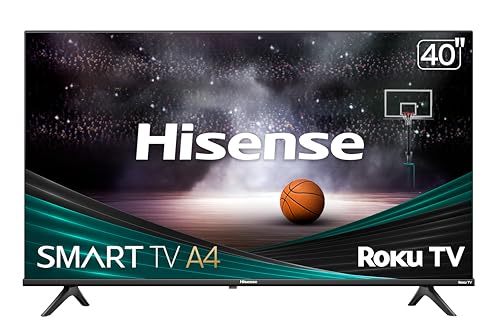
Hisense 40 A4 FHD Roku TV — Roku alternative
Hisense builds the A4 to the same brief as the TCL above — 40 inches, full HD, Roku — and the interesting question is why both deserve a place. The answer is tuning philosophy. Hisense voices its small sets for the rooms they actually serve: bright bedrooms and kitchens where a slightly punchier colour balance and assertive brightness read as clarity rather than excess. Side by side with the TCL, the A4’s factory picture looks warmer and more saturated; viewers who mostly watch sport and daytime programming often prefer it without knowing why.
The A4 also carries Hisense’s game and sports picture modes, which at this level are modest processing presets rather than headline technology, but they are sensibly implemented: the game mode trims processing to keep a connected console responsive, and the sports mode’s motion handling smooths a panning camera across a pitch. For a bedroom set that doubles as the household’s second gaming screen — a common posting for this class — those presets earn their menu space.
Choosing between the A4 and the S3 is a legitimate coin-flip decided by listing health on the day, by which remote your hand prefers, and by picture taste. What matters for the 39-inch refugee is that the class offers the choice at all: two credible makers contesting the 40-inch shelf keeps both honest on price and specification, and either set will feel like the natural continuation of the television it replaces.
- True size and panel: 40-inch LED, 1920×1080
- Platform: Roku TV
- Tuning character: warm, saturation-forward factory picture
- Extras: game and sports picture presets
Strengths
- Bright, warm tuning flatters daytime and sports viewing
- Game mode keeps a bedroom console responsive
- Same dependable Roku platform as its chief rival
Trade-offs
- Factory saturation overshoots on skin tones until adjusted
- Also capped at 1080p, with no path to 4K detail
- Panel uniformity varies across units in this price class
Best for: sport-heavy and daytime viewing in bright secondary rooms, and buyers whose taste runs to a warmer picture.
Not suited for: colour purists who will not touch a picture menu — the factory tuning asks for one adjustment.

Insignia 40 F40 FHD Fire TV — Fire TV route
Insignia’s F40 exists for the household that has standardised on Amazon’s ecosystem, and it makes that case cleanly: a 40-inch full HD panel, the Fire TV platform, and an Alexa voice remote in the box. The voice element is not a garnish in a bedroom set. Searching for a programme by speaking its name, from bed, in the dark, is the single most-used smart feature in secondary rooms, and Fire TV’s implementation is mature — it searches across the major apps rather than only Amazon’s own catalogue, and it will dim smart lights and answer questions while it is at it, for households wired that way.
The panel is the same class of full HD LED hardware as its Roku rivals, with picture quality that tracks them closely: clean at distance, modest in dark-scene contrast, bright enough for lit rooms. Insignia’s sets are built to a price and sold in volume, and the sensible expectation is competence rather than distinction — which, in a bedroom or a rental property or a teenager’s room, is exactly the requirement. The F40’s speakers follow the class pattern and flatter speech; a small soundbar remains the universal upgrade.
Fire TV’s home screen is the consideration to weigh. It is more promotional than Roku’s grid, surfacing Amazon’s content suggestions prominently, and households that dislike being marketed to by their television should factor that in. Households already renting films and subscribing through Amazon tend to experience the same screen as convenience. Either way, the platform decision should be made with eyes open, because at 40 inches the platform is the product.
- True size and panel: 40-inch LED, 1920×1080
- Platform: Fire TV with Alexa voice remote
- Ecosystem fit: Prime Video and Amazon-centric homes
- Role: the Fire TV representative in the 40-inch class
Strengths
- Voice search across apps is genuinely useful in bedrooms
- Full HD panel matches the Roku rivals’ class
- Deep integration for Prime and Alexa households
Trade-offs
- Home screen promotes Amazon content more than rivals do
- Dark-scene contrast is ordinary edge-lit fare
- Less appealing outside the Amazon ecosystem
Best for: Alexa and Prime households replacing a secondary-room set, especially where voice control from the bed will actually be used.
Not suited for: viewers who want a neutral, quiet home screen — Roku’s grid will annoy them less every single day.

Roku 40 Select 1080p TV — The platform’s own set
Roku spent a decade as the software inside other makers’ televisions before building its own, and the Select series is the result: hardware specified by the platform owner to show the platform at its best. The 40-inch Select is a full HD set whose distinction is integration. The remote, the interface, the setup flow and the update cadence are one company’s single vision, and the experience has the coherence that arrangement promises — menus where you left them, a home screen free of any hardware maker’s competing content store, and voice search through the remote or the Roku app.
Picture quality sits in the same honest band as the TCL and Hisense picks, which is unsurprising: at this size and price, panels come from a small pool of suppliers and differentiation lives in processing and tuning. Roku tunes conservatively, favouring a natural balance over showroom punch, and the Select’s picture is correspondingly easy to live with unadjusted. For the 39-inch replacement buyer who has never owned a smart TV — a real constituency, since the sets being replaced predate the category — the Select’s guided setup and unchanging interface minimise the learning curve to nearly nothing.
The strategic point in Roku’s favour is alignment. A hardware maker may abandon a platform generation; the platform owner will not abandon its own sets, because they are its shop window. Firmware support for the Select line is as close to guaranteed as this industry offers, and for a television bought to serve a bedroom for a decade, that support horizon is a rational thing to pay a small premium for.
- True size and panel: 40-inch LED, 1920×1080
- Platform: Roku OS, first-party hardware
- Tuning character: conservative, natural factory balance
- Support note: updates direct from the platform owner
Strengths
- Hardware and software from one maker, visibly coherent
- Natural factory picture needs no adjustment
- Strongest long-term update story in this class
Trade-offs
- Panel hardware is class-standard rather than class-leading
- Roku’s catalogue, while broad, lacks a few niche apps
- No 4K, like every 40-inch pick here
Best for: first-time smart TV buyers and Roku loyalists who want the platform in its purest, longest-supported form.
Not suited for: bargain hunters watching the listings daily, since rival 40-inch sets periodically undercut it on promotion.

Samsung 40 F6000 FHD TV — Big-brand option
Samsung’s presence in the 40-inch class matters out of proportion to the set itself, because Samsung is the brand many households already own in the main room. The F6000 is a full HD model on the Tizen platform, and its core promise is familiarity: the same remote language, the same menu logic and the same Samsung TV Plus layer of free channels that the household’s larger set provides. In homes with several televisions, that consistency quietly eliminates a category of domestic tech-support calls.
The F6000’s picture reflects Samsung’s processing priorities — clean upscaling of broadcast material, confident colour, and motion handling tuned for the sport and general programming this class mostly shows. Tizen’s app catalogue covers the mainstream services comprehensively; it is at the long tail of specialist apps that Roku and Google TV pull ahead, and a buyer with an obscure must-have service should verify its presence before ordering. The set’s design is tidier than the value brands’, with slimmer bezels and a more finished stand, which matters in rooms where the television is furniture as much as appliance.
For the 39-inch shopper, the F6000 is the conservative choice in the best sense: the largest maker’s current small set, bought through the deepest service network, speaking the household’s existing remote language. It does not win the class on any single specification. It wins on the absence of surprises, which in a secondary room is frequently the whole brief.
- True size and panel: 40-inch LED, 1920×1080
- Platform: Samsung Tizen with TV Plus
- Ecosystem fit: homes with a larger Samsung as the main set
- Design note: slimmer, more finished than value-brand rivals
Strengths
- Interface consistency with Samsung main-room sets
- Polished design and finish for a visible room
- Free TV Plus channels suit casual daytime viewing
Trade-offs
- App catalogue thins out at the specialist edges
- Same 1080p ceiling as the rest of the class
- Brand premium over functionally similar rivals
Best for: Samsung households adding a matched secondary set, and buyers who value the maker’s service network.
Not suited for: viewers dependent on a niche streaming service — confirm the app exists on Tizen first.

TCL 43 Q6 QLED 4K TV — Upper boundary
Every guide to a dying size owes its reader the map of where the living market begins, and in this neighbourhood it begins at 43 inches with sets like TCL’s Q6. This is a 4K QLED television: four times the pixels of the 40-inch picks, a quantum-dot colour layer that widens the palette visibly on nature programming and animation, and Google TV as the platform. It is included not as a 39-inch answer — at roughly 38 inches wide it will not fit the tightest 39-inch furniture — but as the honest alternative for readers whose room is a main room and whose old set was simply the smallest they could once afford.
The step from the 40-inch class is larger than the three inches suggest. Resolution quadruples, so streamed 4K material shows detail the 1080p picks physically cannot render; colour volume grows with the QLED layer; and the set’s processing and HDR support move it into the category of televisions that reward good sources. If the household’s viewing has migrated to streaming films and prestige series since the 39-inch set was bought — most households’ has — the Q6 is the pick that matches the present rather than the past.
The costs are width, a higher price class, and a Google TV interface that recommends content more assertively than Roku’s grid. The width is the disqualifier to check: measure the furniture, and if the Q6 fits, the question becomes whether the room’s role justifies the step. For a bedroom, usually not. For the room where the household actually watches, the boundary pick is frequently the one buyers thank themselves for.
- True size and panel: 43-inch QLED, 3840×2160 4K
- Platform: Google TV
- Colour: quantum-dot layer for wider palette
- Role: where the modern market starts, honestly labelled
Strengths
- Full 4K detail transforms streamed film and series
- QLED colour is a visible step beyond the 1080p picks
- Google TV catalogue and casting cover nearly everything
Trade-offs
- Widest pick here — tight 39-inch furniture excludes it
- Higher price class than the 40-inch heirs
- Recommendation-heavy home screen will not suit everyone
Best for: main rooms with the width to spare, where the old 39-inch set was always a compromise the budget imposed.
Not suited for: fitted bedroom units and caravans — take a 40-inch pick and the certainty of fit.
Side by Side: The 40-Inch Heirs and the 43-Inch Boundary
| Pick | True size | Resolution | Platform | Distinction |
|---|---|---|---|---|
| TCL 40 S3 | 40-inch | 1080p | Roku | Simplest all-round replacement |
| Hisense 40 A4 | 40-inch | 1080p | Roku | Warm tuning, sports and game presets |
| Insignia 40 F40 | 40-inch | 1080p | Fire TV | Alexa voice control in the box |
| Roku 40 Select | 40-inch | 1080p | Roku | First-party hardware, longest support |
| Samsung 40 F6000 | 40-inch | 1080p | Tizen | Brand consistency across the home |
| TCL 43 Q6 | 43-inch | 4K QLED | Google TV | The modern market’s entry point |
The table’s lesson is that this class is chosen by platform and room, not by panel. Five sets share a diagonal and a resolution because the factories have settled what a small television is; the differences that survive — interface, tuning, ecosystem, support — are the ones you will live with daily. Pick the platform your household already speaks, confirm the width fits, and the decision is done. Save the agonising for the main room, where the differences are larger and so are the bills.
What Goes Wrong When People Shop for This Size?
The signature mistake is believing a marketplace listing. Search any large marketplace for a 39-inch TV and results appear — but open them and the model years are ancient, the condition is refurbished, or the specification table quietly describes a 40-inch set wearing a 39-inch title for search traffic. Buyers who order on the title alone receive old panels with dim backlights, platforms too old to run current apps, and warranties measured in weeks. If a listing claims this size, read the model number, search the model number, and check its year before anything else.
A second error is assuming the replacement must match the old diagonal to fit the furniture. As the width arithmetic earlier in this guide shows, a modern 40-inch set is barely wider than a decade-old 39 — the bezels shrank faster than the panel grew. Buyers who pre-emptively drop to 32 inches out of caution end up with a visibly smaller picture in a space that would have taken the right size. The tape measure, applied to the actual opening and compared against the new set’s published overall width, settles the question in a minute.
Third, shoppers fixate on the resolution line and miss the platform line. At 40 inches, 1080p is a reasonable engineering match for the size, and every credible set in the class offers it; the daily friction in a secondary room comes from an interface the household dislikes or an app that is missing. Choose the platform first and the set second. Finally, do not overlook the feet: this class stands on two wide-spaced feet, and a narrow chest of drawers that cradled an old pedestal set may need a universal centre stand — a small purchase that is painless when planned and irritating when improvised.
How Do You Set Up a 40-Inch Replacement in an Old 39-Inch Spot?
Start with the opening, not the box. Measure the width and height of the space and the depth of the surface, and compare all three against the new set’s published dimensions, allowing a hand’s breadth behind for cables and air. If the set is wall-bound, check the VESA pattern on the back of the old bracket; patterns in this class are standardised, but the bolt size and spacing should be confirmed before the old set comes down and the wall is bare.
During setup, connect the set to the network and let it update before signing into anything — small sets often ship with firmware several versions behind, and the platform behaves noticeably better once current. Choose the most accurate picture preset for your main viewing, disable motion smoothing for films, and if the set replaces one in a bedroom, find the setting that dims or disables the standby light; a bright LED at 2 a.m. is the most common complaint about new bedroom televisions and every platform buries the fix in a different menu.
Finish by consolidating remotes. Modern sets support HDMI-CEC, so a connected streaming stick, console or soundbar can usually be controlled from the television’s own remote, and the soundbar’s volume will follow it too. Enable CEC on both devices, test the power and volume behaviour once, and the coffee table sheds a remote. Keep the old set’s remote only if a legacy recorder remains in service; otherwise, let the drawer declutter itself.
Does 1080p Still Make Sense at This Size?
It does, and the reasoning is optical rather than nostalgic. Pixel visibility depends on the angle each pixel subtends at the eye, which shrinks with distance. A 40-inch 1080p screen viewed from seven feet — a normal bedroom distance — presents pixels below the threshold at which most viewers can resolve the grid, so broadcast and streamed HD material looks continuous and clean. Move to a desk at three feet and the arithmetic flips, which is why this guide steers desk-bound buyers toward the 43-inch 4K boundary pick or a proper monitor instead.
There is also a content argument. A large share of what secondary-room sets actually show — broadcast channels, older series, daytime programming, many sports feeds — is produced and delivered at 1080p or below. A 4K panel must upscale all of it, inventing detail; a native 1080p panel simply shows it. Upscaling quality has improved enormously and the Q6 above does it well, but the notion that a 1080p set is obsolete confuses the showroom with the living room. Buy resolution for the distance and the content you actually have, and at this size, in these rooms, 1080p remains a defensible engineering answer — which is precisely why the factories keep cutting the panels.
Where Do Sets This Size Actually Live, and What Does Each Home Demand?
The bedroom is the ancestral posting, and its demands are specific: a screen readable from a pillow at seven or eight feet, a remote findable in the dark, a standby light that can be extinguished, and sound clear at low volume rather than powerful at high. Every pick in this guide satisfies the first two; the standby-light setting and a small soundbar or a pair of pillow-friendly listening habits handle the rest. Bedroom buyers should also value a sleep timer that is easy to reach — all three platforms here bury it at different depths, and if the feature matters nightly, it is worth checking the menu path in the manual before choosing.
The student room and the first flat impose a different brief: the set is television, games screen and occasional second monitor in one, carried up stairs and between addresses over its life. Weight and durability argue for this class generally — a 40-inch set is a one-person carry — and the game-mode presets on the Hisense, plus HDMI-CEC across the board, serve the console that shares the desk. The rented room adds one more constraint: nothing may be screwed into walls, so the set lives on its feet on whatever furniture the landlord provided, which returns us to the wide-feet problem and the occasional wisdom of a universal centre stand.
The spare room, the holiday let and the elderly relative’s house form the third constituency, and their brief is hospitality: the set must be operable by a guest with no instructions. This is where platform simplicity stops being a preference and becomes the product. Roku’s grid wins guests; Fire TV’s voice remote wins guests who will speak to it; Tizen wins guests who own Samsungs at home. A set that defeats its visitor has failed its only job, and hosts should choose accordingly rather than by panel nuance.
How Long Will the 40-Inch Class Itself Survive?
A fair question, given that this guide exists because a neighbouring size did not. The honest forecast is that 40 inches is safer than 39 ever was, for structural reasons. It is anchored to an efficient full HD cutting pattern, it serves a durable demand — secondary rooms are not disappearing, and neither are caravans, rentals and small flats — and it is carried by enough makers that no single brand’s exit empties the shelf. The 43-inch 4K class presses it from above as 4K panel prices fall, and the plausible long-term story is that 40 inches gradually becomes the 1080p value tier beneath a 43-inch mainstream, much as 32 inches became the tier beneath it.
For a buyer today, the practical translation is reassurance with a caveat. Reassurance: a 40-inch set bought now joins a large installed base, which means parts, firmware attention and platform support have volume behind them. Caveat: if your room and budget can take 43 inches and 4K, that class has the industry’s momentum, and momentum is what keeps a television’s apps updated in year eight. Neither consideration should paralyse a bedroom purchase. Sets in this class are inexpensive enough that the cost of choosing the merely-good size is small, and the cost of waiting for certainty is a dark screen in the meantime.
One more constituency deserves a mention: buyers furnishing a room for an ageing parent, where the old 39-inch set’s replacement will be operated by someone who never asked for a smart television at all. For that household the priorities invert — the largest buttons, the fewest home-screen distractions, the quickest route back to broadcast channels after an accidental button press. Roku’s grid is again the kindest interface, and setting the set to power on to the aerial input, a buried option on most platforms, restores the old behaviour where the television simply shows television. Configure it once, write the two or three essential steps on a card, and the inch that vanished will not be missed.
It is also worth saying what will not happen: 39 inches will not be revived. Panel capacity is planned years ahead, retail ranges are built around the surviving diagonals, and no maker gains anything by resurrecting a size whose tooling story never worked. If the diagonal held sentimental value — a first flat, a parent’s bedroom — the sentiment survives the inch. The programmes certainly do.
What Should You Spend, and Where Does Extra Money Go at This Size?
Without quoting prices for individual sets — listings move too fast for printed numbers to stay honest — the shape of spending in this class is stable enough to describe. The floor buys a competent 1080p panel on any of the three platforms, and the floor is genuinely sufficient for broadcast and casual streaming in a secondary room. Money above the floor buys, in order of daily value: a better remote, with voice control and a finish that survives drops; a tidier industrial design, if the set is furniture in a room you care about; the maker’s service network and warranty handling, which only reveal their worth when something fails; and marginally better panel uniformity, the luck-of-the-draw quality that separates a clean grey screen from a blotchy one on dark scenes.
What extra money does not buy in this class is a different category of picture. There is no 40-inch OLED, no mini-LED flagship at this diagonal; the ceiling of the class is set by the factories, and it sits at competent full HD. Buyers who find themselves pricing upward within the class in search of a transformation should instead step across to the 43-inch 4K boundary, where the transformation actually lives. Within the class, the wisest surplus spend is not on the set at all but beside it: the small soundbar that fixes the one weakness every thin television shares, and which will still be serving when this set is eventually replaced by whatever size the factories favour next.
How Do You Verify a Small TV Listing Before Believing It?
Because this size neighbourhood attracts stale and mislabelled listings, a short verification routine is worth more than another comparison table. First, extract the exact model number from the listing — not the marketing name, the model number — and search it independently. The maker’s own archive page for that model states its year, its panel resolution and its platform version, and any disagreement with the listing in front of you ends the enquiry. Second, check the platform generation: a set whose smart platform is several versions old may already have lost apps, and at this size the platform is half the product. Third, confirm the warranty is the manufacturer’s, for its full term, rather than a retailer’s short refurbishment cover described in similar words.
Fourth, read the dimensions line rather than the title for the size itself. Marketplace titles are written for search engines, and in this class they routinely round, borrow a neighbouring diagonal, or quote the shipping box. The specification table’s panel diagonal and overall width are the numbers with legal weight behind them. Fifth, if the price of a supposed new 39-inch set looks like a discovery, treat it as a classification error until the model number proves otherwise — genuine production of the size ended, and undiscovered warehouses of new stock are not a thing that happens with consumer electronics. The routine takes five minutes and converts the riskiest corner of the television market into a routine purchase.
Can a Set This Size Handle Games and Sport Properly?
Yes, within the physics of the class, and for many households this size is secretly the gaming television. A 40-inch screen at a desk-adjacent or bedroom distance fills the view without the head-turning a large set demands, the 1080p resolution matches what mainstream consoles render comfortably in their performance modes, and input lag on modern small sets in their game modes is low enough that only competitive players on high-refresh monitors will feel a difference. The Hisense’s game preset and similar modes across the class exist precisely to strip processing delay, and enabling the mode on the console’s HDMI input is the one setup step gamers should not skip.
Connectivity in this class deserves one practical check before ordering. Count the HDMI sockets your life requires — console, streaming stick if the platform disappoints, soundbar on the ARC socket, perhaps a recorder — and compare against the listing, because small sets economise on ports and a household short by one socket will live with a swapping ritual or an HDMI switch. Every pick here carries the class-standard complement, but variants sold under retailer-specific names occasionally differ, which is another reason the model-number verification above earns its five minutes.
Sport is the sterner test, because a broadcast camera panning across a pitch exposes both motion handling and panel uniformity. This class acquits itself adequately: native refresh panels with sensible motion settings keep a football readable, and the factory sports presets, for all their marketing gloss, do choose workable settings. The honest limits are brightness in a sunlit room and the greyish blacks of edge-lit panels under evening lamps — neither ruins a match, both remind you this is the value class. For the main-room sports devotee, the 43-inch boundary pick’s brighter QLED panel is the upgrade that matters; for the bedroom and the second screen, the heirs in this guide are enough.
Why Do Listings in This Class Keep Changing Their Names?
Small televisions are renamed constantly, and understanding why will save a buyer from chasing ghosts. A maker may sell the same panel and platform under one model name through its own store, another through a big retailer, and a third through online marketplaces, with suffixes distinguishing the remote or the region rather than the television. The 40-inch class, being a high-volume value tier, is where this practice runs thickest. The practical consequence is that a review of one model often describes its near-identical siblings accurately in everything except the badge, and that a “discontinued” notice on one listing usually means the name retired, not the television.
The buyer’s defence is to shop by specification and platform rather than by exact model string. Fix the requirements — 40 inches, full HD, the platform your household speaks, the inputs your devices need — and any current listing meeting them from TCL, Hisense, Insignia, Roku or Samsung is a legitimate candidate, with the picks in this guide as the reference points. Chasing a single model number across the internet in this class wastes evenings; the sets are deliberately fungible, and the factories like it that way.
Final Recommendation
The 39-inch television has left the catalogue, but its job description survives intact, and the 40-inch class fulfils it without drama. For most readers the TCL 40 S3 is the purchase: the simplest platform, an honest full HD picture, and a width that slides into the old set’s place as though the size had merely been renamed. Households loyal to Alexa should take the Insignia F40, Samsung homes the F6000, and anyone who prizes the longest software support the Roku Select; the Hisense A4 suits warmer picture tastes. If the room is the household’s real viewing room and the furniture can stretch, skip the class entirely and buy the 43-inch Q6 — the extra inches and pixels are the upgrade your viewing habits have already voted for. One inch closed a size class; it should not be allowed to complicate its replacement.
Frequently Asked Questions
Are any new 39-inch TVs still being made?
No major manufacturer carries a current 39-inch model. The size survives in refurbished stock, old model years and misleading listings. The living size is 40 inches for full HD sets and 43 inches where 4K begins, and both are well stocked by credible makers.
Will a 40-inch TV fit where my 39-inch set sits?
Almost always. A modern 40-inch set is roughly 35.9 inches wide overall, while a decade-old 39-inch set with its thicker bezels often measures 35 inches or more. Compare your opening against the new set’s published overall width to be certain, but the swap rarely fails on width.
Is 1080p enough for a 40-inch TV?
At the six-to-eight-foot distances typical of bedrooms and small rooms, yes — the pixel structure sits below most viewers’ resolving threshold, and much broadcast content is 1080p or less at source. At desk distance it looks soft, and a 4K set or a monitor serves better.
Why did 39 inches disappear while 40 inches survived?
Panel factories cut screens from fixed glass sizes, and 40 inches tiles an efficient pattern for full HD production while 43 inches does the same for 4K. The 39-inch cut fit neither pattern profitably, lost volume as prices fell, and was deleted when ranges were pruned. Survival in television sizes is factory arithmetic, not popularity.
Roku, Fire TV or Tizen — which platform should I pick?
The one your household already uses. Alexa homes take Fire TV, Samsung homes take Tizen for remote consistency, and everyone else is well served by Roku’s simple grid and long update record. At this size the platform shapes daily life more than the panel does.
My old 39-inch set still works. Is there any reason to replace it now?
Only the platform. An ageing set whose streaming apps have been abandoned can be revived completely by an inexpensive streaming stick in an HDMI socket, which is a far cheaper fix than a new television. Replace the set itself when the panel fades, the backlight blotches, or the inputs fail — or when the room’s role changes and the 43-inch 4K step makes sense on its own merits. A working television owes you nothing, and this class rewards patience.
Should I just buy the 43-inch 4K set instead?
If the furniture accepts its roughly 38-inch width and the room is where the household mainly watches, yes — the Q6’s resolution and colour are a genuine step. If the set is for a bedroom, a rental or a tight fitted unit, the 40-inch picks do the job for less money and no measuring anxiety.
Related Guides
Readers working through the small-size landscape may also need the story of the fully extinct 37-inch class and its nearest replacements, a tier-by-tier comparison of the whole 40 to 43-inch LED range, and guidance on using a 4K television as a computer monitor for the desk-bound cases this guide steered away from 1080p.



[…] this shelf, continue with our guide to the best 32-inch televisions overall, compare platforms in our roundup of 32-inch Roku TVs, or step up a size with the best 40-inch smart […]