What's inside
- Where to buy
- Key Takeaways
- Quick Picks
- How We Chose These Picks
- The Gap in the Ladder: Why Sizes Step 32 to 40
- The Armoire Problem: Fitting a Modern Set Into a 36-Inch Opening
- Six Neighbours of a Missing Size
- Both Sides of the Gap in One Table
- Deciding the Fork: Distance, Seating and the Psychology of Four Inches
- What About the 43-Inch Sets Above the Gap?
- Retiring the Old 36-Inch Set: Disposal, Mounts and Hand-Me-Downs
- Sound and Consoles Across the Fork
- Power, Heat and the Enclosed Installation
- The Measuring Protocol: Five Numbers Before Any Purchase
- The Smart Half of the Search: Platforms at the Neighbour Sizes
- What the Neighbours Teach About the Whole Ladder
- Mistakes Specific to Shopping for a Size That Isn’t There
- How the Fork Plays Out Over a Decade of Rooms
- Bright Rooms, Dark Rooms and the Neighbours’ Panels
- Final Recommendation
- Frequently Asked Questions
- Related Guides
As an Amazon Associate I earn from qualifying purchases. This post may contain affiliate links at no extra cost to you.
gizmoverdict.com is reader-supported. When you buy through links on our site, we may earn an affiliate commission.
Where to buy
The best 36 inch smart tvs share a secret with the 30-inch sets elsewhere in this batch: the size in the search box is not a size on the shelf. No current mainstream brand in the verified pool manufactures a 36-inch television. The market’s ladder steps from 32 inches to 40 — with 43 waiting above — and 36 sits in the gap between the rungs, a diagonal that appears in search histories, in the dimensions of old furniture, and in the occasional legacy or commercial panel, but not in the current consumer catalogues of the brands that fill this guide. So the honest list below is built from the two real neighbours: three 32-inch sets and three 40-inch sets, every heading carrying its true measurement, so the reader can decide which direction their room actually leans.
Why does 36 inches feel like it should exist? Partly memory: a generation of CRT and early flat-panel sets made the mid-thirties feel like a natural size, and alcoves, armoires and entertainment units were built to house them. Partly arithmetic: 36 is the exact midpoint between 32 and 40, and shoppers standing between two rungs reasonably ask for the step in the middle. But panel factories do not cut arithmetic midpoints; they cut the diagonals their glass generations yield efficiently, and the current generations yield 32 and 40. The midpoint the shopper wants would be a low-volume panel priced above both its neighbours — a product no brand can sell and no buyer would honestly choose once its price stood beside the 40’s.
The decision this guide actually offers is therefore a fork, and forks are decided by the room. If the constraint is a physical opening — the armoire, the alcove, the cabinet built for a 36-inch CRT — the answer is the 32-inch side of the list, because a television that does not fit is not a television. If the constraint is only an impression — “not too big, not too small” — the answer is usually the 40-inch side, because modern slim-bezel 40-inch sets occupy less wall than their diagonal suggests and because viewers adapt upward with a gratitude they never feel in reverse. Measure the opening, then read the six sections with that number in hand.
Key Takeaways
- No current mainstream brand in the verified pool sells a true 36-inch smart TV; the ladder steps from 32 to 40 inches.
- Three picks measure 32 inches and three measure 40, each labelled with its real diagonal in its heading.
- A fixed opening built for an old 36-inch set decides for the 32-inch picks — fit outranks preference.
- An open wall usually decides for the 40-inch picks: slim modern bezels make a 40 smaller in the room than its number suggests.
- All six picks are 1080p sets on living platforms — Roku, Google TV and Fire TV among them — so the smart half of the search is fully honoured.
- The old 36-inch CRT alcove hides a depth trap as well as a width one; flat panels solve the depth, the width still rules.
Quick Picks
| Pick | Badge | Why it earns its place |
|---|---|---|
| TCL 32-Inch S3 Google TV | 32 inch — the fit-safe Google option | The strongest 32-inch set in the pool for rooms whose opening is genuinely fixed. |
| Roku 32-Inch Select | 32 inch — the calm fit-safe option | Roku’s own hardware at the size that enters a 36-inch alcove with room to breathe. |
| Samsung 40-Inch F6000 | 40 inch — the polished step up | Samsung’s FHD flagship manners at the size above the gap, for open walls. |
| TCL 40-Inch S3 Roku TV | 40 inch — TCL value, Roku calm | The S3 family’s Roku edition: a proven panel for the small living room the 36-inch shopper often has. |
| Hisense 40-Inch QD4SR Roku TV | 40 inch — the colour pick | Hi-QLED colour on a 1080p Roku set: the most vivid picture on either side of the gap. |
| Roku 40-Inch Select | 40 inch — Roku’s own step up | First-party Roku hardware for households standardised on the platform. |
How We Chose These Picks
The method mirrors the 30-inch guide in this batch, because the situation is its twin: verify the absence first, then build the honest neighbourhood. The pool was checked for any true 36-inch model and none exists in it; rather than import an unverified oddity or a commercial signage panel to fill the exact number, the guide took three sets from each neighbouring size — the strongest, most current representatives — and labelled them without mercy. Every pick is 1080p, because a buyer stepping sideways from a remembered 36 inches deserves the full-HD tier and because at these sizes 720p would be a second, quieter downgrade stacked on the size compromise.
Within each size, platform spread did the sorting. The 32-inch side carries Google TV and Roku — the two systems this batch has found strongest at small sizes — plus, in the wider discussion, the Fire TV contrast. The 40-inch side carries Roku in three expressions (Roku’s own hardware, TCL’s S3, Hisense’s QD4SR) and Samsung’s Tizen flagship, because the 40-inch tier is where Roku’s licensing and Samsung’s polish genuinely contend. Sound, stand geometry and cabinet width were read for each pick with the fork in mind: the 32s were judged as furniture-constrained sets, the 40s as wall-and-stand sets, and the sections argue those judgements in the open.
One more filter deserves naming: no pick was allowed to pretend the gap away. Listings elsewhere round 32 up and 40 down with phrases like “36-inch class experience,” and this guide regards that language as the enemy. The headings say 32 or 40 because the panels measure 32 or 40, and the reader’s tape measure — the final authority in every section that follows — will agree with the headings or the purchase should not happen.
The Gap in the Ladder: Why Sizes Step 32 to 40
Television sizes are not a continuous menu but a ladder whose rungs are set by glass. Factories cut panels from mother-glass sheets in patterns that minimise waste, and the patterns the industry settled on yield the diagonals now crowding the catalogues: 24, 32, 40, 43, then the living-room procession upward. A 36-inch cut wastes glass against those patterns, and waste at factory scale is not a rounding error — it is the difference between a panel that can be sold at the tier’s going rate and one that cannot. When CRTs ruled, the tube’s manufacturing followed different economics and the mid-thirties flourished; the flat-panel transition redrew the ladder and the rung vanished, leaving its furniture behind.
The same logic explains the ladder’s other features that shoppers meet in this batch: the death of 30 inches between 24 and 32, the thinness of 37 and 39, the way 40 and 43 coexist uneasily as two factories’ answers to a similar pattern. Once the mechanism is understood, the shopper’s strategy changes from hunting the missing rung to exploiting the ladder’s economics — the rungs that exist are cheap for their size precisely because the factories love them, and the 40-inch picks in this guide deliver more screen per unit of money than any hypothetical 36 ever could. The gap is not a conspiracy against the midpoint-minded. It is the reason both neighbours are bargains.
The Armoire Problem: Fitting a Modern Set Into a 36-Inch Opening
The most concrete version of this search arrives with a tape measure and a piece of furniture: the entertainment armoire, the built-in alcove, the wall unit whose opening measures about 36 inches across — built, usually, for a CRT of that diagonal. Three facts govern that negotiation. First, the opening’s width admits a modern 32-inch set (roughly 29 inches wide in its slim cabinet) with comfortable margin, and excludes every 40-inch set (roughly 36 inches wide before any breathing room) by a hair’s breadth that no optimism should override. Second, the CRT’s depth — the dimension that made those cabinets cavernous — is irrelevant to a flat panel, which needs inches where its ancestor needed feet; the leftover depth becomes storage or ventilation, both welcome. Third, the old cabinet’s height and the new set’s stand must be checked together, since a 32-inch set on its feet stands around 19 inches tall.
Ventilation is the quiet clause. A flat panel sealed into a closed armoire with its doors shut will cook gently in its own warmth; leave the doors open while viewing, or give the cabinet a vented back, and the set will live its full life. Viewing angle is the second clause: an alcove fixes the set’s position, so the seating should be arranged to meet it near the centre, where these panels are at their best. Solved this way, the armoire outcome is genuinely happy — the 32-inch picks are better televisions than the CRT ever was, the furniture keeps its place in the room, and the only casualty is the number 36, which was a diagonal, not a heirloom.
Six Neighbours of a Missing Size

TCL 32-Inch S3 Google TV — 32 inch, the fit-safe all-rounder
On the lower side of the gap, the TCL S3 is the set this batch keeps crowning, and the reasons survive the change of keyword: a full 1080p panel, Google TV with Chromecast and the Play Store, and a cabinet slim enough to enter a 36-inch opening with margin on every side. For the armoire owner, that margin is not wasted space — it is ventilation, cable access and the ability to angle the set a few degrees toward the seating. For the open-wall shopper who lands on the 32 side by budget or by room, it is simply the most complete small television in the pool, asked to do a slightly smaller job.
Its platform depth is the tiebreaker against the other fit-safe pick: where the Roku beside it offers calm, the TCL offers capability — casting from Android phones, the app long tail, Google Assistant routines. In a den or a bedroom that doubles as a workspace, that capability gets used. The set does not know it is a compromise for a missing 36 inches, and after a week neither will its owner; the four-inch difference from the remembered size is the kind that memory exaggerates and rooms forgive.
- Screen: 32-inch class, 1920×1080 full HD
- Cabinet: roughly 29 inches wide — enters a 36-inch opening easily
- Platform: Google TV with Chromecast built in
- Role: lower neighbour, capability-first
Strengths
- Most complete platform at the fit-safe size
- 1080p panel; no resolution compromise stacked on the size one
- Slim cabinet leaves working room inside old furniture
Trade-offs
- Four inches below the searched diagonal — visible in a large room
- Google TV’s sponsored rows share the home screen
- Speakers are speech-clear, not cinematic
Best for: fixed openings and Google households on the lower side of the fork. Not suited for: an open living-room wall, where the 40-inch picks will serve better.
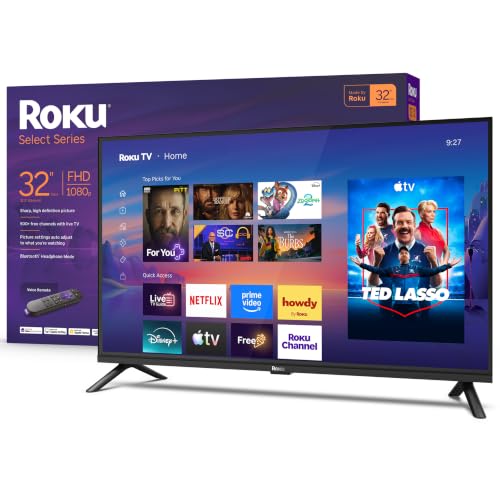
Roku 32-Inch Select — 32 inch, the calm fit-safe option
Roku’s own 32-inch set is the fit-safe pick for the other temperament: the household that wants the television to be an appliance. Its 1080p panel matches the TCL’s, its cabinet fits the same openings, and its interface — the grid, the even-handed search, the antenna tile, private listening through the app — asks nothing of its operator. In the guest room, the grandparents’ den and the rental, those are the winning specifications, and they are why this set anchors the lower side of the fork beside the TCL rather than behind it: the two are peers divided by philosophy.
Measured against the missing 36, the Roku’s pitch is that size regret fades fastest when the daily experience is frictionless. A household that steps down four inches and gains an interface everyone can run will stop mentioning the inches within a month; a household that steps down and fights its television will mention both forever. Roku’s first-party update stream extends the calm across years, which matters in furniture-constrained rooms where the set, once installed in the armoire, tends to stay for a decade.
- Screen: 32-inch class, 1920×1080 full HD
- Cabinet: roughly 29 inches wide — alcove-friendly
- Platform: Roku TV, first-party hardware
- Extras: private listening via the Roku app
Strengths
- The least demanding interface on either side of the gap
- Direct-from-Roku updates for a long, quiet life
- Broadcast handling that suits antenna-fed dens
Trade-offs
- No Chromecast for Android-heavy households
- Four inches under the search, like its lower-side sibling
- Curated store only; no app long tail
Best for: guest rooms, grandparents and rentals on the fit-safe side. Not suited for: habitual casters, who should take the TCL at this size or stretch to a 40.

Samsung 40-Inch F6000 — 40 inch, the polished step up
The upper side of the fork opens with Samsung’s F6000 at 40 inches — the same FHD family as the 32-inch model in this batch’s general guide, grown to the size above the gap. Its argument to the 36-inch shopper is presence with polish: Samsung’s picture processing, a tidier cabinet than the tier’s average, Tizen’s gloss, and channel management that remains the most developed in this guide for antenna households curating a scanned lineup. On an open wall in a small living room, it reads as a deliberate main television rather than a compromise with a missing size.
The conditions are printed on its face: it measures 40 inches, roughly 36 inches wide in the cabinet, and it will not enter the armoire that defines the other fork — measure the opening before falling for the polish, because this pick’s width and the classic opening’s width are close enough to break hearts by an inch. Tizen’s app catalogue covers the mainstream and stops there, and Samsung’s interface carries its own promotions. For the open-wall reader, those are fair prices for the tier’s most finished 40-inch FHD package.
- Screen: 40-inch class, 1920×1080 full HD
- Cabinet: roughly 36 inches wide — open walls only
- Platform: Samsung Tizen (One UI)
- Channel tools: the guide’s most developed editing suite
Strengths
- Refined processing and finish at the upper neighbour size
- Channel curation for serious antenna households
- Presence enough to anchor a small living room
Trade-offs
- Will not fit a true 36-inch opening — the width is the warning
- App long tail is absent on Tizen
- 1080p where 43-inch sets begin offering 4K
Best for: open-wall small living rooms in Samsung households. Not suited for: any fixed alcove or armoire — that is the 32-inch side’s whole reason to exist.

TCL 40-Inch S3 Roku TV — 40 inch, proven panel, calm platform
TCL’s S3 at 40 inches with Roku inside is the upper fork’s value anchor: a long-running, well-understood 1080p panel paired with the interface households fight about least. For the 36-inch shopper whose constraint turns out to be impression rather than architecture — the wall was always open; only the expectation was mid-sized — this is frequently the set that ends the search, because it offers the step up in size without a step into unfamiliar software or flagship pricing. Accessories, mounts and replacement remotes for the S3 family are trivially available, the unglamorous infrastructure of a decade’s ownership.
Edition discipline applies, as it has throughout this batch: the S3 family also ships with Google TV, and this pick is the Roku edition — the platform line on the listing is the product. Roku households gain the familiar grid and store; the panel gains them a small living room’s worth of presence over the 32-inch side. Against Samsung’s 40 it trades polish for platform calm and TCL’s value; against Roku’s own 40 below, it trades first-party purity for the S3’s track record and availability. All three are honest trades, and the sections let the reader pick their own.
- Screen: 40-inch class, 1920×1080 full HD
- Platform: Roku TV (S3 Roku edition — check the edition when buying)
- Cabinet: roughly 36 inches wide; stand width to match
- Role: upper neighbour, value anchor
Strengths
- Proven panel with the household-friendly Roku interface
- Easy accessories and support from a long production run
- Full Roku store and update stream
Trade-offs
- Edition confusion with the Google TV S3 is a real shopping hazard
- 1080p, not 4K, at a main-room size
- Too wide for fixed 36-inch furniture
Best for: Roku households stepping up to a small living room. Not suited for: alcove installations, or Google households who should take the TCL’s other edition at 40 in the Android guide’s terms.

Hisense 40-Inch QD4SR Roku TV — 40 inch, the colour pick
The QD4SR is the upper fork’s picture-quality argument. Hisense’s Hi-QLED panel stretches colour volume beyond the standard LED sets around it — animation, sport and nature programming all show the difference — while the 1080p resolution keeps the set in the FHD tier’s pricing rather than the 4K tier’s. Roku runs the interface with its usual even temper. For the 36-inch shopper who discovers the wall is open, this pick converts the size disappointment into a small upgrade story: four inches more than asked, in the most colourful panel on either side of the gap.
This batch has met the QD4 family before, in the Roku guide, where its 32-inch sibling could only be discussed in prose for want of verification. At 40 inches the family is verified and linked, and the comparison is instructive: the shopper who wanted the QD4 character at the smaller size can have it here, whole, at the cost of the fork’s upper branch. Dolby Audio processing rounds out a package aimed at rooms where the television is watched rather than merely present. Measure the wall, respect the width, and the colour does the rest.
- Screen: 40-inch class, 1920×1080 full HD, Hi-QLED panel
- Platform: Roku TV
- Sound: Dolby Audio processing
- Family: QD4 — verified at this size in the pool
Strengths
- Best colour performance in this guide
- Roku’s calm over Hisense’s panel craft
- Current model with the full Roku store
Trade-offs
- Upper-branch size only; no use to a fixed opening
- 1080p resolution beneath a premium panel layer
- QLED flatters colour, not detail
Best for: open-wall rooms where picture character leads the decision. Not suited for: the armoire, the alcove, or any opening measured under 37 inches.

Roku 40-Inch Select — 40 inch, the platform purist’s step up
Roku’s own 40-inch Select closes the picks as the upper fork’s purist option: first-party hardware, the reference Roku experience, updates from the source, and a 1080p panel sized to anchor a small living room. Households already running the 32-inch Select in another room gain the system’s deepest pleasure — one interface, one account, one remote grammar at two sizes — and households entering Roku for the first time at this size get the platform exactly as its maker intends it, with no licensee variation to learn.
Its limits are the tier’s honest ones: no QLED colour layer, no 4K, sound that a compact soundbar would flatter. Its claim is the one Roku always makes and usually wins on — that a television’s decade is lived in its software manners, and manners are what first-party hardware guarantees. For the 36-inch shopper on the open-wall side who values that guarantee over panel fireworks, this is the terminus of the fork: four inches more than the search asked for, and nothing about the daily experience to apologise for.
- Screen: 40-inch class, 1920×1080 full HD
- Platform: Roku TV, first-party hardware
- Cabinet: roughly 36 inches wide — measure the stand surface
- Role: upper neighbour, platform purist
Strengths
- Reference Roku experience with direct updates
- System continuity with Roku sets in other rooms
- 1080p stays clean at small-living-room distances
Trade-offs
- No QLED or 4K at this rung
- Too wide for any fixed 36-inch furniture
- Speakers serve speech better than film
Best for: Roku-standardised households furnishing a small living room. Not suited for: fixed openings, or colour-first buyers who should take the QD4SR.
Both Sides of the Gap in One Table
| Pick | True size | Approx. width | Platform | Fork logic |
|---|---|---|---|---|
| TCL S3 Google TV | 32 inch | ~29 inch | Google TV | Fits the opening; most capable small set |
| Roku Select 32 | 32 inch | ~29 inch | Roku | Fits the opening; calmest interface |
| Samsung F6000 40 | 40 inch | ~36 inch | Tizen | Open wall; polish and channel tools |
| TCL S3 Roku 40 | 40 inch | ~36 inch | Roku | Open wall; value and track record |
| Hisense QD4SR | 40 inch | ~36 inch | Roku | Open wall; colour flagship |
| Roku Select 40 | 40 inch | ~36 inch | Roku | Open wall; first-party purity |
The width column is the guide’s conscience. Read it before the platform column: a 36-inch opening admits the first two rows and refuses the rest, whatever their virtues, while an open wall admits all six and lets platform and picture decide. Between those two readings sits every buyer’s actual situation, and the table’s job is to make the situation impossible to fudge. There is no 36-inch row, because there is no 36-inch television in the pool — and a table that invented one would be lying in a grid, which is still lying.
Deciding the Fork: Distance, Seating and the Psychology of Four Inches
Where no furniture constrains the choice, viewing distance arbitrates. A 40-inch 1080p screen is comfortable from about five feet to nine; a 32-inch from about three and a half to seven. Small living rooms — sofa against one wall, television against the other — commonly land at seven to nine feet, squarely in the 40’s window and at the 32’s outer edge, which is why open-wall shoppers who “settle” for the 32 so often re-shop within two years. Dens and bedrooms land at five to seven feet, where both sizes work and the 32’s economy is real. Measure the room’s actual seating distance, not its diagonal across the floor plan, and the fork usually decides itself without a single specification being consulted.
The psychology deserves its sentence because it is predictable enough to plan around: viewers adapt to a larger screen within days and experience the adaptation as the room improving, while a smaller screen’s inadequacy is re-noticed at every wide shot and every subtitle. Nobody in the history of the appliance has returned a television for being four inches too large once it fit the wall; the returns queue is built of the opposite regret. That asymmetry is not an argument to ignore the tape measure — the armoire owners above have no choice to make — but where the wall is open, it is an argument to let the fork fall upward and to spend the deliberation on platform instead.
What About the 43-Inch Sets Above the Gap?
Diligent shoppers will notice the ladder continues: 43-inch sets crowd the catalogues just above the 40s, many of them 4K, and a few readers will wonder why this guide stops at 40. The answer is fidelity to the search. A 36-inch shopper is negotiating a few inches around a remembered size; 43 is seven inches and a resolution tier away, a different purchase for a different room, and pulling it into this guide would repeat the very rounding this batch exists to refuse. Readers whose measurements keep growing — the wall is open, the distance is nine feet, the budget breathes — should take the hint their own tape is giving and shop the 43-inch class deliberately, with its 4K panels and its own guides, rather than drift there from a 36-inch search by increments nobody chose.
There is also a width cliff worth knowing: 43-inch sets run roughly 38 inches wide and wider in the cabinet, which crosses the threshold where small-room furniture — the media consoles and stands sized for the 32-to-40 world — stops fitting entirely. The 40-inch picks are the last rung that the existing furniture ecosystem absorbs without a fight. That, as much as panel economics, is why the fork in this guide is drawn where it is: 40 is the largest step the room that wanted 36 inches can usually take without redecorating around the decision.
Retiring the Old 36-Inch Set: Disposal, Mounts and Hand-Me-Downs
The purchase at the end of this search usually begins with a departure: the old 36-inch set, very often a CRT or an early flat panel, leaving the room. CRTs deserve their specific warning — they are heavy beyond their size’s suggestion, they contain leaded glass, and they belong in electronics recycling rather than in a skip or a kerbside pile; many municipalities run collection days precisely because the nation’s armoires are emptying in the same decade. Early flat panels are lighter and simpler but carry the same e-waste logic, and a working one has a second life waiting in a workshop or a relative’s spare room — pass it on with its remote and a factory reset, and say its true diagonal when you do.
The hardware left behind needs auditing rather than assuming. A wall mount that held a 36-inch CRT-era set is engineered for far more weight than any pick here, but its VESA pattern may not match the modern small squares these sets use; check the pattern numbers, not the mount’s confidence. A stand or console sized for the old set will swallow a 32 whole and may just refuse a 40’s foot span — the fork again, decided by furniture. And the old set’s cables are antiques: the new picks want modern HDMI leads, and the drawer of composite and component cables can go to the same recycling as the television, with the household’s blessing.
Sound and Consoles Across the Fork
Neither side of the gap escapes small-cabinet acoustics, but the fork changes the remedy’s context. In the armoire, a 32-inch set’s speakers fire into a wooden box that adds its own resonance; the cabinet can flatter speech and muddy everything else, and the clean fix is the platform’s dialogue settings rather than a soundbar that has nowhere to live. On the open wall, the 40-inch picks gain the soundbar option in earnest — a compact bar under a 40-inch screen is proportioned correctly, where the same bar under a 32 looks and sounds like a guest who dressed for a different party. Headphone routes and private listening, Roku’s especially, serve both sides equally and cost nothing.
Consoles follow the room, not the diagonal. Both sizes here are 1080p standard-refresh panels with game modes adequate for family play; the 40-inch side’s extra presence suits the small living room where a console anchors Friday night, while the 32 in the den is the second console’s natural screen. Port counts should be checked against the household’s actual devices before purchase — console, stick if any, soundbar on the ARC port — because the fork’s loser is often decided by a cable that has nowhere to go. None of these sets is a competitive gaming display, and at a remembered-36-inch brief, none needs to be.
Power, Heat and the Enclosed Installation
The armoire scenario gives this guide’s energy section its specific edge. A 32-inch LED set draws modest power, but inside a closed cabinet its waste heat has nowhere to go, and heat is the slow enemy of panel electronics. The rules are simple and worth printing on the inside of the cabinet door: doors open while viewing, a vent or a gap at the back for the heat’s exit, and no stacking of other warm electronics in the same compartment. Followed, they make the enclosed installation as durable as the open one; ignored, they quietly halve the set’s life while the picture still looks innocent.
On the open wall the 40-inch picks draw somewhat more than the 32s and remain, in absolute terms, cheap appliances to run. Standby behaviour is the only setting with a real signature: fast-start modes keep the network interface listening for the app and the voice remote, a trickle that mains households can ignore and off-grid ones should switch off. As in the batch’s other guides, the meaningful energy decision is not watts but fit — a correctly sized set serves a decade, a mis-sized one is replaced in two years and pays its embodied cost twice. The fork, decided well, is the greenest paragraph in this guide.
The Measuring Protocol: Five Numbers Before Any Purchase
Because this entire search is decided by tape, the protocol deserves to be written as one. Number one: the opening’s clear width, measured at its narrowest point — trim and hinges included — if furniture constrains the purchase. Number two: the opening’s clear height, against the set’s height on its feet, which the manufacturer’s specifications state and listings often omit. Number three: the stand surface’s width and depth, against the pick’s foot span and cabinet depth, for any set that will stand rather than hang. Number four: the seating distance, eye to wall, which arbitrates the fork when the wall is open. Number five: the diagonal of the space’s ambition — the honest answer to whether this room wants a personal screen or a shared one — which no tape provides and every buyer knows.
Write the five numbers down before opening a single listing. The discipline sounds austere and is actually liberating: with the numbers in hand, four of the six picks eliminate themselves, the fork collapses to a platform choice between two survivors, and the purchase takes ten minutes. Without them, the shopper browses six sections of this guide — and forty listings beyond it — in a fog of approximate desire, which is the fog in which half-inch tragedies happen. The tape measure is the cheapest accessory in the entire transaction and the only one that is never redundant.
The Smart Half of the Search: Platforms at the Neighbour Sizes
The search phrase promises “smart,” and both neighbours keep the promise in full — but they keep it in different dialects, and the dialect may outlast the size decision in daily importance. Roku dominates this guide’s picks, appearing at both sizes and in three makers’ cabinets, because Roku’s licensing colonised exactly these rungs of the ladder; a household that standardises on it gains the one-interface archipelago this batch has praised elsewhere. Google TV appears on the lower fork through the TCL 32, carrying casting and the Play Store for Android households whose room happens to be the constrained one. Samsung’s Tizen flies the polish flag at 40. Fire TV, notably, is absent from the picks at these sizes in the pool — Alexa households face a genuine fork of their own, between Insignia’s 32-inch sets in the general guide and stepping outside this page’s six, and the guide notes the absence rather than papering over it with a substitute.
The practical order of operations follows: measure first, because fit eliminates; platform second, because it governs the decade; picture third, where the QD4SR’s colour and Samsung’s processing earn their premiums; and brand sentiment last, where it belongs. A buyer who runs the order in reverse — badge, picture, platform, tape — is the buyer the returns department knows by sight. The missing 36 inches cannot be bought, but the purchase it provokes can still be made in the right order, and that order is this guide’s real product.
What the Neighbours Teach About the Whole Ladder
Step back from the fork and the six picks become a lesson in how to shop any size the factories have orphaned — and there are several, as this batch’s 30-inch guide attests. The method transfers intact: confirm the absence rather than trusting it, identify the neighbouring rungs, label them honestly, and let the room’s measurements choose the direction. Shoppers who internalise that method stop being vulnerable to the two industries that missing sizes feed — the listings that round a neighbour toward the searched number, and the nostalgia that insists the remembered size must exist somewhere if only the search were cleverer. It does not, and the cleverness is in the choosing, not the finding.
There is a consolation built into the ladder’s economics, and it is worth stating plainly at the end of a guide about an absence. The rungs that survive — 32 and 40 among them — survive because they are manufactured in such volume that their prices, their accessories, their replacement remotes and their resale demand all benefit from scale. The 36-inch shopper who lands on either neighbour has not settled for the industry’s leftovers; they have bought into its mainstream, with all the support that mainstream carries. The missing size, mourned accurately and briefly, makes a better purchase possible on both sides of its grave.
Mistakes Specific to Shopping for a Size That Isn’t There
The signature mistake is believing a listing that claims the size. Marketplace and legacy-stock pages still advertise “36-inch” televisions that prove, on the specification sheet, to be 32-inch or 40-inch panels in generous cabinets, or commercial displays with no consumer platform at all. The defence is the batch’s standing one: the manufacturer’s stated diagonal, checked before money moves. The second mistake is measuring the old television rather than the opening — a departing CRT’s cabinet tells you what the furniture swallowed, but the opening’s clear width, height and the shelf’s depth are the numbers the new set must satisfy, and they are not the same numbers.
Third is the diagonal-only measurement: forgetting that a 40-inch set’s feet may spread nearly its full width, so a stand that held a centred-pedestal 36-inch CRT can refuse the newcomer it seemed sized for. Fourth is buying the 32 for an open wall out of midpoint loyalty, then discovering at nine feet that loyalty is not a viewing experience. And fifth is its mirror — forcing a 40 toward an opening measured hopefully rather than actually, and meeting the half-inch that ends the discussion at the door of the armoire. Every one of these errors is a measurement error wearing a shopping costume, which is why this guide has mentioned the tape measure more often than any microchip.
How the Fork Plays Out Over a Decade of Rooms
Televisions at these sizes rarely die in the room they were bought for; they cascade. The 40-inch set that anchors today’s small living room becomes, at the next rearrangement, the large bedroom set, then perhaps the grown child’s first flat screen — each move painless because 40 inches fits through doors, onto dressers and into cars without ceremony. The 32-inch set cascades further and faster: kitchen, workshop, caravan, the relative starting out. A buyer choosing between the fork’s sides is also choosing a cascade path, and households that know their habits — the frequent rearrangers, the handers-down — can weigh it honestly. Platform standardisation compounds the benefit at every step, which is why this guide’s Roku-heavy field is a system as much as a list: any of its sets can inherit any room in a Roku house without a soul needing to relearn a remote.
The cascade lens also redeems the fork’s apparent loser in each household. The 32 bought for the armoire is not the small compromise of the family fleet; it is the future kitchen set, the future caravan set, pre-purchased. The 40 bought for the open wall is not an indulgence; it is the future main bedroom set, waiting its turn. Sizes that exist on the ladder’s strong rungs hold their usefulness across all these lives, which is the deepest reason the missing 36 is no tragedy: a true 36, had it existed as a low-volume oddity, would have cascaded worst of all — orphaned by its own rarity at every move, its mounts and remotes and resale all thinned by the same economics that killed it.
Bright Rooms, Dark Rooms and the Neighbours’ Panels
The fork interacts with light in ways worth a short section, because the rooms that remember 36 inches are often the bright ones — the sunroom, the kitchen-den, the conservatory where the old set lived. All six picks are LED panels of the tier’s standard brightness, which handles ordinary daylight competently when the set is angled away from direct window reflections and the backlight — the correct control — is raised for the day. The QD4SR’s colour volume gives it a small edge in bright rooms, where saturation is the first casualty of ambient light; the Samsung’s processing gives it a small edge in dark ones, where shadow handling shows. Neither edge overturns the fork: a bright room with a fixed opening still takes a 32 and a tilting mount, and a dark room with an open wall still takes the 40 its distance demands.
Evening viewing in the armoire deserves the last lighting note. A screen inside a cabinet sits in its own shadow, which flatters contrast and makes modest panels look richer than they do on an open wall — one of the enclosed installation’s quiet compensations, and a reason the 32-inch side of this fork satisfies its owners out of proportion to its diagonal. The room, as ever in this guide, is half the product; the missing size’s furniture turns out to be an acoustic and optical instrument as well as a constraint, and the purchase that respects it is rewarded nightly.
Final Recommendation
Let the room cast the deciding vote. If an opening rules — armoire, alcove, built-in — take the 32-inch side without a backward glance: the TCL S3 for capability, the Roku Select for calm, and enjoy the margin the old furniture grants them. If the wall is open, take the 40-inch side and let platform and picture arbitrate: Roku’s own Select for the purist, TCL’s S3 for value, Hisense’s QD4SR for colour, Samsung’s F6000 for polish. The 36-inch television you went looking for is not waiting in a warehouse somewhere, and the sooner the search becomes a choice between its two honest neighbours, the sooner it ends the way good purchases end — with a set that fits, on a platform your household likes, at a size the room confirms every evening. The missing rung taught the ladder’s real lesson: buy the rung that exists, and stand on it comfortably.
One closing observation for the reader who feels vaguely cheated by the market’s arithmetic. The television you remembered — the 36-inch set that filled its cabinet and its room exactly — was itself a neighbour once: a product of its factories’ convenience, bought by people who adapted their rooms to it and then mistook the adaptation for a law of nature. The 32 or the 40 you choose from this page will undergo the same alchemy. In five years the room will seem built for it, the cabinet will seem made for it, and some future shopper will search for its size with the same misplaced confidence. Sizes are just where the glass happened to fall. Rooms, and the people watching in them, are the constants — serve those, and the diagonal takes care of itself.
Frequently Asked Questions
Does anyone make a 36-inch smart TV?
No — the verified pool for this batch contains no such model from any major consumer brand. The size survives in legacy stock and commercial displays, but current consumer catalogues step from 32 inches to 40. Any listing claiming a new 36-inch consumer set deserves a specification-sheet check before belief. Be especially wary of the phrase “36-inch class” attached to a set whose own specifications, three clicks deeper, confess to 31.5 or 39.5 inches of viewable screen: class language is legitimate rounding within an inch or so, but it is also the favourite hiding place of the rounding that this guide exists to expose. The manufacturer’s PDF, not the retail headline, is where the diagonal lives.
Why did 36-inch TVs disappear?
Panel factories cut screens from large glass sheets in patterns that minimise waste, and the settled patterns yield 32 and 40 inches efficiently while a 36-inch cut wastes glass. The size flourished in the CRT era under different manufacturing economics and did not survive the flat-panel transition. Occasionally a regional or commercial maker surfaces with something near the number, aimed at signage or institutional tenders; those products lack the consumer platforms, remotes and tuner behaviour a home buyer assumes, and they are not a resurrection of the size so much as a reminder of why the mainstream left it. The neighbours in this guide remain the honest answer.
I have an armoire built for a 36-inch TV. What fits?
A modern 32-inch set: roughly 29 inches wide, it enters the opening with margin for ventilation and cables, and its flat panel ignores the depth the cabinet was built around. A 40-inch set, at roughly 36 inches wide before breathing room, will not fit a true 36-inch opening. Two fitting details complete the armoire picture. The set’s remote signals need a path — an enclosed cabinet with solid doors closed defeats infrared, so plan on doors open during viewing or the platform’s phone app as the remote. And the power socket’s location inside old furniture is often an archaeological surprise; find it before the delivery day, not during it, because a set that fits but cannot be plugged in is the fork’s cruellest punchline.
Will a 40-inch TV look too big in a small room?
At small-living-room distances of five to nine feet, a 40-inch 1080p set looks proportionate, and modern slim bezels make its cabinet smaller than its diagonal suggests. Viewers adapt upward within days. The genuine risks are furniture width and stand span, both settled by measuring. There is one honest exception to the adapt-upward rule: the very small room where the seating sits closer than five feet — the box room, the caravan, the narrow den — where a 40-inch screen’s edges leave the comfortable field of view and the 32 is not a compromise but the correct instrument. Distance, once again, is the referee; the diagonal is merely its most famous statistic.
Should I just buy a 43-inch TV instead?
Only if your measurements are honestly drifting that way — an open wall, a long viewing distance, a stand that takes roughly 38-plus inches of width. A 43 is a different purchase from the 36-inch brief, usually with a 4K panel; choose it deliberately rather than by increments. The drift test is simple: if you find yourself pricing mounts, stands and soundbars around the 43 within the same shopping session, the room was asking for the larger class all along and the 36-inch search was its modest disguise. Honour the drift in the open, with the 43-inch class’s own guides and its 4K expectations, rather than arriving there as the accidental end of a compromise chain that began with a size that never existed.
My old 36-inch set still works. Should I replace it at all?
If it is a CRT, the case rests on weight, power draw and picture: a modern 32-inch pick will be sharper, vastly lighter, cheaper to run and kinder to the furniture, and the CRT’s remaining life is borrowed in any event. If it is an early flat panel whose platform has been abandoned, the tuner and an HDMI stick may still carry it honourably for years in a secondary room. Replacement is a room decision, not a calendar one — when the set’s limits start taxing the household weekly, its successor on either side of this guide’s fork will feel less like spending and more like relief.
Are the picks in this guide really smart TVs?
Yes. Every pick runs a current smart platform — Google TV, Roku or Tizen — with the major streaming services, voice remotes and built-in tuners. The “smart” half of the search is fully satisfied by both sides of the size fork; only the diagonal is a neighbour rather than the number itself. One refinement for the streaming household: if the room’s viewing is dominated by a single service, check that service’s app on the specific platform before buying, since app quality and update cadence vary slightly between systems even when the catalogue matches. The check takes two minutes on the platform’s own store pages and closes the last gap between the smart promise and the smart reality.
Related Guides
Read the twin story in our guide to the vanished 30-inch TV size, browse the lower neighbour in our roundup of the best 32-inch TVs, or compare platforms at the upper size in our guide to 32-inch Roku TVs and their 40-inch siblings.
Related guides
- Best 1080p IP Cameras: PoE Domes, Turrets, Bullets and a PTZ That Earn Their Cable
- Best Doorbell Cameras No Subscription: Local Storage Picks, and the Ring/Blink Truth
- Best AC Powered Wireless Security Cameras: Wi-Fi Data, Mains Power, Zero Sleep
- Best 4K HDR Projectors: Tone Mapping, Color and the Rooms They Deserve



[…] the living sizes with our guide to the best 24-inch LED TVs, compare the step-up properly in the best 32-inch TVs for bedrooms and kitchens, or read our monitor-versus-TV guide for desks and […]