What's inside
- Key Takeaways
- Quick Picks
- How Did We Assemble a Shortlist for a Size That No Longer Exists?
- Why Exactly Did the 37-Inch Panel Die?
- Will a 40-Inch Set Actually Fit Where the 37-Inch One Lived?
- The Six Nearest Living Sizes, Examined One by One
- What Should You Compare Before Choosing a Replacement Size?
- Which Replacement Mistakes Do 37-Inch Owners Keep Making?
- How Do You Swap the New Set Into the Old Set’s Place?
- How Far Do You Sit? The Distance Arithmetic Behind the Replacement
- What About the Second-Hand Market for a Genuine 37?
- Remembering the Heyday: What a Good 37-Inch Set Was Like
- Why Do Modern Sets Sound Worse, and What Fixes It?
- What Else Changes When a 2009 Set Leaves the Room?
- Final Recommendation
- Frequently Asked Questions
- Related Guides
As an Amazon Associate I earn from qualifying purchases. This post may contain affiliate links at no extra cost to you.
gizmoverdict.com is reader-supported. When you buy through links on our site, we may earn an affiliate commission.
Where to buy: The six sets linked in this guide are the closest living relatives of a dead size, sold through Amazon listings we checked against this site’s verified product pool. Each one is labelled with its true diagonal wherever it appears, because a 40-inch set quietly sold as a 37-inch answer would help nobody.
Start with the sentence nobody selling televisions wants to print: there are no best 37 flat screen TVs to buy new in 2026, because the 37-inch television no longer exists as a product. Shoppers searching for the best 37 flat screen TVs are usually replacing a set that died, filling a cabinet or an alcove built around that diagonal, or remembering a screen that sat at exactly the right distance from a desk chair. The honest service this guide can perform is to explain why the size vanished, and then to point at the nearest sizes that did not.
The 37-inch panel had a real moment. Between roughly 2005 and 2012 it was the thinking person’s upgrade: bigger than the 32-inch sets that filled kitchens and student rooms, cheaper and lighter than the 40 and 42-inch models that anchored living rooms, and a natural match for the first wave of 1080p broadcasts. Brands that no longer make televisions at all — Vizio in its early years, Olevia, Westinghouse in its prime, Toshiba, Panasonic with its Viera line — shipped 37-inch LCDs by the container load. If you owned a good television in 2009, there is a fair chance it measured 37 inches corner to corner.
Then the economics of glass turned against it, and economics always wins. A television panel begins life as a huge sheet of mother glass that a factory cuts into finished panels. The sheet sizes are fixed by the generation of the factory, and the art of panel making is the art of cutting each sheet with as little waste as possible. Certain diagonals tile a sheet beautifully; others leave awkward offcuts that somebody has to pay for. As factories standardised around cuts that yielded 32, 40, 43, 55 and 65-inch panels in clean multiples, the 37-inch diagonal became the awkward guest — too close to 40 to justify its own cutting pattern, too far from 32 to share one. One by one, panel makers stopped offering it, and once the glass is gone, the television is gone, whatever the marketing departments might prefer.
Retail finished the job. Shelf space and warehouse slots are allocated by size class, and a class needs volume to defend its slot. Through the early 2010s, falling prices pushed buyers upward: when a 40-inch set costs what a 37-inch set cost last year, most people take the extra three inches and never look back. The 37-inch class lost its volume, lost its shelf slot, lost its panel supply, and by the middle of the decade it had followed the 26-inch and the 19-inch kitchen sets into the museum. What remains in this guide are the two neighbouring sizes that inherited its jobs: 32-inch sets for the tightest spaces, and 40 to 43-inch sets for everyone whose cabinet or viewing distance can stretch a little.
Key Takeaways
- No manufacturer sells a new 37-inch television today; the size disappeared when panel factories standardised their glass cutting around other diagonals.
- A failed 37-inch set is best replaced by a 40-inch model when the furniture allows it, because the width grows by only about two and a half inches.
- Measure the cabinet, not the memory: a 37-inch 16:9 screen is roughly 32.3 inches wide, and most 40-inch sets land near 35.5 inches wide including the bezel.
- Every pick in this guide is labelled with its real size — three 32-inch fallbacks for hard limits, three 40 to 43-inch upgrades for everyone else.
- Modern 40 and 43-inch sets are dramatically lighter than a 2009-era 37-inch LCD, so wall mounts and stands rated for the old set usually cope easily.
- Resolution jumped while the size died: even the cheapest 40-inch pick here is sharper than the flagship 37-inch sets of their era.
Quick Picks
| Pick | Badge | Why it is here |
|---|---|---|
| TCL 40 S3 (40-inch, 1080p, Roku) | Closest honest successor | The smallest step up from 37 inches that still feels like the same television in the same room. |
| Hisense 40 A4 (40-inch, 1080p, Roku) | Second 40-inch route | A rival 40-inch full HD set for buyers who prefer Hisense’s picture tuning and remote layout. |
| Sony 43 Bravia 3 (43-inch, 4K) | The stretch upgrade | Six inches beyond the old set buys genuine 4K and Sony processing for rooms that can take the width. |
| TCL 32 S3 (32-inch, 1080p) | Hard-limit fallback | For cabinets that physically refuse anything wider, this keeps full HD instead of dropping to 720p. |
| Samsung 32 F6000 (32-inch, 1080p) | Brand-name fallback | Samsung’s small-room set for buyers who want a familiar badge on a genuinely compact screen. |
| Insignia 32 F20 (32-inch, 720p, Fire TV) | Cheapest way back to picture | A 720p set, labelled as such, for spare rooms where the old 37-inch only ever showed broadcast TV. |
How Did We Assemble a Shortlist for a Size That No Longer Exists?
The method had to start with an admission and a tape measure. The admission: no search of any current catalogue, in any region, turns up a new 37-inch flat screen from a recognised maker, and any listing that claims the size today is either old stock, a refurbished relic, or a measurement trick — usually the width of the cabinet quoted as though it were the diagonal. We excluded all three categories. A television you cannot buy with a warranty is not a pick; it is a gamble.
The tape measure came next. A 37-inch 16:9 display has a screen about 32.3 inches wide and 18.1 inches tall; with the chunky bezels of its era, the whole set typically spanned 35 to 37 inches. Modern sets carry almost no bezel, so a current 40-inch television is roughly 35.5 inches wide overall — meaning a large share of the furniture that held a 37-inch set will physically accept a 40-inch replacement. That single fact shaped the shortlist: three picks at 40 to 43 inches for the majority whose cabinets stretch, three at 32 inches for the minority whose alcoves, caravans and kitchen walls genuinely do not.
Within each size we favoured sets with honest labelling, a current smart platform that still receives updates, and at least full HD resolution unless the price class made 720p the transparent trade. Every model below was checked against this site’s verified pool before a link was attached, and each carries its true diagonal in its heading so nobody can mistake what is being recommended.
Why Exactly Did the 37-Inch Panel Die?
Panel factories are among the most capital-intensive buildings on earth, and they are organised by generation: each generation works with a specific mother-glass size, and profitability depends on slicing that glass into panels with minimal waste. A generation optimised to cut six 43-inch panels per sheet, or eight 32-inch panels, produces those sizes at a cost nobody else can match. A 37-inch panel fits neither pattern cleanly. It can be cut, of course — anything can be cut — but each sheet yields fewer saleable panels and more scrap, and that cost lands in the price of every 37-inch set on the shelf.
For a while the market tolerated it, because 37 inches sat in a genuine gap: 32 felt small for a main room, 40 and 42 felt extravagant. Two forces closed the gap. First, the efficient sizes got cheaper every year, so the price distance between a 37 and a 40 collapsed. Second, screen sizes drift upward as a matter of habit — the average main television grows steadily, and yesterday’s large becomes today’s medium. Caught between a cheaper 40 below its price and a shrinking reason to exist, the 37-inch class lost volume, and panel supply follows volume the way water follows a slope. By the mid-2010s the major panel makers had quietly dropped the diagonal, television brands followed within a product cycle, and the size joined 26-inch and 29-inch in the list of diagonals your next set will never offer.
The cutting-pattern logic also explains the strange afterlife of the size in specification sheets. Retailers’ databases still carry 37 inches as a selectable filter, a fossil of the years when it moved volume, and marketplace sellers still tag refurbished stock with it. Search engines therefore keep receiving the query, and keep returning a mixture of museum pieces and mislabelled neighbours. A shopper can be forgiven for assuming the size persists when every interface on the internet still offers to sell it to them. It does not persist; the menus simply outlived the merchandise, as menus tend to do.
There is a useful lesson in the corpse. Television sizes are not chosen by what viewers want in the abstract; they are chosen by what glass factories can cut efficiently, and viewer preference adapts to the menu it is given. The same force explains why 39 inches is nearly gone, why 48-inch OLED survives as a by-product of a cutting pattern, and why 83 and 85 inches both exist. When a size puzzles you, ask how it tiles a sheet of glass. The answer is usually the whole story.
Will a 40-Inch Set Actually Fit Where the 37-Inch One Lived?
Usually, yes — and the reason is the bezel. A 37-inch set from 2009 wore a picture frame of plastic an inch or more wide on every side, often with a speaker bar along the bottom. Its overall width commonly reached 36 or 37 inches. A modern 40-inch set, with bezels under half an inch, measures about 35.5 inches wide. Read that again: the bigger screen is frequently the narrower object. Height tells the same story, since the old bottom speaker bar has vanished into thin cabinets and soundbars. Depth has collapsed too; a late-2000s LCD could be four inches thick before its stand, while current sets sit around three inches deep on stands that are narrower than the screen.
Weight settles most remaining doubts. A 37-inch LCD of its era typically weighed 30 to 40 pounds with its stand, because backlights were fluorescent tubes behind thick diffusers. A modern 40-inch LED set usually weighs under 15 pounds. A wall mount or a stand that carried the old set will carry the new one with capacity to spare — though you should still check the VESA pattern, because the bolt spacing on the back may differ even when the weight is friendly.
The exceptions are real and worth measuring for. Built-in entertainment centres with a fixed rectangular opening, caravan and boat cabins, and kitchen installations under wall cabinets can all impose a hard ceiling that even a bezel-less 40-inch set cannot duck under. For those spaces the 32-inch picks in this guide are the honest answer, and the right way to think about them is not as a downgrade but as the size the industry kept alive for exactly your constraint. Measure the opening’s width and height, compare against the set’s overall dimensions on its listing — never the diagonal — and leave a finger’s width for cables and ventilation.
The Six Nearest Living Sizes, Examined One by One
Three of these picks ask your furniture for a few extra inches and repay you with a larger, sharper picture than the set you are replacing. Three accept the hard limit and make the best of 32 inches. Read the size in each heading as part of the recommendation itself.

TCL 40 S3 1080p Roku TV — Closest honest successor
Forty inches is where the 37-inch buyer’s story continues, and TCL’s S3 is the plainest, most direct continuation on sale. It is a full HD LED set with the Roku platform built in, which matters for a replacement purchase because the person mourning a 2009 television does not want a new hobby; they want the news, the streaming apps and the broadcast channels back where they were, on a screen that feels like the one that died. The S3 delivers that with a remote that has almost no buttons and a home screen a grandparent can navigate.
Picture expectations should be set by class, and within its class the S3 behaves well. Full HD at 40 inches from a normal sofa distance looks clean — the individual pixels only announce themselves if you sit desk-close. Colour is respectable rather than vivid, black levels are the greyish dark of an edge-lit LED panel in a bright room and improve as the lights drop, and motion for sport is adequate at the panel’s native refresh. None of that embarrasses it; all of it matches what a mid-range 37-inch set did in its day, with better contrast and far better smart features.
The Roku platform is the quiet argument for this pick over its Hisense rival below. Roku’s interface has stayed recognisably itself for a decade, updates arrive for years, and the app catalogue covers the long tail of regional and specialist services that smaller platforms drop. For a household replacing a beloved old set, that stability is worth more than a spec-sheet flourish.
- Size and resolution: 40-inch LED, 1920×1080 full HD
- Platform: Roku TV built in
- Role in this guide: smallest step up from 37 inches
- Connectivity class: multiple HDMI inputs, Wi-Fi, optical audio out
Strengths
- Width close to a bezelled 37-inch set, so most furniture accepts it
- Roku interface is the gentlest learning curve in the business
- Full HD panel keeps broadcast and streaming clean at sofa distance
Trade-offs
- No 4K, so it will not show the finest detail modern streams offer
- Edge-lit blacks wash out in dark-room film watching
- Feet spacing still needs checking against narrower stands
Best for: households replacing a dead 37-inch set in the same spot, who want the least possible fuss and a remote anyone can master in an evening.
Not suited for: film enthusiasts building a dark-room setup, who should take the width hit and look at the 43-inch Sony further down this page.
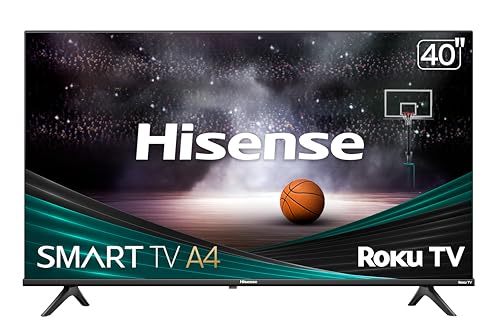
Hisense 40 A4 FHD Roku TV — Second 40-inch route
Hisense’s A4 gives the 40-inch shopper a genuine alternative rather than a copy. It matches the TCL on the fundamentals — full HD LED panel, Roku on board, the same class of inputs — and differs in the tuning choices that only show up when you live with a set: Hisense tends to push colour saturation a touch harder out of the box, its motion processing has its own character, and its remote and menu layout will suit some hands better than TCL’s. Having two honest 40-inch options matters because this size class is thin; in most years only a handful of credible sets occupy it.
For the 37-inch refugee, the A4’s appeal is that nothing about it demands adjustment. The screen is three inches larger than the one it replaces, the platform is the same Roku the TCL offers, and the setup routine — plug in, join Wi-Fi, sign into the apps — is an afternoon’s light work. Sports modes and game modes exist in the menus for those who want them, and the set’s speakers are serviceable for news and daytime viewing, though like every thin television they flatter voices more than music.
Choosing between this and the TCL S3 honestly comes down to which listing is healthier on the day you buy, which remote your household prefers, and small differences in picture taste that no review can settle for you. That is not a dodge; at this size and price class, the two sets are closer to each other than either is to anything else in this guide, and both are respectable heirs to the 37-inch role.
- Size and resolution: 40-inch LED, 1920×1080 full HD
- Platform: Roku TV built in
- Role in this guide: alternative 40-inch successor
- Extras class: sports and game picture modes in menu
Strengths
- Same painless Roku experience as its TCL rival
- Colour-forward factory tuning suits bright daytime rooms
- Keeps the 40-inch class competitive, which helps buyers
Trade-offs
- Also stops at 1080p in a market drifting to 4K
- Built-in sound is thin for films and music
- Panel uniformity varies by unit in this class
Best for: households set on the 40-inch replacement who prefer Hisense’s tuning and remote, or who find this listing in better shape on buying day.
Not suited for: anyone hoping a 40-inch set will double as a crisp desktop monitor, since 1080p text at this size looks soft up close.

Sony 43 Bravia 3 LED 4K TV — The stretch upgrade
Six inches beyond the old diagonal, the Bravia 3 is the pick for the reader whose 37-inch set died in a room that was always slightly too big for it. This is the commonest hidden story behind the search: the cabinet can stretch, the sofa sits eight or nine feet back, and the replacement is a chance to correct a decade of squinting. Sony’s entry-level Bravia brings a proper 4K panel and the company’s picture processing, which earns its reputation most visibly on upscaled broadcast and older content — precisely what a household graduating from a 2009 set will watch for the first months.
The processing point deserves emphasis because it is where cheap 4K sets separate. A 4K panel showing standard-definition or 1080p material must invent three quarters of its pixels, and the quality of that invention decides whether faces look waxy or natural. Sony’s upscaling has been the safe recommendation for years, and the Bravia 3 carries a respectable share of that competence into the affordable end of the range. Google TV on board covers the app catalogue comprehensively and supports the casting habits most households already have.
Do not buy it under a misapprehension: at roughly 38 inches wide overall, this set will not enter a cabinet built tightly around a 37-inch television, no matter how the diagonal arithmetic tempts you. It is the pick for the open wall, the wide stand, the room that can grow. Measure first, then enjoy the fact that the industry killing your size at least left a bigger, sharper, lighter consolation.
- Size and resolution: 43-inch LED, 3840×2160 4K
- Platform: Google TV built in
- Role in this guide: upgrade path when width allows
- Processing: Sony upscaling for broadcast and older sources
Strengths
- Genuine 4K detail plus class-leading upscaling of older content
- Six extra inches transform films and sport at sofa distance
- Google TV covers the widest range of apps and casting
Trade-offs
- Widest set here — hard cabinets rule it out entirely
- Entry Bravia panel lacks the contrast of Sony’s pricier lines
- Overkill for a kitchen or a caravan, in size and in cost class
Best for: living rooms where the old 37-inch always felt small, and where the stand or wall can honestly take a 43-inch width.
Not suited for: fixed entertainment centres with a measured opening under 38 inches — no enthusiasm overrides a tape measure.

TCL 32 S3 1080p Google TV — Hard-limit fallback
When the opening measures what it measures, 32 inches is the size that remains, and the discipline is to lose as little as possible on the way down. The TCL 32 S3’s defining virtue is that it keeps full HD. Many 32-inch sets sold today quietly drop to 720p, and at desktop or kitchen-counter distances the difference is visible in text, in menu sharpness and in the general sense that the picture is slightly out of focus. The S3 refuses that compromise: 1920×1080 on a 32-inch screen is dense enough to look crisp from three feet away.
Google TV is the platform here rather than the Roku of its 40-inch sibling, which brings a recommendation-driven home screen and tight integration with Google accounts and casting. Households deep in the Google ecosystem will prefer it; households replacing a family television should weigh the slightly busier interface. Either way, the app catalogue is complete and the set will stream everything the old 37-inch set needed a separate box to reach.
Physically, this is the pick that fits the caravan, the under-cabinet kitchen slot, the narrow alcove and the small bedroom where a 40-inch set would crowd the wall. It is also dramatically lighter than the set it replaces, which matters on caravan brackets and older wall mounts. What it cannot do is reproduce the presence of the bigger screen for film night in a main room — physics again — but inside a genuine hard limit it is the least-regret purchase in this guide.
- Size and resolution: 32-inch LED, 1920×1080 full HD
- Platform: Google TV built in
- Role in this guide: first choice under a hard width limit
- Note: full HD at this size is rarer than it should be
Strengths
- Keeps 1080p where many 32-inch rivals settle for 720p
- Fits openings and brackets that exclude every larger pick
- Complete Google TV app catalogue and casting
Trade-offs
- Five inches smaller than the set it replaces — film presence shrinks
- Google TV home screen pushes recommendations some users dislike
- Small speakers, best paired with a compact soundbar
Best for: measured openings, caravans, kitchens and bedrooms where 40 inches is physically impossible and 720p would be a daily irritation.
Not suited for: a main living room with any freedom at all, where the 40-inch picks restore the old presence and then some.

Samsung 32 F6000 FHD Smart TV — Brand-name fallback
Some households replacing a long-lived set want the badge they trust on the smaller screen, and Samsung’s F6000 is the 32-inch answer from the industry’s largest maker. It is a full HD set running Samsung’s Tizen platform, which brings a polished interface, the major streaming apps, and Samsung’s TV Plus layer of free ad-supported channels — a genuinely useful extra for a kitchen or spare-room set that mostly shows daytime television.
The F6000’s picture sits at the competent end of the small-set class: clean 1080p, decent colour, and brightness suited to lit rooms rather than blackout cinema. Its appeal for the 37-inch refugee under a hard limit is continuity of a different kind — Samsung remotes, menus and habits carry across the brand’s whole range, so a household with a larger Samsung elsewhere in the house will find this set instantly familiar. In multi-set homes that familiarity is a real feature, not a marketing line.
Against the TCL 32 S3 above, the honest comparison is platform and ecosystem rather than panel: Google TV against Tizen, TCL’s value tuning against Samsung’s polish. Either serves the hard-limit brief. Choose the one whose interface your household already speaks, and spend the difference in budget on a small soundbar, which will improve a 32-inch set’s daily life more than any panel nuance at this size.
- Size and resolution: 32-inch LED, 1920×1080 full HD
- Platform: Samsung Tizen with TV Plus free channels
- Role in this guide: big-brand option under a hard limit
- Ecosystem note: matches larger Samsung sets in the home
Strengths
- Full HD panel from the market’s biggest television brand
- Tizen interface is polished and quick to learn
- Free TV Plus channels suit daytime and kitchen viewing
Trade-offs
- Still a five-inch shrink from the old 37-inch screen
- Tizen app catalogue trails Roku and Google TV at the edges
- Sound needs help for anything beyond speech
Best for: Samsung households adding or replacing a small set under a strict size ceiling, who value a familiar remote and interface.
Not suited for: buyers who need an obscure regional streaming app, where Roku or Google TV catalogues are the safer bet.

Insignia 32 F20 Fire TV — Cheapest way back to picture
Label first, because this guide’s promise is honesty about specifications: the F20 is a 720p television. Its panel resolves 1366×768, not full HD, and we are not going to bury that in the sixth paragraph. It earns its place anyway, because there is a real household in this story — the spare room, the workshop, the guest bedroom, the rental — where the old 37-inch set spent its life showing broadcast news and daytime programmes, and where the cheapest respectable way back to a working screen is the correct recommendation.
At 32 inches, 720p’s softness depends entirely on distance. From across a bedroom it is barely detectable on broadcast material, which is itself often 720p or 1080i in origin. From a desk chair it is obvious in text and menus. The Fire TV platform on board is fully featured, with Alexa voice control through the remote and the complete Amazon app store, so the set’s limitations are purely about panel resolution, not about what it can play.
Think of this pick as the floor of the market, clearly marked. If the room is casual and the budget is the binding constraint, it restores television to the space for the least money in this guide. If the set will be watched closely or used with a computer, step up to either 1080p 32-inch pick above and do not look back — the resolution difference is the one upgrade at this size that every viewer can see.
- Size and resolution: 32-inch LED, 1366×768 — 720p class, stated plainly
- Platform: Fire TV with Alexa voice remote
- Role in this guide: lowest-cost route back to a working screen
- Distance note: acceptable across a room, soft at a desk
Strengths
- Lowest cost class in this guide by a clear margin
- Full Fire TV platform and voice remote included
- Broadcast material, often 720p at source, suits the panel
Trade-offs
- 720p resolution is a genuine step down in sharpness
- Text and menus look soft at close viewing distances
- Least headroom for consoles and streaming detail
Best for: spare rooms, workshops and guest spaces where the screen shows broadcast TV from across the room and budget rules the decision.
Not suited for: desks, kitchens at counter distance, or any viewer who reads text on screen — the 1080p picks exist precisely for you.
What Should You Compare Before Choosing a Replacement Size?
| Pick | True size | Resolution | Platform | Fit story |
|---|---|---|---|---|
| TCL 40 S3 | 40-inch | 1080p | Roku | Near the width of a bezelled 37-inch set |
| Hisense 40 A4 | 40-inch | 1080p | Roku | Same footprint class, different tuning |
| Sony 43 Bravia 3 | 43-inch | 4K | Google TV | Needs a genuinely wider home |
| TCL 32 S3 | 32-inch | 1080p | Google TV | Fits hard openings, keeps full HD |
| Samsung 32 F6000 | 32-inch | 1080p | Tizen | Fits hard openings, Samsung ecosystem |
| Insignia 32 F20 | 32-inch | 720p | Fire TV | Fits hard openings, lowest cost |
Read the fit story column before the resolution column. The defining decision in this guide is physical, not electronic: what will the room accept? Once the size class is settled by the tape measure, the remaining choice is platform and tuning, and those are matters of household habit. A 4K badge on a set that cannot enter the cabinet is worth nothing, and a 720p panel at the right distance in a spare room is worth more than its specification suggests. Let the furniture speak first.
Which Replacement Mistakes Do 37-Inch Owners Keep Making?
The commonest error is ordering by diagonal memory instead of by measured width. Shoppers reason that a 40-inch set must be three inches wider than their 37 and will not fit, so they buy a 32 and live with a screen that rattles around in a cabinet that would have accepted the 40 all along. Modern bezels broke the old arithmetic. Measure the cabinet opening, then compare it with the new set’s published overall width — a figure every listing provides — and let those two numbers decide.
A second mistake is trusting listings that still advertise 37-inch televisions. Scroll far enough through any marketplace and you will find the size claimed by refurbishers, by sellers quoting cabinet width as diagonal, and by old stock with ageing backlights and no meaningful warranty. A fifteen-year-old panel design bought today brings dim output, obsolete inputs and no smart platform. The romance of replacing like with like is understandable; the hardware reality is not on its side.
Third, buyers under a hard limit often grab the first 32-inch set they see and discover at home that it is a 720p panel. At kitchen and desk distances that discovery stings daily. The resolution line is the one specification worth reading twice at this size, and it is why two of our three small picks hold the full HD line. Finally, do not forget the stand: modern sets perch on two feet spaced wide apart rather than a central pedestal, so a narrow shelf that cradled the old set’s single foot may need a universal centre stand, a cheap and easy fix when planned for.
How Do You Swap the New Set Into the Old Set’s Place?
Begin before the new box arrives. Photograph the back of the old installation: which HDMI sockets are occupied, where the aerial or satellite feed lands, how the power runs. Old 37-inch setups often hide a thicket of legacy connections — SCART, component, composite — that modern sets do not accept at all. Anything still in daily use on those connections, typically an elderly DVD player or a retro console, needs an inexpensive converter planned in advance, or a graceful retirement.
When the new set goes in, connect the streaming and broadcast sources first and run the platform setup while the picture is easy to reach. Set the picture mode to its most accurate preset — usually called Movie, Cinema or Filmmaker — and disable the motion smoothing for film content; the soap-opera sheen is the single most common reason a new set looks wrong to eyes trained on an older one. If the old set fed a soundbar or amplifier by optical cable, modern sets still provide that output, and the swap is a two-minute job.
One more practical note belongs here, about stands. The old set almost certainly stood on a central pedestal, which meant any flat surface wider than a dinner plate could host it. The replacements stand on two feet near their edges, so the supporting surface must span nearly the screen’s full width, and a treasured narrow sideboard may fail the new set even when a cabinet opening would have passed it. Universal centre stands that bolt to the VESA holes exist for exactly this problem and cost little; deciding you need one before delivery day is the difference between an evening’s setup and a week’s improvisation with books and boards.
Finish with the unglamorous checks. Update the firmware while the set is new to the house, because platform updates often arrive in the first weeks. Confirm the feet or mount are fully tightened — modern sets are light enough that a half-seated foot goes unnoticed until a door slams. And keep the old set’s remote for a week; if a beloved recording device or box was paired to it, you will want it during the transition.
How Far Do You Sit? The Distance Arithmetic Behind the Replacement
Size choices feel emotional in the shop and mathematical at home, so it is worth doing the small piece of geometry that governs them. A screen fills a portion of your field of view, and comfort depends on that portion. For mixed viewing — news, sport, drama, the odd film — a screen that spans roughly thirty degrees of your vision feels present without demanding head movement. A 37-inch 16:9 screen reaches that span at about six feet of viewing distance. That is why the size thrived in modest living rooms and large bedrooms: six feet is where a great many sofas and beds actually sit.
Run the same arithmetic for the replacements and the shortlist explains itself. A 40-inch screen hits the same thirty degrees at roughly six and a half feet — a difference of a cushion’s depth, which is why the step up feels like continuity rather than change. A 43-inch screen wants about seven feet, and in rooms where the sofa cannot retreat, that extra width starts to dominate the wall and the picture’s edges leave your comfortable glance. A 32-inch screen, by contrast, reaches the same span at five feet; pushed back to a seven-foot sofa it shrinks to the low twenties of degrees, and faces in drama become small enough that subtitles do real work. None of this is law — gamers sit closer, film lovers sit closer, casual viewers sit where the furniture is — but it converts the vague feeling that a size is wrong into a measurement you can pace out with your own feet before ordering.
Resolution interacts with distance in a way that rescues the smaller picks. The closer a viewer sits, the more pixel structure matters; the farther away, the more it vanishes. A 1080p 32-inch set at five feet shows no visible pixel grid to most eyes, which is why the hard-limit fallbacks in this guide perform above their size on paper. Conversely, a 720p panel betrays itself exactly where small sets are watched — at kitchen-counter and desk distances — which is why this guide insists on the resolution line at 32 inches and relaxes about it nowhere else.
What About the Second-Hand Market for a Genuine 37?
Some readers will ask the stubborn question: if the size was so good, why not simply buy another one used? The honest answer is that you can, and that it is usually a poor bargain wearing a sentimental disguise. A 37-inch set for sale today is at minimum a decade old. Its backlight — fluorescent tubes in the early examples, early LEDs later — has dimmed measurably from its factory output, and LCD panels of that vintage yellow gently with age. Its HDMI ports may predate the copy-protection versions current streaming sticks expect, producing the black-screen handshake failures that drive owners to forums at midnight. Its tuner may not decode current broadcast standards in your region. And it carries no warranty whatsoever, so the purchase price buys an unknown remainder of life.
There are narrow exceptions. A late-model 37-inch set from a strong brand, demonstrably little used — a guest-room set, a caravan set — can serve as a stopgap for very little money, and for a workshop or a children’s den the risk calculus is genuinely different. If you go this route, inspect the panel lit, in a darkened room, looking for the blotchy backlight bleed and stuck bright pixels that photographs hide; test every HDMI port with a modern stick before money changes hands; and price the set as though it might last a year, because it might. But for the main screen of a household, the arithmetic favours the new 40-inch picks: they cost less than the 37-inch flagships did in their day, weigh half as much, and arrive with a warranty and a decade of panel progress inside them.
The deeper point is that the used market cannot repeal the factory decision. Every year the surviving population of 37-inch sets shrinks and ages, while the neighbouring sizes grow cheaper and better. Sentiment is a fine reason to keep a working set running. It is a poor reason to buy somebody else’s ageing one.
Remembering the Heyday: What a Good 37-Inch Set Was Like
It helps to remember what is actually being mourned, because the 37-inch era coincided with a sweet spot in television design that the industry has since abandoned for reasons of fashion. Sets of that period were thick enough to house real speakers firing forwards at the viewer, and a good 37-inch model produced dialogue you could follow at low volume without reaching for subtitles. They carried every input a household owned — multiple HDMI ports, component and composite for older machines, SCART in European models, a PC input with its own audio jack — because the industry had not yet begun deleting connections to save pennies. Their remotes were long, labelled and backlit at the better end of the market.
The flagship 37-inch sets of 2008 to 2011 also arrived just as 1080p panels became affordable at that size, so their owners experienced the full jump from standard definition to high definition on one screen. That memory — the first Blu-ray, the first HD football match — attaches itself to the diagonal, which is why the search for this size carries more feeling than the search for, say, a 26-inch replacement. The size did nothing wrong. It simply sat on the wrong tile of the glass sheet.
Understanding the mourning matters for the replacement decision, because two of the losses are real and should be planned for rather than discovered. Sound is the first: every modern pick in this guide, like every thin modern set, fires its small speakers downwards or backwards and sounds thinner than a chunky 2009 set did. Budget for a compact soundbar and the replacement will beat the old set at its own strength. Inputs are the second: legacy machines need converters, as the setup section above explains. Plan for both, and the new set wins on picture, weight, features and reliability while conceding nothing that cannot be bought back cheaply.
Why Do Modern Sets Sound Worse, and What Fixes It?
The physics is unforgiving. A speaker needs a cabinet with some volume and a driver with some diameter, and a television three centimetres thick offers neither. Manufacturers respond with acoustic tricks — downward drivers bouncing sound off the stand surface, rear drivers using the wall as a reflector, elaborate processing — and the results are adequate for speech in a quiet room and little more. The 37-inch sets of the old era, four inches deep with forward-firing drivers flanking the screen, simply had more to work with, and many a buyer has plugged in a gleaming new replacement and felt an unnameable disappointment that was, on inspection, entirely about the audio.
The fix is mature and inexpensive as these things go. A compact soundbar restores forward-firing drivers and a real cabinet, connects through the television’s HDMI ARC socket or optical output — both present on the picks in this guide — and thereafter obeys the television remote for volume, so the household learns nothing new. In a hard-limit 32-inch installation the bar may need to sit in front of the set or on the shelf below; measure its height against the screen’s lower edge so it does not cover the picture or the remote sensor. Treat the soundbar not as an accessory but as the second half of the replacement purchase, and the new installation will surpass the old one in every dimension a viewer or listener can name.
What Else Changes When a 2009 Set Leaves the Room?
Power draw is the quiet dividend. A fluorescent-backlit 37-inch LCD of the late 2000s commonly drew 150 to 200 watts in use — it was, measurably, a small heater that also showed pictures, and owners of sets in caravans or on boats watched their battery budgets accordingly. A modern 40-inch LED set typically draws a third of that or less, and the 32-inch picks less still. Over a year of evening viewing the difference is not life-changing money, but in off-grid and leisure-vehicle settings it can be the difference between an evening’s television and an anxious eye on the battery monitor.
Heat follows power, and heat mattered to the old sets’ longevity: many a 37-inch television died of cooked capacitors in its power supply after a decade of thermal cycling, which is the unglamorous true cause behind a large share of the replacements this guide serves. The cooler-running modern sets are not immortal, but their failure modes have shifted toward software and panels rather than power supplies, and their standby consumption — once a genuine scandal of the old era — has fallen to fractions of a watt under current regulations.
There is also a small ergonomic upgrade hiding in the swap. Modern sets wake in seconds rather than the old backlight’s slow bloom, their electronic programme guides load instantly instead of grinding through a carousel, and their menus respond to the remote without the half-second lag that trained a generation to press buttons twice and then undo the double command. None of this appears on a specification sheet, and all of it is felt within the first evening.
The feature gap, finally, runs entirely one way. The old set needed a separate box for every new service; the replacements carry streaming platforms, voice remotes, screen casting from phones, and programme guides that blend broadcast and on-demand in one list. A household that last bought a television in 2009 is not merely replacing a screen — it is skipping three generations of convenience in a single afternoon, which is some consolation for the three inches of glass the factory took away.
Final Recommendation
The 37-inch television is not coming back, and mourning it will not refill the cabinet. For most households the answer is the TCL 40 S3 or its Hisense A4 rival: a 40-inch set that is, in the only measurement that matters, barely wider than the framed old screen it replaces, with a platform simple enough to end the conversation about how the new TV works. Rooms with width to spare should take the Sony Bravia 3 and enjoy the upgrade the situation is quietly offering. Rooms with none should choose between the two full HD 32-inch sets by ecosystem, and reserve the 720p Insignia for spaces where viewing is casual and distance forgives. The size died of factory arithmetic, but its job — the friendly, mid-sized screen — is still being done, three inches up or five inches down.
Frequently Asked Questions
Can I still buy a new 37-inch TV anywhere?
No major manufacturer lists a 37-inch model in its current range, and panel production for the size ended years ago. Listings using the number today are refurbished units, old stock, or sellers quoting the set’s width as though it were the diagonal. A new 40-inch set is the practical like-for-like purchase.
Why did manufacturers stop making 37-inch TVs?
Panel factories cut finished screens from fixed sizes of mother glass, and 37 inches tiles those sheets inefficiently compared with 32, 40 and 43 inches. As the efficient sizes fell in price, the 37 lost its price gap, then its sales volume, then its panel supply. The size was an economic casualty, not a verdict on its viewing qualities.
Will a 40-inch TV fit in my 37-inch entertainment centre?
Often, yes. Old 37-inch sets had wide bezels and overall widths around 36 to 37 inches; a modern 40-inch set is roughly 35.5 inches wide. Compare your opening’s measured width against the new set’s published overall width, and check the height too, remembering that old sets carried a speaker bar modern ones lack.
Is a 32-inch replacement going to feel like a big downgrade?
In a main room at distance, the loss of five inches is noticeable on film. In kitchens, caravans, bedrooms and alcoves — the places with hard limits — a good 1080p 32-inch set looks sharp and complete. Choose full HD rather than 720p and the downgrade shrinks to size alone.
Did any other screen category keep the 37-inch size alive?
Briefly, in monitors and in commercial signage, odd diagonals lingered longer because those panels were cut for different customers, but the consumer television class is the one that matters to this search, and it closed completely. Public-display panels occasionally surface in surplus channels; they lack tuners, smart platforms and often speakers, and they are built for brightness and duty cycles rather than living-room picture quality. A television-shaped hole in a home needs a television, and the televisions now come in the neighbouring sizes this guide covers.
What should I do with the old 37-inch set if it still works?
Working sets make excellent secondary screens for a spare room or workshop, fed by an inexpensive streaming stick through HDMI. If it has failed, use an electronics recycling route rather than general waste; the backlight and panel materials are handled properly there, and many retailers collect the old set when delivering the new one.
Related Guides
If the replacement conversation has widened beyond one dead size, our companion guides cover the neighbouring questions: the near-extinct 39-inch class and its 40-inch heirs, the full 40 to 43-inch LED range compared tier by tier, and choosing a 4K television to double as a computer monitor.


