What's inside
As an Amazon Associate I earn from qualifying purchases. This post may contain affiliate links at no extra cost to you.
gizmoverdict.com is reader-supported. When you buy through links on our site, we may earn an affiliate commission.
Where to Buy These Cameras
Every camera below is sold through Amazon, and the linked listings carry a check-price button rather than a printed figure, because street prices around this tier drift with seasonal promotions, bundle changes and refurbished stock rotations. Treat the thousand-dollar mark as a ceiling for a working kit rather than a target for a bare body: a camera you cannot afford a lens, a card and a spare battery for is not actually within budget, however attractive its specification sheet looks in isolation. Where a pick ships as a body only, that fact is stated plainly in its review so the real cost of getting started stays visible.
Searching for the best 1000.00 cameras quickly turns into a lesson in how manufacturers slice a market. At this level you can buy a genuinely capable APS-C mirrorless kit, a full-frame body paired with a slow but versatile zoom, or a DSLR whose design predates mirrorless entirely yet still exposes a clean photograph. The six cameras gathered here were chosen because each one spends the same rough pile of money on a different priority: video polish, stills resolution, lens reach, simplicity, optical viewing, or sensor size.
That spread matters because the wrong allocation hurts more than a modest specification. A vlogger gains nothing from a high-resolution sensor behind a fixed screen, while a landscape shooter gains little from face-tracking autofocus tuned for presenters. Read the reviews with your dominant subject in mind, note which picks include a lens and which leave that purchase to you, and pay attention to the trade-off lists: at this tier every camera gives something up, and the honest question is whether what it surrenders is something you personally will ever miss.
Key Takeaways
- A kit lens is not a compromise to apologise for at this level; the 18-45mm zooms bundled with the Canon entries cover the focal lengths most beginners actually use during their first year.
- The Sony a6700 is the strongest video body in this group, but it is sold without glass, so its true starting cost sits above the sticker once a first lens joins the bag.
- Full frame is reachable here through the Canon EOS RP kit, although its video mode and burst speed reveal why it costs less than newer full-frame bodies.
- The Rebel T7 proves a DSLR can still make sense when an optical viewfinder, long battery life and a deep second-hand lens market matter more than video features.
- Bundles deserve scepticism: the R7 package reviewed below mixes two genuine Canon zooms with a long manual telephoto that suits patient wildlife work rather than everyday shooting.
- Memory cards, a second battery and a bag are part of the real purchase; leaving room for them beats stretching to a body you then feed with the slowest card on the shelf.
Quick Picks: Best 1000.00 Cameras
| Camera | Badge | Why it earns its place |
|---|---|---|
| Canon EOS R50 with RF-S 18-45mm Lens | Best all-round starter kit | A friendly APS-C kit whose oversampled 4K video, reliable subject detection and fully articulating screen suit first-time creators. |
| Canon EOS R7 Bundle with RF-S 18-45mm, 55-210mm and 420-800mm Lenses | Most capable stills body here | A 32.5MP enthusiast body with in-body stabilisation and two real Canon zooms, plus a long manual telephoto that rewards patience. |
| Sony Alpha a6700 Body Only | Strongest video specification | A body-only hybrid with 4K120 recording, AI-driven subject recognition and colour tools that outclass everything else listed. |
| Canon EOS R100 with RF-S 18-45mm Lens Kit | Budget room to spare | Canon’s simplest RF body leaves meaningful money unspent for a second lens, a tripod or a lighting starter kit. |
| Canon EOS Rebel T7 with EF-S 18-55mm Lens | The optical-viewfinder option | A traditional DSLR whose battery endurance, through-the-lens viewing and vast used lens market still argue for it. |
| Canon EOS RP with RF 24-105mm Lens Kit | Full frame at the tier | The only full-frame kit in the group, trading speed and video range for sensor size, shallow depth and low-light latitude. |
How We Chose These Picks
Selection started from a simple rule: each camera had to be purchasable as a functioning system at or near the tier, either because a lens is in the box or because common first lenses for its mount are plentiful and affordable. Models that only make sense after expensive glass were set aside. Sensor size alone earned nobody a place; the EOS RP is full frame yet ranks behind crop bodies for video, while the R7’s smaller sensor carries features the RP cannot match. What counted was the balance a buyer actually lives with daily.
Autofocus behaviour, screen articulation, viewfinder quality and video ceilings were weighed next, because those are the traits owners feel within the first week. Resolution figures were treated as secondary: the gap between 24 and 32 megapixels shows up in heavy cropping and very large prints, not in ordinary sharing. Finally, each system was judged on its upgrade path. A camera whose mount offers a sensible second lens at a sane cost will serve longer than a marginally better body stranded on a mount with thin, expensive options and little second-hand supply.

Canon EOS R50 with RF-S 18-45mm Lens — Best all-round starter kit
The R50 occupies the friendliest corner of Canon’s RF lineup: small enough to carry without planning the outing around it, yet built around the same Dual Pixel autofocus family that made Canon’s mirrorless cameras popular with video makers. Its 24.2-megapixel APS-C sensor records 4K video oversampled from a 6K readout at up to 30 frames per second, which produces visibly cleaner detail than the cropped, line-skipped 4K found on cheaper bodies in this roundup. For stills, electronic shutter bursts and a deep buffer are absent, but the mechanical shooting speed remains adequate for family sport and travel sequences.
Handling explains much of its appeal. The vari-angle touchscreen flips forward for self-recording, the menu system offers a guided mode that explains settings in plain language, and the body pairs with a phone over Wi-Fi and Bluetooth for quick transfers. Creators shooting talking-head footage will appreciate the movie self-timer and the product showcase autofocus behaviour inherited from Canon’s vlogging line. What the R50 withholds is equally clear: no in-body stabilisation, a modest electronic viewfinder, a single card slot and a micro-HDMI port rather than a full-size connector. None of those omissions blocks a beginner, but a shooter already planning gimbal-free walking footage or paid client work will outgrow them sooner than the sensor itself.
The bundled RF-S 18-45mm zoom deserves honest framing. It is light, retracts for storage and covers wide establishing shots through short portrait distances, yet its variable aperture dims quickly as you zoom, pushing ISO upward indoors. Treat it as a capable daylight and travel lens, and budget later for a fast prime if low-light portraits become your thing. Within this group, the R50 is the pick that asks the fewest questions of a newcomer while still leaving a credible path into Canon’s growing RF-S and full-frame RF lens catalogue.
Owners stepping up from a phone tend to notice the R50’s colour first: Canon’s default rendering flatters skin and keeps greens believable without editing, which suits the family and travel work this camera will mostly do. The guided shooting modes deserve a mention too, because they explain aperture and shutter choices on screen instead of burying them in a manual, shortening the path from automatic snapshots to deliberate photographs. Pair it later with Canon’s compact RF 50mm f/1.8 and the same body suddenly handles candlelit dinners and portraits with a blurred backdrop that the kit zoom cannot approach, which is exactly the growth pattern a first system should offer.
One more R50 habit worth building early: shoot raw plus JPEG for the first months. The JPEGs give you Canon’s pleasing colour immediately, while the raw files wait in the archive for the day your editing skills catch up with your ambitions, rescuing early favourites you would otherwise outgrow and abandon.
One more R50 habit worth building early: shoot raw plus JPEG for the first months. The JPEGs give you Canon’s pleasing colour immediately, while the raw files wait in the archive for the day your editing skills catch up with your ambitions, rescuing early favourites you would otherwise outgrow and abandon.
- Sensor: 24.2MP APS-C CMOS
- Lens included: RF-S 18-45mm f/4.5-6.3 IS STM
- Video: 4K30 oversampled, Full HD to 120p
- Screen: vari-angle touchscreen
- Mount: Canon RF
Strengths
- Subject-detect autofocus that reliably finds faces, animals and vehicles without menu diving
- Oversampled 4K footage looks cleaner than rivals using cropped or line-skipped readouts
- Compact body and retractable kit zoom make a genuinely portable everyday package
Trade-offs
- No in-body image stabilisation, so handheld video leans on lens stabilisation or support
- Single SD slot and a small battery reward carrying spares on long shooting days
- Kit zoom’s slow maximum aperture limits indoor work without raising sensitivity
Best for: first-time mirrorless buyers who split time between family stills, travel and seated video.
Not suited for: shooters needing weather sealing, dual slots or stabilised handheld footage for paid assignments.
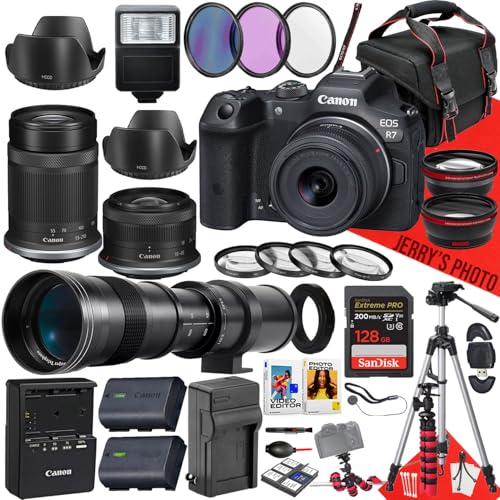
Canon EOS R7 Bundle with RF-S 18-45mm, 55-210mm and 420-800mm Lenses — Most capable stills body here
Strip away the bundle and the R7 is simply the most serious camera in this article. Its 32.5-megapixel APS-C sensor is the highest-resolution chip here, in-body stabilisation works with any lens mounted, dual SD slots allow backup recording, and the autofocus system tracks birds, animals and racing vehicles with settings borrowed from Canon’s professional line. Video reaches 4K60 from an oversampled readout, and the mechanical shutter fires at speeds that make it a legitimate sports camera rather than a stills body that happens to record movies.
The bundle composition needs a clear head. The RF-S 18-45mm covers everyday wide work and the RF-S 55-210mm adds genuine telephoto reach for school sport, zoo visits and compressed landscapes; those two Canon zooms form a coherent two-lens kit. The third optic, a 420-800mm f/8.3 manual-focus telephoto, belongs to a different category of tool. It is slow, entirely manual and optically modest, best treated as an inexpensive way to experiment with extreme reach on a tripod — moon photographs, distant perched birds — rather than as a reason to buy the package. Judged as body plus two zooms with a novelty lens included, the value story is coherent; judged as three equivalent lenses, it is not.
Ergonomics split opinion. The combined shutter-speed and quick-control dial arrangement differs from other Canon bodies, and the viewfinder, while sharp, sits in a body that feels dense rather than svelte. Weather sealing and a proper joystick, though, mark this as a camera bought to be used hard for years. If your thousand goes toward stills first — wildlife, sport, detailed landscapes — and video is a strong secondary need rather than the main event, the R7 bundle is the deepest capability available at this tier, provided you value the body and Canon zooms above the bonus telephoto.
Wildlife shooters should understand what the crop factor gives them here: the 55-210mm zoom frames like a much longer lens on full frame, and the sensor’s pixel density lets you crop further while keeping printable detail. The animal eye detection holds onto birds in branches better than older Canon bodies, though busy backgrounds still fool it often enough that burst discipline matters. For travel, leave the long manual lens at home and the remaining two-zoom kit covers nearly everything a holiday produces, from church interiors to distant harbour details, without turning the bag into a burden.
For R7 owners, the electronic shutter’s silent operation changes behaviour at events and in hides, but keep the mechanical option for venues lit by flickering LEDs, where banding can stripe frames. Learning which shutter suits which room is part of owning a body at this level, and the camera rewards owners who read its deeper menus rather than leaving every setting at the defaults chosen in the factory.
For R7 owners, the electronic shutter’s silent operation changes behaviour at events and in hides, but keep the mechanical option for venues lit by flickering LEDs, where banding can stripe frames. Learning which shutter suits which room is part of owning a body at this level, and the camera rewards owners who read its deeper menus rather than leaving every setting at the defaults chosen in the factory.
- Sensor: 32.5MP APS-C CMOS
- Stabilisation: in-body, up to eight stops with compatible lenses
- Video: 4K60 oversampled, 4K30 from 7K readout
- Storage: dual SD UHS-II slots
- Bundle lenses: 18-45mm, 55-210mm, 420-800mm manual
Strengths
- Highest resolution and fastest burst shooting of any camera in this comparison
- In-body stabilisation benefits every lens, including adapted and manual optics
- Dual slots, weather sealing and a deep autofocus menu suit serious hobbyist use
Trade-offs
- Third bundle lens is manual-focus and slow, useful only for deliberate tripod work
- Body is the heaviest crop option here once the telephoto zoom is attached
- Rolling shutter in electronic mode can skew fast panning subjects
Best for: enthusiast stills shooters chasing wildlife, sport and detailed scenery on a crop sensor.
Not suited for: buyers wanting the lightest travel kit or anyone expecting the long bundle lens to autofocus.

Sony Alpha a6700 Body Only — Strongest video specification
The a6700 is the one camera here sold the way professionals often prefer: as a body, on the assumption that the buyer already owns E-mount lenses or wants to choose the first one deliberately. Its 26-megapixel back-illuminated sensor pairs with a dedicated AI processing unit, and the combination shows in autofocus that identifies people by pose, plus birds, animals, cars, trains and aircraft, holding focus through partial occlusion in a way that feels a generation ahead of the Canon R100 and Rebel T7 also listed. For a buyer stepping up from a phone, the first week with this camera tends to produce an unusually high keeper rate.
Video is where the gap widens into a different league. The a6700 records 4K at up to 120 frames per second for smooth slow motion, captures 10-bit 4:2:2 colour internally, supports S-Log3 with user LUT monitoring, and adds focus breathing compensation with compatible lenses. Five-axis in-body stabilisation steadies handheld clips, and the vari-angle screen, front control dial and improved menu system fix most handling complaints aimed at its predecessor. Heat management is better than earlier Sony compacts, though long 4K120 sessions in warm rooms still demand realistic expectations from a body this small.
The body-only catch must stay front and centre: nothing in the box takes a picture until a lens is added, and a decent E-mount zoom or fast prime will carry the real starting total beyond the tier this article is framed around. That is not a flaw in the camera; it is a budgeting fact. Choose the a6700 if you already shoot Sony, if a specific E-mount lens is the true object of desire, or if video quality leads every other consideration and you accept that the lens purchase follows immediately. As a pure imaging machine it leads this field; as a complete thousand-dollar system it is deliberately incomplete.
Heat and handling deserve a final word for the Sony. Long 4K recording sessions in summer rooms will eventually meet thermal limits, so wedding videographers should plan clip lengths and consider the camera’s accessory fan ecosystem rather than discovering the ceiling mid-ceremony. The grip, though small, is deeper than earlier a6000-series bodies, and the front dial finally gives stills shooters the two-dial control they expect. Custom buttons and three memory positions on the mode dial let a hybrid shooter build genuinely separate stills and video personalities into one compact body.
Sony’s colour science has matured to the point where the old complaint about skin tones rarely survives contact with the a6700’s newer picture profiles. Straight-from-camera footage in the standard creative look is publishable for most creators, and the log modes are there for those who grade, rather than being a tax every user must pay before footage looks acceptable to share with an audience.
Sony’s colour science has matured to the point where the old complaint about skin tones rarely survives contact with the a6700’s newer picture profiles. Straight-from-camera footage in the standard creative look is publishable for most creators, and the log modes are there for those who grade, rather than being a tax every user must pay before footage looks acceptable to share with an audience.
- Sensor: 26MP APS-C BSI CMOS
- Lens included: none, body only
- Video: 4K120, 10-bit 4:2:2 internal recording
- Stabilisation: five-axis in-body
- Mount: Sony E
Strengths
- AI subject recognition covers people, animals, birds and vehicles with unusual tenacity
- 4K120 and 10-bit colour give video headroom no other pick in this list approaches
- Huge E-mount lens catalogue spans budget primes through professional zooms
Trade-offs
- Body-only pricing hides the mandatory first-lens cost from casual comparison
- Single card slot despite the otherwise professional video feature set
- Small viewfinder magnification feels cramped beside the Canon R7
Best for: video-led creators and existing Sony owners who already have, or have chosen, E-mount glass.
Not suited for: anyone needing a complete camera-and-lens outfit inside the tier on day one.

Canon EOS R100 with RF-S 18-45mm Lens Kit — Budget room to spare
The R100 exists for buyers who would rather distribute money across a system than concentrate it in a body. It is Canon’s lightest and simplest RF-mount camera, built around a 24.1-megapixel sensor that has proven itself across several Canon generations, and it arrives with the same retractable 18-45mm kit zoom as the R50. Stills quality in good light is genuinely close to its pricier sibling; the savings were taken from the surrounding machinery instead. The rear screen does not tilt or flip, the 4K mode applies a heavy crop and caps at 24 frames per second with contrast-detection focus, and continuous shooting speeds are modest.
Those cuts define who should buy it. A parent photographing birthdays, a student learning exposure on a real interchangeable-lens camera, or a small business shooting products on a tripod will rarely bump into the R100’s ceilings. The guided interface helps absolute beginners, the body slips into a small bag, and the money left over can fund the RF-S 55-210mm telephoto or a fast 50mm-equivalent prime that transforms low-light results far more than a body upgrade would. Video, though, should be treated as a Full HD camera with a 4K footnote; vloggers who record themselves will miss the flip screen immediately and should step up to the R50.
Longevity is the honest question. The R100 uses Canon’s RF mount, so every lens bought for it carries forward to better bodies, which protects the investment. Its own feature ceiling, however, arrives quickly for anyone whose interest deepens: no touchscreen focus dragging on a tilting display, no headphone or microphone sophistication beyond a basic mic input, and autofocus that hunts more in dim rooms. Buy it as a deliberate first step with glass in mind and it is one of the smartest allocations here. Buy it expecting R50 behaviour at a discount and disappointment follows within a month.
A practical strength rarely mentioned is how the R100 behaves as a second camera. Owners of larger Canon bodies buy it as a lightweight companion for hikes and family days, mounting the same lenses and getting familiar colour in a body that costs little to risk. Its simple control set also makes it a forgiving hand-me-down when a teenager develops an interest, extending the value well past the first owner’s learning phase. The absence of weather sealing is the boundary to respect: drizzle on a tripod for product shots is fine, a soaked football sideline is not what this body was built to survive.
The R100 also deserves credit as a webcam-era utility body: perched on a desk tripod with the kit zoom at its wide end, it delivers a clean feed for calls and recorded lessons that embarrasses any laptop camera, and its simplicity means family members can operate it without a briefing. Cameras earn their keep in these unglamorous roles far more often than on once-a-year trips.
The R100 also deserves credit as a webcam-era utility body: perched on a desk tripod with the kit zoom at its wide end, it delivers a clean feed for calls and recorded lessons that embarrasses any laptop camera, and its simplicity means family members can operate it without a briefing. Cameras earn their keep in these unglamorous roles far more often than on once-a-year trips.
- Sensor: 24.1MP APS-C CMOS
- Lens included: RF-S 18-45mm f/4.5-6.3 IS STM
- Video: 4K24 cropped, Full HD 60p
- Screen: fixed, non-touch rear display
- Mount: Canon RF
Strengths
- Lowest entry cost into the RF system while keeping a proven 24MP sensor
- Featherweight body encourages carrying it where bigger kits stay home
- Savings can fund a second lens that improves results more than a pricier body
Trade-offs
- Fixed screen rules out comfortable self-filming and awkward low angles
- Cropped 4K with contrast-only focus makes video the weakest here alongside the DSLR
- No touchscreen, which slows focus-point placement for newcomers used to phones
Best for: beginners and product photographers who value a lens budget over body features.
Not suited for: vloggers, hybrid shooters or anyone who already knows they need a tilting screen.

Canon EOS Rebel T7 with EF-S 18-55mm Lens — The optical-viewfinder option
Including a DSLR in a mirrorless-era roundup requires justification, and the Rebel T7 offers three concrete ones. First, its optical viewfinder shows the scene directly through the lens with no lag, no blackout drama and no power draw, which some photographers still prefer for outdoor work. Second, battery life measured in hundreds of frames per charge through the finder dwarfs what any mirrorless body here manages with screens and electronic finders running. Third, the EF-S mount opens the door to an enormous second-hand market: decades of Canon and third-party EF lenses circulate at prices the young RF system cannot yet match.
The compromises are equally concrete. Video stops at Full HD, recorded through contrast-detection autofocus that visibly pulses while hunting, so the T7 is a stills camera that can document an event on video rather than a hybrid tool. Its nine-point autofocus array clusters points near the centre, live-view shooting is slow, the rear screen is fixed, and burst shooting tops out around three frames per second. None of this prevents a good photograph — the 24.1-megapixel sensor is capable and the metering is dependable — but action sequences and video projects will expose the age of the design quickly.
Who, then, is it for? A photography student whose course expects a DSLR, a deliberate stills-only shooter who values the finder and the used-lens economy, or a buyer whose entire budget must also stretch to a tripod and lighting for studio-style work at home. In those hands the T7’s maturity is a feature: every quirk is documented, every accessory exists, and tuition materials assume exactly this class of camera. Everyone else, particularly anyone planning to publish video, will extract more from the mirrorless picks surrounding it in this list.
Teachers of photography keep recommending this class of DSLR for a reason that has nothing to do with nostalgia: the T7 forces an understanding of the exposure triangle because its automation is basic enough to show its working. Students see shutter and aperture choices reflected immediately through the finder, and the vast library of EF-mount tutorials assumes exactly this hardware. Battery behaviour also suits coursework, since a single charge survives a week of classes where mirrorless classmates hunt for sockets between sessions. As a learning instrument that also takes genuinely good photographs, it remains oddly hard to beat at its price point.
Second-hand buyers will find the T7 ecosystem unusually forgiving: spare batteries, chargers, grips and even replacement screens circulate cheaply because the Rebel line sold in enormous numbers for years. A camera that can be maintained for the price of a pizza night has a real claim on a student’s budget, whatever the mirrorless specification sheets say about its age and limitations.
Second-hand buyers will find the T7 ecosystem unusually forgiving: spare batteries, chargers, grips and even replacement screens circulate cheaply because the Rebel line sold in enormous numbers for years. A camera that can be maintained for the price of a pizza night has a real claim on a student’s budget, whatever the mirrorless specification sheets say about its age and limitations.
- Sensor: 24.1MP APS-C CMOS
- Lens included: EF-S 18-55mm f/3.5-5.6 IS II
- Video: Full HD 30p maximum
- Viewfinder: optical pentamirror, 95 percent coverage
- Mount: Canon EF-S
Strengths
- Optical viewing with no lag and outstanding battery endurance per charge
- Access to a deep, inexpensive second-hand EF and EF-S lens market
- Simple, well-documented controls make it a natural teaching camera
Trade-offs
- Full HD video ceiling with slow contrast-detection focus while recording
- Nine autofocus points clustered centrally limit off-centre subject tracking
- Fixed screen and slow live view feel dated beside every mirrorless rival here
Best for: stills-first learners and studio-on-a-budget buyers who prize the optical finder.
Not suited for: hybrid creators, sports shooters needing fast bursts, or video-led workflows.

Canon EOS RP with RF 24-105mm Lens Kit — Full frame at the tier
The EOS RP answers a specific longing: full-frame rendering — shallower depth of field at a given framing, gentler high-ISO noise, a wider dynamic range in single exposures — without leaving the tier. Its 26.2-megapixel sensor sits in the smallest full-frame body Canon has made for the RF mount, and the bundled RF 24-105mm f/4-7.1 IS STM zoom covers wide interiors through genuine portrait and short telephoto distances in one light package. For stills photographers shooting portraits, travel scenes and available-light interiors, that combination delivers a look the crop cameras here approximate only with faster, costlier lenses.
The age of the design shows in motion work. Video is limited to 4K24 with a substantial crop and no Dual Pixel autofocus in that mode, or Full HD with proper autofocus; either way, this is not a hybrid shooter’s tool. Burst shooting is leisurely, the buffer shallow, battery capacity small enough that a wedding day demands several spares, and the sensor’s dynamic range at base ISO trails newer rivals when shadows are lifted aggressively. Canon has also kept firmware-era quirks such as a modest electronic viewfinder. Still photographers who expose carefully will rarely care; event shooters firing long sequences will care constantly.
Positioned honestly, the RP kit is a doorway rather than a destination. It puts a buyer inside the full-frame RF ecosystem with a versatile zoom, and every subsequent lens purchase compounds the sensor’s advantage. It also pairs beautifully with Canon’s inexpensive fast primes for low-light portraiture. Choose it when the photograph matters more than the frame rate, when your subjects hold still or move predictably, and when the full-frame look is the thing you have been renting or borrowing cameras to obtain. Choose the R7 instead when the subject runs, flies or scores goals.
Portrait photographers working on a budget should note how the RP pairs with Canon’s inexpensive RF primes: the 50mm f/1.8 turns it into a low-light portrait outfit whose rendering embarrasses far costlier crop setups, and the eye autofocus, while an early implementation, is accurate at the gentle pace portrait sessions move. The small body balances well on a gimbal for the occasional video B-roll, even if it will never be a video-first tool. Treat it as a stills camera with emergency video, feed it good glass over time, and the files reward that patience with a depth and smoothness the crop bodies chase but never quite reach.
Finally, the RP rewards a slower photographic temperament in ways spec tables undervalue: composing through its finder at dusk, watching depth fall away behind a subject lit by a window, is the experience full-frame devotees describe when they explain why they never went back. If that description sounds like marketing to you, buy the R7; if it sounds like your evenings, the RP is your camera in this list.
Finally, the RP rewards a slower photographic temperament in ways spec tables undervalue: composing through its finder at dusk, watching depth fall away behind a subject lit by a window, is the experience full-frame devotees describe when they explain why they never went back. If that description sounds like marketing to you, buy the R7; if it sounds like your evenings, the RP is your camera in this list.
- Sensor: 26.2MP full-frame CMOS
- Lens included: RF 24-105mm f/4-7.1 IS STM
- Video: 4K24 cropped, Full HD 60p
- Body: compact RF-mount, dust and drip resistant
- Mount: Canon RF
Strengths
- Full-frame depth and low-light character unavailable from the crop bodies here
- Bundled 24-105mm range covers most travel and portrait needs in one lens
- Small, light body makes full frame feel no bulkier than crop kits
Trade-offs
- 4K video is cropped and loses Dual Pixel autofocus, limiting hybrid use
- Slow bursts and a shallow buffer frustrate action and event coverage
- Small battery means multi-battery planning for any full day out
Best for: portrait, travel and low-light stills photographers wanting full-frame rendering first.
Not suited for: sports shooters, videographers, or anyone needing long bursts and dual slots.
Comparison Table
| Camera | Defining traits |
|---|---|
| EOS R50 kit | 24.2MP APS-C, RF-S 18-45mm kit zoom, 4K30 video, vari-angle touchscreen, Dual Pixel CMOS AF II. |
| EOS R7 bundle | 32.5MP APS-C, IBIS, 4K60 video, dual card slots, bundle adds 55-210mm zoom and 420-800mm manual telephoto. |
| a6700 body | 26MP APS-C BSI sensor, body only, 4K120 video, 10-bit recording, AI processing unit, five-axis stabilisation. |
| EOS R100 kit | 24.1MP APS-C, RF-S 18-45mm kit, 4K24 cropped video, fixed rear screen, lightest RF body. |
| Rebel T7 kit | 24.1MP APS-C DSLR, EF-S 18-55mm kit, Full HD video only, optical viewfinder, Wi-Fi and NFC. |
| EOS RP kit | 26.2MP full-frame sensor, RF 24-105mm f/4-7.1 kit zoom, 4K24 cropped video, compact weather-resistant body. |
How Do You Choose Where a Thousand Dollars Works Hardest?
Allocation beats specification at this level. The same sum can buy sensor size, autofocus intelligence, lens reach or money left in the bank, and each choice compounds over years of ownership. Work through the four questions below in order; they eliminate most of the field quickly and leave a shortlist that matches how you actually shoot rather than how comparison tables rank hardware.
Start with the lens, not the body
Every interchangeable-lens camera is a commitment to a mount. Ask what your second lens will be and what it costs before admiring any body. Canon’s RF system offers affordable RF-S zooms and a growing prime range; Sony’s E mount is the deepest catalogue in this group, spanning tiny budget primes to professional glass; the Rebel T7’s EF-S mount wins on second-hand abundance but is a closed chapter for new development. A body is replaced in five years; lenses bought well stay in the bag for fifteen, so let the glass roadmap cast the deciding vote when two bodies feel close.
Decide how much video honestly matters
Occasional clips of family events ask little of a camera, and even the R100 or T7 will document them acceptably in Full HD. Regular publishing is another matter: flip screens, microphone inputs, dependable eye autofocus and clean 4K separate tools from toys for that work. Be specific about your ratio. If eight of ten outings end in edited video, weight the a6700 and R50 heavily. If video means a birthday song twice a year, spend the difference on a faster lens for the stills you actually take, and let the specification tables argue among themselves.
Match the sensor to your light, not your ego
Full frame earns its premium in dim interiors, at high sensitivities and when shallow depth is the aesthetic goal. In daylight travel, landscapes stopped down and well-lit family scenes, the APS-C cameras here produce files that stand beside full-frame results in any normal print or screen use. The R7’s crop sensor even becomes an advantage for wildlife, multiplying lens reach. Buy sensor size for the conditions you shoot in weekly, not for the status of owning the larger format or for a holiday trip that happens once.
Count the whole first-year cost
Bodies are the visible expense; ownership is the real one. Add a fast memory card sized for your video ambitions, a second battery, a bag that fits the kit you will actually carry, and the second lens your subjects demand. The R100’s appeal is precisely that it leaves room for those purchases inside the same total. Conversely, the a6700 only makes sense once its first lens joins the arithmetic. A camera bought with nothing left for accessories tends to be underused, and an underused bargain is the most expensive outcome of all.
Plan the upgrade order before you need it
Most owners upgrade in the wrong sequence, replacing a body when a lens, a light or a course would have improved their photographs more. Write down the order in advance: usually a fast prime first, because it changes what you can shoot after dark; then support and audio if video features in your work; then a telephoto matched to your subjects; and only then a body, once you can name the specific limitation the current one imposes. This discipline is why the cheaper bodies in this roundup can be the smarter purchase — they leave money for the steps that visibly change results, instead of consuming the whole budget on day one and freezing the system in its starter configuration for years.
Handle the candidates if you possibly can
Specification sheets cannot tell you whether a grip fits your hand, whether a viewfinder suits your glasses, or whether a menu system feels like help or homework. The R7’s unusual dial layout delights some owners and irritates others; the a6700’s compact rangefinder shape charms travellers and cramps large hands on long shoots. If a local shop or rental service can put two finalists in your hands for ten minutes each, that quarter hour is worth more than another evening of comparison videos, because comfort decides whether a camera gets carried, and a carried camera is the one that produces your best work.
Think about light before reach
New buyers obsess over zoom range and overlook that most disappointing photographs fail for lack of light rather than lack of magnification. A modest flash, a window-side habit or a fast prime transforms indoor results more than any telephoto in these bundles. When you allocate the tier, reserve something — money or at least a plan — for the lighting side of photography, because the cameras here are all good enough that light, not hardware, becomes the limiting factor within your first hundred sessions.
Decide what good enough means for your output
A photograph destined for a phone screen, a family album or a large wall print imposes three different standards, and conflating them wastes money. Social sharing forgives nearly everything in this roundup; album prints forgive almost as much; only the wall print, viewed closely, separates the R7’s resolution and the RP’s rendering from the pack in ways a household will notice. Name your real destination honestly and you may find the mid-priced kit plus a lens beats the flagship body you were stretching toward.
What Mistakes Do Buyers Keep Making Here?
Treating a body-only price as a kit price
Comparing the a6700’s body figure against rivals that include a lens produces a false ranking. Always compare complete, shootable systems: body, one lens you would genuinely use, a card and a battery. Redo the arithmetic that way and several apparent bargains in this category quietly change places.
Buying a bundle for its longest lens
Bundle mathematics tempts buyers to value every included item at retail optimism. The R7 package is strong because of its body and two Canon zooms; the manual 420-800mm is a bonus experiment, not a pillar. Value bundles by the components you would have bought separately anyway, and treat everything else as a free extra rather than a justification.
Ignoring the screen until the first vlog
A fixed rear display seems trivial in a shop and becomes the dominant frustration the first time you film yourself, shoot over a crowd or work at ground level. If any part of your plan involves appearing in front of the camera or contorting for angles, the articulating screens on the R50, R7 and a6700 stop being luxuries and become the feature that decides the purchase.
Stretching for the body and starving the card
High-bit-rate 4K and fast bursts punish slow memory cards with stalled buffers, interrupted clips and corrupted tempers. Budget for a card whose write speed matches the camera’s top modes, especially on the R7 and a6700. The cheapest capacity is false economy when the camera spends its life waiting for storage to catch up.
Assuming megapixels decide print quality
Buyers routinely rank this field by resolution alone, yet lens quality, focus accuracy and light decide far more of what a large print shows. The 24-megapixel files from the R50 or R100 print beautifully at sizes most homes can hang, while a missed-focus 32-megapixel frame from the R7 is worthless at any size. Chase sharp technique and good glass first; resolution differences inside this group are the last variable that will limit you.
Forgetting audio until the first interview
Stills-led buyers overlook that several bodies here differ sharply in microphone and monitoring provisions, and the omission surfaces the day a family interview or a small business video matters. If voices feature anywhere in your plans, confirm the microphone input on your shortlist, budget for an external microphone, and accept that the T7’s video audio belongs to a different, simpler era.
Judging a camera by its first hundred frames
Every body here has a learning curve measured in weeks: autofocus modes to master, colour settings to tune, a grip to grow into. Buyers who declare a camera disappointing after one weekend usually sell at a loss and repeat the cycle. Commit to a season of deliberate practice before blaming hardware; the keeper rate climbs steeply once the controls become reflexes, and that climb, not the purchase, is where photographs actually improve.
Final Recommendation
If a single recommendation must cover the widest range of buyers, the Canon EOS R50 kit takes it: it is complete in the box, forgiving to learn, strong at both stills and presentable video, and priced so the rest of the system stays affordable. Stills specialists should overrule that default in favour of the R7 bundle, video specialists in favour of the a6700 with a chosen lens, and devotees of the full-frame look in favour of the RP kit, accepting its slower pace as the cost of the rendering they want. Also weigh who else might use the camera: a partner or teenager sharing the R50 or R100 will produce good results from the first afternoon, while the R7 and a6700 repay a single dedicated owner’s investment in learning their deeper systems. Also weigh who else might use the camera: a partner or teenager sharing the R50 or R100 will produce good results from the first afternoon, while the R7 and a6700 repay a single dedicated owner’s investment in learning their deeper systems.
Whichever direction you lean, buy the system you will still be feeding with lenses in three years, not the body that wins a specification argument this week. A thousand dollars spent on a mount you believe in keeps returning photographs long after the spec sheets that decided it have been forgotten.
Frequently Asked Questions
Is a full-frame camera always better at this budget?
No. The EOS RP offers full-frame rendering, but the R7 beats it for autofocus sophistication, burst speed, stabilisation and video, while the a6700 outclasses both as a movie tool. Sensor size governs depth of field and low-light behaviour; it does not govern how pleasant or capable the camera feels across a whole day of varied shooting.
Can these cameras handle paid work?
Portraits, products and small events sit comfortably within the R50, R7 and a6700, provided lighting is controlled and expectations are set. Dual card slots appear only on the R7 in this group, and many professionals treat backup recording as non-negotiable for unrepeatable events, which is the practical line between enthusiast and commissioned work here.
Why does the DSLR still appear in a modern roundup?
Because the Rebel T7’s optical finder, battery endurance and access to inexpensive used EF lenses solve real problems for students and stills-only shooters. It is not nostalgia; it is a narrower tool that remains excellent inside its niche and poor outside it, particularly wherever video matters.
Should I buy the a6700 if I own no Sony lenses?
Only with eyes open about the follow-up purchase. The body is the strongest hybrid here, but it photographs nothing until a lens is mounted, and a suitable zoom or prime pushes the true starting cost beyond this article’s tier. If that total is acceptable, it is arguably the best long-term buy; if not, a complete kit serves better.
How long will a camera at this level stay relevant?
Stills capability at 24 megapixels and above has been sufficient for most uses for a decade, and these bodies should remain satisfying for five years or more. Video features age faster, and mounts matter more than bodies: lenses bought for RF or E systems will outlive whichever body you choose today.
Which of these is easiest to resell later?
Mainstream Canon and Sony bodies in current mounts hold value best because demand stays broad, and complete kits with the original zoom sell faster than bodies alone. The DSLR’s value is already low and stable, which cuts both ways: little left to lose, but a shrinking pool of buyers as mirrorless becomes the default expectation.
Do I need weather sealing at this level?
Only if your subjects live outdoors in bad weather: sideline sport in rain, coastal landscapes in spray, festivals in dust. Sealing is a system property, so a sealed body behind an unsealed kit zoom gains little. The R7 offers the most convincing protection here; everyone else should treat sealing as a bonus rather than a deciding factor and carry a simple rain cover.
Related Guides
Keep exploring the camera shelf with our guide to compact travel cameras worth packing, compare notes in the mirrorless lens starter roadmap, and then settle your carrying setup with the camera bag sizing walkthrough before your next outing.


