What's inside
- Where to buy
- Key Takeaways
- Quick Picks
- How did we judge cameras that run on AA batteries?
- How do you get better photographs from a small-sensor AA camera?
- Why do workplaces keep choosing AA cameras for documentation?
- Comparison table
- Which AA battery type should you actually use?
- Where does an AA camera beat a rechargeable one?
- What mistakes do AA camera buyers keep making?
- How should you assemble an AA camera kit for travel?
- What does five years of ownership actually cost?
- Final Recommendation
- Frequently Asked Questions
- Related Guides
As an Amazon Associate I earn from qualifying purchases. This post may contain affiliate links at no extra cost to you.
gizmoverdict.com is reader-supported. When you buy through links on our site, we may earn an affiliate commission.
Where to buy
The four linked cameras below are current Kodak models sold through their Amazon listings, and each one runs on AA batteries — the entire premise of this guide. Listings for this class of camera sometimes bundle memory cards, cases or starter batteries, so a quick scan of what is in the box is worthwhile, but the essential purchase is refreshingly simple: a camera, a pocketful of AAs and a memory card are a complete photographic kit, with no charger brick, no proprietary pack and no cable standard to keep track of.
The best aa powered cameras answer a question the rest of the industry stopped asking: what happens when the battery dies far from a socket? A lithium pack gives one answer — the camera becomes luggage until a charger appears. An AA camera gives another: open a drawer, a glovebox, a village shop, a colleague’s remote control in a true emergency, and keep shooting. That resilience is why AA models persist in gloveboxes, site cabins, school cupboards and expedition spares kits long after sleeker cameras claimed the mainstream.
Honesty about the trade is this guide’s foundation. AA power buys universality at the cost of shot counts that vary wildly with battery chemistry — a fact the reviews quantify carefully. Disposable alkaline cells are everywhere and disappointing in digital cameras; rechargeable NiMH cells are the configuration that makes these cameras genuinely practical, delivering several hundred shots per set and paying for themselves within a few cycles. Lithium AA disposables sit between, excellent for cold weather and long storage. Every pick below is assessed on that real-world basis, and the two prose-only places go to older AA designs that explain where this class came from.
Key Takeaways
- All four linked picks are current Kodak models that genuinely run on AA cells: the FZ45 and FZ55 compacts, plus the AZ405 and AZ528 long-zoom bridge cameras.
- Battery chemistry decides your experience: NiMH rechargeables are the sensible default, alkalines are an emergency fallback, and lithium AAs suit cold or long-stored cameras.
- The AZ528’s 52x zoom and the AZ405’s 40x zoom bring distant subjects close on power you can buy at any petrol station on earth.
- Expect a few hundred shots from a good NiMH set in these cameras, far fewer from alkalines — carry spares and the limitation mostly disappears.
- Two older AA designs, Canon’s SX160 IS and Nikon’s COOLPIX L-series, appear without links as context for buyers shopping the used market.
- AA cameras make most sense as travel backups, off-grid tools, school and site cameras, and gifts for people who will never charge a proprietary battery.
Quick Picks
| Pick | Badge | Why it earns its place |
|---|---|---|
| KODAK PIXPRO FZ45 | Best simple AA compact | A friendly point-and-shoot with a 4x zoom and 27mm wide view that runs on the world’s most available battery. |
| KODAK PIXPRO FZ55 | Best pocketable AA compact | A slimmer 5x-zoom design for coat pockets and day bags, keeping the AA convenience in a smaller body. |
| KODAK PIXPRO AZ405 | Best AA zoom value | Forty times optical zoom with stabilisation, for wildlife gardens, school sports and distant landmarks on AA power. |
| KODAK PIXPRO AZ528 | Best AA superzoom | A 52x bridge camera with Wi-Fi and a more advanced sensor, for travellers who want reach without a charging routine. |
| Canon PowerShot SX160 IS | Prose-only: used-market classic | An older 16x-zoom AA design with manual controls, still circulating second-hand and instructive about the class’s history. |
| Nikon COOLPIX L-series | Prose-only: family archive veteran | The AA-fed COOLPIX generations that filled family drawers for a decade, discussed for buyers inheriting or replacing one. |
How did we judge cameras that run on AA batteries?
The first criterion was literal: the camera must power itself from AA cells as its designed source, not through an adapter or a battery grip accessory. That filter leaves a short modern list, which is why Kodak’s PIXPRO line — the one major range still committed to the format — takes all four linked places. Rather than pretend otherwise, the guide makes a virtue of the reality: these are the AA cameras you can actually buy new today, compared properly against each other.
Battery behaviour was judged per chemistry, because quoting a single shot count for an AA camera is meaningless. Manufacturers’ figures usually assume favourable cells and gentle use; alkaline performance in a hungry digital camera can fall to a fraction of the NiMH figure. Each review therefore discusses endurance in terms of cell types and shooting habits — flash use, screen time, zoom motor activity — the variables that actually decide whether a set lasts a wedding or a weekend.
Optical reach formed the third axis, since the class splits neatly into pocket compacts with modest zooms and bridge bodies with enormous ones. Both serve the AA philosophy differently: the compact is the always-carried backup, the bridge is the deliberate tool for distant subjects. Image quality expectations were set by class and price — these are small-sensor cameras for daylight, sharing and documentation, and they are praised or criticised within that honest frame rather than against flagship standards they never claimed.
Finally, we weighed the ownership ecosystem: standard memory cards, standard cables, batteries available on every continent. An AA camera that demanded an exotic accessory would betray its own premise, and happily none here does.

KODAK PIXPRO FZ45 — Best simple AA compact
The FZ45 is the camera this category looks like when it is being honest with itself: a compact, friendly point-and-shoot with a 4x optical zoom starting at a usefully wide 27mm, a 16-megapixel sensor, 1080p video for the moments that move, and a battery compartment that accepts the most widely sold cell on the planet. There is no touchscreen theatre and no menu labyrinth. You load two AAs, insert a card, and the camera is ready in the time it takes to raise it — a readiness that defines its role in a household.
That role is the camera of no excuses. It lives in a kitchen drawer for the rainbow and the first steps, rides in a work van for documenting deliveries and damage, travels in a student’s backpack for field trips where a phone is banned or a phone battery is precious. Because its power source is universal, it never sits dead for want of a proprietary charger that moved house two years ago. Grandparents operate it without instruction; site managers hand it to new starters without a briefing. Simplicity at this level is a feature engineered as deliberately as any flagship’s autofocus.
Picture quality matches the brief squarely. In daylight the FZ45 produces bright, detailed images that print happily at family sizes and share beautifully. The wide end of the zoom suits interiors, group photographs and landscapes; the modest telephoto end handles portraits and nearby subjects rather than distant wildlife. Indoors, the flash earns its keep and high-sensitivity noise arrives as it does in every small-sensor compact — visible in dim corners, acceptable in the family archive where the moment outranks the pixel.
Battery practice makes or breaks the experience, so let the guidance be specific. Run the FZ45 on NiMH rechargeables as your standard: a healthy set delivers a few hundred shots in mixed use, and keeping two sets in rotation means the camera is never down. Keep a pair of alkalines in the case purely as the emergency reserve — they will get you through an afternoon, not a holiday, and treating them as anything more invites disappointment at the worst moment. Lithium AA disposables are the choice for a camera stored in a cold car or a cabin drawer for months, since they hold charge in storage and perform in low temperatures that sap other chemistries.
Video deserves its honest sentence: 1080p clips from this camera are perfectly serviceable records of birthdays, pets and school plays, with the caveat that zooming while filming and panning quickly will show the limits of a compact’s stabilisation and focus. Treat video as documentation rather than cinema and it satisfies completely.
Against its slimmer sibling below, the FZ45 trades a little pocketability for a slightly wider view and an even simpler proposition. It is the default recommendation of this guide for buyers who want one AA camera, no complications, and photographs that simply happen when life does.
- Power: two AA batteries — NiMH rechargeable recommended
- Lens: 4x optical zoom starting at a wide 27mm equivalent
- Sensor and video: 16MP stills with 1080p Full HD clips
- Character: simple menus, quick startup, household-friendly controls
- Role: drawer, glovebox, school and site documentation camera
Strengths
- Genuinely instant readiness — universal batteries mean it is never stranded by a missing charger.
- The wide 27mm starting point flatters interiors and group shots where compacts usually cramp.
- Controls simple enough to hand to any family member or colleague without a tutorial.
Trade-offs
- The 4x zoom ends quickly; distant subjects belong to the bridge models further down.
- Alkaline endurance is short, so the camera’s promise depends on adopting NiMH habits.
- Low-light images carry small-sensor noise that no setting fully removes.
Best for: households, schools, workplaces and travellers wanting a dependable camera that is always ready on universal power. Not suited for: wildlife or sports shooters needing reach, or low-light specialists.
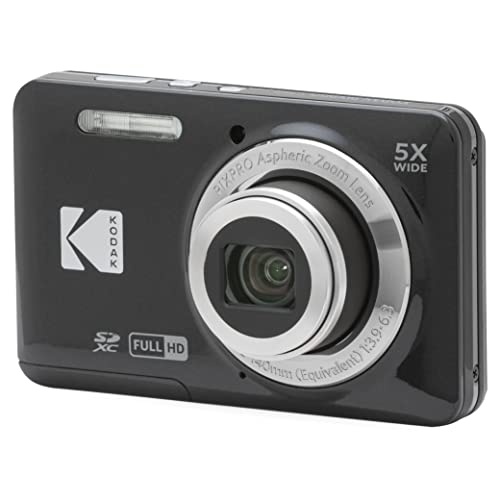
KODAK PIXPRO FZ55 — Best pocketable AA compact
If the FZ45 is the drawer camera, the FZ55 is the coat-pocket camera: a slimmer body, a 5x optical zoom and the same AA heart, designed for people whose photography happens on walks, commutes and day trips rather than around the house. The extra reach over its sibling is modest but real — enough to tighten a portrait, isolate a street detail or frame a monument without crossing the square — while the body stays small enough to forget you are carrying it, which is the entire secret of cameras that actually get used.
Kodak’s Friendly Zoom line has always understood that its competition is not other cameras but the phone in the same pocket. The FZ55’s answer is a dedicated device with a real optical zoom — phone digital zoom crops and degrades, this lens genuinely magnifies — plus a flash with actual presence, a shutter that fires when pressed, and a battery that can be swapped in seconds when the phone’s is being rationed for maps and messages. On a school trip, a festival or a long trail day, that separation of duties keeps both devices alive.
Images follow the family pattern: cheerful daylight colour, detail that satisfies at sharing and album sizes, and a 28mm wide starting point that handles rooms and landscapes gracefully. The sensor’s sixteen megapixels are well matched to the lens; nothing here pretends to large-print gallery ambitions, and the camera is more likeable for its honesty. Video at 1080p covers the moving moments with the same documentary spirit as its sibling.
The AA story in a slimmer body deserves one practical note: pocket cameras get used in bursts — twenty shots at a viewpoint, none for an hour — a pattern NiMH cells handle comfortably across a full day and beyond. The FZ55 also sips rather than gulps when the screen is used judiciously and the zoom motor is not pumped for entertainment. Carry one spare pair of NiMH in the camera’s small case and endurance anxiety simply never enters the day.
Handling is deliberately minimal: a mode dial’s worth of choices reduced to confident automatic operation with scene options for the usual situations. Beginners produce good results immediately; experienced photographers will miss manual control and should look at the used-market Canon discussed later in this guide for that particular itch. The FZ55 knows its audience and serves it without apology.
Between the two compacts, choose the FZ55 when the camera will travel on your person daily and the FZ45 when it will live in a fixed place awaiting moments. Either way, the purchase includes membership of the smallest club in modern photography: people whose camera batteries can be bought at a motorway service station at midnight.
- Power: two AA batteries, NiMH recommended for daily use
- Lens: 5x optical zoom from a 28mm wide starting point
- Sensor and video: 16MP stills, 1080p Full HD video
- Body: slim, pocket-first design in the Friendly Zoom line
- Role: everyday carry for walks, trips and events
Strengths
- The most pocketable genuine AA camera in this guide, so it actually gets carried.
- A real optical zoom out-reaches phone cropping for portraits and details.
- Swappable power keeps it independent of the phone battery rationing on long days.
Trade-offs
- Automatic operation only, in spirit; manual-control seekers must look elsewhere.
- Five times zoom is a step, not a leap — distant wildlife remains out of range.
- Dim interiors challenge it as they challenge every compact in this class.
Best for: walkers, commuters, students and travellers wanting a dedicated pocket camera on universal batteries. Not suited for: photographers wanting manual exposure control or serious telephoto reach.

KODAK PIXPRO AZ405 — Best AA zoom value
The AZ405 changes the conversation from convenience to capability. Forty times optical zoom, starting at a wide 24mm and reaching deep into telephoto territory, mounted in a bridge body with optical image stabilisation — all of it powered by AA batteries. Garden birds fill the frame from a kitchen window. A child’s football match becomes photographable from the touchline’s far end. Landmarks, aircraft, wildlife on a reserve visit: subjects that the compacts above wave at politely, the AZ405 actually photographs.
Bridge cameras earn their keep through that zoom, and the AZ405’s stabilisation is what makes the long end usable. At forty times magnification, a heartbeat becomes an earthquake in the viewfinder; the stabiliser calms the frame enough for handheld shots in good light, while a monopod or a rested elbow completes the job in shade. The 20-megapixel sensor records the detail the lens gathers, and the larger body — grip, dials, a proper hold — suits deliberate shooting sessions rather than pocket snapshots.
That deliberateness extends to power. A bridge camera’s zoom motor and stabiliser drink more deeply than a compact’s, so the AZ405 makes the NiMH case most forcefully in this guide: quality rechargeables deliver a few hundred shots of mixed zooming, alkalines wilt noticeably faster under the same workload, and a serious day’s shooting wants two NiMH sets rotating through the camera and the case. None of this is burdensome — AAs are light and cheap — but it should be planned rather than discovered at a hide in the rain.
The shooting experience includes the manual and semi-automatic modes the compacts omit, letting a learning photographer experiment with shutter speeds for moving water or aperture choices for portraits, all on a camera whose total cost forgives experimentation. Video records at 1080p and benefits from the zoom’s reach for wildlife clips, with the usual advice to zoom before recording rather than during.
Who is it for? The birdwatching beginner, the grandparent at the sports day, the traveller who wants one camera for a safari’s distance and a market’s breadth without a lens bag or a charging ritual. The AZ405’s combination — serious reach, honest price, universal power — has no direct modern rival, because the rest of the industry abandoned AA at exactly the zoom levels where travellers most appreciate buying batteries anywhere.
Its limits are the class limits, clearly kept: small-sensor noise as light falls, autofocus that prefers unhurried subjects, and a body too large for pockets. Within daylight and reasonable expectations, it is the value peak of this guide — the most photographic capability ever offered at the end of an AA battery compartment.
- Power: AA batteries — plan on quality NiMH sets for zoom-heavy days
- Lens: 40x optical zoom from 24mm wide, with optical stabilisation
- Sensor and video: 20MP stills with 1080p Full HD recording
- Controls: bridge body with manual and semi-automatic exposure modes
- Role: wildlife gardens, sports sidelines, travel landmarks
Strengths
- Forty times genuine optical reach transforms distant subjects from specks into photographs.
- Stabilisation makes the long end honestly usable handheld in decent light.
- Manual modes let beginners grow photographic skills on forgiving, affordable hardware.
Trade-offs
- Zoom and stabiliser appetites make alkaline cells a poor match; NiMH is effectively required.
- The bridge body is a bag camera, not a pocket camera.
- Fast-moving subjects at full zoom test the autofocus beyond its comfort.
Best for: garden wildlife watchers, sports-day families and travellers wanting maximum reach on universal power. Not suited for: pocket-carry minimalists or indoor low-light shooters.

KODAK PIXPRO AZ528 — Best AA superzoom
The AZ528 tops the linked range: a 52x optical zoom — among the longest ever fitted to an AA-powered camera — a backside-illuminated sensor chosen to squeeze more from available light, Wi-Fi for moving images to a phone, and the same bridge-body confidence as its AZ405 sibling, extended. If the AZ405 reaches the far touchline, the AZ528 reaches the moon, and it is only half joking to say so: lunar photography is a genuine pastime among superzoom owners, and this is the AA camera they would use.
Fifty-two times magnification is a discipline as much as a specification. At that extension the atmosphere itself becomes a lens element — heat shimmer and haze soften distant subjects on warm days regardless of optics — and the stabilisation works at the edge of physics to keep the frame composable. The photographers who thrive with superzooms learn its courtesies: shoot in the cool of morning, brace the camera, take several frames, and prize the extraordinary fact of the reach over pixel-level perfection at its extreme. Judged that way, the AZ528 delivers experiences no compact can imitate at any price.
The BSI sensor earns its mention in ordinary shooting rather than at the extremes. Backside illumination improves the sensor’s light gathering, which shows up as cleaner images in the shade of a woodland or the gloom of an arena — precisely where bridge cameras are often asked to work. Sixteen megapixels keeps file sizes friendly and the Wi-Fi moves the day’s best frames to a phone for sharing before the journey home, narrowing the convenience gap that phones usually exploit.
Power planning mirrors the AZ405 with emphasis: this is the hungriest camera in the guide, and its owners should standardise on good NiMH sets, plural, with lithium AAs as the winter and expedition reserve. The reward for that small discipline is a camera that can be taken off-grid for a week with a strip of cells in a side pocket and no thought given to sockets, solar panels or power banks. For rural travel, fieldwork and festivals, that independence is the product.
Handling, modes and video follow the bridge pattern — 1080p recording, manual exposure options, a body that two hands operate happily. The AZ528 asks a little more learning than its siblings and returns a lot more reach; buyers torn between it and the AZ405 should ask how often their subjects are truly distant. Occasionally distant favours the cheaper camera and a lighter bag. Habitually distant — birds, aircraft, mountains, the moon — makes the AZ528 the natural summit of the AA idea.
It closes the linked picks as proof of the format’s range: the same battery that powers a kitchen-drawer compact also powers a superzoom that photographs craters. No other battery standard spans that range while remaining buyable in every town on earth, and no other current camera line demonstrates it like this one.
- Power: AA batteries — multiple NiMH sets recommended for full days
- Lens: 52x optical zoom, the longest reach in this guide
- Sensor: backside-illuminated 16MP design for better low-light behaviour
- Connectivity: Wi-Fi for transferring images to a phone
- Role: superzoom travel, wildlife, aviation and lunar photography
Strengths
- Extreme 52x reach opens subjects — distant wildlife, aircraft, the moon — that other picks cannot frame.
- The BSI sensor gives this class unusually respectable results in shade and indoor gloom.
- Off-grid endurance is limited only by how many light, cheap AA sets you pack.
Trade-offs
- At maximum zoom, atmosphere and handshake — not the lens — set the quality ceiling.
- The hungriest power appetite here makes spare NiMH sets a necessity, not an accessory.
- Its size and learning curve exceed what a casual snapshotter needs or wants.
Best for: reach-obsessed travellers, wildlife beginners and off-grid shooters who will exploit the full zoom. Not suited for: pocket carriers, or buyers whose subjects are all within a room’s length.
Canon PowerShot SX160 IS — Prose-only: used-market classic
A generation ago, the AA idea had flagship ambassadors, and Canon’s SX160 IS was among the most loved: a 16x optical zoom compact with genuine manual controls, aperture and shutter priority modes, and a following among photography students who learned exposure on its dials before graduating to larger systems. It appears here without a link because its life is now in the used market, where clean examples circulate as teaching cameras and glovebox veterans.
What the Canon teaches a modern buyer is what the class sacrificed for simplicity. Manual focus options, exposure compensation at a fingertip and a lens that balanced reach with quality made it a photographer’s compact in a way today’s automatic Kodaks do not attempt. Its AA appetite was also famously brisk — the honest ancestor of this guide’s NiMH sermon — and owners from its era will confirm every word of the battery guidance above from personal experience.
Buying one now requires used-market sense: check the lens for dust, the zoom for smoothness, the battery contacts for the green corrosion that stored alkalines leave behind. A good example remains a delightful instrument for learning photography on universal power; a neglected one is a lesson in why the new Kodaks, with warranties, usually make the wiser purchase. It is included so that readers who meet its name in forums and listings understand exactly what it is and was.
- Power: AA batteries, with an appetite that made NiMH famous among owners
- Lens: 16x optical zoom with image stabilisation
- Controls: full manual and priority exposure modes
- Status: discontinued; used market only, discussed without a link
- Role: teaching camera and historical benchmark for the class
Strengths
- Manual controls made it a genuine learning tool, not merely a snapshot box.
- The zoom range balanced reach and quality in a truly pocketable body.
- Used prices can make it a charming, low-risk experiment in AA photography.
Trade-offs
- Age brings wear: contacts, zooms and screens need inspection before purchase.
- No warranty and no modern connectivity; support is community knowledge.
- Its battery hunger punishes alkaline users harder than any current Kodak.
Best for: photography students and enthusiasts who enjoy used gear and manual control. Not suited for: buyers wanting a warranty, modern video or guaranteed condition.
Nikon COOLPIX L-series — Prose-only: family archive veteran
Nikon’s COOLPIX L-series filled more family drawers than any camera range in history, and a large share of those generations ran on AA batteries. Models varied across the years — modest zooms, simple menus, colours aimed at high-street shelves — but the formula was constant: an inexpensive camera that any household member could feed from the battery drawer and operate without a manual. Millions of childhoods are archived on L-series files, which earns the line its place in any honest history of AA photography.
The L-series is discussed without a link because its models are discontinued and their second-hand condition varies enormously. Readers most often arrive here in one of two situations: inheriting one and wondering whether it still serves, or replacing one and wanting its modern equivalent. To the first: load fresh NiMH cells and a small memory card, and an L-series in working order still makes a fine children’s camera, allotment camera or festival camera — a device whose loss would sting briefly rather than ruin a month. To the second: the Kodak FZ45 and FZ55 above are its direct spiritual successors, with better sensors and video wearing the same philosophy.
Its limitations are the era’s: slow operation, screens that wash out in sunshine, video from a time before HD was assumed. None of that diminishes its historical role as proof that the AA proposition — cheap, universal, unkillable by a missing charger — once anchored the best-selling camera line in the world. The format did not fail; the market moved to phones, and the cameras that remained, like the Kodaks in this guide, kept the faith for the users phones forgot.
If you buy one used, the checks mirror the Canon’s: clean contacts, a lens that extends without grinding, a screen without dead patches. Pay accordingly for condition, keep expectations in daylight, and an L-series will still do the job it was built for — being ready, on ordinary batteries, when a moment refuses to wait.
- Power: AA batteries across most generations of the line
- Character: simple automatic compacts aimed at family use
- Zoom: modest ranges varying by model and year
- Status: discontinued; encountered used or inherited, no link provided
- Role: children’s, spare and festival camera; historical context
Strengths
- Proven household durability across millions of units and years of drawers.
- Simplicity that children and technophobes operate without instruction.
- Near-disposable used value makes it a guilt-free risk camera.
Trade-offs
- Performance and screens belong to an earlier era and show it in sunshine.
- Condition varies wildly; every purchase is an individual inspection.
- Modern successors outperform it in every measurable way for little more money.
Best for: families reviving an inherited camera or seeking a near-disposable spare. Not suited for: anyone expecting contemporary speed, video or low-light ability.
How do you get better photographs from a small-sensor AA camera?
Feed the sensor light and it will repay you; starve it and no setting can negotiate. These cameras produce their finest work in the conditions their sensors were designed around — daylight, open shade, bright interiors near windows — so the first skill is positional: move the subject toward light rather than asking the camera to manufacture it. A portrait taken two steps closer to a window, a product photograph made on a doorstep instead of a dim workbench, a group arranged in a garden rather than a corridor — each relocation improves the file more than any menu option in this class of camera.
Hold the camera like it matters. Small bodies invite one-handed snapping, and one-handed snapping at arm’s length is how compact photographs acquire their characteristic blur. Two hands, elbows tucked, a breath paused at the moment of the shutter — the old disciplines — cost nothing and transform results, especially at the AZ models’ long zoom settings where stabilisation assists a steady platform and merely accompanies a wobbling one. Resting the camera on a wall, a fence post or a car’s roof remains the cheapest tripod in photography.
Zoom with intent. The wide end of every lens here is its sharpest, fastest and most forgiving region, while the extreme telephoto end is a specialist tool for distant subjects in good light. Beginners live at maximum zoom because reach feels like power; experienced compact shooters default to wide, move closer when they can, and spend the long end only when distance leaves no choice. Portraits at a mild telephoto setting flatter faces and separate backgrounds pleasantly on the bridge models, whose aperture and sensor give modest but real subject isolation at those lengths.
Manage the flash like a tool rather than a reflex. On-camera flash in a small room bounces harshly off faces at close range; stepping back and zooming slightly softens its fall across a group. Outdoors, forcing the flash on in bright shade fills shadowed eyes beautifully — the classic fill technique that makes holiday portraits look professional. And in venues where flash is forbidden or rude, bracing the camera and accepting a slower shutter preserves the atmosphere the flash would have bulldozed.
Finally, edit with a light hand and keep everything. Small-sensor files reward gentle exposure and contrast adjustments and punish aggressive sharpening or heroic shadow-lifting, which excavates noise. Shoot more frames than feels necessary — memory cards are the cheapest component in this entire guide — and review on a proper screen before judging, because a camera’s rear display in sunshine lies in both directions. The photographers who get the most from these modest cameras are not the ones with secret settings; they are the ones who bring light, steadiness and patience to a tool that amplifies all three.
Why do workplaces keep choosing AA cameras for documentation?
Documentation photography has its own value system, in which the best camera is the one that is present, charged and operable by whoever is standing there. Delivery firms photograph parcels and property conditions; landlords record meter readings and room states; site teams log progress and defects; insurers’ customers capture damage while details are fresh. In each case the image is evidence first and art never, and the failure mode that matters is not noise at high sensitivity — it is a flat proprietary battery and a charger in another depot.
AA power dissolves that failure mode organisationally. Any branch, van or site cabin can stock cells; any new starter can be handed the camera without a charging induction; a camera borrowed between sites arrives usable rather than as a puzzle of missing accessories. Fleet managers quietly understand total cost in these terms: the camera that never misses a photograph because its power source is universal is cheaper than a superior camera that misses three jobs a year. Kodak’s PIXPRO compacts persist in procurement catalogues for exactly this unglamorous reason.
There are disciplines that make workplace fleets work. Label cameras and battery sets so matched NiMH pairs stay together; keep a charging corner with a simple log rather than a drawer of mysteries; set every camera’s clock correctly so timestamps on evidence agree; and standardise on one memory card type so any card fits any camera. None of this requires photographic talent, and all of it converts an inexpensive camera into a reliable instrument of record.
Households can steal the same system wholesale. A labelled camera, a charger in a fixed place, batteries that live in the camera case rather than a junk drawer — this is the difference between a family camera that is always ready and one that is theoretically owned. The AA format’s deepest virtue is not technical at all: it lets ordinary people organise around it successfully, with supplies from any shop, forever. Technologies that forgive their owners tend to outlive technologies that merely impress them.
Comparison table
| Camera | Zoom | Power | Character | Primary role |
|---|---|---|---|---|
| KODAK PIXPRO FZ45 | 4x from 27mm | 2x AA | Simple household compact | Drawer and site camera |
| KODAK PIXPRO FZ55 | 5x from 28mm | 2x AA | Slim pocket compact | Everyday carry |
| KODAK PIXPRO AZ405 | 40x from 24mm | AA set | Stabilised bridge camera | Zoom value |
| KODAK PIXPRO AZ528 | 52x | AA set | BSI-sensor superzoom with Wi-Fi | Maximum reach |
| Canon PowerShot SX160 IS | 16x | 2x AA | Manual-control classic, used only | Learning photography |
| Nikon COOLPIX L-series | Modest, varies | AA | Family automatic, used or inherited | Spare and children’s camera |
Which AA battery type should you actually use?
NiMH rechargeables are the answer for anyone who shoots regularly, and the reasoning is arithmetic as much as performance. A quality NiMH set costs a few times an alkaline set, survives hundreds of charge cycles, and — crucially for digital cameras — holds its voltage steady under load instead of sagging the way alkalines do. Cameras read that sag as exhaustion, which is why alkaline shot counts in this class can collapse to a small fraction of the NiMH figure even though the cells still power a torch happily. The camera is not lying; it is reporting a voltage the chemistry cannot sustain.
Alkalines keep one honourable role: the universal emergency reserve. They store for years, they are sold everywhere humans gather, and a pair in the camera case converts a dead camera into a working one in thirty seconds. Buy them for that drawer, not for the shooting day. Lithium AA disposables occupy the specialist corner — the lightest cells, the best cold-weather performance, the longest storage life — making them the expedition and winter choice, and the right residents for a camera that lives in a vehicle through freezing months.
Charging discipline for NiMH is simple: use a decent charger that treats cells individually, keep sets together as married pairs rather than mixing odd cells, and retire cells that grow hot or refuse a full charge. Modern low-self-discharge NiMH variants hold most of their charge across months on a shelf, removing the old objection that rechargeables were always flat when needed. Equipped that way, an AA camera’s endurance stops being a topic of conversation at all — which is exactly where a tool’s power supply belongs.
Where does an AA camera beat a rechargeable one?
Off-grid travel is the clearest theatre: multi-day treks, rural fieldwork, festivals and boat trips where sockets are contested or absent. A strip of AA cells weighs little, packs flat and never needs a voltage converter’s blessing. Disaster preparedness follows the same logic — an AA camera documents storm damage and insurance evidence when the grid and the phone network are both down, fed from the same battery stockpile as the household torches and radio.
Institutions quietly depend on the format. Schools issue AA cameras because children cannot lose a charger that does not exist and a flat camera is revived from the stationery cupboard. Site managers, letting agents and delivery operations value cameras that any staff member can refuel from a petrol station. And as a backup philosophy, AA is unmatched: the spare camera in a professional’s car boot, loaded with lithium cells that hold charge for years, waits patiently for the day the main kit fails — a day when its modest image quality will look infinitely better than no image at all.
What mistakes do AA camera buyers keep making?
The classic error is judging the camera on alkaline performance: loading disposables, watching the battery gauge dive, and condemning a camera that would have run happily for days on NiMH. Judge any AA camera only on the chemistry you will actually use. The second error is mixing cells — one new, one tired, different brands in a pair — which guarantees the weakest cell dictates the set’s life and can leak in protest. Cells travel in matched sets or not at all.
Third, buyers store cameras with alkalines inside for months and meet the corrosion those cells eventually weep; remove batteries from stored cameras, whatever the chemistry. Fourth, superzoom buyers skip the spare-set habit and lose the last hour of a wildlife day to a preventable flat battery. Fifth, gift-givers hand an AA camera to a relative with a pack of cheap zinc cells from a bargain bin — the worst-performing chemistry of all — and the camera gets blamed for the divorce. Include good NiMH cells and a charger in the gift, and the same camera becomes a favourite.
How should you assemble an AA camera kit for travel?
Begin with the battery rotation, because everything else hangs from it. Three matched NiMH sets is the traveller’s sweet spot: one in the camera, one charged in the case, one resting or charging whenever power appears. Mark sets with a dot of paint or a wrap of tape in different colours so pairs never divorce and remarry randomly in a hotel drawer. A compact USB-powered charger keeps the system independent of local socket shapes — it can drink from a laptop, a power bank or a vehicle’s USB port during a driving day, quietly refilling the rotation without a wall ever being involved.
Storage planning is refreshingly undemanding. These cameras write modest files by modern standards, so a couple of mid-sized cards cover a long trip with room to spare; carry two smaller cards rather than one large one, so a lost or failed card costs a day rather than the journey. Back up opportunistically — a phone transfer on the AZ528’s Wi-Fi, a laptop copy in a hostel — and treat the cards themselves as the archive until you are home. The kit’s total weight, camera and batteries and cards together, stays below that of a single mirrorless lens, which is rather the point of travelling with this class of camera at all.
Protection should match the format’s spirit: a padded pouch, a lens cloth, a small dry bag for boats and downpours. Weather sealing is not these cameras’ claim, and a dry bag is the honest substitute — cheap, universal and effective. A wrist strap matters more than any of it, because the commonest travel loss is a fumbled camera over a railing or into a river, and a strap converts that story into an anecdote instead of an ending.
Finally, rehearse the kit once at home. Run a full day on one NiMH set with your real shooting habits, learn where your personal endurance figure lands, and pack your rotation to that number rather than to a stranger’s estimate. Travellers who know their own consumption stop thinking about power entirely — the highest compliment a travel kit can earn, and one this format hands out more freely than any other in photography.
What does five years of ownership actually cost?
The purchase price of an AA camera is unusually close to its lifetime price, and the arithmetic deserves a paragraph because it reverses the usual electronics pattern. A set of NiMH cells and a competent charger join the camera at the start; memory cards follow the standard the whole industry shares; there is no proprietary battery to replace in year three when the original fades, no charger to repurchase after a house move, no dock or grip the system quietly requires. Owners of lithium-pack cameras know the other ledger — replacement packs at sobering prices, discontinued chargers hunted second-hand — and it is precisely that ledger the AA format refuses to open.
Breakage economics favour the format too. A camera whose total replacement cost is modest gets used in the places photography actually happens — beaches, workshops, children’s hands, festival mud — rather than being protected out of its own usefulness. The best archive is the one that exists, and inexpensive, universally powered cameras accumulate archives that precious equipment, left safely at home, never starts. Several professional photographers keep an AA compact for exactly this reason: not as their best camera, but as the camera present at the unplanned moments that turn out to matter most.
Environmental accounting, finally, cuts in the format’s favour when NiMH discipline holds. A rechargeable cell cycled hundreds of times replaces hundreds of disposables; a camera that remains serviceable for a decade because its power standard never changes avoids the e-waste fate of devices orphaned by dead proprietary packs. The greenest camera is rarely the newest one — it is the one still working, still fed by batteries any shop sells, long after its contemporaries retired for want of a charger. On that measure, the humble models in this guide may out-serve cameras costing ten times more.
Final Recommendation
Most buyers should start with the KODAK PIXPRO FZ45 and a charger loaded with quality NiMH cells: it is the purest form of the AA idea, ready in every drawer and forgiving of every user, from the grandparent recording a birthday to the site manager logging a delivery, and it asks nothing in return except batteries the whole world already stocks. Pocket carriers step to the FZ55, distance hunters to the AZ405, and the truly reach-hungry to the AZ528, while the used Canon and Nikon remain charming context rather than first purchases. Whichever you choose, the ritual is the same — matched NiMH sets in rotation, alkalines only as the reserve, batteries out for storage — and a camera kept that way will still be taking pictures on the day every proprietary pack in the house has retired.
Frequently Asked Questions
How many photos will a set of AA batteries really take?
With quality NiMH rechargeables, expect a few hundred shots in these Kodak models under mixed use — more with gentle screen and zoom habits, fewer with heavy flash. Alkaline sets may deliver only a fraction of that before the camera reports them exhausted, because their voltage sags under load. Lithium AA disposables sit at the strong end and excel in cold weather.
Can I use rechargeable batteries in all of these cameras?
Yes — NiMH rechargeables are the recommended power source for every linked pick in this guide, and the cameras are designed with their voltage characteristics in mind. Keep cells in matched sets from the same pack, charge them together and avoid mixing old and new cells in one load.
Why did most camera brands abandon AA batteries?
Proprietary lithium packs offer more energy in less space, enabling slimmer bodies and higher shot counts, and the market followed those advantages as phones reset expectations. AA survived where universality matters more than slimness — which is precisely the niche this guide serves. The format’s disappearance from flagship lines reflects fashion and physics, not failure.
Are AA cameras good enough for printing photographs?
At family print sizes, comfortably yes. Daylight images from the 16 and 20 megapixel sensors in this guide print cleanly at the sizes albums and frames actually use. Very large prints and aggressive cropping expose the small sensors’ limits, as they do with any compact camera regardless of its battery.
What should I pack for a week off-grid with an AZ528?
Three or four matched NiMH sets in rotation if any charging exists — a vehicle USB charger suffices — or a strip of lithium AA disposables if none does. Add a spare memory card, a lens cloth and a small dry bag. That entire power-and-storage kit weighs less than one proprietary battery grip and works at any altitude your itinerary reaches.
Do AA cameras work in cold weather?
Better than most, provided the chemistry is chosen for the temperature. Ski tours, winter wildlife hides and cold-vehicle storage are all realistic AA scenarios, and each rewards the lithium choice while punishing the bargain-bin one — test your intended cells on a frosty morning at home before trusting them on a trip that matters. Lithium AA disposables are the cold-weather champions of this format, maintaining output in freezing conditions that leave ordinary cells sluggish, which is why expedition spares kits specify them. NiMH sets perform respectably in mild cold, especially when a spare set rides in an inside pocket where body warmth keeps it ready. Alkalines suffer earliest in the cold — one more reason they belong in the emergency role rather than the starting line-up. Photographers working winter mountains with an AZ model should also keep the camera itself under a layer between shots, since a warm camera fogs less and its screen responds faster.
Is a used AA camera a sensible first camera for a child?
It can be ideal: inexpensive, simple and powered from the household battery drawer, with no account, no notifications and no charger to lose. Inspect used examples for clean battery contacts and a smooth zoom, include NiMH cells, and choose a model whose loss would be a shrug rather than a tragedy — the L-series and early PIXPRO compacts fit that brief perfectly.
Related Guides
Still deciding between battery philosophies, zoom ranges and pocket sizes? Browse neighbouring shelves through our guides to affordable 4K cameras for everyday filming, small travel cameras that disappear into a bag and superzoom cameras with the longest optical reach.


