What's inside
- Key Takeaways
- Quick Picks: Best 4K Outdoor Security Cameras
- How We Chose These Picks
- Comparison Table
- How Do You Choose Between Solar, Battery and PoE Outdoors?
- What Does Living With an Outdoor System Actually Involve?
- Which Outdoor Setup Fits Your Kind of Property?
- What Mistakes Do Buyers Keep Making Here?
- Final Recommendation
- Frequently Asked Questions
- Related Guides
As an Amazon Associate I earn from qualifying purchases. This post may contain affiliate links at no extra cost to you.
gizmoverdict.com is reader-supported. When you buy through links on our site, we may earn an affiliate commission.
Where to buy: each linked system below goes to its Amazon listing, where you can confirm the camera count, storage size and cable length in the box before ordering. One pick in this list is covered honestly as a non-4K alternative, and it is labelled that way everywhere it appears.
Finding the best 4k outdoor security cameras starts with a confession: resolution is the easy part of this purchase. Any of the wired kits here will resolve a licence plate at driveway distance, and the better solar cameras are not far behind. What actually separates a system you forget about from a system you curse every month is power. A camera that needs a ladder, a drill and an extension lead behaves very differently across a wet winter from one that sips sunlight on a fence post, and the right answer depends on whether your house has reachable eaves, a spare Ethernet run, or neither.
This guide therefore ranks six systems by the job they do outdoors rather than by headline numbers alone. Two are solar wireless kits that a renter could install with a screwdriver. One is a full sixteen-channel PoE installation with a hard drive that records whether your internet lives or dies. Between those poles sit plug-in wired cameras and a touchscreen solar bundle, plus one famous battery camera that is not 4K at all — included deliberately, clearly flagged, because its two-year battery life solves a real problem for a specific kind of household. Weather sealing, night footage and storage costs get equal billing with pixel counts throughout.
Key Takeaways
- Power source shapes everything outdoors: PoE never sleeps and never needs charging, solar needs honest sunlight, and battery cameras trade recording time for total placement freedom.
- A 4K badge only helps if the lens, bitrate and night illumination support it — several mid-priced kits record sharper usable evidence after dark than sharper-on-paper rivals.
- Local recording to a hard drive or built-in storage keeps evidence during internet outages and avoids the subscription creep that quietly inflates cheap camera kits.
- One pick in this list, the Blink Outdoor 4, records 1080p rather than 4K; it stays because two years between battery changes is a genuine outdoor advantage, not a marketing line.
- Count your entry points before counting cameras: doors, gates and the blind side of a garage decide the kit size, not the discount on a bigger box.
Quick Picks: Best 4K Outdoor Security Cameras
| Pick | Badge | Why it earns its place |
|---|---|---|
| aosu D1 Max 4-Cam Kit | Best solar 4K kit for most homes | Four solar 4K cameras, local storage that can grow to a serious archive, and no subscription standing between you and your own footage. |
| REOLINK RLK16-800B8 16CH 4K PoE System | Best wired system for evidence-grade recording | Eight 4K PoE bullet cameras and a 4TB hard drive recording around the clock — the set-and-forget backbone for larger properties. |
| Hiseeu 4MP Solar Camera System with Touchscreen | Best for monitor-based checking without an app | Solar dual-lens cameras with auto tracking and a 10-inch touchscreen monitor — footage you can glance at in the kitchen, not just on a phone. |
| Hiseeu 5MP Wired Plug-in System with 4K NVR | Best plug-in middle ground | Plug-in powered bullet cameras recording 24/7 to a 4K NVR — continuous coverage without PoE cabling or battery chores. |
| 8-Channel Expandable Solar System, 128GB | Best budget solar system that can grow | An eight-channel solar base with 128GB onboard storage and sizeable 8000mAh batteries — start small, add cameras as the property demands. |
| Blink Outdoor 4 | Not 4K — the two-year battery exception | A 1080p camera, included openly as the endurance pick: up to two years on one set of AA lithium batteries, and almost zero maintenance. |
How We Chose These Picks
Every system here was checked against the same outdoor brief. The housing had to be rated for rain exposure — IP65 as a floor, IP66 or IP67 preferred — because a camera that fogs internally by February is a decoration. Night performance had to be described in concrete terms, whether infrared range, colour night vision with a spotlight, or dual-light designs, since most incidents a homeowner actually reviews happen after dark. Storage had to include a credible local option, because cloud-only systems stop being evidence recorders the moment a subscription lapses.
We also weighed installation honesty. PoE kits ask for cable runs and reward you with the most dependable footage in the category. Solar kits ask for a panel angle that catches winter sun and reward you with zero wiring. Battery cameras ask for almost nothing and repay you with motion-triggered clips instead of continuous recording. None of those bargains is hidden in the reviews below; each pick states plainly what it demands from your house, your ladder confidence and your patience, so the ranking reads as six different answers to six different driveways. One further filter deserves naming: every system here had to make its footage reachable without specialist software, because evidence you need a technician to export is evidence you effectively do not have. App and recorder interfaces were judged on how quickly a tired owner at midnight can find, clip and share the thirty seconds that matter — a mundane test that eliminates more products than any laboratory benchmark, and one worth repeating in the shop before your money follows the same path.

aosu D1 Max 4-Cam Kit — Best solar 4K kit for most homes
The aosu D1 Max is the solar kit that answers the usual solar objections before you raise them. Four 4K cameras cover a typical house’s doors and driveway, each with its own panel, and the system records to local storage that expands to a genuinely large archive rather than the few days of clips many wireless kits hoard. Because the footage lives at home, the absence of a required subscription is not a trial-period trick; the kit keeps working, and keeps its recordings, if you never pay another penny.
Outdoors, its manners are good. The cameras wake on motion and deliver colour footage in decent light, with night performance that leans on illumination rather than sensor bravado. Placement remains the whole game: give each panel a honest slice of sky, angle cameras at the choke points where visitors must slow down — gates, door approaches, the driver’s side of a parked car — and the system settles into the background of household life, which is the highest praise a security kit can earn.
What it will not do is record continuously, and buyers who need an unbroken timeline of a busy street should look at the wired picks below. Solar energy is a budget, and this kit spends it on events. For the far larger group of households whose real need is knowing who came, when, and what they did at the door, that budget is spent exactly where it matters.
One ownership note specific to this kit: rotate your attention across the four panels seasonally. The camera that feasted on June sunlight may be the one a grown hedge shades by October, and a five-minute panel wipe plus a small angle change in autumn prevents the slow winter decline that owners often misdiagnose as a failing battery. The expandable storage also rewards a habit — archive the clips you care about monthly rather than trusting any single device with a year of family evidence.
- Four 4K solar-powered wireless cameras
- Local storage, expandable up to 1TB class capacity
- No subscription required for core recording
- Colour night vision with motion-triggered recording
- Weather-sealed housings for exposed mounting
Strengths
- True 4K detail without a single cable run
- Local expandable storage avoids monthly fees
- Four cameras cover a typical house in one box
Trade-offs
- Event recording only — no continuous timeline
- Panels need real sunlight, not bright shade
- Live viewing drains the power budget if overused
Best for: households that want genuine 4K coverage with zero wiring and zero subscription, on a property with decent sun.
Not suited for: busy road frontages needing non-stop recording, or heavily shaded plots where panels would starve.
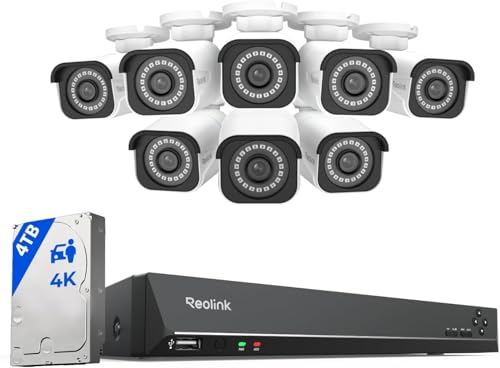
REOLINK RLK16-800B8 16CH 4K PoE System — Best wired system for evidence-grade recording
The Reolink RLK16-800B8 is the opposite philosophy to solar in a single box: eight 4K bullet cameras, each fed power and data by one Ethernet cable, all reporting to a sixteen-channel recorder with a 4TB hard drive. It records whether the internet is up, whether the router is rebooting, whether anyone remembers it exists. Person and vehicle detection trims the review burden, but the core promise is simpler — a continuous, locally stored timeline you can rewind days later and still find intact.
Installation is a weekend of ladders, drill bits and cable clips, and the review should not pretend otherwise. In exchange you get the most dependable footage in this guide: no batteries fading in a cold snap, no solar arithmetic in December, no Wi-Fi arguments through brick walls. Bullet housings also deter in a way discreet domes do not; a visible camera at a yard entrance changes behaviour before a single frame is reviewed, which any small business owner will confirm is worth channels on its own.
Buy it sized for growth. Sixteen channels against eight supplied cameras leaves room for the workshop, the second gate and the camera you will inevitably want over the fuel store. Households with two doors and a postage-stamp garden should save their money and their Saturday; this system rewards properties with genuine ground to cover.
Living with the Reolink means living with a recorder, so give it a sensible home: ventilated, dust-light, and on a small uninterruptible supply if your area suffers flickering power, because hard drives dislike surprises more than cameras do. Label both ends of every cable during installation — future you, adding a ninth camera in the rain, will be grateful. And set the recorder’s clock sync correctly from day one; timestamps are the difference between footage that merely shows an event and footage that proves when it happened.
- Eight 8MP 4K PoE bullet cameras, sixteen channels
- 4TB hard drive fitted, continuous recording
- Smart person and vehicle detection
- H.265 compression stretches archive time
- Single-cable power and data per camera
Strengths
- Records through internet and power-grid dramas alike
- No batteries, panels or charging routine ever
- Spare channels leave honest room to expand
Trade-offs
- Cable runs demand time, tools and planning
- Recorder needs a home with ventilation and power
- Overkill for small flats and short driveways
Best for: larger homes, yards and small businesses that want an unbroken, locally held record and can run cable once.
Not suited for: renters, listed buildings, or anyone whose installation budget is a screwdriver and an afternoon.

Hiseeu 4MP Solar Camera System with Touchscreen — Best for monitor-based checking without an app
Hiseeu’s solar bundle makes one decision the rest of this list avoids: it gives you a screen. The 10-inch touchscreen monitor means a grandparent, a shopkeeper or anyone phone-averse can check the yard by walking past a display instead of unlocking an app, and that single feature will sell this system to households the app-first brands quietly lose. The cameras themselves are 4MP dual-lens units — honest detail below the 4K picks, stated plainly — with auto tracking that pans to follow movement across a driveway or garden.
Solar power keeps installation to screws and sunlight, and dual-band Wi-Fi support helps the cameras hold a link where older 2.4GHz-only systems sulk. Auto tracking deserves a balanced word: on a quiet property it follows the postman beautifully, while on a busy frontage it can spend its day swivelling between passers-by and drain both battery and your patience. Point tracking cameras at private ground — your yard, your gate, your bins — and the feature earns its keep.
Choose this kit for the household workflow, not the spec sheet. If the people who will actually watch the footage prefer a monitor on the counter, this is the only pick that respects that preference, and its cameras are competent enough that the concession costs you little in practice.
The touchscreen changes household dynamics in a way worth planning for: put the monitor where people naturally pass — a kitchen counter, a hall table — rather than in a study where only one person sees it. Because the cameras track movement, give each a defined patrol territory on private ground and resist aiming one across a public pavement, where it will spend its battery chasing strangers and its novelty will curdle into irritation for everyone, including the neighbours it keeps watching.
- Solar wireless cameras with dual lenses, 4MP
- 10-inch touchscreen monitor included
- Auto tracking follows movement in frame
- Dual-band 2.4GHz and 5GHz Wi-Fi support
- Expandable system within the Hiseeu family
Strengths
- A real monitor frees checking from phones
- Auto tracking covers wide yards with fewer cameras
- Solar fitting suits rentals and outbuildings
Trade-offs
- 4MP detail sits below the true 4K picks
- Tracking can overwork itself on busy frontages
- Monitor needs its own power point indoors
Best for: households and small shops where several people check cameras and a countertop screen beats an app.
Not suited for: buyers chasing maximum identification detail at long range.

Hiseeu 5MP Wired Plug-in System with 4K NVR — Best plug-in middle ground
This Hiseeu system occupies the sensible middle that buyers often miss between battery freedom and PoE commitment. Its bullet cameras plug into mains power, so they can record around the clock like a wired kit, but they talk to the 4K NVR over Wi-Fi, so the only runs you make are to power sockets rather than a full Ethernet loom. For houses with outdoor sockets, garage power or a workshop feed, that trade removes most of the installation pain while keeping the continuous timeline that forensic peace of mind is built on.
The cameras record at 5MP — again, below the headline 4K systems and described as such — while the recorder itself is 4K-capable, leaving headroom within the ecosystem. Dual-band Wi-Fi matters here more than in battery kits, because a continuous stream is a heavier, less forgiving load than occasional clips; a camera that drops its link drops your timeline with it. Site the NVR centrally, favour the cameras with the cleanest signal paths, and the system behaves like wired kit that skipped the worst weekend of work.
It suits the semi-practical household: happy to fit cameras and run short power leads neatly, unwilling to core-drill for Ethernet. If your property lacks outdoor power entirely, the solar picks serve you better; if it has power everywhere, this is continuous recording at a friendlier effort level than PoE.
Because these cameras stream constantly, treat their Wi-Fi like a utility: if your router offers a separate network for smart devices, the recorder’s cameras belong on it, both for tidiness and to keep their traffic away from your video calls. Check the furthest camera’s stream after a week of weather, not just on installation day — rain-soaked walls and a house full of evening devices are the real load test, and a small antenna or recorder reposition now beats a gap in the timeline later.
- Plug-in powered outdoor bullet cameras, 5MP
- 4K NVR with 24/7 continuous recording
- Dual-band 2.4GHz and 5GHz Wi-Fi Pro link
- Local hard-drive storage in the recorder
- Weather-sealed housings for wall mounting
Strengths
- Continuous recording without Ethernet runs
- No battery or solar budget to manage
- Recorder headroom suits later expansion
Trade-offs
- Needs reachable mains power at each camera
- Wi-Fi must carry constant streams reliably
- Camera resolution trails the flagship 4K kits
Best for: homes with outdoor power points that want always-on recording without a cabling project.
Not suited for: properties with no exterior sockets, or Wi-Fi dead zones at the exact corners needing cover.

8-Channel Expandable Solar System, 128GB — Best budget solar system that can grow
Not every property announces its camera count on day one, and this eight-channel solar system is built for the households that would rather grow into coverage. The base records to 128GB of built-in storage with no subscription in the way, the cameras carry comparatively large 8000mAh batteries behind their panels, and spare channels wait for the side gate, the shed and the second thoughts that follow any first installation. Starting with the doors and adding outward is a legitimate strategy, and this is the kit that formalises it.
Dual-band Wi-Fi support helps the far cameras hold on, and the solar-plus-battery sizing is aimed at the real enemy of wireless systems — the grey fortnight in midwinter when panels sip rather than gulp. Even so, keep the same discipline as with any solar pick: panels angled at genuine sun, cameras aimed at choke points rather than open lawns, and live view treated as a treat rather than a television channel. Managed that way, the running costs after purchase are effectively zero.
Its footage will not out-resolve the flagship 4K kits, and the review table says so. What it offers instead is the lowest-friction route into whole-property awareness for buyers whose budget arrives in stages. For a first system on a mid-sized plot, that is often the smarter purchase than a flagship kit covering half the doors.
The staged-growth design invites one discipline: keep a simple map of which channel watches what, updated as you add cameras, because eight similar thumbnails in an app become a memory test by the second year. The 128GB store is adequate for event clips but not infinite, so export anything tied to a dispute, a delivery claim or an insurance question promptly rather than assuming it will still be there at renewal time. Bought with those habits, the kit’s modesty becomes its charm.
- Eight-channel expandable wireless base
- 128GB built-in storage, no subscription
- 8000mAh solar-powered camera batteries
- Dual-band 5GHz and 2.4GHz Wi-Fi
- Add-on cameras available within the system
Strengths
- Channels spare for cameras you add later
- Generous batteries suit dull winter stretches
- No subscription gatekeeping your own clips
Trade-offs
- Storage is smaller than hard-drive kits
- Detail trails the dedicated 4K systems
- Growth depends on staying in one ecosystem
Best for: staged buyers covering a mid-sized property door by door, with room to expand next season.
Not suited for: anyone needing weeks of continuous archive from day one.

Blink Outdoor 4 — Not 4K — the two-year battery exception
Honesty first, in bold terms a skim-reader cannot miss: the Blink Outdoor 4 records 1080p, not 4K, and if resolution is your priority you should stop here and choose any other pick in this guide. What earns a non-4K camera its place is the other axis of outdoor ownership — time. Blink rates the Outdoor 4 for up to two years of operation on a set of AA lithium batteries, and in a world of monthly charging rituals and solar arithmetic, a camera you fit and then ignore for seasons at a stretch is a genuinely different product.
Its natural posts are the quiet ones: a side gate opened twice a week, a shed door, a holiday-let entrance, the far end of a garden where running any kind of power is absurd. Infrared night view covers the dark hours in monochrome, motion clips land in the app promptly, and the small weather-sealed body mounts almost anywhere without announcing itself. Ask it to identify a stranger’s face across a long driveway and it will disappoint you — that is 4K work, and this camera never claimed otherwise.
Treat the Blink as the specialist in a mixed system or the whole system for a small, quiet property. Plenty of households run a 4K kit on the house and a Blink on the outbuilding, and that division of labour is exactly how this pick should be read: endurance where endurance matters, resolution where resolution matters, and no confusion between the two.
Blink ownership is mostly about resisting upgrades of attention: set the clip length and sensitivity once, position the camera where its infrared view is unobstructed by nearby walls that bounce the light back, and then genuinely leave it alone. Owners who check live view daily halve the battery advantage they bought it for. Also keep a spare set of the correct lithium cells in a drawer — when the two-year run finally ends, it ends without much ceremony, and a camera blinking offline for a month while batteries ship is a silly way to lose coverage.
- 1080p HD video — not a 4K camera
- Up to two-year battery life on AA lithium cells
- Infrared night view for after-dark clips
- Compact weather-resistant wireless body
- Motion-triggered clips with app alerts
Strengths
- Battery life measured in years, not weeks
- Smallest, simplest fitting in this guide
- Perfect for remote, low-traffic watch posts
Trade-offs
- 1080p detail cannot match the 4K picks
- Event clips only — no continuous recording
- Full cloud features sit behind a Blink plan
Best for: quiet gates, sheds and second buildings where a camera must survive unattended for seasons.
Not suited for: identification at distance, busy frontages, or anyone who came here specifically for 4K.
Comparison Table
| Pick | Defining traits |
|---|---|
| aosu D1 Max 4-Cam Kit | Solar 4K quartet, expandable local storage, subscription-free — the wireless reference point in this list. |
| REOLINK RLK16-800B8 16CH 4K PoE System | Sixteen-channel PoE, 4TB drive, eight 4K bullets — the continuous-recording heavyweight here. |
| Hiseeu 4MP Solar Camera System with Touchscreen | Solar dual-lens cameras plus a 10-inch touchscreen — the people-first outlier in the group. |
| Hiseeu 5MP Wired Plug-in System with 4K NVR | Plug-in 5MP cameras, 4K NVR, non-stop recording — the effort-versus-evidence compromise. |
| 8-Channel Expandable Solar System, 128GB | Expandable eight-channel solar with 128GB onboard — the grow-into-it option. |
| Blink Outdoor 4 | 1080p, two-year battery, zero wiring — the endurance specialist, included with its limits on the label. |
How Do You Choose Between Solar, Battery and PoE Outdoors?
Before comparing individual systems, settle the three questions that decide whether any outdoor camera still satisfies you a year from now: where its power comes from, where its footage lives, and what its night pictures genuinely look like.
Start with the cable question, not the camera question
Walk your property with a phone and photograph every spot you want watched, then ask how power would reach each one. An eave above a garage door usually hides a soffit where a PoE cable or a plug-in lead can run neatly. A fence line forty metres from the house rules both out and points straight at solar or battery. A rental rules out drilling altogether. Writing this down first prevents the classic error of buying a beautiful wired kit for a house that cannot be wired, or a battery kit for a busy street where it will record in exhausted bursts and miss the middle of events.
Read weather ratings like a sceptic
IP65 means a housing shrugs off rain jets from any direction, which covers most wall-mounted positions under an eave. IP66 and IP67 add margin for exposed poles, coastal spray and driving storms, and matter most where a camera faces prevailing weather with no shelter at all. Beyond the rating, look at the operating temperature range if your winters bite, check whether the lens sits recessed behind a lip that sheds droplets, and favour metal or well-sealed housings for cameras mounted low enough to be reached, splashed by sprinklers or investigated by wildlife.
Judge night footage by illumination, not by megapixels
A 4K sensor drinking weak infrared produces a tall, grainy picture; a well-lit lower-resolution frame often identifies a face more reliably. Outdoors, ask three things: how far the infrared or spotlight genuinely reaches, whether the camera offers colour night vision and at what light cost, and whether headlights, porch lights or reflective number plates blow out the exposure. Dual-light systems that idle in infrared and flare white light on motion give you discreet monitoring plus a deterrent, while always-on spotlights advertise the camera and annoy neighbours. Match the illumination style to the street you actually live on.
Decide where recordings live before the first incident
Hard-drive kits record continuously and keep weeks of footage without asking the internet for permission, which is why they remain the evidence gold standard. Solar and battery systems usually store motion events locally or in a cloud plan; event storage is fine for package alerts and hopeless for reconstructing a slow afternoon of suspicious loitering. If you choose event-based storage, confirm what happens when memory fills, whether clips can be exported without a subscription, and how the system behaves during a broadband outage — the answers differ more between brands than any resolution figure does.
Plan the network the cameras will actually use
Wireless outdoor cameras live or die on signal through exterior walls, which attenuate Wi-Fi far more than interior partitions do. A camera that shows full bars during a sunny setup test may drop frames in heavy rain at the far corner of a plot. Systems with their own base station or NVR receiver often hold marginal links better than cameras begging a crowded home router. For PoE, the planning shifts to cable length, switch ports and where the recorder sits so its fan noise and blinking lights do not colonise a bedroom. Ten minutes of network planning saves a season of intermittent gaps.
Think about who reviews the footage, and how fast
Evidence has a shelf life measured in behaviour, not just storage days. If nobody in the household ever opens the app, the finest 4K archive is a diary nobody reads, so design the review habit alongside the hardware: a two-minute glance at overnight door events with morning coffee catches most of what matters while it is still actionable. Systems with person detection earn their keep here by shrinking that glance to the clips with a human in them. When choosing between two kits, favour the one whose app your household will actually open — review friction is a specification, even if it never appears on a box.
What Does Living With an Outdoor System Actually Involve?
Specifications end at the garden gate. What follows is the ownership layer — the checks, habits and small decisions that decide whether a system still protects you in its second year.
The first month teaches you your real motion map
Every new system spends its first weeks over-reporting. Spiders colonise lenses, hedges wave in storm winds, and the neighbour’s cat treats your driveway as a thoroughfare, each event arriving as a phone alert until the owner either tunes the system or starts ignoring it — the most dangerous outcome in home security. Spend the first month adjusting sensitivity per camera, drawing activity zones that exclude the road and the hedge line, and repositioning the one camera whose angle catches headlights sweeping a wall. A system tuned in month one gets checked in month twelve; a system left screaming gets muted, and a muted camera is furniture.
Storage arithmetic you should do once, on paper
Continuous kits make the maths easy to postpone and important to face: eight 4K cameras recording around the clock consume a 4TB drive in a span measured in weeks, not months, with compression settings deciding where in that range you land. Decide your genuine retention need — most households reviewing an incident do so within a fortnight — and set overwrite behaviour deliberately rather than discovering it during a police visit. Event-based systems invert the problem: their archives stretch for months but contain only what motion triggers caught, so the arithmetic becomes about trigger discipline instead of terabytes.
Weather will test your installation, not the camera
Cameras rarely die from rain; installations do. Water tracks along cables into junctions, sun degrades cheap cable jackets, and mounts loosen a fraction each season until a gale finishes the job. Use drip loops so water falls off cable rather than running into housings, keep connections inside eaves or junction boxes, and re-check fixings each autumn with the same seriousness as gutter clearing. The IP rating on the box assumes the cable entries were treated with respect, and respecting them is a twenty-minute job that separates five-year systems from two-year disappointments.
Alerts are a household policy, not a default setting
Decide who in the household receives which alerts before the system decides for you. The usual failure is democratic: everyone gets every ping, everyone learns to swipe them away, and the one alert that mattered dissolves into the noise. A calmer pattern gives door and driveway alerts to whoever is home, reserves gate and outbuilding alerts for everyone, and silences overview cameras entirely — their footage exists for review, not interruption. Detection features that distinguish people from vehicles help enormously here, because a household can treat a person alert at midnight as an event and a vehicle alert as a log entry.
Plan the upgrade path while the ladders are out
The cheapest time to future-proof an outdoor system is during the first installation. PoE buyers should run one spare cable to the attic junction while the drill is charged; solar buyers should note which positions get surplus sun, because those are where a future camera can live without anxiety; everyone should photograph cable routes and mount positions before ladders go back to the garage. Systems grow — a gate camera this year, a workshop camera next — and the owners who planned for growth extend in an afternoon what others rebuild in a weekend.
What to check before you trust the night footage
Do one deliberate night test in the first week: walk your own driveway at the pace of someone trying not to be recognised, then review the footage the next morning and judge it as a stranger would. Can you describe the walker’s build, clothing and direction? Does the face resolve at the door, or only the silhouette? Adjust one variable at a time — camera height, spotlight behaviour, a porch light left on — until the choke-point camera produces a description you could hand to someone else. That single test teaches more than any resolution chart, and it costs one evening.
Neighbour relations are part of the installation
Outdoor cameras point at shared boundaries, and a few minutes of diplomacy prevents most friction: tell adjoining neighbours where your cameras look, aim lenses to keep their windows and gardens out of frame where the system allows masking, and use privacy zones without being asked. Beyond courtesy, footage that habitually records a neighbour’s private space creates legal and social headaches no resolution figure justifies. The well-installed system watches your doors, your drive and your gates with precision — and can prove, if ever challenged, that it was designed to do exactly that and little more.
When one camera is genuinely enough
Not every reader needs a system. A single door, a small yard and a quiet street can be covered honestly by one good camera at the entrance, especially a solar or battery model that costs an afternoon to fit. The trap is pretending one camera covers a property with three approaches; the virtue is recognising when it does. If your shortlist anxiety comes from a small, simple plot, buy the single camera that matches your power situation, place it at head height by the door, and let the money saved stay saved.
Which Outdoor Setup Fits Your Kind of Property?
The same six systems rearrange themselves completely depending on the building in front of them, so here is the shortlist read through four common properties.
A detached house with a driveway and a patient owner
This is PoE country. You have eaves to hide cable, a cupboard for the recorder and incidents worth reconstructing in full, so the Reolink sixteen-channel kit earns its installation weekend: continuous recording, no batteries to nurse, and bullet cameras whose deterrence value starts before anyone reaches the door. Add the Hiseeu plug-in wired cameras only if a side path sits beyond sensible cable reach; mixing one wireless outpost into a wired backbone is normal practice, not a compromise to apologise for.
A rental, a townhouse, or anywhere drilling is banned
Solar and battery systems exist for you. The aosu four-camera kit covers doors and a small yard with panels that ask only for sunlight and screws a landlord rarely notices, while the Blink Outdoor 4 watches a low-traffic side gate for years on one set of lithium cells. Accept the shared limitation honestly: both record events rather than everything, so position them where motion begins — at gates and door approaches — instead of asking them to surveil open space they will sleep through.
A small business yard, workshop or holiday property
Distance and darkness dominate here. A yard needs the continuous recording and expandable channels of the Reolink system, or the Hiseeu wired kit where Wi-Fi already reaches the outbuildings and plug-in power exists. Holiday properties add a different pressure: nobody visits for weeks, so solar endurance and remote viewing matter more than forensic detail, and the touchscreen Hiseeu bundle suits an owner who wants a relative nearby to check a physical monitor rather than an app.
A large plot with gates far from the house
Range breaks most consumer kits on big plots, so build in layers. Put the wired or strongest-signal cameras on the house itself, where their footage is guaranteed, then treat distant gates as alert posts covered by solar cameras whose job is notification rather than identification. The eight-channel solar system fits this outer ring well because its cameras sip power and its storage sits in the box. Expecting one kit to identify faces at a gate sixty metres away, through trees, on Wi-Fi, is how buyers end up disappointed and out of pocket.
A farmhouse or rural home with outbuildings
Rural properties stretch every assumption: distances grow, lighting vanishes, and help is not two minutes away. Anchor the system with continuous recording on the house and yard — the Reolink kit if cable can trench between buildings, the plug-in Hiseeu where barn power already exists — then push solar cameras out to the lane entrance and machinery store as alert posts. Accept that the outer cameras report rather than identify. What matters at 2 a.m. is knowing which building drew attention, in which order, and having the inner ring’s footage waiting in forensic quality when it counts.
What Mistakes Do Buyers Keep Making Here?
Buying 4K and mounting it too high to use
Resolution cannot rescue geometry. A camera perched at second-storey height records the tops of heads and the crown of a cap at any pixel count, while the same camera at door height captures the face you actually need. Buyers routinely spend on 4K, mount for the widest possible view, and end up with expansive footage that identifies nobody. Decide per camera whether its job is overview or identification, mount identification cameras near head height at choke points, and let one wide overview camera do the scenic work.
Believing the solar panel rating instead of your sky
Solar cameras are sold on panel wattage and battery size, but your roofline, tree cover and latitude decide the real budget. A north-facing wall in a shaded garden can starve a panel that would thrive two metres away, and winter weeks of short grey days expose optimistic summer testing. Before committing to a solar kit, note where direct sun actually lands across a full day, mount panels on their own brackets angled at that sun rather than flat against the camera, and keep one camera position wired as insurance for the darkest corner.
Ignoring storage until the footage is gone
The bitterest outdoor-camera stories share a plot: something happened, the owner opened the app, and the clip had already been overwritten, paywalled or never recorded because the trial subscription expired. Storage terms deserve the same scrutiny as lenses. Read how many days a kit retains locally, what the cloud plan costs after the honeymoon, and whether exporting a clip requires the plan to be active. A system with a hard drive in your cupboard answers all three questions permanently, which is a large part of why wired kits keep winning forensic arguments.
Mixing brands and expecting one app to rule them
A camera added cheaply here and a kit added there soon means three apps, three motion settings and three places an alert can hide. Households tolerate this for a month and then stop checking any of them. Choose one ecosystem per property where you can, extend it with its own add-on cameras, and reserve second-brand experiments for genuinely separate buildings. The systems in this guide were picked partly because each can grow inside its own family instead of forcing a patchwork.
Forgetting the camera itself needs protecting
Outdoor cameras get stolen, sprayed, swivelled and nested in by insects. A camera mounted within easy reach should sit in a housing that resists casual tampering, with cables tucked where they cannot be snipped in one motion. Check fixings after storms, clean lenses before winter rather than after a blurry incident, and angle cameras so a single act of vandalism cannot blind the whole property — overlapping views are a security feature, not a luxury for big budgets.
Testing only in daylight on installation day
Almost every outdoor camera looks heroic at noon in June. The failures — infrared glare off a white wall, a panel shaded by September foliage, Wi-Fi sagging under evening load, a lens fogged by the first cold night — all keep office hours after dark and after summer. A system judged only at installation is a system judged at its easiest moment. Revisit every camera after the first rainy night and again when the seasons turn; the ten minutes spent re-aiming in October is the cheapest performance upgrade in this entire guide.
Final Recommendation
If your house accepts cable, the Reolink sixteen-channel PoE kit is the system this guide would install first: it records everything, stores it at home, and asks for nothing weekly. If your house refuses cable, the aosu D1 Max kit is the solar answer with the fewest asterisks, and the Hiseeu options split the difference for plug-in positions and monitor-based households. The Blink Outdoor 4 remains the honest exception — not 4K, never pretending otherwise, and unmatched where a camera must simply watch a quiet gate for years.
Choose by power first, storage second and pixels third, and the system you buy will still be earning its keep when the novelty of the app has long worn off.
Frequently Asked Questions
Is 4K worth it on an outdoor camera?
It is worth it where identification matters at distance: a driveway long enough that a visitor’s face occupies a small part of a 1080p frame, or a yard where you need to zoom into recorded footage afterwards. Digital zoom into a 4K recording retains usable detail roughly twice as far as the same move on 1080p. It is worth much less on a short porch where any modern camera already fills the frame with the subject, and it is worth nothing if the camera sleeps through events or its night illumination is weak. Buy 4K for reach, not for reassurance.
Can solar cameras really run all winter?
Well-sited ones can, and badly sited ones cannot, and the difference is placement rather than brand. A panel receiving a few hours of direct winter sun, angled toward it and kept clear of shading branches, will usually hold charge even through grey weeks because the cameras draw little while idle. Problems start with panels flat on shaded walls, cameras facing busy roads that trigger constant recording, and live-view habits that keep the camera awake. Treat solar as a power budget you manage, and keep expectations honest in the darkest month.
Why is a 1080p camera in a 4K guide at all?
Because the Blink Outdoor 4 solves a problem none of the 4K systems match: it watches a low-traffic position for up to two years on one set of batteries. For a side gate, a shed or a holiday-let entrance, that endurance can matter more than resolution, provided you buy it knowing exactly what it is. It is labelled as 1080p in the table, the review and this answer. If your priority is identifying faces at distance, skip it and take any of the genuine 4K picks instead.
Do PoE kits keep recording when the internet drops?
Yes — that is one of their defining advantages. A PoE system records to its local hard drive over your own cabling, so broadband outages, router reboots and cloud service problems do not interrupt the footage; you simply lose remote viewing until the connection returns. Wireless systems vary: some keep recording events to local storage, others pause what they cannot upload. If the property has unreliable internet, or the footage genuinely matters, local-first recording should rank above almost every other feature on your list.
How many cameras does a typical house need?
Most houses are honestly covered by four well-placed cameras: front door and driveway, back door, the blind side wall, and the garden or gate. Bigger kits earn their channels on larger plots, outbuildings and business yards. Extra cameras pointed at the same driveway add cost, storage pressure and review time without adding evidence. Start with the entry points a person must cross, cover each once at identification height, then add overview angles only where a real blind spot remains after the first four are planned.
What does IP67 actually promise outdoors?
The first digit covers dust — six means fully dust-tight — and the second covers water, with seven meaning the housing survives temporary immersion and six meaning it resists powerful water jets. For a wall camera, IP65 or IP66 already covers rain, hose spray and storms comfortably. IP67 adds margin for very exposed mounts and accidental dunking during installation mishaps. No rating excuses mounting a camera where a gutter overflows directly onto it, so placement still matters alongside the number.
Should outdoor cameras be visible or hidden?
Visible, in almost every domestic case. A camera that can be seen changes behaviour before anything happens — opportunistic theft, fence-hopping and door-testing all decline when a lens is obviously watching — while a hidden camera only helps you review a loss that deterrence might have prevented. Hidden placement has narrow legitimate uses, such as watching a spot already targeted repeatedly where evidence is the goal, but even then a visible decoy position nearby often does the deterrent work. Mount openly, mount securely, and let the cameras advertise themselves; secrecy is a poor substitute for prevention.
How do I stop spiders and rain ruining the picture?
Both problems are about the lens environment rather than the lens. Spiders love the warmth of infrared emitters, so a camera whose night light attracts webs needs a monthly wipe with a soft cloth and, if your housing allows it, a small overhang that breaks up the web anchors around the bezel. Rain spots blur images when droplets sit on the glass, which recessed lenses and downward tilt largely prevent. What never works is ignoring it until an incident: build the wipe into the same round as checking mounts each season, and review one night clip afterwards to confirm the picture is back.
Related Guides
Keep researching with our companion coverage of indoor monitoring, camera storage and home network planning: best indoor security cameras for pet and baby monitoring, how long do security cameras keep footage and best mesh Wi-Fi systems for large homes.


