What's inside
- Key Takeaways
- Quick Picks
- What did we look for in a non-GoPro action camera?
- Why do people look beyond GoPro in the first place?
- How do the six compare where it counts?
- How do you choose mounts and positions like someone who does this often?
- What mistakes do action-camera buyers keep making?
- How does action-camera stabilisation actually work?
- What does a good day’s workflow look like, from trailhead to shared clip?
- Which camera suits which sport?
- How do you keep an action camera alive for years?
- How do you manage power and storage on a multi-day trip?
- What do the numbers on an action camera’s box actually promise?
- How do the accessory ecosystems compare in real life?
- What does each buyer type in this guide’s inbox actually end up choosing?
- What about filming other people — the courtesy chapter?
- One last check before you order
- Final Recommendation
- Frequently Asked Questions
- Related Guides
As an Amazon Associate I earn from qualifying purchases. This post may contain affiliate links at no extra cost to you.
gizmoverdict.com is reader-supported. When you buy through links on our site, we may earn an affiliate commission.
Where to buy: every camera below is listed on Amazon under the name shown; follow a pick’s name to check which mounts, batteries and cases the specific bundle in front of you actually includes.
GoPro built the action camera category so completely that its name became the noun — which makes the search for the best action cameras besides gopro a genuinely interesting one, because the alternatives have had to earn attention the hard way: better sensors, cleverer formats, or prices that make a second camera feel like no decision at all. This guide ranks six of them. Two are DJI’s Osmo Action 4 in different bundles, the camera most reviewers reach for when a GoPro is not in the bag. One is Insta360’s X4, which is not really a rival so much as a different species — a 360 camera that sees everything at once and lets you choose the shot afterwards. The remaining three are budget cameras from AKASO and Hiicam that cost a fraction of the flagships and are bought, very often, precisely because they might not survive the trip.
That last idea deserves respect rather than snobbery. An action camera’s job description includes being strapped to things that crash: mountain bikes, surfboards, dogs, drones, a teenager’s first motorbike. There is a rational world in which the camera on the risky mount is the cheap one, and the expensive camera stays on the helmet where the risk is lower. This guide therefore refuses to rank by price or prestige; it ranks by what each camera is genuinely best at, and it tells you plainly where the budget models’ footage gives ground — low light, stabilisation finesse, audio — so the saving is a decision rather than a surprise.
One structural note: the two DJI entries are the same camera in two bundles, the Standard and Essential combos, which differ in accessories rather than in the camera itself. They are ranked as a pair in first and second place deliberately, because for many buyers the real choice is not which camera but which box — and the honest answer depends on which mounts you already own. The reviews below treat the camera once, deeply, and then settle the bundle question directly.
Key Takeaways
- The DJI Osmo Action 4 is the strongest conventional action camera here: a large 1/1.3-inch sensor, 4K at 120fps and low-light footage the budget picks cannot approach.
- Standard versus Essential combo is an accessories decision, not a camera decision — audit your existing mounts before paying for duplicates.
- The Insta360 X4 shoots 8K 360 video: capture everything, frame later, and get the invisible-selfie-stick shot no conventional camera can copy. It is a different class of tool, ranked on its own terms.
- AKASO’s EK7000 and Brave 4 deliver honest 4K/30 footage with waterproof cases for a fraction of flagship prices — ideal for risky mounts and first cameras.
- The Hiicam adds dual touchscreens, which makes it the easiest budget pick for framing yourself.
- Every camera here needs its waterproof case for serious depth except the Action 4, which is waterproof to 18m on its own.
Quick Picks
| Pick | Badge | Why it earns its place |
|---|---|---|
| DJI Osmo Action 4 Standard Combo | Best overall | The big-sensor flagship alternative: 4K/120fps, superb stabilisation and low-light footage, with the standard accessory set included. |
| DJI Osmo Action 4 Essential Combo | Best if you own mounts | The identical camera in a leaner box, for buyers whose drawer already holds mounts, batteries and cases. |
| Insta360 X4 | Best creative format | 8K 360 capture with reframing in the app and an invisible selfie stick effect — a different kind of action camera entirely. |
| AKASO EK7000 | Best budget classic | 4K/30 video, a remote control and a 40m waterproof case at the price of a flagship’s spare battery. |
| AKASO Brave 4 | Best budget all-rounder | A step up in finish and features over the EK7000 while keeping the same spend-it-without-wincing price logic. |
| Hiicam 4K Action Camera | Best budget screens | Dual touchscreens front and rear make self-framing easy, with EIS and a waterproof rating for the pool and the trail. |
What did we look for in a non-GoPro action camera?
Sensor size came first, because it is the specification that decides what happens when the light goes. Action cameras live at dawn surf checks, in shaded forest singletrack and under evening skate-park lights, and the DJI’s 1/1.3-inch sensor — large by action-camera standards — gathers meaningfully more light than the smaller sensors in the budget trio, which shows up as cleaner shadows and less of the smeary noise that budget footage is famous for. Any camera can look good at noon in July; the ranking was built at the edges of the day.
Stabilisation came second, and here the test is not smoothness in a car park but composure on a vibrating handlebar or a running chest mount. DJI’s stabilisation is the reference in this six; the budget cameras’ electronic stabilisation works respectably in daylight at moderate violence and gives ground as the shaking grows. Third, we weighed the ecosystem honestly: mounts, batteries, cases and app quality decide how a camera lives after the unboxing, and it is why the same DJI camera appears twice — the bundle is part of the product.
Finally, format honesty. The X4’s 360 capture is not “more resolution” in any simple sense — its 8K spreads across a full sphere, so a reframed 16:9 clip carries less detail than the Action 4’s native 4K frame. What it buys is certainty: you cannot miss the moment, because the camera never points the wrong way. Ranked as a creative tool rather than a spec-sheet rival, it earns its place without pretending to be something it is not.
Why do people look beyond GoPro in the first place?
Sometimes it is the sensor story above: DJI’s larger sensor won over low-light shooters one dawn patrol at a time. Sometimes it is workflow — Insta360’s reframing lets a solo creator film first and direct later, which no forward-facing camera offers at any price. And very often it is arithmetic: a rider who wants cameras on the helmet, the bars and the seat post can buy three AKASOs for the cost of one flagship and come home with angles no single expensive camera could have captured. Multi-camera coverage of one run is the budget fleet’s killer feature, and it is unavailable at any flagship quantity most people will pay for.
There is also a freedom in a camera you can afford to lose. Footage from a mount that might genuinely detach — a surfboard leash plug, a kite line, a bumper before a track day — carries a charge that careful footage never does, and it exists because the camera on that mount was replaceable. The wisest action-camera setups in this guide’s view are often mixed: a flagship where quality concentrates, budget cameras where risk concentrates.

DJI Osmo Action 4 Standard Combo — Best overall
Start with the sensor, because everything good about the Action 4 flows from it. At 1/1.3 inch it is substantially larger than the sensors in most action cameras, and the dividend is paid in the footage action cameras usually ruin: the last run of the day, the forest trail under cloud, the dawn paddle. Where smaller sensors smear into noise, the DJI holds colour and texture, and its 4K recording runs to 120 frames per second, so slowing a jump or a wave to quarter speed keeps the motion liquid rather than steppy.
The supporting cast is flagship-grade throughout. Stabilisation is the calm, gimbal-adjacent kind that lets a chest-mounted run look like a drone shot; the camera is waterproof to 18 metres without a case, which covers snorkelling and surfing outright; front and rear touchscreens both work with wet hands better than they have any right to; and the magnetic quick-release mount system makes moving the camera between helmet, bars and tripod a two-second click rather than a thumbscrew negotiation. Battery endurance in the cold is a quiet DJI party trick — the cells are rated to keep working in temperatures that shut rival cameras down mid-descent.
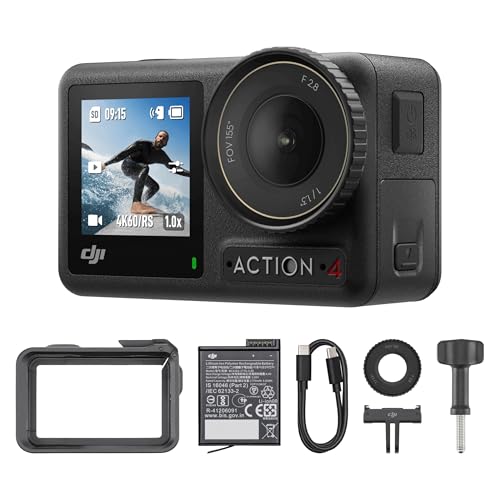
The Standard Combo is the box for a first-time owner: the camera, its protective frame, quick-release adapter mounts, a battery and the essentials to get it onto a helmet or bars today. Nothing in it is exotic, and that is the point — it converts money into footage with the fewest intermediate purchases of any pick here.
- Sensor: 1/1.3-inch
- Video: 4K up to 120fps
- Waterproof: 18m without a case
- Mounting: magnetic quick-release system
- Screens: front and rear touch
Strengths
- Low-light footage in a class the budget picks cannot reach.
- Stabilisation stays composed on genuinely violent mounts.
- Quick-release mounts make multi-position days effortless.
Trade-offs
- Costs several times the budget cameras in this guide.
- Best mounts live inside DJI’s own ecosystem.
- Over-specified for a camera destined for a disposable mount.
Best for: riders, skiers, paddlers and creators who shoot at the edges of the day and publish the results.
Not suited for: mounts where loss is likely — that is what the AKASOs below are for.
DJI Osmo Action 4 Essential Combo — Best if you own mounts
Everything written above about the Action 4’s sensor, stabilisation and waterproofing applies here unchanged, because this is the same camera — the Essential Combo simply trims the box. That makes this review a purchasing exercise rather than a technical one, and it begins with a drawer audit. Open the drawer where action-camera accessories go to multiply: if it contains mounts, adapter plates, spare batteries and a case from an earlier DJI or a compatible setup, the Essential box stops you paying twice for objects you already own.
If the drawer is empty, the arithmetic flips — buying the missing pieces separately usually costs more than the Standard Combo’s premium, and arrives in three parcels across a fortnight. The Essential buyer is therefore a specific person: the upgrader, the second-camera buyer adding a B-angle to an existing DJI setup, or the minimalist who mounts a camera in exactly one place and needs nothing else. For the second-camera buyer especially, matching the A-camera exactly is worth more than any accessory: identical colour, identical stabilisation character, cuts that interleave without grading gymnastics.
One check before ordering either combo: confirm the current listing’s contents line by line, because bundle compositions shift between seasons and regions, and the difference between the two boxes is precisely the sort of detail a headline will not tell you. The camera, though, is a constant — and it is the best conventional action camera in this guide in whichever box it arrives.
- Sensor: 1/1.3-inch (same camera as Standard Combo)
- Video: 4K up to 120fps
- Waterproof: 18m without a case
- Bundle: essentials only — mounts and spares trimmed
- Best paired with: an existing DJI accessory collection
Strengths
- Flagship camera without paying again for owned accessories.
- Perfect B-camera match for an existing Action 4 setup.
- Leaner box means less plastic in the infamous drawer.
Trade-offs
- False economy for a first-time owner with no accessories.
- Bundle contents vary — the listing must be read carefully.
- Spares you skip buying are spares you will want mid-trip.
Best for: upgraders and second-camera buyers already inside DJI’s accessory ecosystem.
Not suited for: a first action camera purchase, where the Standard Combo is the safer spend.

Insta360 X4 — Best creative format
The X4 must be introduced as what it is: a 360 camera, a different class from the forward-facing five around it. Two fisheye lenses record the entire sphere around the camera in 8K, and the creative act moves from the mountain to the edit — afterwards, in the app, you pan a virtual camera through the recorded sphere and export ordinary clips of whichever direction turned out to matter. The skier who fell behind you, the whale that surfaced on the other side of the kayak, the summit view opposite your selfie: a 360 camera was already looking at all of them.
Its party piece is the invisible selfie stick. Mounted on the standard stick, the X4’s stitching erases the stick from the footage, producing the floating, drone-follows-you shot that made this format famous — a solo rider apparently filmed by a patient friend who does not exist. It also works as a conventional camera: a single-lens mode records ordinary wide-angle 4K video when the sphere is unnecessary, and the camera is waterproof to 10 metres with removable lens guards for the risky days.
The costs are workflow and files. Reframing takes time — minutes per clip in an app that is powerful but a commitment — and 8K 360 files are enormous, hungry for card space and phone storage alike. A reframed clip also carries less fine detail than the Action 4’s native frame, because its pixels were spread across a whole sphere. Buy the X4 for the shots only it can make, not as a like-for-like flagship replacement, and it will feel like a superpower; buy it expecting a simpler GoPro and it will feel like homework.
- Format: dual-lens 360 camera
- Video: 8K 360; 4K single-lens mode
- Waterproof: 10m without a case
- Signature: invisible selfie stick effect
- Editing: reframe in app after shooting
Strengths
- Never points the wrong way — the moment is always in frame.
- Floating third-person shots with no drone and no cameraman.
- Single-lens mode covers ordinary action-camera duties.
Trade-offs
- Reframing workflow adds real editing time to every clip.
- Huge files demand fast cards and generous storage.
- Reframed detail trails a native 4K action camera.
Best for: solo creators, skiers, riders and travellers who film alone and direct later.
Not suited for: anyone who wants finished clips straight off the camera with no editing step.

AKASO EK7000 — Best budget classic
The EK7000 is the budget action camera against which all others are measured, largely because it has been answering the same question for years: what does honest action footage cost at minimum? Its answer is 4K video at 30 frames per second, 20MP stills, electronic stabilisation, a wrist remote that starts recording without fumbling for the camera, and a waterproof case rated to 40 metres — the full grammar of the category, at a price that reclassifies the camera from “equipment” to “consumable” in the owner’s mind, with all the creative freedom that brings.
Daylight is its element. On a sunny trail or a bright beach, EK7000 footage is cheerful, sharp enough for any screen it will actually be watched on, and stabilised adequately for handlebar and helmet mounts. The bundled accessory kits that accompany most listings — mounts, straps, the case — mean a first-time owner films on day one with nothing else to buy, which is a large part of how this camera became the default gift, club and school-trip action camera.
The giving ground appears exactly where physics says it must. The small sensor’s low-light footage is noisy and soft; stabilisation, being electronic and daylight-dependent, deteriorates as light falls; audio through the waterproof case is muffled, as it is on every cased camera. None of this surprises anyone who read the price. Judge the EK7000 by its daylight, at its price, on the mounts too risky for a flagship, and it is not a compromise at all — it is the correct tool, bought with open eyes.
- Video: 4K at 30fps
- Stills: 20MP
- Waterproof: to 40m in supplied case
- Stabilisation: electronic (EIS)
- Extras: wireless wrist remote included
Strengths
- The complete action-camera experience at the lowest cost here.
- Remote control is genuinely handy on helmet and bar mounts.
- Deep-water case included rather than sold separately.
Trade-offs
- Low-light footage is the weakest in this roundup.
- 4K recording tops out at 30fps — no slow-motion headroom.
- Case muffles audio, as waterproof cases always do.
Best for: risky mounts, first cameras, club and family fleets bought in multiples.
Not suited for: dawn, dusk or forest shooting where its sensor runs out of light.

AKASO Brave 4 — Best budget all-rounder
The Brave 4 sits a rung above the EK7000 in AKASO’s own ladder, and the step buys polish rather than a new category: 4K/30 video and 20MP stills again, electronic stabilisation, the same 40-metre waterproof case arrangement, and a generally more finished camera to live with — the pick for the budget buyer who wants the fleet camera to also be the camera they reach for when only one goes in the bag. Its adjustable field of view is a thoughtful inclusion, letting you narrow the fisheye sprawl for a more natural frame when the ultra-wide look is not wanted.
On the trail, the Brave 4 and EK7000 produce footage closer than their prices suggest, which is a compliment to both. The Brave’s stabilisation and handling feel a touch more assured, its menus and screens a touch clearer, and those touches compound across a season of use in the way spec sheets never capture. For a buyer choosing between them, the honest guidance is this: multiples for a fleet, take the EK7000 and spend the change on mounts; a single budget camera to live with daily, take the Brave 4.
Its ceiling is the family ceiling — small sensor, 30fps at 4K, stabilisation that prefers daylight. Within that ceiling it is a complete, likeable camera, and its existence is the strongest argument in this guide that the action camera’s essential magic — waterproof, mountable, fearless — was never really about the flagship price at all.
- Video: 4K at 30fps
- Stills: 20MP
- Waterproof: to 40m in supplied case
- Stabilisation: electronic (EIS)
- Field of view: adjustable
Strengths
- More polished handling than the EK7000 for a modest step up.
- Adjustable field of view tames fisheye when you want it to.
- Same fearless price logic as its sibling.
Trade-offs
- Shares the budget class’s low-light and 30fps ceilings.
- Footage gap to the EK7000 is smaller than the price gap.
- App experience is functional rather than delightful.
Best for: the single budget camera you will actually live with every weekend.
Not suited for: buyers planning a multi-camera fleet, where the EK7000’s price multiplies better.
Hiicam 4K Action Camera — Best budget screens
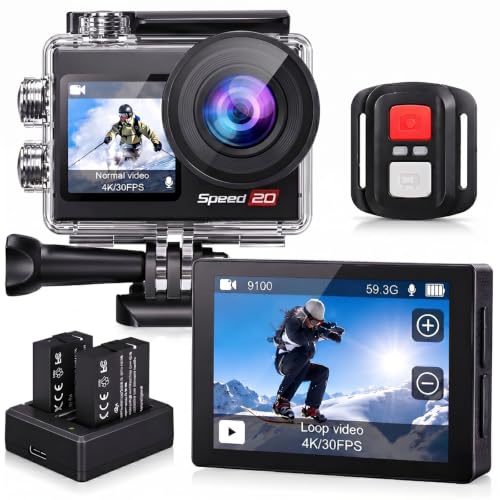
The Hiicam’s distinguishing idea is aimed at the person holding it: two touchscreens, one on the back and one facing forward, so the camera can be framed properly when it points at you. On the budget end of this market that is a genuinely differentiating feature — vlog-style pieces to camera, self-timed group shots and any mount where the photographer is also the subject stop being guesswork. Around that idea sits a familiar, competent package: 4K video, 20MP stills, electronic stabilisation, a 170-degree wide lens, Wi-Fi for phone transfer, and waterproofing to 40 metres with its case.
In use, the front screen changes behaviour more than any spec bump would. A rider narrating a trail, a traveller recording the summit piece, a parent filming themselves being towed by toddlers on a sledge — all stop performing the record-check-shuffle of rear-screen cameras. The touchscreen interface also lowers the learning curve for the family members and friends these cameras get lent to, which, given the lending habits of action-camera owners, is a practical virtue and not a small one.
Expect the budget class’s usual physics beyond the screens: daylight is its friend, dusk is not, and its stabilisation is a daylight tool. What the Hiicam proves is that the budget tier has stopped merely copying flagship spec sheets and started solving its own users’ problems — and for the self-filming majority, a front screen solves a bigger problem than another ten frames per second would.
- Video: 4K
- Stills: 20MP
- Screens: dual touchscreens, front and rear
- Lens: 170° wide angle
- Waterproof: to 40m with case
Strengths
- Front touchscreen makes self-framing foolproof.
- Touch interface is the friendliest here for beginners.
- Full budget feature set around the screens.
Trade-offs
- Low-light performance matches its budget class, not the DJI.
- Two screens draw more battery than one.
- Brand support network is thinner than DJI’s or AKASO’s.
Best for: vloggers, travellers and families who film themselves as much as the scenery.
Not suited for: a buyer whose priority is an established brand’s long-term support.
How do the six compare where it counts?
| Camera | Top video | Sensor/format | Waterproof | Defining trait |
|---|---|---|---|---|
| DJI Action 4 (both combos) | 4K/120 | 1/1.3-inch | 18m bare | Low light + stabilisation |
| Insta360 X4 | 8K 360 | Dual-lens 360 | 10m bare | Reframe after shooting |
| AKASO EK7000 | 4K/30 | Small sensor | 40m in case | Price and fleet value |
| AKASO Brave 4 | 4K/30 | Small sensor | 40m in case | Budget polish |
| Hiicam 4K | 4K | Small sensor | 40m in case | Dual touchscreens |
The table’s story is that “best” in this category is a job description, not a ladder. The DJI wins the image-quality job outright; the X4 wins a job only it applied for; and the budget trio win the jobs — risky mounts, fleets, self-filming — where a flagship would be wasted or worse, left at home for fear of losing it.
How do you choose mounts and positions like someone who does this often?
The mount decides the movie more than the camera does. Chest mounts give the most immersive riding and paddling footage because the frame includes your arms, bars or paddle — the viewer borrows your body — while helmet mounts float higher and steadier but can feel detached, showing the world without the effort. Handlebar and frame mounts vibrate the most and reward the DJI’s stabilisation specifically; on the budget cameras, a bar mount in rough terrain is where their electronic stabilisation reaches its honest limit, and moving the same camera to your chest will improve its footage more than any setting.
Whatever the mount, the safety tether is the professional’s tell. A short leash from camera to a second anchor point costs almost nothing and converts most “camera lost” stories into “camera dangled” stories; the budget cameras’ replaceability is a comfort, not a strategy. Suction mounts on vehicles want a clean surface, a tether, and a test tug at walking pace before the road does the testing for you. And learn the quick-release direction of your system blindfolded — the DJI’s magnetic mounts shine here — because the moment worth filming rarely waits for fine motor skills in gloves.
Angles multiply stories. On any ride or run, two positions — chest and seat-post rear-facing, say — cut together into something that feels directed, and this is where the mixed fleet earns its keep: the DJI forward, an AKASO behind, the X4 on a stick for the summit. You are not buying cameras at that point; you are buying viewpoints, and viewpoints are what editing turns into films.
What mistakes do action-camera buyers keep making?
Buying resolution and ignoring frame rate is the classic. Slow motion — the genre’s signature pleasure — lives in frames per second: the Action 4’s 4K/120 exists precisely so a jump can unfold at quarter speed without juddering, while a 4K/30 budget camera slowed the same way turns steppy. If slow motion is your plan, frame rate is your specification, and it outranks resolution entirely. The mirror-image mistake is filming everything at maximum settings by default: 4K/120 devours cards and batteries, and a gentle trail ride home in 4K/60 or 1080p loses nothing anyone will see.
Second, forgetting that audio is half the memory. Wind noise ruins more action footage than shaky mounts do; a foam wind cover, a camera position sheltered by your own body, or simply accepting music over the top are the working answers, and cased cameras — all the budget picks underwater — record the world through plastic, which no setting fixes. Third, neglecting the boring rehearsal: pair the app, format the card in-camera, and record a test clip at home. Every action camera in this guide is simple; every one has a menu quirk that is much better discovered in the kitchen than on the chairlift.
Finally, owners under-buy storage and power. Action days generate footage in torrents, and a card that fills at the day’s best moment is a small tragedy repeated across the sport. Carry a second card and a second battery before you carry a second mount; the fleet cameras’ cheap batteries make this painless, and the DJI rewards the same habit on longer expeditions.
How does action-camera stabilisation actually work?
Every camera here stabilises electronically, and understanding the mechanism explains both its magic and its limits. The camera reads motion sensors hundreds of times per second, then shifts and slightly crops the image frame in the opposite direction of each shake, smoothing the footage in real time. The crop is the tell: stabilisation costs a slice of your field of view, and stronger stabilisation costs a bigger slice, which is why several of these cameras offer stabilisation levels rather than a single on-off switch. For a gentle hike, the light setting preserves the widest view; for a downhill run, the strongest setting earns its crop.
Light is the mechanism’s silent partner. Electronic stabilisation needs fast shutter speeds to work with sharp frames; in dim light the camera lengthens each exposure, frames smear with motion blur, and no amount of shifting can un-smear them. This is why the budget cameras’ stabilisation “gets worse at dusk” in owner reports — it is not the algorithm failing, it is the raw material degrading — and why the DJI’s larger sensor, which keeps shutter speeds up in poorer light, seems to stabilise better in the evening as a side effect of gathering more light. When a trail runs into evening, the practical fixes are a chest mount (your torso is a stabiliser), slower and smoother riding, or accepting the grittier look as the honest texture of last-light footage.
The X4 plays a different game entirely: because it records the whole sphere, its stabilisation re-aims a virtual camera through perfectly smooth space in the edit, producing that uncanny floating footage where the horizon stays level while the world pitches around it. It is the strongest stabilisation story in this guide, purchased — as ever with the X4 — with workflow rather than with money.
What does a good day’s workflow look like, from trailhead to shared clip?
The owners who love their footage share a rhythm. Before leaving: batteries charged the night before, card formatted in-camera, lens wiped, and one test clip recorded and played back — thirty seconds that have saved more days than any accessory. On the trail: short clips, deliberately. A dozen twenty-second clips are an edit waiting to happen; one forty-minute recording is an archaeological dig. Start the camera before the interesting section, stop it after, and use the AKASOs’ wrist remote or the DJI’s quick capture from standby to make that discipline effortless.
Back home, the transfer decides whether footage gets watched or buried. The DJI and Insta360 apps make phone edits genuinely pleasant — Insta360’s is the creative centre of the whole X4 proposition — while the budget cameras are happiest with a card reader and a laptop folder named by date and place. Whatever the route, rename or folder the day’s files before the next outing; action footage is uniquely anonymous a month later, one rocky descent looking much like another, and the metadata of your own memory fades faster than the cards fill.
Editing restraint is the final skill. Cut the clip to the moment, keep the natural sound where it carries the story — water, wind, a whoop — and resist stabilising or filtering footage that was honestly rough. The audience for action video can smell over-processing, and the genre’s charm has always been evidence over polish: proof that you were there, at that speed, in that light.
Which camera suits which sport?
Mountain biking splits by light: open, sunny bike-park laps flatter every camera here, but wooded singletrack — the sport’s soul — is a low-light exam the DJI passes and the budget cameras sit nervously. Skiing and snowboarding add cold to the exam, and the Action 4’s cold-rated batteries are a genuine competitive edge on a January chairlift; the X4, meanwhile, is the skier’s creative favourite, its invisible-stick follow shots having practically become the house style of solo ski edits. Surfers divide by budget and bravery: the DJI case-free to 18 metres for the confident, an AKASO in its case on the board itself, where boards and cameras part company often enough that replaceability is a feature.
Motorsport and track days reward frame rate above all — wheel speed, suspension movement and the moment of a slide all live in high-frame-rate footage — which points again to the DJI, tethered, on a suction or roll-bar mount. Underwater leisure reverses several rankings: colour fades with depth for every camera, cases fog if sealed with humid air inside (assemble them in air-conditioning, with a desiccant strip), and the simple, cheap, cased AKASOs have filmed a generation of holiday reefs perfectly happily. Runners and hikers, carrying everything on their bodies, should weigh grams and simplicity: the budget cameras’ lightness and the DJI’s quick-release both argue well, and the X4 on a short stick has become the trail runner’s selfie instrument of choice.
The pattern underneath the sport-by-sport answers is consistent enough to state as a rule: the more your sport involves darkness, cold or speed, the more the flagship earns; the more it involves water, impacts and multiples, the more the fleet cameras make sense. Most owners’ sporting lives contain both kinds of day, which is why this guide keeps landing on mixed setups as the grown-up answer.
How do you keep an action camera alive for years?
The lens is the life of the camera, and it is unprotected glass on most of these bodies — the X4’s protruding twin lenses most of all, which is why its removable guards exist and why they should be on whenever the camera is not actively filming something precious. A scratched lens cannot be polished out at home; it is a repair or a replacement, so the guard, the case in transit, and never tossing the bare camera into a kit bag are the three habits that decide longevity. The DJI’s flatter lens and available protective glass make it the most forgiving of the six in this respect.
Water discipline comes second. Rinse salt water off with fresh water after ocean days, open cased cameras only when hands and camera are dry, and inspect the case seal for a single hair or grain of sand before every dive — that grain is the difference between a 40-metre rating and a flooded camera, and it has ended more EK7000s than any wave. Batteries prefer being stored half-charged rather than full or empty across a winter, and a camera put away clean in October is a camera that works on the first powder day of December.
How do you manage power and storage on a multi-day trip?
Expeditions expose the arithmetic that day trips hide. A camera recording 4K through a six-hour riding day wants roughly three batteries and, at high frame rates, can fill a large card before dinner. The working system is rotation: battery in the camera, battery in a pocket warming against you in cold weather, battery on charge whenever a vehicle or a lodge socket appears — with the DJI’s fast-charging case turning that rotation into an organised habit rather than a cable tangle. The budget cameras’ cheap spare batteries make the same rotation painless in money terms, which is one more reason fleets travel well.
Storage discipline matters as much as power. Offload each evening to a laptop or a portable drive, format the card in the camera afterwards, and never let the only copy of a day’s footage ride in the same bag as the camera for the rest of the trip. The X4’s enormous 360 files compress this schedule hardest — expedition X4 owners plan storage the way film photographers once planned rolls, deciding which runs earn the sphere and which are shot in single-lens mode. That decision, made on the chairlift rather than in the edit, is the mark of someone who has lived with the format.
What do the numbers on an action camera’s box actually promise?
Resolution and frame rate combine into the honest specification: “4K/30” promises full detail at normal speed, “4K/120” promises the same detail slowed to quarter speed, and a camera that shouts “4K” while whispering its frame rate is telling you where its ceiling sits. Bitrate — rarely printed, always felt — decides how much of that resolution survives movement and texture; grass, water and gravel are bitrate stress tests, and the flagship’s cleaner rendering of a gravel descent is bitrate and sensor working together, not resolution alone.
Waterproof numbers need the same translation. A bare-camera rating like the DJI’s 18 metres or the X4’s 10 describes the camera itself, seals and all; a cased rating like the budget cameras’ 40 metres describes the case, and collapses to “splash-proof at best” the moment the camera comes out of it. Owners who understand which number they are holding make better decisions at the water’s edge. Finally, treat every “up to” in battery claims as a fair-weather figure measured at gentle settings; your real number, at your settings, in your cold, is the one the trip-planning section tells you to build rotation around.
How do the accessory ecosystems compare in real life?
An action camera is a mount standard with a sensor attached, and the six here divide into three ecosystems. DJI’s magnetic quick-release is the modern pole: fast, positive, increasingly supported by third parties, and the reason Action 4 owners swap positions mid-ride without tools. The budget trio use the traditional action-camera mounting world — the fin-and-thumbscrew pattern the whole industry grew up on — which means a decade of cheap mounts, poles, clamps and harnesses fits them all, and a broken mount on holiday can be replaced from almost any beach shop on earth. That ubiquity is a genuine ecosystem advantage the flagship cannot copy.
The X4 stands apart again: it works best on selfie sticks and poles rather than body mounts, uses standard tripod threads, and treats its lens guards and stick as core kit rather than accessories. Owning two ecosystems is less burdensome than it sounds — most mixed-fleet owners standardise on the traditional mounts for the fleet and keep the DJI on its quick-release for the A-camera, with one adapter plate bridging the two worlds on the rare day everything must share a pole.
Batteries tell the same story in miniature. DJI’s cells cost flagship money and behave like it in the cold; AKASO batteries cost so little that owners buy them by the handful and stop thinking about power entirely. Neither approach is wrong — they are the premium and fleet philosophies expressed in a charger — but know which philosophy you are buying into, because the camera is the cheap part of any ecosystem over a five-year life.
What does each buyer type in this guide’s inbox actually end up choosing?
The upgrading phone-filmer, tired of a phone’s fragility and zoom, lands on the Action 4 Standard Combo nine times out of ten and never looks back. The parent equipping two children and a dog lands on a pair of EK7000s and reports, correctly, that the footage of the dog is priceless and the cameras are somehow still alive. The solo ski-tourer lands on the X4, films everything, edits on the train home, and becomes evangelical in a way this guide can describe but not reproduce.
The returning enthusiast with a drawer of mounts lands on the Essential Combo and spends the saving on a bigger card. The family documenter lands on the Hiicam because grandma can work its touchscreen. And the rider who does everything — dawn patrols, bike parks, one surf trip a year — lands, eventually, on the mixed fleet: a DJI for the helmet, an AKASO for the bars, and no anxiety anywhere in the system. These patterns are offered not as rules but as recognition: if you saw yourself in one of them, your decision is probably already made, and it is probably right.
What about filming other people — the courtesy chapter?
Action cameras film everyone around their owner, and the genre’s social licence depends on owners behaving as if that matters. On trails and slopes the convention is relaxed — a camera on a helmet is visible, expected, and mostly pointed at its owner’s friends — but a few habits keep it that way. Tell your group when the camera is rolling if you are recording conversation as well as descents, keep the camera off in changing areas and around other people’s children at the pool, and be gracious when a stranger asks not to be in the background of a piece to camera. It costs a clip; it buys the sport its welcome.
Publishing raises the stakes one notch. Footage of your own group, posted for your own circle, is the genre’s home ground; footage in which a stranger’s crash, argument or number plate is the attraction deserves a second thought and, where practical, a blur or a crop. The X4 sharpens the question in an interesting way, because it records people its owner never saw — behind, beside, across the lift queue — and reviewing 360 footage before posting sometimes reveals bystanders who never knew a camera existed. A minute spent checking is the difference between a creator and a broadcaster of other people’s afternoons.
None of this is legal advice, and rules vary by place and purpose; it is simply the etiquette that keeps action cameras welcome on the mountains and beaches they were built for. The owners in this guide’s community who film the longest careers are, without exception, the ones other people are happy to see arrive with a camera.
One last check before you order
Confirm three things on the listing in front of you, whichever pick you chose. First, the bundle contents as they stand today — combos are revised quietly, and the difference between a camera that arrives ready to mount and one that arrives needing three more purchases is written in that contents list, not in the headline. Second, the card: none of these cameras includes the fast, large microSD card their best modes want, so add one to the same order rather than discovering the omission at the trailhead. Third, the return window and warranty route, especially on the budget picks, where buying from a seller who honours returns painlessly is worth more than the last few units of discount elsewhere. Do those three checks and the camera that arrives will be the camera this guide described — which is the entire point of reading it before, rather than after, the box lands on the mat.
Final Recommendation
Let the work choose. If one camera must do everything well — publishable footage, dawn starts, violent mounts, years of service — the DJI Osmo Action 4 is the answer, in the Standard Combo for new owners and the Essential Combo for anyone already holding DJI accessories. If you film alone and want shots that look crewed, the Insta360 X4 is not a compromise but a different and delightful instrument. And if the plan involves risk, multiples or a first taste of the category, the AKASO EK7000, Brave 4 and Hiicam divide the budget honours by job: fleets, daily polish and self-filming respectively. The best action camera besides GoPro, it turns out, is not one camera — it is the one whose strengths point at your footage and whose price points at your courage, mounted well, tethered always, and rolling before the moment arrives.
Frequently Asked Questions
Is the DJI Action 4 really better than a GoPro?
They are close rivals with different strengths; this guide exists for buyers choosing not to buy a GoPro, and within that brief the Action 4’s larger sensor gives it the low-light edge that decides most real-world comparisons, alongside stabilisation and cold-weather battery behaviour that owners consistently praise. If your footage lives at dawn, dusk or in the forest, it is the strongest conventional choice here.
Do the AKASO cameras really record 4K?
Yes — the EK7000 and Brave 4 record genuine 4K-resolution video at 30 frames per second. What separates them from the DJI is not honesty but physics: smaller sensors, less low-light ability and stabilisation that prefers daylight. In bright conditions their footage satisfies most viewers on most screens.
Can the Insta360 X4 replace a normal action camera?
For many solo shooters, yes — its single-lens mode records ordinary 4K wide-angle video, and the 360 mode covers everything else. The replacement costs you editing time on 360 clips and some fine detail compared with a native action camera, so hybrid owners often end up pairing an X4 with a conventional camera rather than choosing between them.
Which camera is best for snorkelling and diving?
For snorkelling and casual depth, the Action 4’s 18-metre case-free rating is the most convenient — nothing to seal, nothing to fog. For diving toward 40 metres, the cased budget cameras and a cased DJI all qualify; the AKASOs include that case in the box, which makes them the value diver’s pick.
How long do action-camera batteries last?
Plan around one to two hours of recording per battery depending on resolution, frame rate, screen use and temperature — the DJI sits at the strong end of that range and resists cold unusually well, while dual-screen use shortens the Hiicam’s day. Every serious outing in this guide’s advice carries a spare battery; they are small, and the best light of the day rarely checks your charge level first.
What memory card should I buy?
A reputable microSD card rated for sustained video write speeds — look for V30 or better for 4K work, and higher for the X4’s 8K 360 files, which are the hungriest here. Format the card in the camera before a big day, and treat bargain no-name cards as the false economy they reliably prove to be.
Are action cameras good for family holidays?
Surprisingly, they may be the best holiday cameras of all: waterproof in the pool, unbothered by sand, small enough to hand to a child, and wide enough that aiming barely matters. The Hiicam’s front screen suits family pieces to camera, the EK7000’s price suits being borrowed by the entire villa, and the footage — splashes, rides, grandparents on a pedalo — tends to be rewatched more than any posed album. Many families buy one for a trip and find it has quietly become the household’s default camera for anything involving water, wheels or weather.
Can I use an action camera as a dashcam or webcam?
Most of these cameras offer loop recording or a webcam mode over USB, and the DJI in particular moonlights respectably at a desk. As dashcams they work but ask for daily attention a dedicated dashcam does not; as webcams their wide lens flatters no one at close range, though it captures a whole workshop or classroom in a way a laptop camera cannot. Treat both roles as pleasant side talents rather than reasons to buy — the mountain is still the main job, and it is the job these six were ranked on.
Related Guides
More camera guidance lives in our roundups of the best 4k underwater cameras, the best 8k video cameras and the best 1080p action cameras.



[…] more camera roundups: the best 4k zoom cameras, the best affordable portrait cameras and the best advanced compact […]