What's inside
- Key Takeaways
- Quick Picks
- What Makes a DSLR Work on the Street at All?
- Which Focal Lengths Does the Street Actually Run On?
- How Do You Shoot Street With a DSLR Without Becoming the Story?
- What Does the Rest of the Street Kit Look Like?
- How Does Zone Focusing Turn a Slow Camera Fast?
- What About Colour Versus Black and White?
- How Should You Handle the Ethics of Photographing Strangers?
- Where Do You Walk? Building a Street Practice in Your Own City
- How Do You Edit a Street Day Without Killing It?
- What Does Travel Change About the Street Kit?
- How Long Can a DSLR Street Kit Sensibly Last?
- Which Settings Deserve a Custom Button and Which Deserve Forgetting?
- How Do You Practise When the Streets Are Quiet?
- Side by Side: Size, Screens and Street Manners
- Which Street Buying Mistakes Repeat Most Often?
- Final Recommendation
- Frequently Asked Questions
- Related Guides
As an Amazon Associate I earn from qualifying purchases. This post may contain affiliate links at no extra cost to you.
gizmoverdict.com is reader-supported. When you buy through links on our site, we may earn an affiliate commission.
Where to buy: Street kits live and die by what is actually in the box, so read each listing’s contents line before comparing headline prices — several picks below are bundles or two-lens kits whose value sits in the glass, and one is an older sealed Pentax whose listing is a remaining-stock kit rather than current production.
Street photography asks a camera to disappear. The best dslr cameras for street photography are therefore the small ones, the quiet ones and the ones that focus without fuss while a scene assembles itself for half a second and then dissolves. That is an awkward brief for a DSLR, a format built around a mirror box and an optical finder, and this guide will not pretend otherwise: a mirrorless camera or a fixed-lens compact will always be smaller. What a DSLR still offers the street shooter is a particular set of virtues — an optical viewfinder that shows the street exactly as your eye sees it, battery life measured in days of walking rather than hours, a deep shelf of small prime lenses at used prices, and a shape the public reads as a tourist’s holiday camera rather than professional equipment.
That last virtue is underrated. On the street, being underestimated is a working tool. A modest Rebel or a small Nikon with a pancake prime draws a fraction of the attention of a flagship body with a fast zoom, and attention is the currency street photographs are paid for in. Every pick below was chosen for how it behaves at arm’s length from strangers: its size with a compact prime fitted, the sound and discretion of its shutter, how quickly it wakes and focuses, and whether its screen lets you shoot from the waist like the photographers who defined the genre with twin-lens cameras held at their belts.
One structural note before the picks. Most of these cameras are APS-C bodies, and on the street that is a feature disguised as a compromise. The crop factor turns small, cheap prime lenses into classic street focal lengths — a 24mm pancake becomes a 38mm equivalent on Canon, a 35mm becomes a 52mm on Nikon — and the deeper depth of field at working apertures forgives the zone-focus technique the genre runs on. Full frame is not missed here. Discretion is everything, and crop bodies are the discreet ones.
Key Takeaways
- Size with a compact prime fitted matters more than body specifications; every pick below was judged as a carried camera, not a shelved one.
- APS-C is an advantage on the street: small primes land on classic focal lengths and depth of field forgives zone focusing.
- An optical viewfinder keeps you watching the street instead of a screen, and DSLR battery life covers days of walking per charge.
- Waist-level shooting via a tilting or articulating screen is the modern version of the classic twin-lens street technique.
- The Pentax K-50 is the sealed pick for wet cities; its successor, the K-70, had no clean current listing when this pool was checked.
- Buy the prime before the zoom: a kit zoom is for learning, but a small fast prime is what makes a DSLR vanish in the hand.
Quick Picks
| Pick | Badge | Why it earns its place |
|---|---|---|
| Nikon D5600 (18-55mm kit) | Best overall | The balanced street Nikon: light body, swivelling touchscreen for waist-level frames, and Nikon’s small DX primes behind it. |
| Canon EOS Rebel SL3 (bundle) | Best compact DSLR | The smallest DSLR Canon made, with Dual Pixel focusing and a screen that flips for discreet low angles. |
| Pentax K-50 (18-55mm WR kit) | Best weather-sealed value | A genuinely sealed body and kit lens at an entry price, for cities where the rain is part of the material. |
| Canon EOS Rebel T8i (kit) | Best video-capable | Canon’s most polished Rebel for shooters who split their street work between stills and short vertical clips. |
| Nikon D3500 (kit) | Best beginner price | The lightest way into the Nikon street kit, with a battery that outlasts a weekend of walking. |
| Canon EOS Rebel T7 (two-lens kit) | Best two-lens kit | Two zooms in the box cover wide scenes and compressed candids from across the street on day one. |
What Makes a DSLR Work on the Street at All?
Start with the objection, because it is a fair one: the mirror slap of a DSLR is audible, the body is deeper than a mirrorless rival, and the genre’s legends mostly shot rangefinders. The counter-argument is practical rather than romantic. A DSLR’s optical finder never blacks out, never lags, and never shows you a processed preview instead of the world — you watch the actual street, at the speed of light, and the frame you take is the frame you saw. For a style of photography built on anticipation, that directness is not nostalgia. It is a working method.
The second practical argument is endurance. Street photography is walking: six hours through a city, camera on, finder used constantly, screen mostly off. DSLRs were engineered for exactly that duty cycle, and the picks below return battery figures — in real use, not brochure language — that let a shooter forget the charger for a weekend trip. The third argument is economic. Because the industry moved on, the small primes that street photography runs on — Canon’s EF-S 24mm pancake, Nikon’s 35mm DX, Pentax’s limited pancakes — circulate used at prices that make experimentation cheap. A street kit assembled around any body here can cost less than a single fashionable fixed-lens compact, and it can change its lens.
Judging, then, weighted carried size with a prime fitted, shutter discretion, wake-and-focus speed, screen flexibility for waist-level work, and the prime shelf behind each mount. Raw sensor heroics mattered less: street light is usually workable light, and the genre’s grain-tolerant aesthetic forgives high ISO in a way product photography never would.
Which Focal Lengths Does the Street Actually Run On?
The classic street kit is one body and one prime, and the focal-length argument has run for seventy years without a loser. The arithmetic on these crop bodies runs like this: Canon’s EF-S 24mm pancake delivers roughly a 38mm equivalent view, Nikon’s 35mm DX prime delivers roughly a 52mm view, and a kit zoom at its wide end covers the broader, scene-setting angles. The 35-to-40mm view shows a scene with context: a subject, their gesture, and enough of the street around them to explain why the moment mattered. The 50mm view isolates: a face, a pair of hands, a shaft of light, with the background politely compressed.
Neither is correct; they are different temperaments. Photographers who work close and wide accept being noticed occasionally as the price of intimacy. Photographers who work at 50mm and beyond trade intimacy for invisibility. The two-lens T7 kit at the end of this list exists for readers who do not yet know their temperament: its zooms cover both views clumsily but completely, and a season of shooting with them will reveal which prime to buy — the focal length your zoom kept returning to is the prime you actually are.

Nikon D5600 (18-55mm kit) — Best overall
The D5600 is the street pick for readers who want one camera that behaves properly in every street situation rather than excelling at one. The body is light without feeling hollow, the grip suits one-handed shooting with the strap wrapped at the wrist, and its 24.2-megapixel sensor delivers files that take cropping gracefully — a real consideration when a frame grabbed at waist level needs straightening and trimming in the edit. Its vari-angle touchscreen is the headline feature for this genre: fold it out, hold the camera at your belt, and compose on the screen looking down, the exact posture that made the old twin-lens cameras such discreet street instruments. Nobody photographs a person holding a camera at their waist the way they photograph a person raising one to their eye.
Through the finder, the 39-point autofocus is quick enough for walking-pace subjects and honest about its limits with erratic motion. In live view the focusing is slower and more deliberate, which suits the waist-level method — street scenes at f/8 with zone focus barely ask the autofocus to work at all. SnapBridge connectivity moves a finished frame to your phone without a cable, which matters to shooters who publish the same evening. The kit 18-55mm AF-P lens is quiet, compact for a zoom, and at its wide end gives the classic context-rich view; the natural graduation is Nikon’s 35mm DX prime, which turns this into a fast, small, near-silent outfit.
What it is not: weather sealed, particularly rugged, or blessed with a quiet-shutter mode that truly hushes the mirror — no DSLR fully manages that, and the D5600’s standard shutter has the usual mechanical voice, moderated by a small body that keeps the sound short. In a loud city that is a non-issue; in a quiet gallery or a place of worship, work slowly and accept the limit. As the complete, balanced answer for most street shooters buying a DSLR on purpose, it stands at the top of this list on merit.
- Sensor: 24.2-megapixel DX-format CMOS
- Screen: 3.2-inch vari-angle touchscreen for waist-level composition
- Kit lens: AF-P DX 18-55mm VR, compact and quiet-focusing
- Connectivity: SnapBridge Bluetooth and Wi-Fi for phone transfer
- Natural upgrade: 35mm f/1.8 DX prime for the classic standard view
Strengths
- Waist-level shooting via the swivelling screen keeps the camera out of faces
- Light, well-balanced body that carries all day without neck fatigue
- Files crop gracefully when a grabbed frame needs straightening
Trade-offs
- No weather sealing for committed rain shooting
- Live-view autofocus is deliberate rather than quick
- Mirror sound remains audible in quiet interiors
Best for: street shooters who want one balanced Nikon for finder work, waist-level frames and evening publishing
Not suited for: photographers whose cities are reliably wet and who shoot through the rain regardless

Canon EOS Rebel SL3 (bundle) — Best compact DSLR
The SL3 exists because Canon asked how small a DSLR could be, and the answer turned out to be: small enough to change the street calculation. It is the lightest body in this guide, closer in hand feel to a chunky compact than to the workhorse DSLRs of the previous decade, and paired with Canon’s EF-S 24mm pancake lens it forms the most discreet interchangeable-lens DSLR outfit ever sold — a camera that reads as a tourist snapshot machine and performs like a serious one. The bundle listing here packages the body with the extras a starter needs, which suits the way this camera is usually bought.
Inside the small shell sits a 24.1-megapixel sensor and Canon’s Dual Pixel autofocus, which makes the SL3 the best live-view focuser among the finder-first bodies in this list. That matters for the waist-level and overhead methods: tap the screen where the subject will be, and the focus lands smoothly without hunting. The articulating touchscreen matches the D5600 for low-angle discretion, the optical finder is bright for the class, and the battery stretches across long walking days in the way DSLRs are loved for. Its 4K video is heavily cropped and best treated as a curiosity; its 1080p is clean and entirely usable for street clips.
The compromises are the honest ones of miniaturisation. The finder shows a slightly smaller image than the bigger bodies, the autofocus array through the finder is a modest nine points, and the small grip will feel cramped to large hands after a full day. None of that outweighs the central fact for street work: this is the DSLR least likely to be noticed, commented on, or left at home because it felt like a burden — and the camera you carry is the only one that takes street photographs.
- Sensor: 24.1-megapixel APS-C CMOS with Dual Pixel AF
- Size claim to fame: The smallest and lightest DSLR Canon produced
- Screen: 3.0-inch fully articulating touchscreen
- Signature pairing: EF-S 24mm pancake for a near-compact street outfit
- Video: 4K with a heavy crop; clean 1080p for everyday clips
Strengths
- Genuinely inconspicuous size, especially with the pancake prime
- Dual Pixel live-view focus leads this group for screen-based street methods
- Full articulation supports waist-level, overhead and corner-held frames
Trade-offs
- Nine-point finder autofocus is basic for fast crossing subjects
- Small grip tires large hands on long walks
- 4K video crop is too tight to be a real feature
Best for: photographers whose first requirement is not being noticed, and who shoot a prime at a time
Not suited for: large-handed shooters who prefer a deep grip and a big finder image
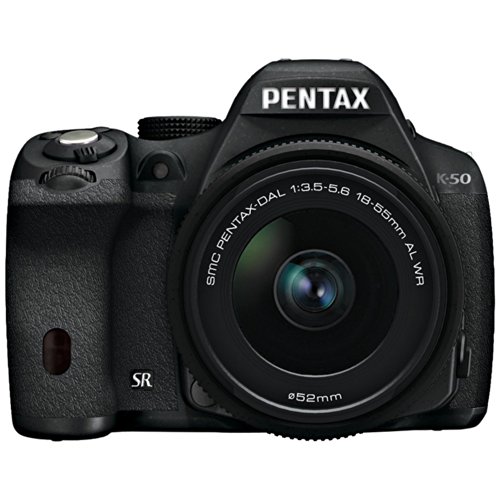
Pentax K-50 (18-55mm WR kit) — Best weather-sealed value
Every street guide needs a pick for the photographer who shoots in the rain on purpose, and the K-50 is that pick at a price nothing else here approaches. Pentax built sealing into this entry-level body and its bundled 18-55mm WR kit lens — dozens of seals against rain and dust — at a tier where Canon and Nikon offer no sealing at all. Wet pavement is the street photographer’s studio: reflections double the light, umbrellas make shapes, crowds thin out, and the city turns graphic. A camera that does not need to hide under your coat when the weather turns is a camera that gets those frames.
Beyond the sealing, the K-50 carries Pentax virtues that suit the genre. In-body shake reduction stabilises every lens fitted, including the cheap old primes the K mount is full of. The viewfinder is a proper glass pentaprism with full frame coverage, a specification rivals reserve for dearer bodies, and it makes the small body feel like a serious instrument at the eye. The 16-megapixel sensor is the oldest and lowest-resolution here, and its high-ISO ceiling shows it — but street work at f/5.6 to f/8 in daylight, or under city lights at moderate ISO, sits comfortably inside what it does well. Uniquely in this list, it can run on AA batteries with an optional holder, a genuine rescue option when travelling far from your charger.
Context matters with this pick. The K-50 is a discontinued model and the listing is remaining stock; its successor, the K-70, is the better camera on paper but had no clean current listing when this guide’s pool was verified, so the K-50 is the sealed Pentax you can actually buy with confidence today. Treat it as what it is: the cheapest honest route to weather-sealed street shooting, bought with open eyes about its age, and a body whose files will look entirely at home in a gritty black-and-white street series.
- Sensor: 16-megapixel APS-C CMOS with in-body shake reduction
- Sealing: Weather-resistant body and bundled WR kit lens
- Viewfinder: Glass pentaprism, 100% coverage — unusual at this tier
- Power quirk: Runs on AA batteries with the optional holder
- Status: Discontinued model sold as remaining stock; successor K-70 mentioned for context
Strengths
- Real weather sealing for body and kit lens at an entry-level cost
- In-body stabilisation benefits every K-mount prime, old or new
- Pentaprism finder gives a bright, complete view of the frame
Trade-offs
- Oldest sensor here, with the least high-ISO headroom
- Fixed screen rules out waist-level composition
- Discontinued: buy it as remaining stock, not as a growing system
Best for: wet-climate street shooters who want sealing and Pentax primes without flagship spending
Not suited for: low-light specialists who live at the top of the ISO range after dark

Canon EOS Rebel T8i (kit) — Best video-capable
The T8i is the Rebel for the street shooter whose practice has quietly become half video: stills on the walk, short clips for a channel, vertical footage for social feeds. Canon gave it the most complete video toolkit of any DSLR in this list — 4K recording, clean 1080p at smooth frame rates, a microphone input, and a vertical-video orientation feature aimed squarely at phone-shaped publishing. Dual Pixel autofocus keeps faces tracked while you concentrate on the scene, and the articulating touchscreen supports the low, discreet angles street stills demand as happily as it supports filming.
As a stills camera it is a polished, late-generation Rebel: 24.1 megapixels, a 45-point finder autofocus system that is the most capable in this guide’s Canon contingent, and handling that feels a size up from the SL3 without becoming conspicuous. With the 24mm pancake fitted it remains a modest presence; with the kit 18-55mm it is the tourist camera the whole genre hides behind. Battery life through the finder covers a day’s walking, and Eye AF in live view is a genuine gift for candid portraits grabbed at close range.
The reservations are about value and ceiling. The T8i was the dearest Rebel of its generation, and remaining-stock pricing can drift close to better-equipped alternatives, so the case rests on wanting its specific stills-plus-video blend in a DSLR body. Its 4K carries a crop, like the SL3’s. And a shooter who never records video is paying for a toolkit they will not open — the D5600 or SL3 will serve them better for less. For the hybrid street documentarian, though, no other DSLR here speaks both languages as fluently.
- Sensor: 24.1-megapixel APS-C CMOS with Dual Pixel AF
- Finder AF: 45-point all cross-type system, strongest of the Canon picks here
- Video: 4K with crop, microphone input, vertical-video support
- Screen: 3.0-inch fully articulating touchscreen
- Kit lens: EF-S 18-55mm IS STM, quiet for video work
Strengths
- Most complete video feature set of any DSLR in this guide
- Eye AF and Dual Pixel make candid live-view portraits dependable
- Finder autofocus handles crossing, moving subjects with confidence
Trade-offs
- Premium Rebel pricing for features stills-only shooters will not use
- 4K recording is cropped, narrowing the field of view
- Slightly larger presence than the SL3 with the same sensor
Best for: street documentarians who publish stills and short clips from the same walk
Not suited for: purists who never shoot video and resent paying for the privilege

Nikon D3500 (kit) — Best beginner price
The D3500 is the camera this guide recommends to the reader who is street-curious and budget-honest. Nikon stripped the D3000 line to its essentials and produced the lightest DSLR in the range, with a deep grip that belies its size, a 24.2-megapixel sensor shared with dearer Nikons, and battery endurance that is the stuff of legend among travel shooters — a full weekend of walking photography on a charge is a normal expectation, not a best case. For a beginner building the daily-carry habit that street photography actually consists of, those three facts outweigh every feature it omits.
What it omits is a known list: no touchscreen, no tilting screen, no Wi-Fi beyond a low-energy Bluetooth link for transferring small files. The waist-level method belongs to the D5600 above. In exchange, the D3500 offers Nikon’s Guide Mode, which genuinely teaches exposure decisions in plain language, and a control layout simplified to the point where a new shooter can run the camera by feel within a fortnight. With the kit lens it is a learning instrument; with the 35mm DX prime added — the single most recommended second purchase in this entire guide — it becomes a fast, light, classic street outfit for remarkably little money.
Experienced shooters should read it as the second-body or loaner option: the camera you hand to a friend who wants to try the genre, or keep in the car for the unplanned hour in a photogenic town. Its files are thoroughly modern; its ceiling is set by its controls, not its sensor. Beginners who outgrow it will have been taught by it, which is the most a first camera can honestly promise.
- Sensor: 24.2-megapixel DX-format CMOS
- Battery: The endurance champion of this list, built for multi-day trips
- Teaching aid: Guide Mode explains settings in plain language
- Screen: Fixed, non-touch — finder shooting is the intended method
- Natural upgrade: 35mm f/1.8 DX prime transforms it into a classic street outfit
Strengths
- Lowest cost of entry to a modern-sensor DSLR street kit
- Battery life removes charging from the travel equation entirely
- Simplified controls build the daily-carry habit fast
Trade-offs
- No tilting or touch screen for discreet low-angle methods
- Eleven-point finder AF is the most basic Nikon system here
- Kit lens cannot be removed from the equation until a prime is bought
Best for: newcomers who want a real DSLR street kit at the gentlest total cost
Not suited for: screen-led shooters who compose at waist level as their main method

Canon EOS Rebel T7 (two-lens kit) — Best two-lens kit
The T7 two-lens kit answers a different question from the other picks: not which camera, but how to be equipped for every street distance on the first morning. The box pairs the 24.1-megapixel T7 body with the EF-S 18-55mm for scenes and context, and the EF 75-300mm telephoto for the other half of street photography — the compressed candid taken from across the square, the detail of hands and signage, the layered crowd shot where distance is what makes the frame. No other pick here covers that second territory at all, and for a beginner unsure of their temperament, coverage is a form of education.
The body itself is Canon’s simplest Rebel formula: a capable sensor, a nine-point finder system, built-in Wi-Fi for moving keepers to a phone, and controls that stay out of the way. It lacks the articulating screen and Dual Pixel refinements of the SL3 and T8i — live view focusing is slow and best reserved for static subjects — and the 75-300mm is an honest budget telephoto rather than a jewel: perfectly serviceable in daylight, which is when most street telephoto work happens, and not the lens for dusk. Judged as two lenses and a modern sensor at a kit price, rather than as a body against its siblings, the package makes its own sense.
Plan the upgrade path while you buy it. The kit teaches you your focal lengths; the purchase that follows should be the prime matching the length you used most — the 24mm pancake for the wide workers, a fast 50mm-class option for the distance workers. Bought in that spirit, the T7 kit is not a compromise but a survey instrument, and its telephoto will still be earning frames years after the prime arrives.
- Sensor: 24.1-megapixel APS-C CMOS
- Kit lenses: EF-S 18-55mm plus EF 75-300mm telephoto in one box
- Screen: Fixed, non-articulating
- Connectivity: Built-in Wi-Fi and NFC for phone transfer
- Finder AF: Nine-point system, centre-point led
Strengths
- Only kit here covering both context scenes and across-the-street candids
- A season on two zooms reveals your true focal length before you buy a prime
- Simple controls keep a beginner’s attention on the street, not the menus
Trade-offs
- No articulating screen or Dual Pixel for discreet live-view methods
- Budget telephoto is a daylight lens, softening as the light falls
- Two zooms encourage carrying everything, against the genre’s one-lens discipline
Best for: beginners who want every street distance covered from day one at kit pricing
Not suited for: minimalists who already know their prime and want the smallest possible outfit
How Do You Shoot Street With a DSLR Without Becoming the Story?
Technique matters more than gear here, and the DSLR-specific technique begins with preparation. Set the camera before the scene: aperture around f/8, shutter fast enough to freeze walking pace, ISO on auto with a sensible ceiling, and focus either zone-set at a chosen distance or left to a single central point you can place instantly. The photographers who look effortless are running a pre-configured camera and spending their attention entirely on the street — watching light, gesture and geometry converge — rather than negotiating with a menu when the moment arrives.
Position and patience do the rest. Street photography rewards the shooter who finds a stage — a shaft of light between buildings, a poster wall, a market doorway — and waits for the actors, over the shooter who chases moments down the pavement. The articulating-screen bodies in this list add the waist-level posture to that patience: camera resting at the belt, eyes free to watch the scene directly, frame composed with a downward glance. It is slower and calmer than finder shooting, and in sensitive situations it is kinder. When someone does object, the professional habits are simple ones: smile, show the frame if asked, delete without argument if asked, and remember that no photograph in this genre is worth a confrontation. The camera’s job is to be forgotten; the photographer’s job is to be forgettable.
What Does the Rest of the Street Kit Look Like?
Very little, by design. A wrist strap rather than a neck strap keeps the camera in the hand and the silhouette small. A spare battery is insurance you will rarely cash with these bodies; a spare card is the one that matters. Comfortable shoes are genuinely photographic equipment in a genre measured in miles. A small, soft bag that does not announce itself as a camera bag — or no bag at all on prime-only days — completes the outfit. The one upgrade that outranks every accessory is the prime lens discussed throughout: it shrinks the camera, speeds the low-light work, and enforces the one-focal-length discipline that teaches composition faster than any course.
Money discipline follows the same shape as the real-estate guide’s, inverted. There, the lens mattered because rooms demand width; here, the lens matters because the genre demands invisibility and speed. Either way, the body is the platform and the glass is the practice. A D3500 with the 35mm prime will out-photograph a T8i with only its kit zoom on most street days, which is why this guide keeps steering budget toward the prime shelf behind each body.
How Does Zone Focusing Turn a Slow Camera Fast?
The oldest street technique is also the answer to every autofocus complaint in this guide. Zone focusing means pre-setting a manual focus distance and an aperture small enough that everything within a band of the street — say from two metres to six — falls acceptably sharp. The camera then needs no focusing at all: see the scene, raise or level the camera, fire. Response becomes instant in a way no autofocus system of this era matches, and the technique is why the genre’s history was written at f/8 on cameras far cruder than any pick here.
Crop bodies are zone focusing’s natural home, because their deeper depth of field widens the sharp band at any given aperture. The practical setup is a prime with a readable distance scale — another quiet argument for the prime shelf — aperture set for the light, shutter speed confirmed fast enough, and the discipline to work within your chosen band rather than lunging at subjects outside it. The articulating-screen bodies can zone focus at waist level for the full classic method. Beginners often resist the idea for a week, then discover their keeper rate has doubled and their missed-moment rate has collapsed. It is the single highest-value skill this guide can hand you, and it costs nothing but practice on your own street.
What About Colour Versus Black and White?
Street photography’s black-and-white tradition is partly aesthetic and partly an artefact of film economics, and DSLRs free you from choosing in advance: shoot colour RAW and decide in the edit, scene by scene. The working rule most street shooters settle on is that colour must earn its place — a red coat against a grey street, signage, the specific sodium-and-neon palette of a city at night — while scenes whose content is gesture, geometry and expression usually strengthen in monochrome, where nothing distracts from the relationships inside the frame.
There is a camera-handling consequence. Shooting with a monochrome preview — most of these bodies offer a black-and-white picture style that still records full colour RAW — trains you to see light and shape rather than colour patches, and many street photographers find their compositions improve within a month of trying it. The optical finder, of course, still shows the world in colour, which is one more honest difference from the mirrorless method: a DSLR street shooter previews in colour at the eye and in monochrome on the screen, and learns to translate. Whichever route you take, consistency across a series matters more than the choice itself; a body of work that alternates randomly reads as indecision, while one committed palette reads as a voice.
How Should You Handle the Ethics of Photographing Strangers?
The genre’s licence comes from its history and its honesty, and both impose duties. The first is proportionality: a photograph of public life, crowds, gesture and place sits at one end of the scale; a lingering, targeted portrait of a vulnerable person — someone in distress, a child without a parent nearby, a person who cannot meaningfully object — sits at the other, and the fact that a frame is lawful does not make it kind. Experienced street photographers develop a private code stricter than the law and follow it without debating themselves in the moment.
The second duty is conduct when noticed. Most encounters end with a nod when the photographer is visibly relaxed and the camera is plainly a camera, not a concealed device — one more argument for these honest, tourist-shaped DSLRs over spy-like gadgets. If asked what you are doing, the true answer works: you photograph street life, here is the frame, would you like a copy, and shall I delete it if you prefer. Deleting on request costs a file and buys the next photographer a welcome. The genre survives on public tolerance, and every shooter is its ambassador whether they applied for the job or not.
Where Do You Walk? Building a Street Practice in Your Own City
Beginners assume street photography requires a famous city; the work itself disagrees. What it requires is density of incident — places where people, light and geometry overlap often enough that waiting produces scenes — and every town has them: the market on its busy morning, the station forecourt at commuting hour, the high street when the low sun turns shop windows into mirrors, the funfair, the protest, the first warm evening of spring when everyone emerges at once. The practical method is a circuit: two or three such locations within walking distance, visited repeatedly at their best hours, until the regulars stop registering your presence and the light’s timetable is in your bones.
Repetition is the unglamorous secret. The first visit produces postcards; the tenth produces photographs, because you have stopped photographing the place and started photographing what happens there. Any body in this guide supports that practice equally — which is the final truth of the category. Street photography is the least gear-bound genre in this entire batch of guides: the camera must be carried, quick and forgotten, and beyond that the work is walking, waiting and seeing. Choose the pick that fits your hand and your weather, and let the circuit do the teaching.
How Do You Edit a Street Day Without Killing It?
A day of street shooting returns hundreds of frames of which perhaps five matter, and the edit is where the genre is truly practised. Work fast on the first pass and star anything with a pulse — a gesture, an alignment, an expression caught mid-change — because street frames are judged on life before technique. Sleep on the selection if you can; the frame you loved for its cleverness at midnight often reads empty in the morning, while the quiet one you nearly passed over turns out to be the keeper. Sequence the survivors as a conversation rather than a trophy shelf: street photographs strengthen each other, and a series with a rhythm of wide scenes, close gestures and pauses teaches viewers how to read your city.
Processing should stay honest. The genre tolerates — expects — grain, contrast and imperfect exposure as the texture of real light, and the files from every body here hold up under a firm monochrome conversion or a restrained colour grade. What it does not tolerate well is the over-cooked look: clarity pushed until faces look carved, shadows lifted until night reads as day. Edit to the memory of being there. If the afternoon felt golden and chaotic, let the set feel that way; your consistency of mood across a series is worth more than any single frame’s technical polish.
What Does Travel Change About the Street Kit?
Travelling street photographers face the same choices with the volume raised: unfamiliar light, unfamiliar customs, and a kit that must survive being carried twelve hours a day in a strange city. The DSLR case strengthens here in one specific way — battery endurance. The D3500 and D5600 can shoot for days between charges, which frees the traveller from the nightly cable ritual and from carrying a charger brick on day trips. The counterweight is size at borders and in crowds: a DSLR reads as serious equipment to officials and thieves alike in a way a compact does not, and the SL3’s tourist disguise or the K-50’s indifference to weather become deliberate travel choices rather than quirks.
The practical travel kit from this list is one body, one prime, the kit zoom left at the hotel for excursion days, cards enough to never delete in the field, and a nightly backup to a phone or small drive. Learn the local norms before the first frame — some cultures and districts treat photography with a suspicion that no amount of smiling dissolves, and the travelling photographer’s first duty is to be a guest. The photographers whose travel work endures are the ones whose subjects, years later, would mostly be glad the camera came.
How Long Can a DSLR Street Kit Sensibly Last?
Street photography is gentle on cameras in one way — no client deadlines, no resale value anxiety — and hard on them in another: they are carried daily, in all weather, at arm’s length over pavement. The bodies here are consumer-grade instruments, and treated as such they still measure their lives in years of weekends. Shutters in this class are rated well beyond what a street practice accumulates, sensors do not wear out, and the failure points are the ordinary ones: a dropped body, a drowned body, a battery door after a thousand openings.
The strategic answer mirrors the rest of this guide’s economics. Because the format is end-of-line, replacement bodies on the used market are cheap and will stay cheap; the rational street shooter buys the body that fits today, invests in the primes that fit the hand and the eye, and treats the body as a consumable platform for the glass and the practice. If the format’s remaining decade produces your best work — and for the walking genres, it very plausibly will — the question of what replaces it can be somebody else’s problem, later, with a portfolio already made.
Which Settings Deserve a Custom Button and Which Deserve Forgetting?
Street cameras benefit from a ruthless setup session. Put the handful of decisions you actually make mid-walk — ISO ceiling, focus point selection, exposure compensation — on the controls your fingers find without looking, and bury everything else. Exposure compensation is the street shooter’s steering wheel: scenes against bright shopfronts or dark arcades fool the meter predictably, and a thumbwheel nudge becomes reflex within a month. Back-button focus suits shooters who alternate between tracked subjects and zone focus, letting the two methods coexist without a menu visit.
Then there is the discipline of what to leave alone. Picture styles beyond your chosen preview, in-camera effects, scene modes and digital zooms are dead weight for this genre; the RAW file and your judgement in the edit outrank all of them. A street camera correctly configured feels almost featureless in the hand — aperture, compensation, fire — and that emptiness is the point. Every body in this list can be reduced to that state in ten minutes, and the ten minutes repay themselves on the first walk.
How Do You Practise When the Streets Are Quiet?
Every street photographer faces dead hours and dull towns, and the practice habits built there decide the work made in rich ones. Set exercises with a real constraint: one focal length for a month; only frames containing hands; only reflections; only photographs taken without raising the camera to the eye. Constraints convert an ordinary high street into an assignment and train the specific muscles — pre-visualising, positioning, patience — that opportunity alone cannot. The zone-focus drill belongs in the same programme: a week of manual distance estimation, checked against the lens scale, until your guesses land within the depth of field every time.
Review the work like an editor rather than a fan. Print small, pin the month’s candidates to a wall, and live with them for a week before deciding; street photographs reveal themselves slowly, and the wall is merciless about which frames were merely lucky. Keep a notebook of locations, hours and light — the street photographer’s real database — so that when conditions promise something, you know exactly which corner to be standing on. None of this needs a better camera. All of it is what the camera in your hand is for.
Side by Side: Size, Screens and Street Manners
| Pick | Sensor | Screen | Discretion asset | Street weakness |
|---|---|---|---|---|
| Nikon D5600 kit | 24.2MP DX | Vari-angle touch | Waist-level composing on the swivel screen | No sealing |
| Canon EOS Rebel SL3 | 24.1MP APS-C | Fully articulating touch | Smallest DSLR body ever sold by Canon | Nine-point finder AF |
| Pentax K-50 kit | 16MP APS-C | Fixed | Shoots through rain that empties the street | Oldest sensor here |
| Canon EOS Rebel T8i | 24.1MP APS-C | Fully articulating touch | Hybrid stills and clips from one small body | Dearest Rebel pricing |
| Nikon D3500 kit | 24.2MP DX | Fixed, non-touch | Multi-day battery; never hunts for a charger | No screen methods |
| Canon EOS Rebel T7 kit | 24.1MP APS-C | Fixed | Telephoto candids from across the square | Slow live-view focus |
The table compresses to a sentence per temperament. Screen-led shooters take the D5600 or SL3; weather-led shooters take the K-50; hybrid publishers take the T8i; budget-led beginners take the D3500; the undecided take the T7 kit and let a season of frames arbitrate. What no row offers is true silence or rangefinder smallness — if those are your non-negotiables, the honest advice is to shop the mirrorless shelf instead, and this guide would rather lose the sale than mislead the walk.
Which Street Buying Mistakes Repeat Most Often?
Buying the biggest body in the range is the classic one: the flagship feels like ambition in the shop and like furniture on the street, and it photographs its owner’s hesitation in every frame it intimidates out of a stranger. The second mistake is the fast zoom as first lens — large, attention-drawing, and an invitation to stand still and zoom instead of walking and seeing. Third is judging a street camera by its screen-off spec sheet while ignoring how it hangs in the hand at hour five of a city day.
Two quieter errors complete the set. Ignoring the used prime market throws away the format’s economic charm, since the pancakes and fast standard primes behind these mounts are plentiful and cheap second-hand. And buying for low-light heroics you rarely use — the sensor that shines at extreme ISO — while your actual street work happens in daylight at f/8, misallocates the budget that a better lens or a second body for a travelling companion would have used better.
Final Recommendation
Take the Nikon D5600 if you want the complete street DSLR in one purchase: the swivelling screen for waist-level work, the files that survive cropping, and the 35mm prime waiting as its obvious partner. Choose the SL3 when discretion outranks everything and the pancake prime will live on the body. Let the K-50 have the wet cities, the T8i the hybrid channels, the D3500 the honest beginner, and the T7 kit the photographer still discovering their distance. Then close the laptop, charge nothing — these batteries will not need it — and go walking, because the street grades cameras only on the frames they were carried to.
One closing observation from the genre’s long history: nobody remembers which camera made the great street photographs, including, eventually, the photographers. They remember the corner, the light and the decade. Buy the body that fits your hand and your climate from the six above, spend the savings on the prime and on shoe leather, and your future self — judging a wall of prints rather than a spec sheet — will consider the decision well made.
Frequently Asked Questions
Is a DSLR too loud and bulky for street photography?
Bulkier than a mirrorless camera, yes; too bulky, no — the bodies here are the small end of the format, and with a pancake prime the SL3 in particular passes as a tourist camera. The shutter is audible in quiet spaces, which rules out some interiors, but city streets are loud places and the optical finder and battery life repay the compromise daily.
Which single prime should I buy first?
The one that matches the classic view you prefer: Canon’s EF-S 24mm pancake for a roughly 38mm equivalent, Nikon’s 35mm DX for roughly 52mm, or a Pentax limited pancake in the same territory. If you genuinely do not know, shoot a kit zoom for a month and buy the prime at the focal length your files cluster around.
What settings work as a street starting point?
Aperture-priority at f/8, auto ISO with a ceiling you trust, a minimum shutter speed fast enough for walking subjects, and a single focus point or a zone-focus preset. The aim is a camera that needs no decisions in the half-second a scene gives you; refine from there once the habit is built.
Is it legal to photograph strangers in public?
In most places, photographing people in public spaces is lawful, while commercial use of a recognisable likeness is a separate question, and rules vary by country and city. Treat legality as the floor, not the standard: work openly rather than sneakily where you can, respect a clear objection, and check local rules before travelling with the camera. This is general information, not legal advice.
Why does this guide keep recommending APS-C over full frame?
Because the street rewards the crop format’s traits: smaller bodies, smaller and cheaper primes landing on classic focal lengths, and deeper depth of field that suits zone focusing. Full frame’s advantages — extreme low-light reach and shallow depth of field — matter less in a genre that mostly shoots daylight scenes at f/8.
Should I shoot JPEG or RAW for street work?
RAW, if your editing habit can carry it, because street light is mixed light and the white-balance and exposure rescues RAW allows will save frames every week. The honest exception is the high-volume shooter publishing same-day social work straight from the camera via Wi-Fi or SnapBridge: a well-tuned JPEG with a chosen picture style is a legitimate workflow there. Many street photographers record both — RAW for the archive, JPEG for the evening’s quick shares — and every body in this list supports exactly that arrangement.
Can these cameras handle night street photography?
Within reason. City light is brighter than it feels, and a fast prime at moderate ISO covers most night streets on any body here. The newer Canon and Nikon sensors hold up better as ISO climbs; the K-50 shows its age soonest. A stabilised hand and a willingness to embrace grain extend every one of them further than spec sheets suggest.
Related Guides
Round out the outfit with our selection of compact prime lenses for everyday carry, plan longer work with the best travel cameras for city breaks and long walks, and protect the kit with our guide to discreet camera bags that do not look like camera bags.
Related guides
- Best Basic Phones Camera Buyers Can Trust: Flip Phones and Simple Handsets That Still Take a Photograph
- Best Sony Full Frame Cameras for Astrophotography: Sensitivity vs Resolution
- Best Affordable Android Tablets: Five True Android Slates and One Fire OS Specialist, Clearly Labelled
- Best Airbnb Security Cameras: Compliant Outdoor Cameras and Noise Sensors for Hosts



[…] the kit around your body with our guide to the best wide-angle lenses for interior photography, compare the mirrorless route in our roundup of cameras for walkthrough video tours, and keep the […]