What's inside
- Where to buy
- Key Takeaways
- Quick Picks
- How did we choose these underwater cameras?
- What shooting technique matters most beneath the surface?
- Comparison table
- How deep do you actually need your camera to go?
- How should you care for a camera after salt water?
- What are the most common mistakes buyers make?
- Final Recommendation
- Frequently Asked Questions
- Related Guides
As an Amazon Associate I earn from qualifying purchases. This post may contain affiliate links at no extra cost to you.
gizmoverdict.com is reader-supported. When you buy through links on our site, we may earn an affiliate commission.
Where to buy
Every camera in this guide is sold through the Amazon listings linked below, and the bundle question matters more here than in most camera categories. An action camera sold as a bare unit and the same camera sold with a dive housing, spare batteries and a floating grip are effectively two different purchases, so each review names what the linked listing actually centres on and flags the accessories a diver or snorkeller will still need to add. Where a depth figure depends on a housing, the review says so in plain terms rather than letting a headline number do quiet double duty.
The best 4k underwater cameras divide along a line that marketing blurbs work hard to blur: how deep the camera itself can go with nothing bolted onto it, versus how deep a sealed plastic case can take it. That distinction decides what you pack for a reef snorkel, what you trust on a wreck dive, and what happens the first time a housing latch gets sand in it. This guide keeps the two numbers separate for every single pick. The OM SYSTEM Tough TG-7 descends to about fifteen metres on its own sealed body. DJI rates the Osmo Action 4 to roughly eighteen metres bare. The GoPro LIT HERO and both AKASO models reach their headline figures — in the AKASO listings, one hundred and thirty-one feet — only inside a waterproof case, and their naked bodies belong at the surface or in rain, not down a mooring line.
Salt water adds a second discipline that no depth rating can waive. Seawater dries into crystals that creep under seals, corrode contacts and cloud lens ports, so every camera here needs a freshwater soak or rinse after ocean use, every time, without exception. The reviews treat that rinse as part of owning the camera rather than an optional courtesy, and the care section near the end walks through the routine in detail. Buyers who accept those two realities — honest depth accounting and mandatory rinsing — will find six genuinely capable cameras below, ranging from a macro-obsessed compact built for reef life to a spherical 360 flagship that happens to swim.
Key Takeaways
- The OM SYSTEM Tough TG-7 is the only true diving compact here: roughly fifteen metres of native depth, microscope-grade macro modes and raw capture, aimed squarely at reef photographers.
- DJI’s Osmo Action 4 offers the deepest bare-body rating in this group at about eighteen metres, paired with the largest sensor and the steadiest stabilisation for open-water video.
- GoPro’s LIT HERO brings a built-in light to shallow snorkelling and night swims, but its deeper excursions depend on a housing, so plan the kit around that case.
- AKASO’s EK7000 and Brave 4 reach their rated 131 feet only inside their supplied waterproof cases; treat the cases as essential dive equipment, not packaging.
- GoPro’s MAX2 is a 360 camera first and an underwater camera second, framed separately in this guide because reframing spherical footage is a different craft from shooting a conventional frame.
- Whichever model you choose, a freshwater rinse after every salt-water session is non-negotiable maintenance, and skipping it shortens the life of seals, ports and charging contacts.
Quick Picks
| Pick | Badge | Why it earns its place |
|---|---|---|
| OM SYSTEM Olympus Tough TG-7 | Best for reef photography | A sealed compact that dives to fifteen metres unaided and focuses closer to small reef life than anything else in this line-up. |
| DJI Osmo Action 4 Standard Combo | Best bare-body video camera | Eighteen metres without a housing, a large sensor that holds colour at depth, and stabilisation that copes with surge and fin-kick alike. |
| GoPro LIT HERO | Best for shallow water and low light | A featherweight body with its own light source, happiest in rock pools, reef flats and dusk snorkels close to the surface. |
| AKASO EK7000 | Best budget dive-kit value | An inexpensive camera whose included case carries it to 131 feet, making it the low-risk way to start filming dives. |
| AKASO Brave 4 | Best budget alternative angle | Adjustable field of view and a similar case-based depth story, suiting divers who want framing flexibility on a strict budget. |
| GoPro MAX2 | Best 360 underwater option | Spherical capture that lets you choose the frame after surfacing, for divers willing to trade editing effort for total coverage. |
How did we choose these underwater cameras?
Selection began with a hard filter: every camera had to record genuine 4K video and survive real immersion, not merely shrug off splashes. Plenty of rugged compacts advertise water resistance that amounts to rain protection, and plenty of action cameras quote depth figures that belong entirely to an accessory. Both kinds were set aside unless the listing made the arrangement explicit enough to describe honestly, which is why the AKASO pair appears with its case dependency stated up front rather than buried.
Depth accounting came next. For each candidate we separated the native rating of the body from the rating achieved inside a housing, then weighed which figure a typical buyer would actually use. A snorkeller who never passes five metres gains little from a housing rated for forty, while a certified diver planning wreck footage needs the case figure and the discipline that comes with it. Cameras earned credit for making the bare-body experience complete — good screens, glove-friendly controls, sealing that tolerates repeated opening — because underwater photography involves constant battery and card changes at wet benches.
Image-making credentials were judged on underwater terms specifically. Sensor size influences how much colour survives at ten metres, where red light has already vanished. Stabilisation matters because surge moves a diver constantly, even when hovering feels still. Macro ability matters because much of the reef’s drama happens at the scale of a thumbnail. Still-photo quality mattered too: many buyers in this category shoot more photographs than video, and a camera that treats stills as a screenshot button disappoints quickly.
Finally, we considered the ownership trail — housings, filters, grips, spare seals, battery cost — because an underwater camera is a small system rather than a single object. Models with healthy accessory ecosystems and replaceable wear parts scored ahead of sealed curiosities that become landfill when one gasket fails. The six survivors span that system thinking from the TG-7’s microscope accessories to the MAX2’s software-driven reframing pipeline.

OM SYSTEM Olympus Tough TG-7 — Best for reef photography
The TG-7 occupies a category almost by itself: a compact camera engineered from the first sketch for immersion, rather than a land camera later taught to swim. Its sealed body is rated to roughly fifteen metres underwater without any housing, and that figure is the honest centre of its appeal. A snorkeller drifting over a reef flat, a freediver ducking down to a turtle, a kayaker rolling a camera into the shallows — all of them stay comfortably inside fifteen metres, and the TG-7 meets them there with no case to fog, flood or forget on the boat. Buyers who later want proper scuba depths can add the dedicated housing, but the camera never demands it for the shallow work most owners actually do.
What separates the TG-7 from every action camera in this guide is its relationship with small things. The microscope modes focus astonishingly close, turning a nudibranch, a cleaner shrimp or the polyps of a coral head into frame-filling subjects. Underwater, where approaching a shy fish usually means watching it leave, the ability to make a two-centimetre subject monumental changes what a dive yields. The bright lens helps here as well, gathering light that deeper or murkier water steals, and the camera records raw files so that the blue-green cast of depth can be corrected properly at a desk instead of baked into a compressed image forever.
Video is present and competent at 4K, though nobody should buy this camera primarily as a video tool. Its 4K recording serves the diver who wants a moving record of a reef scene between stills; the frame is fixed, the perspective is that of a photographer’s compact, and long continuous filming is not its temperament. Judged as a stills machine that also swims and films, it has no rival in this group. Judged purely as a video camera, the DJI below is the stronger instrument, and the guide scores them accordingly rather than pretending one tool tops every chart.
Handling underwater rewards practice. The controls are proper dials and buttons rather than a touchscreen that water renders useless, and the grip shape works with cold, wrinkled fingers. The camera also tolerates the wider abuse of expedition life — drops, dust, freezing conditions — which matters on boats where gear slides around in rinse bins. Battery changes happen through a sealed door with a double lock; learn the motion on dry land, because fumbling it on a rocking deck with wet hands is how lint reaches a seal.
Colour management deserves a paragraph of its own. The TG-7 offers dedicated underwater white-balance settings tuned for different depth bands, and using them saves hours of correction later. At three metres the water steals warmth gently; at twelve, the scene sits under a blue blanket that auto settings often misread as the scene’s true palette. Photographers who shoot raw can ignore much of this and rebuild colour in editing, yet the in-camera options produce pleasing JPEGs straight off the boat for anyone sharing images the same evening.
Accessories extend the system in photographic directions: macro lights, wide conversion options and that deeper housing for scuba work. None is required for the core experience. What is required is the rinse ritual — a soak in fresh water with buttons worked gently to flush salt from the controls, then air drying before the doors open. Owners who keep that habit report years of service from these Tough bodies; owners who skip it meet stiff dials and cloudy seals within a season.
- Sensor and lens: compact-sensor stills camera with a bright wide-to-standard zoom and raw capture
- Native depth: about fifteen metres on the sealed body alone
- Video: 4K recording alongside its stills-first design
- Standout modes: microscope macro with extreme close focusing, underwater white-balance presets
- Build: sealed against water, dust, shock and freezing conditions
Strengths
- Genuine fifteen-metre native depth removes housing anxiety from snorkelling and shallow freediving entirely.
- Macro performance is in a class of its own here, opening up reef subjects that action cameras simply cannot frame.
- Raw files plus tuned underwater white balance give photographers real control over colour at depth.
Trade-offs
- Video plays a supporting role; extended 4K filming is not where this design concentrates its strengths.
- Scuba depths beyond fifteen metres still require the optional housing and its extra care routine.
- The compact sensor asks for good light or close subjects when the water turns green and murky.
Best for: snorkellers, freedivers and reef photographers who shoot stills first and want macro reach without a housing. Not suited for: divers whose primary output is long-form video, or anyone planning routine descents well past fifteen metres without buying the case.

DJI Osmo Action 4 Standard Combo — Best bare-body video camera
DJI built the Action 4 around a sensor notably larger than the action-camera norm, and underwater that size pays rent on every frame. Water absorbs light greedily, reds first, then oranges, until a scene at ten metres is lit by a fraction of what left the surface. A bigger sensor gathers more of what remains, holding shadow detail in reef overhangs and keeping a diver’s dark wetsuit separate from the blue behind it. Paired with a native depth rating around eighteen metres — the deepest bare-body figure in this guide — the Action 4 lets a snorkeller or shallow diver film with nothing between the camera and the sea but its own seals.
Stabilisation is the other half of its underwater personality. Surge rocks a swimmer in slow arcs; fin kicks add a rhythmic pulse; a hand-held camera at arm’s length amplifies both. The Action 4’s electronic stabilisation irons those motions into footage that looks shot from a slow dolly, and it keeps working at the high frame rates that let a leaping dolphin or a startled ray be replayed in smooth slow motion. Surface intervals benefit as well, since the same steadiness flatters boat footage, beach walks and the swim back to shore.
Colour science deserves attention because DJI offers a flat profile for editors alongside a ready-to-share look. Underwater shooters who grade their footage can record the flat profile, then restore reds in post using the depth cues the scene provides. Those who prefer finished colours on the day can use the standard profile and accept the water’s cast as atmosphere. Either path benefits from the sensor’s dynamic range when a bright surface shimmers above a shadowed reef wall in the same frame.
The magnetic quick-release mounting system speeds transitions between a handheld grip, a chest mount and a selfie stick, which matters on a boat where the next subject rarely waits. Dual touchscreens — front and rear — remain legible in bright tropical glare, and the front screen lets a snorkeller frame self-portraits with a turtle without twisting the camera around blindly. Voice control and big physical buttons cover the moments when wet screens misbehave.
Ownership details are well considered. The battery door seals with a positive action that is easy to verify visually, the lens cover unscrews for filter or replacement, and the camera charges quickly between dives. A dive housing exists for those who later train deeper, extending the system rather than replacing it. For the eighteen-metre world of reefs, wrecks in shallow water, surf zones and pool training, though, the bare camera is the complete tool — and that completeness is precisely what this pick celebrates.
Practical technique still applies. Keep the sun behind you where possible, get closer to subjects instead of zooming with your feet planted on fragile coral, and rinse the camera in fresh water after every ocean session, working the buttons during the soak so salt leaves the seams. The Action 4 tolerates heavy use, but its seals are consumables in the long run and the rinse is what stretches their life across seasons rather than months.
- Sensor: large 1/1.3-inch class sensor with strong low-light behaviour
- Native depth: about eighteen metres without a housing
- Video: 4K at high frame rates, including smooth slow-motion options
- Mounting: magnetic quick-release system with dual touchscreens
- Profiles: standard colour plus a flat profile for grading
Strengths
- The deepest native rating here means most recreational water time needs no housing at all.
- Sensor size preserves colour and shadow detail where smaller cameras collapse into blue murk.
- Stabilisation quality turns surge and fin-kick into gentle, watchable motion.
Trade-offs
- Certified dives beyond eighteen metres still mean buying and maintaining the dive case.
- Stills are serviceable snapshots rather than a photographer’s tool; the TG-7 owns that brief.
- The flat colour profile only pays off if you actually enjoy grading footage afterwards.
Best for: snorkellers and shallow divers who film video primarily and want the fewest accessories between packing and shooting. Not suited for: macro stills specialists, or deep wreck divers unwilling to add a housing to the kit bag.

GoPro LIT HERO — Best for shallow water and low light
The LIT HERO starts from a question the other cameras never ask: what about the water at the edges of the day? Dawn swims, dusk snorkels, rock pools under a cliff’s shadow, night training in a lit pool — these are the moments when a small built-in light changes a camera from a passenger into a tool. GoPro fitted a light into a compact, lightweight body, and the result is a camera aimed at the surface world and the first few metres below it, where that light can actually reach a subject and restore the colours depth begins to steal almost immediately.
Honesty about depth is essential with this model. The LIT HERO is a waterproof action camera for swimming, snorkelling and rain-soaked days, and its listing leads with that surface-and-shallows identity. Taking it deeper belongs to housing territory: a protective case is the route for anyone planning to descend beyond its native comfort, and buyers should budget and pack accordingly rather than reading the word waterproof as a scuba invitation. Framed correctly — as a shallow-water specialist — the camera makes complete sense. Framed as a dive camera, it would disappoint, and this guide refuses to frame it that way.
In its element, the package charms. The body is small enough to live in a swim bag, light enough to mount on a mask strap or a child’s snorkel vest without dragging, and simple enough that a first-time user can be filming within minutes of opening the box. The 4K video is crisp in daylight, the light fills shadows in tide pools where hermit crabs and small fish carry on regardless of the camera, and the whole thing encourages the casual, frequent shooting that produces the clips families actually rewatch.
The light deserves a clear-eyed paragraph. Built-in illumination at arm’s length restores red and orange to a subject a metre away; it cannot light a reef scene ten metres off, and no camera-mounted light at this size could. Its honest uses are close work — faces, hands, small creatures, the underside of a ledge — plus surface shooting after sunset, where it doubles as a gentle video light for talking to camera on a beach. Within those limits it is genuinely useful rather than a gimmick, which is more than can be said for many headline features.
Battery and workflow follow GoPro’s familiar patterns, with app-based transfer and editing for those who want it and straightforward card-based offloading for those who do not. The rinse discipline applies here with extra force: a light lens and small seals both suffer when salt dries on them, so the freshwater soak after ocean use protects the very feature that defines the camera.
Consider this the pick for buyers whose water life is measured in arm lengths rather than atmospheres — surf instructors filming students, parents recording first snorkels, travellers who swim at dawn and film tide pools at noon. It asks little, weighs little and lights its own small world. Divers shopping for depth should keep reading; the cameras around it carry that brief.
- Defining feature: integrated light built into a compact waterproof body
- Video: 4K recording with a lightweight, beginner-friendly control scheme
- Depth: native waterproofing for surface and shallow use; deeper work requires a housing
- Photos: stills sized for sharing and family archives
- Handling: small, light body suited to mask, grip and vest mounts
Strengths
- The built-in light genuinely transforms close-range shooting in shade, pools and evening water.
- Featherweight handling makes it the easiest camera here to mount, carry and hand to a beginner.
- Daylight 4K footage is clean and colourful in the shallow zones the camera is designed for.
Trade-offs
- Depth ambition must run through a housing; the bare camera is a surface and shallows tool.
- A small light cannot illuminate wide reef scenes, so expectations must stay at close range.
- Serious divers will outgrow its envelope quickly and should start with a deeper-rated model.
Best for: swimmers, snorkellers, surf schools and families whose filming happens at or near the surface, especially in low light. Not suited for: scuba divers planning routine descents, who need a native rating or a case-first design.

AKASO EK7000 — Best budget dive-kit value
The EK7000 has introduced more people to underwater filming than any flagship ever will, and its formula explains why: a simple 4K action camera, a remote control, and — critically for this guide — a waterproof case in the kit that carries the camera to a rated 131 feet. That case figure must be read correctly. The EK7000’s own body is a splash-and-rain device; the depth belongs to the housing, full stop. Divers who internalise that distinction get a startling amount of capability for very little money. Divers who ignore it get a flooded camera, and the camera will not be at fault.
Life with a housing shapes the whole experience, so let us describe it plainly. Before a dive, the case gets inspected: O-ring clean and lightly seated, latch closing with even pressure, a tissue test or an empty test descent if you are careful. On the dive, the case’s physical buttons operate the camera, the wide lens drinks in reef scenes, and the housing’s bulk actually steadies the shot slightly. After the dive, the case stays closed until the whole assembly has soaked in fresh water, because opening a salty case over a camera invites exactly the grit that kills seals. This routine is not a flaw in the EK7000; it is the standard discipline of housed cameras at every price, learned here on inexpensive hardware.
Image quality sits where the price predicts and slightly above it. Daylight footage at reef depths is bright and detailed, electronic stabilisation smooths a swimmer’s progress, and the included remote helps when the camera rides a pole or a tray. Low light is the honest weakness: as depth eats the sun, the small sensor’s footage grows softer and noisier than the DJI’s, and night dives push it past its comfort. Within sunlit recreational depths, though, the gap between this camera’s output and cameras costing several times more is far smaller than the gap in their prices.
The accessory bundle around the EK7000 deserves its reputation. Mounts, the remote, spare batteries in many kits and that essential case mean a beginner can assemble a working dive rig without a second shopping trip. Replacement cases are cheap when one eventually scars or its seal tires, which reframes the whole purchase: this is a camera system you can afford to maintain properly, replacing wear parts on schedule instead of nursing a precious flagship past its seals’ prime.
Who should skip it? Videographers chasing the cleanest possible low-light footage, and divers who hate pre-dive checklists. Who should buy it? Anyone starting out, anyone equipping a second angle, any dive club or school that needs cameras students can use without financial terror. The EK7000’s role in this guide is the honest entry ticket: case-dependent depth, stated loudly, and remarkable value inside that rule.
One more practical note: the Wi-Fi and app features work on the surface for framing and transfer, not underwater, where wireless signals die within centimetres. Set the camera before the case closes, trust the remote on land, and let the physical buttons do the work below. Owners who plan that way find the EK7000 a willing, uncomplicated companion for years of recreational diving.
- Depth: 131 ft inside the supplied waterproof case; body alone is splash-resistant
- Video: 4K recording with electronic image stabilisation
- Included kit hallmarks: waterproof case, remote control and a broad mount selection
- Connectivity: Wi-Fi for surface framing, preview and transfers
- Positioning: entry-level price with a complete starter accessory ecosystem
Strengths
- The included housing makes real recreational dive depths accessible at the lowest cost in this guide.
- A generous accessory bundle lets a beginner build a complete rig from a single purchase.
- Cheap replacement cases and batteries make proper maintenance genuinely affordable.
Trade-offs
- Every metre of its depth rating lives in the case; the bare body must stay out of the deep.
- Low-light and deep-water footage trails the larger-sensor cameras noticeably.
- Housing discipline — inspection, soaking, careful opening — is mandatory homework for owners.
Best for: new divers, snorkellers on a budget and schools needing capable cameras that are cheap to maintain and replace. Not suited for: low-light specialists or anyone unwilling to run a housing checklist before every dive.

AKASO Brave 4 — Best budget alternative angle
The Brave 4 is the EK7000’s sibling with a different emphasis: framing flexibility. Its adjustable field of view lets a diver narrow the lens’s perspective for a subject across the reef or widen it for a cavern entrance, a choice the fixed-perspective EK7000 does not offer in the same way. For budget buyers who found the EK7000’s single wide view limiting — distortion at the frame edges, subjects smaller than hoped — the Brave 4 answers with options, while sharing the family arrangement that matters most: depth arrives courtesy of a waterproof case rated to 131 feet, and the camera body itself is not a deep-water device.
That shared arrangement deserves repeating because it is the single most misunderstood fact in budget underwater photography. The Brave 4 goes diving inside its housing. The housing’s seal, latch and buttons are the dive equipment; the camera is the recorder riding within. Buyers comfortable with that model — inspect, seal, soak, open dry — get a flexible, inexpensive system. Buyers who want to clip a naked camera to a BCD and descend should be looking at the TG-7 or the Action 4 instead, and this guide points them there without hesitation.
On a dive, the Brave 4’s framing choices earn their keep in specific moments. A turtle resting under a ledge fills more of the frame at a narrower setting, shot from a respectful distance that does not disturb it. A wreck’s bow, approached along the mooring line, wants the widest view the lens can give. Switching between those perspectives on one dive, from one inexpensive camera, is the Brave 4’s genuine party trick, and snorkellers benefit equally when a ray passes at middle distance.
Footage quality tracks its sibling: bright, pleasing 4K in sunlit water, stabilisation that handles a swimmer’s motion well, and a small sensor that concedes ground as light fades. The Brave 4’s stills and video both serve the sharing-first diver — clips for friends, records of a certification weekend, a log of reef life across a season — rather than the pixel-peeping editor, and judged on that brief it delivers completely.
The kit philosophy matches the EK7000’s: case, mounts and the essentials to start immediately, with inexpensive spares thereafter. Two budget AKASOs in one guide might look like duplication, but they serve different instincts — the EK7000 for the buyer who wants the simplest, most proven starter rig, the Brave 4 for the buyer who already knows framing choices will matter to them. Choosing between them is a matter of temperament, not quality tiers.
Care notes mirror the family pattern, with one addition: the adjustable lens settings are chosen before the case closes, since the housing’s buttons cannot reach every menu layer. Decide your framing plan on the boat, set it, seal it, and dive the plan. After the dive, the freshwater soak protects case and camera together, and the O-ring inspection before the next outing keeps that depth rating honest.
- Depth: 131 ft inside the waterproof case; housing required for diving
- Lens: adjustable field of view for narrower or wider framing
- Video: 4K recording with electronic stabilisation
- Kit: case and mounts included, following the AKASO starter-bundle pattern
- Positioning: budget flexibility pick alongside the EK7000
Strengths
- Adjustable framing solves the fixed-wide-view complaint that budget action cameras usually attract.
- Case-based depth to 131 ft keeps full recreational diving within reach.
- Starter kit completeness means the first dive needs no additional shopping.
Trade-offs
- The housing dependency is absolute; there is no bare-body diving with this camera.
- Framing choices must be set before sealing the case, which rewards planning over spontaneity.
- Deep or dark water exposes the small sensor’s limits sooner than the premium picks.
Best for: budget divers and snorkellers who want framing flexibility and accept housing discipline as the price of admission. Not suited for: anyone wanting a naked camera on deep descents, or low-light videographers.
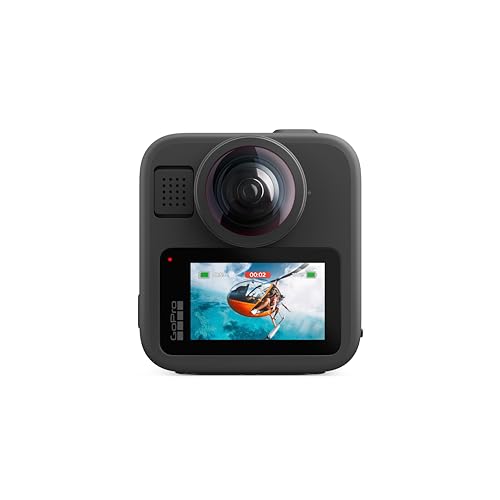
GoPro MAX2 — Best 360 underwater option
The MAX2 is included under its own framing, and the framing matters: this is a spherical camera that records everything in every direction, from which conventional footage is chosen afterwards. Underwater, that inversion solves a real problem. A diver cannot always point a camera at the shark that arrives from behind, the turtle that surfaces overhead or the buddy signalling from the side — but a 360 camera has already recorded all of them. The dive becomes pure experience; the directing happens later, at a desk, with the whole sphere to choose from. No other pick in this guide works this way, and comparing it as though it were a conventional camera would miss its point entirely.
Its underwater credentials are genuine but should be read in GoPro’s usual terms: a waterproof action body for surface and shallow immersion, with deeper ambitions again belonging to protective housing territory. Most MAX2 underwater use — snorkelling, shallow reef work, surf and pool filming — sits happily inside the native envelope, and the spherical view is at its most magical exactly there, where a swimmer can pass through a bait ball or under a breaking wave and capture the full wrap of the moment.
The costs of the spherical bargain are editorial. Reframing footage means choosing angles, adding keyframes and exporting through GoPro’s software workflow; a dive day produces raw material, not finished clips. Stitching lines, the faint seams where the twin lenses’ views merge, can appear when subjects cross close to the camera — a real consideration underwater, where curious fish approach lenses. Resolution is shared across the entire sphere, so any single reframed view carries fewer pixels than a dedicated camera’s full frame; the 4K output is a crop of a much larger spherical master, impressive in context but not a free lunch.
Where the MAX2 wins, it wins uniquely. A single camera on a short pole records the diver and the reef simultaneously, enabling the selfie-and-scene shots that once needed two cameras and luck. Freedivers can document a descent and the surface light above in one continuous sphere. Instructors can review a student’s whole surroundings, not just the slice a lens happened to face. These are new capabilities, not better versions of old ones, and for some buyers that novelty is worth every editorial hour it costs.
Handling follows GoPro’s flagship conventions — touchscreen, voice control, app pipeline — with the added care that two exposed lens domes demand. Underwater, those domes are the vulnerable surface: rinse them gently, never wipe salt from them dry, and keep the protective caps discipline strict on the boat. The rinse rule, as everywhere in this guide, is mandatory after salt water, with extra gentleness around the optics.
Buy the MAX2 if the sphere itself excites you — if you already imagine the reframed shots and accept the editing as part of the hobby. Buy anything else in this guide if you want the camera to make framing decisions in the water and hand you finished footage on the boat. Both instincts are legitimate; they simply lead to different cameras, and this one serves the first instinct superbly.
- Capture: spherical 360 video and photos, reframed afterwards in software
- Modes: 360 capture plus a conventional single-lens action mode
- Depth: waterproof body for surface and shallow use; deeper work needs protective housing
- Optics: twin lens domes enabling the full-sphere view
- Workflow: app and desktop reframing with keyframed virtual camera moves
Strengths
- Nothing escapes the sphere, which transforms how unpredictable underwater encounters get recorded.
- Simultaneous self-view and scene-view shots are impossible for every conventional camera here.
- The single-lens mode still functions as a capable ordinary action camera when 360 is overkill.
Trade-offs
- Every clip needs reframing work before it is a finished, shareable video.
- Close subjects can cross stitch seams, and per-view resolution trails dedicated cameras.
- Twin exposed domes demand the gentlest handling and rinsing routine in this guide.
Best for: creators who want total coverage and enjoy post-production, plus instructors and freedivers capturing whole scenes. Not suited for: divers wanting finished footage straight from the water, or anyone careless with exposed optics.
What shooting technique matters most beneath the surface?
Proximity beats magnification, every single dive. Light travelling from a subject to your lens passes through water twice — once from the sun to the animal, once back to the camera — and each metre of that journey strips colour and contrast. A mediocre camera held a metre from a turtle records richer footage than a flagship filming the same animal from five metres through blue haze. New underwater shooters instinctively hang back, fearing they will frighten the subject; patient, slow approaches usually earn closeness instead, and the footage improves out of all proportion to any equipment upgrade.
Buoyancy is the hidden tripod. A diver who can hover motionless without finning produces footage that looks professionally stabilised before any electronics intervene, because the camera platform itself stops surging. Practise holding position beside a sandy patch, breathing in small adjustments, before blaming a camera for shaky results. Electronic stabilisation then polishes a steady base rather than rescuing chaos, and the difference shows in every clip. Snorkellers get the same benefit by holding a breath and sinking slightly at the moment of recording, letting the body settle before pressing anything.
Shoot slightly upward when the scene allows it. Framing a subject against the bright surface and its dancing light patterns gives footage depth and a sense of place that downward shots onto sand rarely achieve. The classic silhouette of a turtle against sunlit water exists because generations of photographers discovered this geometry works. Watch your exposure when doing it, since the bright background tempts cameras to darken the subject; many models let you lock exposure on the animal before reframing.
Plan sequences rather than single clips. A wide establishing shot of the reef, a mid shot of the school moving through it, then a close portrait of one fish tells a story that ten unrelated fragments never will. The cameras in this guide all record long enough to gather such material in a single dive, provided batteries and cards were prepared on the boat. Editors — even casual ones trimming a holiday video — bless the shooter who brought home connected pieces instead of highlights alone.
White balance choices reward experimentation across a trip. Shoot a short test clip at your working depth with each available underwater setting, then compare on a screen that evening and commit to the winner for the remaining days. Conditions differ between the gin-clear tropics and a green temperate bay, and the setting that flatters one can sabotage the other. Photographers using the TG-7’s raw files can defer the decision entirely, which is one more reason that camera suits deliberate stills shooters.
Finally, respect the reef as a condition of filming it. Never brace against living coral for a steadier shot, never chase an animal into stress for a closer frame, and keep fins clear of the bottom where silt clouds the water for everyone behind you. The best underwater footage in any archive tends to come from the calmest divers, and calm is a technique, not a temperament.
Comparison table
| Camera | Native depth | Depth with case | Core strength | Primary role |
|---|---|---|---|---|
| OM SYSTEM Tough TG-7 | About 15 m | Deeper via optional housing | Macro stills and raw capture | Reef photography |
| DJI Osmo Action 4 | About 18 m | Deeper via optional housing | Large sensor, stabilised 4K video | Bare-body video |
| GoPro LIT HERO | Surface and shallows | Housing extends range | Built-in light, tiny body | Shallow and low-light fun |
| AKASO EK7000 | Splash resistance only | 131 ft in supplied case | Complete budget dive kit | Entry-level diving |
| AKASO Brave 4 | Splash resistance only | 131 ft in supplied case | Adjustable field of view | Budget framing flexibility |
| GoPro MAX2 | Surface and shallows | Housing extends range | Spherical capture, reframing | 360 underwater stories |
How deep do you actually need your camera to go?
Work backwards from your real water life, not your ambitions. Snorkelling happens between the surface and about five metres, even when a confident swimmer duck-dives to a shell on the sand. Recreational scuba limits sit far deeper, but most reef diving concentrates between ten and twenty-five metres, where the light and the life both are. A camera whose native rating covers your actual depths removes an entire failure mode — the flooded housing — from your day, which is why the TG-7 and Action 4 feel so liberating to shallow divers. A camera whose depth lives in a case is not worse; it simply asks you to become the kind of diver who maintains cases, and many happy owners do exactly that.
Next, decide what you actually make. Stills photographers should weight macro ability, raw capture and flash or light options heavily, because a reef rewards patience at close range. Video-first swimmers should weight sensor size and stabilisation, because surge and fading light punish small sensors mercilessly. Social sharers can relax both demands and buy handling, simplicity and price. The 360 question stands apart: only choose spherical capture if the reframing workflow sounds like play rather than homework.
Light is the third decision, and it is really a depth decision in disguise. Every metre down steals colour, and no white-balance setting fully restores what physics removed. Cameras with lights — the LIT HERO at close range — or cameras fed by accessory lights in a housing system recover colour at the subject, which is why serious reef photographers eventually add illumination regardless of camera choice. Budget for that future if reef stills are your goal.
Finally, think about the second year of ownership. Seals age, cases scratch, batteries tire. Systems with cheap, available spares — AKASO’s cases, DJI’s batteries, OM SYSTEM’s housing and light accessories — keep working long after sealed bargains become e-waste. The cheapest camera to buy is rarely the cheapest camera to own, and underwater gear punishes false economy with floods.
How should you care for a camera after salt water?
Rinse or soak the camera — or its closed housing — in fresh water after every ocean session, without exception and before anything dries. Work the buttons and dials gently during the soak so trapped salt leaves the seams instead of crystallising there. Shake off the water, then let everything air-dry completely before opening any door or case; opening wet gear drags droplets and grit across the very seals that keep the sea out. Only then remove batteries and cards, inspect O-rings for sand, hair or cracks, and store the camera dry with doors closed and housings latched loosely or as their makers advise.
Never wipe a lens or dome that carries dried salt; the crystals scratch coatings like sandpaper. Soak first, always. Keep silicone grease, where a housing maker specifies it, to the thinnest film on the O-ring — excess grease collects grit. And retire seals on schedule rather than on failure: an O-ring replaced at home costs little, while the same ring failing at fifteen metres costs a camera.
What are the most common mistakes buyers make?
The costliest mistake is reading a case depth as a body depth — trusting one hundred and thirty-one feet on a listing while the camera inside the buyer’s hand is splash-proof. This guide has flagged that distinction on every affected pick; honour it. The second mistake is skipping the freshwater rinse because the camera still works afterwards. Salt damage is cumulative and silent; the camera works until the day a stiffened seal or corroded contact ends it mid-trip.
Third, buyers over-descend on optimism: taking a fifteen-metre camera to eighteen because the reef sloped, or a shallow-water camera snorkelling-deep on a freedive. Depth ratings are engineering limits with safety margins you cannot see, not challenges. Fourth, divers open housings on wet boats with wet hands, introducing the droplets that fog lenses and the grit that nicks seals. Fifth, beginners buy the camera and forget the system — no spare battery for the second dive, no float strap, no red filter or light — then blame the camera for an incomplete kit.
Finally, there is the framing mistake: expecting a 360 camera to behave like a point-and-shoot, or a macro compact to behave like a cinema rig. Every pick here is excellent at its own brief and ordinary outside it. Match the brief to your water, and the camera will feel brilliant; mismatch it, and no specification would have saved the purchase.
Final Recommendation
For most readers, the DJI Osmo Action 4 is the underwater camera to buy: the deepest native rating in this guide, the strongest video sensor, and stabilisation that forgives surge and excitement alike, all without a housing for the shallow diving and snorkelling that fill most water lives. Photographers should step sideways to the TG-7, whose macro eye and raw files serve the reef’s small citizens better than any action camera can. Budget divers start honestly with an AKASO inside its case, light-seekers take the LIT HERO to the shallows, and spherical storytellers take the MAX2 and its editing desk with them. Choose by the water you truly swim in, rinse what the sea touches, and the camera you pick will still be earning its place years from now.
Frequently Asked Questions
Can I take the AKASO cameras diving without the waterproof case?
No. Both the EK7000 and the Brave 4 rely on their housings for the one hundred and thirty-one foot figure in their listings; the bodies themselves are protected against splashes and rain. Diving either camera bare risks immediate flooding. If case-free diving is your priority, the TG-7 and the Osmo Action 4 carry native ratings for exactly that use.
How deep can the TG-7 go on a scuba dive?
Its sealed body is rated to about fifteen metres, which covers shallow reef scuba comfortably but not deeper wreck or wall profiles. For descents beyond that, OM SYSTEM offers a dedicated housing that extends the working depth. Many owners dive the TG-7 bare on shallow profiles and housed on deep ones, treating the housing as profile-specific kit.
Why does underwater footage lose its red colours?
Water absorbs wavelengths unevenly: red light disappears within the first few metres, orange and yellow follow, and blue-green penetrates furthest. Cameras record what reaches them, so subjects look blue unless white balance, filters or lights intervene. Getting physically closer to subjects helps more than any setting, because the light then travels through less water on its way back to the lens.
Is a 360 camera practical for ordinary holiday snorkelling?
It is practical if you enjoy editing. The MAX2 records everything and asks you to choose the framing afterwards, which turns a snorkel into raw material rather than finished clips. Families wanting footage ready to share on the same evening usually prefer a conventional camera; creators who like directing after the fact find the sphere addictive.
What single accessory helps underwater footage most?
A light, used at close range, restores the colours depth removes and transforms subjects within arm’s reach. Beyond that, a floating grip protects against the oldest underwater loss of all — the camera sinking out of reach — and spare batteries protect the second dive of the day, which is often the better one.
How often should housing O-rings be replaced?
Inspect before every dive and replace at the first sign of cracking, flattening or embedded grit that will not rinse away. Many divers replace seals annually regardless of appearance, because the cost is trivial beside the camera inside. Keep a spare O-ring kit in the dive bag; the day you need it, no shop will be nearby.
Related Guides
Depth ratings, rinsing rituals and macro modes are a lot to hold at once, so keep exploring the camera shelf at your own pace with our guides to action cameras beyond the usual flagship names, affordable 4K cameras for travel and everyday filming and vlogging cameras with proper 4K video.
Related guides
- Best Canon Point and Shoot Digital Cameras: PowerShot Picks From Pocket Compacts to Travel Zooms
- Best Balancing Stabilizers for Mirrorless Cameras: Payload, Balancing and Native Vertical Shooting
- Best Basic Phones Camera Buyers Can Trust: Flip Phones and Simple Handsets That Still Take a Photograph
- Best Sony Full Frame Cameras for Astrophotography: Sensitivity vs Resolution


