What's inside
- Key Takeaways
- Quick Picks: Six PoE Kits Sized From a Single Unit to a Full Facility
- How We Chose These Picks
- Why Does a Warehouse Need Wired PoE Instead of Wireless Cameras?
- How Should You Lay Out Cameras Across Aisles, Doors and a Yard?
- How Much Recording Retention Does a Warehouse Actually Need?
- What Makes Warehouse Footage Stand Up When an Insurer or Police Officer Reviews It?
- How Do You Stop Alerts From Becoming Background Noise?
- What Does the Network and Power Plan Need Before the First Cable Is Pulled?
- Reading the Six Warehouse Kits Against Each Other, Channel by Channel
- How Do You Choose Between Eight and Sixteen Channels Without Guessing?
- What Maintenance Does a Warehouse System Need Across a Year?
- Which Installation Shortcuts Come Back as Incidents?
- Why Does the Building’s Own Lighting Decide Half of What These Cameras Achieve?
- What Do Staff and Visitors Deserve to Know About the System?
- Final Recommendation
- Frequently Asked Questions
- Related Guides
As an Amazon Associate I earn from qualifying purchases. This post may contain affiliate links at no extra cost to you.
gizmoverdict.com is reader-supported. When you buy through links on our site, we may earn an affiliate commission.
Where warehouse systems get ordered: all six kits below are sold through Amazon, and each system name links to its listing so you can confirm camera counts, recorder channels and the hard drive included before a purchase order is raised.
Facilities managers comparing the best ip cameras for warehouse duty quickly discover that the product on sale is not really a camera — it is a system. Every pick in this ranking is a Power over Ethernet kit: a set of wired IP cameras and a network video recorder with a hard drive inside, sold as one working unit. That architecture is not an accident of packaging. A warehouse is a hostile place for surveillance — vast, metal-clad, full of forklift traffic and Wi-Fi dead zones behind racking — and a wired PoE system answers those conditions in a way a scatter of wireless cameras never will: one cable per camera carries both power and video, the recorder keeps days of footage on site, and nothing depends on a battery or a signal bar.
So this guide judges the six kits as systems, on the terms their own listings state: how many channels the recorder offers, how many cameras actually ship in the box, how much storage is included, and what detection and night-vision claims the maker prints. Read those numbers as a map of your building. An eight-channel kit with four cameras covers a small unit today and accepts four more cameras tomorrow; a sixteen-channel system with sixteen cameras is a whole facility in one purchase. The right choice is the one whose headroom matches your site’s next two years, not merely its next two months.
One more framing note before the rankings: none of these systems is a substitute for a lighting plan, an alarm contract or a sensible key policy. Cameras record and deter; they do not intervene. What a good kit buys a warehouse operator is evidence that survives scrutiny — a face at the shutter door, a registration plate at the gate, a timeline of the night the pallets moved — and the six systems below are ranked by how reliably they produce exactly that.
Key Takeaways
- Warehouse surveillance is bought as PoE kits, not single cameras: cameras, recorder and hard drive arrive as one system.
- Channel count is future capacity; camera count is what watches your building on day one — do not confuse the two numbers.
- The 4COVR kit is the only full sixteen-camera package here, built for a whole facility in one installation.
- ANNKE and Reolink offer the balanced middle: eight or sixteen channels with half the camera positions filled.
- The Hiseeu kit fills all eight of its positions with wide-view cameras and two-way audio for staffed sites.
- Storage stated in the listing — 1TB, 2TB or 4TB — decides how many days of evidence you keep before the oldest footage is overwritten.
Quick Picks: Six PoE Kits Sized From a Single Unit to a Full Facility
| Pick | Badge | Why it made the cut |
|---|---|---|
| Hiseeu 4K PoE System (8x 5MP) | All positions filled | Eight 5MP cameras for eight channels, with a wide 121-degree view, two-way audio and colour night vision for a staffed warehouse. |
| ANNKE 8CH 5MP PoE System (1TB) | Compact starter system | Four 3K outdoor cameras on an eight-channel recorder, leaving clean headroom to double coverage later. |
| ANNKE 16CH 4K PoE System (4TB) | Large-site ANNKE | Sixteen channels, eight 8MP cameras and 4TB of storage with Alexa compatibility for a growing operation. |
| REOLINK RLK8-410B4 5MP PoE System | Balanced brand-name kit | Four 5MP cameras, an 8-channel 4K recorder and 2TB of storage from the most established name in this set. |
| REOLINK 16CH 12MP PoE System | Highest-resolution kit | Eight 12MP cameras on a sixteen-channel recorder with 4TB, for yards and gates where detail is the evidence. |
| 4COVR 16CH PoE Business System (4TB) | Whole-facility package | Sixteen vandal-proof dome cameras fill every channel, aimed squarely at commercial premises. |
How We Chose These Picks
We screened PoE kits the way a facilities manager writes a specification: recorder channels, cameras in the box, included storage, ingress protection as listed, and the detection features the maker claims in the title itself. Anything that could not state those basics plainly was set aside, because a warehouse purchase is usually justified to someone else — an owner, an insurer, a landlord — and a kit whose own listing cannot say how many cameras it contains will not survive that conversation. We also weighted the spread of the set deliberately, from an eight-channel starter to a full sixteen-camera facility package, so that a reader can locate their building’s size in the ranking rather than extrapolate from a single class of kit.
Just as deliberately, we judged only what the listings state. Where a title gives a camera’s resolution, a drive size or a waterproof rating, the review uses it; where a title is silent — on cable lengths, on exact night-vision range, on app specifics — the review says so instead of borrowing numbers from a sibling model. Warehouse buyers are burned more often by assumed specifications than by missing features.
Why Does a Warehouse Need Wired PoE Instead of Wireless Cameras?
Start with the building itself. A warehouse is a metal box full of metal racking, and radio signals treat it as a maze: the aisle that shows full Wi-Fi bars at ground level is a dead zone at the top of the racking where the camera actually sits. Add forklift chargers, industrial lighting and neighbouring units’ networks, and a wireless camera fleet becomes a maintenance hobby — cameras dropping, reconnecting, missing the exact forty seconds they existed to record. A PoE cable removes the question entirely. The same run that carries the video carries the power, the connection is as reliable as the cable is intact, and a camera’s silence means a physical fault you can find, not a radio mystery you cannot.
Then consider scale and evidence. Sixteen wireless cameras contend for one building’s airwaves; sixteen PoE cameras each get a private lane to the recorder. The recorder’s hard drive keeps footage on your premises under your control, retained for exactly as long as its capacity allows, with no subscription deciding when your evidence expires. For an operator answering to insurers after an incident, that local, continuous, timestamped record is the product. Everything else — the app, the alerts, the colour night vision — is commentary on top of it.
The honest cost is installation labour. Cable runs across a working warehouse need planning, a lift or a tall ladder, and respect for the operation’s own safety rules. Budget that day of work once, and the system repays it every night for years; skip it for wireless convenience, and the repayment schedule reverses.

Hiseeu 4K PoE System (8x 5MP) — All positions filled
Most kits in this ranking ship with half their recorder’s channels empty, treating the missing cameras as a future purchase. The Hiseeu system takes the other path: eight 5MP IP cameras in the box for an eight-channel 4K PoE system, so the day the installation finishes is the day coverage is complete. Its listing headlines a 121-degree wide view, and in warehouse geometry that number earns its prominence — a wide camera at the end of an aisle or above a shutter door sees the racking on both sides and the floor between, where a narrower camera forces a choice between the door and the aisle it serves.
The feature list reads like a staffed site’s wishlist: two-way audio, so the office can speak to a driver at the goods-in door rather than walking the floor; colour night vision for the hours the building is lit only by emergency fittings; human and vehicle detection to keep alerts meaningful; an IP66 waterproof rating for cameras mounted at exposed doors and yard positions; free remote access for the manager checking in from home; and a 1TB hard drive recording around the clock. For a small-to-medium warehouse that wants one purchase, one installation and no phase two, this is the most complete answer in the set.
Completeness is also its boundary. With every channel filled, growth means a second system or a recorder swap, and the 1TB drive is the smallest here alongside one ANNKE — on eight cameras recording continuously, retention is measured in a modest number of days, so an operator with a longer evidence policy should plan a drive upgrade early. Buy it as a finished system for a defined building and it is exactly right; buy it for a site already planning an extension and the headroom lives in the kits below.
- Cameras, as listed: 8 pieces, 5MP IP cameras, 121-degree wide view
- Recorder class, as listed: 4K PoE security camera system
- Storage, as listed: 1TB HDD for 7/24 recording
- Features, as listed: Two-way audio, colour night vision, human/vehicle detection, free remote access
- Protection, as listed: IP66 waterproof
Strengths
- Every channel populated — no second purchase needed to finish the job
- Wide 121-degree view suits aisle ends and shutter-door coverage
- Two-way audio helps a staffed site manage deliveries at the door
Trade-offs
- No spare channels for expansion without replacing the recorder
- 1TB storage is the joint-smallest here for round-the-clock recording
- Wide views trade fine detail at distance for breadth of coverage
Best for: small and medium warehouses wanting a complete system in one installation. Not suited for: sites with a funded extension planned, which need spare channels more than instant completeness.
See the Hiseeu system listing on Amazon to confirm the current kit contents before ordering.

ANNKE 8CH 5MP PoE System (1TB) — Compact starter system
This ANNKE kit is the measured way into warehouse PoE: an eight-channel recorder with a 1TB hard drive and four 3K outdoor IP cameras in the box. Read that as a deliberate half — four cameras cover the entrances, the yard gate and the high-value aisle of a compact unit on day one, and four empty channels wait for the day the operation grows into the next bay or adds the car park. The recorder itself is listed as an 8-channel 6MP H.265+ NVR, and the H.265+ compression matters in a building that records around the clock, because efficient compression is what stretches a 1TB drive across a useful retention window.
The cameras bring a smart dual light arrangement and colour night vision, with AI detection and an IP67 waterproof rating — a step above the Hiseeu’s IP66 on paper — plus one-way audio. Dual light, in practice, means the camera can work discreetly in infrared and bring up white light when an event needs colour evidence, a combination warehouse operators value at doors where a face in colour is worth ten silhouettes. For a first system in a leased unit, where the installation must justify itself quickly and possibly move premises one day, this kit’s balance of capability and restraint is well judged.
Its limits are the arithmetic of its class: four cameras is a beginning, not a facility, and the 1TB drive asks for a retention policy rather than offering one by default. An operator covering a large footprint from day one should step up to the sixteen-channel kits instead of buying this twice. As a starter that grows by adding cameras rather than by replacement, though, it is the cleanest entry in the ranking.
- Recorder, as listed: 8-channel 6MP H.265+ NVR
- Cameras, as listed: 4 pieces, 3K outdoor IP cameras
- Storage, as listed: 1TB HDD, 24/7 recording
- Features, as listed: Smart dual light, AI detection, colour night vision, one-way audio
- Protection, as listed: IP67
Strengths
- Half-empty recorder gives clean, cheap growth by adding cameras
- Dual-light cameras capture colour evidence when an event occurs
- Efficient compression stretches the included drive’s retention
Trade-offs
- Four cameras cover a compact unit, not a large footprint
- 1TB drive requires a deliberate retention policy
- One-way audio cannot answer a driver at the door
Best for: compact units and first-time system buyers expecting to expand. Not suited for: large sites needing full coverage in a single installation.
Check the ANNKE 8-channel listing on Amazon for the current bundle details.

ANNKE 16CH 4K PoE System (4TB) — Large-site ANNKE
ANNKE’s sixteen-channel system is where this ranking steps from unit security to facility security. The box holds eight 8MP IP wired outdoor cameras against a sixteen-channel 4K PoE recorder with a 4TB hard drive — double the ANNKE starter’s channels, double its cameras, quadruple its storage, and a higher camera resolution throughout. Eight 8MP cameras place real detail at the points that matter — shutter doors, the gate, the dispatch office, the high-value cages — while the eight empty channels hold the map of the site’s future: the mezzanine, the new racking run, the yard’s far corner.
The feature set suits a site with staff and systems: smart dual light with spotlight colour night vision, AI human and vehicle detection to sort a forklift’s rounds from a stranger’s visit, built-in microphones on the cameras, and compatibility with Alexa for the office screen that shows the gate feed. The 4TB drive is the retention story an insurer wants to hear, holding weeks rather than days at sensible settings, which changes the system from a tripwire into an archive — the difference between knowing something happened last night and proving what happened three Tuesdays ago.
Scale brings its own discipline. Sixteen channels of cable runs is a planned project, not an afternoon, and eight cameras still leave half the recorder to justify over time; a site that never grows into those channels has bought headroom it will not use. But for the operator whose building is large today and larger next year, this is the ANNKE to standardise on.
- Recorder, as listed: 16-channel 4K PoE security camera system
- Cameras, as listed: 8 pieces, 8MP IP wired outdoor cameras
- Storage, as listed: 4TB HDD
- Features, as listed: Smart dual light, spotlight colour night vision, AI human/vehicle detection, built-in mic
- Integration, as listed: Compatible with Alexa
Strengths
- Sixteen channels with eight high-resolution cameras covers a facility properly
- 4TB storage supports a serious evidence-retention window
- Detection distinguishes people and vehicles from routine yard movement
Trade-offs
- Installation at this scale is a project needing planning and access equipment
- Half the channels start empty, so full value arrives with expansion
- More system than a single small unit can justify
Best for: growing facilities that want one recorder standard for years. Not suited for: a single compact unit whose whole perimeter is four walls and a door.
Review the ANNKE 16-channel listing on Amazon to confirm camera count and drive size in the current offer.

REOLINK RLK8-410B4 5MP PoE System — Balanced brand-name kit
Reolink is the name warehouse buyers most often arrive already knowing, and this kit is the reason: a tidy eight-channel system with four 5MP wired PoE cameras, a 4K 8-channel NVR and a 2TB hard drive for round-the-clock recording. The specification is a study in balance. The drive is double the 1TB starters’, the cameras sit at the 5MP level that reads a face across a loading bay without drowning the recorder, and the smart detection distinguishes person, pet and vehicle — a taxonomy written for homes that translates to a warehouse as staff, the yard cat and everything with wheels.
In a working building, the Reolink’s virtue is the ecosystem around the hardware: a mature app, remote viewing that the night manager will actually use, and a brand whose replacement cameras and recorders will still be findable when a forklift meets a camera in year three. Warehouses do not run systems in showroom conditions; they run them until something breaks, and the availability of the matching spare is a specification no title can print but every operator learns to value.
The kit’s restraint is equally clear. Four cameras is starter coverage, the recorder’s eight channels cap the site’s growth at double, and buyers wanting the sharpest gate detail should look at the 12MP Reolink below. As the default recommendation for a small warehouse that wants a known quantity, installed once and understood by everyone, it remains the easiest system in this ranking to defend in a budget meeting.
- Recorder, as listed: 4K 8-channel NVR
- Cameras, as listed: 4 pieces, 5MP wired PoE cameras, black
- Storage, as listed: 2TB HDD for 24-7 recording
- Detection, as listed: Smart person/pet/vehicle detection
- Model, as listed: RLK8-410B4-5MP
Strengths
- 2TB drive doubles the retention of the 1TB starter kits
- Established brand ecosystem eases spares, app use and staff familiarity
- Balanced specification avoids paying for resolution the site cannot use
Trade-offs
- Four cameras in the box is a starting point, not full coverage
- Eight channels cap long-term expansion at twice the start
- Gate and plate detail seekers should step up to the 12MP system
Best for: small warehouses wanting a dependable, well-supported first system. Not suited for: large yards where camera count and resolution both need to run ahead of this kit.
Open the Reolink RLK8 listing on Amazon to verify the current kit configuration.
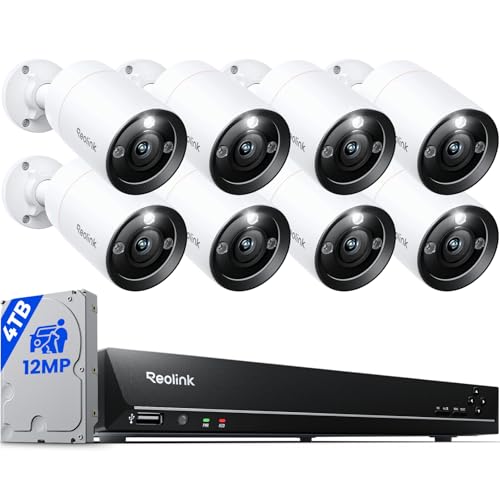
REOLINK 16CH 12MP PoE System — Highest-resolution kit
This is the detail merchant of the ranking. Reolink’s sixteen-channel system carries eight H.265 12MP PoE bullet cameras — the highest camera resolution stated anywhere in this guide — on a recorder with a 4TB hard drive. Twelve megapixels earns its keep at exactly the positions where warehouses lose money invisibly: the gate, where a registration plate at distance is the whole case; the dispatch bench, where a label dispute is settled by reading the parcel; the long yard, where a figure must be identified rather than merely detected. Resolution is not vanity in those frames; it is the difference between footage that describes an event and footage that concludes an investigation.
The supporting specification matches the intent: smart detection, spotlight colour night vision for the hours the yard is dark, two-way talk for the gate intercom role, and sixteen channels so the high-resolution core can be joined later by cheaper cameras on the quiet corners. The 4TB drive matters more here than anywhere, because 12MP streams are heavy and retention is where high-resolution systems quietly fail when the storage was specced by optimism.
The trade is that same weight. Eight 12MP cameras demand a network and an installation done properly, and the system’s strengths are wasted on a building whose risks are all at conversational distance. Buy it for a site with a gate, a yard and a shrinkage problem, and it is the strongest evidence machine in this ranking; buy it for a lock-up and it is a race engine in a delivery van.
- Recorder, as listed: 16-channel security camera system
- Cameras, as listed: 8 pieces, H.265 12MP PoE bullet cameras
- Storage, as listed: 4TB HDD, model RLK16-1200B8-A
- Features, as listed: Smart detection, spotlight colour night vision, two-way talk
- Night vision type, as listed: Spotlight colour night vision
Strengths
- 12MP cameras deliver plate-and-label detail at gate and yard distances
- 4TB storage is sized to the heavy streams the cameras produce
- Sixteen channels leave room to add economical cameras on quiet corners
Trade-offs
- High-resolution streams punish a carelessly planned network
- Over-specified for small units whose risks are all close-range
- Installation effort is the largest of the eight-camera kits here
Best for: sites with gates, yards and shrinkage investigations that turn on detail. Not suited for: a compact lock-up needing four honest cameras and nothing more.
See the Reolink 16-channel 12MP listing on Amazon for the current system contents.

4COVR 16CH PoE Business System (4TB) — Whole-facility package
The 4COVR system is the only pick that fills its recorder completely at the top of the range: sixteen 5MP dome cameras against sixteen channels, with a 4TB drive, sold explicitly as a business system. The camera form is the story — IK10 vandal-proof, IP67 dome cameras. IK10 is an impact rating, and in a warehouse it addresses the two ways cameras actually die: deliberate tampering in the blind corner where stock walks away, and accidental violence from the machinery of the building itself. A dome that shrugs off a blow and hides its viewing direction inside a smoked housing changes the behaviour of anyone considering either.
Sixteen cameras changes the coverage philosophy. Instead of choosing which doors deserve watching, the facility watches everything: every aisle head, every door, the car park, the cage, the office corridor — with AI human and vehicle detection and round-the-clock recording sorting the footage into events a manager can actually review. For multi-tenant units, logistics sheds and any site whose insurer asks about coverage in percentages, a full sixteen is a different conversation from a promising eight.
The commitment is real: sixteen cable runs, sixteen mounts, and a recorder with no channel left for the camera you will inevitably want at the new mezzanine. Expansion means a second recorder, and the 5MP resolution, while ample for identification at working distances, is not the plate-reading instrument the 12MP Reolink is. This is the system for a defined, complete facility — bought once, installed once, and left to watch everything for years.
- Recorder, as listed: 16-channel NVR
- Cameras, as listed: 16 pieces, 5MP dome commercial IP cameras
- Protection, as listed: IK10 vandal-proof, IP67
- Storage, as listed: 4TB
- Features, as listed: Night vision, AI human/vehicle detection, 24/7 recording
Strengths
- Sixteen cameras included — complete facility coverage in one purchase
- IK10 vandal-proof domes survive tampering and industrial knocks
- Dome housings conceal viewing direction, deterring blind-spot planning
Trade-offs
- No spare channels; growth requires a second recorder
- Sixteen installations is the biggest labour commitment in the ranking
- 5MP detail trails the 12MP kit at gate and plate distances
Best for: complete facilities, multi-tenant units and insurer-driven coverage requirements. Not suited for: a growing site that needs empty channels waiting for next year’s extension.
Review the 4COVR business system listing on Amazon to confirm the full package before committing.
How Should You Lay Out Cameras Across Aisles, Doors and a Yard?
Begin with the doors, because every loss story in a warehouse walks through one. Each shutter door and personnel entrance gets a camera positioned to capture faces at conversational distance, not a wide establishing shot of the whole elevation — identity lives at head height, a few metres from the threshold. The yard gate gets the opposite treatment: a camera placed for the longest, clearest view of a vehicle’s approach, where the high-resolution picks earn their premium. Between those anchors, cover the aisle heads rather than the aisles themselves; a camera at each end of a racking run sees everyone who enters the run, at a fraction of the count a camera-per-aisle fantasy demands.
Then walk the building at night in your mind and mark the routes a person would take to reach the high-value cage, the dispatch office and the server cabinet without crossing a lit area. Those routes get cameras even if they look redundant on the plan, because redundancy across a route is what turns three partial sightings into one continuous, court-presentable timeline. Mount at a height that balances two failures: too low invites tampering — the case for the 4COVR’s rated domes — and too high turns every face into the top of a cap. The recorder’s spare channels, where a kit provides them, are best spent after a month of watching real footage and discovering the one corner the plan got wrong.
How Much Recording Retention Does a Warehouse Actually Need?
Retention is where a specification becomes a policy. The drive sizes in these listings — 1TB, 2TB and 4TB — translate into days of footage through three variables: camera count, camera resolution and how the recorder is set to record. Continuous recording of eight high-resolution cameras consumes a small drive with startling speed; motion-triggered recording in a quiet building can stretch the same drive across weeks, at the risk that a slow, deliberate theft moves too gently to trigger an event. Most operators land on continuous recording for doors and gates with event recording elsewhere, and size the drive to the longest gap between someone checking the system — which, in a real business with holidays and sick days, is longer than anyone first admits.
Work backwards from your incident history instead. If stock discrepancies surface at a monthly stocktake, retention must comfortably exceed a month or the footage of the relevant night is overwritten before the question is asked. If the system’s job is next-morning review of alarms, a week is plenty and a 1TB kit suffices. The 4TB systems in this ranking exist for the first kind of operator. Whichever you choose, test the archive before you need it: pull footage from the oldest day the drive claims to hold, confirm the timestamps against a known event, and write the retention figure you verified — not the one you hoped for — into the site’s security file for the insurer.
What Makes Warehouse Footage Stand Up When an Insurer or Police Officer Reviews It?
Evidence has a chain, and a camera system is only its first link. Footage persuades when its timestamps are provably right, which means the recorder’s clock should be synchronised automatically and checked after any power cut — a two-minute drift between the camera timeline and the gate log has undermined more than one otherwise clear case. It persuades when the export is handled properly: the relevant hour copied out through the recorder’s own export function, stored unedited, with the person who exported it noted alongside the date. And it persuades when the camera positions were documented before the incident, on a simple site plan that shows what each camera was intended to see, because intention is what turns a fortunate recording into a system working as designed.
Resolution plays its part at exactly one moment — identification. A figure crossing a yard is an event; a recognisable face or a legible plate is evidence. That is the honest argument for placing the highest-resolution cameras in a kit at the gate and the doors rather than spreading resolution evenly, and it is why the mixed strategy the sixteen-channel systems allow — flagship cameras at the identity points, economical cameras on the routes between — is how experienced installers actually deploy them. The 12MP Reolink kit front-loads that identity detail; the 4COVR kit spreads sixteen competent eyes so that no route goes unwitnessed; both are coherent answers to the same question asked with different buildings in mind.
Finally, keep the system’s paperwork with the same care as its footage: purchase records, the installation plan, the retention figure you verified, and a log of every time footage was exported and why. When an insurer’s assessor asks how long you keep recordings, the operator who answers from a document gets a different meeting from the operator who answers from memory.
How Do You Stop Alerts From Becoming Background Noise?
Every kit in this ranking offers detection — human, vehicle, or the Reolink’s person, pet and vehicle sorting — and every operator who enables all of it, everywhere, at full sensitivity learns the same lesson within a fortnight: a system that alerts two hundred times a night alerts, in human terms, never. The night manager silences the phone, and the one genuine event arrives to a muted device. Alert discipline is therefore a configuration task with a security outcome. Set detection zones that exclude the public road beyond the gate and the neighbouring unit’s yard. Schedule the aggressive alerting for the hours the building is actually empty, and let the staffed hours rely on recording rather than notification. Reserve instant alerts for the two or three cameras whose events are never routine — the cage, the dispatch office after hours, the rear shutter that should not move at night.
Review the alert log weekly for the first month and tune what you find: the camera that fires on the heating vent’s shimmer gets a smaller zone, the gate camera that misses slow vehicles gets more sensitivity, the aisle camera that reports every forklift as a person gets its detection type narrowed. This tuning week is the difference between a system the team trusts and a system the team routes around, and it costs nothing but attention. The detection features in these listings are genuinely capable; they are also, out of the box, merely average for your specific building, and the last ten percent is always local.
What Does the Network and Power Plan Need Before the First Cable Is Pulled?
PoE simplifies a warehouse installation enormously and eliminates none of its planning. Each camera draws power from the recorder or a PoE switch, so the electrical question concentrates in one place: the recorder’s location needs a clean, backed-up supply, because a recorder that dies with a power flicker takes sixteen cameras with it. A modest uninterruptible power supply sized for the recorder and its drive is the least glamorous and most consequential accessory in the entire system, bridging the short outages that industrial estates specialise in and letting the recorder shut down cleanly through the long ones.
Cable planning follows the building’s own logic. Runs should follow existing containment and cable trays where they exist, keep clear of forklift impact zones and shutter-door mechanisms, and terminate at camera positions chosen for view rather than for cabling convenience — a camera placed where the cable was easy is a camera aimed at nothing in particular. Leave a service loop at each camera and label both ends of every run; the person who thanks you is yourself, at height, in February, tracing a fault. Where a run must cross to an outbuilding or the far side of a large yard, that single link deserves the planning attention of a small project of its own, because it carries every camera beyond it.
Document the result as you go: a port map naming which recorder channel serves which position, kept with the site plan from the evidence section. Systems documented this way can be extended by any competent installer years later; systems held in one departed employee’s memory effectively cannot, and the difference shows up precisely when the spare channels were meant to be used.
Reading the Six Warehouse Kits Against Each Other, Channel by Channel
| System | Channels / cameras as listed | Storage as listed | Defining trait |
|---|---|---|---|
| Hiseeu 4K PoE System | 8 channels / 8 × 5MP | 1TB | Complete on day one, 121-degree wide view |
| ANNKE 8CH 5MP System | 8 channels / 4 × 3K | 1TB | Starter half-kit with room to double |
| ANNKE 16CH 4K System | 16 channels / 8 × 8MP | 4TB | Facility scale with Alexa compatibility |
| REOLINK RLK8-410B4 | 8 channels / 4 × 5MP | 2TB | Balanced brand-name starter |
| REOLINK 16CH 12MP System | 16 channels / 8 × 12MP | 4TB | Highest detail for gates and yards |
| 4COVR 16CH Business System | 16 channels / 16 × 5MP domes | 4TB | Full facility of vandal-proof domes |
How Do You Choose Between Eight and Sixteen Channels Without Guessing?
Count positions, not floor area. Walk the site and list every point that genuinely needs a camera: each external door, the gate, each aisle head, the cage, the dispatch and goods-in benches, the car park, the plant room. Most single units arrive at five to seven honest positions; most full facilities arrive at twelve to twenty. Now apply the two corrections experience teaches. First, subtract the positions a single wide-view camera can honestly cover — the Hiseeu’s 121-degree cameras exist for exactly this consolidation at door-and-aisle combinations. Second, add back the position you have not thought of yet, because every operator discovers one within a quarter, and it is the reason a recorder bought exactly at today’s count is a recorder replaced early.
That arithmetic usually lands small units on the eight-channel kits with headroom to spare, growing sites on a sixteen-channel recorder bought before it is full, and complete static facilities on the 4COVR’s filled sixteen. It also exposes the false economy in buying a second small system later instead of one larger recorder now: two recorders means two interfaces, two retention policies, two clocks drifting apart — and an incident that crosses from one system’s territory to the other’s becomes an editing exercise instead of a single timeline. One recorder per building is a principle worth paying a little extra to keep.
If the count lands between the classes — say ten positions in a building that will not grow — the sixteen-channel kits still win on that single-timeline logic, with the surplus channels simply waiting. Unused channels cost nothing to run; a second recorder costs clarity forever.
What Maintenance Does a Warehouse System Need Across a Year?
Less than most equipment in the building, but not none, and the schedule is worth writing down because every item on it is cheap and every failure it prevents is expensive. Monthly, review ten minutes of night footage from two cameras on rotation: this one habit verifies focus, night-vision performance, timestamps and retention in a single sitting, and it is how mis-aims caused by a knocked mount or a new racking run are caught in weeks rather than discovered after an incident. Quarterly, clean the external camera housings — yard dust, diesel film and spider architecture degrade night images gradually enough that nobody notices until the footage is needed — and check the recorder’s drive health report and fan noise while you are there.
Twice a year, audit the human layer: who still has the app, whose login should have been retired with their employment, whether the remote access the listings advertise is reaching only the people it should. Annually, re-walk the coverage plan against the building as it now is, because warehouses change — a new mezzanine, a relocated cage, a rented corner sublet to another operator — and cameras keep faithfully watching the layout of two years ago unless someone updates the map. None of this requires a service contract for the kit classes in this guide; it requires an owner, a diary and the understanding that a surveillance system is a promise the building makes to its future self, renewed by attention rather than by hardware.
Which Installation Shortcuts Come Back as Incidents?
The classic is the camera aimed at where the last incident happened rather than where the next one will: coverage designed by anecdote leaves the rest of the building unwatched and merely relocates the problem. Second is cabling treated as an afterthought — runs draped across forklift routes, connectors exposed to yard weather, a recorder locked in a cupboard that overheats by July. PoE is forgiving of distance but not of physics, and most ‘camera failures’ on mature systems are cable and connector failures wearing a disguise.
Third is the password and access failure: a recorder left on its factory credentials, remote access shared on a sticky note, ex-staff retaining the app login after they leave. A surveillance system with weak access control is not merely useless — it is a liability that shows an intruder exactly where the blind spots are. Change every credential at installation, name one system owner, and review access whenever staff change. Fourth, and quietest, is never reviewing footage until an incident forces it, by which time the mis-aimed camera and the full drive have been silently failing for months. A monthly ten-minute review — one camera, one night, one playback — is the cheapest maintenance contract in this entire guide.
Why Does the Building’s Own Lighting Decide Half of What These Cameras Achieve?
Operators routinely blame cameras for failures that belong to the lighting plan. A camera facing a shutter door that opens onto bright daylight spends its life fighting contrast: the figure in the doorway is a silhouette until they step fully inside, whatever the night-vision claims on the box. The fixes are architectural and cheap relative to the system — a canopy or a repositioned fitting that evens the doorway’s light, a camera angle shifted so the door is crossed rather than faced, the dual-light cameras of the ANNKE kits given a wall to bounce their white light from instead of a void. Walk each camera position at the worst hour, not the best, and judge the view the way the recorder will see it in January at six in the evening.
Inside the racking, the equivalent trap is the high-bay fitting directly above a camera, which lights the top of every head and leaves faces in shadow while convincing the exposure system that the scene is bright. Slight repositioning — cameras offset from the fitting rows, aimed along the aisle rather than across it — recovers more image quality than a resolution upgrade at the same position. The colour night vision several of these kits advertise depends entirely on some light existing to work with; in a truly dark corner, plan for the camera’s own illumination or add a modest fitting, and treat that small electrical job as part of the camera budget. Surveillance and lighting are one system wearing two invoices, and the sites that understand this get evidence-grade footage from mid-range kits while sites that do not manage to waste flagship ones.
What Do Staff and Visitors Deserve to Know About the System?
A warehouse camera system watches employees far more hours than it will ever watch an intruder, and the operators who handle that fact well get more security from their system, not less. Signage at entrances, a plain statement of where cameras are and why — stock protection, safety investigations, door management — and a firm rule that footage is reviewed for incidents rather than for supervision theatre: these cost nothing and they convert the workforce from the system’s adversaries into its witnesses. Staff who trust the system’s purpose report the blind corner and the propped-open door; staff who resent it learn its blind spots as a hobby.
There is a safety dividend to spend deliberately. The same cameras that guard stock can review the near-miss at the dock leveller and the forklift route that everyone privately knows is wrong, and using footage visibly for safety — with the people involved treated as participants rather than suspects — builds the legitimacy that makes the security use uncontroversial when it matters. Keep retention and access rules written, keep audio recording decisions explicit rather than accidental (several kits here include microphones or two-way audio, and a goods-in door intercom is a different moral object from a silent microphone in a rest area, which no position in this guide should ever cover). A system run with that clarity is one an operator can describe to an insurer, a new hire or a court with the same sentences — and that consistency is itself a form of protection.
Final Recommendation
Size the system to the building you will have in two years, then choose by the evidence you most need. A defined small unit is best served complete by the Hiseeu or balanced by the Reolink eight-channel kit; a compact site expecting growth should take the ANNKE starter and its empty channels. Large facilities divide by priority — ANNKE’s sixteen for storage and spread, Reolink’s 12MP for gate detail, 4COVR’s sixteen domes for total, tamper-resistant coverage. Whichever kit goes on the wall, the warehouse that plans its cable runs, sets its retention deliberately and reviews its footage monthly will sleep better than the one that simply bought the most cameras.
Frequently Asked Questions
Can I add cameras from another brand to these recorders later?
Sometimes, through standard network camera protocols, but compatibility is never something to assume from a listing title. The practical test is dull and decisive: buy one candidate camera, not eight, attach it to a spare channel, and live with it for a fortnight — checking its night behaviour, its detection events and whether its footage exports cleanly alongside the native cameras’ footage. A mixed fleet that passes that fortnight can grow with confidence; one that fails has cost you a single camera and a lesson, rather than a building-wide compromise discovered during an incident review. If mixing brands is part of your plan, verify it with the maker’s documentation for the specific recorder before purchase — the safer growth path is same-brand cameras on the spare channels.
How long will the included hard drives actually record?
It depends on camera count, resolution and recording mode, and on a fourth factor operators forget: how busy the building is, since event-based recording in a three-shift distribution shed consumes space almost like continuous recording, while the same setting in a quiet archive store barely sips., which is why this guide treats drive size as a policy choice rather than quoting a single day figure. Estimate from your longest review gap — a monthly stocktake cycle demands the 4TB class of system.
Do these systems need an internet connection to work?
The recording core is local: cameras keep talking to the recorder over the building’s own cables whether or not the outside world is reachable, which is one of the structural reasons warehouses standardise on wired kits. A broadband failure on a storm night — precisely the kind of night when a site most wants its evidence intact — leaves a PoE system’s recording untouched, and the cameras at the doors and gate go on writing to the drive exactly as they did the night before. Internet access is what enables the remote viewing and alerts the listings describe, so a site can record through a broadband outage and simply lose off-site viewing until it returns.
Are dome or bullet cameras better for a warehouse?
They answer different threats, and most real facilities end up using both shapes in different positions rather than declaring a single winner for the whole building. The choice is made per mounting point — by height, by exposure to tampering, by the distance to the subject — and the kits in this ranking simply start you from one shape or the other. Domes — especially the 4COVR’s IK10-rated set — resist tampering and hide their aim, suiting interiors and low mounts. Bullets announce themselves and reach further visually, suiting yards and gates where deterrence and distance detail matter, as in the 12MP Reolink kit.
What should I do on the first day after installation?
Run the acceptance routine while the installer is still reachable. Confirm every camera’s view against the site plan in daylight and again after dark, because several positions will have been aimed by ladder logic rather than by the night reality. Record one deliberate test event — a person walking the main routes, a vehicle through the gate — and play it back end to end, checking that faces and plates are legible at the identity points and that the timestamps agree with a phone clock. Export that test clip through the recorder’s own process so the first export of the system’s life is a rehearsal rather than an emergency. Finally, change every default password, write the retention figure you intend into the site file, and set the monthly review date. A system accepted this way starts its life verified; most of the failures described in this guide belong to systems that never had a first day like this.
Who should install a sixteen-channel system?
A competent low-voltage installer or an in-house team with access equipment and a cable plan. The cameras themselves are plug-and-run once cabled; the professional content is in the routes, the mounting heights and the recorder’s configuration, and it is worth paying for once.
Related Guides
Continue planning your site’s security with our adjacent guides: best security cameras for businesses, best poe security cameras and best outdoor security cameras.
The long, uneventful vigil is the job description both systems share, and our guide to the best live nest cameras for filming hummingbird nesting runs it at garden scale.
Inspection is where warehouse cameras and bench cameras meet, and our guide to the best nikon cameras for microscopy covers the bench end of that meeting.
The walkthrough eye and the surveillance eye are cousins, and our guide to the best point and shoot cameras for real estate trains the walkthrough side.
Related guides
- Best 43 1080p TVs: Why 43 Inches Went 4K — and Where True Full HD Survives
- Best 1080p IP Cameras: PoE Domes, Turrets, Bullets and a PTZ That Earn Their Cable
- Best Doorbell Cameras No Subscription: Local Storage Picks, and the Ring/Blink Truth
- Best AC Powered Wireless Security Cameras: Wi-Fi Data, Mains Power, Zero Sleep


