What's inside
As an Amazon Associate I earn from qualifying purchases. This post may contain affiliate links at no extra cost to you.
gizmoverdict.com is reader-supported. When you buy through links on our site, we may earn an affiliate commission.
Where to Buy
This guide mixes two kinds of product that Amazon lists side by side as if they were rivals, so the listings need reading with one question in front: does this box contain a recorder, or only a camera that expects one? The two Reolink kits and the ANNKE system are complete — recorder, hard drive and cameras together. The Jennov PTZ, the Reolink Duo 2V and the 4K turret are single cameras: superb eyes that record nothing until a compatible NVR, a PoE switch and storage join them. Neither kind is superior; they are different halves of the same system, sold separately, and the check-price figures only become comparable once you know which half you are pricing.
For single cameras, budget the other half before ordering: a recorder channel, PoE power, cable and either a hard drive in the recorder or a card in the camera where supported. The camera’s price is the entry fee, not the system price, and planning the difference in advance is what separates a smooth install from a fortnight of extra parcels.
A final listing habit for this category: screenshot the configuration you ordered — camera count, drive size, recorder channels — on the day of purchase. Kit families share near-identical pages across configurations, and that screenshot settles any delivery dispute in one message instead of five.
Resolution claims in surveillance are usually where honesty goes to die, so the best 4k 8mp security cameras deserve a guide that starts with the arithmetic: 4K and 8MP are the same thing said twice — an 8-megapixel sensor in the 16:9 shape produces the roughly 3840×2160 frame the television industry calls 4K. Any listing that presents them as two separate virtues is selling one sensor with two labels. What genuinely separates the six picks below is not the pixel count they share but the systems around those pixels: complete recorder kits versus lone cameras, domes versus bullets versus turrets, fixed lenses versus a 20x PTZ that can read a gate number from across a yard.
The practical question 8MP answers is cropping. A 4K frame holds enough detail that the interesting quarter of a wide view — a face at the door, a plate at the gate — can be enlarged into usable evidence, where a 2MP frame dissolves. That is the entire case for the resolution, and it is a strong one for driveways, yards, shop floors and car parks. It buys nothing for a camera pointed at a blank fence, which is why this guide spends as much time on placement and recorders as on sensors.
Three complete kits (two Reolink RLK16 systems and a twelve-camera ANNKE) anchor the guide for buyers starting from zero. Three single cameras — Jennov’s long-range PTZ, Reolink’s dual-lens Duo 2V and a wide-angle turret — serve buyers who already own a recorder, or who are building a system one excellent eye at a time.
One more distinction runs through every review below and is worth naming before it starts deciding things: resolution is gathered by the camera but kept by the recorder. A buyer seduced by sensors alone ends up with glorious footage retained for four days; a buyer who sizes the drive, the bitrates and the detection together ends up with the same footage retained for the month that an insurance process actually takes. This guide consistently praises the second kind of purchase.
Key Takeaways
- 4K and 8MP describe the same sensor; judge picks by their recorders, lenses and housings, not by which label a listing shouts loudest. Always.
- The Reolink RLK16-800D8 (domes) and RLK16-800B8 (bullets) are the complete-kit benchmarks: eight 8MP PoE cameras, 16 channels, 4TB fitted.
- The ANNKE 4K system is the coverage maximalist’s kit — twelve 8MP turrets on a 16-channel recorder with a 4TB drive.
- The Jennov PTZ, Reolink Duo 2V and the 4K turret are single cameras that need an NVR and PoE to record; price the whole system, not the camera.
- The Duo 2V’s twin lenses stitch a panoramic view from one mounting point and its IK10 housing shrugs off vandalism.
- PoE is the backbone of every pick: one cable per camera carrying power and 4K video, recorded locally with no subscription.
- Budget cable, a PoE wattage check and one rehearsed footage export into every install; those three habits separate systems that merely record from systems that testify.
Quick Picks
| Pick | Badge | Why it is here |
|---|---|---|
| Reolink RLK16-800D8 Dome Kit, 4TB | Best complete dome kit | Eight 8MP PoE domes on a 16-channel recorder — the discreet, vandal-resistant route to a full 4K system. |
| Reolink RLK16-800B8 Bullet Kit, 4TB | Best complete bullet kit | The same recorder heart with eight visible bullet cameras whose presence deters before they record. |
| ANNKE 4K PoE 16-Channel System, 12 Turrets | Most cameras per system | Twelve 8MP turrets, smart dual light and a 4TB drive for premises that count angles in double figures. |
| Jennov 4K 8MP PTZ PoE Camera, 20x Zoom | Best long-range single camera | A speed dome with 20x optical zoom and roughly 320ft of infrared for yards and car parks — recorder required. |
| Reolink Duo 2V PoE Dual-Lens Camera | Best panoramic single camera | Two lenses, one panoramic view, IK10 vandal-proofing — recorder or compatible system required. |
| 4K 8MP PoE Turret Camera, 2.8mm | Best wide-angle add-on camera | A 105-degree full-colour turret that fills the one angle a kit missed — recorder required. |
How We Chose These Picks
The first requirement was a true 8MP sensor feeding a genuine 4K stream — not an upscaled 5MP, not a ‘4K’ produced by interpolation. Listings were read for sensor and stream specifications, and any pick whose 4K existed mainly in its title was excluded. The second requirement was an honest system story: kits had to include a recorder and a real hard drive, and single cameras had to be standard PoE devices that mainstream recorders can actually adopt, because a brilliant camera orphaned by proprietary quirks helps nobody.
Detection intelligence was scored as a force multiplier on the resolution. Person and vehicle classification on a 4K timeline converts an unwatchable month of footage into a searchable shortlist, so kits offering it ranked above equally sharp kits without it. Night performance was judged by identification logic — infrared throw for distance work, full-colour or dual-light designs for entrances — rather than by the single largest metre figure in a listing.
Housing choice was treated as a genuine decision rather than a cosmetic one, and the picks deliberately span it: domes for discretion and vandal resistance, bullets for visible deterrence, turrets for the best night-vision manners, and one PTZ for the properties whose problem is distance. A guide that recommended six identical housings would be dodging the buyer’s real question. That scoring is also why no pick here relies on a phone app as its only brain: at this level the recorder is the product, and the app is its window.
Power budgeting closed the selection process. PoE switches and recorder ports have wattage ceilings, and PTZ motors plus infrared arrays are the hungriest mouths in any system; the picks were checked to sit comfortably within mainstream PoE budgets, with the standing advice that a PTZ on a very long cable run deserves a higher-wattage port reserved for it.

Reolink RLK16-800D8 16-Channel 4K Dome Kit, 4TB — Best complete dome kit
Eight 8MP dome cameras, sixteen recorder channels and a 4TB hard drive make the RLK16-800D8 the reference complete kit in this guide: unbox it, run Ethernet, and a property gains a full 4K nervous system in a weekend. PoE powers every dome down the same cable that carries its video, the recorder writes continuously, and smart person and vehicle detection filters the archive so that reviewing a fortnight means watching minutes.
Domes are the diplomat’s housing. Under an eave or a shop canopy they read as architecture rather than accusation, their direction is hard to judge from the ground — a genuine tactical property, since a subject who cannot tell where the lens points cannot perform for its edge — and the dome shape sheds casual interference. For entrances, reception areas and anywhere a camera must coexist with customers or guests, that discretion is worth real money.
Search behaviour on the recorder is where owners feel the system’s quality daily. Filtering a fortnight by ‘person, front door, evenings’ and landing on a shortlist in seconds is the experience that separates a modern NVR from a digital VHS — and it is the reason the detection specification, unglamorous in a listing, dominates real ownership satisfaction.
Guest Wi-Fi thinking applies to the recorder’s network place too: the NVR belongs on the trusted side of the home network, with remote access through the manufacturer’s app rather than exposed ports. A weekend spent on that hygiene at install is the cheapest cybersecurity a household buys all year.
The 4TB drive across eight 4K cameras yields retention measured in a couple of weeks at full quality, and the recorder’s eight spare channels are an insurance policy owners actually claim: the workshop built next year, the gate camera after the fence moves, the rental unit’s door. Systems are replaced when they cannot grow; this one’s growth is pre-paid.
Dome ownership has one ritual: keep the covers clean. Infrared light reflecting off a dusty or rain-spotted dome fogs night footage from inside, an affliction bullets and turrets largely escape. A soft cloth twice a year is the entire maintenance contract, and owners who sign it get the discreet housing without the night-time penalty.
For a buyer starting from zero who wants 4K coverage that looks considered rather than fortified, this is the kit the guide reaches for first — complete, expandable, and polite about its own presence.
Five-year ownership of this kit looks like a drive replacement at some point, a cloth for the domes twice a year, and nothing else — the profile of infrastructure rather than gadgetry. That is the highest state a security system can reach, and the RLK16-800D8 reaches it as reliably as anything in this guide.
Churches, halls and small offices repeatedly choose dome kits of this class for a human reason: congregations and customers accept cameras they barely notice. Acceptance is a security feature — a system nobody resents is a system nobody unplugs.
- Cameras in box: 8 × 8MP PoE domes
- Recorder: 16-channel NVR, 4TB HDD fitted
- Detection: Smart person and vehicle detection
- Power: PoE — one cable per camera
- Recording: Continuous 24/7 to local drive
- Expansion: 8 spare channels
Strengths
- Complete 4K system in one purchase
- Discreet, vandal-resistant dome housings
- Half the recorder left free for future cameras
Trade-offs
- Dome covers need periodic cleaning for clear night video
- Eight Ethernet runs are a real weekend project
- Premium kit pricing
Best for: Homes and customer-facing premises wanting full 4K coverage that does not look like a fortress.
Not suited for: Buyers who want visible deterrence — that is the bullet kit’s job.
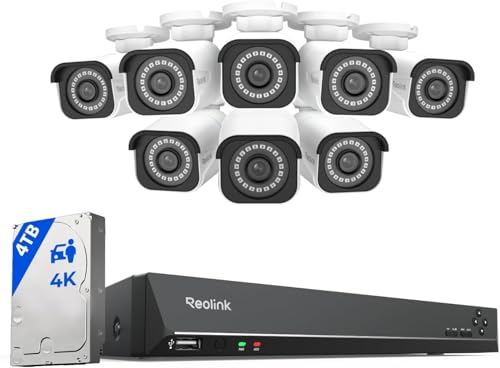
Reolink RLK16-800B8 16-Channel 4K Bullet Kit, 4TB — Best complete bullet kit
Same recorder heart as its dome sibling — sixteen channels, 4TB drive, H.265 efficiency, person and vehicle detection — wearing the opposite philosophy on its sleeve. The RLK16-800B8’s eight 8MP bullet cameras are meant to be seen. A bullet announces surveillance the way a lock announces itself: most of its work is done before anyone tests it, by persuading the casual opportunist that this particular property is more trouble than the next one.
Bullets also win the practical optics argument outdoors. The housing shades its own lens with a brow, rain runs off predictably, and the camera can be aimed with a precision domes make fiddly — down a driveway’s length, along a fence line, across a yard’s diagonal. Where a dome watches an area, a bullet watches a route, and routes are how people actually cross a property.
Farms give bullet kits their sternest test and their best reviews: dust, driving rain, machinery vibration and long dark approaches are the bullet housing’s home terrain. The sun-brow that looks cosmetic in a product photo is, by harvest season, the reason the lens is still seeing clearly.
Aiming bullets is a two-person job done properly: one at the ladder with the camera loose in its mount, one at the recorder screen calling adjustments. Ten minutes of that choreography per camera at install saves the season of ‘nearly right’ footage that solo installers accept and regret.
Infrared performance follows the form: bullet IR arrays throw clean, unfogged light with no dome to reflect from, so night identification distances hold up in the weather that defeats lesser housings. For rural properties where the night view is a long, dark approach rather than a lit porch, that reliability is the deciding specification.
Choose between the two Reolink kits by asking what your cameras are for. If the property hosts the public — customers, guests, clients — the domes’ discretion protects the welcome. If the property’s problem is intrusion across open ground, the bullets’ visibility and aim protect the perimeter. The recorder, the drive and the app experience are identical twins; the housings are where the personalities live.
Like its sibling, the kit leaves eight channels open, and bullet systems tend to use them: a PTZ like the Jennov below on the longest approach is the classic first addition, turning a fixed perimeter into one with a telescope. Plan the recorder’s home centrally and the expansion is a cable run, not a rebuild.
Resale and hand-me-down value quietly favour complete branded kits: a matched recorder-and-cameras set with spare channels is a legible product to a second owner in a way a box of mixed singles never is. Buyers who may sell a property with the system installed should weigh that legibility.
Insurance conversations sometimes reward visible systems explicitly; a bullet perimeter photographs well for a risk assessment. Keep the install tidy and the recorder’s paperwork tidier, and the kit can pay a small dividend before it ever records an incident.
- Cameras in box: 8 × 8MP PoE bullet cameras
- Recorder: 16-channel NVR, 4TB HDD fitted
- Compression: H.265 for storage efficiency
- Detection: Person and vehicle detection
- Power: PoE — one cable per camera
- Recording: Continuous 24/7 to local drive
Strengths
- Visible deterrence plus precise route aiming
- Clean infrared without dome reflections
- Identical expandable recorder to the dome kit
Trade-offs
- Conspicuous housings suit some properties poorly
- Fixed bullets must be aimed thoughtfully at install
- Same installation weekend as any eight-camera PoE kit
Best for: Rural properties, yards and perimeters where being seen is half the security.
Not suited for: Guest-facing entrances where discretion matters more than deterrence.
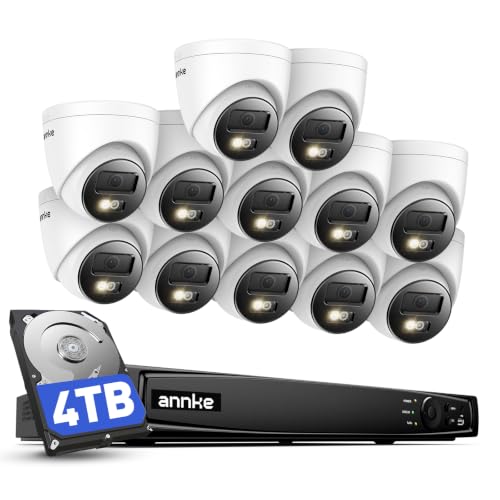
ANNKE 4K PoE 16-Channel System with 12 Turret Cameras — Most cameras per system
Twelve cameras changes the planning conversation from ‘which angles can we afford’ to ‘is there any angle left’, and that is the ANNKE system’s entire pitch: a 16-channel recorder, a 4TB drive, and a dozen 8MP turret cameras to spread across a property that thinks in double figures — a smallholding, a multi-unit rental, a workshop compound, a large house with outbuildings that each deserve an eye.
Turrets are the connoisseur’s housing for night work, and twelve of them is a statement. The flat-faced turret design separates lens from infrared, which kills the reflections that fog domes and the spider-web glare that plagues bullets; add this system’s smart dual light — infrared that can switch to a visible white light when a person is detected — and night footage gains both clarity and a deterrent flash of acknowledgement.
The dual-light behaviour deserves choreography at setup: white light on detection is a deterrent at a gate and a nuisance outside a bedroom window. Assign the bright response to public-facing angles and let bedroom-side turrets stay infrared-quiet; the system’s flexibility is only an asset when someone configures it per position.
Label the ANNKE’s twelve cables at both ends as they are run — tape and a marker, nothing fancier. Twelve identical grey leads arriving at one recorder is a puzzle nobody should set their future self, and the labelling takes less time than one troubleshooting session it prevents.
AI motion detection across twelve channels is not a luxury; it is the only way the archive stays reviewable. A dozen cameras recording a windy week generate a mountain of nothing, and classification is the machinery that finds the somebody inside it. The 4TB drive divides across twelve 4K streams to a retention best described as days-to-a-fortnight at full tilt, so buyers should configure bitrates deliberately — full quality on the entrances, leaner streams on the quiet stockyard views.
Installation is the honest price, again: twelve Ethernet runs is a project with a plan, a cable budget and probably a second pair of hands. But divide the system’s cost by twelve and the per-camera economics undercut every smaller kit in this guide, which is how serious properties have always bought surveillance — by the covered angle, not by the box.
Sixteen channels with twelve filled leaves four spare, a smaller margin than the Reolink kits’ but pointed the same way. For the property that counted its angles and reached double digits, this is the only pick here that does not ask it to count again.
For multi-unit landlords the ANNKE’s dozen turrets map naturally onto a building’s shared geography — entrances, car park, bin store, bike shed, corridors’ exterior doors — with channels left for the angle the first incident report will inevitably request. Systems bought with that report in mind age gracefully.
The ANNKE’s scale also suits phased projects: wire the whole property in one disruptive weekend, populate twelve positions now, and let the four spare channels absorb the garden room and the new gate when those projects land.
- Cameras in box: 12 × 8MP turret cameras
- Recorder: 16-channel, 4TB HDD fitted
- Night design: Smart dual light — IR plus white light on detection
- Detection: AI motion detection
- Power: PoE
- Expansion: 4 spare channels
Strengths
- Twelve angles covered in one system
- Turret design gives the cleanest night footage here
- Lowest cost per covered angle in the guide
Trade-offs
- Twelve cable runs is a substantial project
- 4TB spreads thinner across twelve 4K streams
- Overkill for ordinary houses
Best for: Smallholdings, compounds, multi-unit properties and large homes with outbuildings.
Not suited for: Anyone whose honest angle count is six or fewer.
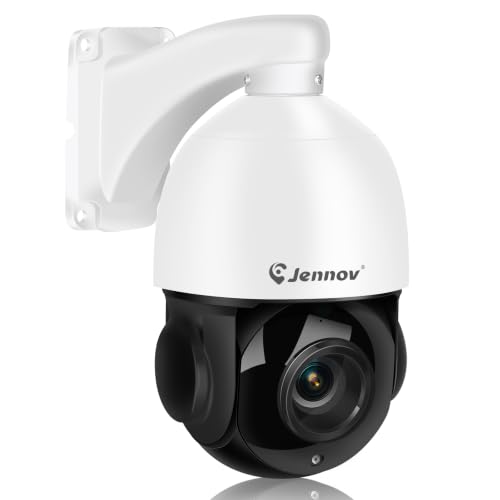
Jennov 4K 8MP Outdoor PTZ PoE Camera, 20x Optical Zoom — Best long-range single camera
This is a single camera, and the listing’s silence about a recorder is the most important specification on its page: the Jennov is an eye in search of a brain. Connect it by PoE to a compatible NVR and it becomes the long arm of a system like the Reolink kits above — a speed dome whose 20x optical zoom reads detail at distances fixed cameras surrender, with infrared reach quoted around 320 feet for night work across yards, car parks and long driveways.
Optical zoom is the operative phrase. Twenty times magnification through glass gathers real detail — a plate at the far gate, a face at the yard’s end — where digital zoom merely enlarges pixels into soup. Paired with pan and tilt, one Jennov on a corner mount can patrol the work of three fixed cameras, swinging between preset viewpoints: the gate, the fuel store, the loading bay, back to the gate.
Preset discipline makes or breaks PTZ ownership. Program a small circuit of named viewpoints, set a sane dwell time on each, and let tracking interrupt the circuit only inside your own boundaries. Owners who skip this homework own a camera that stares at wherever it was last left pointing — usually the least important wall on the property.
Weather at height is the PTZ’s working environment: wind load on a dome at a gable end is real, and the mount deserves fixings chosen for the wall’s material rather than the ones that happened to be in the box’s bag. A dome that survives its first storm unmoved will serve for years; one that shifts a degree a month becomes a patrol of the sky.
That patrol is also the camera’s honest limitation, and buyers should hold it clearly: a PTZ sees one direction at a time. While it inspects the gate, the fuel store is unwatched. Mature systems therefore pair a PTZ with fixed cameras that never blink, letting the dome investigate what the fixed eyes detect. Bought as a system’s telescope, it is superb; bought as a lone camera for a large site, it is a guard who can only face one way.
Auto-tracking features in this class follow a detected person across the frame, and on a big open property that transforms the footage from ‘someone was in the yard’ into a continuous, identified walk. Set the tracking zones thoughtfully — a public footpath beyond the fence will otherwise keep the camera dancing all day — and the dome becomes the hardest-working single position in the system.
Confirm recorder compatibility before ordering, as with any single PoE camera: mainstream ONVIF-friendly NVRs adopt such cameras readily, but the five minutes spent checking is the difference between an expansion and a return parcel.
Pair the Jennov with one wide fixed camera watching its own mounting area and the classic PTZ blind spot closes: the dome roams the yard while a humble turret guards the dome’s back. System design at this level is chess, not shopping, and the PTZ is the piece that rewards the player who thinks in combinations.
Delivery and logistics yards get a specific gift from a tracking PTZ: a continuous follow of a vehicle from gate to bay replaces the stitched guesswork of five fixed clips, and disputes about where a pallet went end in one viewing.
- Type: Single PTZ speed dome camera — recorder required
- Sensor: 4K 8MP
- Zoom: 20x optical zoom
- Night vision: Infrared to roughly 320ft
- Power: PoE
- Movement: Pan and tilt with preset patrols and tracking
Strengths
- Genuine optical reach for gates and yards
- One dome patrols several fixed viewpoints
- Auto-tracking follows a subject across open ground
Trade-offs
- Records nothing without an NVR and PoE supply
- Sees one direction at a time
- Compatibility check with your recorder is essential
Best for: Farms, yards, car parks and long driveways already running — or planning — an NVR system.
Not suited for: Standalone buyers expecting a camera that records out of the box.

Reolink Duo 2V PoE 8MP Dual-Lens Camera — Best panoramic single camera
Two lenses in one housing, stitched into a single panoramic view: the Duo 2V solves the corner problem. Mounted on a building’s edge or above a yard, its twin 8MP-class eyes cover the wide sweep that would otherwise need two cameras and two cable runs, presenting the recorder with one combined panorama in which nothing crosses a seam between separate cameras because there is no between.
The IK10 rating is the specification that tells you where Reolink expects this camera to live: within reach. IK10 is the highest common impact rating — the housing is built to survive deliberate blows — which suits school walls, car-park pillars, shopfronts and any mount a passer-by can touch. Most cameras in this guide assume altitude protects them; the Duo 2V assumes the opposite and armours up.
Mounting height interacts with the Duo’s panorama in a way worth visualising before drilling: too high and the stitched view becomes a map of hat crowns; at three to four metres the panorama reads faces across its sweep. The camera forgives many things, but geometry is not one of them.
The Duo’s single-cable economy compounds in awkward buildings: one run across a listed façade or a finished ceiling is a negotiation; two runs for two cameras can be a refusal. Where routing is the constraint, a panoramic camera is not a luxury but the only viable design.
Person, vehicle and animal detection runs on the combined view, and the animal category earns its keep in the places this camera mounts: farmyards distinguishing a fox from a thief, stables watching horses, kennels and catteries keeping night logs. Colour night vision keeps those identifications readable after dark, at the usual cost of needing some ambient or onboard light to work with.
It remains a single camera in the system sense: PoE-powered, recorder-fed, recording nothing alone. Within a Reolink ecosystem it integrates most smoothly, and its panorama can replace two fixed positions in an RLK kit’s channel budget — a trade worth modelling, because two saved channels and one saved cable run sometimes beat the camera’s price difference against a standard turret.
For a single mounting point that must see a whole yard, a playground or a forecourt, nothing else in this guide does the job in one housing. The Duo 2V is a specialist, and its specialty is commoner than buyers first think.
Animal businesses should demo the Duo’s detection against their own residents before trusting its logs: a week of the camera learning the difference between the yard cat and a midnight stranger tunes expectations better than any specification. Detection categories are statistical, and a calibration week is professional practice, not a complaint.
Playgrounds and sports clubs use the Duo’s panorama for safeguarding reviews as much as for intrusion: one wide, timestamped view of the whole space answers ‘who was where’ questions that matter to people far more than property does.
- Type: Single dual-lens PoE camera — recorder/system required
- View: Panoramic stitched view from twin lenses
- Housing: IK10 vandal-proof rating
- Detection: Person, vehicle and animal detection
- Night vision: Colour night vision
- Power: PoE
Strengths
- One mount covers a two-camera sweep
- IK10 armour for reachable positions
- Animal detection suits farms and animal businesses
Trade-offs
- Needs a recorder or system to record
- Panorama is fixed — no zooming into corners later beyond the 8MP crop
- Premium for a single camera position
Best for: Corners, yards, forecourts and animal premises needing one wide, armoured view.
Not suited for: Long-distance identification — that is the PTZ’s territory.

4K 8MP PoE Turret Camera, 2.8mm Wide Angle — Best wide-angle add-on camera
Every kit leaves one angle behind — the side door added after the build, the bin store where packages keep vanishing — and this unbranded-class 4K turret is the patch the market provides: an 8MP PoE turret with a 2.8mm lens giving roughly a 105-degree view, H.265 compression, IP67 sealing and full-colour night vision, built to join an existing recorder system at a price that makes a single addition painless.
The 2.8mm lens choice deserves translating. Wide lenses trade distance for breadth: this camera sees a whole entrance, a whole room corner, a whole short driveway in one frame, and identifies people at conversational distances rather than across a field. That is exactly right for the gap-filling role — the missed angles in most systems are near, not far — and exactly wrong for gate-at-fifty-metres work, which belongs to the Jennov’s zoom.
A word on colour night vision’s appetite: full colour after dark needs photons, from the camera’s own illumination or the property’s lighting. Pair this turret with a porch light or a motion light at its entrance and the colour footage sings; starve it of light entirely and even the best sensor negotiates. Lighting and cameras are one system, bought in two aisles.
Firmware honesty is the unbranded camera’s open question: updates may be rare, so buy it for what it does on day one rather than what it might become. Judged on that basis — a sharp, wide, colour 8MP turret at a gap-filler’s price — it needs no promises about the future to earn its place.
Full-colour night vision around the clock is the turret’s second headline. Where infrared renders the night in grey, a colour-capable turret near an entrance records the jacket, the car, the delivery van’s livery as they actually were. Colour is evidence-grade information, and at doorways it is frequently the detail that resolves a dispute or identifies a repeat visitor.
Compatibility is the buyer’s homework, stated plainly: the listing promises broad NVR compatibility, and PoE standards make that plausible, but an unbranded camera joining a branded recorder deserves a five-minute check of the recorder’s supported protocols before the ladder comes out. Bought with that check done, this is the highest-value single addition in the guide — name-brand ecosystems charge considerably more for the same 8MP turret shape.
IP67 sealing suits full weather exposure, and the turret form keeps night footage clean of the reflections that trouble domes. As the sixth pick it is deliberately unglamorous: the camera you add when the system is already good and one angle is still dark.
Buy two if the budget allows and the gaps are plural — the side door and the bin store rarely improve one at a time, and a matched pair of turrets keeps the system’s night colour consistent across the near angles where identification actually happens.
Keep the turret’s box and your recorder’s protocol notes together; if a future firmware change ever loosens the pairing, that scrap of paper is the difference between a ten-minute fix and a forum expedition.
- Type: Single PoE turret camera — recorder required
- Sensor: 4K 8MP
- Lens: 2.8mm, roughly 105-degree view
- Night vision: Full-colour night vision
- Compression: H.265
- Sealing: IP67 weatherproof
Strengths
- Wide colour view for entrances and gaps
- Excellent value as a system addition
- Clean turret night performance
Trade-offs
- Wide lens identifies near, not far
- Recorder compatibility must be verified
- Unbranded support ecosystem versus the big names
Best for: System owners filling one near, wide angle — a side door, a store, an entrance — in colour.
Not suited for: Distance work, or shoppers expecting a complete kit in the box.
Comparison Table
The ‘in the box’ column is the whole story of this category: three of these products are complete systems, three are single eyes awaiting one, and confusing the two groups is the most expensive reading error a buyer here can make.
| Pick | In the box | Housing | Special power | Recorder | Watch out for |
|---|---|---|---|---|---|
| Reolink RLK16-800D8 | Kit: 8 domes + NVR | Dome | Discretion, IK-style toughness | Included, 4TB | Dome cleaning ritual |
| Reolink RLK16-800B8 | Kit: 8 bullets + NVR | Bullet | Visible deterrence | Included, 4TB | Conspicuous by design |
| ANNKE 16CH System | Kit: 12 turrets + NVR | Turret | Dual-light nights | Included, 4TB | Retention across 12 streams |
| Jennov PTZ | Single camera | Speed dome | 20x optical zoom | Required, not included | One direction at a time |
| Reolink Duo 2V | Single camera | Dual-lens | Panorama, IK10 armour | Required, not included | Fixed wide view |
| 4K Turret 2.8mm | Single camera | Turret | 105° colour view | Required, not included | Verify NVR compatibility |
Kits versus Cameras: How to Think About the Two Halves
A surveillance system is a recorder with opinions about cameras attached. The recorder owns the archive, the app, the detection filtering and the user experience; the cameras own the light. Buyers who grasp that hierarchy shop correctly: choose the recorder ecosystem you want to live with — its app, its search, its export workflow — then choose housings and lenses to serve each position. Reversing the order, collecting attractive cameras first, produces the drawer of incompatible hardware every installer has seen.
This is also why the single cameras in this guide were chosen for standards compliance. A PoE camera speaking the common protocols can migrate between recorders across its life; a proprietary oddity is married to one box. The Jennov, the Duo 2V within its ecosystem logic, and the turret all respect that principle to the degree their classes allow.
What 8MP actually buys at three distances
At doorway distance — two to four metres — even a 2MP camera identifies a face, and 8MP’s gift is margin: the same face stays identifiable off-centre, in motion, in worse light. At driveway distance, eight to fifteen metres, 8MP is the difference between a recognisable visitor and a figure in a jacket; plates become readable at the nearer end of that band. At yard distance, thirty metres and beyond, no fixed 8MP lens identifies faces — that is zoom territory, and pretending otherwise is how buyers end up disappointed with excellent cameras aimed at impossible jobs. Match the sensor to the distance honestly and 4K never disappoints.
Cable is the unglamorous specification that decides reliability
Every pick here trusts its life to Ethernet, so the cable deserves the same care as the cameras: outdoor-rated runs for outdoor routes, gentle bends, drip loops where a cable meets a camera so water follows gravity instead of the wire, and terminations kept out of weather. Installers’ folklore is unanimous that most ‘camera faults’ in mature systems are cable faults wearing a disguise. An hour of care with the cheap part protects the expensive parts for a decade.
Detection zones: the free feature owners underuse
Every kit here lets you draw where detection applies, and the drawing is where false alerts go to die. Exclude the public pavement, include the gate’s swing, hug the driveway’s edges and leave the washing line’s choreography outside the fence of pixels. Twenty minutes of zone-drawing per camera at install converts the app from a nuisance into an instrument, and it is the single highest-return configuration task in the entire category — ahead of bitrate tuning, ahead of retention maths, ahead of everything.
How Do You Choose Between a Complete Kit and Building Your Own System?
Start from what you already own
A house with no recorder should almost always start with a complete kit: the recorder, drive and cameras are guaranteed to cooperate, the per-camera cost is lowest, and the system works the weekend it arrives. A house with a recorder already running should buy single cameras — the PTZ for distance, the Duo for a corner, the turret for a gap — because its expensive half is already paid for. The only wrong move is the middle path taken accidentally: a lone camera bought by someone who believed it was a kit.
Which housing belongs at which position?
Walk the property and assign housings by job. Entrances that host people get domes or turrets — discreet, clean at night, kind to visitors. Approaches and boundaries get bullets, whose visibility and aim work the route. The one long view gets the PTZ. The corner that sees two directions gets the Duo. A system designed this way looks intentional because it is: each housing is an answer, not a default.
How much retention does a 4K system really hold?
Divide the drive by the cameras and respect the resolution: 4K streams are hungry, and eight of them fill 4TB in roughly a couple of weeks at full quality, twelve faster. H.265 compression and sensible bitrates stretch that considerably, and motion-heavy scenes eat more than still ones. Decide your retention target — most homes need a fortnight, most businesses a month — and configure per-camera bitrates to hit it, rather than discovering the overwrite horizon during an insurance claim.
Is person and vehicle detection worth paying for?
At 4K scale, yes — it is the difference between an archive and a haystack. Without classification, reviewing a week means scrubbing; with it, the week becomes a list of arrivals. Every kit in this guide includes some form of smart detection, and single-camera buyers should confirm their recorder supplies it. Resolution gathers evidence; detection is how you ever find it again.
What about the app and the television?
Recorder systems live in two places: the recorder’s own screen interface, best for deep archive work with a mouse, and the phone app, best for alerts and quick checks. Households differ in which they inhabit, and the kits here serve both competently. Single-camera buyers inherit their recorder’s interfaces entirely — one more reason the recorder, not the camera, is the purchase to research hardest.
What will you do with the footage on the worst day?
End the planning where the system will one day be used: an incident, a claim, a police visit. The workflow that matters is find-export-hand over, and it should be rehearsed once in peacetime — locate an event by detection filter, export ninety seconds to a stick, play it on a different machine. Kits and cameras in this guide all support that workflow; the rehearsal is what turns support into readiness, and it takes less time than mounting one camera.
Common Mistakes
Buying a single camera and expecting footage
The classic error of this category: a PTZ or turret arrives, gets mounted, and records nothing because no recorder exists. The product was never broken — the system was never bought. Read every listing for the words ‘NVR required’ and price the recorder, switch and drive into any single-camera purchase.
Believing 4K and 8MP are two features
They are one sensor described twice. A listing that stacks both as separate virtues is marketing to the uncritical; the honest specifications to compare are lens, housing, night design, detection and the recorder behind the camera.
Aiming a wide fixed camera at a distant job
An 8MP wide view of a fifty-metre yard produces beautiful, unidentifiable footage. Distance is a zoom problem, not a resolution problem. Put the PTZ or a narrower lens on the long view and let wide cameras work the near ground they are good at.
Running every camera at maximum bitrate by default
Factory-maximum streams halve your retention for detail nobody reviews. Set bitrates per position — maximum at the money angles, moderate on the quiet views — and the same drive holds weeks more of the footage that matters.
Skipping the compatibility check on add-on cameras
Five minutes confirming that a single camera speaks your recorder’s language prevents the most avoidable return in the category. Standards make success likely; they do not make the check optional.
Mounting every camera at the same height and angle
Uniformity feels tidy and wastes the housings’ differences. Entrances want lower, face-height identification; yards want height and overview; the PTZ wants the corner with the longest sightlines. A system whose cameras all stare from identical eave positions has paid for variety and declined to use it.
Hiding the recorder where nobody can reach it — including you
Security argues for discretion; maintenance argues for access. A recorder entombed behind stored furniture will not get its drive swapped, its firmware updated or its footage exported quickly. Choose discreet-but-reachable: a ventilated cupboard shelf beats both the hallway table and the attic’s far corner.
Judging night performance from the showroom feed
Showrooms are lit like operating theatres; every camera looks forensic under them. The honest test is your own darkest position at your own midnight, reviewed the next morning during the returns window. Sellers of the picks above can survive that test — which is precisely why it should be run.
Final Recommendation
Two purchasing rules govern everything recommended above: never price a camera without pricing its recording, and never count a kit’s channels when you should be counting its cameras.
Starting from zero, take a complete kit and take it once: the Reolink RLK16-800D8 for properties that host people and value discretion, its bullet twin RLK16-800B8 for perimeters that value being seen, or the ANNKE twelve-turret system when the angle count honestly reaches double figures. Each leaves channels spare, records continuously to a real drive, and asks nothing monthly for the privilege.
Already own a recorder? Then this guide’s second half is your shopping list — the Jennov PTZ for the long view, the Duo 2V for the corner, the little turret for the gap by the side door — three specialists that make a good system feel designed.
Whichever half you buy first, remember that the camera is the eye and the recorder is the memory, and a security system is only ever as good as the half you were tempted to skip.
Frequently Asked Questions
Are 4K and 8MP the same thing?
Effectively, yes. An 8-megapixel sensor in widescreen proportions produces a frame of about 3840×2160 pixels, which is the 4K UHD standard. Listings use both terms because buyers search for both; treat them as one specification and spend your comparison effort on lenses, housings, night design and recorders.
Can I use the Jennov, Duo 2V or turret without an NVR?
They need somewhere to record: a compatible NVR is the designed answer, and some cameras also support local card recording or NAS/PC software — check the specific listing. What they cannot do is behave like a self-contained app camera out of the box. Budget the recorder side before buying any single PoE camera.
How many 4K cameras can a 16-channel recorder really handle?
Sixteen channels means sixteen cameras, but bandwidth and the fitted drive decide comfort: eight 4K cameras at full bitrate is a well-matched load for the kits here, and per-camera bitrate settings let a system stretch toward its channel count without drowning the recorder. The kits’ configurations — eight or twelve cameras on sixteen channels — reflect that engineering honesty.
Do these systems work without internet?
Yes for recording and local viewing: PoE systems are local networks with a recorder at the centre, and they keep writing through an internet outage. Remote app viewing and alerts pause until the connection returns. That local-first design is precisely why this category suits buyers wary of cloud dependence.
Turret, dome or bullet — which is best at night?
Turrets generally produce the cleanest night footage because their infrared sits apart from the lens, avoiding reflections and the web-glare that domes and bullets can suffer. Domes fog if their covers dirty; bullets throw far and clean. For entrances, a turret or a colour-night model wins; for long dark approaches, a bullet or the PTZ’s infrared wins.
Can I mix these single cameras into a Reolink kit?
The Duo 2V is designed for that ecosystem. Third-party PoE cameras like the Jennov and the turret commonly join mainstream recorders via standard protocols, but ‘commonly’ is doing work in that sentence — verify your recorder’s supported protocols against the camera’s listing before ordering, every time.
How difficult is a PoE kit to install for a first-timer?
A weekend of honest work for a typical house: mounting cameras, running cable through lofts and soffits, crimping or using pre-made leads, and an hour of recorder setup. The skills are patience and ladder sense rather than electronics. Owners who plan cable routes on paper first finish on time; owners who improvise discover the one wall that defeats them at dusk on Sunday.
When should I replace a recorder’s hard drive?
Surveillance drives in continuous service commonly last for years; recorders report drive health in their menus, and a drive flagged with errors should be swapped at the next convenient weekend rather than the next emergency. Keep the old drive until the new one has a fortnight of footage on it — archives have a way of being requested at the worst moment.
Is H.265 worth insisting on?
Yes at 4K scale. H.265 squeezes the same picture into roughly half the storage of older compression, which at eight or twelve cameras is the difference between a fortnight’s archive and a month’s. Every kit in this guide records with it; single-camera buyers should confirm their recorder decodes it before pairing.
Related Guides
Continue with our companion guides to PoE installation practice, camera placement by housing type, and realistic recorder storage planning: How to install a PoE camera system Dome vs bullet vs turret cameras explained How much NVR storage do you need



[…] outdoor camera placement, home network design for streaming cameras, and solar panel positioning: Outdoor security camera placement guide How to fix Wi-Fi dead zones for cameras Solar security camera winter […]