What's inside
- Key Takeaways
- Quick Picks
- What Happened to the 4.1 Soundbar?
- What Does a 4.1 Search Reveal About Shopping by Numbers Generally?
- Why Did the Centre Channel Win?
- Who Actually Searched for 4.1 — and What Did Each of Them Mean?
- How Should You Choose Between the Successors?
- How Did 4.1 Systems Render Surround Without a Centre?
- What About Music — the 4.1 Era’s Strongest Suit?
- Will an Older 4.1 System Even Talk to a Modern Television?
- What Should a Former 4.1 Owner Expect in the First Week With a Successor?
- Comparison Table
- How Should You Read Channel Numbers From Now On?
- Could 4.1 Ever Come Back?
- What Mistakes Do Buyers Make Chasing a Vanished Category?
- A Note on Disposal, Spares and Keeping Old Systems Alive
- Final Recommendation
- Frequently Asked Questions
- Related Guides
As an Amazon Associate I earn from qualifying purchases. This post may contain affiliate links at no extra cost to you.
gizmoverdict.com is reader-supported. When you buy through links on our site, we may earn an affiliate commission.
Where to buy: Three picks below link to listings verified in this site’s product pool, each labelled with the configuration its listing actually states. Three further picks are prose-only routes to the genuine 4.1 idea, offered without links because no verified current listings exist for them.
Here is the sentence this entire guide hangs on, placed where it cannot be missed: the 4.1 soundbar has nearly vanished from the current market. A generation ago, the configuration — four front-and-surround channels rendered by a bar, plus a subwoofer, without a discrete centre channel — was a recognised product class sold by major brands. Today the best 4.1 soundbars, as a literal shopping category, survive mainly as older models draining through clearance and second-hand channels. The industry moved on: buyers who wanted more than stereo overwhelmingly chose layouts with a centre channel, and manufacturers consolidated around 3.1, 5.1 and Atmos configurations, leaving 4.1 behind as an evolutionary branch that did not lead anywhere.
That honesty shapes everything below. No pick in this guide is a 4.1 soundbar, and none is described as one anywhere in these pages. The three linked systems are the nearest living relatives, each labelled with its true configuration at every appearance: a 5.1.4 Vizio system, a 5.1 Hisense system with separate surround speakers, and a 3.1.2 Samsung system that approaches the old idea from the centre-channel side. The three prose-only picks address the genuine 4.1 article itself — the older LG SH7 generation and its contemporaries, the second-hand route more broadly, and the component alternative for listeners who truly want four channels and a sub with no centre.
Why did 4.1 exist at all? Its logic was sound in its era. A bar could render left, right and two surround channels — sometimes with wireless rear speakers, sometimes by bouncing and processing — while a subwoofer handled bass, and the phantom centre formed between the front pair handled dialogue. What killed it was not failure but comparison: once wireless surround kits and cheap centre channels became routine, shoppers asked why they should accept a phantom centre when a real one cost little more, and the 5.1 layout answered with better dialogue and a cleaner upgrade story. Understanding that history is the difference between hunting a 4.1 bar as an informed enthusiast and ordering one by accident under the impression it is a current category. This guide is written for the first of those readers, while protecting the second from a purchase they would describe, accurately, as not what they ordered.
Key Takeaways
- The 4.1 configuration has nearly disappeared from current lineups; this guide says so rather than disguising substitutes.
- No pick below is labelled 4.1 — each linked system carries its true configuration everywhere it appears.
- The linked picks are the nearest living relatives: 5.1.4, 5.1 with separate surrounds, and 3.1.2.
- Genuine 4.1 hardware, led by the older LG SH7 generation, is now a prose-only, second-hand conversation.
- The old layout’s weakness was its phantom centre; modern 5.1 and 3.1 designs exist because shoppers noticed.
- A component receiver system remains the one route to a true, current 4.1 layout — at component prices and effort.
Quick Picks
| Pick | Badge | Why it earns its place |
|---|---|---|
| VIZIO SB36514-G6 | Surround-plus-height heir — 5.1.4 | Real surround channels and Atmos height in the spirit of the old ambition, with a centre added. |
| Hisense HS5100 | Separate-surround value — 5.1 | A 5.1 system with wireless sub and rear surround speakers included in the package. |
| Samsung HW-Q600C | Centre-first alternative — 3.1.2 | Approaches from the opposite flank: discrete centre plus height, no separate rears. |
| LG SH7 generation (prose-only) | The genuine 4.1 article | The older true-4.1 class itself, now found through clearance and second-hand channels. |
| Second-hand 4.1 systems generally (prose-only) | The enthusiast’s hunt | Contemporary 4.1 systems from the class’s era, bought with verification discipline. |
| Component 4.1 via AV receiver (prose-only) | The build-it-yourself route | A receiver and speakers configured as 4.1 — the only current way to own the exact layout. |
What Happened to the 4.1 Soundbar?
Product categories die the way languages do — gradually, then in a single catalogue season. Through the mid-2010s, 4.1 systems occupied a defensible shelf: more immersive than 2.1, simpler than a full 5.1 with its centre and rears, and well matched to an era when streaming surround was still maturing. The LG SH7 generation represented the class at its most polished, with wireless subwoofers and music-friendly features that acknowledged how much of a soundbar’s life is spent playing songs rather than films.
Three pressures then converged. First, the centre channel’s dialogue advantage became conventional wisdom — shoppers learned to ask for it by number, and 4.1 has no number to answer with. Second, Atmos arrived and reorganised the premium shelf around height, pulling development budgets toward configurations ending in .2 and .4. Third, the 5.1 soundbar system — bar, wireless sub, compact rears — fell in price until the simplicity argument for 4.1 collapsed: the supposedly simpler system saved little money and little effort while giving up the centre. Manufacturers did not so much cancel 4.1 as stop renewing it, model cycle by model cycle, until the class existed only in warehouses and listings for older stock.
The lesson generalises beyond this keyword. Channel configurations are not eternal verities; they are industrial settlements that hold while economics and content formats agree. A shopper who understands why 4.1 faded will shop its successors more wisely — and will recognise the same pattern early if, one day, a currently fashionable configuration begins its own quiet exit.
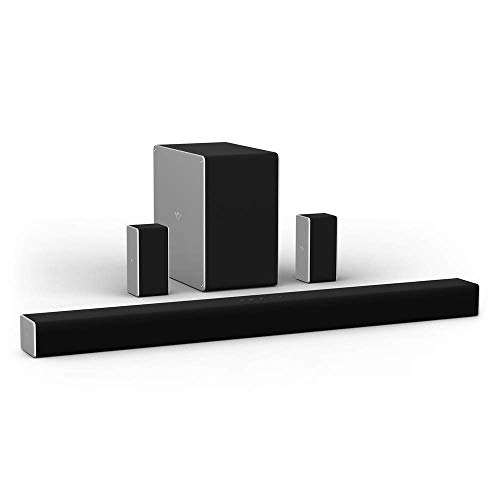
VIZIO SB36514-G6 — Surround-plus-height heir (5.1.4, not 4.1)
The Vizio SB36514-G6 is what the 4.1 idea grew up to become when the market demanded a centre channel and then kept demanding more. Its listing describes a premium home theatre sound system with Dolby Atmos, and its configuration is 5.1.4: five ear-level channels including a discrete centre, a wireless subwoofer, and four height channels in the layout’s arithmetic. Measured against the old 4.1 brief — surround immersion from a bar-based system without separates — the Vizio does not merely match the ambition; it exceeds it on every axis while correcting the old layout’s central weakness, the phantom centre, by fitting a real one.
That correction deserves emphasis for readers arriving with 4.1 nostalgia. The dialogue stability a centre driver provides is the single largest everyday difference between the generations, larger than the height channels that headline the newer system’s marketing. Height is for film nights; the centre works every night, on the news, on drama, on the documentary nobody planned to watch. A shopper who loved a 4.1 system for its surround generosity and tolerates its dialogue vagueness will find the Vizio’s arrangement strictly better. A shopper who specifically loved the centre-free voicing — some listeners genuinely prefer a phantom image for music — should read the prose-only picks below with more attention.
Practically, this is a system rather than a bar: surround speakers join the package’s logic, the wireless sub needs its socket and its spot, and the household should want the full arrangement rather than tolerating it. Vizio’s long specialisation in exactly this kind of package shows in the completeness of the proposition. Labelled honestly as 5.1.4 at every mention, it stands here as the maximalist heir — the pick for the reader whose 4.1 search really meant “as much surround as a soundbar system can give me.”
- Configuration: 5.1.4 (listing-described Atmos home theatre system)
- Subwoofer: wireless (per listing)
- Centre channel: discrete — the correction to the 4.1 layout
- Height: four channels in the configuration’s arithmetic
Strengths
- The fullest surround-and-height package among the linked picks.
- A real centre channel repairs the historical 4.1 weakness outright.
- System completeness — bar, sub and surrounds conceived together.
Trade-offs
- It is emphatically not 4.1; buyers wanting the literal layout must look to the prose-only routes.
- More boxes, more placement decisions, more household negotiation.
- Its scale overshoots small rooms and simple needs entirely.
A note on provenance within this guide’s own discipline: the SB36514-G6 is an established model rather than this season’s launch, which cuts both ways in the buyer’s favour. Its behaviour in real homes is extensively documented by its owner base, and its positioning reflects maturity rather than novelty. Households should nonetheless confirm the delivered unit’s completeness — a system with this many pieces rewards a careful unboxing inventory — and run every channel through the setup routine before the packaging leaves the house.
Best for: surround maximalists whose 4.1 search meant immersion first. Not suited for: literal 4.1 seekers, minimalists, or rooms that cannot host rear speakers.

Hisense HS5100 — Separate-surround value (5.1, not 4.1)
The Hisense HS5100 answers the 4.1 longing with the configuration that replaced it in the value tier: 5.1, stated in its listing, with a wireless subwoofer and rear surround speakers both named in the title. That last detail is the heart of its case. The romance of the old 4.1 class was real surround presence without a receiver and a tangle of wire; the HS5100 delivers that presence with actual rear speakers in the box, then adds the centre channel the old layout lacked. Dolby Audio and DTS Virtual:X processing, also named in the listing, round out a package whose honesty is refreshing: the channels are physical, the count is printed, and the value positioning is plain.
Rear speakers change the domestic negotiation, so let us have it in the open. They need positions behind or beside the seating and power or a connecting arrangement depending on the system’s design; they reward the household that arranges a room around watching, and they mildly punish the household that treats the television as furniture’s afterthought. For the former, the HS5100 is the most direct modern fulfilment of what 4.1 shoppers wanted — enveloping sound, bar-based simplicity, a sub with real work to do. For the latter, the Samsung below keeps the whole system at the front of the room.
Hisense’s television pairing adds the usual ecosystem comfort for its own sets, and the system’s mainstream positioning keeps it the value anchor among the linked picks. It is labelled 5.1 everywhere in this guide because that is what it is; the reader who came for 4.1 should understand they are being offered the successor, not the ancestor — a successor that history suggests most households, given a week with both, would choose.
- Count: 5.1, as printed
- Boxes: a wireless sub and separate rear surrounds, both named in the title
- Sound formats in the title: Dolby Audio with DTS Virtual:X
- Middle voice: a real centre driver inside the 5.1 arrangement
Strengths
- Physical rear surround speakers deliver the envelopment 4.1 promised.
- The centre channel the old layout lacked is present and discrete.
- Value positioning makes the full system the accessible route to real surround.
Trade-offs
- Rear speakers demand placement and household cooperation.
- Not 4.1 — the literal configuration remains the prose-only picks’ territory.
- Processing extras are modest beside the Vizio’s height ambitions.
The HS5100 also illustrates a quiet shift in what value means in this category. A decade ago, rear speakers at this positioning would have been unthinkable without a receiver; the wireless era collapsed that cost, and the 5.1 soundbar system inherited the 4.1 class’s entire reason for existing. Readers comparing the Hisense against memories of an old 4.1 setup should expect the same enveloping character with two upgrades they will notice nightly — dialogue that holds its place, and a subwoofer system designed alongside the rears rather than asked to compensate for them.
Best for: households ready for real rear speakers and wanting the complete modern successor package. Not suited for: front-only rooms, or anyone collecting the genuine historical configuration.

Samsung HW-Q600C — Centre-first alternative (3.1.2, not 4.1)
The Samsung HW-Q600C approaches the 4.1 question from the far side and must be labelled with its full configuration: 3.1.2. Where 4.1 spread its channels sideways and backward without a centre, the Samsung concentrates on the front — left, centre, right — and then adds height. It is, philosophically, the anti-4.1: a bet that the centre and the vertical dimension matter more to modern viewing than rear envelopment. A reader whose 4.1 search was really a search for “more than stereo, from one bar, without rear speakers to place” may find that this bet describes their actual desire better than the historical layout did.
The listing’s named features support the front-focused story: HDMI eARC for full-quality television audio, Q-Symphony for cooperation with compatible Samsung sets, Game Mode Pro for console households. Nothing here pretends to place sound behind the listener, and this guide will not pretend it on the Samsung’s behalf. What it offers instead is the strongest front stage in this roundup — dialogue anchored by hardware, Atmos height rendered by dedicated channels — in a single-bar installation with no rear-speaker diplomacy required.
Choose it with the trade consciously made. Film soundtracks mixed for surround will fold their rear information forward, gracefully but noticeably to ears that know the difference; the Hisense and Vizio exist in this guide for those ears. Drama, sport, news and games — the majority of most households’ hours — play to the Samsung’s strengths entirely. Labelled 3.1.2 at every appearance, it is the pick for the reader who discovers, reading this guide, that their 4.1 curiosity was actually a front-stage curiosity wearing a vintage number.
- Count: 3.1.2, printed in the listing
- Return channel: eARC, per the listing title
- Title extras: Q-Symphony, Game Mode Pro, Dolby Audio
- Stage shape: everything up front, plus height — nothing behind the listener
Strengths
- The strongest front stage here — discrete centre plus genuine height channels.
- Single-bar installation avoids all rear-speaker placement questions.
- eARC and Samsung pairing polish suit modern television households.
Trade-offs
- No rear envelopment — surround mixes are folded forward.
- Furthest in spirit from the 4.1 layout despite sharing this guide.
- Q-Symphony’s bonus belongs to Samsung television owners.
There is a generational irony in the Samsung’s presence here that deserves one sentence of appreciation: the 3.1.2 layout is, in channel-count terms, exactly as far from 4.1 as 5.1 is — yet it serves the subset of 4.1 searchers who never wanted rears at all, merely a bar that did more than stereo. Product categories are Venn diagrams, not ladders, and the Q600C occupies the overlap between ‘one bar only’ and ‘more than two channels’ that the old class also served, from the opposite direction.
Best for: front-stage households — dialogue and height prioritised, rears unwanted. Not suited for: listeners whose definition of surround requires sound behind them.
LG SH7 Generation — The genuine 4.1 article (prose-only)
Now, the real thing. The LG SH7 generation represented the 4.1 class in its maturity: a bar rendering four channels with a wireless subwoofer, music-conscious features, and the sleek industrial design LG’s audio line was known for. Owners praised exactly what the configuration promised — a wide, enveloping front-and-surround presentation with a lighter installation than full 5.1 — and the systems developed a quiet following among listeners who preferred the phantom centre’s blend for music. None of that makes the SH7 generation a current product. It is discontinued territory, and this guide links nothing for it because the verified pool holds no listing for it; what follows is guidance for the hunt, not a product endorsement of any specific unit.
Buying one now is an exercise in applied scepticism. The subwoofer’s wireless link is the first thing to verify in person or by return-protected trial, since a bar separated from its sub is a diminished object and replacement subs for discontinued lines are effectively unobtainable. The remote, the feet, the wall-mount hardware — each missing piece is effectively permanent, so completeness is worth more than cosmetic perfection. Firmware is frozen at whatever the final update was, which matters less for a bar fed by a television than for a smart device, but streaming features of that era should be assumed fragile and treated as a bonus if they work at all.
Who should walk this route? The listener who owned the class and loved it, the music-first household that genuinely prefers the centre-free presentation, and the enthusiast who enjoys keeping good older hardware in service. Who should not: anyone buying a gift, anyone without a painless returns path, and anyone whose household will blame them personally every time a nine-year-old electronic device behaves like one. The SH7 generation was good. History has still moved on, and buying history requires a historian’s temperament.
- Configuration: 4.1 — the genuine historical layout
- Link status: prose-only; no verified current listing
- Critical checks: subwoofer pairing, remote and hardware completeness
- Support horizon: discontinued; community knowledge only
Strengths
- The actual configuration the keyword names, with its period virtues intact.
- Music-friendly phantom-centre presentation some listeners still prefer.
- Ownership can be genuinely economical for the prepared buyer.
Trade-offs
- Every unit is ageing; subwoofer pairing and completeness are existential checks.
- No current support, firmware or spare-parts pipeline.
- Streaming features of its era should be considered decorative.
One more test separates a cherished SH7-class unit from a tired one: sustained listening at the volumes the household actually uses. Ageing amplifiers and power supplies often behave at a demo’s whisper and complain at a film’s climax, so audition with a demanding scene, not a gentle one, and listen for distortion, subwoofer chuffing or a wireless link that drops when the room’s other electronics wake up. A unit that passes an honest hour has earned its place; a unit that fails it is a parts donor wearing a price tag.
Best for: informed enthusiasts and former owners who know exactly what the class was. Not suited for: gift buyers, the returns-averse, or anyone needing a warranty with a pulse.
Second-Hand 4.1 Systems of the Era — The enthusiast’s hunt (prose-only)
Beyond the LG line, the 4.1 era included contemporaries from several major brands, and the second-hand market treats them as an undifferentiated pool of “old soundbars” — which is precisely where a prepared buyer finds value. Sellers frequently mislabel configurations in both directions: 4.1 systems advertised as 5.1 by hopeful copy, and occasionally the reverse. The manufacturer’s archived specification is the only authority worth consulting, and the discipline from this site’s other guides applies with doubled force: verify the channel count from the maker’s documents, verify the subwoofer is the correct paired unit, and verify every cable and remote the system needs to be whole.
Condition grading deserves a colder eye here than for renewed current models. A renewed programme implies an inspector; a second-hand listing implies a seller’s optimism. Budget mentally for the accessories that will be missing, test the wireless links within the return window if one exists, and prefer local purchases where the system can be heard before money moves. The reward for this rigour is real: the era’s better systems were built to a standard that flatters them still, and a well-kept example can serve a music-and-film room for years at a fraction of its original station.
The boundary of this pick should be plain. It is a route for people who enjoy the process — research, verification, a certain affection for rescued hardware. It is not a recommendation that the average household should furnish its living room from the second-hand pool, and this guide’s linked picks exist for that household. Enthusiasm is a resource; spend it where it pays, and do not let a search term spend it for you.
- Configuration: 4.1 systems of the class’s era (verify per model)
- Link status: prose-only; no verified listings
- Authority: manufacturer’s archived specification, never the seller’s title
- Testing: wireless sub link and completeness within any return window
Strengths
- The broadest pool of genuine 4.1 hardware available anywhere.
- Mislabelled listings occasionally price real quality as generic old stock.
- Keeps well-built hardware in service — a virtue beyond the budget.
Trade-offs
- Verification burden falls entirely on the buyer.
- Condition varies from cherished to fictional.
- No programme, inspector or warranty stands behind the purchase.
Documentation is the second-hand hunter’s force multiplier. Owner forums for the era’s systems preserve setup sequences, pairing rituals for orphaned subwoofers, and the small firmware-era quirks that no seller will mention. An hour in those archives before a purchase is worth more than any extended warranty the used market pretends to offer, and it occasionally surfaces the original owner’s manual — the single most useful artefact a discontinued system can travel with.
Best for: hobbyists who treat verification as part of the pleasure. Not suited for: households wanting a purchase that is finished when the box is opened.
Component 4.1 via AV Receiver — The build-it-yourself route (prose-only)
There is exactly one way to own a brand-new, fully supported 4.1 system today: build it from components. An AV receiver does not care that the market abandoned the layout; configure it with front left and right speakers, two surrounds, a subwoofer, and no centre, and it will render a genuine 4.1 stage with modern decoding, room calibration and connections no soundbar can match. This pick is prose-only because it is a route rather than a product — no single listing in the verified pool represents it — but for the reader whose attachment is to the layout itself rather than to the soundbar form, it is the honest destination.
The virtues are the component world’s usual ones. Speakers can be chosen for the room and replaced individually; the receiver brings calibration that measures the actual space; music performance scales with the speakers in a way fixed soundbar systems cannot follow. The phantom centre, in a well-set-up component system with properly positioned fronts, is also the best version of itself — the configuration’s original hi-fi context, where the centre-free stage was a deliberate audiophile choice rather than a cost saving. Listeners who prefer that presentation will find its finest expression here, not in any bar.
The costs are equally characteristic: money, space, cabling, and a setup process measured in an afternoon rather than minutes. A receiver-based 4.1 is a hobbyist’s answer, and presenting it in a soundbar guide is an act of respect for the reader’s actual question — “how do I get 4.1?” — rather than the narrower one the keyword implies. Most readers should take the hint in reverse: if the component route’s effort is unappealing and the second-hand route’s risks are unappealing, then the modern linked systems above are not a compromise at all. They are the answer the market built for you.
- Configuration: true 4.1, assembled from receiver and speakers
- Link status: prose-only; a route, not a product
- Modern benefits: current decoding, room calibration, replaceable parts
- Costs: component pricing, space, cabling, setup time
Strengths
- The only route to a new, supported, genuine 4.1 layout.
- Calibration and speaker choice give the phantom centre its best possible form.
- Every component is replaceable and upgradeable individually.
Trade-offs
- It is not a soundbar — the form factor that drew most readers is abandoned.
- Total cost and effort exceed every other pick in this guide.
- Cabling and furniture demands are real and ongoing.
Budget honesty applies here too, stated qualitatively since this route has no single price: a receiver and four competent speakers plus a subwoofer will outspend every soundbar in this guide, and the cabling, stands and calibration microphone ecosystem will add their own quiet costs. The route is recommended for the layout’s sake, not as a bargain. Readers who balk at that sentence have learned something useful — their attachment was to the soundbar idea all along, and the linked successors are waiting above with their labels on.
Best for: hi-fi-minded listeners committed to the layout itself. Not suited for: anyone whose 4.1 interest was really a wish for simple, bar-based surround.
What Does a 4.1 Search Reveal About Shopping by Numbers Generally?
Every category has its ghost configurations and orphaned specifications — numbers that made sense inside a technological moment and persisted in shoppers’ vocabulary after the moment passed. The healthy response is neither mockery nor blind loyalty. The number encoded real experience: people who owned these systems heard something they valued, and that value survives translation into modern terms, as this guide’s four shopper profiles showed. The unhealthy response is to let the number shop unattended, clicking whatever a results page files beneath it, because results pages are organised by sellers and sellers are organised by inventory — and inventory, unlike the reader, has no memory of what the number used to mean or any obligation to explain what replaced it.
Keep the translation habit for the next category you shop, whatever it is. Ask what the number did, ask what does it now, and let listings prove their configurations from specifications rather than from headings. It is a slower way to buy and a much faster way to be satisfied, and it converts guides like this one from product lists into what they should be — dictionaries between the language shoppers inherited and the language the shelves currently speak.
Why Did the Centre Channel Win?
Because dialogue is television’s main event. For all the spectacle of surround effects, the hours a household spends with its system are dominated by speech — news, drama, documentary, sport commentary, the late-night film watched at low volume. A configuration that asks speech to exist as a phantom, stable only from the middle seat, concedes the main event to win the spectacle. The market’s verdict on 4.1 was, at bottom, a verdict about priorities, delivered one living room at a time by people who kept asking each other what was just said.
Technology then sealed the outcome. Once centre drivers and wireless rears became inexpensive, the 4.1 layout’s remaining defences — price and simplicity — evaporated within a few product cycles. It is worth adding that the phantom centre is not bad; in music especially, a well-imaged stereo pair can be beautiful, which is why the component route and the SH7 generation retain their devotees. But a mass-market television product is judged on television’s terms, and on those terms the centre channel’s victory was neither marketing nor fashion. It was ergonomics, confirmed nightly by every household that stopped rewinding to catch a line of dialogue.
Who Actually Searched for 4.1 — and What Did Each of Them Mean?
Four distinct shoppers hide inside this keyword, and separating them is the fastest route to the right purchase. The first is the former owner, whose era system has died and who types the remembered number expecting a like-for-like replacement that no longer exists; their true need is continuity of experience, and the 5.1 successors serve it best. The second is the bargain hunter, who has heard that odd configurations discount heavily; their need is value, and both the closeout routes and the value-positioned Hisense speak to it, in ascending order of safety.
The third is the music-first listener, who encountered the class through its musical reputation and wants that voicing without a centre channel’s film-first priorities; their honest destinations are the component route or a modern bar auditioned carefully in its music mode. The fourth is the specification collector, assembling a system by numbers and intrigued by a configuration they have not owned; their need is understanding, and this guide’s history sections are written for them — though the kindest advice is that an unowned number is a curiosity, not a requirement, and the modern menu will serve their room better than a museum layout will.
Notice that none of the four actually needs a new 4.1 soundbar, because none exists to need. Each needs something the current market, the second-hand market or the component market genuinely provides. A search term is a question posed in shorthand; the work of a guide is to translate the shorthand back into the question, and then to answer the question rather than the shorthand.
How Should You Choose Between the Successors?
Ask where you want the extra channels to live. Behind you: the Hisense HS5100’s physical rears or the Vizio’s fuller system, both 5.1-family layouts that fulfil the old envelopment promise with a centre included. Above you: the Vizio’s height channels or the Samsung’s 3.1.2 front-plus-height arrangement. In the dialogue: the Samsung’s concentrated front stage. Each answer is a legitimate reading of what a 4.1 searcher might have meant, and the guide’s comparison table lays the configurations side by side precisely so the choice is made on architecture rather than on advertising.
Then ask the domestic questions. Will rear speakers be welcomed or resented? Does the room have a ceiling that height channels can use? Is the household’s viewing mostly speech, mostly spectacle, or honestly divided? The 4.1 era forced one compromise on everyone; its successors let each household choose its own. That, more than any single product, is what replaced the category — a small menu of honest trade-offs where a single take-it-or-leave-it layout used to be.
How Did 4.1 Systems Render Surround Without a Centre?
Two techniques carried the class. The hardware route placed genuine surround speakers — sometimes integrated at the bar’s ends and angled outward, sometimes separate wireless rears — and let the front pair form the centre as a phantom. The processing route used psychoacoustic tricks, delaying and filtering signals so a listener’s ears reported width and envelopment the drivers had not literally produced. Most era systems blended both, and the blend explains the class’s split reputation: in a tidy room with a centred sofa, a good 4.1 system could sound genuinely cinematic; in a long room with scattered seating, the same system dissolved into pleasant vagueness.
The subwoofer’s role was correspondingly larger than in centre-equipped designs. With no centre driver anchoring the middle of the stage, the sub and the front pair shared responsibility for the illusion of a complete front presentation, and the crossover region — where bar hands over to sub — became audible in a way 5.1 owners rarely notice. Era reviewers who praised a 4.1 system’s “seamlessness” were praising that handover. It is also why this guide keeps insisting that a second-hand 4.1 with a tired sub is not the genuine article at all: the layout’s centre of gravity, literally, sits in that box, and a buyer who auditions only the bar has examined the supporting actor and hired him as the lead.
What About Music — the 4.1 Era’s Strongest Suit?
Music is where the old configuration’s defenders make their best case, and it deserves a fair hearing. A centre channel contributes nothing to a stereo recording; the music is mixed for two speakers and a phantom image, and a 4.1 system’s front pair plus sub is, for music, simply a good 2.1 system with surround garnish available. Listeners whose soundbar spends half its life on albums sometimes found the era’s music-tuned systems — LG’s especially — more congenial than film-first successors that voice everything for dialogue.
The counterpoint is that modern systems have learned manners. A 5.1 or 3.1 bar in its music mode routes stereo to the front pair and sub and sits the centre out, reproducing the same honest 2.1 presentation the old class offered. The musical argument for hunting vintage hardware is therefore narrower than nostalgia suggests: it favours specific beloved models and tunings, not the configuration itself. Readers who stream music through the television all day should audition the successors’ music modes before concluding that the past sounded better — in this one respect, it mostly sounded the same, through fewer, older boxes.
Will an Older 4.1 System Even Talk to a Modern Television?
Mostly, yes — with managed expectations. ARC existed through much of the class’s era, and optical connections are effectively universal, so the audio path itself rarely fails. What ages out is everything around the audio: HDMI-CEC dialects drift, streaming apps built into era bars lose their services, Bluetooth versions multiply pairing quirks, and a television’s eARC socket will negotiate downward to whatever the bar understands. The sensible architecture for a vintage system in a modern home is to let the television be the smart device — apps, streaming, switching — and ask the bar only to be a speaker, the job it was always best at.
That framing also protects the purchase emotionally. A second-hand 4.1 system bought as a fine speaker for a television will delight; the same system bought as a smart platform will disappoint within a week. Set the job description before the money moves, in this category above all, because the hardware’s talents and its era’s limitations are both entirely genuine.
What Should a Former 4.1 Owner Expect in the First Week With a Successor?
Adjustment, mostly pleasant. The surround character will feel like a homecoming — the rears and the sub doing familiar work — while the centre channel announces itself in small ways: a commentator who no longer drifts when you shift on the sofa, a quiet scene that stays intelligible at the volume you chose rather than the volume you keep chasing. Owners often report one disorientation: music, folded through a centre-equipped system left in its film mode, can sound oddly focused in the middle. The music mode exists for that moment; find it in the first week and the successor’s manners become complete.
Give the new system the same fortnight of settling described elsewhere in this site’s guides. Levels set in the first loud hour are levels set by novelty, and the subwoofer especially tends to start its life too generous. By the second week the household stops noticing the equipment, which is the highest compliment domestic audio ever earns — and the precise point at which the old configuration’s absence stops being a topic of conversation.
Comparison Table
| Pick | True configuration | Centre channel | Status |
|---|---|---|---|
| VIZIO SB36514-G6 | 5.1.4 | Discrete | Linked, verified pool |
| Hisense HS5100 | 5.1 with rear surrounds | Discrete | Linked, verified pool |
| Samsung HW-Q600C | 3.1.2 | Discrete | Linked, verified pool |
| LG SH7 generation | 4.1 (historical) | Phantom | Prose-only, discontinued |
| Second-hand 4.1 systems | 4.1 (era models) | Phantom | Prose-only, verify per unit |
| Component 4.1 build | 4.1 (assembled) | Phantom, by design | Prose-only route |
How Should You Read Channel Numbers From Now On?
Let this category’s biography become a permanent shopping skill. A channel count is a sentence with grammar: the first number counts ear-level channels, the second counts subwoofers, the third — where present — counts height channels. Read grammatically, the numbers in this guide stop being rivals and become descriptions: 3.1.2 is a front stage with bass and height; 5.1 is a surround stage with bass and a centre; 4.1 is a surround stage with bass and a phantom where the centre would be. A shopper who reads that way cannot be upsold by arithmetic, because they are comparing architectures rather than collecting digits — and architectures, unlike digits, can be matched to a sofa.
Two corollaries follow. First, more is not a synonym for better — it is a synonym for elsewhere, channels placed where a given household may or may not sit. Second, a missing number is information too: the listings in this site’s other guides that state no channel count are describing products whose makers chose not to enumerate, and the honest response is to describe them functionally, as those guides do, rather than to assign them a borrowed figure. The 4.1 story began with a number outliving its shelf; it ends, usefully, with readers who will never be fooled by a number again.
Could 4.1 Ever Come Back?
Categories do occasionally resurrect — vinyl being the standing proof that reports of death are negotiable — but the conditions that buried 4.1 have not weakened. The centre channel’s advantage is ergonomic and permanent; Atmos has entrenched height as the premium direction; and the content pipeline never adopted the layout, so no library of 4.1 material exists to demand hardware. A revival would need a new use case, perhaps ultra-compact gaming setups or spatial-audio experiments, and would arrive wearing a new marketing name rather than the old number. Readers should buy for the market that exists, while keeping the historian’s affection this guide has tried to model: configurations pass, but the listening they enabled was real, and the households still running era systems tonight are not behind the times — they are simply listening to a dialect the industry stopped speaking.
What Mistakes Do Buyers Make Chasing a Vanished Category?
The first is trusting a listing’s headline over its specification — in a dying category, retail copy lingers for years after the products change, and more than one “4.1” page today describes a system that is nothing of the kind. The second is paying collector prices for ordinary old hardware out of keyword loyalty; the genuine article was a mass-market product and should be priced as used mass-market electronics, not as a relic. The third is assuming a phantom centre will behave like the discrete one a friend’s 5.1 system has, then blaming the purchase for physics.
Fourth, buyers of older systems neglect the subwoofer’s centrality: in a 4.1 layout the sub carries more of the presentation than in centre-equipped designs, and a unit with a failing or mismatched sub is not a bargain at any figure. Fifth, modern households forget to check the connection story — an era system may predate the television’s eARC expectations entirely, working through ARC or optical with corresponding limits. None of these mistakes is foolish; all of them are what happens when a search term outlives the shelf it described, which is the entire subject of this guide.
A Note on Disposal, Spares and Keeping Old Systems Alive
Households that do walk the vintage route inherit a small stewardship. Keep the remote safe — for discontinued systems it is the component most likely to end the product’s life, and a learning universal remote programmed while the original still works is cheap immortality. Photograph the subwoofer pairing labels and the rear-panel connections before anything is moved; future troubleshooting will thank present diligence. And when an era system finally dies beyond economic repair, recycle it as electronics rather than landfill — the drivers and cabinets of that generation were built substantially, and the materials deserve better than a skip.
Owners replacing a still-working 4.1 system with a successor face the happier version of the same duty: the old system, complete with its paired sub and remote, is exactly what the second-hand hunters in this guide are searching for. Sold honestly — configuration stated, condition described, quirks disclosed, the sub’s health demonstrated rather than asserted — it funds part of its own replacement and continues its working life in a room that wants it. The category may be gone from the catalogues, but its hardware circulates for years, and honest labelling is what keeps that circulation healthy.
Final Recommendation
Decide what your search actually meant. If it meant immersion — sound that wraps the room from a bar-based system — take the modern heirs with their labels intact: the Hisense HS5100 for real rears at a value position, the Vizio SB36514-G6 for the full surround-plus-height statement, both of them 5.1-family systems and proud of it. If it meant the front stage above all, the Samsung HW-Q600C’s 3.1.2 concentration is the thoughtful buy. If it truly meant 4.1 — the layout, the phantom centre, the period hardware — then walk the prose-only routes with a verifier’s discipline, or build the component system and own the layout properly. What no reader should do is buy a modern box believing it is a configuration it never claimed to be in its own listing; the category’s ghost deserves respect, not impersonation, and a household that chooses its successor with open eyes will not miss the old number for long — it will be too busy hearing the centre channel it never had, in the seat it always wanted, at the volume the neighbours allow.
Frequently Asked Questions
Can I still buy a new 4.1 soundbar anywhere?
Not as a current mainstream product, based on what this site’s verified pool could find. The configuration survives in older stock, second-hand listings and the component route. Any page presenting a current model as 4.1 deserves a specification check before belief.
What replaced 4.1 in manufacturers’ lineups?
Primarily 5.1 systems — which add the centre channel and keep the surrounds — and 3.1 or 3.1.2 front-focused designs. The Hisense and Vizio picks show the 5.1 succession; the Samsung shows the front-stage alternative.
Is a phantom centre really that much worse?
From the middle seat, often not — the image can be convincing, especially for music. From the sofa’s ends, and at low volumes, a discrete centre is plainly more stable and intelligible. The difference is seating geometry, not snobbery.
Why is the LG SH7 not linked?
Because the verified pool contains no current listing for it, and this guide does not invent links. The SH7 generation is discussed as a prose-only route with the checks a buyer should perform on any unit they find.
Are soundbar categories going to keep changing under me?
Yes, and that is normal rather than alarming. The durable purchases are the ones bought for a room and a habit rather than for a number: they keep satisfying after the catalogue reorganises itself, because the room and the habit did not change. Buy the architecture your seating needs, keep the receipt and the remote, and let the industry’s vocabulary drift where it likes, secure in the knowledge that a well-chosen system answers to the room, not to the catalogue.
Would a 5.1 system sound very different from my old 4.1?
The surround character will feel familiar; the dialogue will feel noticeably more anchored, particularly from off-centre seats and at night-time volumes. Most former 4.1 owners experience the change as the same idea with its main weakness repaired.
My old 4.1 bar still works. Is there any reason to replace it?
Only the reasons that apply to any ageing appliance: if its connections no longer suit the television, if its subwoofer link has grown unreliable, or if the household’s seating has spread beyond the phantom centre’s comfortable reach. A working era system in a room it suits is not an embarrassment to be corrected; it is a sunk cost performing beautifully, and the successors will still be there when it finally retires.
Is building a component 4.1 system difficult?
Moderately. A modern receiver’s calibration automates the acoustic setup; the effort is in speaker placement, cabling and cost. It is a weekend project for an enthusiast, not an evening’s unboxing for a soundbar household.
I found a listing that calls a current bar 4.1. Should I believe it?
Treat it as unproven until the manufacturer’s own specification agrees. Retail headlines in this category have inherited copy from older models, bundled unlike products under familiar numbers, and occasionally described a 2.1-with-processing system in the vocabulary of a class it never belonged to. The maker’s archived or current spec sheet is the court of appeal; if it does not say 4.1, the listing is wrong regardless of how confidently it says otherwise.
Did any content ever get mixed specifically for 4.1?
Effectively no. Films and broadcasts were mixed for stereo, 5.1 and later object formats; 4.1 systems rendered those mixes by folding the centre into the front pair. That is another quiet reason the layout faded — nothing in the content pipeline ever depended on it, so nothing defended it when the centre channel’s case was argued.
Related Guides
Continue with the 5.1 soundbar guide for systems with real surround, compare centre-channel soundbars and their honest configurations, or browse 3.1 soundbars within a midrange budget frame.
Related guides
- Best 43 1080p TVs: Why 43 Inches Went 4K — and Where True Full HD Survives
- Best 1080p IP Cameras: PoE Domes, Turrets, Bullets and a PTZ That Earn Their Cable
- Best Doorbell Cameras No Subscription: Local Storage Picks, and the Ring/Blink Truth
- Best AC Powered Wireless Security Cameras: Wi-Fi Data, Mains Power, Zero Sleep


