What's inside
- Where to buy
- Key Takeaways
- Quick Picks
- How did we define “affordable” without printing prices?
- Which affordable art printer fits your work?
- What does “affordable” really cost over two years?
- How do you get professional-looking results from a mid-tier machine?
- How do dye, pigment and tank inks actually differ on paper?
- How do you build a selling workflow on a mid-tier machine?
- Which papers flatter affordable machines most?
- How do you frame and display affordable prints without apology?
- When do you outgrow this class?
- How do you choose in one evening?
- How do you stop the screen from lying to you?
- Why does the affordable tier own the gift economy?
- How do the six compare side by side?
- What mistakes do affordable art printer buyers keep making?
- Final Recommendation
- Frequently Asked Questions
- Related Guides
As an Amazon Associate I earn from qualifying purchases. This post may contain affiliate links at no extra cost to you.
gizmoverdict.com is reader-supported. When you buy through links on our site, we may earn an affiliate commission.
Where to buy
Every printer in this guide is linked to its Amazon listing, because affordable art printing is a category where stock and street pricing move weekly and the listing is the only honest price tag. Check the full ink set’s cost on the same page before you fall for any machine — at this end of the market, the second purchase is the one that defines the first.
The best affordable art printers answer the most hopeful question in home printing: how good can a print look before the money gets serious? The honest answer, in 2026, is startlingly good. The six machines below all print at 13×19 or feed wide media, all use five or more ink channels in pursuit of real colour, and all sit in the entry and mid tiers of their makers’ lines rather than the flagship shelf. What they trade away against the professional machines is not beauty — it is armour: smaller ink supplies, lighter build, fewer archival promises, and paper paths that prefer cooperation to combat.
The class divides into three philosophies, and choosing between them matters more than choosing between models. Dye machines — Canon’s PRO-200S, Epson’s XP-15000 and XP-980, and the budget iX6820 — deliver glossy, saturated colour at the friendliest prices. One pigment entry, Canon’s PRO-310, sells matte depth and archival manners at the top of this guide’s budget. And one tank machine, Epson’s EcoTank Photo ET-8550, attacks the problem from the running-cost side entirely, betting that the cheapest art print is the one whose ink arrives in bottles. This guide positions each pick by tier — entry, mid, step-up — and never prints a price, because in this category the number changes faster than the advice.
Key Takeaways
- Affordable art printing is a three-way choice: dye for gloss and saturation, pigment for matte and longevity, tanks for running costs — pick the philosophy before the model.
- The PRO-200S is the gloss champion of the group, an 8-colour dye machine that makes portfolio colour sing at an entry-professional tier.
- The PRO-310 is this guide’s one pigment machine, the step-up for matte and fine-art papers within an affordable frame.
- Epson’s ET-8550 turns art printing into a low-ink-cost habit with refillable tanks and 13×19 output — the volume artist’s answer.
- Canon’s iX6820 is the budget 13×19 route: five individual tanks, no frills, and a price of admission that leaves money for paper.
- At this level, paper choice flatters or exposes a printer more than any specification — budget for good sheets from the start.
Quick Picks
| Pick | Badge | Why it earns its place |
|---|---|---|
| Canon PIXMA PRO-200S | Best glossy colour | An 8-colour dye system in a 13-inch professional body — the most beautiful affordable prints on glossy and luster papers. |
| Canon imagePROGRAF PRO-310 | Best for matte papers and fine-art stock | The guide’s pigment step-up: 9-colour pigment inks for cotton papers and prints meant to be kept. |
| Epson EcoTank Photo ET-8550 | Best running costs | Six-colour tank printing at 13×19 with scan and copy aboard — art printing without cartridge anxiety. |
| Epson Expression Photo HD XP-15000 | Best wide dye value | Six Claria inks including red and grey, 13×19 output, and a compact body at a mid-tier position. |
| Canon PIXMA iX6820 | Budget 13×19 route | Five individual ink tanks and wide output with everything non-essential stripped away. |
| Epson Expression Photo XP-980 | Best all-in-one convenience | Six-colour wide printing with scanning and copying in the newest Expression Photo body. |
How did we define “affordable” without printing prices?
By tier and by total habit, not by a number that expires. A machine qualified if it sits in the entry or mid tier of its maker’s photo line, prints genuinely wide — 13×19 or an equivalent wide path — and uses an ink system with at least five channels or a colour set clearly aimed at photographic work. We then weighed what ownership actually costs in this class: the price of a full ink set relative to the machine, the availability of larger cartridge capacities, and whether the printer tolerates the third-party papers that art buyers inevitably try. Machines were cut when their wide claim meant a single manual sheet at a time with no tray support, when their ink sets were four-colour office systems in a photo costume, or when their running costs were flagship-shaped despite the friendly shelf position.
One judgement deserves declaring: we included exactly one pigment machine, at the top of the budget, because an affordable-art guide that pretends pigment does not exist would fail the matte-paper half of its audience — and a guide with three pigment machines would no longer be affordable. The PRO-310 is the bridge pick. Everything below it is dye or tank, chosen proudly for what dye and tanks do best, with the trade-offs written on the label.
Which affordable art printer fits your work?

Canon PIXMA PRO-200S — Best glossy colour
The PRO-200S is the machine that makes people reconsider what “affordable” prints look like. Its 8-colour dye ink system — a professional formulation in a 13-inch body — produces glossy and luster prints with a saturation and smoothness that embarrass machines costing considerably more, particularly in the warm tones of portraits and the saturated skies of travel work. Dye ink sinks into glossy coatings and lets the paper’s own shine do the presentation, and Canon’s ChromaLife colours exploit that physics beautifully. For portfolio pages, competition prints and framed colour behind glass, this is the most flattering printer in the guide.
The honesty paragraph: dye is dye. On matte and cotton papers the PRO-200S remains good, but it cedes the depth crown to the pigment PRO-310 below, and its prints ask for sensible display — framed, sleeved, out of punishing direct sun — to keep their decades. The machine itself is a refined object: a 3-inch screen, quiet manners, and a paper path that handles fine-art sheets through its manual feed with more grace than its price suggests. Artists whose work lives glossy — illustrators printing editions, photographers selling colour — will find this the happiest money in the category.
Its working personality rewards the organised hobbyist. Canon’s layout and colour utilities are genuinely pleasant, the machine wakes and prints without ceremony, and the 13-inch width covers the standard art-print sizes sellers actually move — up to 13×19 posters that frame into standard shop sizes. Keep it printing weekly, keep a set of its favourite papers stocked, and the PRO-200S behaves like a small studio that happens to sit on a desk.
Give it the portrait test and its case closes. Skin tones are where affordable printing usually confesses — a waxy smoothness, a magenta lean, a gradient that steps instead of breathing. The 200S’s eight channels divide that labour finely enough that faces keep their modelling and their warmth, and a portfolio printed on it has sent more than one photographer to a competition with confidence the entry fee did not predict. If people are your subject, this is the affordable machine that treats them with professional respect.
- Maximum print: 13×19 in. class, 13-inch carriage
- Ink: 8-colour dye system
- Panel: 3-inch colour LCD
- Tier: entry-professional
- Connections: wireless, Ethernet, USB
Strengths
- Glossy and luster colour with a richness nothing else here matches.
- Professional paper handling and utilities at a mid-tier position.
- Quiet, civilised manners for a home studio or shared room.
Trade-offs
- Matte papers reveal dye’s limits beside the pigment pick.
- Prints deserve protected display to fulfil their lifespan.
- Cartridges are the running cost; heavy printers should price the XL habit.
Best for: illustrators, colour photographers and portfolio printers whose work lives on glossy and luster papers. Not suited for: cotton-paper matte specialists, or art destined for sunny walls.
Gloss-first artists should check the PRO-200S on Amazon and add a pack of luster paper to the same order — they were made for each other.

Canon imagePROGRAF PRO-310 — Best for matte and fine art
Every affordable guide needs its “spend a little more, get a different species” pick, and the PRO-310 is this one’s. Its 9-colour pigment ink set is a true professional system in a 13-inch body: pigment particles rest on the paper surface, which is why its matte prints carry the dense blacks and textured-paper authority that dye cannot counterfeit, and why its output on cotton and fine-art stocks carries archival manners the rest of this guide does not claim. If your art lives on matte — watercolour-style illustration, monochrome photography, prints meant to be handled and kept — this is not the expensive option. It is the only option in the guide actually built for your paper.
Position it honestly: it is the step-up tier here, priced above the dye machines and worth it for exactly one audience. That audience will also appreciate the 3-inch screen, the front feed for thicker art sheets, and Canon’s media utilities, which treat paper profiles as a first-class citizen. Glossy work remains very good — pigment has closed most of that gap — though the PRO-200S keeps the gloss crown on pure sparkle. Buy the 310 for the surface your art calls home, and the premium stops looking like a premium and starts looking like the entry fee to the right room.
There is a longevity argument that suits art sellers particularly. A print sold is a promise that outlives the transaction, and pigment’s behaviour on matte papers — water tolerance, surface stability, light patience — is the strongest promise this budget can make. Sellers of nursery art, wedding pieces and anything bought to be kept by strangers will feel the difference in their inbox: fewer worries, longer guarantees they can say out loud. That commercial confidence is part of what the step-up buys.
Monochrome is where it converts the sceptics. A black-and-white photograph on matte cotton from the PRO-310 has the chalky, settled depth that made darkroom prints feel permanent — tones that sit in the paper like weather rather than on it like paint. Artists who shoot or draw in monochrome and have been making do with dye’s glossy compromise tend to have a short conversation with this machine and a long one with their budget. If your portfolio is half monochrome, weight this pick as though the guide had been written for you alone, because in spirit it was.
- Maximum print: 13-inch carriage class
- Ink: 9-colour pigment with dedicated matte black
- Panel: 3-inch colour LCD
- Tier: step-up within this guide
- Connections: Wi-Fi, Ethernet, USB
Strengths
- Matte and cotton-paper prints with genuine professional depth.
- Archival manners that let sellers make promises confidently.
- Compact body keeps flagship ink behaviour desk-sized.
Trade-offs
- The highest shelf price in this guide, by design.
- Pigment cartridges are a professional-grade running commitment.
- Gloss sparkle, while strong, yields to the dye PRO-200S.
Best for: matte and fine-art printers, monochrome artists, and sellers whose work must last. Not suited for: glossy-first printing on a strict entry budget.
Matte artists can see the PRO-310’s current Amazon price — and should compare it against the cost of reprinting faded work, once.

Epson EcoTank Photo ET-8550 — Best running costs
The ET-8550 attacks art printing’s true recurring expense and wins by knockout. Its six-colour EcoTank system refills from bottles — including a grey that smooths monochrome and a pigment-based black for text — so the per-print ink cost collapses to a level cartridge owners find faintly implausible. It prints to 13×19, scans and copies as a full all-in-one, and produces photographic colour with the cheerful saturation that makes it a favourite of craft sellers, sticker and planner artists, and anyone whose art business prints daily rather than ceremonially.
The trade is refinement for freedom. The ET-8550’s output is very good rather than gallery-fastidious; its paper handling is competent rather than connoisseur-grade; and tank printers reward regular use, sulking through cleaning cycles if abandoned for months. But consider what the freedom buys: the willingness to proof at full size, to print the second and third version, to experiment on a Tuesday. Artists develop faster when prints are cheap, and no machine in this guide makes prints cheaper. For a working Etsy studio, that development speed is worth more than the last degree of gloss.
Its all-in-one half earns keep in an art business, too — scanning originals for digital products, copying line art for transfer work, printing packaging inserts at odd sizes. The EcoTank turns the printer from a single-purpose shrine into the studio’s utility player, and the ink economics mean none of those jobs carries a mental price tag. Owners consistently report the same behavioural change the tabloid world knows: when ink stops being precious, the printer gets used for everything, and the studio gets more capable in ways nobody itemised at purchase.
Children, it turns out, are an ET-8550 constituency of their own. A household that can print a 13×19 poster of a child’s drawing for the price of a shrug will do it weekly, and the machine’s scanner closes the loop — draw, scan, enlarge, hang. Family printing at that scale and economy is a use case no specification sheet captures, and for many owners it quietly becomes the reason the machine would be replaced tomorrow if it vanished tonight.
- Maximum print: 13 x 19 in.
- Ink: 6-colour refillable EcoTank bottles
- Functions: print, scan, copy
- Speed: up to 16 ppm per the listing
- Connections: wireless, Ethernet, USB
Strengths
- Bottle ink makes full-size proofing and experimentation nearly free of anxiety.
- Wide output plus a scanner makes it a complete small-studio hub.
- Six colours including grey keep photos and monochrome honest.
Trade-offs
- Output refinement sits a step below the two Canons at their best.
- Idle months are punished with cleaning cycles; print weekly.
- The shelf price is mid-tier — the saving arrives over time, not at checkout.
Best for: craft sellers, planner and sticker artists, and prolific home printers. Not suited for: exhibition perfectionists, or twice-a-year printers.
Volume artists should look at the ET-8550 on Amazon and do the bottle-versus-cartridge maths against their own monthly print count.
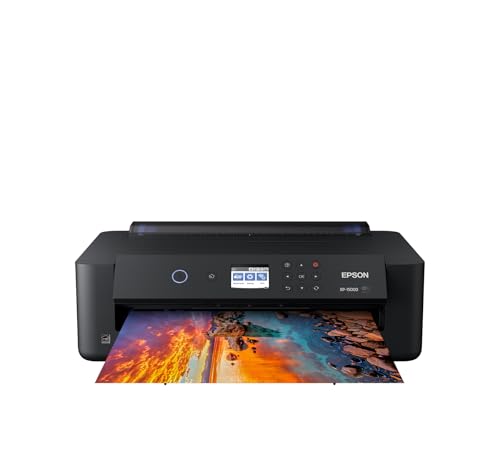
Epson Expression Photo HD XP-15000 — Best wide dye value
The XP-15000 is the quiet achiever of affordable wide printing: six Claria HD dye inks — with red and grey joining the usual set — in a compact body that prints to 13×19 and behaves like a well-bred appliance. The red channel is not a gimmick; it widens the printable gamut exactly where posters, product art and warm illustration live, and the grey steadies black-and-white and shadow transitions that four-colour machines turn to mush. For its mid-tier position, the colour ambition is remarkable.
It is a printer only — no scanner pretending otherwise — and its compact footprint suits desks that cannot host the Canons’ professional sprawl. Automatic two-sided printing at smaller sizes handles the studio’s paperwork, while the rear feed takes the thick art sheets on the occasions that matter. Running costs are cartridge-shaped and honest, with larger capacities available for the colours that empty first. Buyers who want wide, vivid and uncomplicated — and who print often enough to keep dye nozzles cheerful — will find the XP-15000 the easiest recommendation in this guide to live with.
Its age in the line is, paradoxically, a comfort: the model has been understood by its owners for years, its paper settings are documented across every art forum that matters, and its quirks are known quantities rather than surprises in waiting. A new art printer could do worse than choose the machine whose entire personality is already public knowledge, especially when the price position has settled into the friendly territory mature models occupy.
Posters are its home fixture. The red channel earns its keep in gig posters, product art and the warm end of illustration, where lesser sets turn brick into mud and sunset into soup; the XP-15000 keeps those passages separated and confident at sizes that fill a door. A student designer with this machine and a stack of satin stock can paper a corridor with work that looks commissioned, which is not a small thing to be able to say about the mid tier of anything.
- Maximum print: 13 x 19 in.
- Ink: 6-colour Claria HD dye, including red and grey
- Two-sided printing for everyday sizes
- Tier: mid, compact wide body
- Connections: Wi-Fi, Ethernet, USB
Strengths
- Red and grey channels give posters and monochrome unusual range for the tier.
- Compact wide body fits desks the professional machines bully.
- Years of owner knowledge cover every paper you will try.
Trade-offs
- No scanner — it is a printer, entirely and unapologetically.
- Dye limits apply on matte papers and sunny walls.
- Cartridge costs reward shopping for the larger capacities.
Best for: poster and illustration printers wanting wide vivid colour without professional sprawl. Not suited for: studios needing scan-copy aboard, or matte-paper purists.
Value hunters, check the XP-15000’s Amazon listing — and price the high-capacity red and grey cartridges while you are there.

Canon PIXMA iX6820 — Budget 13×19 route
The iX6820 is what remains when a maker strips a wide printer to its honest essentials: a 13×19-capable print engine, five individual ink tanks — the classic Canon set with a pigment black for text and dye colours for images — and wireless connectivity, in a body with no screen worth mentioning and no ambitions beyond printing well for very little money. It has been the budget artist’s open secret for years, and its survival in Canon’s line is itself the review: generations of students, hobbyists and market sellers have bought it, fed it decent paper, and produced saleable art.
Expectations must be set like a professional’s. There is no scanner, the controls are minimal, the build is light, and the five-tank set lacks the extra colour channels the machines above use to flatter difficult tones. What it does — clean, confident colour at sizes that dwarf its price — it does without apology, and its individual tanks mean you replace colours as they empty rather than as a set. For a first wide printer, a classroom, or a seller testing whether 13×19 art earns before investing in the professional shelf, the iX6820 is the rational doorway.
It also teaches the category’s best lesson by example: paper is the great leveller. An iX6820 printing on a quality luster or matte sheet produces work that casual buyers cannot distinguish from prints made on machines at several times its shelf position, because at normal viewing distances the paper’s surface and the image itself do most of the talking. Spend the savings where the eye actually lives — on paper and on the art — and the budget route stops feeling like a compromise.
Classrooms make the same discovery at scale. A teacher with an iX6820 and a ream of decent matte stock can put every student’s work on the wall at a size that respects it, for a consumables budget a school can actually sign. The machine’s simplicity becomes a virtue there — fewer settings to be sabotaged, fewer features to break — and its prints, pinned in a row down a corridor, have launched more young artists than many a flagship in a locked cupboard.
- Maximum print: 13 x 19 in. class
- Ink: 5 individual tanks, pigment black plus dye colours
- Body: compact, minimal controls
- Tier: entry — the lowest in this guide
- Connections: wireless and USB
Strengths
- Wide art printing at the friendliest admission price in the class.
- Individual tanks keep replacement costs proportional and sane.
- A decade of student and seller mileage proves the engine’s honesty.
Trade-offs
- No scanner, no screen, no frills of any description.
- Five channels cannot match the tonal finesse of the wider ink sets.
- Lightweight build asks for a stable desk and gentle handling.
Best for: students, first wide printers, classrooms and sellers testing the 13×19 market. Not suited for: anyone wanting an all-in-one, or exhibition-grade tonal control.
The doorway is cheap and honest: see the iX6820 on Amazon and put the money you save toward the paper it deserves.

Epson Expression Photo XP-980 — Best all-in-one convenience
The XP-980 is the newest Expression Photo body in this guide, and it is the pick for artists whose studio is also an office. Six-colour wide-format printing — the Expression Photo family’s photographic ink set — arrives with scanning and copying aboard, memory card and USB paths for printing straight from a shoot, and the general competence of a machine designed to be the only printer in the house. Where the XP-15000 is a specialist, the XP-980 is a citizen: it prints the art, scans the sketchbook, copies the invoice, and never makes any of them feel like an intrusion.
Photo output is the family’s familiar strength — smooth gradients, willing colour, borderless prints at the sizes craft and home decor consume — at up to 13×19-class width for the pieces that need presence. The all-in-one tax is paid in the usual currency: it is not the last word in matte depth, its ink set is cartridge-based with the running costs that implies, and production artists will outgrow its pace. But as the single machine for a creative household — art on the walls, documents in the tray, originals scanned for the portfolio site — it is the most complete affordable answer here.
Newer bodywork brings the small generosities that age well: a tidier interface, faster waking, and connectivity that assumes phones and tablets are primary citizens. For the artist who sells digital downloads alongside prints, the scan-to-workflow path is a business tool, not a bullet point — originals become products without leaving the desk. That dual citizenship, art printer and studio scanner in one footprint, is the XP-980’s whole case, and for the right household it is conclusive.
Its borderless prints deserve a practical nod for the home-decor market: the sizes crafters actually sell — the nursery print, the seasonal sign, the personalised name piece — emerge ready to frame without a trimming session, and the six-colour set keeps pastel work, that market’s native palette, smooth where four-colour machines band in the gentlest gradients. A machine that flatters pastels and scans the original artwork has understood its household precisely.
- Maximum print: wide-format, 13×19 class
- Ink: 6-colour Expression Photo set
- Functions: print, scan, copy
- Inputs: wireless, USB and memory card
- Tier: mid, all-in-one
Strengths
- Wide photo printing and a real scanner in one household footprint.
- Card and USB printing suit photographers working straight from a shoot.
- Newest interface and connectivity manners in this guide.
Trade-offs
- Cartridge running costs sit above the EcoTank’s bottle economics.
- Matte depth yields to the pigment PRO-310, as dye must.
- Production pace is domestic, not commercial.
Best for: creative households and hybrid artists who scan as much as they print. Not suited for: high-volume sellers, or matte-paper specialists.
Households wanting one machine can review the XP-980’s Amazon page and check its footprint against the desk it will share with everything else.
What does “affordable” really cost over two years?
Run the habit, not the box. A cartridge machine printing twenty art sheets a month will consume ink sets at a rhythm its owner should price before purchase — the shelf discount that evaporates by the third set is the oldest story in this category. The tank machine reverses the shape: a mid-tier admission, then ink so cheap it stops appearing in the studio’s mental accounts. The budget iX6820 plays a third shape — low everything, with individual tanks keeping the rhythm gentle — while the pigment PRO-310 prices like what it is, a professional system, and justifies itself in the work’s lifespan rather than in ink arithmetic.
Paper is the co-conspirator in every version of this maths. Good sheets cost real money at 13×19, and the artist who budgets only for ink discovers the paper drawer is the actual subscription. The healthiest affordable studios standardise: one glossy or luster paper, one matte, bought in the larger packs, with experiments rationed to a monthly sheet or two. Affordable art printing is not cheap art printing — it is art printing whose costs have been chosen deliberately instead of discovered accidentally.
Keep the receipts in a single folder, paper and ink together, for the first year. The folder is the studio’s truth serum: it will tell you which machine you actually own — the cheap one with the expensive appetite, or the mid-priced one that sips — and it will price your work, if you sell, with an honesty no estimator matches. Artists who keep it stop arguing about tiers in the abstract, because their own numbers have already voted.
How do you get professional-looking results from a mid-tier machine?
By spending discipline where the flagships spend money. First, calibrate your expectations with a test chart print on your main paper, and learn what your machine does to skies, skin and shadows — every model here has a personality, and printing with it rather than against it is the whole craft. Second, use the maker’s own paper profiles or the paper maker’s settings for your printer, exactly as published; the gap between a profiled print and a guessed one is larger than the gap between this guide’s cheapest and dearest machines. Third, proof small and print large once — a quarter-size proof on the same paper catches composition and colour sins while they are still inexpensive.
Fourth, respect drying. Dye prints in particular continue to settle as their carriers leave the coating, and a print judged wet will be edited wrongly. Give finished sheets an hour of peace before judging, a day before framing under glass. And fifth, keep the machine in weekly use and its nozzles exercised, because the most affordable printer is the one that never needs a heroic cleaning cycle or a replacement head. Technique is the subsidy that makes this entire category punch above its tier.
How do dye, pigment and tank inks actually differ on paper?
Think of dye as a stain and pigment as a paint. Dye dissolves into the paper’s coating and colours it from within, which is why glossy dye prints seem lit from inside — the surface stays smooth and reflective, and light bounces through the colour rather than off it. Pigment sits on the surface as a fine solid layer, which scatters light softly and reads as depth on matte stocks where dye, soaking into uncoated fibres, turns quiet and grey at the edges. Neither behaviour is a defect; each is a personality, and the affordable artist’s first real decision is which personality their subjects prefer.
Tanks are not a third ink chemistry but a third delivery system, and the distinction matters. The ET-8550’s bottled dye behaves like dye — glossy-friendly, matte-modest — while its economics behave like nothing else here. When artists say a tank changed their practice, they mean the proofing: full-size tests stop being expenditures and become sketches, and an artist who proofs freely iterates three times where a cartridge artist commits once and hopes. Over a year, that iteration gap can matter more to the work than any gamut chart — which is why this guide treats the tank as a philosophy and not merely a plumbing choice.
Longevity completes the triangle honestly. Pigment on the right paper carries the archival banner; dye behind glass in ordinary rooms carries a perfectly respectable working life; dye unprotected in bright sun carries a warning label the seller should repeat to themselves before repeating it to a customer. Affordable printing is the art of matching those truths to real display conditions instead of buying flagship insurance against rooms your prints will never hang in.
How do you build a selling workflow on a mid-tier machine?
With rituals that cost nothing. Standardise two papers and learn their profiles until colour stops being a negotiation. Print editions in single sessions so every copy in the run shares the same machine mood, ink state and paper lot. Inspect each finished sheet under the light your buyers will use — a cool daylight check and a warm room check — because affordable machines reward owners who catch their small inconsistencies before the packaging does. Keep a simple log of file, paper, setting and date for every design you sell, so a reprint ordered in six months emerges as a sibling, not a stranger.
Packaging is the other half of perceived quality at this level. A print from a budget machine, shipped flat in a rigid mailer with a backing board and a glassine sleeve, arrives feeling like a product; the same print rolled carelessly arrives feeling like a poster from a tube. Sellers consistently discover that customers cannot name the printer but can absolutely name the care, and care is the one upgrade every machine in this guide supports for free. Build the ritual before the sales, and the machine’s tier stops being the story your reviews tell.
Which papers flatter affordable machines most?
Luster first. A good luster or satin paper is the great diplomat of surfaces — enough sheen to give dye its glow, enough texture to forgive the small imperfections mid-tier machines leave in skies and gradients. It is the paper on which the gap between this guide and the flagship shelf is hardest to see, and the correct first pack for every pick here except the pigment PRO-310, whose diplomacy runs the other way. For the 310, begin with a smooth matte cotton: it is the surface its ink was born for, and the first print will explain the premium better than this paragraph can.
Matte papers in the dye machines deserve a fairer hearing than purists give them. A quality coated matte — not the bargain office sheet — holds dye respectably and suits illustration, typography-led art and the planner-and-sticker economy where the ET-8550 and XP-980 thrive. What matte will not do for dye is the deep, chalky black of pigment; design around it, favouring brighter palettes and stronger shapes, and the limitation becomes a style. Artists have built entire followings inside exactly that constraint.
Buy paper like a studio, even a small one: the larger pack of the sheet you have chosen beats three sampler packs of sheets you have not, every month of the year. Consistency is a creative tool. When the paper stops changing, the only variable left is your art — which was supposed to be the point of the machine in the first place.
How do you frame and display affordable prints without apology?
By exploiting the standard sizes this class prints. A 13×19 sheet trims into the most stocked frame dimensions in the craft-store world, and an 11×14 or 12×16 print matted inside a larger ready frame acquires the white border that signals “art” to every eye that has ever walked a gallery. The mat is the affordable printer’s best friend: it costs little, it standardises your presentation across machines and papers, and it keeps fingers and glazing off the print surface, which is where dye prints prefer their protection to live. Buy mats in your two selling sizes, in honest acid-free board, and your budget machine’s output will hang with a composure that gives nothing away.
Display honesty is the other half. Sell and hang dye work where it will be loved rather than tested: out of the one window that takes the afternoon sun full in the face, behind the glass or acrylic that ready frames already include. Pigment work from the PRO-310 can take the braver walls. None of this is a confession — it is the same counsel galleries give about works on paper of any pedigree, and following it makes the affordable choice invisible in the only place it matters, which is the wall.
When do you outgrow this class?
The signs are practical, not emotional. Your matte work starts carrying the price points where buyers ask archival questions you cannot answer with dye. Your edition sizes grow until cartridge changes interrupt production days. A paper you have fallen for — a heavy cotton, a board — feeds reluctantly in a path built for lighter stock. Or your scanner becomes the bottleneck in a business the XP-980 once served alone. Any of those, arriving as a pattern across a season, is the market telling you the step-up guides exist for your next machine, and that this one has done its job: it made you the kind of printer who can use a flagship.
Until then, resist the upgrade itch with the evidence of your own walls. Most artists in this class are limited by paper knowledge, proofing discipline and display craft long before they are limited by ink channels — and all three of those travel with you to whatever machine comes next, which is why the affordable years are never wasted years. They are the apprenticeship, served on machines honest enough to teach it.
How do you choose in one evening?
Answer four questions on paper, honestly, and the list chooses itself. What surface will eighty percent of your prints live on — glossy, matte, or whatever is cheapest this month? How many sheets a month, counted from last month’s actual behaviour rather than next month’s intentions? Do you need a scanner in the same footprint? And is anything you print a promise — a sale, a gift meant to be kept for decades — or is it all for the pleasure of the making? Glossy plus promises points at the PRO-200S; matte plus promises points at the PRO-310; volume points at the ET-8550; the scanner question settles the XP-980; and a strict budget with honest answers everywhere else lands, without shame, on the XP-15000 or the iX6820.
Then do the one piece of homework this category uniquely demands: price the full ink set and a month of your paper for the finalist, in the same basket, before the machine itself is ordered. If the total still feels like the hobby you wanted, buy with confidence. If it startles you, the tier below is not a defeat — it is the correct machine introducing itself.
How do you stop the screen from lying to you?
Beginners blame affordable printers for a universal crime: the print is darker and duller than the monitor promised. The monitor is a lantern and the print is a wall — of course they differ — and the fix is a handful of habits rather than a more expensive machine. Turn the screen’s brightness down until a white page on screen resembles a white sheet under your room’s light. Edit with the room lit the way it will be when you judge prints. Then, in the print dialogue, choose the exact paper you loaded and let the maker’s profile do its translation, instead of letting the application and the driver both manage colour at once, which double-books the translation and muddies everything.
Soft-proofing is the grown-up version of the same habit, and even free editors offer it: view the image through the paper’s profile before printing, notice where the matte paper will clip your deepest shadows or the glossy will oversaturate a red, and adjust the file rather than the printer. Ten minutes of this saves the expensive sheet, the cartridge’s dignity and the artist’s evening. It is also the moment affordable printing stops feeling like a lottery — the print that emerges starts resembling the one you approved, and the machine’s tier quietly leaves the conversation.
Why does the affordable tier own the gift economy?
Because a print is the rare gift that is personal, physical and producible the night before. The family calendar with a year of photographs, the restored picture of a grandparent scanned on the XP-980 and printed at a size the original never reached, the child’s artwork enlarged on the EcoTank until it looks like the gallery piece its maker always believed it was — these are the jobs affordable wide printers were secretly designed for, and they explain the December ink shortages better than any art-market analysis. A machine that can turn a memory into a framed object in an evening changes a household’s relationship with its own photographs.
The craft is in the calendar, not the machine: scan and restore in the quiet months, test papers before the season, and print the gifts in November while the ink is stocked and the artist is calm. Every December, the owners who planned own the smugness; the owners who did not own the queue at the one-hour photo counter, looking at what the lab made of their files. Affordable printing rewards the organised with a superpower — manufactured sentiment, at cost, on demand — and it is reason enough by itself for half the machines in this guide.
How do the six compare side by side?
| Model | Ink approach | Colours | Scans | Tier |
|---|---|---|---|---|
| Canon PRO-200S | Dye cartridges | 8 | No | Entry-professional |
| Canon PRO-310 | Pigment cartridges | 9 | No | Step-up |
| Epson ET-8550 | Dye tank bottles | 6 | Yes | Mid |
| Epson XP-15000 | Dye cartridges | 6 | No | Mid |
| Canon iX6820 | Mixed, 5 tanks | 5 | No | Entry |
| Epson XP-980 | Dye cartridges | 6 | Yes | Mid |
What mistakes do affordable art printer buyers keep making?
The canonical error is buying the machine on its shelf price and meeting its ink set at the till a month later, unresearched — in this category the second purchase routinely rivals the first, and it repeats. Second, owners feed bargain paper into capable machines and blame the printer for results the paper authored; at 13×19 the sheet is half the image. Third, buyers chase colour counts as a score, when the working differences are which colours and what paper they serve — a grey channel helps monochrome more than a second cyan helps anything. Fourth, the printer gets parked for a season and returns to a cleaning cycle that drinks the savings. And fifth, artists frame dye prints in the sunniest window of the house, then write reviews about fading that the framing chose. Every one of these is a habit, not a hardware fault, and habits are the cheapest upgrades in this guide.
There is a sixth, specific to this tier’s temptations: buying the sampler habit in ink form — a drawer of half-used third-party cartridges in rotating brands, each with its own colour opinion, until no profile on earth can predict the next print. Consistency is a system, and every substitution reopens negotiations the artist already settled. Whatever ink you choose, choose it like a paper: once, deliberately, and then for a year.
Final Recommendation
Let your paper decide. Glossy and luster artists should take the Canon PRO-200S and enjoy the richest affordable colour in the business; matte and cotton artists should stretch to the PRO-310 and stop apologising for the step-up. If your art is a business that prints daily, the ET-8550’s bottle economics will quietly out-earn every cartridge in this guide, while the XP-15000 remains the wide, vivid, no-fuss middle and the XP-980 the household that also scans. And if the budget is truly the brief, the iX6820 plus excellent paper will embarrass printers three times its price in front of any honest audience. Buy the philosophy first, feed it good sheets, print every week — affordable machines reward exactly the habits that make artists better.
And keep the receipt folder. A year from now it will tell you whether the tier you chose was the tier you needed, in numbers nobody can argue with, and it will make the next purchasing decision — stay, step up, or specialise — the easiest one in your studio’s life. Affordable printing done deliberately is not a compromise on the way to real printing. For most artists, most years, it is the real printing, and these six machines are its current best instruments.
Frequently Asked Questions
Can an affordable printer really sell prints at markets and online?
Thousands do, daily, at craft fairs, on marketplace storefronts and through print-on-demand sidelines run from spare rooms. Buyers purchase the image, the paper and the finish — not the printer’s badge — and a well-profiled print from any machine here on quality stock passes the market test comfortably, especially when it arrives packaged like it matters. Where the flagships pull ahead is longevity promises, matte depth and the calm of never thinking about either, which matter for higher price points and for galleries.
Is dye ink a mistake for art that will be framed?
No — framed behind glass or acrylic, away from harsh direct sun, dye prints from these machines hold their colour for a very respectable span, long enough that most framed pieces are redecorated around, moved house with, or simply outlived by the room’s next idea before the ink becomes the issue. Dye’s true limits appear on matte papers, in unprotected display and in archival promises made to strangers. Match the ink to the display conditions, say the conditions out loud when you sell, and the anxiety mostly evaporates.
Tank or cartridges for a beginner?
If you will print weekly or more, the tank’s economics and always-ready ink levels forgive beginner exuberance, its bottles turn restocking into a quarterly errand instead of a monthly emergency, and proofing freely is how beginners improve fastest. If your printing will be monthly and careful, cartridges avoid the idle-machine cleaning ritual and cost less to start. Be honest about which beginner you are.
What paper should I buy first?
One pack of a quality luster or glossy for colour work and one pack of smooth matte for everything else, in 13×19 if your machine takes it. Learn those two surfaces completely — their profiles, their drying times, their tempers in your room’s light — before collecting others; the sampler-pack drawer is where affordable printing budgets go to be admired rather than used, and where good intentions go to be stored in assorted sizes.
How big can I print before quality falls apart?
Every machine here is built around the 13×19 ceiling, and within it quality is a file question more than a hardware one: a well-prepared image at 240 to 300 pixels per inch at final size, sharpened for print rather than for screen, will look sharp at arm’s length on any of the six, in any room, under any honest light. Below that, seat the print further from its audience — posters forgive, portfolios do not — and let viewing distance do the honest work it has done for posters and gallery pieces alike.
Do I need the printer maker’s own ink?
For colour-critical art, the maker’s ink is what the profiles assume, it is what the machine’s cleaning and calibration routines were tuned around, and it is the safe recommendation of this guide for anyone whose prints carry a price tag or a promise. Third-party inks exist and some artists swear by them, but they transfer the colour-management burden onto you. Beginners should earn their consistency first and experiment later, on non-critical work.
Related Guides
Matte specialists will want the dedicated survey of the best 12 x 12 pigment photo printers, sellers stepping up should read the best 13 x 19 professional printers, and the wider budget shelf is covered by the best affordable printers. Buyers who need scanning at the same width should read the best 11×17 aio printers before choosing. Studios outgrowing desktop machines should study the best 44 fine art printers.


