What's inside
- Key Takeaways
- Quick Picks: Elementary Art Desks at a Glance
- How Did We Narrow Down the Elementary Art Desks Worth Recommending?
- Which Art Desk Fits Which Elementary Child?
- Side by Side: How the Six Elementary Art Desks Compare
- What Should You Check Before Buying an Art Desk for an Elementary Child?
- How Do You Set Up an Art Station a Child Will Keep Using?
- What Mistakes Do Parents Make When Choosing a Kids’ Art Desk?
- Are You Buying This Desk as a Gift for Someone Else’s Child?
- Final Recommendation
- How Does an Art Desk Differ from an Ordinary Small Desk?
- How Does the Right Desk Change Across the Elementary Years?
- What Should Live on the Desk, and What Should Live Elsewhere?
- Which Room Should the Art Desk Live In?
- How Do You Keep a Kids’ Art Desk in Good Shape Year After Year?
- Should You Buy One Desk per Child, or One to Share?
- Frequently Asked Questions
- Related Guides
As an Amazon Associate I earn from qualifying purchases. This post may contain affiliate links at no extra cost to you.
gizmoverdict.com is reader-supported. When you buy through links on our site, we may earn an affiliate commission.
Where to buy: each set below links to its Amazon listing, where you can confirm the colour, the chair count and what arrives in the box before ordering.
Parents searching for the best art desks elementary school children will actually use run into a sizing puzzle straight away. A desk that suits a three-year-old kneeling at it will frustrate a seven-year-old whose knees no longer fit underneath, while a table bought for a tall nine-year-old leaves a younger sibling dangling above the floor with crayons rolling out of reach. The six sets in this guide were chosen for the elementary years specifically, roughly the stretch from kindergarten through the middle primary grades, and each one earns its place for a different reason: one converts into an easel, one hides the mess inside drawers, one feeds paper from a roll so the supply never quite runs dry mid-project.
One boundary before the picks themselves. Nothing in this guide claims that a particular table will improve a child’s drawing, handwriting or school results, because furniture does not do that and listings that hint otherwise are selling you a story. What a well-chosen art desk genuinely does is more modest and more useful: it gives paints, glue sticks and half-finished collages a permanent home that is not your dining table, it puts the work surface at a height where a child can sit comfortably for the length of a homework sheet or a rainy-afternoon painting, and it contains the clutter so clearing up takes minutes rather than a negotiation. Judge every pick below on those practical grounds and you will not go far wrong.
Key Takeaways
- Chair height matters more than tabletop decoration: a seat that lets feet rest flat keeps a child at the desk longer than any themed paint job.
- Paper-roll holders quietly save money and tempers, because a continuous sheet replaces the pad that always seems to run out on page two.
- Sets with two chairs suit siblings and playdates; single-chair designs fit tighter corners and cost less floor space in a shared bedroom.
- Storage you can see, such as open bins and shelves, gets tidied by children far more reliably than storage hidden behind doors they forget exist.
- Plastic sets shrug off paint water and glue spills that would stain bare wood, while wooden sets tend to feel steadier under a leaning elbow.
Quick Picks: Elementary Art Desks at a Glance
| Pick | Badge | Why it made the cut |
|---|---|---|
| 5-in-1 Kids Art Table and Chairs | Most adaptable set | Converts between table, easel and storage modes, so one purchase covers drawing, painting and craft storage as interests shift. |
| BOLUO Kids Art Table and Chair Set | Drawer storage pick | Built-in drawers swallow pencils and sticker sheets, keeping the white top clear for the project in front of your child. |
| INFANS Kids Art Table and Chair Set | Paper roll plus bookshelf | Pairs a roll-fed drawing surface with a small bookshelf and canvas bins, suiting children who rotate between reading and art. |
| Kinder King Kids Art Table and 2 Chairs Set | Natural wood choice | A warm wood finish, two chairs and an integrated bookshelf make it the set that looks least out of place in a living room. |
| Kids Art Table and Chair Set with 2 Chairs and Bins | Widest work surface | The 44-inch top spreads two children side by side with room for a shared sheet between them and bins underneath. |
| Simplay3 Creative Kids Art Desk | Toughest for messy play | Moulded construction with an attached chair tolerates enthusiastic toddlers-turned-schoolkids and wipes clean after glitter incidents. |
How Did We Narrow Down the Elementary Art Desks Worth Recommending?
We started from what elementary-age children actually do at these tables, which is a wider mix than the toddler years: colouring still happens daily, but so do written homework, scissor-and-glue projects, sticker albums, bead threading and the occasional science-fair poster that needs to lie flat overnight. That mix set our first filter, surface size. Anything too small to hold an open workbook beside a pencil pot was cut, however cute the photograph looked. Our second filter was seating honesty: sets were favoured when the listing stated the included chairs plainly, because a table photographed with two chairs but shipped with one is a disappointment that arrives in a cardboard box.
Storage was the third filter, judged by how a child rather than an adult uses it. Drawers that glide, bins that lift out and shelves at knee height all scored well; fiddly latches and deep boxes where small items vanish scored poorly. We also weighed clean-up reality. Washable surfaces and raised edges that stop pencils migrating to the floor counted in a set’s favour, and we noted which designs rely on a paper roll, since roll-fed paper changes the economics of a heavy drawing habit. Finally, we kept a spread of constructions in the final six: convertible plastic-and-board hybrids, painted wood-style sets and one fully moulded option, because the right material depends on whether the desk lives in a playroom, a bedroom corner or the end of your kitchen.
A note on ages: where a listing states a suggested age range, we repeat it as the manufacturer’s own guidance and nothing more. Children grow at wildly different rates, and a tall six-year-old may outgrow a set that still fits a petite eight-year-old perfectly well, so treat any printed age as a rough starting point and measure your child’s seated knee height against the dimensions on the listing instead.
Which Art Desk Fits Which Elementary Child?
Before the detailed reviews, it helps to sort the six by household rather than by price or colour. Families with one child and limited floor space usually do best with a compact set whose storage is vertical, like the INFANS with its bookshelf, because the footprint stays small while books and paper stack upward. Households with siblings close in age should look first at the two-chair sets, since the second chair is where the value hides: buying a matching extra chair later often proves impossible once a design is discontinued. If your child’s art habit leans toward painting rather than drawing, prioritise wipe-clean surfaces and a lip or tray that corrals runaway water pots, which pushes the Simplay3 and the 5-in-1 toward the top of your list. And if the desk must live in a room adults also use, the Kinder King’s natural finish is the one least likely to make you wince every time you walk past it.
One more sorting principle deserves air before the reviews begin: buy for the mess you can tolerate supervising. Every set here can host painting, but the honest question is whether an adult will usually be nearby when paint comes out. Households where art happens independently while dinner cooks should weight wipe-clean surfaces and self-contained storage most heavily, because those features decide whether independence ends in a masterpiece or in a painted radiator. Households where an adult joins in can choose more freely, letting looks, size and books carry the decision instead.

5-in-1 Kids Art Table and Chairs — Most adaptable set
The headline trick of this set is conversion. In table mode it behaves like any other craft desk, flat top, chair tucked under, storage drawer beneath for the supplies that would otherwise migrate across the room. Flip the arrangement around and it becomes an easel with a paper roll holder, which changes the posture of drawing completely: standing to paint a big sheet feels like an event to most elementary children, and vertical work keeps sleeves out of wet paint far better than a flat table does. The remaining configurations rearrange the pieces into storage and display roles, so the set keeps finding jobs as your child’s habits move from scribbling to structured projects.
That flexibility carries a practical benefit parents rarely anticipate, which is longevity of interest. A plain table is furniture; a set that transforms is a toy in its own right, and children return to it partly for the fun of rebuilding it. The storage drawer matters more than it first appears, too, because it gives the current project a home. Half-glued collages and works in progress can slide away instead of occupying the dining table until they dry, and the paper roll means the easel mode never stalls for want of a fresh sheet. Assembly is a parent job involving multiple configurations worth photographing as you go, so you can rebuild a mode later without reverse-engineering it from memory.
- Format: convertible table and easel set with seating included
- Paper supply: roll holder built into the easel arrangement
- Storage: drawer under the work surface for ongoing projects
- Surface role: flat drawing, standing painting and craft work
- Best setting: playrooms where one set must cover several activities
Strengths
- Easel mode lifts painting off the table and keeps sleeves cleaner during big, wet projects.
- Five configurations stretch the useful life of the purchase across several school years.
- The under-surface drawer gives unfinished work somewhere safe to wait between sessions.
Trade-offs
- Reconfiguring between modes takes adult help at first, so spontaneous mode-switching is limited.
- More joints and parts mean more screws to check and tighten during your periodic once-over.
- The footprint grows in easel mode, which tight corners in small bedrooms may not forgive.
Best for: families wanting one purchase that covers drawing, painting and storage from kindergarten onward. Not suited for: anyone who wants a set-and-forget table that never changes shape or needs reconfiguring.

BOLUO Kids Art Table and Chair Set — Drawer storage pick
The BOLUO takes the opposite philosophy to the convertible above: a fixed, honest table whose talent is tidiness. Its storage drawers sit where a child can reach them without standing up, and that single ergonomic detail changes behaviour. Pencils live in the drawer because returning them requires no effort, sticker sheets stop colonising the sofa, and the white top stays clear enough that homework and art can share the surface across one evening without a full excavation in between. For elementary children juggling school tasks alongside free drawing, that clear-top discipline is worth more than novelty features.
Visually the set plays it safe, with a clean white finish that suits the Scandinavian-leaning children’s rooms many families now favour, and which shows crayon marks honestly so you know when it needs a wipe. The chair is proportioned for the younger end of elementary school, so taller children in the upper grades may find it snug sooner than the two-chair wooden sets further down this list. Treat the BOLUO as the strong choice for a first proper desk in a bedroom where floor space is measured and tidiness is a standing battle, and check the listing’s stated dimensions against your child’s current chair at home to judge the fit.
- Format: fixed table and chair set in a white finish
- Storage: integrated drawers sized for pencils, paper and small craft supplies
- Surface role: drawing, writing practice and tabletop crafts
- Seating: single chair included, sized toward younger elementary children
- Best setting: bedrooms where a clear top has to serve homework too
Strengths
- Reachable drawers make tidying the default rather than a chore imposed afterwards.
- The plain white top doubles comfortably as a writing desk for schoolwork.
- A fixed design with few moving parts keeps assembly and upkeep simple.
Trade-offs
- One chair only, so siblings will negotiate turns or need a second seat from elsewhere.
- No easel or paper roll, which heavy painters may miss compared with convertible rivals.
- The light finish shows every crayon scuff until wiped, even if it cleans easily.
Best for: a single child whose desk must alternate between art and homework in a tidy bedroom. Not suited for: siblings who draw together daily, or painters who want a standing easel.

INFANS Kids Art Table and Chair Set — Paper roll plus bookshelf
INFANS builds its set around two habits elementary children cycle between constantly: drawing and being read to. One end of the arrangement holds a paper roll that feeds across the surface, so a fresh sheet is always a tear away and long banner-style drawings become possible without taping pages together. The other side carries a small bookshelf with canvas storage bins below, which gives picture books and early chapter books a home at the same station. The grey finish is a quieter choice than the primary-coloured sets aimed at toddlers, and it ages gracefully as the room’s decor matures around it.
The canvas bins deserve a mention because they solve a real problem with younger elementary children: rigid boxes get overfilled and then abandoned, whereas soft bins accept a jumble of felt tips, stamps and glue sticks without complaint and can be carried to the floor for a sprawling project, then slung back. The bookshelf keeps reading material at seated eye level, which encourages the draw-then-read rhythm many families want at bedtime. As with every roll-fed design, budget for replacement rolls in the size the listing specifies, and keep the tear edge supervised with younger children until they master ripping a straight line without pulling the whole roll onto the floor.
- Format: table and chair set with bookshelf section, finished in grey
- Paper supply: roll holder feeding the drawing surface
- Storage: bookshelf plus removable canvas bins for loose supplies
- Seating: chair included for one child
- Best setting: reading-and-drawing corners in bedrooms or family rooms
Strengths
- Continuous paper removes the empty-pad stall that ends many drawing sessions early.
- Books and art supplies share one station, suiting children who alternate between them.
- Soft canvas bins tolerate chaotic packing by small hands better than rigid boxes.
Trade-offs
- Replacement paper rolls are an ongoing purchase in a specific size.
- The bookshelf section widens the footprint beyond a plain table of similar top size.
- Grey fabric bins show paint fingerprints readily and need occasional washing.
Best for: children who split their desk time between drawing and books, in a room that suits muted colours. Not suited for: two children needing to sit and work at the same time.

Kinder King Kids Art Table and 2 Chairs Set — Natural wood choice
Kinder King leads with warmth. The natural wood finish reads as furniture rather than nursery equipment, which matters when the only available corner is in a living room or open-plan kitchen where a bright plastic set would shout. Two chairs come in the box, settling the sibling question at purchase rather than at the first playdate, and the bookshelf built into the design gives the set a library corner feel: sit, choose a book, draw the favourite scene from it. The paper roll holder continues the theme, feeding the surface so drawing can start the moment inspiration arrives.
Wooden construction brings a steadiness that helps with the heavier work of the upper elementary years, pressing hard with pencils, leaning over a poster board, using a ruler and craft knife under supervision. It also brings weight, so plan the room layout before assembly rather than expecting to slide the set around weekly. Wipe spills promptly, because bare and lightly finished wood remembers paint water rings in a way moulded plastic never will. For families who want the art station to blend into a grown-up room while still serving two children properly, this is the most convincing compromise in the six.
- Format: wooden table with two chairs and bookshelf, natural finish
- Paper supply: roll holder mounted for the drawing surface
- Storage: bookshelf section for books and finished artwork
- Seating: two chairs included from the start
- Best setting: living rooms and shared spaces where looks matter
Strengths
- Two included chairs end the sibling seat dispute before it begins.
- The natural finish sits comfortably among adult furniture in shared rooms.
- Sturdy wooden build handles leaning, pressing and poster-sized projects calmly.
Trade-offs
- Heavier than plastic rivals, so rearranging the room becomes a deliberate job.
- Wood needs spills wiped quickly to avoid marks that plastic would shrug off.
- The traditional look may feel plain to children drawn to bright, themed designs.
Best for: two siblings sharing an art station in a room adults also live in. Not suited for: anyone planning to move the desk between rooms often, or hose it down after messy play.

Kids Art Table and Chair Set with 2 Chairs and Bins — Widest work surface
Size is the argument here. At 44 inches long by 24 inches wide, the top gives two elementary children a genuine half each, with a shared middle strip for the paper pot and the scissors both of them need. That elbow room defuses the most common cause of art-table arguments, which is rarely malice and usually just geography: one child’s sheet drifts, a paint pot tips, and the session ends in tears. Storage bins beneath the surface keep supplies under each child’s own side, reinforcing the truce, and the natural finish keeps the large piece from dominating the room visually despite its size.
Measure before you order, because 44 inches is a serious commitment in a small bedroom and the set will not squeeze through wishful thinking. Where it fits, though, the big top earns its keep in ways beyond sibling peace: board-sized school projects lie flat without overhang, a parent can sit alongside for homework help without displacing the art supplies, and the surface moonlights as a puzzle or building-brick table between art sessions. The two chairs match the set, so proportions stay consistent as children grow into the middle elementary years. If your household art problem is fundamentally about space per child, this is the direct answer.
- Format: large table with two chairs, natural finish
- Surface: 44 inches long by 24 inches wide, the biggest top in this guide
- Storage: bins beneath the surface, split between the two seats
- Seating: two chairs included, one for each side of the table
- Best setting: playrooms and larger bedrooms with room to spare
Strengths
- Generous top ends elbow wars and fits poster-sized school projects flat.
- Per-side storage bins give each child ownership of their own supplies.
- Room for a parent to sit in and help without clearing the whole surface.
Trade-offs
- The footprint is simply too large for compact bedrooms and box rooms.
- Fewer organisational features than bookshelf designs, so books live elsewhere.
- A big flat surface invites non-art clutter unless the bin habit takes hold.
Best for: siblings who create side by side and need real elbow room to stay friends. Not suited for: small rooms, or families wanting books stored at the desk itself.
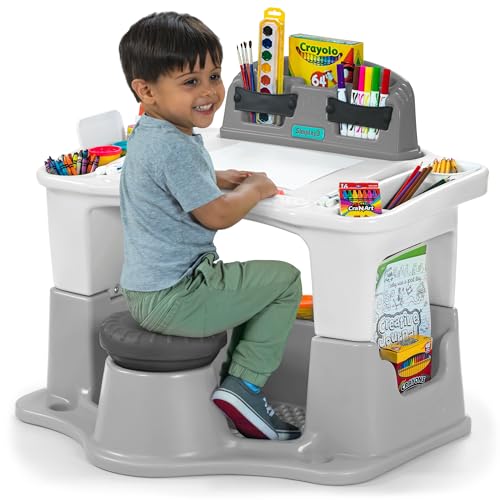
Simplay3 Creative Kids Art Desk — Toughest for messy play
Simplay3 moulds its desk as a single robust unit with the chair attached, a design that reads younger than the wooden sets but hides a practical genius: nothing tips, nothing separates, and nothing gets dragged into another room and lost. The attached seat keeps posture roughly where the designer intended, the work surface carries storage for art materials within arm’s reach, and the whole structure wipes down in seconds after the kind of session that leaves glue on every surface including, somehow, the ceiling. For children entering elementary school straight from enthusiastic toddler art, this continuity is comforting rather than babyish.
Be honest about the growth window, though. An attached chair fixes the distance between seat and surface, which suits younger elementary children beautifully and taller ones less so, since legs need somewhere to go. That makes the Simplay3 the pick for the kindergarten-to-second-grade stretch rather than a desk to see a child through to age ten, and within that window its indestructibility is a genuine virtue: it can be inherited by a younger sibling afterwards with nothing more than a good clean. Place it where messy art actually happens, near a washable floor, and let the wooden sets handle the calmer upper-grade work later.
- Format: moulded desk with attached chair as one unit
- Storage: built-in spaces for art supplies around the work area
- Surface role: drawing and crafts for younger elementary children
- Seating: fixed attached chair, distance set by the design
- Best setting: playrooms and kitchen corners where mess is expected
Strengths
- One-piece moulded build cannot wobble, separate or lose its chair.
- Wipes clean in moments after paint, glue and glitter sessions.
- Attached seating keeps younger children positioned sensibly without reminders.
Trade-offs
- Fixed seat distance suits younger children and is outgrown sooner than separate chairs.
- The moulded look is more playroom than living room for style-conscious spaces.
- Less flat area for oversized projects than the wide two-chair table above.
Best for: younger elementary children whose art is gloriously messy and frequent. Not suited for: tall older children, or buyers wanting one desk to last the whole elementary span.
Taken together, the six divide into three philosophies. The converters and moulded sets treat art as play and prioritise fun plus forgiveness. The drawer and bookshelf sets treat art as a daily station and prioritise order. The wide two-chair table treats art as a shared social activity and prioritises room. Naming your family’s philosophy honestly, in one sentence, usually identifies your pick faster than any feature comparison.
Side by Side: How the Six Elementary Art Desks Compare
| Pick | Seating | Storage style | Standout trait |
|---|---|---|---|
| 5-in-1 Kids Art Table and Chairs | Chair included | Drawer plus convertible storage modes | Turns into an easel with a paper roll for standing painting sessions |
| BOLUO Kids Art Table and Chair Set | One chair | Drawers within seated reach | Keeps its white top clear enough to double as a homework desk |
| INFANS Kids Art Table and Chair Set | One chair | Bookshelf with canvas bins | Roll-fed paper beside a reading shelf in a calm grey finish |
| Kinder King Kids Art Table and 2 Chairs Set | Two chairs | Bookshelf in natural wood | Blends into adult rooms while seating siblings properly |
| Kids Art Table and Chair Set with 2 Chairs and Bins | Two chairs | Bins split beneath each seat | The 44-inch top gives each child a real territory of their own |
| Simplay3 Creative Kids Art Desk | Attached chair | Built-in supply spaces | Moulded one-piece build that shrugs off the messiest sessions |
Notice, too, what the table does not rank: prettiness in a catalogue photograph. Every set here photographs well in a styled room with three pencils arranged artfully. Your room will contain forty pencils, a leaning tower of paper and one mysterious sticky patch, so judge by storage, seating and surface, the three things that survive contact with real childhood.
Read the table by household problem rather than by row order. If arguments about space cause your art sessions to collapse, the wide two-chair set answers you directly. If supplies scattered across three rooms cause the collapse, drawer and bin storage matters more than surface area. And if the desk must earn its keep in a room guests see, finish and footprint deserve the deciding vote.
What Should You Check Before Buying an Art Desk for an Elementary Child?
Start with the seated fit, because it quietly determines how long sessions last. Sit your child at your current dining table with feet supported and look at the angle of the forearm resting on the surface: roughly level is comfortable, shoulders hunched up toward ears means the surface is too high, and a child perched on knees means too low. Compare that against the desk and chair heights printed on each listing. Manufacturers state suggested ages, but those ranges assume an average child, and yours has a specific leg length that matters more than any average.
Next, audit the art your child actually produces. Drawing-heavy children benefit from paper rolls and flat storage for finished sheets. Painting-heavy children need wipeable surfaces and edges that contain water pots. Children deep into cutting, sticking and model-making need a top big enough that the project, the materials and the child’s elbows coexist. Match the desk to the dominant activity rather than the activity you hope will develop, because a desk bought for imaginary neat watercolour work will still be used for gloriously untidy collage.
Then walk the room with a tape measure. Mark the desk footprint on the floor with painter’s tape and live with the outline for a day: can the chair pull out fully, can a parent kneel beside it, does a door swing through the space? Convertible sets need extra room in easel mode, and bookshelf designs need wall-side placement so the shelf faces the chair. Finally, think about the exit strategy. A set that a younger sibling will inherit justifies spending more; a desk bought for one school year before a house move should be the one that assembles and disassembles with the least drama.
How Do You Set Up an Art Station a Child Will Keep Using?
Placement beats equipment. Put the desk where family life already happens, within sight of a kitchen or living area, because elementary children create socially and a desk exiled to a spare room becomes a desk visited twice. Light matters enormously: side light from a window falls across the page without the child’s own shadow covering the work, and a small lamp for winter afternoons should stand on the non-dominant side so the drawing hand does not shade the paper. Keep a lidded bin within throwing distance, since scraps that must be carried across a room tend to stay on the floor.
Stock the station in layers. The everyday layer lives on or in the desk: pencils, crayons, scissors, glue, a ruler and the current paper supply. The second layer, paints, glitter and anything that needs supervision or newspaper underneath, lives in a box an adult fetches, which keeps the desk usable daily while reserving the messy materials for when someone has time to oversee them. Finished work needs a destination too, a shallow tray or a string with pegs on the wall, because children abandon stations whose output has nowhere to go. Refresh the everyday layer monthly, binning dried pens and blunt pencils in one ruthless pass, and the desk stays inviting rather than becoming an archaeological dig.
What Mistakes Do Parents Make When Choosing a Kids’ Art Desk?
The classic error is buying for the age on the box instead of the child in front of you, which produces the desk that is perfect for an average seven-year-old and wrong for your tall six-year-old by Christmas. The second error is falling for storage theatre: sets photographed with every supply in a labelled compartment, when your child’s real system is one glorious jumble that only bins and drawers, not tiny dividers, will survive. Third comes ignoring the chair. A beautiful table paired with a chair at the wrong height gets abandoned for the kitchen table within a fortnight, and the desk becomes expensive shelving.
Parents also underestimate paper. Drawing children consume it at a rate that surprises everyone, and a desk without a paper system, roll, drawer stack or shelf, becomes a desk covered in loose sheets that slide to the floor. Finally, many families skip the safety once-over after assembly: run a hand along every edge, tug each leg and chair, and tighten every screw, then repeat the check a few times a year, because children’s furniture works loose under daily enthusiastic use and a wobbly desk quietly teaches a child to work somewhere else.
Are You Buying This Desk as a Gift for Someone Else’s Child?
Grandparents and relatives buy a large share of children’s furniture, and gift purchases fail in predictable ways worth avoiding. The first is size surprise: a desk that delights in a photograph can overwhelm a small flat, so share the listing dimensions with the parents and let them tape the footprint before you order. The second is duplication, two well-meaning relatives buying near-identical sets in the same birthday week, which a thirty-second message prevents. The third is assembly: a gift that arrives as a flat box of panels is also a gift of an hour’s work, so either choose a simpler build or offer to assemble it as part of the present.
If you are the parent receiving the desk, do a quiet inventory before it arrives. Decide which existing supplies will live in its drawers and bins, which will be retired, and where finished artwork will go, so the new station starts organised rather than absorbing the old clutter wholesale. Children read the adults’ framing: a desk unveiled with its supplies arranged and a first project ready feels like an invitation, while a desk assembled in a corner and ignored for a week becomes furniture. The sets in this guide all reward that small ceremony equally, whatever their shape.
Final Recommendation
Most families should start with the question of who sits down together. Siblings who create side by side belong at the wide 44-inch set or the Kinder King, single children in tidy bedrooms suit the BOLUO or the INFANS depending on whether books share the station, keen painters deserve the convertible 5-in-1 or the wipe-clean Simplay3 according to age. None of the six is the wrong answer in the abstract; each is wrong only for a household it was not shaped for. Measure your child, tape the footprint on the floor, and buy the set whose storage matches the mess your family actually makes, then let the dining table return to being a place where people eat.
How Does an Art Desk Differ from an Ordinary Small Desk?
Parents reasonably ask why a child needs an art desk at all when small writing desks exist in every furniture range. The difference lies in what each surface expects to happen on it. A writing desk assumes a book, a notebook and a pencil, all dry, all flat, all easily cleared. An art desk assumes liquids, loose parts, oversized paper and work that must be left mid-process without being disturbed, and the designs in this guide answer those assumptions with paper rolls, wipeable finishes, bins that swallow jumbles and storage shaped for trays and pots rather than textbooks.
The seating differs too. Art involves more posture variety than writing: children stand at easels, perch while cutting, sit sideways to share a sheet with a friend. Sets designed for art accommodate that variety with chairs that tuck fully away, surfaces at heights that work for standing younger children, and in the convertible design, a genuine easel mode. A conventional small desk paired with a dining chair can certainly host drawing, and for a child who draws twice a month it is the sensible choice; the dedicated art desk justifies itself when creating is a daily event and the supplies need a permanent, self-contained home.
There is also a psychological distinction children feel keenly. A desk that is theirs, stocked and ready, invites use in a way that clearing a shared table never does, because starting requires no negotiation and no setup. Teachers notice the same effect with classroom art corners: availability drives activity. If your child draws whenever materials are within reach, removing the setup friction with a dedicated station will multiply the drawing that happens in your house, and if your child rarely draws even when supplies sit out, no desk will manufacture the interest, which is worth knowing before you spend.
How Does the Right Desk Change Across the Elementary Years?
Kindergarten art is mostly process: big sheets, thick crayons, paint applied with more enthusiasm than aim, and sessions that last fifteen joyful minutes before something else calls. A desk for this stage earns its keep by containing chaos and cleaning quickly, which is why wipeable surfaces, attached seating and supply storage within arm’s reach dominate the younger picks in this guide. The work itself needs little flat precision, so a compact top suffices, and the chair matters mainly as something that cannot be dragged away, tipped or repurposed as a climbing frame mid-session.
By the middle elementary years the work changes character. Projects span several days, instructions must be followed in sequence, and homework begins to share the surface with free creation. Desks for this stage need a top that clears completely, storage that separates the current project from the general supply jumble, and enough flat area for an open book beside the work. This is where drawer-based designs and the wide two-chair table pull ahead, because they treat the desk as a workstation rather than a play surface, and children rise to that framing more readily than adults expect.
In the upper elementary years, scale becomes the pressure. Poster boards, dioramas and early design projects sprawl, and a child who has to work with materials hanging off the edge of a small top learns to dread big assignments. Families often solve this by promoting the art desk to a secondary role, supply storage and quick sketches, while large projects migrate to a dining table protected by a mat. Planning that migration when you buy saves resentment later: choose a set whose storage stays useful even after the top feels small, such as bookshelf and bin designs, and the purchase keeps paying rent long after its drawing days peak.
What Should Live on the Desk, and What Should Live Elsewhere?
Every art station fails the same way when left unmanaged: everything a child owns migrates onto it, the surface vanishes, and drawing moves back to the kitchen table. A simple zoning habit prevents the slide. Reserve the desktop itself for the current project plus a small caddy of daily tools, nothing more. If an item has not been touched in a week, it does not belong on the top; it belongs in the drawer, the bin or the shelf, and a five-minute Sunday reset with your child restores the boundary before it dissolves entirely.
Paper deserves its own system because it is both supply and output. Fresh paper flows in one direction, from roll, drawer or shelf to the surface, while finished work flows to a tray, a display string or the recycling, never back into the fresh stack. Children grasp this one-way system quickly when the destinations are physical and visible, and it quietly teaches the project hygiene that teachers beg for: name on the back, date in the corner, finished pieces stored flat so they survive to be shown to grandparents.
Wet and dry materials should never share a container. Paint water, brushes and glue live in a washable tray that travels to the sink as one unit, while pencils, crayons and paper stay dry in drawers and bins. The separation sounds fussy until the first time a leaking glue stick meets a stack of finished drawings; after that, every family invents this system independently. Sets with multiple distinct storage zones, drawers plus bins, bookshelf plus drawer, make the separation easy to keep, which is a hidden reason they dominate this guide’s recommendations.
Which Room Should the Art Desk Live In?
A playroom is the forgiving option: mess stays behind a door, the desk can be the largest the budget allows, and siblings can work in parallel without disturbing adult life. If you have the room, the wide two-chair set or the convertible easel design uses the space best, because both reward room to spread out and to stand back from a big sheet. Keep a washable mat under the painting zone regardless of flooring promises, since paint migrates in ways that defy physics and parental optimism in equal measure.
A bedroom corner demands the opposite virtues: vertical storage, a footprint that leaves play floor intact, and a finish that suits a room where a child also sleeps and reads. Bookshelf designs shine here because they consolidate two furniture jobs into one footprint, and a calm colour like the INFANS grey avoids visually shrinking a small room. Measure the chair pull-out space as carefully as the desk itself, since a chair that cannot slide back properly will be climbed over, and the desk will be blamed for a layout problem.
Shared adult space, a living room end or a kitchen nook, asks for discretion and quick transformation. The Kinder King’s natural wood is the natural candidate, reading as a small library table when the art supplies are stowed, while the BOLUO’s clean white profile suits modern kitchens where homework happens under adult eyes. In shared rooms the tidy-up standard matters more than the desk: a two-minute reset routine, supplies in, chairs tucked, project tray stacked, keeps the arrangement welcome rather than resented, and any of the six sets can meet that standard if its storage matches the supplies you actually own.
How Do You Keep a Kids’ Art Desk in Good Shape Year After Year?
Children’s furniture lives a harder life than almost anything else in the house, and a small maintenance rhythm keeps any of these six sets serviceable for a sibling or a resale listing. Once a month, empty the storage zones completely rather than tidying around their contents: dried glue sticks, glitter containers with failed lids and paper offcuts accumulate at the back of every drawer, and only a full emptying reveals them. Wipe surfaces with a damp cloth as you go, check the underside fixings while the desk is clear, and tighten anything that has worked loose under daily use.
Seasonally, usually at the start of a school term, re-fit the station to the child. Raise or swap the chair if knees now bump the underside, retire supplies the child has outgrown, chunky crayons giving way to finer pencils, and restock the everyday caddy for the term’s actual projects. This ten-minute ritual does more for the desk’s usefulness than any accessory purchase, because a station stocked for last year’s child feels subtly wrong to this year’s, and children vote with their feet by drifting back to the kitchen table.
Damage control is mostly about speed. Paint and ink wiped within the hour rarely leave a mark on any surface in this guide; left for a week, they settle into finishes and fabrics alike. Keep a dedicated cloth in the storage drawer so the wipe never waits for a trip to the kitchen, line painting zones with a washable mat, and accept that a well-used desk will carry a few honourable scars. A desk that looks pristine after three years is usually a desk nobody loved.
Should You Buy One Desk per Child, or One to Share?
Sharing works when the surface and storage divide cleanly, which is precisely what the two-chair sets in this guide are engineered for: a defined half each, personal bins, and a shared strip for communal tools. Sharing fails when one child’s project must be cleared for the other’s homework every evening, because the clearing becomes a nightly eviction and the evicted child stops starting projects. If your children’s schedules collide that way, two modest single desks in different corners often serve peace better than one splendid shared table.
Budget reasoning points the same way. A single quality two-chair set usually costs less than two separate sets of similar build, stores its supplies in one place, and keeps art activity in one supervisable location. Separate desks win on personal territory, display space for each child’s work, and the ability to place each station near the light and power that child needs. There is no universal answer, only the honest question of whether your children’s creative lives run in parallel or in shifts.
Twins and close siblings often thrive on the shared arrangement because so much of their art is collaborative anyway, murals, joint comics, shared sticker economies. Children further apart in age usually need separation, since a ten-year-old’s multi-day project cannot survive a five-year-old’s enthusiastic participation. Match the purchase to the relationship you actually observe at the kitchen table today, not the one the product photographs suggest.
Frequently Asked Questions
How long will an elementary art desk realistically last?
Plan on the span your child’s legs dictate rather than a fixed number of years. Separate-chair sets usually adapt longest because a bigger chair can substitute as your child grows, while attached-chair designs like the Simplay3 fit the earlier elementary years best and then pass down to a younger sibling.
Is a paper roll worth it, or is it a gimmick?
For children who draw daily it proves genuinely economical and convenient, since a roll removes the empty-pad interruption and allows long banner drawings. For occasional drawers, a drawer full of loose sheets serves just as well and avoids buying replacement rolls in a specific size.
Wood or plastic: which survives childhood better?
They survive differently. Moulded plastic tolerates water, glue and paint without marking and wipes clean instantly, while wood feels steadier and looks better in shared rooms but records spills if they sit. Choose by where the desk will live and how messy the resident artist tends to be.
Can these desks double for homework?
Yes, provided the top clears easily and the chair height suits writing as well as drawing. The BOLUO’s drawer-kept surface and the wide two-chair set handle the art-to-homework switch most gracefully, because supplies vanish into storage instead of competing with the workbook.
What safety checks should I do after assembly?
Follow the maker’s instructions fully, tighten every fixing, run your hand along edges and corners for roughness, and confirm the set stands stable under a firm push from several directions. Recheck screws periodically, keep small loose parts away from younger siblings, and place the desk so chairs cannot tip backwards against walls or radiators.
My child prefers drawing on the floor. Is a desk still worth buying?
Often, yes, but buy it for storage and project-keeping rather than expecting an instant change of habit. Many children floor-draw for the space and freedom, then migrate to a desk for writing-heavy schoolwork and detailed projects as they grow. A set with generous bins and a display spot for finished work earns its place during the transition, and the wide two-chair top, which mimics floor sprawl at chair height, converts floor artists more successfully than small upright desks.
What should I do with finished artwork so the desk stays usable?
Give it a route out. Photograph everything, keep the pieces your child names as important in a flat portfolio or tray, display a rotating few on a string or board, and recycle the rest with your child’s involvement so the system feels fair. A desk whose output has a destination stays clear; a desk that is also the archive slowly buries itself, whatever storage the manufacturer built in.
How much assembly should I expect with these sets?
Most arrive flat-packed and ask for a methodical half hour to an hour of adult work, with the convertible 5-in-1 at the slower end because its several configurations share parts. Lay every panel and fixing out before starting, photograph each stage of a multi-mode build for later reference, and keep children clear of the small hardware until the set stands finished. Moulded designs such as the Simplay3 typically ask the least assembly of the six, which is worth weighing if the desk is a gift arriving close to the day it will be used.
Related Guides
Keep building out the children’s corner with our companion reading: adjustable art desks for older students, space-saving desks for small bedrooms and standing desk options for family workspaces.
Related guides
- Best 4K UHD HDR HDMI Extenders: 4K60, Long-Run and 4K120 Kits Compared
- Best 25–35 Inch Monitors With Lowest Display Lag: An Honest Ranking Without Invented Numbers
- Best Enterprise SATA SSDs: Endurance Classes, Power-Loss Protection and Fleet Sense
- Best Color Product Label Printers: Six Desktop Machines for Short-Run Product Labels


