What's inside
- Key Takeaways
- Quick Picks
- How did we choose these picks?
- How do the six Canvas cards compare rung by rung?
- How did Class 10 go from flagship promise to historical footnote?
- Which rating should you actually shop by today?
- Why does one brand fill this whole guide, and should that worry you?
- Which mistakes follow the Class 10 logo around?
- Final Recommendation
- How do you read a modern card listing without being misled?
- Which devices in a modern household still genuinely want Class 10-tier cards?
- How should you care for budget-tier cards so they outlast expectations?
- How does a Class 10 card behave inside devices that never read its ratings?
- What changed in card buying when the famous old lines disappeared?
- How should a household organise a drawer full of small cards?
- How do you spot a counterfeit card before it costs you photographs?
- What is the honest upgrade path from a Class 10 drawer to a modern kit?
- What is the one-page checklist for buying any card on this shelf?
- Why does this humble shelf still deserve a buyer’s full attention?
- A final word on keeping the paperwork
- Frequently Asked Questions
- Related Guides
As an Amazon Associate I earn from qualifying purchases. This post may contain affiliate links at no extra cost to you.
gizmoverdict.com is reader-supported. When you buy through links on our site, we may earn an affiliate commission.
Where to buy: All six picks come from this site’s verified pool and are Kingston Canvas listings, the family that currently defines the traditional Class 10 shelf, in full-size SD plus one microSD card with adapter.
The phrase behind the best class 10 sd memory cards deserves a translation before any recommendation can be honest. Class 10 is the oldest speed mark still printed on cards, a guarantee from the era of early digital cameras that a card can sustain writing at ten megabytes per second. Ten megabytes per second was once brisk; today it is a floor so modest that almost every reputable card clears it without trying. Modern cards speak in newer dialects — U1 and U3, V10 through V90 — and those numbers, not the Class 10 logo, describe what a card will actually do in a current camera.
That translation shapes this entire guide, because the six picks below are all Kingston Canvas cards, and that fact needs saying plainly rather than dressing up. When we assembled this list from the cards actually on sale through verified listings, the traditional full-size Class 10 shelf turned out to be dominated by Kingston’s Canvas family: the Select Plus line that carries the Class 10 banner most openly, its Go Plus and React Plus relatives, and one microSD member of the family. Other famous names have largely moved their full-size ranges upmarket or let the old listings lapse, so the honest guide to this shelf is a guided tour of one family’s ladder.
Read it that way and the list becomes genuinely useful. The Canvas ladder climbs from V10 media for gentle cameras, through a V30 full-size card for modern stills and 4K, up to a UHS-II V60 flagship that wears the Class 10 mark almost as an afterthought, because Class 10 is printed on nearly everything as a legacy courtesy. The lesson threading through every entry is the same: buy the V rating your camera needs, treat Class 10 as a minimum sanity check from a previous decade, and never let the old logo talk you out of reading the new numbers.
Key Takeaways
- Class 10 guarantees only ten megabytes per second of sustained writing, a floor from another era.
- Modern buying decisions should follow the U and V ratings printed beside the old logo.
- All six picks here are Kingston Canvas cards, because that family owns today’s traditional Class 10 shelf.
- The Canvas ladder runs from V10 basics to a UHS-II V60 flagship under one brand umbrella.
- A Class 10 card suits older cameras, Full HD video and gentle stills, not demanding 4K work.
- One pick is microSD with an adapter; the rest are full-size SD for camera slots.
Quick Picks
| Pick | Badge | Why this rung earned its place |
|---|---|---|
| Kingston 256GB Canvas Select Plus SD Card | The classic Class 10 choice | 256GB of Select Plus, the line that defines this shelf today. |
| Kingston 64GB Canvas Select Plus SD Card Up to 100MB/s Class 10, UHS-I, U1, V10 SDS3/64GB | Small and simple | The 64GB Select Plus for older cameras and light duties. |
| Kingston 512GB Canvas Select Plus SDXC Card | Half-terabyte value | The biggest Select Plus, with a V30 rating hiding in its listing. |
| Kingston Canvas Go Plus 64GB SD Card | The modern step up | Go Plus brings U3 and V30 to a compact full-size card. |
| Kingston 256GB Canvas React Plus SD Card | The family’s flagship | React Plus leaps to UHS-II and V60 while still wearing the old mark. |
| Kingston 32GB Canvas Select Plus microSDHC Card | The microSD member | A 32GB microSD card with adapter for small devices and spares. |
How did we choose these picks?
Assembling a Class 10 list in the current market meant first admitting what the shelf actually contains. We worked from verified listings for cards that carry the Class 10 designation, and Kingston’s Canvas family supplied every credible candidate in the traditional formats, so the guide compares within that family honestly instead of pretending a variety the market no longer offers. Each rung of the ladder was then judged on the ratings that matter now: its V class, its U rating, its bus, and the capacity at which it is sold.
The intended reader guided the ordering. Many people searching this phrase own an older camera, a child’s camera, a trail camera or a Full HD camcorder, and need a card that simply works at a fair price; the Select Plus entries serve them. Others arrived with a modern camera and an outdated vocabulary, and for them the Go Plus and React Plus entries translate the old question into the new answer. The microSD closer serves the adapter-and-spare drawer that every photography household accumulates.

Kingston 256GB Canvas Select Plus SD Card — The classic Class 10 choice
Start where the shelf itself starts: the 256GB Canvas Select Plus, the card that defines what a mainstream Class 10 purchase looks like now. Its listing quotes reads up to 150MB/s and rates the card U1 and V10 under the UHS-I bus, numbers that place it honestly in the gentle tier. It will record Full HD video all day, feed an older DSLR or mirrorless camera shooting stills at a human pace, and hold a quarter of a terabyte of family archives without drama or expense.
What it will not do is sustain modern 4K video or heavy burst shooting, because V10 guarantees a tenth of what demanding cameras drink. That is not a defect; it is a description, and the card’s popularity comes from how many real devices live exactly within its description. Point-and-shoots, older interchangeable-lens cameras, camcorders, photo frames, printers and the family camera that emerges at holidays all ask for precisely this: a big, calm, inexpensive card from a name the owner recognises. In that role the Select Plus is not a compromise at all, but the correct tool bought at the correct tier.
- Format: full-size SDXC, UHS-I bus
- Rating: Class 10, U1, V10
- Capacity of this version: 256GB
- Listed read figure: up to 150MB/s as quoted by the listing
- Role: mainstream card for gentle cameras and Full HD recording
Strengths
- The defining card of the modern Class 10 shelf
- Large capacity at the family’s friendliest pricing
- Ideal manners for older cameras and holiday shooting
Trade-offs
- V10 floor excludes serious 4K and burst work
- Read headline flatters a card bought for writing
- Modern cameras deserve the V30 rungs above it
Best for: an owner of an older or gentle camera who wants maximum room at minimum fuss
Not suited for: a 4K videographer, for whom the V30 and V60 rungs exist precisely
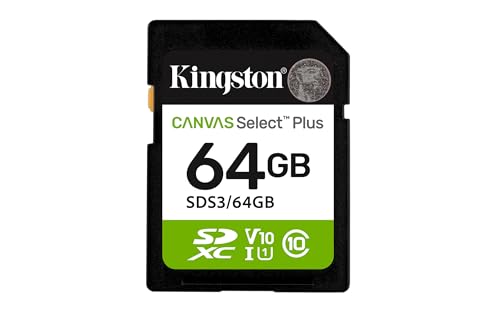
Kingston 64GB Canvas Select Plus SD Card Up to 100MB/s Class 10, UHS-I, U1, V10 SDS3/64GB — Small and simple
The 64GB Select Plus is the same card in a smaller, cheaper bucket, and its listing is refreshingly plain about the specification: reads up to 100MB/s, Class 10, UHS-I, U1, V10. This is the card for the camera in the kitchen drawer, the compact that goes to school events, the older camcorder that still records the family, or the spare slot in a bag whose main cards are grander. At 64GB it holds thousands of JPEGs or hours of Full HD footage, which for its intended devices is not a limitation but a match.
Small cards also enforce the healthiest habit in this whole category, which is regular offloading. A card that fills in a season gets emptied, checked and reformatted in the natural rhythm of use, while a giant card can become a forgotten archive of originals existing nowhere else. If this Select Plus is destined to be a household’s only card, its size is almost a feature. Buy it for the gentle device, let it live there permanently, and resist promoting it into a modern camera where its V10 floor would turn a happy shoot into a waiting exercise.
- Format: full-size SDXC, UHS-I bus
- Rating: Class 10, U1, V10
- Capacity of this version: 64GB
- Listed read figure: up to 100MB/s as quoted by the listing
- Role: household cameras, spares and gentle dedicated duty
Strengths
- The gentlest price into reputable branded media here
- Perfect size for compacts and older camcorders
- Encourages the offload habit by filling at a human pace
Trade-offs
- Too small and slow for modern RAW workflows
- V10 ceiling is absolute, not a suggestion
- Growing families will outgrow it within a camera upgrade
Best for: a household equipping an older camera, compact or camcorder for ordinary memories
Not suited for: a new mirrorless owner, who should begin at the V30 rung instead
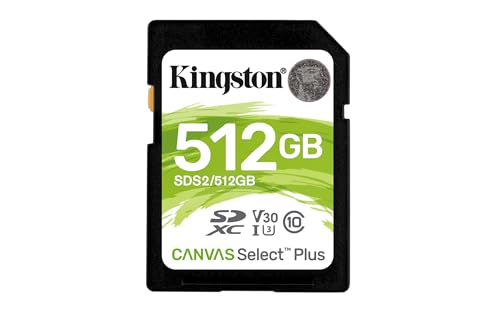
Kingston 512GB Canvas Select Plus SDXC Card — Half-terabyte value
The 512GB Select Plus contains this guide’s favourite small surprise: read its listing closely and the rating says V30, not the V10 of its smaller siblings, alongside Class 10, UHS-I and U1-era labelling that undersells it. Half a terabyte with a V30 floor is a meaningfully more capable card than its family position suggests, able to sustain the write pace that Full HD and lighter 4K recording require, while still wearing the Select Plus name and pricing that define the value shelf.
Who is it for? The owner of a long-trip camera, a video diary habit, a wildlife feeder camera or a family archive project, where capacity is the binding constraint and the writing is steady rather than violent. It will not satisfy a burst shooter, because sustained stills sequences ask different questions of a card than continuous video does, but as a volume card with a better floor than expected, it is the quiet bargain of this line-up. Just pair the purchase with an offload ritual, because half a terabyte of unrepeatable footage on one card is a concentration of risk no rating can fix.
- Format: full-size SDXC, UHS-I bus
- Rating: Class 10 with V30 as listed, UHS-I
- Capacity of this version: 512GB, the largest full-size here
- Listed read figure: up to 100MB/s as quoted by the listing
- Role: high-volume steady recording and archive-friendly shooting
Strengths
- A V30 floor hiding inside the value line
- Half a terabyte ends capacity anxiety for steady shooters
- Same familiar family and handling as its siblings
Trade-offs
- U1-era labelling confuses anyone reading quickly
- Still not a burst-shooting card despite the rating
- One card this large demands a strict backup routine
Best for: a steady-recording owner whose binding constraint is sheer room
Not suited for: an action stills shooter, whose bursts ask for a different kind of speed

Kingston Canvas Go Plus 64GB SD Card — The modern step up
The Canvas Go Plus at 64GB is where this family’s ladder reaches the modern era properly. Its listing quotes reads up to 200MB/s and rates the card U3 and V30 on the UHS-I bus, which translates into the sustained floor that current cameras ask for when recording 4K video or writing enthusiastic bursts of stills. It still prints Class 10 on the card, because everything does, but nobody should buy it for that mark; buy it because V30 is the first rating in this guide that a modern camera purchase should treat as a starting point.
The 64GB capacity is the deliberate trade here. Go Plus pricing buys speed before size, so this rung suits the shooter whose outings are intense but bounded: a match, a recital, a morning of wildlife, after which the card comes home and empties. Owners who record long-form video should climb capacity within the same idea rather than shrink their ambitions to fit the card. As the translation pick of the guide — the card for someone who arrived asking an old question with a new camera in hand — the Go Plus earns its place by answering the question they actually meant to ask.
- Format: full-size SDXC, UHS-I bus
- Rating: Class 10, U3, V30
- Capacity of this version: 64GB
- Listed read figure: up to 200MB/s as quoted by the listing
- Role: modern camera card for intense, bounded outings
Strengths
- V30 floor matches what current cameras actually require
- Fast reads return footage to the computer quickly
- The correct translation of the Class 10 question for new gear
Trade-offs
- 64GB is tight for long-form 4K recording
- Speed costs more per gigabyte than the Select Plus rungs
- Heavy shooters will want its larger siblings instead
Best for: a modern camera owner whose shooting days are intense but come home nightly
Not suited for: a long-form video recorder, who needs capacity first and this speed second

Kingston 256GB Canvas React Plus SD Card — The family’s flagship
At the top of the ladder sits a card that makes the guide’s thesis all by itself. The Canvas React Plus at 256GB is a UHS-II card rated V60, quoting reads up to 280MB/s, a specification that belongs to professional stills and serious 4K video. It also carries the Class 10 designation, because Class 10 is a floor from history that even flagships technically satisfy and politely print. Holding this card beside the 64GB Select Plus, with both wearing the same Class 10 ancestry, is the clearest possible proof that the old mark no longer separates anything from anything.
In a UHS-II camera this card writes with the authority its V60 rating promises, clearing bursts and sustaining video that would flatten the lower rungs, and through a UHS-II reader it empties at a pace that respects a working evening. In an older UHS-I camera it falls back gracefully and behaves like a strong UHS-I card, which makes it the one pick here that can travel upward through a photographer’s upgrading years. It costs flagship money, and it should be bought by photographers whose cameras can spend its speed, but as the answer to where the Class 10 road actually leads in the modern market, it is the destination.
- Format: full-size SDXC, UHS-II bus, backwards compatible
- Rating: Class 10, U3, V60
- Capacity of this version: 256GB
- Listed read figure: up to 280MB/s as quoted by the listing
- Role: flagship card for UHS-II cameras and serious video
Strengths
- V60 and UHS-II place it in a different league entirely
- Graceful fallback makes it safe across old and new bodies
- 256GB suits professional stills and long 4K days
Trade-offs
- Flagship pricing for speed many cameras cannot use
- Needs UHS-II hardware at both ends to shine
- Its Class 10 mark teaches nothing about its real tier
Best for: a photographer with a UHS-II camera who wants one card to grow with the kit
Not suited for: an owner of a gentle older camera, where its talents would sleep unused

Kingston 32GB Canvas Select Plus microSDHC Card — The microSD member
The family tour ends at the smallest physical format: a 32GB Canvas Select Plus microSDHC card, supplied with the SD adapter that lets it moonlight in full-size slots. Its listing rates it A1 and Class 10 on the UHS-I bus with reads up to 100MB/s, a specification aimed at phones, small tablets, handheld consoles, dash accessories and the long tail of little devices that still eat microSD media. The adapter makes it the most flexible object in this guide and also the one needing the most honest handling advice.
Use the bare card in microSD devices, where it is a perfectly good citizen. Use it in the adapter only for light full-size duties — a spare for a compact camera, a transfer mule, an emergency card — because adapters add a contact layer that serious cameras do not need in their lives. At 32GB it is a card of small jobs, and there is no shame in that: every household in this category accumulates devices whose entire storage ambition fits in this card twice over. It closes the guide as a reminder that the Class 10 shelf was never really about speed at all, but about dependable little cards for ordinary machines.
- Format: microSDHC, UHS-I bus, SD adapter included
- Rating: A1, Class 10 as listed
- Capacity of this version: 32GB
- Listed read figure: up to 100MB/s as quoted by the listing
- Role: small devices, spares and adapter-based light duty
Strengths
- Adapter makes it the most versatile card here
- Right size for the small devices that still use microSD
- A1 rating suits app-carrying phone and tablet duty
Trade-offs
- 32GB is small for any camera-centred purpose
- Adapter use adds a failure point in serious cameras
- Dated HC format caps its growth at this capacity
Best for: a household feeding small devices and wanting one flexible spare
Not suited for: a photographer seeking a main camera card, who should choose full-size media
How do the six Canvas cards compare rung by rung?
Lined up together, the six Canvas cards show the whole argument of this guide: the Class 10 ancestry stays constant from bottom to top while the ratings that actually matter climb from V10 to V60.
| Card | Size and format | Marks on the card | Natural home in this guide |
|---|---|---|---|
| Kingston Canvas Select Plus 256GB | 256GB full-size SDXC, UHS-I | Class 10, U1, V10 | Mainstream gentle cameras and Full HD |
| Kingston Canvas Select Plus 64GB | 64GB full-size SDXC, UHS-I | Class 10, U1, V10 | Household cameras and bag spares |
| Kingston Canvas Select Plus 512GB | 512GB full-size SDXC, UHS-I | Class 10, V30 as listed | High-volume steady recording |
| Kingston Canvas Go Plus 64GB | 64GB full-size SDXC, UHS-I | Class 10, U3, V30 | Modern cameras on bounded outings |
| Kingston Canvas React Plus 256GB | 256GB full-size SDXC, UHS-II | Class 10, U3, V60 | UHS-II cameras and serious 4K video |
| Kingston Canvas Select Plus 32GB microSD | 32GB microSDHC, UHS-I, adapter | Class 10, A1 | Small devices and flexible spare duty |
How did Class 10 go from flagship promise to historical footnote?
When the SD Association introduced speed classes, the problem they solved was chaos: early cards varied wildly, and a camcorder owner had no way to know whether a card could keep up with a recording. The class number promised a minimum sustained write speed in megabytes per second, and Class 10, guaranteeing ten, was for years the mark of a serious card, the one photographers asked for by name. Camera shops built their advice around it, and the phrase entered the language the way this guide’s search term proves it remains there.
Then the cameras outgrew the ruler. Full HD video wanted more than the old classes described, 4K wanted multiples more, and burst photography turned sustained writing into the whole game. The Association answered with the UHS speed classes, U1 and U3, and then the video speed classes, V10 to V90, each guaranteeing higher sustained floors with testing to match. Class 10 never got faster; the world simply built taller ladders beside it. A modern flagship still satisfies Class 10 the way a motorway satisfies a footpath’s width requirement, which is why the mark survives on packets as reassurance for shoppers whose vocabulary, understandably, was formed in the earlier era.
Which rating should you actually shop by today?
Match the rating to the hungriest thing your device records. For stills at a gentle pace and Full HD video, a V10 card like the Select Plus rungs is honestly sufficient, and millions of cameras live their whole lives there. For 4K video from a modern camera, or enthusiastic burst shooting, V30 is the floor this guide recommends treating as standard, because it guarantees three times the sustained pace and absorbs the spikes that real recordings produce. V60 and V90 belong to high-bitrate video and professional burst work, where the camera’s manual will usually name the requirement outright.
Two habits protect you regardless of tier. First, read the V and U figures on the listing rather than the class logo or the read speed, since only those figures promise anything about recording. Second, check your camera manual’s own card guidance, because manufacturers state the floor their highest modes need, and that sentence outranks any shop’s advice. The Select Plus 512GB in this guide, quietly carrying V30 inside a value listing, shows why the habit matters in both directions: ratings, read carefully, sometimes reveal a card is better than its shelf position, not only worse.
Why does one brand fill this whole guide, and should that worry you?
It should inform you rather than worry you, and the reason is market history. As the industry moved its marketing energy to UHS-II and V90 flagships, the traditional Class 10 full-size shelf thinned out; some famous lines were discontinued, others drifted into marketplace listings of uncertain freshness. Kingston kept the Canvas family broad, current and everywhere, from the Select Plus value tier to the React Plus flagship, so a guide assembled from cards genuinely on sale today naturally becomes a tour of that family’s ladder.
The practical consequence is that comparison shopping in this tier is now mostly comparison within the family: choose your rung by rating and capacity, and let the brand question settle itself. Kingston’s long presence in memory, the Canvas line’s clear tiering, and the sheer availability of fresh stock all support that settlement. The caution that remains is the universal one for this category — buy from reputable sellers, because counterfeit cards imitate exactly the popular, affordable lines that households buy most, and a fake Select Plus is a far more common misfortune than a genuine one failing.
Which mistakes follow the Class 10 logo around?
The defining mistake of this category is buying by the Class 10 logo for a modern camera. The logo promises a pace from the standard-definition era, and a 4K camera fed a V10 card will stutter, stop or refuse its higher modes. Translate the purchase into V ratings before any money moves.
A second mistake is reading the largest number on the packet as the card’s speed. That number is almost always a read figure under ideal conditions, relevant to offloading and irrelevant to recording. The guaranteed write floor, printed smaller as the U or V rating, is the number your camera will actually live with.
Third, shoppers assume a famous old listing equals a current product. This shelf is full of legacy stock and marketplace ghosts, which is one reason this guide leans on a family with fresh, current listings. Check that the exact capacity and rating in the title match the specification in the description before ordering.
Finally, do not let a bargain microSD-plus-adapter bundle become a serious camera’s main card by default. Adapters are conveniences for readers and light duties; a camera recording an unrepeatable day deserves a native full-size card with one set of contacts and no intermediary plastic between it and your files.
Final Recommendation
The Class 10 question, translated into modern language, answers itself in tiers. Gentle cameras and Full HD lives are served honestly by the Select Plus cards, with the 256GB as the default and the 512GB as the quietly better-rated volume surprise. Modern cameras should start at the Go Plus and its V30 floor, and UHS-II owners end at the React Plus, where the old logo rides along on a genuinely flagship card.
Keep the family’s smallest member for the small devices it suits, and keep the guide’s central lesson closer still: Class 10 is where card literacy begins, not where it ends, and the photographer who learns to read V ratings will never again buy the wrong card by accident.
How do you read a modern card listing without being misled?
A contemporary card listing is a small museum of competing numbers, and learning to walk through it in the right order turns shopping from guesswork into inspection. Begin at the ratings cluster, the U, V and Class marks, and read only the guarantees: the V number tells you the sustained write floor, the U number restates a similar promise, and Class 10 nods politely from history. Everything else on the packet is either a ceiling or a courtesy, and ceilings describe the best second of a card’s life rather than the average hour your camera will actually spend with it.
Next, find the read figure and file it under offloading. A card reading at 150 or 200 megabytes per second will empty into a good reader with satisfying speed, and that matters to people who import large shoots, but it says nothing about recording, and conflating the two numbers is the single most successful confusion in this market. Then check the bus: UHS-I serves the vast majority of cameras ever made, while UHS-II only wakes up in bodies and readers built for it, falling back gracefully everywhere else, which is why the React Plus in this guide can be both a flagship and a safe guest in an old camera.
Finish with the unglamorous checks that prevent the commonest disappointments. Confirm the capacity in the title matches the capacity in the specification table, because marketplace listings occasionally marry one product’s headline to another’s details. Confirm the format — SD, SDHC and SDXC describe capacity generations as much as sizes, and the oldest devices can be particular about SDXC. And confirm the seller is the brand’s own channel or a retailer you would trust with a lens, because in a category this counterfeited, the seller is part of the specification whether the listing admits it or not.
Which devices in a modern household still genuinely want Class 10-tier cards?
Walk through a house with this guide’s question in mind and the gentle tier keeps finding work. The compact camera in the holiday drawer, the older DSLR that now serves as the family camera, the Full HD camcorder that records school concerts, the trail camera watching a garden, the digital photo frame cycling a decade of birthdays, the printer that scans to card, the handheld console’s older sibling, the dashboard camera’s modest cousin — none of these devices can spend more than the Select Plus rungs offer, and all of them run for years on exactly this tier of media.
That is why declaring Class 10 dead misses the point of the category. The mark died as a performance promise, but the tier it named became the standard diet of the long tail of devices that households actually own, devices bought once and used for a decade rather than upgraded annually. Kingston’s Canvas family thrives precisely because it feeds that long tail at every capacity the tail requires, from the 32GB microSD in a doorbell-era gadget to the half-terabyte Select Plus swallowing a trail camera’s entire season.
The buying skill is matching rather than maximising. A device with a stated maximum card size should be given that size and no speech about future-proofing, because its future is fixed by its own firmware. A device that records continuously, like a camera watching a bird table, values several mid-size cards rotated over one giant, so a failure loses a week rather than a season. And a device holding anything irreplaceable deserves a card from a reputable seller at whatever tier, because in the gentle tier the difference between brands matters far less than the difference between genuine and fake.
How should you care for budget-tier cards so they outlast expectations?
Cards in the gentle tier usually die of handling rather than of specification, so their care is a handling discipline. Keep them in their little plastic cases rather than loose in pockets and bags, because the contacts on a full-size SD card are exposed by design and every journey across a set of keys is a small abrasion. Label each card with its device and purchase date in fine marker on the label’s edge, and a household fleet stops being a drawer of identical mysteries within a single season.
Give each card a home device and let it live there. Cards that tour between cameras, frames, printers and computers accumulate formatting personalities and contact wear at a rate their price never budgeted for, while a card that spends its life in one trail camera or one family compact often outlasts the device itself. When a card must move, format it in its new home before use, and copy off anything precious first, because formatting is the moving van that empties the house before the new tenant arrives.
Retire on evidence, not on age. A gentle-tier card that begins asking to be formatted, that produces one strange file in a set, or that a device intermittently fails to see, has begun its resignation speech, and the correct response is gratitude and replacement rather than negotiation. At these prices, the replacement costs less than the afternoon spent recovering a corrupted card, and incomparably less than the school concert that existed, briefly and entirely, on a card its owner had already been warned about twice.
How does a Class 10 card behave inside devices that never read its ratings?
Most devices in the gentle tier never interrogate a card’s class at all; they simply write at their own pace and trust the card to keep up, which it does until the day it cannot. A photo frame reads a slideshow at a stroll. A printer accepts a scan and writes it at the speed of its own modest processor. A trail camera wakes, writes a burst of images or a short clip, and sleeps again, asking of its card only that it be awake, honest about its capacity, and unchanged since yesterday. For these citizens, the entire ratings alphabet is a foreign language, and the qualities that matter are genuineness, capacity and the simple continuity of being the same card tomorrow.
That invisibility is exactly why the gentle tier’s failures surprise their owners. A card that has served a frame or a feeder camera for years gives no performance signals to monitor, because the device never pushes it; its decline announces itself only in the device’s confusion, a frame that stops mid-slideshow, a trail camera that records gaps in a busy night. The household habit that protects against the surprise is the occasional census: once a season, let each long-service card visit a computer, copy off anything that matters, confirm the card reports its true capacity, and return it to duty or retire it on the evidence.
It is also why matching card to device, at this tier, is mostly about not overthinking. The doorbell-era gadget with a stated maximum card size wants its 32GB card and no larger, because its firmware was written in a smaller world. The family compact wants the 64GB Select Plus and a decade of birthdays. The devices are honest about their appetites in their manuals, and the Class 10 shelf, for all its faded glory, remains the correct and sufficient answer to appetites of that scale, provided the card itself is genuine.
What changed in card buying when the famous old lines disappeared?
Long-time photographers returning to this shelf after a decade away experience a small culture shock, because the names that once divided the market have rearranged themselves. Some famous lines were retired as their makers chased the professional tiers, some survive mainly as marketplace listings of uncertain age and provenance, and the centre of the shelf consolidated around families like Kingston’s Canvas that kept their tiers broad, current and easy to find. The shopper’s task changed with the shelf: less choosing between rival flags, more choosing the right rung within the family that still shows up to work.
The consolidation carries a hidden benefit for careful buyers, because a single family’s ladder is unusually legible. Within Canvas, the step from Select Plus to Go Plus to React Plus is a step in rating and bus that the listings state plainly, so a buyer can climb exactly one rung past their camera’s requirement and stop, rather than decoding five brands’ private dialects for the same three ideas. Legibility is worth money in a category where the commonest loss is not a failed card but a mis-bought one, a V10 card in a 4K camera or a flagship idling in a photo frame.
The corresponding risk is complacency about provenance. A consolidated shelf concentrates counterfeiters’ attention on the same popular lines everyone buys, so the family’s very ubiquity makes seller choice the decisive specification. Buy the Canvas rungs from the brand’s own storefront or a retailer with a reputation to lose, check the card’s reported capacity on arrival with a full write test if the purchase matters, and the consolidated market becomes what it should be: the simplest shelf in photography, where the remaining decision is merely how far up a clear ladder your camera asks you to climb.
How should a household organise a drawer full of small cards?
Every photography household accumulates the same drawer: cards from dead cameras, cards that arrived inside devices, cards whose capacities record a decade of falling prices. Organising that drawer takes one honest afternoon and pays rent for years. Begin by gathering every card and its adapter into the light, then sort without mercy into three companies: cards whose device and duty you can name, cards that test healthy and await assignment, and cards that fail, confuse or carry forgotten mysteries, which should be wiped, retired and physically marked so they never drift back into service during a future emergency.
Give each surviving card a single named duty and write the duty on its case in marker: the trail camera’s card, the family compact’s card, the Fire tablet’s spare, the bag spare for the main camera. Single-duty cards live longer, confuse nobody, and make the household’s storage legible to someone other than their purchaser, which matters the first time a partner or a grandparent needs the camera to work without a consultation. Keep adapters with the cards that need them rather than in a separate archaeology of small plastic, and store the whole fleet in one rigid case in one known place, because a spare that cannot be found is a spare in name only.
Finally, let the drawer’s census become a seasonal ritual as light as checking smoke alarms. Once or twice a year, confirm that each duty card still reports its capacity, that the bag spare is formatted and ready, and that anything irreplaceable living on any card also lives somewhere else. Households that keep this small ceremony discover their card problems during the ceremony, at a table, with time and coffee available. Households that skip it discover the same problems at a trailhead, a school hall or a departure gate, where the tuition for the identical lesson is considerably higher.
How do you spot a counterfeit card before it costs you photographs?
Counterfeit media announces itself in whispers before it shouts, and the whispers are learnable. The first is price: a famous card at a fraction of its street price, from a seller with no reputation to protect, is not a discovery but a diagnosis, because genuine supply chains do not produce miracles of that shape. The second is presentation: printing that sits slightly soft under a close look, packaging whose seals and fonts drift from the brand’s standard, capacities offered that the maker never sold. Any one sign can be argued with; two together should end the conversation and the purchase.
The third whisper is arithmetic, and it is decisive. A counterfeit card typically contains a small genuine memory reprogrammed to report a grand capacity, so it accepts files happily until the real space ends, after which new data silently overwrites the old. A full write-and-verify test on a computer — filling the card completely and reading everything back — exposes the fiction in one pass, because the card cannot return what it never held. Run that test on any card bought through an unfamiliar channel before it carries real work, and treat a failure as a refund claim, not as a disappointment to be lived with.
The deeper defence is habit rather than detection. Buy the popular lines in this guide from the brand’s own storefront or a retailer whose name is the warranty, keep the receipt until the card has survived real assignments, and be suspicious forever of the too-good listing, especially for the affordable cards households buy in quantity. Counterfeiters farm exactly the gentle tier this guide covers, because its buyers are numerous and its prices make scrutiny feel disproportionate. A minute of scrutiny per card is the correct proportion, and it is cheaper than any recovery service ever advertised.
What is the honest upgrade path from a Class 10 drawer to a modern kit?
Most photographers do not need a new card system; they need their existing drawer translated. The translation begins by sorting current cards against current cameras rather than against memory. The camera you shoot today states its needs in its manual and in its behaviour: if its highest video mode and your longest bursts have never once complained, your present tier is not a problem awaiting a purchase, whatever the internet’s flagship reviews imply. Upgrade pressure should come from a named frustration — a mode refused, a buffer that interrupts your actual subjects — and not from the ambient sense that newer numbers must be better numbers.
When a frustration does name itself, climb one rung, not three. The V10 shooter whose new camera records 4K moves to the V30 tier, in this family the Go Plus or the quietly V30-rated Select Plus 512GB, and stops there to let the new tier prove itself across a season. The UHS-II body owner is the exception, because the bus itself is the frustration, and the React Plus answers it in one step. One-rung climbing keeps spending welded to evidence, and it leaves headroom in the budget for the unglamorous purchases — the reader, the case, the second destination for copies — that protect more photographs than any tier ever has.
Let the old cards retire downward through the household rather than outward to the bin. A card outgrown by the main camera becomes the family compact’s card, then the trail camera’s, then the frame’s, shedding risk at every step as the copies it holds matter less and its own remaining life is spent at duties matched to its age. That cascade is the quiet economics of the Class 10 shelf: nothing in it is wasted, everything in it is eventually outgrown, and the photographer who manages the cascade spends less across a decade than the one who buys flagships for cameras that cannot read their badges.
What is the one-page checklist for buying any card on this shelf?
The whole guide compresses into five questions that fit on an index card and work in any shop or listing. First, what does the device actually record, and which V rating does that honestly require? Second, what capacity matches the device’s own stated limits and the household’s real habits, rather than the largest number on the shelf? Third, is the format correct — full-size or microSD, and which capacity generation does the device accept? Fourth, is the seller the brand’s own channel or a retailer with a reputation worth more than this transaction? Fifth, when the card arrives, will I run the full write-and-verify test before it carries anything that matters?
A buyer who asks those five questions in order will almost never buy the wrong card on this shelf, because the questions route around every trap the category sets: the faded Class 10 logo, the billboard read speed, the too-good price, the legacy listing, the adapter masquerading as a camera card. The Kingston ladder then becomes what it should have been from the start, a simple staircase where each question points at its rung — Select Plus for the gentle answers, Go Plus for the modern ones, React Plus for the flagship body, and the little microSD for the small devices that started the whole conversation.
Why does this humble shelf still deserve a buyer’s full attention?
It would be easy to treat the Class 10 shelf as photography’s past, a clearance corner beneath the real action of UHS-II flagships, and that ease is precisely what makes the shelf dangerous to shop carelessly. The cards here outsell the flagships many times over, they serve the devices households actually keep, and they hold, in aggregate, an enormous share of the world’s family photographs, school concerts, garden wildlife and holiday mornings. The stakes on this shelf are not lower than the professional tier’s; they are merely distributed across millions of unrepeatable small moments instead of concentrated in a few large ones.
Attention, on this shelf, looks like the habits this guide has repeated until they risk becoming a refrain: read the modern rating, buy the genuine article, test on arrival, match the rung to the device, and copy the irreplaceable things somewhere else. None of that requires expertise beyond this page, and all of it together converts the humblest purchase in photography into one of its most reliable. The Class 10 logo began, decades ago, as a promise that an ordinary buyer could trust an ordinary card. The promise survives — it simply moved house, into the V ratings and the seller’s name, waiting for the buyer who knows where to read it.
A final word on keeping the paperwork
One last practical note belongs to every rung equally: keep the receipt and the packaging until a new card has survived its first real assignments, because the honest sellers who anchor this guide make returns painless, and a card that fails its arrival tests should travel back while the paperwork still can. That small retention habit closes the loop this guide opened, turning a purchase into a probation with an exit, and it costs nothing but a drawer corner for a month.
Frequently Asked Questions
Is Class 10 fast enough for 4K video?
Class 10 alone guarantees only ten megabytes per second, which most 4K cameras exceed quickly. Some Class 10 cards, like the V30-rated entries in this guide, also carry the higher modern rating that 4K actually needs, so judge by the V number rather than the class logo.
Why do expensive cards still print Class 10 on them?
Because they satisfy it trivially, and the mark remains familiar to shoppers. It functions as a legacy reassurance on modern packaging, similar to a flagship phone still listing basic network compatibility, and it tells you nothing about the card’s real ceiling.
What is the difference between U1, U3 and the V ratings?
U1 and U3 guarantee sustained writes of ten and thirty megabytes per second, and the V scale extends the same idea upward through V10, V30, V60 and V90 with video-oriented testing. For buying purposes, read the V rating as the headline guarantee and the U rating as its close relative.
Can the microSD pick replace a full-size card in my camera?
With its adapter it will work, and for light duties that is acceptable, but a native full-size card is the dependable choice for a camera’s main slot. Keep the microSD card for the small devices it was made for and as an emergency spare.
Which pick suits an older DSLR that only shoots stills?
The 256GB Select Plus is the natural fit: capacity for years of JPEGs or a long season of RAW files, a floor that gentle stills writing never troubles, and pricing that matches the camera’s own place in life.
Is a Class 10 card the same as a UHS-I card?
No, the terms describe different things. Class 10 is a speed guarantee from the older system, promising ten megabytes per second of sustained writing, while UHS-I names the bus the card uses to talk to the device. Most modern cards are both at once, which is why the phrases are so often confused in listings.
My camera manual from years ago asks for Class 6 or better. What should I buy?
Any card in this guide exceeds that requirement many times over, so buy by capacity and seller trust rather than by hunting for an antique rating. The 64GB or 256GB Select Plus will serve such a camera for the rest of its life, at a price its original Class 6 card would have found astonishing.
Related Guides
Canon 7D Mark II SD card choices explained V30, V60 and V90 ratings decoded for video shooters Kingston Canvas families compared rung by rung
Related guides
- Best Direct Thermal Printers: Shipping-Label Machines and Professional Label Systems
- Best 4K UHD HDR HDMI Extenders: 4K60, Long-Run and 4K120 Kits Compared
- Best 25–35 Inch Monitors With Lowest Display Lag: An Honest Ranking Without Invented Numbers
- Best Enterprise SATA SSDs: Endurance Classes, Power-Loss Protection and Fleet Sense


