What's inside
- Key Takeaways
- Quick Picks
- How Did We Judge Camcorders by Football’s Rules?
- Why Does the All-22 Shot Change What a Camera Must Do?
- What Else Belongs in a Football Film Kit?
- How Do You Film a Game So Monday’s Session Actually Works?
- What Changes Between Youth, High-School and College Filming?
- Reach, Steadiness and Workflow: the Six Compared for Friday Night
- How Should a Recruiting Reel Change What You Film?
- What About Sound, Streams and the People Watching at Home?
- What Do Football Film Crews Most Often Get Wrong?
- Does the Same Camera Cover Practice, 7-on-7 and the Off-Season?
- Final Recommendation
- Frequently Asked Questions
- Related Guides
As an Amazon Associate I earn from qualifying purchases. This post may contain affiliate links at no extra cost to you.
gizmoverdict.com is reader-supported. When you buy through links on our site, we may earn an affiliate commission.
Where to buy: Camcorders are a mature, slow-changing category, so every recommendation below is anchored to a retail page we checked, and several of these models have sold in the same form for years. That longevity is a virtue for football programmes: accessories, batteries and even the coaching staff’s muscle memory carry across seasons, and a replacement bought in October matches the camera that filmed September.
The best video cameras for football are not chosen the way wedding cameras are chosen, and this guide will judge them by the sport’s own tests. Football is filmed from far away — a press box, a scaffold tower, the top row of bleachers — at subjects that move in bursts, stop, and explode again. The camera’s job is to hold the far hash marks steady and legible for two to three hours, in weather that ranges from August heat to November sleet, operated often by a volunteer, a student manager or an assistant coach whose real job starts on Monday morning in the film session.
That brief makes three specifications matter more than everything else on the box. Optical zoom reach comes first, because digital zoom is just cropping with worse manners, and the far side of the field is a long way from the fifty-yard line. Stabilisation comes second, because bleachers vibrate, towers sway, and handheld end-zone angles shake exactly when the play develops. And 4K resolution earns its place for a football-specific reason: it lets a coach crop into a quarter of the frame during film study and still read jersey numbers, which turns one wide tactical shot into both the all-22 view and the close study copy.
One more consideration runs through every review and deserves naming before them: total cost of the season, not of the camera. Football consumes batteries, media, rain covers and eventually a companion angle, and the mature models in this guide keep those running costs low because their accessories have been manufactured for years and their media is the inexpensive kind. A newer, cleverer camera whose batteries cost three times as much and whose format fills cards twice as fast can be the more expensive season by November, whatever the bodies cost in August. Programmes buy seasons; this guide prices them that way.
Six camcorders make the cut, five of them 4K and one an honest HD budget route whose review says plainly what it cannot do. Between them they cover the programme with a film crew of students, the parent filming a recruiting reel from the stands, and the semi-serious videographer streaming Friday nights to the families who could not make the trip.
Key Takeaways
- Optical zoom is the football specification: every pick here offers at least 20x, because the far hash is further than it looks.
- 4K’s real football value is the film-room crop — one wide shot serves as both the tactical view and a readable close-up.
- Stabilisation decides handheld usability: Sony’s gimbal-style Balanced Optical SteadyShot is the class benchmark in this list.
- The Canon G70’s on-screen time stamp and USB live streaming make it the coaching-film and broadcast specialist.
- Panasonic’s twin-camera and multi-scene tricks solve the scoreboard-and-reaction problem without a second operator.
- The Sony CX405 is HD only — a fine budget route for youth football, and honestly labelled as such throughout.
Quick Picks
| Pick | Badge | Why it earns its place |
|---|---|---|
| Sony FDR-AX53 | Best overall | Gimbal-style stabilisation, 4K detail and a 20x zoom — the steadiest handheld football footage in this guide. |
| Panasonic HC-VX981K | Best zoom | 20x optical reach with HDR capture and Wi-Fi multi-scene recording for a companion angle from a phone. |
| Canon VIXIA HF G70 | Best 4K value | 4K UHD, 20x zoom, USB live streaming and an on-screen time stamp that film-study coaches genuinely use. |
| Panasonic HC-WXF991K | Best feature set | A built-in second camera in the screen edge, an EVF for bright Fridays, and 5-axis hybrid stabilisation. |
| Sony AX43A | Best compact 4K | The AX53’s stabilisation philosophy in a smaller body for parents and travelling videographers. |
| Sony HDR-CX405 | Best budget HD | 30x optical zoom and HD recording at a youth-football price — with the HD ceiling stated, not hidden. |
How Did We Judge Camcorders by Football’s Rules?
We weighted the sport’s geometry first. A football field is 53 yards wide and the camera usually sits beyond one sideline or behind an end zone, so reach and the steadiness to use it dominate: a 20x optical zoom that shakes is worth less than the same zoom on a stabilised platform, which is why stabilisation systems are named and compared in every review rather than summarised as a logo. Resolution was judged by film-room utility — can this frame be cropped on Monday and still teach? — rather than by specification pride.
Operation came next, because football filming is volunteer labour. Controls that survive gloves, menus that a student manager can learn in one practice, battery options that span a freshman game and a varsity game back to back, and recording media cheap enough to hand to a coach without a deposit — these decide whether a programme’s film actually exists in November. Finally we considered the second jobs these cameras do: streaming to the school’s channel, feeding a scoreboard, and shooting the recruiting clips that have become part of a high-school player’s real prospects.
Why Does the All-22 Shot Change What a Camera Must Do?
Coaches film football differently from fans, and the difference is a formation-wide frame called the all-22: every player on the field, held in shot from snap to whistle, so that Monday’s session can trace all eleven assignments on both sides. The all-22 is a wide shot by design, which sounds forgiving and is the opposite — it asks the camera to hold twenty-two moving subjects legibly at distance, in a frame where each player occupies a few dozen pixels of height in HD. That arithmetic is the practical case for 4K in this guide: quadruple the pixels and the same wide shot yields a study copy a coach can crop two-deep while keeping numbers readable.
It also explains the zoom paradox of football filming. The all-22 operator barely zooms during a play at all — the craft is in the pre-snap framing and the disciplined pan — while the end-zone and sideline cameras that feed highlights and recruiting reels live at the long end of their zooms chasing individual matchups. A programme’s ideal kit holds both behaviours, and the picks below divide accordingly: the stabilised Sonys and the feature-rich Panasonics serve the mobile angles, while the Canon’s streaming and time-stamp tools serve the film-room pipeline that the all-22 feeds.
What Else Belongs in a Football Film Kit?
A tripod with a genuinely smooth video head is worth more than the next camera tier up, because the all-22 pan is a tripod shot and a sticky head prints its hesitation into every play. Height is the second purchase — a scaffold, a lift, or at minimum the discipline to claim the highest row — since elevation is what turns a tangle of helmets into readable assignments. Power and media follow: a varsity double-header outlasts single batteries and small cards, and the cameras here were chosen partly for their tolerance of long, boring, reliable recording. A rain cover, finally, is the cheapest insurance in the sport; November does not care about your equipment budget.
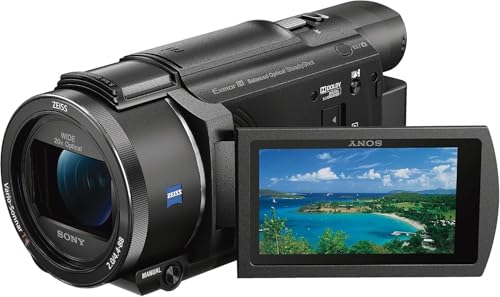
Sony FDR-AX53 — Best overall
The AX53’s claim on this guide’s top spot is a stabilisation system with a mechanical idea behind it: Balanced Optical SteadyShot floats the entire lens-and-sensor assembly like a small gimbal, so the correction happens optically, smoothly, and across the whole zoom range. On a vibrating bleacher or a swaying scaffold, the difference against ordinary electronic stabilisation is not subtle — the far-hash shot holds its composure through the snap, the pan stays level as the play breaks, and handheld end-zone footage comes back usable instead of seasick. For the volunteer operator filming from wherever the programme could put them, that steadiness is the feature that survives contact with Friday night.
Around it sits a complete football specification. The 4K recording carries the film-room crop this guide keeps returning to; the 20x optical zoom covers the field’s width from a midfield perch and reaches individual matchups from the end zone; the 5.1-channel microphone and accessory shoe serve the streaming and atmosphere duties; and the body has the heft and control layout of a serious camcorder rather than a travel toy. Low light is respectable for its sensor class — late-season games under modest stadium lights are its home turf — and its autofocus tracks a developing play without the hunting that ruins amateur footage.
Age is the honest footnote: this is a mature model whose design has been sold for years, and its menus and connectivity feel their generation beside the Canon below. What the years have also done is prove it — parts, batteries and knowledge are everywhere, and programmes running two of them seasons apart get identical footage. For a single camera that a programme, a parent or a videographer can build a football workflow around, the AX53 remains the steadiest answer in this article.
- Recording: 4K UHD with the film-room crop headroom coaches use
- Stabilisation: Balanced Optical SteadyShot — gimbal-style optical float
- Zoom: 20x optical, ZEISS-branded optics
- Audio: 5.1-channel microphone and an accessory shoe for upgrades
- Focus: fast, confident autofocus for developing plays
- Role: the programme’s principal camera, tripod or handheld
Strengths
- The steadiest handheld and bleacher footage in this guide, full stop.
- 4K detail converts directly into Monday’s crop-and-study workflow.
- A proven, long-running model with deep accessory and battery support.
Trade-offs
- Menus and connectivity belong to its generation, not the streaming era.
- Larger and heavier than the compact picks — a tripod repays it.
- No built-in live-streaming path like the Canon’s USB route.
Best for: programmes and parents who film handheld or from imperfect perches and need footage that stays composed when the stands start shaking. Not suited for: broadcasters who need streaming built into the camera itself, or minimalists who want the smallest bag on the bus.
A note on pairing: programmes that can stretch to a second unit most often put this camera on the scaffold for the all-22 and something nimbler at field level, but if the budget holds only one body, the AX53 is the one that suffers least at either post — steady enough for the handheld angle, resolved enough for the wide study shot. Its long production run also means a programme can add a matching second body in a later season without changing its footage’s character, a continuity that coaching staffs notice more than any specification.

Panasonic HC-VX981K — Best zoom
Reach is this Panasonic’s argument, and it makes the argument completely: a 20x optical zoom over a 1/2.3-inch backside-illuminated sensor, recording 4K, with HDR capture to hold a white jersey and a shadowed sideline in the same frame. From the press box, that zoom spans the tactical wide and the individual matchup without a lens change that camcorders cannot make anyway. From the end zone, it brings the far red zone to you. Zoom range is a specification every pick here shares in number; the VX981K earns its badge by pairing it with the image processing to keep the long end honest — stabilisation that behaves at full extension and a sensor that holds detail when the light goes November-grey.
Its party trick serves football specifically. Wi-Fi Multi Scene recording links a smartphone as a second, wireless camera whose picture appears picture-in-picture in the main recording — station the phone on the scoreboard, on the bench, or in a parent’s hands at field level, and the film gains the context angle that programmes usually need a second operator to capture. HDR movie mode deserves its sentence too: Friday night stadiums are contrast traps of floodlit turf and black sky, and the VX981K’s HDR handling keeps both ends of that range more honest than its price class promises.
The compromises are ergonomic and generational. The body is compact in a way that suits travel more than gloved operation, the control depth rewards an owner who reads the manual once, and its stabilisation — good hybrid correction — does not match the Sony flagship’s floating-lens composure at full zoom on a shaking perch. Choose it when reach and the companion-angle trick are the brief, and put it on a proper video head to let the zoom do its work.
- Recording: 4K Ultra HD with HDR capture for floodlit contrast
- Zoom: 20x optical over a 1/2.3-inch BSI sensor
- Companion angle: Wi-Fi Multi Scene links a phone as a wireless sub-camera
- Stabilisation: hybrid optical correction, best on a solid head
- Extras: in-camera editing touches for quick highlight assembly
- Role: the reach camera for press-box and end-zone positions
Strengths
- Long, honest zoom reach with HDR to survive stadium contrast.
- The phone-as-second-camera trick adds an angle without an operator.
- 4K detail supports the film-room crop workflow fully.
Trade-offs
- Stabilisation trails the Sony’s optical-float system at full extension.
- Compact body and menu depth are less glove-friendly on cold nights.
- The companion-angle feature needs Wi-Fi conditions a crowded stadium may tax.
Best for: press-box and end-zone operators who live at the long end of the zoom and want a built-in companion angle for context. Not suited for: handheld bleacher filming in a bouncing student section, where the AX53’s stabilisation earns its premium.
Recruiting coordinators quietly favour this camera’s output for a practical reason: the long end of its zoom, stabilised on a decent head, produces the isolated matchup clips — a tackle’s kick-slide, a receiver’s release — that college staffs actually evaluate, and the HDR mode keeps a white-helmeted player readable against a dark crowd behind him. Shoot those clips in the game’s natural light without effects or slow motion, and they carry the credibility that over-produced highlight reels have taught recruiters to discount.

Canon VIXIA HF G70 — Best 4K value
The G70 reads like a camera specified by the coaching staff rather than the marketing department. Yes, the core is right — 4K UHD from a 1/2.3-inch sensor, a 20x optical zoom, proper image stabilisation — but the details around that core are the film programme’s details. An on-screen display time stamp burns the clock into the recording, which sounds minor until a coach syncs game film against a play chart or verifies a prospect’s forty time against footage. USB live streaming turns the camera into the school’s broadcast unit without a capture card. An accessory-shoe and audio provision that takes the job seriously complete a package aimed at programmes, not tourists.
On the field it behaves like the professional-leaning tool it is. The zoom rocker and control layout suit gloved, cold-weather operation better than the compact picks; the image holds together at the long end where recruiting clips are made; and the 800x digital zoom figure on the box should be ignored by everyone, as this guide ignores it — the honest reach is the 20x optical, and it is enough. Slow-motion options in HD serve the technique-coaching niche, where a quarterback’s footwork at reduced speed teaches more than another wide shot.
Value is the badge and value is the truth of it: this is the least expensive route in the guide to a complete, programme-grade 4K workflow with streaming included, from a maker whose VIXIA line has filmed school sports for decades. Its sensor is the small class shared with the Panasonics, so low-light heroics belong to no one here; its stabilisation is competent rather than class-leading. But for the school that needs film on Monday and a stream on Friday from one purchase, the G70 is the most considered answer in this article.
- Recording: 4K UHD from a 1/2.3-inch CMOS sensor
- Zoom: 20x optical (the 800x digital figure is marketing; ignore it)
- Coaching tools: on-screen time stamp for film sync and verification
- Streaming: USB live streaming without a capture card
- Controls: programme-grade layout suited to gloves and tripods
- Role: the school’s combined film-room and broadcast camera
Strengths
- Time stamp plus streaming are features programmes actually use weekly.
- The most complete 4K football workflow at its price class.
- Controls and build suit student crews and cold-weather operation.
Trade-offs
- Small-sensor low-light limits are shared with its class, not solved.
- Stabilisation is competent; the Sonys are steadier handheld.
- Its talents aim at programmes — casual buyers pay for tools they may not use.
Best for: school programmes and coaching staffs who need film study, verification tools and a Friday stream from a single camera. Not suited for: parents filming one child’s highlights, who will use a tenth of its apparatus and should buy the steadier, simpler Sony.
The time stamp deserves its final word, because programmes discover uses for it all season: verifying a kicker’s operation time, settling the eternal argument about when a play actually started, and syncing the end-zone angle against the wide shot in a two-camera edit by matching burned-in clocks instead of waveforms. It is the kind of feature that never appears in a consumer review’s headline and appears in a coaching office’s gratitude weekly — which is the most reliable sign in this guide of a camera designed by people who have delivered film on a Monday morning.

Panasonic HC-WXF991K — Best feature set
The WXF991K’s signature is built into its screen: a second camera embedded in the display’s edge, recording its own view simultaneously with the main lens. Aim the main 20x Leica DICOMAR zoom at the play and the sub-camera at the bench, the scoreboard or your own commentary position, and the recording carries both — a picture-in-picture film that solves, in hardware, the context problem the VX981K solves with a phone. For the one-person film crew that most programmes actually have, it is the cleverest idea in this guide.
The main camera underneath the trick is fully specified for the sport: 4K recording over a 1/2.3-inch BSI sensor, 5-axis hybrid optical stabilisation that is Panasonic’s best answer to the shaking-perch problem, HDR mode for floodlit contrast, and — a feature whose value appears the first bright afternoon game — a proper electronic viewfinder, because composing on a sun-washed LCD at a September kickoff is guesswork. Wi-Fi multi-scene recording adds the phone angle as well, so the feature set genuinely stacks: main lens, sub-camera, and a phone can all contribute to one film.
Complexity is the tax. This is the most feature-dense camera here, and its menus and modes ask an operator to learn them before the season rather than during the third quarter. The sub-camera’s fixed wide view is a context tool, not a second tactical angle, and should be valued as such. But for the programme videographer who films alone and edits for both coaches and families, no other pick returns this much finished film from one pair of hands.
- Recording: 4K with HDR mode over a 1/2.3-inch BSI sensor
- Zoom: 20x Leica DICOMAR optical
- Second camera: sub-camera built into the screen edge, recorded simultaneously
- Viewfinder: EVF fitted — decisive at bright daytime games
- Stabilisation: 5-axis hybrid optical system
- Role: the solo operator’s complete production unit
Strengths
- The twin-camera recording adds context no single-lens rival captures.
- An EVF makes bright-day composition a certainty instead of a squint.
- Feature depth serves both the film room and the family highlight cut.
Trade-offs
- The densest menus here — learn them in August, not mid-game.
- The sub-camera is a fixed wide context view, not a tactical angle.
- Premium pricing among the Panasonics for features some crews will not open.
Best for: solo programme videographers who must return tactical film, atmosphere and a watchable broadcast from one position and one pair of hands. Not suited for: rotating volunteer crews, whose operators will never learn its depths — the simpler Canon serves a cast of thousands better.
There is a broadcast lesson embedded in this body’s design that solo operators absorb quickly: audiences forgive a modest main picture and never forgive missing context. The sub-camera’s humble wide shot of the bench erupting, the band rising, the scoreboard changing — intercut or inset at the right second — is what makes a school stream feel produced rather than merely transmitted. Programmes whose streams hold their remote families to the fourth quarter have usually learned that lesson; this is the camera that teaches it in hardware.

Sony AX43A — Best compact 4K
The AX43A compresses the AX53’s philosophy into a body a parent will actually carry to every game, and that compression is its entire case. Sony’s Balanced Optical SteadyShot — the floating lens-and-sensor assembly that makes handheld football footage civilised — survives the shrinking, as does 4K recording and a 20x zoom. What changes is scale: a smaller, lighter Handycam that rides in a jacket-side bag, sets up on a mini tripod on the bleacher bench, and never becomes the reason a travelling family leaves the camera at the hotel for the away game.
Its automatic talents suit its audience honestly. Intelligent Auto modes that genuinely work, face detection that keeps a featured player framed for the recruiting clip, and highlight-assist features that assemble a shareable cut in-camera serve the parent-videographer better than manual depth they will never open. The microphone arrangement is simplified compared with its bigger sibling, and serious audio — the band, the crowd, the PA — is captured adequately rather than gloriously.
Judge it as the portability pick and every compromise lands fairly: less manual control, a smaller handgrip for long handheld stretches, and low-light performance that follows its compact sensor class. Against that, it films 4K with the steadiest stabilisation philosophy in the guide from a body half the programme cameras’ bulk. For the recruiting-reel parent and the travelling videographer, presence is a specification — and this is the 4K camera most likely to be present.
- Recording: 4K UHD in a compact Handycam body
- Stabilisation: Balanced Optical SteadyShot, the guide’s benchmark system
- Zoom: 20x optical for sideline-to-far-hash reach
- Automation: Intelligent Auto and face detection for non-specialist operators
- Extras: in-camera highlight movie assembly for quick sharing
- Role: the travelling parent’s and compact-crew camera
Strengths
- Flagship-grade stabilisation in a body that travels without debate.
- Automation that makes a non-operator’s footage genuinely usable.
- 4K detail keeps the recruiting-clip crop workflow available.
Trade-offs
- Manual control depth is limited beside the programme cameras.
- Audio provision is simplified — atmosphere yes, production audio no.
- Small grip tires hands over a full double-header handheld.
Best for: parents filming recruiting reels and travelling videographers who need 4K steadiness in the smallest credible package. Not suited for: programme film crews who need streaming, time stamps and manual depth — the Canon G70 is built for that desk.
One practical travel note completes its case: away games compress everything — the bag rides a bus, the perch is an unfamiliar bleacher with worse vibration, and setup time shrinks to the national anthem. A compact body with trustworthy automation is not a lesser choice in that environment; it is the professional one, because the footage exists and is steady. More than one programme’s archive holds a season of beautiful home film and a smear of away games shot on a camera nobody wanted to carry — this pick exists to close that gap.
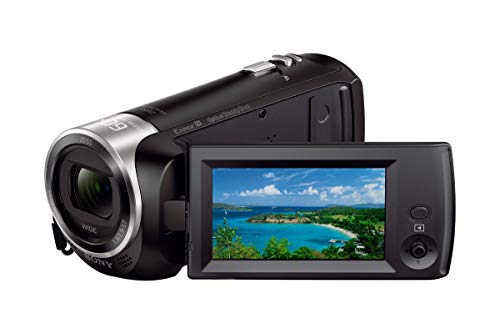
Sony HDR-CX405 — Best budget HD
The label comes first, because this guide’s honesty rule demands it: the CX405 records HD, not 4K. Its ceiling is 1080p, and everything good in this review lives under that ceiling. What it offers for a youth-football price is a 30x optical zoom — the longest reach in this guide, reaching the far corner of a youth field from any parent’s perch — Sony’s SteadyShot stabilisation in its standard form, and a body so light and simple that the team parent who drew filming duty can be competent with it by the second series.
Youth football is its natural habitat for reasons beyond price. The fields are smaller, the film’s purpose is memory and basic coaching rather than recruiting crops, and HD on a family television looks exactly like what it is: sharp, colourful, sufficient. The 30x zoom covers a youth field’s whole geography from one spot, the battery sips rather than gulps, and the camera’s simplicity — few modes, fewer mistakes available — is a feature when the operator is also watching their own child play. It doubles happily as the family’s general camcorder for the other eleven months.
The ceiling’s consequences should still be read before buying. Without 4K there is no film-room crop: the frame you shoot is the frame you study, so the operator must zoom with intent during the play rather than fixing it Monday. Low light is the weakest here — dusk practices and dim fields will show the small sensor’s limits — and the feature set has no streaming or companion-angle tricks. As the budget route for youth and casual football, it is recommended warmly; as a varsity programme camera, it would be a false economy this guide will not sign.
- Recording: Full HD 1080p — no 4K, stated as the pick’s defining limit
- Zoom: 30x optical, the longest reach in this guide
- Stabilisation: Sony SteadyShot, standard form
- Body: the lightest and simplest camera here
- Media and power: economical cards and battery for casual use
- Role: youth football and family filming duty
Strengths
- 30x reach covers a youth field from any seat in the house.
- Simplicity makes a conscripted parent competent immediately.
- The price leaves budget for the tripod that improves any camera.
Trade-offs
- HD only — no cropping into plays during film study.
- Low-light performance is the weakest in this guide.
- No streaming, time stamp or multi-angle features for programmes.
Best for: youth-league families and casual filmers who need reach, simplicity and memories in HD at the gentlest price here. Not suited for: varsity programmes, recruiting reels or any film room that crops — step to the AX43A or G70 and the workflow changes class.
Its second career deserves the last word in this review: the family camera. The same simplicity and reach that serve a youth sideline serve school plays, holiday mornings and grandparents’ visits, and a budget pick that earns its keep twelve months a year is easier to justify than a specialist that sleeps between seasons. Buy it as the household’s camera that specialises in autumn Saturdays, and the HD ceiling reads as sensible budgeting rather than compromise — which, at this level of the sport, is exactly what it is.
How Do You Film a Game So Monday’s Session Actually Works?
The protocol experienced film crews teach is short enough to tape to the tripod. Settle the frame before the offense breaks the huddle: the all-22 width, the line of scrimmage placed a third up the frame, focus and exposure locked or at least supervised so the camera does not hunt as the light changes. Follow the play’s flow rather than its ball-carrier — a pan that keeps the formation’s edges in frame until the whistle. Between plays, and only between plays, reframe for the next snap. The discipline sounds passive and is anything but: it is the difference between film a coach can teach from and footage of somebody watching football through a camera.
Halftime and between games are the crew’s working minutes. Swap media before a card forces the issue, rotate a battery that the cold has been quietly taxing, wipe the front element whether it looks fogged or not, and confirm the stream’s audio survived the band. Programmes that build these rituals into the job get a whole season of unbroken film; programmes that improvise them get a highlight package of the games where nothing went wrong. The cameras in this guide were chosen to make the rituals easy — accessible media, honest battery doors, controls that work with gloves — because a filming protocol is only as good as the hardware’s willingness to be serviced in the dark.
What Changes Between Youth, High-School and College Filming?
Youth football is filmed by family, for memory, on smaller fields with shorter games — the CX405’s whole world, where reach and simplicity outrank resolution and the correct camera is the one a different parent can operate each week without a tutorial. High-school football adds the two professional pressures that reshape this guide: the coaching film, with its all-22 discipline and Monday deadline, and the recruiting clip, where a player’s prospects ride on footage that must be steady, legible and honestly framed. That is the level the 4K picks serve, and the level where a programme’s camera stops being a purchase and becomes infrastructure.
College and semi-professional filming professionalises the pipeline rather than the picture: multiple synced angles, staff roles for filming and logging, and delivery systems that feed a building full of coaches by morning. The cameras here still appear in that world — as end-zone units, practice cameras and travel backups — which says something useful about their durability. But the honest guidance for a programme climbing levels is to buy for the level you are at, in the order this guide presents: one great wide-shot camera first, the streaming and companion-angle tools second, and the multi-angle apparatus when the staff exists to run it.
Reach, Steadiness and Workflow: the Six Compared for Friday Night
| Camera | Recording | Optical zoom | Stabilisation character | Signature football tool |
|---|---|---|---|---|
| Sony FDR-AX53 | 4K UHD | 20x | Optical float — steadiest handheld | All-round programme workhorse |
| Panasonic HC-VX981K | 4K UHD + HDR | 20x | Hybrid correction | Phone as wireless companion angle |
| Canon VIXIA HF G70 | 4K UHD | 20x | Optical, programme-grade | Time stamp and USB streaming |
| Panasonic HC-WXF991K | 4K + HDR | 20x Leica | 5-axis hybrid | Built-in second camera plus EVF |
| Sony AX43A | 4K UHD | 20x | Optical float, compact form | Travel-ready 4K steadiness |
| Sony HDR-CX405 | Full HD only | 30x | Standard SteadyShot | Longest reach at the lowest price |
The table’s lesson is that zoom numbers tie at 20x across the 4K field, so the decision moves to the columns beside it: how steady the reach is, and which signature tool matches your programme’s Monday. The CX405’s 30x stands alone and so does its HD ceiling — both facts belong in the same sentence whenever it is recommended.
How Should a Recruiting Reel Change What You Film?
Recruiting footage obeys different rules from coaching film, and the camera operator who knows which reel is being shot serves the player better. College staffs want full plays at game speed, from an angle where the prospect’s assignment and technique are legible, with the jersey identifiable and the context honest — a tackle filmed only in isolation drills tells them less than one series of ordinary plays from the wide shot. The practical workflow most programmes settle on is therefore two products from one night: the all-22 master for the coaches, and a prospect cut assembled from it, supplemented by a tighter companion angle at the games that matter most.
That workflow is another argument for the 4K picks’ crop headroom: a prospect isolated from the wide master in post retains enough resolution to evaluate, sparing the operator the impossible choice of which player to follow live. It is also an argument for restraint in editing — recruiters have watched thousands of reels and discount the ones cut like trailers. Steady, honest, complete plays, filmed on the steadiest camera the programme owns: that is the entire formula, and it is why this guide ranks stabilisation alongside resolution rather than beneath it.
What About Sound, Streams and the People Watching at Home?
A school stream is a broadcast to grandparents, alumni and parents on work trips, and its failures are almost never photographic. They are audio failures — wind across the microphone, a PA speaker blaring into the camera’s position, commentary recorded at a whisper or a shout — and continuity failures, where the stream dies in the third quarter because a battery, a cable or a hotspot gave up. The cameras here with streaming paths and accessory shoes exist to make the fixes physical: an external microphone under a windscreen, positioned away from the PA, and power planned for four quarters plus the freshman game that ran long.
Programmes that stream well share a staffing insight: the camera operator films, and a second person — often a student, learning a genuinely useful trade — produces: watching levels, updating the score graphic, and guarding the stream’s health. Every camera in this guide can be the picture half of that arrangement; the Canon simply arrives with the most of the pipeline already inside the body. Treat the stream as a programme with an audience rather than a camera with a cable, and the audience stays to the final whistle.
What Do Football Film Crews Most Often Get Wrong?
The commonest error is filming the ball instead of the play. New operators chase the runner with the zoom at full extension, producing a seasick close-up from which nothing can be coached. The discipline the pros teach is the opposite: frame the formation before the snap, hold the wide shot through the whistle, and let the 4K crop do the chasing on Monday. Every camera in this guide was chosen partly for how well it supports that discipline — steadiness and resolution in service of a wide, patient frame.
The second error is audio neglect at streamed games. A stream with clean picture and wind-blasted, unintelligible sound loses its audience by the second quarter; a windscreen on the microphone, a position sheltered from the press-box PA speaker, and levels checked during the band’s warm-up are the unglamorous fixes. Third is power optimism: a freshman game that runs long, a cold night that shortens batteries, and a varsity kickoff filmed on a quarter charge is a story every programme tells once. Spares are cheaper than the apology.
A fourth error hides in the archive rather than the filming: unlabelled, unbacked-up footage. A season of film on a single drive in a desk drawer is a season one accident away from folklore, and the programmes with real archives name files by date, opponent and angle the night they are shot, keep the coaches’ copy and a second copy in different buildings, and treat the stream recording as a backup rather than the master. The cameras here all record to inexpensive, swappable media precisely so that discipline is cheap to keep; the only expensive version is learning why it matters after a drive fails in playoff week.
Finally, do not let the highlight reel eat the coaching film. The temptation to zoom tight for dramatic clips is constant, especially with a prospect’s family asking — but the programme’s film is the wide shot, and the correct answer is a companion angle for highlights, which is precisely what the Panasonics’ multi-scene tricks and the twin-camera body exist to provide from a single operator.
Does the Same Camera Cover Practice, 7-on-7 and the Off-Season?
Programmes film far more practice than games, and the camera that only suits Friday night is half a purchase. Practice filming is a different discipline: closer distances on a drill field, a tower or lift behind the offense, and an emphasis on repetition — the same route run six times, the same drill from two heights — where the operator’s zoom works constantly rather than holding a wide frame. The picks here divide naturally across that work too: the compact Sony follows a position group through individual drills, the Canon’s time stamp keeps a timed testing day honest, and the Panasonics’ companion angles let one coach film a drill and its reaction simultaneously.
Summer 7-on-7 and camp season add heat, dust and travel to the specification. Games run back to back on adjacent fields, batteries cycle constantly, and the footage’s purpose shifts toward evaluation and recruiting — tighter framing, individual matchups, and clips destined for a prospect’s profile rather than a playbook. This is the CX405’s honest ceiling moment and the AX43A’s finest hour: compact, steady, present for every rep. A programme choosing one camera for the whole calendar, rather than for September alone, should weight these paragraphs as heavily as the Friday-night sections — the season is long, and most of it is not played under lights.
Final Recommendation
Most buyers should start with the Sony FDR-AX53: its stabilisation forgives the perches real football offers, and its 4K frame feeds the film room all season. Programmes building a pipeline rather than a camera bag should take the Canon G70 for its time stamp and streaming, and solo operators who must return finished, contextual film should stretch to the twin-camera Panasonic. Parents should choose between the AX43A’s portable 4K and the CX405’s honest HD by the age of the football in front of them. Friday nights are filmed by whoever shows up with a charged battery — pick the camera your programme will actually carry up the bleachers, and the season will be on film.
Frequently Asked Questions
Is 4K really necessary for high-school football film?
For the highlight reel, no — HD looks fine on a phone. For the coaching film, it has become the practical standard, because the all-22 wide shot in 4K can be cropped in study while keeping numbers and assignments readable, which HD cannot survive. Programmes that film only for memories can save with the CX405; programmes that film to coach should treat 4K as the entry point, which is how this guide’s picks are ordered.
Where is the best place to film from?
As high and as close to midfield as the venue allows, on the side opposite the sun for day games. Elevation converts a tangle of helmets into readable assignments, and midfield minimises the extreme zoom distances the far corners demand. End-zone positions serve specific purposes — line play, kicking, and the recruiting angle for linemen — and pair with a midfield camera when a programme can staff two.
Can one camera handle both the coaching film and the live stream?
Yes, and the Canon G70 is this guide’s pick for exactly that double duty, with USB streaming that needs no capture card. The discipline it demands is operational: the stream wants the same wide, steady frame the coaches want, which happily aligns — but assign one person to the stream’s audio and graphics rather than asking the camera operator to produce a broadcast mid-play.
How long a zoom do I need for the far side of the field?
The 20x optical zooms across this guide’s 4K picks are the established answer — they hold individual matchups legibly from press-box distance, which is the longest routine shot in the sport. Beware digital zoom figures in the hundreds printed on boxes; they describe cropping, not reach. The CX405’s 30x optical is genuinely longer and genuinely useful on youth fields, where its HD ceiling matters less.
What tripod and head should a programme buy first?
A fluid video head on legs rated well above the camera’s weight — the head is where the all-22 pan is made, and a cheap head’s stick-slip hesitation appears in every single play, all season. Height matters after smoothness: a tall tripod or a small platform that lifts the camera above the fence line and the standing crowd transforms a sideline position. Buy the head before the second camera; programmes consistently report it as the upgrade their existing footage felt most.
How do I keep footage steady without a tripod?
Brace like a photographer and lean like a local: elbows into the body, the camera’s strap or your own stance triangulated against a rail or a seat back, and breathing settled before the snap. The stabilised bodies in this guide — the Sonys above all — forgive a great deal of the rest. What no stabilisation forgives is walking while filming or standing in a bouncing row; relocate two rows to the aisle’s edge and the footage improves more than any setting could achieve.
What settings should a new operator start with?
Keep it simple until the protocol is second nature: the camera’s intelligent auto or a supervised program mode, stabilisation on, zoom worked slowly and deliberately, and the widest framing that still fills the sensor with the formation. Lock exposure once the stadium lights settle if the body allows it, because auto-exposure hunting between a bright field and a dark crowd is the amateur tell in otherwise good film. Add manual refinements one at a time across the season — the footage improves in step with the operator, which is the natural order of a film programme.
Should a programme buy one premium camera or two mid-range ones?
Two angles beat one perfect angle for almost every programme purpose: the wide master plus an end-zone or field-level camera produces coaching film, recruiting material and a watchable stream simultaneously, and provides insurance when one unit fails mid-game. The exception is the solo parent, for whom one steady camera — the AX53 — outperforms two shakier ones. Buy the companion angle when the staff to run it exists; an unmanned premium camera films nothing at all.
Can a student crew really run this equipment?
Yes — school film crews are the norm, not the exception, and the cameras here were judged partly on how teachable they are. The working model is a short August training: one session on the filming protocol, one on the halftime servicing ritual, and a supervised scrimmage before the games count. The Canon’s programme layout and the Sonys’ automation are the most forgiving for rotating crews; the feature-dense Panasonic rewards a smaller, stable crew that keeps the same hands on it all season.
Camcorder or mirrorless camera for football?
For this specific job, the camcorder’s case is stronger than fashion suggests: power-zoom lenses with football-length reach built in, recording endurance measured in games rather than clips, no overheating drama across a double-header, and controls designed for one job. A mirrorless camera films beautifully and serves stills too, but matching a camcorder’s zoom range means a long, costly telephoto, and its recording limits and heat manners need managing. Programmes film on camcorders for the same reason they practise in pads — the equipment is shaped by the sport.
How much battery and storage does a game actually take?
Plan for more than the game. A full varsity contest with warm-ups, halftime atmosphere and post-game handshakes can run past three hours of attendance and well over an hour of recorded plays; double-headers double it. Carry battery capacity for the whole evening rather than the headline game, and media with a third to spare — 4K files from a full night are measured in tens of gigabytes, and the card you fill in the fourth quarter is the one holding the winning drive.
What about filming in rain and cold?
All six bodies will work a cold night with warm spare batteries rotated through them; none should be trusted in rain without a cover. A dedicated rain cover or even a carefully managed plastic shield, a lens cloth in a dry pocket, and the discipline to wipe the front element between series are the difference between a filmed fourth quarter and a fogged one. Sleet in November has ended more seasons of film than any camera defect in this guide.
Related Guides
Football filming grows into a small production discipline, and our neighbouring guides cover its other half. Programme streamers should read our guide to the best cameras for live streaming school sports next, highlight editors will want our roundup of the best camcorders for youth sports for the younger game, and anyone building the full kit should finish with our selection of the best tripods and video heads for sports filming.



[…] quickly beyond bodies, and our neighbouring coverage follows it. Lens shoppers should continue to our guide to the best wide-angle lenses for Milky Way photography, technique builders to our walkthrough of star trackers and how to choose one, and […]
[…] cameras for sports photography for the modern counterpoint, glass shoppers should continue to our roundup of the best telephoto lenses for trackside work, and technique builders can finish with our masterclass on panning and motorsport camera craft […]