What's inside
- Key Takeaways
- Quick Picks
- How Were Compact Underwater Cameras Judged?
- Why Does Water Rewrite Every Camera Rule You Know?
- How Do You Actually Film Underwater Without Ruining the Dive or the Footage?
- When Does a Video Light Stop Being Optional?
- How Does the Advice Change for Snorkellers, Freedivers and Scuba Divers?
- What Should You Practise at the Surface Before the First Real Dive?
- How Do You Edit Underwater Footage Without Making It Look Artificial?
- What Does Ownership Look Like After a Season of Salt Water?
- How Should a Beginner’s First Underwater Season Be Planned?
- Why Do Filters, Trays and Grips Matter More Than Their Size Suggests?
- What Does Cold Water Change?
- Depth, Light and Sensor: Six Cameras in the Water
- What Do Underwater Buyers Most Often Get Wrong?
- Final Recommendation
- Frequently Asked Questions
- Related Guides
As an Amazon Associate I earn from qualifying purchases. This post may contain affiliate links at no extra cost to you.
gizmoverdict.com is reader-supported. When you buy through links on our site, we may earn an affiliate commission.
Where to buy: One pick below — the Insta360 X4 — is discussed without a purchase link, deliberately: the standard-bundle listing returned when this guide’s pool was verified was a Renewed unit, so the camera is reviewed on its merits and left for you to source carefully. Every other pick links to the verified listing named in its review, and depth figures in this guide are stated per camera, because “waterproof” on this page means anything from a snorkel’s depth to a wreck diver’s.
Water is where camera specifications go to be humbled. The best compact underwater video cameras are not simply action cameras with a depth number; they are machines that must keep shooting when the light turns green and dim, when the subject is a turtle that did not agree to pose, and when the person holding the camera is also managing buoyancy, a buddy and a finite tank of air. This guide covers the compact end of that world — snorkellers, freedivers, holiday divers and kayakers — and it is organised around a truth the marketing prefers to blur: the right camera depends entirely on how far below the surface your filming actually happens.
So the depth ratings in this guide are stated plainly and per model, because they divide the list into different instruments. The action cameras are waterproof to snorkelling and shallow-diving depths as bare units — roughly ten to twenty metres depending on the model — and go deeper only inside housings. The OM SYSTEM Tough TG-7 is a stills-first tough camera rated to fifteen metres that also shoots 4K video: a snorkeller’s and rockpooler’s camera, not a dive-action instrument, and it is framed that way below. The SeaLife is the opposite philosophy — a permanently sealed dedicated underwater camera rated far deeper than any recreational diver will go, which never needs a housing at all. And the prose-only X4 brings 360-degree reframing to the shallows. Six cameras, four philosophies; the reviews sort them by the water you actually enter.
Light is the second dividing line. Water drinks colour in order — red first, gone within a few metres — so underwater footage lives or dies on sensor sensitivity, colour correction and, past snorkelling depth, artificial light. That is why this guide includes a camera-plus-light set as a first-class idea rather than an accessory afterthought, and why low-light performance earns one pick its badge outright.
Key Takeaways
- Depth ratings divide this list into different instruments — read each model’s figure rather than trusting the word waterproof.
- The GoPro and DJI are the dive-capable action cameras; the TG-7 is a 15-metre stills-first tough camera for snorkelling that also shoots 4K.
- The SeaLife Micro 3.0 is permanently sealed and rated to 60 metres, so it never needs a housing or O-ring ritual.
- Colour disappears with depth, red first — past a few metres, a video light matters more than another resolution step.
- The Insta360 X4 is prose-only here because its checked standard-bundle listing was a Renewed unit; it is reviewed without a link.
- Bare action cameras reach their depth limits quickly — a housing is a planned purchase for divers, not an optional extra.
Quick Picks
| Pick | Badge | Why it earns its place |
|---|---|---|
| GoPro HERO13 Black | Best overall | 5.3K video, the deepest accessory and housing ecosystem, and handling every diver already knows. |
| DJI Osmo Action 5 Pro | Best low light | A large sensor that holds colour and detail as the light fails, with a 20-metre bare depth rating. |
| Insta360 Ace Pro 2 | Best image quality | 8K capture and a Leica-engineered lens deliver the sharpest footage here in good light. |
| OM SYSTEM Tough TG-7 | Best for snorkelling and macro | A 15-metre tough stills camera with remarkable macro modes that also records 4K on the surface world. |
| SeaLife Micro 3.0 | Best dedicated underwater camera | Permanently sealed to 60 metres with controls designed for gloved, underwater hands. |
| Insta360 X4 (prose-only) | Best 360 reframing | Reviewed without a link — its checked standard-bundle listing was a Renewed unit — for 8K 360 video in the shallows. |
How Were Compact Underwater Cameras Judged?
The judging weighted four things in the order the water imposes them. Depth integrity came first: the bare-camera rating, the housing route beyond it, and the sealing philosophy — a camera that cannot survive your actual depth is not a worse camera, it is no camera. Image behaviour underwater came second, meaning sensitivity as light fails, colour handling in green and blue water, and stabilisation that copes with surge and a finning shooter. Third came underwater operability: controls that work with cold, gloved hands, screens readable in bright surface light, and menus that do not need adjusting at depth. Fourth, and honestly least, came surface specifications — headline resolution and frame rates — because a turtle at eight metres in flat light does not care about any of them.
Two framing decisions shaped the list and are stated openly. The TG-7 is included as the snorkelling and macro specialist, not miscast as a dive camera; its stills heritage is treated as its strength. And the X4 is included as a prose-only pick because 360 reframing is a genuinely different creative tool that readers ask about — but the renewed-listing finding is stated wherever it appears, and no link is offered. A guide that hides either fact would be easier to write and worse to use.
Why Does Water Rewrite Every Camera Rule You Know?
Because water is a filter, a dimmer and a lens all at once. It absorbs colour by wavelength — reds vanish within the first few metres, oranges and yellows follow, until the world is rendered in the blue-green that remains — which is why uncorrected footage from depth looks like it was shot through aquarium glass, and why the experienced underwater videographer’s kit list runs: camera, then light, then everything else. It dims fast, too; even tropical noon at fifteen metres is a low-light problem wearing a bright disguise, which is why sensor size keeps appearing in these reviews. And it refracts, narrowing fields of view and magnifying subjects, so the ultra-wide lenses that feel excessive on land become the correct working tools below it — you shoot close, because close is where the colour and clarity live.
The working technique follows from the physics. Get nearer than instinct suggests. Keep the sun behind you and shoot slightly upward toward the light for silhouettes and drama, or level for portraits of reef life. Move slowly enough that the stabilisation and your buddy both forgive you. Every camera below can produce beautiful footage inside those rules; none can repeal them, and the reviews are written accordingly.

GoPro HERO13 Black — Best overall
The HERO13 Black is the default underwater action camera for reasons that compound. Its 5.3K video at up to 60 frames per second is the sharpest mainstream footage in the class, its HyperSmooth stabilisation has been refined across more generations of real dives than any rival system, and the camera is waterproof to ten metres as a bare unit — snorkelling, surfing, kayaking and shallow reef territory — with GoPro’s protective housing extending that to proper recreational diving depths. Around the camera stands the deepest accessory ecosystem in this guide: housings, filters for colour correction at depth, mounts, lights and trays, all designed for this exact body shape and available everywhere divers travel.
The HERO13 generation added a thoughtful trick for underwater shooters: compatibility with GoPro’s HB-series interchangeable lenses, including ultra-wide and macro options that change what the camera can frame without changing cameras. Battery behaviour is the line’s modern strength — the Enduro battery chemistry handles cold water better than the generations that made divers carry spares in their wetsuits — and the dual screens keep framing honest when the camera is on a tray or a pole. Voice control, wet hands permitting, and the familiar two-button logic mean the camera asks little attention at depth, which is precisely the virtue a diver needs from it.
The honest limits: ten metres bare is a snorkelling rating, not a diving one, so scuba shooters must budget the housing from day one; the touchscreen is unusable underwater, leaving physical buttons and pre-set modes as your interface at depth; and low-light footage, while improved, still cedes the twilight wreck to the DJI below. As the complete, supported, everywhere-serviceable answer for compact underwater video, though, it remains the camera this guide recommends first and the benchmark the others are measured against.
- Video: 5.3K up to 60fps; high-frame-rate 4K and 2.7K modes
- Depth: 10 metres bare; deeper via the protective housing
- Stabilisation: HyperSmooth, the class’s most mature system
- Lenses: HB-series interchangeable lens compatibility, including macro and ultra-wide
- Ecosystem: The deepest range of housings, filters and mounts here
Strengths
- Sharpest mainstream footage with stabilisation proven over generations
- Accessory and housing support available anywhere divers gather
- Lens options extend the same body from reef-wide to macro
Trade-offs
- Bare depth rating covers snorkelling; divers need the housing
- Touchscreen is unavailable underwater, so modes are set at the surface
- Low-light performance trails the DJI’s larger sensor
Best for: snorkellers and divers who want the supported, expandable default with a housing path to depth
Not suited for: divers unwilling to buy a housing who need deep ratings from the bare camera

DJI Osmo Action 5 Pro — Best low light
The Osmo Action 5 Pro’s case is written in its sensor size. A 1/1.3-inch sensor — large for this class — gathers the light that water steals, and the result is footage that holds colour, detail and dignity at depths and dusk conditions where smaller-sensor rivals smear into noise. DJI rates the bare camera to twenty metres, double the GoPro’s bare figure, which moves a meaningful band of recreational reef diving inside the no-housing zone. Its 4K recording reaches 120 frames per second for slow-motion of fast marine life, subject tracking keeps a chosen subject framed, and dual OLED touchscreens — bright, and usable with the wet-surface tolerance divers need at the surface — make it the friendliest interface here.
Practical design runs deep in this camera. Internal storage of 47GB means a forgotten card is an inconvenience rather than a cancelled dive. Battery endurance is the class’s strong suit, rated in hours that survive a two-dive day, and the quick-release mounting system it shares with its predecessor makes moving between tray, pole and helmet a one-handed job. Colour science deserves a mention: DJI’s 10-bit colour modes give the editor real material to correct the blue-green cast with, which is where underwater footage is actually won.
Against the GoPro it concedes ecosystem depth — fewer third-party housings, filters and trays, though the essential ones exist — and its headline resolution stops at 4K where the GoPro offers 5.3K. Judge the trade by your water: bright, shallow and accessory-hungry favours the GoPro; deeper, dimmer and colour-critical favours this camera, whose badge here is the most literally earned in the guide.
- Sensor: 1/1.3-inch, the low-light advantage of the class
- Video: 4K up to 120fps with 10-bit colour modes
- Depth: 20 metres bare — the deepest action-camera rating here without a housing
- Storage: 47GB built in, plus card slot
- Screens: Dual OLED touchscreens, front and rear
Strengths
- Footage that survives depth, dusk and cave-shadow better than rivals
- Twenty-metre bare rating covers much recreational reef diving directly
- Internal storage and long battery life suit full dive days
Trade-offs
- Accessory ecosystem is thinner than GoPro’s
- Maximum resolution is 4K rather than 5.3K
- Serious depth still requires its housing, like every action camera
Best for: divers filming in dimmer water who want colour that survives the descent
Not suited for: accessory collectors who want every mount and filter ever made
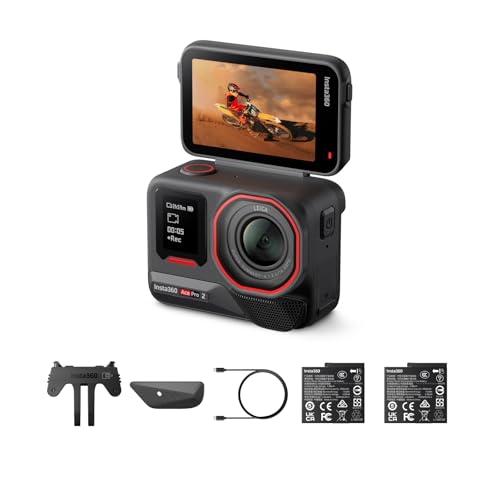
Insta360 Ace Pro 2 — Best image quality
The Ace Pro 2 is the image-quality maximalist of the group: a 1/1.3-inch sensor behind a Leica-engineered lens, recording 8K video at up to 30 frames per second and 4K at up to 120, with a flip touchscreen that makes it the only action camera here that frames a surface vlog and an underwater scene with equal ease. In bright, shallow water — the snorkelling reefs, the sunlit wrecks, the pool — its footage is the sharpest and most detailed in this guide, and its PureVideo low-light mode narrows the DJI’s advantage more than any rival manages. This listing is the dual-battery bundle, which suits a camera whose top modes are thirsty.
Underwater manners are considered. The bare camera is rated to twelve metres — snorkelling and shallow reef depth — with a dive case available for the full recreational range. Insta360’s colour tools include an underwater mode that begins correcting the blue-green cast in camera, and the flip screen, useless submerged like all touchscreens, is a genuine surface asset for the boat-side pieces to camera that travel videos are stitched together from. The dual AI chip branding translates, in practice, to responsive processing of its high-resolution modes without the hesitations older action cameras showed.
The reservations are heat, appetite and ecosystem. Sustained 8K recording is a fair-weather, shorter-take affair; the batteries work harder than the DJI’s; and the accessory shelf, while growing, does not match GoPro’s. Buy the Ace Pro 2 when your water is bright and your priority is the finest footage the class can record — the snorkel guide filming for a channel, the freediver working sunlit walls — and accept the dive case as the price of taking that quality deeper.
- Sensor: 1/1.3-inch with a Leica-engineered lens
- Video: 8K up to 30fps; 4K up to 120fps
- Depth: 12 metres bare; dive case for greater depths
- Screen: 2.5-inch flip touchscreen for surface framing
- Listing: Dual-battery bundle, suited to its high-resolution modes
Strengths
- Finest detail and sharpness here in bright, shallow water
- Low-light processing mode keeps it competitive after sunset shallows
- Flip screen makes it the best surface-and-underwater hybrid presenter
Trade-offs
- Top modes are battery-hungry and heat-conscious on long takes
- Dive case required beyond snorkelling depths
- Smaller accessory ecosystem than GoPro’s
Best for: snorkellers and freedivers publishing footage where image quality is the channel’s signature
Not suited for: long-take divers who prize endurance over resolution

OM SYSTEM Tough TG-7 — Best for snorkelling and macro
The TG-7 needs its framing stated before its virtues, because it is a different species from the action cameras around it: a stills-first tough compact, waterproof to fifteen metres, freezeproof and crushproof, which also records 4K video. As a snorkelling camera it is superb and as a dive-action camera it is not a contender — fifteen metres is snorkel and shallow-reef territory, and its video, while perfectly good, is a feature of a photographer’s camera rather than the purpose of a videographer’s. Judged in its true role, it earns its place outright, because no action camera in this list can touch what it does at the small end of the underwater world.
That specialism is macro. The TG-7’s microscope modes focus to within a centimetre of the lens, turning a rockpool’s anemones, a nudibranch on a reef, or a hermit crab’s portrait into frame-filling subjects without accessory lenses, and its underwater modes — including dedicated macro and wide settings with colour tuned for the shallows — show two decades of Olympus and OM SYSTEM refinement of exactly this niche. As a stills camera it shoots RAW, its lens is bright for its class, and its toughness extends to the beach realities action cameras ignore: dropped on rock, frozen in a ski jacket, sat on in a boat.
For video-led buyers the limits are the review’s duty to state: 4K without the action cameras’ frame-rate depth or stabilisation sophistication, controls designed for photographers, and that fifteen-metre ceiling with no housing path to serious depth in the way the action cameras offer. Buy the TG-7 if your underwater life is snorkelling, rockpools, tide lines and macro wonders, with video as the supporting act. If your life is scuba and motion, the cameras above and below it are your list.
- Sensor: 12-megapixel stills sensor; 4K video as a supporting mode
- Depth: 15 metres — snorkelling and shallow reef, not a dive-action rating
- Toughness: Freezeproof, crushproof and dustproof beyond the camera’s water rating
- Macro: Microscope modes focusing to about a centimetre
- Stills: RAW capture, the strongest stills specification in this guide
Strengths
- Macro capability no action camera here approaches
- Toughness for beaches, boats and rockpools beyond mere waterproofing
- Proper stills camera for the surface half of a trip
Trade-offs
- Fifteen-metre ceiling rules out scuba use
- Video is a secondary mode beside the action cameras’ systems
- Controls and menus are a photographer’s, not a videographer’s
Best for: snorkellers, rockpoolers and macro lovers who shoot stills first and video second
Not suited for: scuba divers seeking a primary underwater video camera
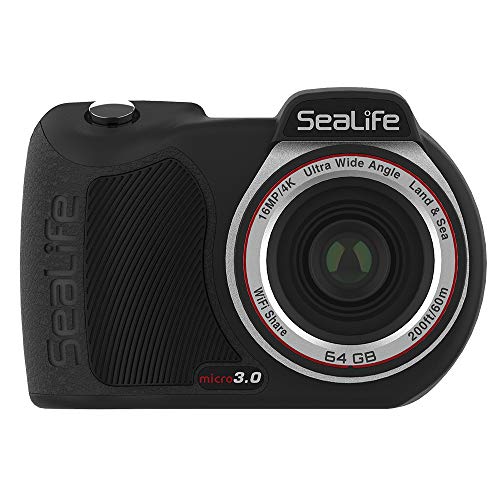
SeaLife Micro 3.0 — Best dedicated underwater camera
The Micro 3.0 is what happens when a camera is designed by divers instead of adapted for them. It is permanently sealed — there is no housing, no O-ring to grease, no door whose grain of sand floods the camera — and it is rated to sixty metres, beyond recreational limits, in its bare and only form. Its controls are large, piano-key buttons made for gloved hands and cold fingers; its menus are a short list of underwater decisions rather than a phone’s worth of settings; and its colour modes are tuned for water first and land second. For the diver who wants to think about the dive and let the camera be simple, nothing else in this guide is built the same way.
The imaging is competent and honest: a 16-megapixel sensor recording 4K video, with a wide lens suited to reef scenes and the close-focus, get-near discipline underwater photography teaches. SeaLife’s ecosystem is the diver’s version of support — trays, handles and its Sea Dragon lights mount directly, and the natural upgrade sits inside this very pick’s family: the SeaLife Micro 3.0 Pro Light Set bundles this same camera with the Sea Dragon 3000 light, case and grip, which is the configuration this guide recommends for anyone filming past a few metres, where the light stops being an accessory and becomes the image. Buy the bare camera for bright shallows; buy the set for real diving.
The trade-offs are the inverse of its virtues. Permanently sealed means the battery is internal and the camera is a single sealed unit for life; the screen and interface are divers’ tools rather than a creator’s studio; and on land it is outclassed by everything else here. It is also a considered purchase rather than an impulse one. But for its purpose — a camera that lives in a dive bag, survives every trip, and never once asks whether the housing was closed properly — the Micro 3.0 occupies ground none of the action cameras can take from it.
- Sensor: 16-megapixel, with 4K video
- Depth: 60 metres, permanently sealed — no housing exists or is needed
- Controls: Large piano-key buttons for gloved hands
- Storage: 64GB internal in this configuration
- Upgrade path: Pro Light Set variant adds the Sea Dragon 3000 light, case and grip
Strengths
- No housing, no O-rings, no flood anxiety — sealed for its whole life
- Depth rating beyond recreational limits as the bare camera
- Controls and menus designed underwater, for divers, first
Trade-offs
- Internal battery and sealed unit cannot be serviced or swapped in the field
- Surface and creator features trail the action cameras
- Needs the light set to shine past shallow, bright water
Best for: scuba divers who want a dedicated, flood-proof camera that lives in the dive bag
Not suited for: surface creators who need flip screens, apps and land-first features
Insta360 X4 — Best 360 reframing (prose-only)
The X4 is included without a purchase link, and the reason belongs in the open: when this guide’s pool was verified, the standard-bundle listing for this camera was a Renewed unit, so the X4 is discussed on its merits and you should source it carefully — from a seller whose listing condition is explicit — rather than through a link we are not willing to stand behind. With that said plainly, the camera itself offers the one creative capability nothing else here has: 8K 360-degree video that captures everything around the diver and lets the framing be chosen afterwards, in the edit, from a sphere of footage.
For underwater work the reframing trick is more than a novelty. A diver cannot aim a camera and manage a dive at once; a 360 camera on a short pole records the turtle to the left and the buddy’s signal to the right in the same take, and the invisible-selfie-stick effect removes the pole from the frame entirely. The bare camera is rated to ten metres — snorkelling and shallow depths — with a dedicated dive case extending it to fifty metres for those who commit to the format. Its single-lens mode doubles as a conventional wide action camera at the surface.
The costs of the sphere are workflow and appetite. Reframing is an editing discipline of its own, the files are the largest in this guide, battery life is measured against two hungry lenses and sensors, and stitching lines can betray close subjects. Treat the X4 as a second camera for divers already served by a primary one in this list — or as a deliberate first camera for the creator whose entire format is reframed 360. Either way, buy it with your eyes open about the listing you choose, because the renewed-unit finding above is exactly the kind of detail that decides whether a purchase delights or disappoints.
- Video: 8K 360-degree capture; single-lens mode for conventional wide footage
- Depth: 10 metres bare; dive case available to 50 metres
- Signature: Reframe after the dive; the pole disappears from the shot
- Workflow: The largest files and the heaviest editing in this guide
- Status: Prose-only in this guide — checked standard-bundle listing was a Renewed unit
Strengths
- Captures everything, decides framing later — uniquely forgiving underwater
- Invisible-pole effect produces impossible-looking follow footage
- Dive case takes the format to full recreational depth
Trade-offs
- Reframing workflow is a real learning curve with very large files
- Battery life is the shortest here in its top mode
- No verified new listing in this guide’s pool — source it deliberately
Best for: divers and snorkellers whose format is reframed 360 footage and impossible angles
Not suited for: anyone wanting point, shoot and publish without an editing stage
How Do You Actually Film Underwater Without Ruining the Dive or the Footage?
Buoyancy first, footage second — the rule that keeps both safe. A camera, especially on a tray with lights, changes how you move in the water, and the divers who film well are the ones whose buoyancy was automatic before the camera arrived. Work close to subjects rather than chasing them; marine life tolerates a slow, predictable approach and flees a lunging one, and the footage improves in exact proportion to the animal’s calm. Keep clips short and deliberate — ten good seconds of a settled subject out-edit two minutes of pursuit — and surface with your buddy, your air and your manners intact, because no footage in this guide’s class is worth a bent rule of diving.
Camera craft underwater is mostly preparation done on the boat. Set the mode, the white balance approach and the frame rate before descent, because touchscreens stop at the surface and menus at depth are a tax on air and attention. Rinse every camera in fresh water after salt use — even the sealed SeaLife, whose buttons and lens deserve the salt removed — dry before opening anything with a door, and grease O-rings on housings with the religion of someone who has seen a flood. The cameras here are tough; the rituals are what make toughness a statistic rather than a hope.
When Does a Video Light Stop Being Optional?
Sooner than beginners expect. In clear tropical water at snorkelling depth, sunlight does the work and colour correction — in camera or in the edit — finishes it. Past roughly five metres, or under a ledge, or on a cloudy day at any depth, the reds the camera needs are simply not in the water any more, and no setting can record light that never arrived. A video light restores the spectrum at close range — which is why underwater technique insists on closeness — and the SeaLife Pro set’s inclusion in this guide’s pool is an acknowledgement that for divers, the light is half the camera. Action-camera shooters reach the same conclusion by the accessory route: a tray, two arms and one or two compact video lights, which is the point where a GoPro stops being a pocket camera and becomes a rig. Budget for that destination honestly if your diving is deeper than your snorkelling.
How Does the Advice Change for Snorkellers, Freedivers and Scuba Divers?
Snorkellers live in the best light and the worst stability: the surface chop that makes the shallows sparkle also bobs the camera, so stabilisation and a wide lens matter more than depth rating, and every pick here is rated for the job. The TG-7’s macro turns a snorkel over a rockpool into a safari; the Ace Pro 2’s detail flatters sunlit reefs; the GoPro’s ecosystem adds the floaty grips and filters a snorkelling kit actually uses. Freedivers add speed and silence to the brief — one breath, a descent, a subject that must not be startled — and they favour the compact bare cameras whose ratings cover their working depths without a housing’s bulk, with the DJI’s twenty metres covering most recreational freediving outright.
Scuba divers should read the list through the housing lens. Your camera is a system at depth: housing, tray, lights, and the discipline to run it all with task-loaded hands. That is the SeaLife’s home water and the housed GoPro’s; it is where the bare ratings stop mattering and the controls, the flood-resistance and the light take over the decision. A scuba buyer who chooses by headline resolution has answered a question the ocean did not ask. Choose by depth integrity and light, and the footage follows.
What Should You Practise at the Surface Before the First Real Dive?
Everything that is hard at depth is learnable in a pool or a calm bay, and an hour there is worth a holiday of fumbling. Practise changing modes with the physical buttons alone, eyes on an imaginary subject, until the sequence is muscle memory. Practise the rinse-and-open routine until it is boring. Film a patient friend, a pool’s lane markings, anything with edges, and review the footage for the two beginner signatures: horizon tilt from surge, and the constant slight zoom of a camera being pushed toward its subject rather than carried level. Both are technique, both are curable at the surface, and both are invisible to the person filming until the footage is reviewed — which is the argument for reviewing early and often.
Battery and storage drills belong in the same hour. Learn what a full card and a full battery actually hold in your chosen mode, at your water’s temperature, rather than trusting a rating measured in a laboratory. Divers plan gas; underwater videographers plan power and space with the same seriousness, because a camera that dies at the turtle is a story told at the bar instead of shown.
How Do You Edit Underwater Footage Without Making It Look Artificial?
The edit is where underwater footage is rescued or ruined, and restraint is the skill. White balance is the main lever: correct toward the memory of the scene — reef colours as your eye, adapted to the water, actually saw them — rather than toward a laboratory neutral that turns the ocean into a swimming pool. Resist the saturation slider’s invitation; water footage pushed hard goes cartoonish faster than any other kind, and the 10-bit files from the DJI and the colour modes across this list reward a gentle hand disproportionately. Cut on movement and behaviour rather than on scenery: a turtle’s turn, a school changing direction, a diver’s hand signal. Thirty seconds of behaviour outlasts five minutes of reef panorama in every audience ever assembled.
Sound deserves one honest paragraph. Underwater footage is essentially silent footage — bubbles, breathing, the occasional boat — and most finished pieces are carried by music or by the surface sounds of the day. Record the boat, the beach and the briefing with the same camera at the surface; your future edit will thank you for the texture. The cameras here all record usable surface audio, and the habit of gathering it is the cheapest production value in the genre.
What Does Ownership Look Like After a Season of Salt Water?
Salt is patient and undefeated; ownership of an underwater camera is a maintenance relationship. The rituals are short but absolute: soak and rinse in fresh water after every salt day, working the buttons during the soak so crystals leave the mechanisms; dry in shade, never in a sealed wet bag; inspect door seals and housing O-rings under good light, replacing them on schedule rather than on failure; and store the camera dry, open-doored where it has doors, with a silica pack for company. The SeaLife’s sealed design removes the O-ring chapter but not the rinsing one — salt crusts a lens as happily as it crusts a seal.
Budgeted honestly, ownership also includes the consumables and the spares that keep trips alive: O-ring kits and grease for housed cameras, spare batteries because cold water shortens every rating, a second card, and the anti-fog inserts whose absence has ended more dives than any electronic failure. None of it is expensive beside the camera; all of it is the difference between a system that survives its third season and a story about a flood in a forum. The divers whose footage fills this guide’s imagination are not the ones with the newest cameras — they are the ones whose five-year-old cameras still work, because the rituals were never skipped.
How Should a Beginner’s First Underwater Season Be Planned?
Start shallow and bright, where every camera here succeeds, and let the season teach the order of needs. A snorkelling month with any pick builds the approach technique and the editing eye; the footage will show you, personally and undeniably, whether your next want is light, reach, macro or depth — and that evidence is worth more than a month of reviews, including this one. Add one element at a time: the filter before the tray, the tray before the light, the light before the housing, so that each purchase answers a limitation you have actually met in the water.
Keep expectations honest about the learning curve. Underwater videography stacks a new skill on top of an existing one — diving or snorkelling competence — and the first season’s footage is tuition, not portfolio. The cameras in this guide were chosen so that none of them becomes the bottleneck during that tuition: each can grow with its owner for several seasons, by accessory or by role. Buy the one matched to your water today, film everything, and let the ocean set the syllabus.
Why Do Filters, Trays and Grips Matter More Than Their Size Suggests?
The accessory layer of underwater video is unglamorous and decisive. A red or magenta correction filter, matched to salt or fresh water, restores at the lens a share of the colour the water removed — most effective in the five-to-fifteen-metre band where there is still spectrum left to rebalance, and the cheapest image improvement a housed or bare action camera can be given. A tray with two handles transforms stability more than any electronic system can, because it gives the camera a base the surge moves as one unit, and it provides the mounting points the light will eventually occupy. A wrist lanyard or coil, costing almost nothing, is the difference between a dropped camera being a scare and being a donation to the reef.
The order of purchase matters and mirrors the lighting argument: grip and tray first, because stability improves every frame from every camera; filter second, for the mid-depth band; light third, when your diving outgrows the sun. Each step is a modest spend against the camera’s price, and together they describe the real shape of an underwater video hobby — the camera is the seed, not the tree. The GoPro’s ecosystem leads on exactly this layering, the SeaLife builds it into its own family, and the DJI and Insta360 shelves cover the essentials; no pick here strands its owner at the first accessory.
What Does Cold Water Change?
Cold water is the quiet specification-killer of this category. Battery chemistry slows as temperature falls, so the endurance figures earned in tropical reviews shrink in a temperate lake or a northern sea — sometimes dramatically — and the practical defences are the diver’s ones: start with a warm, full battery, keep the camera inside your exposure suit’s warmth between dives where the design allows, and carry the spare as a plan rather than a hope. Cold also thickens the water’s green and shortens the light’s reach, which pushes the low-light argument toward the DJI and the lighting argument toward the SeaLife set sooner than a tropical reader would guess.
Handling changes with the temperature, too. Thick gloves turn every small control into a negotiation, which is where the SeaLife’s piano keys and the action cameras’ two-button logic earn their keep, and where touchscreen-dependent habits formed at the surface quietly die. If your water is cold for most of the year, weight those handling judgements in the reviews above as heavily as the image ones; a camera you cannot operate in gloves is a camera you do not own in February, whatever its sensor can do.
Depth, Light and Sensor: Six Cameras in the Water
| Pick | Bare depth | Top video | Sensor character | True habitat |
|---|---|---|---|---|
| GoPro HERO13 Black | 10m (housing beyond) | 5.3K60 | Action sensor, stabilisation-led | Snorkel to housed scuba |
| DJI Osmo Action 5 Pro | 20m | 4K120 | 1/1.3-inch, low-light-led | Reef diving in dim water |
| Insta360 Ace Pro 2 | 12m (dive case beyond) | 8K30 | 1/1.3-inch, detail-led | Bright shallows, freediving |
| OM SYSTEM Tough TG-7 | 15m | 4K30 | Stills-first, macro-led | Snorkelling and rockpools |
| SeaLife Micro 3.0 | 60m, sealed | 4K30 | Diver-tuned, simplicity-led | Scuba, with or without its light set |
| Insta360 X4 (prose-only) | 10m (dive case to 50m) | 8K 360 | Dual-lens sphere | Reframed shallows and dives |
The depth column is the honest summary of the whole guide. If your filming life happens above fifteen metres, every camera here can join it, and the choice becomes about footage character. If your life happens below it, the list narrows to the housed action cameras, the deeper-rated DJI and the sealed SeaLife — and the TG-7 and the bare X4 politely leave the conversation, which is not a criticism of either but the physics of their design.
What Do Underwater Buyers Most Often Get Wrong?
Trusting the word waterproof without reading the metres is the founding error, and it floods more plans than cameras: a ten-metre action camera taken on a thirty-metre dive inside no housing is a paperweight with a final photograph. The second error is buying resolution for depth — an 8K badge cannot restore the red light that fifteen metres of water removed — while the light that would have transformed the footage goes unbought. Third is neglecting the rinse-and-dry ritual until a door seal fails on the one trip that mattered.
Two quieter mistakes complete the set. Overlooking handling — tiny touchscreens and gloved hands are enemies, and the cameras that respect buttons age better in divers’ affections — and buying a 360 camera for its novelty without budgeting the editing hours its footage demands. The X4 is a wonderful instrument for a committed reframer and a drawer ornament for everyone else, which is why this guide presents it honestly, without a link and without a push.
Final Recommendation
Start with the GoPro HERO13 Black if you want the underwater action camera with the deepest support and a housing path to any depth, and choose the DJI Osmo Action 5 Pro instead when your water runs dim and its larger sensor and twenty-metre bare rating match your reefs. Take the Ace Pro 2 for the finest bright-water footage, the TG-7 for the snorkelling and macro life it was born for, and the SeaLife Micro 3.0 — as the Pro Light Set if your dives pass a few metres — when you want a camera that is a diver first and a gadget never. Keep the X4 in mind as the creative second camera, sourced carefully. Whatever you choose, get close, go slow, and rinse it like you mean it — the ocean grades technique far more harshly than it grades equipment.
One final word belongs to the reef itself, because every camera in this guide is a visitor there. Film nothing at the cost of touching, feeding or chasing; the footage of an undisturbed animal is better in every way that matters, including the only way that lasts. The compact cameras here are small enough to be unobtrusive guests — which, in the end, is the quality that the best underwater videographers and the best underwater cameras genuinely share.
Frequently Asked Questions
Can I take an action camera scuba diving without a housing?
Only within its bare rating: ten metres for the GoPro, twelve for the Ace Pro 2, twenty for the DJI — which covers shallow reef dives for the DJI only. Beyond those depths, a housing is mandatory, not advisory. The SeaLife is the exception in this guide, sealed to sixty metres with no housing at all, and the TG-7’s fifteen metres makes it a snorkelling camera regardless of housings.
Why does my underwater footage look blue and washed out?
Because water absorbs red light within the first few metres, leaving the blue-green cast you are seeing. The remedies in order of power: get closer to the subject, add a video light for anything past shallow snorkelling depth, use the camera’s underwater colour mode or a correction filter for mid-depths, and correct white balance in the edit. Resolution is not on the list, because the missing ingredient is light, not pixels.
Is the TG-7 a good underwater video camera?
It is a good snorkelling video camera attached to an excellent tough stills camera. Within fifteen metres, in the shallows it was designed for, its 4K footage is perfectly enjoyable and its macro stills are unmatched here. As a primary scuba video camera it is the wrong tool — depth ceiling, video system and controls all say so — and this guide recommends it warmly for its true job rather than miscasting it.
Why is the Insta360 X4 not linked in this guide?
Because the standard-bundle listing returned when the guide’s pool was verified was a Renewed unit. Rather than link a listing whose condition does not match how the camera is presented, the X4 is reviewed in full as a prose-only pick. If you buy one, choose a listing whose condition — new or renewed — is stated explicitly and matches the price you are paying.
Do I need a tray and lights, or is the bare camera enough?
For snorkelling and bright shallows, the bare camera is enough and its simplicity is the pleasure. For scuba filming past a few metres, a light becomes the difference between documentary evidence and actual footage — the SeaLife Pro Light Set exists for exactly that reason, and action-camera owners reach the same place with a tray and a light. Add stability and light in that order as your depth grows.
What frame rates and settings work best underwater?
Record at 4K and 30 frames per second as the default for reef and wreck filming — it balances detail, file size and low-light behaviour on every camera here — and step to 60 or the DJI’s and Ace Pro 2’s 120 when fast marine life or a planned slow-motion moment justifies it, accepting the extra light those rates demand. Lock white balance when you can, or use the camera’s underwater mode, rather than letting auto balance wander as the light changes with your depth. Above all, keep the settings consistent through a dive; the edit forgives a steady look far more easily than a shifting one.
Can these cameras be used on land as ordinary action cameras?
The action cameras can, completely — the GoPro, DJI and Ace Pro 2 are land cameras that happen to swim, and their stabilisation and screens serve trails, bikes and travel days without adaptation. The TG-7 is equally at home on land as a tough travel compact. The SeaLife is the deliberate exception: it can record on land, but its soul is underwater, and buying it as a general camera would waste everything that makes it special.
What memory cards do these cameras need?
Fast ones, honestly labelled. The high-bitrate modes in this guide — 5.3K on the GoPro, 8K on the Ace Pro 2 and the X4’s 360 files — write data at rates that expose optimistic card ratings quickly, so choose cards from each maker’s recommended list in capacities that hold a full dive day per card. The SeaLife sidesteps the question with internal storage, and the DJI’s internal memory rescues a forgotten card, but for the rest, the card is part of the camera’s price and should be budgeted with it from the start.
Are correction filters worth it, or can software fix the colour?
Both work, at different depths and with different costs. A filter restores colour balance optically in the band where some red light still survives — roughly the snorkelling and shallow-diving range — and it does so for every frame without editing time. Software correction is free and flexible but cannot invent spectrum that never reached the sensor, so it succeeds in the shallows and strains at depth, where only a light truly solves the problem. Most serious shooters end up using all three in their zones: filter in the shallows, light at depth, software as the final polish on both.
How long do batteries really last on a dive day?
Less than the box implies, in proportion to your modes and your water temperature. High-resolution and high-frame-rate modes are the thirstiest, cold water shortens everything, and screens left bright at the surface between dives quietly spend the reserve. The DJI’s endurance leads this group, the GoPro’s modern batteries are respectable, and the 360 X4 works hardest per minute recorded. Plan on a battery per dive as the conservative rule for action cameras, charge everything the night before, and treat any surplus as a gift rather than a plan.
Can I use these cameras for snorkelling with children?
Yes, and the shallows are where this guide’s cameras are happiest. The TG-7 and the bare action cameras are simple enough for a confident young snorkeller to operate with the record button pre-set by an adult, and the footage of a first reef — however wobbly — tends to become family treasure. Tether the camera to a wrist, choose the camera you can afford to lose, and let the child film the fish rather than performing for yours.
How do I stop the lens fogging or the housing misting?
Assemble the camera and housing in cool, dry air — an air-conditioned room or the shade, never in humid sun on the boat — and include the anti-fog inserts housings provide for. Keep the camera out of direct sun before the dive, and never open a housing between dives with wet hands. Fog is condensed humidity you sealed in at the surface; the fix is entirely in the preparation.
Related Guides
Complete the rig with our guide to underwater video lights and trays for compact cameras, protect the investment using our roundup of dry bags and hard cases for dive travel, and plan the surface half of the trip with our selection of action cameras for kayaking and paddle sports.



[…] kit with our guide to telephoto zoom lenses for sports and wildlife, protect it in transit with our roundup of hard cases and backpacks for long-lens kits, and compare the newer route in our assessment of mirrorless cameras for fast […]
[…] the homework station with our guide to desk lamps with adjustable colour temperature, keep the archive safe using our roundup of external drives for family photo and document backups, […]