What's inside
- Where to buy
- Key Takeaways
- Quick Picks
- How We Chose These Picks
- What Should Parents Honestly Expect From Thermal Prints?
- How Do These Six Children’s Cameras Compare on Paper, Prints and Purpose?
- Which Camera Fits Which Age, From Toddler to Tween?
- What Mistakes Do Parents Make When Buying a Child’s Print Camera?
- How Do These Cameras Earn Their Keep at Parties, Classrooms and Rainy Weekends?
- What Does the Paper Habit Cost, and How Do Families Keep It Sensible?
- Which Small Projects Turn a Toy Camera Into a Lasting Habit?
- What Goes Wrong Most Often, and How Do Parents Fix It Calmly?
- How Should Grandparents and Distant Relatives Choose From This List?
- How Do You Introduce the Camera So the First Afternoon Goes Well?
- What About Photographs of Other Children, Parties and Privacy?
- How Long Will a Child Actually Stay Interested?
- A Note on Comparing These Toys With a Parent’s Old Camera or Phone
- What Should You Check on the Listing Before Ordering for a Child?
- How Do Siblings Share One Camera Without a Treaty Negotiation?
- One Last Word on Expectations, From the Adults Who Tested the Category’s Patience
- Final Recommendation
- Frequently Asked Questions
- Related Guides
As an Amazon Associate I earn from qualifying purchases. This post may contain affiliate links at no extra cost to you.
gizmoverdict.com is reader-supported. When you buy through links on our site, we may earn an affiliate commission.
Where to buy
Every name below carries a link to a listing we examined closely, and parents should read that page with one question in mind: what exactly comes in the box — camera only, or camera with paper rolls, case and extras? The best instant print cameras for kids are, with one partial exception in this guide, toys that print with heat onto thermal paper, and that single fact should shape every expectation in your household: the prints are small, mostly monochrome or softly coloured, and charming rather than sharp. Children adore them anyway, because a photograph they can hold, colour on and hand to a grandparent within a minute is a different species of joy from a perfect image trapped in a parent’s phone.
Honesty protects the gift. Marketing photographs for this category sometimes imply glossy, richly coloured prints; the reality from thermal paper is closer to a friendly receipt with a picture on it — greys and soft tones, modest detail, and a surface children can draw on with the pencils several of these sets include. Set that expectation at the unwrapping, call the prints what they are — little paper photographs to keep, colour and trade — and disappointment evaporates. Children calibrate instantly; it is adults who arrive with the wrong mental picture.
Running costs in this category are gentle compared with film cameras, because thermal paper rolls are inexpensive and widely sold, but they are not zero. A keen child can empty a roll at one birthday party, so a spare roll or two in the drawer is the difference between a camera that keeps delighting and one that gets shelved while everyone forgets to reorder. Several picks below bundle paper generously, and those bundles deserve the attention their listings give them.
Key Takeaways
- The VTech KidiZoom PrintCam in Blue is the sturdy, parent-trusted starting point from a dedicated children’s brand.
- myFirst’s Insta 2 pairs a 12MP camera and 1080P video with ink-free thermal printing for ages four to twelve.
- Dragon Touch’s InstantFun leans into creativity, arriving with stickers and colour pencils for decorating prints.
- The myFirst Insta 20 Bundle Plus is the generous gift box: 16MP camera, nine rolls of paper and a travel case.
- KOKODI’s instant print camera targets boys aged three to twelve with simple digital video and printing in one toy body.
- The AGFA Photo kids camera is the screen-based exception — photographs and video to view and keep digitally, not a printer.
Quick Picks
| Pick | Badge | Why it earns its place |
|---|---|---|
| VTech KidiZoom PrintCam Blue | Trusted Toy-Brand Pick | A child-first design from VTech’s KidiZoom line, built around simple instant paper prints. |
| myFirst Insta 2 Blue | Best Specs for the Age | 12MP stills, 1080P video and ink-free thermal printing with microSD support. |
| Dragon Touch InstantFun | Most Creative Box | Prints arrive ready to decorate, with cartoon stickers and colour pencils included. |
| myFirst Insta 20 Bundle Plus | Most Complete Gift Set | A 16MP camera with nine paper rolls and a travel case, so the fun survives the month. |
| KOKODI Kids Camera Instant Print | Party-Gift Favourite | A cheerful blue digital video and print camera pitched squarely at boys aged three to twelve. |
| AGFA Photo Kids Digital Camera | Screen-First Alternative | A 3.5-inch screen, dual cameras and fun filters for children who enjoy viewing over printing. |
How We Chose These Picks
We judged these cameras as toys first and cameras second, because that is how children will treat them. Could small hands hold the body, find the shutter and understand the result without an adult translating every step? Did the listing state its printing method and contents plainly? Thermal printing dominates the category for good reasons — no ink, no fragile chemistry, cheap refills — and five of the six picks use it, while the sixth earns its place by serving children who prefer screens. Age guidance in the listings was taken seriously: a camera pitched at ages four to twelve makes different promises from one aimed at three-year-olds, and this guide keeps those lanes separate.
Print honesty was the second filter. Any camera whose presentation implied film-quality colour from thermal paper was treated with suspicion in our ordering, and the sections below describe output as it is: small, soft, largely monochrome-feeling prints that children colour, trade and treasure. We also valued bundles that include paper and cases, because the true cost of a children’s camera is measured across the school holidays, not at the checkout. Finally, video appeared in several listings, and we treated it as a bonus for young film-makers rather than a reason to forgive weak printing.
What Should Parents Honestly Expect From Thermal Prints?
Thermal printing works by heating coated paper so an image appears, the same family of technology as a shop receipt, refined for photographs. The results are grayscale-leaning, gentle in detail and small — prints a child can hold in one hand, stick into a notebook or pin in a row along a bedroom wall. Faces of nearby people read clearly; distant playground scenes dissolve into soft shapes. Colour, where a model adds it, is a tint rather than a photograph’s full palette. None of this troubles children, who judge a print by whether it shows their dog, their friend or their own triumphant grin.
The paper itself invites creativity that glossy film never could. Children draw borders, add speech bubbles, colour in skies and write captions, turning each print into a small craft project. Teachers use that quality deliberately: a printed photograph becomes a writing prompt, a sequencing card, a label for a nature table. Parents should also know thermal prints can fade over time, especially in sunlight or heat, so a favourite deserves a photograph-of-the-photograph on a parent’s phone as a backup, or a place inside a book away from the window.
Compared with the adult instant cameras in our companion guides, these toys trade print richness for safety, simplicity and running costs a household can shrug at. That is the correct trade for a six-year-old. The mistake is only in expecting otherwise — so if your heart is set on rich colour prints for a child’s birthday, read our beginner instant camera guide as well, where the film cameras live, and consider whether the birthday child is ready for an adult system under supervision instead.

VTech KidiZoom PrintCam Blue — Trusted Toy-Brand Pick
VTech builds electronics for children as its entire business, and the KidiZoom PrintCam carries that specialisation in its bones. The blue body is sized and shaped for small hands, the controls speak the language of a toy rather than a shrunken adult camera, and the printing produces instant paper photographs a child can hold, swap and stick up within moments. For many families this is the default recommendation in the category precisely because the brand’s other products already live in the toy box and have survived there.
The experience is designed around immediacy. A child photographs a friend, a pet or a heroic tower of cushions, prints it, and the social magic happens: prints get compared, traded and decorated on the spot. Parents appreciate that the consumable is paper rather than ink, keeping both costs and mess in the toy-appropriate range. The camera also functions as a small creative studio in the KidiZoom tradition, encouraging children to treat photography as play rather than performance, which is exactly the relationship with cameras worth forming at five or six.
Set expectations with the honesty this guide keeps repeating: prints are small, soft and thermal in character, keepsakes rather than portraits. The camera is a toy, with a toy’s priorities, so low-light results will be murky and fast-moving subjects will blur while children learn to hold still. None of that diminishes it. Judged by laughter per roll of paper and by how independently a young child can operate it, the PrintCam remains the category’s reassuring benchmark.
- Print style: instant thermal paper prints
- Audience: young children, toy-first design
- Body: blue, sized for small hands
- Brand: VTech KidiZoom children’s line
Strengths
- Children can operate it without adult translation.
- The brand specialises in surviving childhood.
- Paper printing keeps mess and costs toy-sized.
Trade-offs
- Prints are small and softly detailed by design.
- Dim rooms produce murky results quickly.
- It will be outgrown as photography interest matures.
Best for: younger children receiving a first camera of their own, and parents who value a proven children’s brand. Not suited for: older children wanting rich colour prints or a camera that grows toward adult quality.
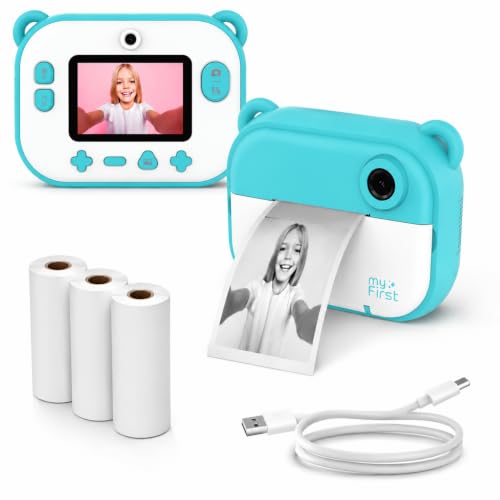
myFirst Insta 2 Blue — Best Specs for the Age
myFirst designs technology specifically for children, and the Insta 2’s listing reads like a respectful attempt to give them real capability: a 12MP camera, 1080P video, ink-free thermal printing and microSD card support, aimed at ages four to twelve. That combination matters because the digital files survive even when a paper print gets lost under a car seat; parents can rescue favourites from the card, and children who take to film-making get a video mode that records their narrated tours of the garden.
The printing follows the category’s thermal pattern — small, gentle prints produced in seconds without ink — and children quickly learn its grammar: nearby faces and bold shapes print best, while busy distant scenes turn impressionistic. The blue body keeps the toy friendly, and the controls are arranged for the age range named, with the grown-up specifications living quietly underneath rather than complicating the surface. As a birthday or holiday gift for a child who already shows a photographer’s curiosity, it stretches further than most rivals.
Its strengths create its cautions. A wider age range means the youngest users need supervision to enjoy the video and storage features, and microSD management is a parent’s job in practice. Thermal paper remains thermal paper: anyone expecting the 12MP figure to translate into glossy colour prints will be disappointed, because the sensor’s detail mostly benefits the saved digital files and video. Read that way — as a capable little digital camera that also prints paper souvenirs — the Insta 2 is one of the most satisfying designs in this guide.
- Camera: 12MP stills with 1080P video, per the listing
- Printing: ink-free thermal paper prints
- Storage: microSD card support for keeping files
- Ages: four to twelve, in blue
Strengths
- Digital files survive even when prints wander off.
- Video mode delights young narrators and film-makers.
- Specifications respect an older child’s ambitions.
Trade-offs
- Print quality stays thermal despite the sensor.
- Card management falls to parents in practice.
- Younger children need help reaching its features.
Best for: curious children roughly six and up who photograph and film everything, with parents happy to curate the card. Not suited for: toddlers, or families expecting colour prints like adult film.
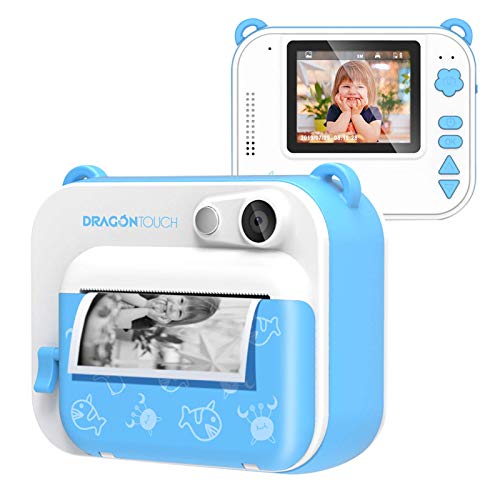
Dragon Touch InstantFun — Most Creative Box
The InstantFun understands something essential about children and photographs: the print is the beginning, not the end. Its listing bundles the camera with print paper, cartoon stickers and colour pencils, which tells you the intended workflow — photograph, print, then decorate the result into something personal. A thermal print’s matte, pencil-friendly surface is perfectly suited to this, and children who might shrug at a plain photograph will spend a happy hour turning prints of their friends into stickered, captioned artworks.
As a camera it covers the category’s essentials in a portable blue body aimed at boys and girls alike: digital capture, instant paper printing, and controls a child can master without a manual-reading ceremony. Party value is unusually high, because the decorating step stretches one photograph into an activity, and a table of children with prints and pencils is a notably calmer table than most party entertainment produces. Grandparents receive the finished pieces like gallery works, which, in the only sense that matters, they are.
The compromises are the category’s usual ones, plus a creative twist: the decorating supplies are consumables too, and the pencils and stickers will run out or wander before the camera does. Print quality is thermal — soft, small, monochrome in character — and the camera’s photographic ceiling is modest, so a child who develops a serious eye will outgrow it. As a gift engineered for an afternoon of making things, though, the InstantFun is arguably the most thoughtfully assembled box in this guide.
- Print style: thermal paper prints, decoration-ready
- Bundle: stickers and colour pencils included
- Audience: boys and girls, portable blue body
- Character: camera plus craft activity in one
Strengths
- Decorating supplies turn prints into projects.
- Party and playdate value is exceptionally high.
- The concept suits artistic children perfectly.
Trade-offs
- Craft supplies deplete faster than the camera.
- Thermal prints remain soft and small.
- Serious young photographers will outgrow it.
Best for: creative children, party gifts and households where crafts already cover the kitchen table weekly. Not suited for: children who want prints that look like a parent’s photographs.

myFirst Insta 20 Bundle Plus — Most Complete Gift Set
Most children’s cameras fail as gifts in the same quiet way: the box delights on day one and the paper runs out on day nine. The Insta 20 Bundle Plus attacks that failure directly. Its listing describes a 16MP camera with a selfie lens, printing in about seven seconds without ink, and — the headline for parents — nine rolls of paper plus a travel case in the box, aimed at ages four to twelve. That is a gift designed to survive the school holidays rather than the unboxing video.
The camera itself continues myFirst’s pattern of respecting children’s capability. A selfie lens acknowledges how children actually photograph — themselves, with friends, at arm’s length — and the quick print cycle keeps up with party energy. The travel case matters more than it appears to: cameras with a home get carried, and cameras that get carried get used, and the case also corrals the paper rolls that otherwise migrate through every drawer in the house. Digital files provide the usual safety net for favourites.
Honesty corner, as always in this guide: the prints are thermal, which means small, soft and restrained in tone regardless of the sensor’s megapixels, and nine rolls will eventually become zero rolls in an enthusiastic household, so note the paper type for reordering before the last roll is loaded. The bundle costs more upfront than camera-only rivals, a premium that is really prepaid paper and peace of mind. For a main birthday or holiday present, that arithmetic is easy to defend.
- Camera: 16MP with selfie lens, per the listing
- Printing: inkless, roughly seven-second prints
- Bundle: nine paper rolls and a travel case
- Ages: four to twelve
Strengths
- Generous paper supply keeps the fun alive.
- The case gives the camera a travelling home.
- Selfie lens matches how children truly shoot.
Trade-offs
- Thermal print character remains modest.
- Upfront price reflects the bundled paper.
- Refill paper type must be matched when reordering.
Best for: a headline birthday or holiday gift where the giver wants zero follow-up shopping for months. Not suited for: small token gifts, or anyone expecting glossy colour output.
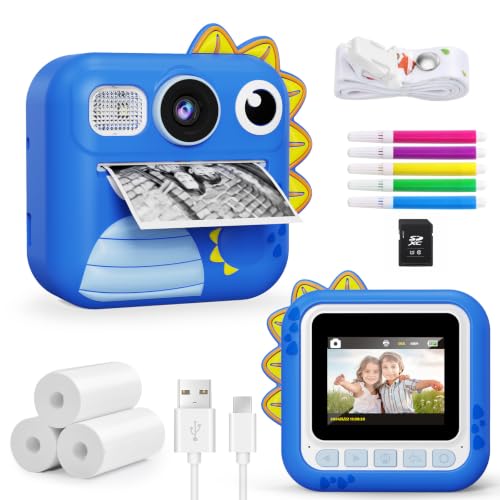
KOKODI Kids Camera Instant Print — Party-Gift Favourite
KOKODI’s camera knows its occasion: the listing presents it as a birthday and Christmas gift for boys, spanning ages three to twelve, in a cheerful blue body that combines digital video with instant printing. That breadth of ages signals a toy designed for simple pleasures rather than photographic ambition — press, print, laugh, repeat — and for the younger half of its audience, simplicity is the entire specification that matters. A three-to-five-year-old does not need modes; they need a shutter that rewards them instantly, and this camera is built around that reward.
At parties and family gatherings the KOKODI pattern works beautifully. Children photograph each other, prints circulate as souvenirs, and the video function captures the singing and the chaos for parents to rescue later. The prints follow the thermal rulebook — small, soft, monochrome in feeling — which children accept without a flicker because the photograph shows their friend and arrived in their hand within moments. As with every pick here, the adult’s job is stocking paper and occasionally untangling enthusiasm from the printer slot with patience.
Its limits mirror its positioning. The wide age claim means older children near twelve may find it young in design and capability, and parents of a serious nine-year-old photographer should compare the myFirst models above. Print and video quality serve memory-making rather than display. None of that prevents it being exactly right for its stated purpose: an affordable-feeling, joyful first print camera for a young boy’s birthday, where the measure of success is how quickly it disappears into play.
- Print style: instant thermal-style paper prints
- Extras: digital video alongside stills
- Audience: boys aged three to twelve, per the listing
- Finish: blue gift-ready body
Strengths
- Simplicity suits the youngest photographers here.
- Gift positioning and design land with its audience.
- Video adds party and family value cheaply.
Trade-offs
- Older children may find it young quickly.
- Print quality is souvenir-grade, as expected.
- Design language targets boys specifically.
Best for: birthdays for younger boys, party entertainment and a first taste of printing photographs. Not suited for: older children developing a real photography interest.

AGFA Photo Kids Digital Camera — Screen-First Alternative
The AGFA Photo camera is this guide’s honest exception, included because some children prefer screens to prints and some parents prefer zero consumables. Its listing describes a kids’ digital camera with a selfie mode, a 3.5-inch LCD screen, photo and video capture, fun filters, dual cameras and a rechargeable battery — and no printer. Photographs live on the screen and in memory, to be browsed, shown and kept digitally. Buying it as an instant print camera would be a mistake; buying it knowingly, as a view-and-play camera, can be exactly right.
The dual-camera arrangement with selfie mode matches how children document their world, and the large screen turns every photograph into an immediate show-and-tell without paper costs or printer jams. Fun filters supply the silliness that decorating pencils provide on the thermal models, in digital form. AGFA’s long photographic name gives parents a recognisable badge, and the rechargeable battery removes the battery-drawer chore entirely. For travel, it is arguably the lowest-maintenance pick here: no rolls to pack, nothing to run out at the crucial moment.
The trade is the physical object. There is no print to hand a grandparent, pin above a desk or decorate at a party, and for many children that object is the entire point of this category. Image quality is toy-grade, serving the screen it ships with. Families should therefore choose it deliberately: it suits a child who loves gadgets and screens, or a household minimising consumables, while print-loving children should be steered to the five thermal cameras above without hesitation.
- Print style: none — digital photographs and video
- Screen: 3.5-inch LCD for viewing and play
- Cameras: dual lenses with selfie mode
- Power: rechargeable battery, no paper costs
Strengths
- Zero consumables to reorder or run out of.
- The big screen makes reviewing half the fun.
- Filters and dual cameras suit playful shooters.
Trade-offs
- It cannot produce a physical print at all.
- No keepsake object for grandparents or walls.
- Image quality serves its screen, nothing larger.
Best for: screen-loving children, travel with minimal luggage and parents avoiding ongoing paper purchases. Not suited for: any child whose heart is set on holding prints.
How Do These Six Children’s Cameras Compare on Paper, Prints and Purpose?
| Camera | Prints? | Print character | Defining extra |
|---|---|---|---|
| VTech KidiZoom PrintCam | Yes, thermal paper | Small, soft, monochrome-leaning | Toy-brand child-first design |
| myFirst Insta 2 | Yes, thermal paper | Small, soft, ink-free | 1080P video and microSD saving |
| Dragon Touch InstantFun | Yes, thermal paper | Small, decoration-ready | Stickers and colour pencils included |
| myFirst Insta 20 Bundle Plus | Yes, inkless paper | Small, quick prints | Nine rolls and travel case bundled |
| KOKODI Instant Print | Yes, paper prints | Small, souvenir-grade | Gift design for boys three to twelve |
| AGFA Photo Kids Camera | No | Screen viewing instead | 3.5-inch screen and dual cameras |
Read the print character column until it sinks in, because it is the most important column in this guide. Every printing model here produces modest thermal output, and they differ in everything around that output: bundles, video, creativity supplies, brand trust and age fit. Choosing well means choosing the surroundings your child will love, while accepting the shared print reality with clear eyes and cheerful expectations.
Which Camera Fits Which Age, From Toddler to Tween?
For three-to-five-year-olds, supervision and simplicity rule. The KOKODI and the VTech PrintCam pitch their designs at this end, with big rewards for a single press and bodies made to be grabbed. An adult should still manage paper loading and keep an eye on any small accessories, and sessions work best as shared play rather than solo expeditions. Expect blur, expect photographs of the floor, and expect one accidental portrait of a grandparent that the family keeps forever.
Six-to-nine-year-olds are this category’s heartland. They can aim deliberately, understand printing as a process, decorate output and begin keeping collections. The Dragon Touch’s craft angle and the myFirst Insta 2’s video both flourish here. Give this age group a small album or a bedroom string with pegs, and the camera becomes a diary they maintain without being asked. Paper consumption peaks in this band too, so the Insta 20’s nine-roll generosity earns its keep.
Tweens approaching ten to twelve split into two camps. Those still delighted by paper souvenirs remain happy with the myFirst models, whose specifications respect their competence. Those developing a photographer’s eye or a social-media sensibility may be ready to graduate toward the adult beginner cameras in our companion guide, under supervision and with film costs discussed openly. The AGFA suits the tween who mostly wants a gadget for video diaries and filtered selfies with friends. Matching the child in front of you, rather than the age on a box, is the parent skill this whole category quietly tests.
What Mistakes Do Parents Make When Buying a Child’s Print Camera?
The headline mistake is expecting glossy colour prints from thermal paper, then declaring the camera broken or cheap when gentle monochrome prints appear. The second is buying camera-only for a keen child with no spare paper in the house, guaranteeing a mid-holiday shutdown. Third comes ignoring the age lanes: a design pitched at toddlers bores a ten-year-old, while a feature-rich model frustrates a four-year-old. Fourth, parents forget the backup habit — a quick phone photograph of a beloved print preserves it against fading, loss and the washing machine, three forces that govern children’s possessions absolutely.
A subtler mistake is confiscating the camera into adult standards: deleting a child’s experiments, rationing paper so tightly that shooting feels illicit, or insisting every print be of something worthy. Children’s photography develops through volume and play. The paper is inexpensive precisely so that a hundred odd, joyful, badly framed prints can teach what ten careful ones never would.
How Do These Cameras Earn Their Keep at Parties, Classrooms and Rainy Weekends?
A children’s print camera at a birthday party is infrastructure, not entertainment garnish. Set up a small photo corner — a plain wall, the camera, a box for finished prints — and children will organise themselves into photographers and subjects with minimal adult direction. Prints become party favours that outlast the cake, and the decorating models turn the corner into a craft station during the party’s natural lulls. Hosts should load a fresh roll beforehand and keep the spare within reach, because party consumption outruns every estimate made in a calm kitchen.
Teachers have quietly adopted this category for good reasons. A thermal print is a tangible record a young child can sequence, label and glue into a project book on the same day it was taken: the bean plant’s growth, the stages of a construction challenge, the cast of the class play. The absence of ink and the low cost per print make classroom use realistic, and the modest image quality hardly matters when the learning lives in the ordering, captioning and discussing. Cameras with saved digital files, like the myFirst models, let teachers keep a class archive even as prints go home in backpacks.
Rainy weekends reveal the third use: the scavenger hunt. A printed list — something round, something that makes noise, a reflection, the family pet mid-yawn — sends children around the home with a camera and a purpose, and the resulting prints become the score sheet. Grandparents’ visits produce a fourth: a child photographing a grandparent, printing it on the spot and presenting it with ceremony is practising generosity, portraiture and printing in one gesture. These are the uses that justify the category far beyond novelty, and they work with every printing model in this guide.
What Does the Paper Habit Cost, and How Do Families Keep It Sensible?
Thermal paper is the friendliest consumable in photography, yet enthusiasm multiplies it. A useful household rhythm is one roll in the camera, one in reserve, and a standing note to reorder when the reserve gets loaded — the same system as household batteries, and just as effective at preventing sad weekends. Bundles like the Insta 20’s nine rolls simply move several months of that rhythm into the gift box, which is why they photograph so well in listings and perform so well in real homes.
Refill compatibility deserves a careful minute whenever you reorder. Rolls vary in width and core style between brands, and a roll that almost fits will jam, tear or print crooked at the worst moment. Note the exact paper specification from your camera’s box or manual before the first reorder, keep that note with the spare roll, and resist anonymous bargain rolls whose dimensions are described vaguely. The money saved by a mismatched roll is repaid in frustration at a rate no parent enjoys.
Parents sometimes ask whether rationing paper teaches care. In practice, gentle abundance teaches photography while tight rationing teaches avoidance; children stop reaching for a camera that feels policed. A better economy is structural: everyday shooting is free play, while special projects — the birthday book, the holiday diary — get their own fresh roll, which makes abundance feel organised rather than endless. Most families find the total spend modest beside the albums accumulating on the shelf.
Which Small Projects Turn a Toy Camera Into a Lasting Habit?
The doorway portrait is the classic: the same child, the same doorway, one print a month. Thermal prints pinned in a column make growth visible in a way height marks on a frame never quite match, because faces change more interestingly than inches. A pet diary works similarly, especially for children whose animals tolerate fame; the pet’s expressions across a season become a small family archive. Both projects suit every printing camera here and cost one print at a time.
Nature tables and seasonal collections give the Dragon Touch and VTech models a curriculum: photograph the leaf, the shell, the first snowdrop, print it, label it, and arrange the series. Children who might resist a nature walk will conduct one voluntarily when a camera and a collection are involved. For the video-capable myFirst and KOKODI models, a narrated tour project — my garden, my street, my grandmother’s kitchen — teaches sequencing and storytelling, with parents rescuing the files before cards fill.
The gift-back project may be the finest: a child photographs each family member, decorates the prints, and presents them at a holiday gathering as handmade presents. It costs a roll of paper and produces the kind of object adults keep in wallets for years. Projects like these are why this guide treats even the simplest toy camera with respect — in the right small hands, with a roll of paper and a purpose, it is an instrument for paying attention.
What Goes Wrong Most Often, and How Do Parents Fix It Calmly?
Blank prints usually mean the paper is loaded the wrong way round, since thermal paper prints on one side only; reloading it flipped cures the mystery in most households. Faint prints can follow a nearly exhausted battery or paper that has lived somewhere hot, so charge or swap before concluding the camera is broken. Jams happen when small hands tug a print before it finishes emerging — teach the household rule of letting the camera finish its work, then tearing cleanly along the edge.
Blurry results are a technique lesson rather than a fault: these cameras have modest sensors and no stabilisation worth the name, so bright light and a steady two-handed hold transform output. Move the subject near a window, step closer rather than relying on any digital zoom, and let children practise on still subjects — a sleeping pet is the category’s most photographed teacher. Video files that seem missing usually live on the card awaiting a parent’s rescue, which is a good moment to start the family archive folder you will thank yourself for later.
When a camera truly misbehaves — refusing paper it accepted before, printing stripes, dying mid-roll — check the simple trilogy first: correct paper, clean print path free of sticker debris from decorating sessions, and a full charge. Craft supplies and printer mechanisms are natural enemies, so decorating should happen at a table away from the open camera. Most household crises end at one of those three checks, with the party saved and no repair bill in sight.
How Should Grandparents and Distant Relatives Choose From This List?
Relatives buying from a distance should privilege completeness over cleverness. The Insta 20 Bundle Plus arrives with months of paper and a case, so the gift cannot stall for want of a roll the parents must source. The VTech PrintCam is the confidence purchase: a known children’s brand, a simple promise, and a design the child will understand before the wrapping paper is cleared. The Dragon Touch suits the relative who knows the child as a maker, while the KOKODI is the cheerful, occasion-ready choice for a young boy’s birthday when the giver cannot consult the parents first.
Two cautions travel with distant gifting. First, align on the print expectation with the parents, not the child: a quick message explaining that prints are small thermal keepsakes prevents the awkward moment where a household expected glossy photographs. Second, add your own first print if you can be present, or enclose a note suggesting the first subject if you cannot. A camera that begins with a mission gets used; a camera that begins as an object on a shelf must compete with every other object on that shelf, and shelves are where good toys go to be admired instead of loved.
How Do You Introduce the Camera So the First Afternoon Goes Well?
Begin with light and closeness, the two variables that govern every result in this category. Take the first photographs outdoors or beside the brightest window, of people and pets at conversational distance, and let the child see a good print before they meet a murky indoor one. Early success teaches the camera’s grammar faster than any explanation: bold shapes, nearby subjects, steady hands. Parents who stage that first success — deliberately, the way you would choose a gentle slope for a first bicycle ride — give the toy a far longer life.
Load the paper together, slowly, naming the steps, because the child who can reload alone owns the camera in a deeper sense. Practise the household rules in the same session: prints finish emerging before anyone pulls, the camera stays out of the bathroom and the paddling pool, and finished prints go to the designated box or string rather than the floor. Rules delivered during a happy first session feel like part of the game; rules delivered after the first jam feel like blame.
End the first session by displaying something. A print on the fridge, a row pegged along a shelf, a decorated frame in the hallway — visibility is the mechanism by which a toy becomes a habit. Children return to cameras whose work is honoured on the household’s walls, and they quietly abandon cameras whose output vanishes into drawers. That single parental decision, repeated weekly, matters more than which of these six models you chose.
What About Photographs of Other Children, Parties and Privacy?
Children’s cameras create children’s photographs of children, and a light-touch household etiquette keeps that joyful. Teach young photographers to ask before photographing someone who might mind, and to accept a no gracefully — the same lesson phones will demand later, learned here at paper scale. At parties, a simple announcement that the young photographer is on duty, and that anyone can ask for their print or decline, keeps the photo corner cheerful for guests and hosts alike.
Prints given away belong to their recipients; prints kept at home belong in the album rather than in circulation at school without thought. Parents of older children using the video-capable models can introduce the idea that recordings of friends deserve the same courtesy as photographs. None of this needs a lecture — a few calm sentences at the right moments build the instinct. This category, handled kindly, is a gentle rehearsal for the networked photography these children will inhabit as teenagers.
How Long Will a Child Actually Stay Interested?
Interest follows a predictable curve: a joyful spike, a quieter week, then either a habit or a shelf. The difference is rarely the camera. Households that weave prints into life — the fridge rotation, the doorway series, the party corner — keep the curve alive for years, often across siblings, with the camera passing down like a good bicycle. Households that treat the camera as a solo toy for quiet time watch it fade beside louder entertainments, which says more about the framing than the child.
Rekindling is easy when it fades: a fresh roll presented as project supplies, a printing challenge before a family visit, or a request from a grandparent for new portraits restarts the engine reliably. Several parents report the camera’s second life arriving with a new sibling, a new pet or a house move — new worlds to document. Buy the model whose ecosystem your household will actually feed with paper and attention, and the interest question largely answers itself.
A Note on Comparing These Toys With a Parent’s Old Camera or Phone
Sooner or later a parent wonders whether a hand-me-down phone or an old compact would serve better. For photographs as files, often yes; for a child’s own practice, usually no. A phone carries messages, games and the entire internet in its wake, while these cameras do one thing with cheerful limits. An old compact produces better files but no object a child can hold, decorate and give away in the minute after taking it. The print, humble as it is, is the pedagogy: it slows the child down, makes the photograph social, and turns mistakes into paper lessons instead of deleted files.
What a drop costs the household matters just as much. A dropped toy camera is a household anecdote; a dropped phone is a household budget meeting. Paper prints forgive sticky fingers, sandy hands and enthusiastic decorating in ways screens never will. Families who keep both — a parent’s phone for the formal portrait, the child’s camera for everything else — usually find the child’s archive more honest and more loved, which tells you what these little machines are actually for.
What Should You Check on the Listing Before Ordering for a Child?
Confirm the bundle contents in plain language: camera only, or camera with paper, case and extras, because listings in this category vary enormously behind similar photographs. Confirm the paper type the camera uses and glance at refill availability in the same sitting, so the second month is planned before the first begins. Check the stated age range against your child honestly — a range is a design confession, not a legal boundary — and note whether video files can be saved or transferred if that feature is part of your gift’s promise.
Finally, look at the finish and the extras through your child’s eyes rather than your own. A travel case a child finds ugly will be left behind; a blue body a child loves will be carried everywhere. In this category, affection is a specification. The camera that gets carried gets used, and the camera that gets used teaches photography — everything else in this guide is commentary on that single sentence.
How Do Siblings Share One Camera Without a Treaty Negotiation?
Shared cameras survive on simple systems: alternating days, a print quota per outing, or a joint album where both names appear on the cover. The models with generous paper bundles ease the arithmetic, and decorating supplies give the waiting sibling a job — official decorator — that converts queueing into participation. Parents who photograph the photographers, printing or saving those meta-moments too, usually find the camera becomes family property in the warmest sense rather than contested territory.
When sharing fails repeatedly, the honest answer is sometimes a second, simpler camera rather than a stricter rota; this category’s prices make that a realistic option in a way adult film cameras never were. Let the elder child graduate to the more capable myFirst model while the younger inherits the simpler body, and the household gains a photography culture instead of a scheduling dispute.
One Last Word on Expectations, From the Adults Who Tested the Category’s Patience
Every disappointment in this category traces back to a single moment: an adult imagining a miniature version of their own camera while a child imagined a magic printer. Both imaginations meet in the middle at the actual product — a toy that makes small, soft, wonderful paper photographs — and the meeting goes well when the adult narrates it correctly. Call the first print a keepsake, not a photo in the grown-up sense, and watch the child’s pride survive intact.
Then step back. The photographs will be crooked, the subjects will be odd, the dog will feature beyond all editorial reason, and the resulting collection will describe your family’s year more truthfully than the curated album on any parent’s phone. That is the entire case for these cameras, stated as plainly as this guide can state it.
Keep one more small ritual in mind for the months ahead: the periodic print review. Spread a season’s prints across a table with the child, choose favourites together, retire the rest without ceremony, and file the chosen few where they will be found in a decade. Children learn editing, storytelling and the value of their own attention in that half hour, and parents learn what the year looked like from three feet lower than usual — a perspective no adult camera in the house can supply.
And if the camera eventually quiets, as toys do, resist the urge to judge the purchase by its active months alone. Somewhere in a book or a box there will be a strip of small grey prints — a lost tooth, a snowman, a grandparent laughing — that no other device in the house thought to make. Families rediscover those strips years later with a disproportionate joy that reframes the whole purchase, which is why this category, for all its modest specifications, keeps earning its place on birthday lists.
Buy the paper before you think you need it, charge the camera the night before any celebration, and keep the decorating pencils in the same box as the spare rolls. Those three tiny logistics, handled by the adults in the background, are what allow the children in the foreground to experience the camera as pure magic rather than a series of small shortages.
One final encouragement for hesitant gift buyers: children are the most forgiving photographers on earth and the least forgiving audience for boredom. Every camera in this guide passes the only test that matters to them — it makes a thing, quickly, that they can hold — and the differences between models are differences in how long and how richly that delight continues.
Choose with that delight in mind, wrap the camera with its first roll already counted as part of the present, and be ready with a wall, a string or a fridge door where the opening day’s prints can go on show before bedtime.
The rest — the crooked horizons, the thumb in the corner, the forty photographs of the cat — is not a flaw in the plan. It is the plan, working exactly as childhood intended.
Trust the small prints, stock the paper, and let the youngest photographer in the house lead.
Final Recommendation
For most families, the VTech KidiZoom PrintCam is the safest first step, with the myFirst Insta 2 the upgrade for a child who will use video and saved files, and the Insta 20 Bundle Plus the gift that keeps working longest without a follow-up order. Choose the Dragon Touch for a craft-loving child, the KOKODI for a young birthday boy, and the AGFA only when screens genuinely beat prints in your household. Set the thermal expectation aloud at the unwrapping, stock one spare roll, and then let the child photograph the dog forty times — somewhere in that joyful excess is the exact moment they become someone who notices the world, and no specification in this guide is worth more than that.
Frequently Asked Questions
Are the prints from these cameras in colour?
Mostly not in the way adults mean. Thermal prints are small and monochrome-leaning or softly tinted, with modest detail. Children treat them as keepsakes and craft material, which is their real purpose.
How long do thermal prints last?
They can fade with time, heat and sunlight. Keep favourites inside books or albums, and photograph any truly precious print with a phone as a backup copy.
Which pick is best for a four-year-old?
The KOKODI or the VTech PrintCam, with adult help for paper and supervision during play. Both reward a single press with an immediate result a young child understands.
Do any of these cameras need ink cartridges?
No. The printing models use heat on thermal paper, so the only consumable is the paper itself. The AGFA model does not print and needs no consumables at all.
Can parents save the photographs digitally as well?
On the myFirst models, yes — files are saved and the Insta 2 supports microSD cards. That safety net is a strong reason to choose them for milestone events.
Is the AGFA camera a mistake in an instant print guide?
No — it is the deliberate exception for children who prefer screens, filters and video over paper. It is only a mistake if bought expecting prints, which is why this guide flags it clearly.
Related Guides
Parents may also want our beginner instant camera guide for older children and adults, the full Fujifilm instant camera roundup for family cameras, and our guide to inexpensive point and shoot cameras for a child’s next step.
Related guides
- Best Kids Smartwatches for Texting and Calling: Six Watch-Phones Under Parent Control
- Best Fast Charge Qi Wireless Chargers: Qi2 at 15W and Qi2.2 at 25W
- Best Airbnb Security Cameras: Compliant Outdoor Cameras and Noise Sensors for Hosts
- Best 5.5 Inch Android Phones: Compact Phones That Still Fit One Hand


