What's inside
- Where to buy
- Key Takeaways
- Quick Picks
- How We Chose These Picks
- What Is the Real Difference Between Film, ZINK and Digital-Only Instant Cameras?
- How Do the Six Beginner Routes Stack Up for a First Month of Shooting?
- How Can a Beginner Avoid Wasting the First Pack of Film or Paper?
- Which Mistakes Do First-Time Instant Owners Make Most Often?
- What Does a Beginner’s First Month With an Instant Camera Actually Teach?
- How Should You Choose Between These Cameras for a Gift?
- Where Do Instant Prints End Up Living, and Why Does That Decide the Camera?
- How Do You Look After Film, Paper and Prints Without Becoming Precious About It?
- What Separates Beginners Who Keep Shooting From Those Who Stop by Spring?
- How Does Each System Behave at the Moments Beginners Photograph Most?
- What Should a Beginner Spend on Accessories, and in What Order?
- A Few Words on Handing These Cameras to Other People
- How Do Beginners Graduate From One of These Cameras to a Deeper Habit?
- What About Weather, Travel Rules and Other Practical Edges?
- How Should a Beginner Read a Listing Page Without Getting Caught Out?
- One More Consideration: How Social Do You Want Your Camera to Be?
- Before You Check Out: A Beginner’s Sanity Checklist
- Final Recommendation
- Frequently Asked Questions
- Related Guides
As an Amazon Associate I earn from qualifying purchases. This post may contain affiliate links at no extra cost to you.
gizmoverdict.com is reader-supported. When you buy through links on our site, we may earn an affiliate commission.
Where to buy
The six cameras below link to the listings we checked, and a first instant camera deserves one calm minute on that page before ordering: confirm whether film or paper is included, because some boxes are ready to shoot on arrival while others assume you already own supplies. The best beginner instant cameras divide into three families that behave very differently after the shutter — traditional film cameras from Fujifilm and Polaroid, digital cameras that print onto ZINK paper, and one tiny digital companion that stores photographs for printing elsewhere — so the buying decision is really about which family’s habits suit your patience and your pocket.
Beginners often imagine all instant cameras work like the ones in films: press, whir, wave the print, done. The modern market is kinder and more varied than that. Film cameras develop chemically and produce the richest, most characterful prints, but every frame costs money whether it succeeds or not. ZINK cameras capture digitally and print with heat onto special paper, so you can review, retake and print copies, at the cost of a flatter, more inkjet-like look. One pick here, the Instax Pal, separates capture from printing entirely. None of these approaches is the correct one; each suits a different kind of first-time owner, and this guide keeps returning to that distinction.
Budget honestly for the second month, not just the first day. Film and ZINK paper are ongoing costs, a case protects a camera that will live in bags and car footwells, and a small album gives early prints somewhere safer than a kitchen drawer. Beginners who plan those three things enjoy their cameras far longer than beginners who spend everything on the body and then ration frames so tightly that the camera stays home.
Key Takeaways
- The Instax Mini 12 Holiday Bundle in Blossom Pink is the gentlest complete start, with film-seasoned packaging and automatic exposure.
- Polaroid’s Go Generation 2 is the smallest true film camera here, built for pockets and spontaneous days out.
- Kodak’s Printomatic removes film anxiety entirely by printing digitally captured shots onto sticky-backed ZINK paper.
- The Polaroid Now bundle delivers the classic large Polaroid frame with film included from the first evening.
- Instax Pal is a screen-free digital companion that stores shots for later printing through a phone or a separate printer.
- Kodak’s Step adds a screen and picture modes for beginners who like choosing before they print.
Quick Picks
| Pick | Badge | Why it earns its place |
|---|---|---|
| Fujifilm Instax Mini 12 Holiday Bundle Blossom Pink | Softest Landing | A gift-ready bundle around the friendliest Instax, with automatic exposure and a selfie mirror. |
| Polaroid Go Generation 2 White | Tiniest True Film Camera | A pocketable Polaroid shooting its own miniature Go film for genuinely analogue prints. |
| Kodak Printomatic | No Film Nerves | Digital capture with instant ZINK prints that stick, share and cost less per frame. |
| Polaroid Now 3rd Generation Bundle Arctic Blue | Classic Frame, Complete Box | The big Polaroid look with colour film bundled in, plus autofocus to help a newcomer. |
| Instax Pal Digital Camera Pistachio Green | Playful Digital Companion | A tiny remote-friendly camera that saves shots digitally for printing later your way. |
| Kodak Step Instant Camera | Screen-Guided ZINK Pick | A viewfinder, flash and picture modes over ZINK printing for choosy beginners. |
How We Chose These Picks
Beginner-friendliness was judged on the first ten frames, not the spec sheet. How many decisions does the camera demand before a decent print appears? How forgiving is it when the light is a dim kitchen or a bright beach? How expensive is a mistake? Cameras that answer those questions kindly earned places here, across three different print technologies so that readers can choose a philosophy as well as a product. We favoured listings that state plainly what arrives in the box, because surprise shortages of film sour more first weekends than any optical flaw.
We also weighted the social life of each camera. A beginner instant camera gets handed around, borrowed by cousins, aimed by grandparents and dropped, eventually, by somebody. Simple controls, clear viewfinders and bodies that do not intimidate matter as much as print chemistry. Finally, we considered the exit routes for photographs: prints that stick to laptops, prints that fill an album page, digital files that can be reprinted — each beginner graduates toward a different habit, and the six picks below cover those paths deliberately.
What Is the Real Difference Between Film, ZINK and Digital-Only Instant Cameras?
Film cameras — the two Fujifilm and Polaroid designs here — expose a frame of real photographic film that develops through chemistry inside the print. The results have depth, gentle unpredictability and a physical uniqueness collectors prize: that exact print is the photograph, with no negative and no identical twin. The discipline is financial as much as artistic, because a blink, a thumb or a dark room consumes a frame permanently. Beginners who love ritual, surprise and the social theatre of a developing print tend to thrive with film.
ZINK cameras — the two Kodaks — are digital cameras with a printer attached. Heat activates colour crystals inside the paper, so no ink cartridges exist to replace, and prints can be repeated from the saved file. The images look cleaner and more predictable, colours sit flatter than film, and the paper’s sticky back turns prints into labels, journal decorations and locker art. For beginners whose fear is wasting money on mistakes, ZINK’s retake-friendly nature is a genuine kindness, and the cost per print generally undercuts film.
The Instax Pal takes the digital logic one step further by removing the printer. It is a tiny camera that stores images for transfer to a phone, where they can be printed on a separate Instax Link printer if you own or buy one. That separation confuses buyers who expect prints from the box, so read its section carefully. Chosen knowingly, it is a delightful remote-shutter companion; chosen by mistake, it disappoints on the first afternoon. Honesty about that distinction is exactly what a beginner guide owes you.
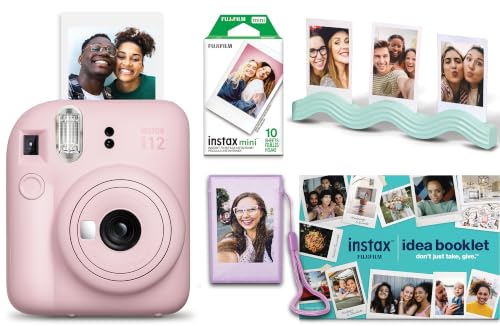
Fujifilm Instax Mini 12 Holiday Bundle Blossom Pink — Softest Landing
A bundle built around the Mini 12 solves the beginner’s two opening problems at once: which camera, and what else do I need? The camera itself is the friendliest Instax Fujifilm makes, with automatic exposure reading the scene, a selfie mirror beside the lens, and a close-up mode for nearer subjects. The listing describes the holiday bundle in Blossom Pink with those same Mini 12 virtues, and the seasonal packaging makes it the natural gift pick of this guide — the box announces celebration before it is even opened.
Using it feels like being taught by a patient friend. Twist the lens, frame through the viewfinder, press the shutter, and a Mini print slides out with bright, kind colours. There is no menu to configure wrongly and no screen to second-guess the moment, which is precisely why beginners relax with it at parties and family lunches. The pastel pink finish photographs beautifully in the unboxing moment and, more importantly, invites people to pick the camera up and join in rather than treating it as fragile equipment.
Its beginner limits mirror its virtues. Every frame prints, including experiments, so a trigger-happy first hour can empty a pack; the bundle softens that lesson but does not repeal it. Indoor flash flattens faces at distance, and the camera cannot rescue a phone photograph or print a second copy. Graduates often keep the Mini 12 forever as the household party camera even after buying something more deliberate, which tells you how completely it succeeds at its one job: making a first-time owner feel capable within ten minutes.
- Print system: Instax Mini film, developing prints
- Exposure: automatic, with selfie mirror and close-up mode
- Bundle character: holiday gift packaging in Blossom Pink
- Controls: twist-lens start, single shutter decision
Strengths
- The learning curve is nearly flat from the first frame.
- Bundle format removes the forgotten-film disappointment.
- Colours and flash flatter casual portraits generously.
Trade-offs
- Mistakes print permanently and consume film.
- No screen, memory or reprint ability exists.
- Seasonal bundle availability can come and go.
Best for: gift buyers and first-time owners who want the classic instant experience with training wheels built in. Not suited for: anyone who wants to review shots before committing or print from a phone.

Polaroid Go Generation 2 White — Tiniest True Film Camera
The Polaroid Go shrinks the Polaroid idea until it fits a jacket pocket, and that size changes how often it gets used. It shoots Polaroid Go film — miniature versions of the famous frame, only compatible with Go film as the listing states plainly — and produces genuine chemical prints with the soft, dreamy rendering Polaroid is loved for. A selfie mirror, self-timer and double-exposure capability hide inside the tiny white body, giving a beginner creative levers that the simplest Instax models omit.
Carrying it everywhere is the point. Spontaneous cameras catch the moments planned cameras miss: the dog in a hat, the sunset from a train window, a friend’s expression between poses. The Go’s prints are small enough to tuck into a phone case or pin inside a locker, and their miniature scale makes people protective of them in a way larger prints rarely inspire. Rechargeable power keeps it ready without a battery drawer ritual.
Smallness brings compromises a beginner should accept knowingly. Go film is its own format, stocked less widely than Instax Mini, so buying ahead matters before trips. The little prints reward close viewing and punish distant subjects; landscapes can feel like postage stamps of themselves. Exposure in tricky light asks for patience while you learn the camera’s habits. For the beginner whose priority is a real film camera that never gets left behind, though, the Go’s charm is not a gimmick — it is the entire argument, and it is a strong one.
- Print system: Polaroid Go film only, miniature frames
- Size: pocketable body in white
- Creative tools: double exposure and self-timer
- Extras: selfie mirror for arm’s-length framing
Strengths
- It is the film camera most likely to be with you.
- Double exposure gives beginners an artistic toy early.
- Prints carry unmistakable Polaroid character.
Trade-offs
- Go film is a separate, less common format to stock.
- Tiny prints underwhelm for scenery and groups.
- Its exposure needs a learning period in mixed light.
Best for: everyday-carry romantics, travellers packing light and beginners who value spontaneity over print size. Not suited for: group photographers or anyone wanting film available in every corner shop.

Kodak Printomatic — No Film Nerves
The Printomatic answers the beginner who loves the idea of instant prints but flinches at paying for every mistake. It captures digitally and prints onto ZINK paper — the listing specifies the 2×3-inch sticky-backed sheets — so a bad frame costs a retake rather than a print, and good frames can be printed again for a second friend. The 5MP sensor named in the listing sets honest expectations: this camera serves small prints, not gallery enlargements, and within that role its output is cheerful and clean.
Simplicity defines the experience. The body, in the blue finish listed here, is point-and-shoot in the truest sense, with automatic behaviour doing the work while you concentrate on moments. ZINK prints emerge dry, smudge-resistant and ready to stick onto journals, laptops and bedroom walls, which makes the Printomatic a quiet favourite for scrapbookers and students. Because the file is saved digitally, a print given away is not a photograph lost, a comfort film cannot offer.
The trade is texture. ZINK prints lack the depth and gentle unpredictability of chemical film; colours can lean flat, and skin tones under odd lighting may look more printed than photographic. Paper is a consumable to keep stocked, and the camera’s modest sensor shows its limits if you crop aggressively on a computer later. Beginners who treat prints as social currency rather than heirlooms usually find the exchange delightful, and the lower cost per print encourages the generous shooting that builds confidence.
- Print system: ZINK 2×3-inch sticky-backed paper
- Sensor: 5MP digital capture, per the listing
- Reprints: saved files allow duplicate prints
- Finish: blue body, pocket-friendly shape
Strengths
- Retakes cost nothing, which relaxes new shooters.
- Sticky prints suit journals, lockers and laptops.
- No ink or film chemistry to manage at all.
Trade-offs
- Print character is flatter than real film.
- The modest sensor limits later cropping.
- Paper packs are an ongoing purchase to track.
Best for: scrapbookers, students and nervous beginners who want instant prints without per-frame pressure. Not suited for: romantics chasing the chemical film look or large display prints.

Polaroid Now 3rd Generation Bundle Arctic Blue — Classic Frame, Complete Box
Some beginners do not want miniature anything; they want the big square Polaroid frame from the films of their childhood, developing in their palm. The Now, in its third generation, is Polaroid’s mainline camera for exactly that wish, and this Arctic Blue bundle includes colour i-Type film — sixteen photos, per the listing — so the first evening ends with real prints rather than a shopping list. Autofocus with two lens choices handled automatically helps newcomers more than they realise, quietly selecting the right setup for portraits versus distance.
The experience is theatrical in the best way. The camera is a handful, the shutter sound is satisfying, and the large prints command a table’s attention as they develop. A self-timer and double-exposure mode extend the creative menu, and the camera’s design language — friendly, rounded, unmistakably Polaroid — makes it a talking point before a single frame emerges. For weddings, reunions and milestone birthdays, that presence is a feature: people gather around developing prints like a small campfire.
Reality checks apply. i-Type film is the priciest consumable in this guide per frame, and the Now’s size means it travels in a bag, not a pocket. Polaroid prints are also the most light-sensitive here during development; shielding a fresh print face-down while it works is a habit to learn on day one. Beginners who budget film thoughtfully and shoot deliberately will find the Now the most emotionally generous camera in this guide — every print feels like an occasion, because at this size and cost, it is one.
- Print system: Polaroid i-Type film, full-size frames
- Bundle: camera plus sixteen colour photos included
- Focus: automatic lens selection for near and far
- Extras: self-timer and double-exposure mode
Strengths
- Large prints deliver the definitive Polaroid feeling.
- Included film makes the first session complete.
- Autofocus quietly protects beginners from blur.
Trade-offs
- Per-frame film cost is the highest here.
- The body is bag-sized, never pocket-sized.
- Fresh prints need shielding while developing.
Best for: romantics, event hosts and gift-givers set on the iconic frame with no extra shopping required. Not suited for: high-volume shooters or strict consumable budgets.
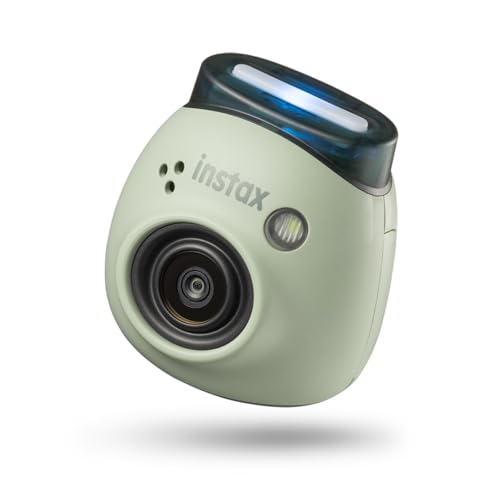
Instax Pal Digital Camera Pistachio Green — Playful Digital Companion
The Pal needs an honest introduction before its charms: it is a digital camera, small enough to dangle from a finger loop, and it does not contain a printer. Photographs are stored digitally and travel to a phone through its app, where owners can print them on a separate Instax Link printer if they have one. Buyers who understand that sentence tend to adore the Pal; buyers who skip it feel misled, so this guide repeats it in the spec box below without embarrassment.
Freed from printing, the Pal becomes a remote-control photography toy in the best sense. Prop it somewhere interesting — a shelf, a garden wall, the far end of a picnic blanket — then step back and trigger it from the phone while watching the framing live. Its wide view gathers groups without a designated photographer standing apart, and pre-shutter sounds and interval shooting invite the kind of playful experiments beginners rarely attempt with precious film. The Pistachio Green finish underlines its accessory-like, carry-everywhere spirit.
Its limits are structural. Without a Link printer, your photographs live on screens, which may be perfectly fine for social sharing but is not instant printing. Image quality serves phone viewing and small prints rather than large displays. And the Pal’s tiny size, while delightful, makes it easy to misplace in a busy household. As a second camera for an Instax household, or a first camera for a child-adjacent beginner under supervision, it is genuinely inventive; as a standalone instant printer, it is simply the wrong product, and no beginner deserves that confusion.
- Print system: none built in — digital storage, app transfer
- Printing route: separate Instax Link printer, if owned
- Shooting style: remote shutter with phone live view
- Finish: Pistachio Green, finger-loop tiny body
Strengths
- Remote framing solves the missing-photographer problem.
- Zero consumable cost while shooting and learning.
- Its size encourages carrying it absolutely everywhere.
Trade-offs
- It cannot print by itself, full stop.
- A Link printer is a further purchase for physical prints.
- Tiny bodies are easy to lose in busy homes.
Best for: Instax households adding a playful second camera, and social shooters happy to print later. Not suited for: anyone expecting prints straight from the box.

Kodak Step Instant Camera — Screen-Guided ZINK Pick
The Step is Kodak’s more deliberate ZINK camera: a 10MP sensor per the listing, a classic viewfinder, a built-in flash and six picture modes that let a beginner nudge the mood of a shot before printing onto ZINK paper. Where the Printomatic aims for total autopilot, the Step invites small decisions — a mode for the scene, a moment to compose — which suits beginners who learn by adjusting rather than by surrendering. Prints carry the same sticky-backed convenience for journals and gifts.
In daily use it feels like a bridge between a phone and a film camera. The digital file remains saved, so a print handed to a friend can be reprinted for yourself, and the picture modes give parties and holidays a little variety without editing software. The white body listed here keeps the design clean and giftable. Battery and paper management are the only real chores: keep both topped up and the Step behaves like an appliance, quietly producing prints whenever the moment asks.
ZINK’s familiar caveats apply — flatter colour than chemical film, prints that read as charming rather than rich — and the picture modes are seasoning, not transformation. The viewfinder experience is simpler than a modern screen, which some beginners love and others find old-fashioned. Against the Printomatic, the Step justifies itself through control and resolution headroom; against film cameras, through retakes and reprints. Beginners who know they enjoy choosing will feel the difference within the first paper pack.
- Print system: ZINK paper, sticky-backed prints
- Sensor: 10MP image sensor, per the listing
- Modes: six picture modes plus built-in flash
- Framing: classic viewfinder design
Strengths
- Picture modes teach scene thinking gently.
- Higher sensor resolution leaves cropping room.
- Reprints protect generous gifting habits.
Trade-offs
- ZINK colour still trails film for depth.
- Modes add decisions some beginners skip anyway.
- Paper and battery both need routine restocking.
Best for: choosy beginners, journal keepers and anyone graduating from phone filters toward physical prints. Not suited for: purists after chemical texture or shooters wanting zero settings.
How Do the Six Beginner Routes Stack Up for a First Month of Shooting?
| Camera | Print technology | Can you retake before printing? | First-month personality |
|---|---|---|---|
| Instax Mini 12 Holiday Bundle | Instax Mini film | No | Gift-ready, gentle, classic |
| Polaroid Go Generation 2 | Polaroid Go film | No | Pocketable and spontaneous |
| Kodak Printomatic | ZINK paper | Yes | Carefree and sticky-backed |
| Polaroid Now Bundle | Polaroid i-Type film | No | Big-frame and theatrical |
| Instax Pal | Digital only | Yes, prints later elsewhere | Remote, playful, printer-free |
| Kodak Step | ZINK paper | Yes | Guided with picture modes |
The retake column is the honest divider in this guide. Film’s no-retake rule is not a flaw; it is the discipline that makes each print feel earned, and many beginners fall for exactly that pressure. ZINK and digital routes remove the pressure and replace it with abundance, which builds a different kind of confidence. Decide which emotion you want from your first month — reverence or freedom — and the table narrows itself to two or three names without further argument.
How Can a Beginner Avoid Wasting the First Pack of Film or Paper?
Start in good light, closer than feels natural, with the sun or window beside you rather than behind your subject. Every system in this guide rewards that single habit more than any setting. Keep backgrounds simple for the first dozen frames; a plain wall teaches you how your camera renders faces without distractions arguing in the corners. On film cameras, slow down and count to three before pressing — the pause costs nothing and saves frames. On ZINK and digital models, use the freedom to experiment, but still review honestly and print only the frames you would give away.
Learn your flash’s honest distance by testing it at home: photograph the same chair from several steps away and watch where darkness wins. That five-minute experiment prevents the classic dark-party disappointment on every system here. Store film and paper at room temperature, keep fresh Polaroid prints face-down while they develop, and resist opening a film camera’s back mid-pack out of curiosity. Finally, write dates on borders or the backs of prints from the very first pack; future you is the most grateful audience a beginner can serve.
Which Mistakes Do First-Time Instant Owners Make Most Often?
Buying the camera without consumables is the evergreen error, followed closely by choosing a system for its looks while ignoring its running costs. A third mistake is treating the first pack’s failures as the camera’s character; every model here has a learning curve measured in frames, and the second pack is always kinder. Fourth comes storage neglect — film in hot cars, prints loose in sunlit rooms — which quietly degrades results that owners then blame on the camera. The last is buying for a fantasy self: the deliberate artist, the pocket minimalist, the party host. Buy for the person who actually attends your weekends, and the camera will be used rather than admired.
What Does a Beginner’s First Month With an Instant Camera Actually Teach?
Week one teaches distance. Beginners stand too far away because phone habits encourage capturing everything, yet instant prints reward filling the frame with the person or object that matters. By the end of the first pack, most owners have learned to take two steps forward before pressing the shutter, and their prints transform accordingly. Week one also teaches light direction, usually through one memorable backlit failure whose subject became a silhouette against a bright window.
Week two teaches restraint on film systems and generosity on digital ones. Film shooters begin composing with their feet and checking backgrounds before committing a frame, discovering that a half-step sideways removes the stranger, the bin and the exit sign from the story. ZINK and Pal shooters learn the opposite virtue: abundance is only useful when followed by editing, and printing everything merely relocates the camera roll onto paper. Both lessons are really the same lesson about attention, learned from opposite directions.
Weeks three and four teach voice. Owners notice they photograph the same subjects repeatedly — a grandmother’s hands, a child’s inventions, the light in one particular café — and those repetitions become a style before the word style ever gets mentioned. This is the point where a beginner camera stops being a novelty and starts being a practice, and it is why this guide cares less about which system wins on paper than about which system a given beginner will still be feeding with film or paper in month six.
How Should You Choose Between These Cameras for a Gift?
Gifting a beginner camera is really gifting a hobby, so match the system to the recipient’s temperament with unusual honesty. The impatient friend who photographs everything and shares instantly will love the Kodak routes, where prints appear without chemistry lessons and duplicates solve the who-keeps-it argument. The sentimental friend who keeps ticket stubs and writes letters deserves film — the Mini 12 bundle for ease, the Polaroid Now bundle for grandeur — because the ritual is the present as much as the hardware.
For a teenager, consider where prints will live. Bedroom walls and school journals favour ZINK’s sticky backs and lower running costs, sparing parents a film budget negotiation every month. For a grandparent entering instant photography to document great-grandchildren, the Mini 12’s total simplicity beats every clever feature in this guide; set it up, load it, and take the first portrait yourself so the camera arrives with a memory already inside its story. For a couple marrying, the Now bundle plus extra film becomes part of the celebration rather than an object on a registry.
Whatever you choose, include the consumables to survive the first fortnight and write a short note suggesting the first subject. That tiny prompt — photograph the dog, the team, the garden in the morning — reliably converts a gifted camera from shelf ornament into habit, because the hardest frame for any beginner is the very first one taken alone.
Where Do Instant Prints End Up Living, and Why Does That Decide the Camera?
It sounds backwards, yet the destination of prints predicts satisfaction better than any specification. Wallet and phone-case carriers belong with Mini film or the tiny Polaroid Go frames, which travel without ceremony. Album builders should think in formats: Mini prints tile densely and cheaply, Polaroid frames anchor a page each, ZINK prints collage beautifully thanks to their sticky backs. Fridge-door households do well with any system but should know that magnets and sunlight wage a slow war on every print; rotating favourites into an album each season preserves them.
Digital-leaning beginners who mostly share online, printing only heroes, are the Pal’s natural audience, provided a Link printer exists in the household plan. Classroom and club environments favour ZINK, where a teacher can reprint a group shot until every child holds one. Event hosts planning a guest book should price the film for the Polaroid Now honestly before committing, because generosity at a wedding multiplies frames faster than any estimate made in a quiet kitchen.
None of these destinations is more legitimate than another. The beginner who knows where their prints will live can read the Quick Picks table like a map; the beginner who skips the question often buys a fine camera whose prints have nowhere to go, and unused prints are the first step toward an unused camera.
How Do You Look After Film, Paper and Prints Without Becoming Precious About It?
Unshot film and ZINK paper share one enemy: heat. A drawer at room temperature is the entire storage strategy most owners need, with a glance at expiry dates when buying in quantity. Keep a spare pack in the camera bag rather than the car, and rotate stock so older packs get shot first. Film cameras should not be opened mid-pack to check how many frames remain; the counter exists precisely so curiosity does not fog the remaining shots.
Finished prints ask for shade and dryness. Albums remain the safest home, shoeboxes the acceptable one, and sunlit windowsills the place prints go to fade. ZINK prints tolerate handling well and suit high-touch uses like classroom displays. Polaroid prints appreciate a dark first few minutes while developing and gentle handling by their edges. Instax prints are the hardiest of the film family and forgive handbags, pinboards and enthusiastic children better than their delicate reputation suggests.
Cameras themselves need little: a soft cloth for lenses, a case for travel, and protection from sand and rain. Rechargeable models appreciate being charged before events rather than after months in a drawer. None of this care is burdensome, and most of it is really one habit — putting the camera and its supplies back in the same place every time, so the kit is always ready when a moment announces itself without warning.
What Separates Beginners Who Keep Shooting From Those Who Stop by Spring?
The pattern is consistent across every system in this guide. Keepers display their prints, because visible photographs invite the next photograph. Keepers also give prints away constantly, which turns the camera into a social instrument rather than a private gadget; a camera that produces gifts gets carried to occasions. Keepers keep consumables in stock, so inspiration never meets an empty camera. And keepers forgive their early frames, understanding that the slightly soft portrait of a laughing parent will matter more in ten years than a technically perfect still life ever could.
Stoppers, by contrast, usually bought a system at war with their temperament: the spontaneous soul rationing expensive film, the perfectionist haunted by film’s no-retake rule, the digital native puzzled that a camera cannot share directly. This guide’s real work is preventing that mismatch. Read the trade-offs under each pick as personality descriptions, choose the camera whose flaws you will find charming, and the keeping part tends to take care of itself.
How Does Each System Behave at the Moments Beginners Photograph Most?
Birthday parties are the beginner’s proving ground: dim rooms, fast children, candles, and relatives who blink. Film cameras with honest flash — the Mini 12 and the Now — handle the room’s chaos with the fewest decisions, while the Go asks its owner to stay close to the action. ZINK models shine when the birthday child wants a print immediately for a friend, then another for a cousin, then one for the fridge; reprinting turns a single good frame into party favours without fresh shooting.
Holidays abroad test different virtues. The Pal and Go travel light and survive being carried daily, which matters more than any feature list when the alternative is a camera left in the hotel. The Printomatic’s sticky prints decorate travel journals on trains and café tables, building the album during the trip rather than after it. Film shooters should pack more consumables than instinct suggests, because unfamiliar cities are generous with subjects and cruel about restocking specific formats at short notice.
Quiet home moments — a pet asleep in sun, a grandchild reading, bread emerging from an oven — reward whichever camera is loaded and within reach. This is the deepest argument for simple systems: the Mini 12 on a kitchen shelf gets used, while a complicated camera in a cupboard documents nothing. Beginners consistently overvalue features and undervalue readiness, and the first month of ownership corrects that ranking in every household that keeps a small print wall growing.
What Should a Beginner Spend on Accessories, and in What Order?
Resist the accessory avalanche. The correct first purchase after the camera is consumables — enough film or paper to shoot freely for a month — because confidence is built with frames, not straps. Second comes somewhere for prints to live: an album, a box, or a pinboard, chosen to match the destination thinking earlier in this guide. Third comes a case once the camera starts travelling, which for most owners is week two rather than day one.
After those essentials, let real friction choose the next accessory. Owners who lose group shots to the missing-photographer problem will value the Pal’s remote approach or a small tripod for the film cameras. Owners whose prints curl in handbags need rigid album pages. Owners shooting at evening events may add a simple hand strap after the first near-drop concentrates the mind. Accessories bought in response to experienced problems earn their keep; accessories bought in anticipation of imagined problems mostly decorate drawers.
One non-accessory deserves budget priority over everything decorative: a second set of eyes. Printing a small contact selection monthly — or pinning ZINK prints in sequence — lets beginners see their own patterns and improve deliberately. The cameras in this guide are simple; the seeing is the skill, and it develops fastest when prints are reviewed together rather than scattered.
A Few Words on Handing These Cameras to Other People
Instant cameras are social objects, and every beginner becomes a teacher within days. The ten-second briefing prevents most disasters: where the shutter button lives, how close is too close, and the rule that nobody opens the camera’s back. Film cameras benefit from a gentle warning that each press costs a frame, delivered with humour rather than anxiety, because guests shoot better relaxed. ZINK cameras can be handed over more freely, though paper counts still deserve a glance at long parties.
Children deserve special mention here, since this guide’s adult picks differ from the toy cameras in our companion guide for kids. A supervised child with a Mini 12 or a Printomatic often produces the day’s most honest photographs, taken from knee height without self-consciousness. Set a frame budget together, let them choose subjects, and print or keep everything they make during the session; editing a child’s generosity teaches the wrong lesson at exactly the wrong age.
Finally, expect the camera to change the room. People pose differently for a print they will hold, conversations pause for developing frames, and strangers ask to see. Beginners who enjoy that theatre should lean toward film’s ceremony; beginners who find it exposing may prefer the quieter digital routes. Neither preference needs defending — the right beginner camera is the one whose social weather matches its owner’s.
How Do Beginners Graduate From One of These Cameras to a Deeper Habit?
Graduation rarely means replacing the camera. More often it means the beginner camera acquires a role — the party camera, the travel camera, the grandparent-visit camera — while its owner adds a notebook, a project or a second format around it. Mini 12 owners frequently add monochrome film and discover portraiture. Printomatic owners start journals. Now owners begin planning film purchases around family milestones with the seriousness of tiny archivists. Each path is the hobby deepening rather than the gear escalating.
Projects accelerate the deepening. A print-a-week commitment through a year produces an album that no phone gallery matches for emotional density. A doorway portrait series, taken in the same spot each month, turns children into time-lapse subjects and teaches composition through repetition. A workplace or classroom print wall builds community while quietly training the photographer’s eye for candid timing. Beginners who adopt even a modest project by month two almost never drift away from the camera.
When a second camera does arrive, let it answer a felt limitation: prints too small, retakes too expensive, pockets too tight. That discipline keeps collections purposeful — a film camera for ceremony and a ZINK camera for abundance is a coherent pairing, while three similar cameras bought on impulse mostly compete for the same shelf. This guide’s six picks were chosen so that any of them can serve as either the first camera or the considered second.
What About Weather, Travel Rules and Other Practical Edges?
Instant cameras travel well with modest care. Film should ride in hand luggage at comfortable temperatures, and owners passing through airport security can politely ask about hand inspection for unexposed packs when staff are receptive, though everyday screening is a routine experience for Instax and Polaroid travellers alike. ZINK paper is indifferent to scanners and only asks to stay dry. At the destination, shade is the travelling instant photographer’s friend: midday tropical sun overwhelms every system here, while morning and evening light flatters all of them.
Rain deserves respect rather than fear. None of these cameras is a weather-sealed tool, so a plastic bag in the kit and a towel in the car cover most adventures. Cold slows film development, which a warm inside pocket solves elegantly. Heat is the greater enemy, softening colours and shortening consumable life, so the shaded bag beats the sunny dashboard every time. These are small disciplines, learned once, and they protect exactly the photographs — holidays, reunions, once-a-year gatherings — that beginners most want to keep.
Finally, a word about photographing strangers, because instant cameras invite it. A print offered is a powerful courtesy: ask, shoot, and hand over the frame, keeping a second only if the moment and the subject allow. Many beginners discover that giving the photograph away is the hobby’s deepest pleasure, and several picks here — the reprinting Kodaks especially — exist almost perfectly for that generosity.
How Should a Beginner Read a Listing Page Without Getting Caught Out?
Three details decide whether the box that arrives matches the afternoon you imagined. First, the consumable: does the listing include film or paper, and if so, how much? Bundles in this guide state their contents, but marketplace listings for the same camera vary, and a camera-only box is a disappointment with a bow on it. Second, the format name must match exactly — Go film fits only the Go, i-Type belongs to the Now family, Mini film feeds the Fujifilm picks, and ZINK sheets come in sizes that must suit the Kodak in question.
Third, check the power story. Rechargeable models need their cable found and a socket near the party; battery models need spares in the drawer before the event, not during it. Colour names deserve a glance too, because gift recipients do notice whether the camera is the Arctic Blue or Blossom Pink they admired. None of this requires expertise — only the same slow minute on the listing that this guide took on your behalf when assembling the pool behind these picks.
Sellers matter at the margins. A reputable listing with clear contents beats a mysterious bargain, particularly for film, whose storage history affects every frame. If a price on film looks too kind, assume the packs holidayed somewhere warm. Cameras themselves are sturdy, simple machines across all six picks; the consumables are where quality quietly lives, and beginners feel that difference in their prints long before they can name it.
One More Consideration: How Social Do You Want Your Camera to Be?
Some cameras start conversations and others quietly record them. The Polaroid Now, with its generous developing frames, gathers a crowd wherever it appears; the Mini 12 invites handling and passing around; the Go disappears into a pocket until the exact second it is wanted. The Kodaks produce prints so quickly and cheaply that they become party infrastructure, churning out keepsakes without ceremony. The Pal is the introvert’s instrument, capturing from a shelf while its owner stays inside the moment and inside the photograph.
Beginners rarely think to ask which social role they want, yet it predicts weekend satisfaction remarkably well. Hosts should buy ceremony or abundance. Observers should buy discretion. Gift-givers should buy the role the recipient performs at gatherings, not the one they perform at work. Hold that thought beside the running-cost thought, and the six-way choice in this guide usually resolves into a single name with surprising calm.
Before You Check Out: A Beginner’s Sanity Checklist
Say the system aloud once — film, ZINK or digital-only — and confirm it matches your expectations for the first afternoon. Name the consumable your camera eats and add a spare pack to the order. Picture the prints living somewhere specific in your home. If all three answers come easily, the choice is sound and further comparison is procrastination wearing a sensible hat.
If two cameras remain tied after that exercise, let generosity break the tie: choose the one whose prints you would more happily give away, because giving is where instant photography stops being a purchase and becomes a practice. Then stop researching, order, and spend the waiting days deciding whose portrait deserves frame one.
One habit separates happy owners from frustrated ones in the first week: keeping the camera where life happens. A beginner camera stored in its box photographs nothing, while the same camera resting by the front door or on the kitchen counter accumulates a small archive almost by accident. Readiness is a feature no specification sheet lists, and every pick in this guide is simple enough to deserve that counter space.
It is also worth forgiving the genre its small imperfections in advance. A slightly soft focus, a colour that leans warm, a print that emerges a touch dark — these are the fingerprints of instant photography, present in every system gathered here. Beginners who expect character rather than laboratory precision enjoy their cameras from the first pack onward, and their albums, years later, look alive rather than audited.
And when the first print of someone you love slides out warm and imperfect and entirely theirs, the whole comparison — formats, costs, systems, screens — will feel briefly beside the point, which is exactly the feeling these cameras were invented to sell.
Final Recommendation
Most beginners should start with the Instax Mini 12 Holiday Bundle, because it removes every early obstacle and teaches the film ritual kindly. Choose the Polaroid Now bundle when the big frame is the dream itself, the Go when pockets decide what gets carried, and either Kodak when retakes and reprints matter more than chemical texture. Take the Pal only with open eyes about its printer-free design. Whichever route you pick, shoot the first pack within days, label the prints, and let the second pack be the one where your taste shows up — beginners become photographers somewhere around frame twenty, and these six cameras are simply six different doors into that same room.
Frequently Asked Questions
Which system has the lowest running cost for a beginner?
ZINK paper generally costs less per print than Instax or Polaroid film, and the Instax Pal costs nothing per shot while shooting digitally. Film costs more because each frame is unique and chemical.
Can I print a second copy of a film photograph?
Not from the camera. Film prints are one-offs; scanning one lets you make reproductions, but the original remains singular. ZINK cameras keep the digital file, so reprints are straightforward.
Is the Instax Pal a printer as well as a camera?
No. It captures and stores photographs digitally and sends them to a phone app. Printing requires a separate Instax Link printer, which is why this guide flags it so clearly.
Which pick suits a wedding guest book?
The Polaroid Now bundle, because its large prints fill pages and guests love watching them develop. Budget for extra i-Type film, since guest books consume frames joyfully.
Do ZINK prints fade or smudge like inkjet prints?
ZINK prints emerge dry and resist smudging because the colour lives inside the paper. Like all prints, they last longest away from prolonged direct sunlight and damp.
What should I buy alongside the camera on day one?
At least one spare pack of the correct film or paper, a simple case, and an album or box for finished prints. That trio prevents nearly every first-week disappointment.
Related Guides
Keep exploring with our brand-by-brand look at the best Fujifilm instant cameras, a guide to instant print cameras sized and priced for kids, and our favourite compact cameras for video-minded beginners.
Related guides
- Best 400 FPS High Speed Cameras: The Honest Truth About Burst Slow Motion
- Best Kids Smartwatches for Texting and Calling: Six Watch-Phones Under Parent Control
- Best Fast Charge Qi Wireless Chargers: Qi2 at 15W and Qi2.2 at 25W
- Best Airbnb Security Cameras: Compliant Outdoor Cameras and Noise Sensors for Hosts


