Our Top Picks
 Evelots 4-Pack Hand Crank Flashlights for EmergenciesSet of 44 x 2 x 1 inches0.57 poundsCheck on Amazon


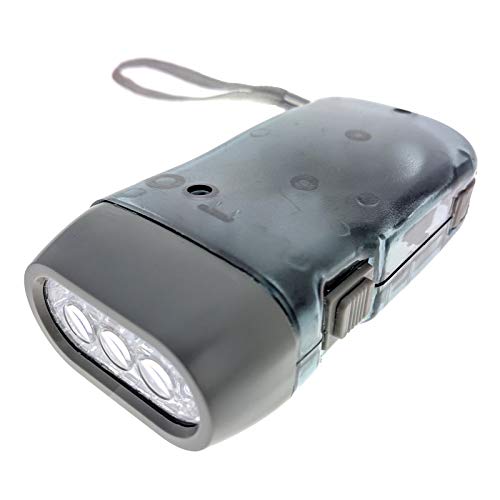


What's inside
- How hand-powered generators make light
- The storage question: what “battery-free” really means
- Realistic light output: lumens, beams, and honest expectations
- Charge per squeeze and the physics of runtime
- Durability: gears, springs, capacitors, and cells
- Water resistance, temperature, and rough treatment
- Where these lights earn their place
- What to check before buying
- The limits of the class, stated plainly
- Care habits that keep a hand-powered light ready
- Check prices on Amazon
- Choosing with clear eyes
As an Amazon Associate I earn from qualifying purchases. This post may contain affiliate links at no extra cost to you.
A squeeze flashlight makes a small promise that most torches cannot: it will work after years in a drawer, because the energy it runs on comes from your hand rather than from a cell that slowly empties itself on the shelf. You grip the handle, work a lever or a crank for half a minute, and a modest beam appears. There is no pack of spares to keep track of, no expiry date printed on a wrapper, and no moment of discovering that the light you stored for an emergency died quietly two summers ago. That promise is real, but it comes with honest limits, and this guide works through both sides of it in detail.
This is a guide to a product class rather than to a single model. Battery-free hand-powered lights come in three broad mechanical families: squeeze-lever dynamo lights, rotary hand-crank lights, and shake lights that use a moving magnet and a coil. All three convert muscle work into electricity, store a little of it or use it on the spot, and feed one or more light-emitting diodes. The differences between them matter more than most packaging admits, because the generator design decides how tiring the light is to charge, how steady the beam feels, and how long the mechanism is likely to survive.
One point deserves to be made early, because it shapes every buying decision in this category. Many lights sold as battery-free are not free of batteries at all in the strict engineering sense. They contain no disposable cells, and that part of the claim holds up. Inside the housing, though, a good number of them store energy in a small rechargeable cell, very often a nickel-metal hydride button cell or a small lithium cell, while others store charge in a supercapacitor, and a minority store nothing at all and shine only while you keep working the mechanism. Each storage choice behaves differently over years of storage, and the sections below explain what each one means for shelf life in plain terms.
The output of this class is also modest, and no honest guide should dress that up. A typical hand-powered light produces a few lumens at the low end and a few dozen lumens at the strong end. That is enough to find a keyhole, read a fuse box label, walk a dark hallway, or check on a sleeping child. It is not enough to light a football pitch, signal across a valley, or replace a modern battery torch that can push hundreds of lumens down a trail. Judged against the jobs it is actually built for, the class performs well. Judged as a substitute for a full-size torch, it will always disappoint.
This guide rests on manufacturer-published specifications, product documentation, and established electrical and mechanical principles rather than on personal use of the lights discussed, and the claims made here are framed so you can check them against published documentation for any model you shortlist. Where figures are given, they are presented as class-typical ranges drawn from published documentation across the category, not as measurements of one retail product. Retailer links on this page are commerce links, and the site may earn a commission when a reader buys through them; that arrangement does not change the technical limits described here, which apply to the whole class regardless of brand.
How hand-powered generators make light
Every light in this category is a small power station with four stages. A mechanical input, your hand, moves something. That movement spins or slides a magnet relative to a coil of wire, or spins a tiny generator through a gear train. The moving magnetic field induces an electric current in the coil, a principle set out by Michael Faraday in the nineteenth century and still the basis of every dynamo built since. The raw current is then cleaned up by simple electronics, stored briefly or used at once, and delivered to the LEDs at a voltage they can work with.
The details differ by family, but the physics does not. Electrical power out can never exceed mechanical power in, and in practice it falls well short, because gears rub, bearings drag, coils resist, and conversion electronics waste a share as heat. A healthy adult hand working a small crank can sustain perhaps five to ten watts of mechanical effort for a short burst, and a well-made miniature generator turns only part of that into electricity. The LED then turns part of that electricity into light. Each stage takes its cut, which is why the beam from a hand-powered light is measured in modest lumens rather than hundreds.
Squeeze-lever dynamo lights
The squeeze design hides a lever in the handle. You grip the light and close your fingers, the lever travels inward, and a rack or linkage converts that short linear stroke into rotation. A gear train steps the rotation up, spinning a small dynamo far faster than your hand moved. Release the grip and a spring returns the lever, ready for the next squeeze. Some designs harvest energy on both the squeeze and the return stroke; many harvest mainly on the squeeze and let the return run free.
The appeal of the squeeze layout is that it needs no separate winding motion and can be worked one-handed, even by someone with cold fingers or gloves on. The trade-off is stroke length. A grip can only travel a few centimetres, so each squeeze delivers a small packet of energy, and the gear train must multiply speed aggressively to make useful voltage. Aggressive multiplication means small gear teeth carrying real load, which is why the quality of the gear material matters so much in this family, a topic covered in the durability section below.
Squeeze lights also tend to pulse. Unless the model stores energy in a cell or capacitor, the beam brightens with each squeeze and sags between strokes. Storage smooths that pulse into a steadier glow, which is one reason so many squeeze lights pair the lever with a small internal cell. When you read a product description, look for wording about what happens between squeezes; a light that holds a steady beam for a minute after a short burst of squeezing is telling you, indirectly, that it has storage inside.
Rotary hand-crank lights
The crank design is the oldest of the three and the easiest to understand. A fold-out handle on the side or rear of the light turns a shaft. Gears step that shaft speed up, commonly by a large ratio, so that one comfortable turn of the handle spins the generator many times. Crank at a steady one to two turns per second and the generator settles into a smooth hum, producing a fairly even flow of power for as long as your arm keeps going.
Because the input motion is continuous, crank lights usually feel less frantic than squeeze lights and can gather more energy per minute of effort. They are also easier to share between hands: when one arm tires, you swap. The weaknesses are mechanical exposure and size. The crank handle sticks out, folds, pivots, and can snap if the light is dropped on it or crushed in a packed bag. The hinge and the first gear in the train take the full force of every turn, so published documentation that mentions reinforced crank arms or metal gearing is worth more than a long list of lighting modes.
Many crank models add extras around the same generator: a small radio, a phone-charging socket, a siren, or a red warning light. Those extras draw from the same small energy budget. A radio sips power and can run for a fair while on a winding session. Charging a phone is a different matter: a phone battery holds vastly more energy than a minute of cranking provides, so documentation for such models usually frames the socket as a way to gain a short emergency call rather than a full recharge, and that framing is the honest one.
Shake lights and the Faraday principle
The shake light is the most elegant of the three families and the most constrained. Inside a sealed tube sits a strong magnet that can slide from end to end, passing through a coil of wire wound around the tube. Shake the light, the magnet travels through the coil, the changing magnetic field induces a current, and that current charges a capacitor. There are almost no moving parts to wear: no gears, no crank hinge, no lever spring. In principle, a shake light can sit sealed for a very long time and still work.
The constraint is energy per shake. One pass of one magnet through one coil yields a small amount of charge, and gathering enough for a useful beam takes vigorous shaking, commonly quoted in product documentation in the range of half a minute to a minute of steady work for a few minutes of dim light. The beam from a shake light is usually the faintest of the three families, suited to close tasks. Some very cheap shake lights sold over the years also cheated, hiding ordinary disposable coin cells inside a fake generator layout; published teardowns and regulator warnings have documented that practice, and it is one more reason to buy this family from makers who publish clear internal specifications.
The storage question: what “battery-free” really means
Strip the marketing language away and every hand-powered light answers one question in one of three ways: where does the energy wait between the moment your hand produces it and the moment the LED spends it? The answer is a rechargeable cell, a supercapacitor, or nowhere. That single design choice decides how the light behaves after a year in a drawer, how bright it can be in the first seconds after you pick it up, and how it will eventually fail. It deserves more attention than the headline lumen figure, which is why it gets a full section here.
Lights with a small rechargeable cell inside
The most common arrangement pairs the generator with a small rechargeable cell. Nickel-metal hydride button cells appear often in this class because they tolerate rough handling, accept charge from an unsteady generator without complex protection circuitry, and hold up across a wide temperature range. Some models use a small lithium-ion cell instead, gaining energy density and losing some tolerance for deep discharge and long storage at full charge. Either way, the cell acts as a buffer: your squeezing or cranking fills it, and the LED draws from it smoothly, so the beam stays even while your hand rests.
The benefit is convenience. A buffered light can be wound for a minute in the evening and used in short bursts all night, and it can reach the brighter end of the class range because the cell can deliver current faster than your hand can generate it. The cost is that the light has quietly rejoined the world of batteries, with a rechargeable one you cannot see or swap. Cells age whether you use them or not. Nickel-metal hydride cells self-discharge over months, faster in warm storage, and lose capacity over years. Lithium cells age by calendar as well as by cycle count and dislike sitting fully charged in a hot place. A cell-buffered light left untouched for five years may still work, but it will likely hold less than it did when new, and when the cell finally gives out, the whole light usually goes with it, because the cell is soldered in and not sold as a spare part.
None of that makes cell-buffered lights a poor choice. It makes them a choice with a maintenance habit attached: wind them a few times a year, use them now and then, and they will serve for a long time. The failure mode to avoid is pure neglect combined with high expectations. If a product page for a cell-buffered model claims a decade of untouched readiness, treat that claim with the same scepticism you would apply to any rechargeable product making it.
Lights with a supercapacitor inside
The second arrangement stores charge in a supercapacitor, also called an ultracapacitor. A capacitor stores energy electrostatically rather than chemically, which gives it a very different character. It charges in seconds, delivers its charge quickly, tolerates hundreds of thousands of charge and discharge cycles with little wear, and shrugs off temperatures that would trouble a chemical cell. For a light that is charged by hand and used in short bursts, that character fits beautifully.
The weakness is capacity and self-discharge. A supercapacitor that fits in a torch handle holds far less energy than even a small cell, so runtime per winding session is shorter, often a handful of minutes of useful light rather than an evening of it. Capacitors also leak their charge away over hours to days, depending on size and design, so a capacitor light wound on Monday will not still be holding that charge on Friday. That sounds like a flaw until you remember the use case: the light is meant to be charged at the moment of need, by the hand that needs it. Judged that way, fast charging and near-immunity to cycle wear matter more than holding a charge across a week.
Shake lights lean heavily on capacitors, because the tiny packets of energy from a sliding magnet suit a storage device that accepts charge in small gulps without complaint. If long shelf readiness with zero maintenance is your priority, a capacitor-based light from a maker who publishes the capacitor specification is the closest this class gets to a fit-and-forget tool, provided you accept the shorter runtime and the need to shake or squeeze at the moment you want light.
Direct-drive lights with no storage at all
The third arrangement stores nothing. The generator feeds the LEDs through simple rectification and regulation, and the light shines only while the mechanism moves. Stop squeezing and the beam dies within a second or two. These are the purest form of the idea and the least convenient: you cannot set one down lit on a table, you cannot use it hands-free, and reading with one means keeping a rhythm going with your fingers the whole time.
Direct-drive designs still earn a place in the discussion because they remove every storage failure mode at once. There is no cell to age and no capacitor to leak. If the gears and the LEDs survive, the light works, whether it was made last year or twenty years ago. Some squeeze lights behave almost this way, with only a tiny capacitor smoothing the pulses between strokes. When documentation describes a light as shining while squeezed with no stated runtime after winding, you are almost certainly looking at a direct or near-direct design, and you should buy it only if that behaviour matches the job you have in mind.
What storage type means for shelf life
Shelf life is where the three designs separate most clearly. A capacitor light asks nothing of you between emergencies and gives back short, dim, dependable light on demand. A direct-drive light asks nothing either and gives light only while you work. A cell-buffered light asks for a few minutes of attention a few times a year and gives back the brightest, longest, steadiest beam of the class. The mistake is expecting one design to deliver the virtues of another. Write down, before you buy, which bargain you actually want, because the product pages will not always state the storage type in plain words; look for mentions of an internal cell, a stated capacity in milliamp-hours, which signals a cell, or a stated capacitance in farads, which signals a capacitor.
Realistic light output: lumens, beams, and honest expectations
Lumens measure total light output, and in this class the totals are small. Published documentation across the category puts basic shake lights at the bottom, often in the low single digits to around ten lumens. Mid-range squeeze and crank lights commonly sit somewhere between roughly ten and thirty lumens. The strongest hand-powered models, usually crank designs with a healthy cell buffer and several LEDs, reach a few dozen lumens. For comparison, a modest modern battery torch on a low setting often matches that whole range, and on higher settings leaves it far behind; a phone torch sits somewhere in the same modest band as a decent crank light, which is a useful mental yardstick.
Those numbers sound weak until they are translated into tasks. A few lumens will show you the steps on a dark stair, the dial of a meter cupboard, or the page of a book held close. Ten to twenty lumens will light a small room well enough to move around safely, find clothing, and check on children or pets. A few dozen lumens will let you walk a garden path, inspect a tent pitch, or work under a car bonnet on close components. What none of them will do is throw a beam across a field, pick out a trail marker at distance, or light a work site. Beam distance in this class is typically measured in tens of metres at best, and the useful, comfortable range is much shorter than the headline figure.
Beam shape matters more than the lumen count
At these low outputs, how the light is spread matters as much as how much of it there is. A tight spot beam concentrates the few available lumens into a bright pool that is good for looking into a cupboard, a drain, or an engine bay. A wide flood spreads the same lumens thinly and evenly, which suits walking and room lighting but can feel feeble outdoors. Many hand-powered lights use a simple reflector or a bare LED behind a plain lens, giving a middling beam with a brighter centre. Some add a diffused mode or a lantern-style setting for area light. When documentation lists both a spot and a flood figure, or shows a beam pattern, that tells you more about real usefulness than a single peak lumen number.
LED count and what it does and does not tell you
Product pages in this category love LED counts: three LEDs, five LEDs, a ring of them. More emitters can spread light more evenly and provide redundancy if one fails, and at low drive currents several LEDs run efficiently. But LED count alone does not set brightness. One modern, efficient LED driven well can outshine five older, cheaper emitters driven weakly, and five LEDs fed from a tiny generator share the same small energy supply between them. Read LED count as a hint about beam spread, not as a score. The published lumen figure, even allowing for optimism, and the stated runtime at that output tell you far more.
Charge per squeeze and the physics of runtime
Runtime claims in this category follow a pattern: a stated period of winding buys a stated period of light. Documentation for crank lights often frames it as roughly a minute of steady cranking for somewhere between several minutes and half an hour of light, depending on brightness setting and storage size. Squeeze lights frame it per burst of squeezes. Shake lights frame it per bout of shaking. Behind all three framings sits the same arithmetic, and understanding it once will let you read any product page in this category with clear eyes.
Start with energy. Light output costs electrical power continuously. A small LED cluster drawing, say, a fraction of a watt will drain a small store quickly: a storage device holding one watt-hour would run a one-watt load for one hour, a half-watt load for two hours, and so on. Hand generators fill that store slowly. If a crank and generator deliver a few watts of electrical power while you work, then one minute of cranking banks a few watt-minutes of energy, minus conversion losses at every stage. Spend that bank at a low brightness setting and it stretches. Spend it at full brightness and it goes in minutes. There is no design cleverness that escapes this exchange rate; there are only designs that waste less of it.
Why brightness falls away instead of stopping dead
New users are often surprised that a hand-powered light does not hold full brightness and then switch off cleanly, the way a regulated battery torch may. Instead, most models fade. The reason lies in the storage. As a capacitor discharges, its voltage falls steadily, and LED brightness follows voltage down unless the electronics boost it, which costs energy and complexity most of these lights skip. A cell holds its voltage flatter for longer, so cell-buffered lights fade more gently and then drop faster near the end. Either way, the practical runtime figure that matters is not the time until the last visible glow, which can be very long and nearly useless, but the time the beam stays bright enough for the task. Published runtimes rarely separate the two, so discount headline runtime figures mentally and expect the genuinely useful portion to be the earlier, brighter part of the curve.
This fade behaviour has one kind side effect: it warns you. A hand-powered light seldom abandons you without notice. The beam thins, you wind or squeeze for twenty seconds, and you carry on. Build that rhythm into how you plan to use the light, especially for children and for older relatives, for whom a sudden total blackout from a dead battery torch can be more unsettling than a gentle fade they can fix themselves with a few squeezes.
Effort, cadence, and tired hands
Charging effort is a specification too, even when it is not printed as one. Squeeze levers ask for repeated grip force; crank handles ask for steady arm rotation; shake lights ask for vigorous whole-arm movement. A minute of any of them is easy. Ten minutes spread across an evening is fine. Sustained winding to run a bright light continuously for an hour is genuinely tiring, and anyone who has kept a crank light at full output through a long power cut will tell you the arm notices. People with arthritis, weak grip, or limited arm mobility should weight this heavily: for them, a capacitor squeeze light used for short bursts may serve better than a crank model that assumes a strong, steady winding arm, and a hybrid kit with rechargeable battery lights as the main tool may serve better than either.
Cadence matters as well. Generators have a comfortable speed band. Crank too slowly and voltage stays low and charging crawls; crank frantically and gear wear, heat, and your own fatigue all climb while efficiency falls. Product documentation sometimes states a recommended winding speed, often around two turns per second for crank models. Treat that figure as the design centre of the light. If a maker publishes a recommended cadence and a runtime earned at that cadence, that is a sign of documentation written by people who measured something real.
Durability: gears, springs, capacitors, and cells
A hand-powered light replaces the usual failure point of a torch, the flat battery, with a set of mechanical failure points. That trade is the heart of the category, so it pays to know where these lights actually wear out. Field reports and repair write-ups on this class point to the same short list again and again: stripped gear teeth, cracked crank handles, tired lever springs, worn generator brushes in designs that use them, failed switches, and, in cell-buffered models, an internal cell that no longer holds a useful charge.
Gear trains and mechanism materials
The gear train is the hardest-worked part of squeeze and crank lights. Your hand delivers slow, forceful movement; the generator wants fast, light rotation; the gears stand between those two demands and multiply speed, commonly by ratios in the dozens. Small plastic gears can do this job quietly and cheaply, and in a lightly used emergency light they may do it for years. Metal gears, or hybrid trains with metal at the high-load first stage and plastic later, tolerate more force, more cycles, and more ham-fisted cranking. Documentation that names gear materials is giving you one of the most useful durability signals in the whole category. Documentation that says nothing about the mechanism while dwelling on lighting modes is telling you where the maker’s priorities sat.
How you treat the mechanism matters as much as what it is made of. Steady, moderate cranking wears gears slowly. Violent, jerky winding, especially forcing a crank past resistance or squeezing a lever with full bodybuilder grip, chips teeth and bends shafts. Teach children the rhythm rather than the maximum; a light charged gently a thousand times will outlast a light charged brutally a hundred times. If a model offers a folding crank, check how the handle locks in its working position, because a handle that collapses mid-turn concentrates force exactly where the hinge is weakest.
Capacitor and cell lifespan
Supercapacitors are the marathon runners of this category. Rated cycle lives in the hundreds of thousands are routine in component documentation, and calendar life is measured in years to decades, with gradual loss of capacitance rather than sudden death. For a light that might be wound a few hundred times in its life, the capacitor is very unlikely to be the part that ends it. The gears, the switch, or the housing will almost always go first.
Rechargeable cells live shorter, busier lives. A nickel-metal hydride cell in this duty might deliver hundreds of full cycles and several years of calendar life before its capacity fades to the point where runtime feels poor. A lithium cell trades some of that calendar patience for energy density. The practical point for buyers is not the exact figure, which varies by cell quality and storage temperature, but the shape of the ending: cell-buffered lights usually fade into uselessness gradually over years rather than failing on one bad night, as long as they get occasional use. A light that is wound and used a little every few months keeps its cell exercised and its owner aware of its health. A light sealed in a kit for five years deserves a check before the kit is relied on, whatever the packaging promised.
Switches, lock-out, and accidental drain
The humble switch decides more real-world readiness than any generator. On a cell or capacitor light, a switch knocked on inside a bag can drain the store before you ever reach for it. Better designs answer this in one of three ways: a recessed or stiff switch that resists knocks, a sliding switch with a firm detent, or a lock-out feature that disables the light for storage and transport. Some squeeze lights sidestep the problem elegantly, because squeezing is itself the switch: no squeeze, no light, nothing to leave on. If you plan to keep a light loose in a glovebox or a child’s school bag, weigh the switch design as heavily as the generator design. A lock-out or a squeeze-to-shine layout can be the difference between a light that is ready and a light that is merely present.
Switch quality also shows up in modes. Many models cycle through brightness levels or flashing modes with repeated presses. Flashing modes have genuine emergency value for signalling and for being seen by the roadside. They have genuine annoyance value when you must click through them every time you want plain light. Documentation that describes the switch sequence honestly, including whether the light remembers its last mode, helps you judge whether the light will suit an older relative or a child, who both do better with one press, one plain beam.
Water resistance, temperature, and rough treatment
Hand-powered lights live in wet, cold, and grubby places: rain-soaked tents, flooded cellars, steamy kitchens, frosty cars. Their moving mechanisms complicate weather protection, because every lever slot, crank shaft, and folding handle is a doorway that a sealed battery torch does not have. Published ingress protection ratings in this class, where they appear at all, tend to sit at the splash-resistant end of the scale rather than the submersible end. A rating in the IPX4 region means the light shrugs off splashing water from any direction, which covers rain and wet hands. Ratings are given under the IEC 60529 framework, and the digits after IP describe protection against solids and water separately; when a maker publishes only a phrase such as water resistant with no rating, assume splashes at most.
Treat any hand-powered light without a stated rating as a dry-weather tool that tolerates damp hands. Do not store one where it will sit in standing water, and dry a soaked light with the mechanism worked gently a few times before putting it away, so moisture trapped around the gear train gets a chance to leave. Shake lights have a natural advantage here: with no external mechanism, they can be sealed thoroughly, and some published designs in that family carry stronger water resistance than their crank and squeeze cousins. If your main scenario is a boat kit, a fishing bag, or a flood-prone cellar, that sealing advantage deserves real weight in the decision.
Heat, cold, and the glovebox problem
Cars are the harshest common storage place for any light. A parked car in summer sun can push interior temperatures far beyond anything a living room reaches, and a winter night can take the same space well below freezing. Chemical cells dislike both extremes, and heat especially shortens cell life. This is one of the strongest arguments for keeping a capacitor-based or direct-drive hand-powered light in the car rather than a cell-buffered one, and for checking a glovebox light at the start of each season rather than assuming it survived the summer.
Cold affects the user as much as the light. Squeezing a stiff lever with numb fingers is harder than it sounds, and crank handles are easier to work with gloves on. If the light is destined for a car kit in a cold climate, a crank design with a handle you can grip in a mitt, or a squeeze design with a broad lever, will serve better than a dainty model that assumes bare hands at room temperature. Drivers who keep a layered kit, with a hand-powered light as the always-there backup and a rechargeable torch as the main tool, may also want our comparison of best 12v solar trickle chargers when thinking about how the vehicle itself stays ready between trips.
Where these lights earn their place
The strongest case for this class is not that it replaces other lights. It is that it covers the specific moments when other lights fail: the battery that self-discharged, the rechargeable that was never put back on charge, the spares that were borrowed for a toy and never returned. A hand-powered light is the light of last resort that manufactures its own readiness. With that role in mind, the use cases below are where the category genuinely shines, along with the design choices each one favours.
Emergency kits and blackout drawers
Preparedness guidance from public bodies such as the Red Cross and national emergency agencies consistently places a light source near the top of household kit lists, for the simple reason that power cuts arrive at night as often as by day. A hand-powered light suits the kit role because it removes the battery-checking chore from kit maintenance. Choose a capacitor or robust crank model for a kit that will sit untouched, store it where every adult in the house can find it in the dark, and pair it with a note of where the candles, matches, and breaker panel are. In the blackout drawer at home, a squeeze light has a particular charm: it can be found by touch, worked one-handed while the other hand holds a phone or a child’s hand, and it cannot have been left on by accident if the design lights only while squeezed or has a firm lock-out.
Keep expectations matched to the scenario. In a blackout, the jobs are moving safely, finding supplies, checking the breaker panel, and comforting children. A few dozen lumens do all of that. The jobs a hand-powered light will not do, such as lighting a whole room brightly for hours while you cook and read, belong to lanterns and to battery lights with big reserves. A sensible household owns both kinds and stops asking either to do the other’s work.
Car gloveboxes and roadside moments
The roadside scenario is short, stressful, and usually wet: a tyre to inspect, a warning triangle to place, a map or a phone to read, a long walk to a farmhouse door. A hand-powered light that has lived in the glovebox for three years and still works on the first squeeze is worth more in that moment than a brighter torch with a flat cell. Crank models with a flashing red mode or a warning setting add signalling value, and a magnetic base or a hanging loop, where fitted, frees both hands for the wheel brace. Check the stored light whenever the car is serviced, work the mechanism for half a minute, and put it back; that tiny habit keeps gears free and reminds you the light is there.
Children’s lights
For children, the appeal runs the other way: the charging is the fun. A squeeze or crank light turns bedtime reading, den building, and garden exploring into a small lesson in energy that no lecture matches, because the child can feel the exchange in their own hand: work goes in, light comes out, light fades, more work is needed. There are no small disposable cells to swallow, no charger cables to manage, and no tears over a torch left on under the bedclothes until it died. Choose a model with a smooth, enclosed mechanism that cannot pinch small fingers, a lever or crank sized for small hands, and a simple single-mode switch. Expect the beam to be modest and treat that as a feature: a dim light is kinder to a shared bedroom and to a parent crossing the landing at midnight.
Off-grid cabins, boats, and garden buildings
Buildings that stand empty for weeks suit this class well. A cabin light that depends on stored batteries may meet its owner with a flat cell and a corroded contact after a damp winter. A hand-powered light asks only that its gears have not seized, and a crank model hung by the door covers arrivals after dark, trips to the wood store, and checks of the water tank. Cabins that also keep rechargeable tools and lamps on site sit in a middle ground: the hand-powered light is the greeter and the backup, while charged equipment does the heavy work, and owners who maintain vehicle and equipment batteries at such properties may find our comparison of best 6v and 12v battery chargers relevant to the wider kit, even though the squeeze light itself will never need it.
On boats, the sealing point returns. A shake light in a grab bag, immune to cell leakage and indifferent to months of storage, is a rational choice even at very low output, because the scenario it serves is signalling and close inspection rather than navigation, which belongs to proper marine lights. In garden buildings and allotments, where theft and damp both argue against leaving good battery kit, an inexpensive crank light on a hook is light enough for locking up after dusk and cheap enough not to mourn if it wanders off.
What to check before buying
The category rewards a buyer who reads documentation closely, because the honest makers publish the details that matter and the careless ones publish adjectives. Work through the checks below in order. Together they take ten minutes with a product page and a search engine, and they will filter out most of the disappointment this class can deliver.
Identify the storage type, in writing
First, establish what stores the energy. Look for a stated cell type and capacity, a stated capacitance, or an explicit statement that the light works only while the mechanism moves. If the page will not tell you, treat that silence as information: makers of good capacitor lights usually say so proudly, because it is their best feature, and makers of cell lights usually state the cell because buyers ask. A light whose storage cannot be identified from its own documentation is a light bought blind, and in a category built on long-term readiness, blind is the one thing you cannot afford to be.
Judge the mechanism by its materials and its spare logic
Next, read everything the maker says about the moving parts. Gear material, crank arm construction, lever spring design, and hinge reinforcement are the vocabulary of durability here. Prefer documented metal gearing or reinforced polymer at the high-load stages, a crank handle that locks open, and a lever that travels without grating or side play in the display video or description. Ask the spare-part question too: if the crank snaps in year three, can it be replaced, or is the light finished? For a product whose whole purpose is to outlast batteries, a light that dies with its cheapest plastic part has missed its own point.
Test the lumen claim against the energy budget
Then apply the physics check from earlier sections. A hand generator delivers a few watts at best. A claim of a few dozen lumens sustained fits that budget comfortably. A claim of very high output with very long runtime from brief winding does not fit any budget, and the usual explanation is that the two figures were measured in different universes: peak output for a few seconds from a full store, and runtime at the dimmest setting until the last glow. Neither figure is a lie told in so many words, but together they mislead. Prefer makers who state output and runtime at the same setting, and who state how much winding earns that runtime.
Check the switch, the lock-out, and the modes
Look for a storage lock-out or a switch design that cannot be knocked on in a bag. Confirm how many presses stand between off and a plain beam, and whether a flashing mode must be cycled through every time. If the light is for a child or an older relative, one press and one beam beats a menu of modes every time. If the light is for a car kit, a flashing or red mode earns its complexity back as a warning signal.
Read the water and temperature notes honestly
Note the ingress rating if one is published, and be wary of unrated claims in wet use cases. Consider where the light will actually live. A light bound for a hot car should lean toward capacitor or direct-drive storage. A light bound for a boat bag should lean toward the sealed shake family. A light bound for a bedside drawer can be any type, because its environment is gentle and its user is near.
Fit the light into a wider kit, not above it
Finally, decide what job remains for your other lights, because a hand-powered light works best as one layer among several. Households that keep rechargeable AA and AAA lights for everyday tasks may want our comparison of best aa and aaa battery chargers to keep that layer healthy, while readers whose main torch runs on cylindrical lithium cells may find our comparison of best 18650 chargers more to the point. The hand-powered light then takes the role it is genuinely best at: the reserve that cannot be flat, kept in the drawer, the car, or the kit where reserves belong.
The limits of the class, stated plainly
Every strength described so far has a shadow, and a trustworthy guide names them together. Output is the first limit: this class will not light a work site, a playing field, or a search area, and pretending otherwise in an emergency plan is a real safety error rather than a marketing quibble. Effort is the second: light from these devices is paid for in arm work, in real time, and people who are ill, injured, elderly, or very young may be unable to pay that price for long, which is why a household plan should never rest on hand power alone. Runtime is the third: stored energy in this class is measured in minutes of good light, not hours, and tasks should be planned in bursts with winding breaks between them.
There are softer limits too. The mechanisms make noise: gear whir, lever clicks, and the rattle of a sliding magnet are all audible on a quiet night, which matters in a tent with sleeping children. The beams, with honourable exceptions, are fixed in shape, without the focusing or the high-colour-rendering emitters found further up the torch market. And the category’s cheapest corner is genuinely poor: flimsy gears, fake shake mechanisms hiding disposable cells, and invented output figures all cluster at the bottom, which is why the documentation checks above matter more here than in categories where even the budget options are competent.
Care habits that keep a hand-powered light ready
These lights ask for little, but not quite nothing. Work the mechanism for half a minute every few months, which keeps gear grease distributed, exercises a cell if one is fitted, and confirms the light still lives. Store the light somewhere you can reach in the dark and tell the household where it is; a reserve light nobody can find is furniture. Keep it dry, wipe mud from lever slots and crank hinges, and avoid leaving a cell-buffered model in a hot car across a whole summer if a cooler drawer is available. If a light fades over the years, wind it fully and run it down two or three times before judging it; cells that have sat idle sometimes recover a useful share of their capacity with gentle exercise, while a light that stays dim after that treatment is telling you its store is near the end of its life.
When a hand-powered light finally does wear out, the failure is usually mechanical and visible: a slipping gear, a cracked handle, a switch gone loose. That visibility is itself a virtue. Unlike a battery torch that can look perfect while its cells quietly die, a worn dynamo light tends to announce its decline in your hand, in time for you to replace it before the night it is needed.
Check prices on Amazon
Live listings for the shortlist in this guide are pulled from Amazon below, so prices and availability are always current at the moment you look.


Choosing with clear eyes
Pick the storage type that matches your neglect pattern, the mechanism your hands can work happily, and the output your real tasks need, and this modest category will repay you for years. The squeeze light by the bed, the crank light in the car, and the shake light in the boat bag are not competing answers to one question; they are three answers to three questions, and the right purchase starts with knowing which question you are asking. Buy from makers who publish their storage type, their gear materials, and output and runtime measured together, and you will almost certainly end up with a light that works on the one night when nothing else does. When the power fails and the drawer opens, the best flashlight in the house is the one that answers your first squeeze with light, years after every other torch in the building has forgotten how.


