Our Top Picks
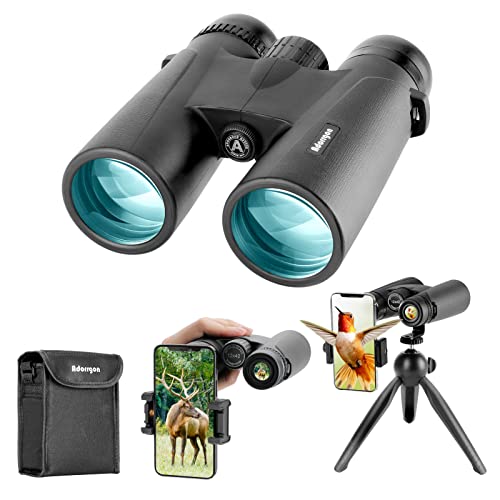 Adorrgon 12x42 High Powered Binoculars for Adults12x425.75 x 4.95 x 2.1 inches1.1 poundsCheck on Amazon
 15x52 HD Binoculars for Adults High Powered with15x526.5 x 5.4 x 2.5 inches2.2 poundsCheck on Amazon


What's inside
- What fixed observation asks of an instrument
- The five classes, and what each one is for
- Exit pupil: the most useful number in the category
- Why roughly 12x is the hand-holding ceiling
- Field of view versus identification distance
- Prisms: glass, shape and the large-aperture problem
- Coatings: where the gathered light is kept or lost
- Nitrogen, sealing and the permanently sited instrument
- Mounts, adapters and the discipline of a steady view
- Three posts, three honest setups
- Law and privacy: a short, factual note
- Binoculars, spotting scopes and cameras compared
- Check prices on Amazon
- Choosing, in the order the post demands
As an Amazon Associate I earn from qualifying purchases. This post may contain affiliate links at no extra cost to you.
This guide rests on manufacturer-published specifications, optical standards and product documentation rather than personal use, and it covers one narrow job: watching a fixed place, from a fixed place, for a long time. Observation binoculars are the instruments people set up at a gate, a farmyard, a harbour wall, a coastal lookout or the end of a long field, and then leave pointed at the same ground for an hour or a whole evening. That job sounds simple, and the optics that serve it well are not exotic. They are large, heavy, honest binoculars, used on a support, chosen by arithmetic rather than by headline numbers. Retailer links on this page are commerce links from which this site may earn a commission, and that commercial arrangement has no bearing on the classes, formulas or limits set out below, which come from published optical practice that any reader can check with a pocket calculator.
A birding binocular is built to move. It is light, it hangs from a neck, it focuses fast, and it trades aperture for portability because its owner walks to the subject. An observation binocular reverses every one of those choices. Its owner walks to a post, a porch, a hide, a vehicle or a harbour railing, sets the instrument down, and brings the subject closer by glass alone. Weight stops being a defect and becomes a resource, because a heavier instrument can carry larger objective lenses, and larger objective lenses gather more light and resolve finer detail. Bulk stops mattering once a tripod enters the picture, and a tripod should enter the picture early in any honest discussion of this category, because most of the instruments described here are not meant to be held for more than a brief look.
What fixed observation asks of an instrument
Fixed observation has a rhythm unlike any other use of binoculars. The watcher settles, scans a known area slowly, returns to the same landmarks again and again, and waits. A gate either opens or it does not. A ewe either rejoins the flock or she does not. A boat either rounds the harbour arm or it stays beyond it. The work is mostly patience, punctuated by short moments when detail matters urgently: a registration plate half-read, a collar colour on a dog worrying sheep, a name on a stern, a figure at a fence line whose intent needs judging before a decision is made. An instrument for this work must be comfortable for the long quiet stretches and decisive in the short busy ones, and those two demands pull the design in opposite directions. Comfort wants a bright, wide, relaxed view. Decisiveness wants magnification. The whole art of choosing in this category is knowing where, for a given post and a given distance, the balance falls.
Distance is the first fact to establish, and it should be measured rather than guessed. The range from post to gate, from house to field boundary, from lookout to harbour mouth can be found on a map, with a measuring wheel, with a laser rangefinder, or by pacing ground that is safe to pace. Most fixed posts turn out to serve one dominant distance band. A yard watch may live between 60 and 180 metres. A farm post covering several fields may work between 250 and 600 metres. A coastal lookout may care about a channel marker at 900 metres and shipping beyond it. Each band favours a different class, and a watcher who names the band honestly will rarely buy the wrong instrument. A watcher who buys for the most distant object ever imagined, rather than the ground actually watched, ends with too much magnification, too narrow a field, and a view that shakes, dims and frustrates in daily use.
The five classes, and what each one is for
10×50: the general-purpose observation class
A 10×50 magnifies a scene ten times and gathers light through two 50 millimetre objectives. It is the smallest class in this guide and the only one that most people can hand-hold for extended periods without strain, though even here a monopod or a rested position improves the view more than most owners expect. Class-typical examples offer a field of view near six and a half degrees, which is roughly 113 metres of width at 1,000 metres, wide enough to take in a yard, a gate and both approach lanes in one frame. The exit pupil, worked below, is a generous 5 millimetres, which suits adult eyes in dim light and makes eye placement forgiving. For posts under about 250 metres, where the task is awareness rather than fine identification, the 10×50 is often the correct and sufficient answer, and its relative lightness means it can be carried between two or three posts rather than married to one.
12×50: the upper edge of hand-holding
A 12×50 keeps the same objectives and raises magnification by a fifth. That step is larger in practice than it looks on paper. Detail at the centre of the field grows, the field itself narrows to a class-typical five and a half degrees or so, near 96 metres at 1,000 metres, and hand shake, which was a nuisance at 10x, becomes the limiting factor in the view. Many watchers can use a 12×50 from a seated position with elbows braced, and many cannot use one standing for more than a minute before the image begins to swim. The exit pupil falls to about 4.2 millimetres, still serviceable at dusk but less generous. This class suits a watcher whose post is a little too far for 10x and whose ground is a little too wide for 15x, provided a monopod, a fence post, a vehicle roof or some other rest is part of the routine. Bought as a purely hand-held instrument for long sessions, it disappoints a good share of its owners.
15×70: the first true post instrument
With 15×70 the category changes character. The 70 millimetre objectives gather almost twice the light of 50 millimetre objectives, because light gathering scales with lens area, and area scales with the square of diameter: seventy squared divided by fifty squared gives a ratio of 1.96. Magnification of 15x is beyond sensible hand-holding for observation, so a tripod stops being an accessory and becomes part of the instrument. In return, the watcher gets a class-typical field near 4.4 degrees, about 77 metres at 1,000 metres, an exit pupil near 4.7 millimetres, and a view at 400 to 700 metres that a 10×50 cannot match for identification. This is the class that suits the farm post, the long yard, the reservoir shore and the harbour wall where shipping names and buoy numbers are the daily currency. It is also the class where build quality begins to separate honest instruments from fragile ones, because a large binocular that loses collimation, the alignment of its two optical trains, shows every error doubled to a tired brain.
20×80: reach for kilometre ground
A 20×80 is a serious post instrument, typically well over two kilograms before its mount is counted, with a class-typical field near 3.2 degrees, about 56 metres at 1,000 metres. Its exit pupil is 4 millimetres exactly, a figure that rewards good coatings and clean glass because there is less spare light in the system. At 20x, the atmosphere itself joins the optical chain as a limiting element: heat shimmer over sunlit ground, haze over water, and rain haze at dusk all cap the useful detail long before the lenses do. On a still, clear morning, though, a 20×80 at a kilometre resolves the kind of detail that decides a watch: whether a gate chain is fastened, whether a trailer light cluster is lit, whether the figure at the fence carries a tool or a dog lead. This class belongs on a substantial tripod, ideally with a fluid head or a fork mount, and it belongs to watchers whose dominant distance band genuinely starts beyond 600 metres.
25×100: the giant class
The 25×100 is the largest class in common observation use, and it is closer to a pair of small telescopes sharing a mount than to a binocular in the everyday sense. Each objective is 100 millimetres across, gathering four times the light of a 50 millimetre objective by the same area rule. The field narrows to a class-typical two and a half degrees, roughly 44 metres at 1,000 metres, which means the instrument must be aimed like a telescope, often with the help of a finder, a landmark routine, or a lower-power companion binocular used to locate the target first. Exit pupil is again 4 millimetres. Some instruments in this class offer interchangeable eyepieces, which can change magnification, and a few are built at an angle, with eyepieces set at 45 degrees to the optical axis, a mercy for watchers who look upward at cliffs, masts or high structures. A 25×100 needs a heavy tripod or a parallelogram mount, a permanent or semi-permanent post, and a watcher who understands that its gifts appear only in good air. In poor air it is an expensive way to magnify haze.
Exit pupil: the most useful number in the category
The exit pupil is the bright disc of light that leaves each eyepiece and enters the eye. Its diameter follows from one division: objective diameter divided by magnification. A 10×50 gives 50 divided by 10, which is 5 millimetres. A 12×50 gives 50 divided by 12, which is 4.17 millimetres, usually rounded to 4.2. A 15×70 gives 70 divided by 15, which is 4.67 millimetres. A 20×80 gives 80 divided by 20, which is 4 millimetres. A 25×100 gives 100 divided by 25, which is 4 millimetres again. Any reader can hold a binocular at arm’s length toward a bright sky, look at the small discs floating behind the eyepieces, and see the physical reality behind the arithmetic. The discs are there whether a seller mentions them or not.
The exit pupil matters because the eye has an pupil of its own, and the two must be compared. In bright daylight the human iris closes to roughly 2 to 3 millimetres. In dim light it opens, reaching perhaps 5 millimetres in a middle-aged adult and up to 7 millimetres in a young adult in full darkness, with the wider figures becoming less common as age advances, a well documented effect in the ophthalmic literature. Light that falls outside the iris is wasted. Light that fails to fill the iris leaves the view dimmer than the scene itself. So a 5 millimetre exit pupil, as the 10×50 provides, matches a dusk-adapted eye well and wastes nothing at noon beyond what every instrument wastes. A 4 millimetre exit pupil, as the two largest classes provide, suits daylight and civil twilight well, and at deep dusk delivers a view that is usable but visibly less bright than the scene a younger eye perceives unaided.
This is the honest trade at the heart of the category. Magnification spends brightness. Every step up in power, at a fixed objective size, shrinks the exit pupil and dims the image, even though the instrument gathers exactly the same total light. The only cure is aperture, and aperture costs weight, size and money in a steep curve. That is why the classes in this guide pair their magnifications with the objectives they do. A maker who offered 20x through 50 millimetre objectives would produce a 2.5 millimetre exit pupil and a view that turns grey and grainy well before dusk, a pairing that looks impressive in a headline and fails at a post. When a pairing looks odd, do the division before admiring the headline.
Relative brightness: squaring the exit pupil
Relative brightness is a conventional index formed by squaring the exit pupil diameter. The 10×50 scores 25. The 12×50 scores about 17.4. The 15×70 scores about 21.8. The 20×80 and the 25×100 each score 16. The index is useful for comparing instruments on paper, because it tracks how much light reaches each unit area of the retina, and the ranking it produces surprises many first-time buyers: by this measure the humble 10×50 presents the brightest image of the five classes, brighter than giants costing far more. That is not a trick. It is the geometry of the trade described above, and it explains why experienced watchers often keep a 10×50 beside a much larger instrument, reaching for the smaller glass as light fails and the task shifts from identification back to awareness.
Twilight factor: a reach index, not a brightness index
Twilight factor is formed by multiplying magnification by objective diameter and taking the square root of the product. For the 10×50, the product is 500 and the root is about 22.4. For the 12×50, 600 gives about 24.5. For the 15×70, 1,050 gives about 32.4. For the 20×80, 1,600 gives exactly 40. For the 25×100, 2,500 gives exactly 50. The index rewards both power and aperture, and it was devised as a rough guide to the detail an instrument can pull out of dim scenes, on the sound reasoning that resolving a dim shape needs both light and size in the image.
Why roughly 12x is the hand-holding ceiling
The human hand is not steady, and it does not need to be unsteady by much. Every person carries small involuntary movements: a fine tremor in the fingers, the pulse transmitted through the arms, the sway of a standing body, the larger corrections of balance that arrive every few seconds. Through an unaided eye these movements are invisible, because the scene moves by a fraction of what the eye can notice. A binocular magnifies movement exactly as faithfully as it magnifies the scene. At 8x, a sway that moved the view by one unit now moves it by eight. At 12x, by twelve. At 20x, the same ordinary sway sweeps the image across the field in a way that destroys fine reading, tires the eye, and, over a long watch, tires the watcher into inattention.
Empirical guidance across optical makers and observing handbooks converges on the same boundary. Most adults can hold 8x well, 10x adequately for moderate periods, and 12x only briefly or with bracing. Beyond that, the limiting factor in the system is no longer the lens but the support, which is the human body, and no improvement in glass can fix a support problem. This is why the ceiling in this guide is stated as roughly 12x rather than as a precise figure: hands differ, age and fatigue differ, wind differs, and a seated watcher with elbows on a table works under different physics from a standing watcher on an exposed wall. The boundary is real even though its exact position moves from person to person.
Image stabilisation changes the boundary by changing the support problem into an engineering problem. Stabilised binoculars carry either a gimballed prism assembly or an electronic correction system that senses movement and counteracts it, and published correction ranges from makers are commonly stated in fractions of a degree to about a degree of movement. The effect at 14x or 16x is striking: the view settles, fine detail becomes readable from a boat deck, a vehicle or a standing position, and the instrument remains portable in a way no tripod outfit is. The costs are equally real. Stabilised instruments are heavier than plain ones of the same aperture, they depend on batteries, their apertures are usually moderate, so the giant classes have no stabilised equivalents in ordinary commerce, and the mechanism adds a failure mode that a plain instrument does not have. For a fixed post, where a tripod can stand ready all season, stabilisation solves a problem the post does not have. For a watcher who moves between posts, it can be the difference between carrying 14x and settling for 8x.
A monopod deserves its place in this discussion, because it occupies the honest middle ground. A single leg cannot remove sway in every direction, but it removes the vertical load from the arms, damps the largest component of shake, and turns a 12×50 into a sustainable instrument and a 15×70 into a usable one for shorter sessions. Monopods suit posts where a tripod is impractical: a narrow harbour wall, a crowded hide, a gate side where vehicles pass, a slope where three legs never sit level for long. Many observation binoculars accept a tripod adapter that also fits a monopod head, so the same instrument can move between the two supports as the post demands, a flexibility worth more in a season of watching than a small difference in published field width.
Field of view versus identification distance
Field of view is stated two ways in catalogues, and a watcher should be fluent in both. The angular field, in degrees, describes the slice of the world visible at once. The linear field, in metres at 1,000 metres, describes the width of ground that slice covers at observation distance, and it follows from the angle by simple trigonometry: width equals twice the distance multiplied by the tangent of half the angle, which for the small angles involved is very close to distance multiplied by the angle in radians. A degree is about 17.45 milliradians scaled to ground, so each degree of field shows roughly 17.5 metres of width at 1,000 metres, 8.7 metres at 500 metres, and 3.5 metres at 200 metres. Multiply the class-typical angular fields by those figures and the working widths appear: the 10×50 shows about 113 metres at a kilometre, the 15×70 about 77 metres, the 25×100 about 44 metres.
Width is awareness. A wide field lets a watcher hold a gate, its hinges, its latch side, the ditch beyond it and the lane approaching it in one unmoving view, and movement anywhere in that frame registers in peripheral vision even while attention sits at the centre. A narrow field forces a choice about where to point, and every choice leaves ground unwatched. This is the sense in which magnification can reduce security rather than add to it. A post watched through too narrow a field is a post watched in slices, with the watcher forever sweeping to cover ground that a wider instrument would have held quietly all along. Sweeping has a second cost: a moving view is harder to read than a still one, so the watcher who sweeps constantly identifies less, not more, despite owning the larger instrument.
Identification is the opposing demand, and it is governed not by field but by resolution: the smallest detail the whole system, lens, air, eye and brain together, can separate. Here honest physics must replace catalogue enthusiasm, because the numbers are humbling and they apply to every instrument ever made. The healthy human eye resolves about one minute of arc under good contrast, a figure established in vision science and used throughout optical design. One minute of arc is one sixtieth of a degree. At a given distance, the smallest feature spanning that angle follows from the same trigonometry as field width: distance multiplied by the tangent of one arcminute, very nearly distance multiplied by 0.000291. At 200 metres, that product is about 5.8 centimetres. At 500 metres, about 14.5 centimetres. At one kilometre, about 29 centimetres. Those are the sizes of the smallest single features an unaided eye can separate under ideal contrast, and they explain at a glance why nobody reads a distant plate with the naked eye.
Magnification divides those figures. Put a 10x instrument in front of the eye and the eye’s one arcminute is applied to a scene enlarged tenfold, so the effective resolution at the subject improves to roughly 5.8 millimetres at 200 metres, 14.5 millimetres at 500 metres, and 29 millimetres at a kilometre, always assuming the optics and the air allow the eye to remain the limit. At 15x the kilometre figure improves to about 19 millimetres. At 20x, to about 14.5 millimetres. At 25x, to about 12 millimetres. These are theoretical best cases under strong contrast, steady air and a rested eye, and real posts deliver less, but even discounted by half they explain the genuine power of the large classes. A gate chain link, a padlock body, the individual letters of a boat name, the coloured band on a bird or the ear tag on a sheep all live in the one to five centimetre range, and the arithmetic shows which classes can reach them at which distances.
Resolution of a feature is not the same as recognition of a pattern, and the gap between the two is where many expectations fail. To read a character, the eye needs several resolution elements across its height, not one. A common rule from imaging science holds that a letter needs roughly five elements of height to be read reliably, and a face or a plate needs its critical features sampled several times over before the brain will commit to an identification. Apply that rule and the honest reading distances shrink. A registration character 11 centimetres tall, a typical size on vehicle plates in many countries, presents about nine resolution elements to a 20x system at 500 metres under ideal conditions, and is plausibly readable in good light on a still day. The same character at a kilometre presents fewer than five elements to the same system and becomes a guess dressed as a reading. A watcher who understands this will site the post, or choose the class, so that the identification task sits comfortably inside the physics rather than at its ragged edge.
The lens itself imposes a second, separate limit, set by diffraction. The theoretical angular resolution of a circular aperture is given by the Rayleigh criterion, about 1.22 multiplied by the wavelength of light and divided by the aperture diameter, which for visible light works out near 138 divided by the aperture in millimetres, giving resolution in seconds of arc. A 50 millimetre objective resolves about 2.8 arcseconds in theory. A 70 millimetre objective, about 2 arcseconds. A 100 millimetre objective, about 1.4 arcseconds. Compare those figures with the eye’s 60 arcseconds divided by magnification, which is 6 arcseconds at 10x and 2.4 arcseconds at 25x, and a welcome fact emerges: across these five classes, lens and eye are well matched, with the eye usually the limit at low power and the two limits converging at high power. Aperture in this category is bought for light first and for theoretical resolution second, and any claim that a giant objective unlocks detail far beyond the figures above should be read as marketing rather than optics.
The air imposes the third limit, and on many days it is the strictest of the three. Warm ground under a cold sky bends light unevenly, and the shimmer that results can blur a view to several arcseconds or worse, changing by the minute. Haze scatters light and lowers contrast, and low contrast quietly steals resolution, because the eye’s one arcminute figure presumes bold black on white. A grey shape against grey ground at dusk may need to be three or four times larger than the ideal figure before a watcher can name it with confidence. This is why experienced coastal and hill watchers do their demanding identification in the first hours of the day, when the air is stillest, and treat late afternoon views over sun-baked ground with suspicion. It is also why two watchers with different instruments often report that the smaller glass performed as well as the giant on a given evening: the air, not the optics, was the ceiling for both.
The practical synthesis is a two-instrument logic that many posts arrive at by experience. A moderate class holds the wide, bright, always-on view of the whole ground, and a large class, mounted and ready, is swung onto whatever the wide view finds. Where only one instrument can be owned, the class should be chosen so that its field still covers the post’s essential ground at the post’s dominant distance, with identification needs checked against the resolution arithmetic rather than against hope. A field that covers the ground and resolves most of what matters beats a field that resolves everything and covers half the ground, because an event outside the frame is not a degraded observation. It is no observation at all.
Prisms: glass, shape and the large-aperture problem
Inside every binocular in this guide, prisms fold the light path and turn the image upright. The glass those prisms are made from, and the shape they take, shape the view more than many specifications that receive louder billing. The two glasses in common use are BK-7, a borosilicate crown glass with a refractive index near 1.517, and BaK-4, a barium crown glass with a refractive index near 1.569. The higher index of BaK-4 matters because prisms depend on total internal reflection, and a higher index makes that reflection more complete across the angles inside the prism. The visible consequence appears at the exit pupil. In a BK-7 instrument of fast optical design, part of the pupil can show greyed, squared edges where reflection has failed and light has leaked away. In a BaK-4 instrument the pupil is round and evenly bright to its edge. At the moderate classes this difference is modest. At large apertures and wide fields, where the light cone is steep, BaK-4 is the glass a serious observation instrument is expected to carry, and its presence in a published specification is a fair proxy for the maker’s intent.
Prism shape divides the category into two families. Porro prism instruments offset the objectives wider than the eyepieces, giving the familiar zigzag body. Roof prism instruments run straight, with the objectives in line with the eyepieces, giving a slim twin-tube body. For observation classes the porro design holds structural advantages that explain its dominance at 70 millimetres and above. The porro path is optically forgiving, needs no exotic mirror coatings to reach high transmission, delivers a strong sense of depth because the objectives sit far apart, and can be built to a given optical standard for less money, a difference that grows with aperture. The roof design at large aperture must solve harder problems: its internal mirror surface needs highly reflective dielectric coatings to match porro transmission, its prism faces need phase correction coatings to preserve contrast, and its narrow body leaves little room for the mechanics of a large instrument. Fine large roof instruments exist, but they are rare and costly, while fine large porro instruments are the backbone of the category.
Coatings: where the gathered light is kept or lost
Every boundary between air and glass reflects some light away, and a binocular contains many such boundaries: objective elements, prism faces, eyepiece elements, sometimes a dozen or more surfaces in each barrel. Anti-reflection coatings are thin films applied to those surfaces so that reflected waves interfere and cancel, letting more light pass through. The vocabulary of coatings in catalogues follows a ladder, and the ladder is worth learning precisely, because the words sound alike and mean different things. A binocular described simply as coated has one layer on at least some of its surfaces. Fully coated extends that single layer to every air-to-glass surface in the instrument. Multi-coated means at least some surfaces carry multiple layers. Fully multi-coated means all surfaces carry multiple layers, the standard a serious observation instrument should meet, since a multi-layer treatment can cut reflection at a surface from roughly four percent to well under one percent across the visible spectrum.
The arithmetic of surfaces is unforgiving. Ten surfaces at four percent loss each pass only about two thirds of the light, even before absorption in the glass itself. The same ten surfaces at half a percent loss each pass about ninety-five percent. That gap, multiplied across two barrels and viewed at dusk, is the difference between a shape and a suspicion. Coatings also govern contrast in bright conditions, because light reflected inside the instrument does not simply vanish; some of it scatters and lands on the image as veiling glare, washing shadows towards grey. A watcher looking across sunlit water or pale concrete lives inside this problem for hours at a time, and good coatings, deep lens hoods where fitted, and clean internal blackening earn their cost in reduced eye fatigue as much as in brightness.
Two further optical terms appear in better specifications and deserve plain explanations. Phase correction coatings, relevant to roof prisms, align the two halves of the light wave that a roof edge splits, restoring contrast that would otherwise soften. Extra-low dispersion glass, often shortened to ED, uses glass formulations that bend colours by more nearly equal amounts, reducing the coloured fringing that appears around high-contrast edges at high magnification: the purple or green fringe on a white gable against a dark wood, or on a mast against bright sky. At 20x and 25x, fringing is not a cosmetic matter only, because a fringe occupies the same few arcseconds as the detail a watcher is straining to read, and an instrument that controls it identifies more. At 10x on a yard post, the same refinement is pleasant but rarely decisive, and money may serve better spent on the mount.
Nitrogen, sealing and the permanently sited instrument
An instrument that lives at a post lives outdoors in all but name. It sits in a cold hide before dawn, it is carried into a warm room at night, it breathes damp harbour air, it bakes in a sunlit window between watches. Each temperature change invites the air inside to contract, expand and, if it can, trade places with the air outside, carrying moisture with it. Moisture inside an optical instrument eventually condenses on the inner faces of lenses and prisms as fog that no cloth can reach, and given time it feeds fungal growth that etches coatings permanently. The defence used across the serious end of this category is to fill the instrument with dry nitrogen and seal it with O-rings, so the internal atmosphere holds almost no water vapour and the pressure balance discourages damp air from entering at all.
Nitrogen filling is sometimes described in catalogues as though the gas itself were the protection. The gas is the marker; the sealing is the protection. A well sealed instrument keeps its dry fill for years. A poorly sealed one loses it quietly and fogs on the first cold morning of autumn, which is why the published specification that matters is the waterproof rating and its depth and duration figures, where a maker states them, together with the fog-proof claim that the fill supports. Watchers should also understand what the ratings do not promise. Waterproof means the instrument survives immersion to a stated depth for a stated time under test conditions; it does not mean the instrument enjoys being left in standing water, nor that its seals survive solvents, pressure washers or a decade of ultraviolet without ageing. A permanently sited instrument still deserves a hood, a cover between watches, and a mount position that sheds rain rather than collecting it.
Mounts, adapters and the discipline of a steady view
Most observation binoculars carry a threaded socket for a tripod adapter, commonly centred between the barrels at the front of the hinge or beneath the body, threaded to the photographic standard of a quarter inch with twenty threads per inch. The adapter itself is usually an L-shaped bracket or a slim post that reaches the socket without fouling the focus wheel, and its quality matters out of proportion to its price. A flexing adapter wastes a good tripod, because the chain of steadiness is only as firm as its weakest link, and the adapter is the link most often bought as an afterthought. On the largest classes, the instrument may carry its own mounting foot or be carried in a fork or yoke that grips both barrels, spreading the load and letting the great binocular balance at its centre of gravity rather than hang from a single small thread.
Tripod choice should be made by working height and load, in that order. The eyepieces must reach the watcher’s eyes at the posture the post demands, seated or standing, without the centre column raised to its trembling maximum. Legs fully extended at their lowest section are steadier than a column wound high. The head matters as much as the legs. A fluid video head, designed to move smoothly under load, serves a scanning watcher well. A simple alt-azimuth fork serves a fixed target best. A ball head, so convenient for a camera, is often the worst choice here, because a heavy binocular flops sideways the moment the clamp loosens, and constant small corrections replace the stillness the mount was bought to provide. Whatever the head, the routine of the post should include a settle check: a firm tap on a leg, a count of the seconds the view takes to calm, and adjustments made in daylight rather than discovered at dusk.
Three posts, three honest setups
Gate and yard watch
The yard post is the shortest-range work in this guide and the most forgiving. Distances run from tens of metres to perhaps 250, the ground is known to the metre, and the questions are concrete: is the gate shut, is the chain on, which vehicle is at the barrier, is that figure an employee, a delivery driver or a stranger, and has anything moved since the last round. A 10×50 covers most yards whole, and its wide field holds gate, fence line and approach together. Where the yard is long or the barrier distant, a 12×50 on a monopod or shelf mount earns its place, and the extra power reads a plate or a jacket logo at the far fence without surrendering the whole scene. Light at this post is often artificial after dark, a mixed blessing: yard lighting raises contrast near lamps and deepens shadow between them, and a bright exit pupil helps the watcher hold the shadowed ground. The yard watcher should note that glass sees only what light touches; the dark corner behind a container stays dark through any instrument, and repositioning a lamp outperforms any upgrade of optics for that corner.
Livestock and land monitoring
The farm post stretches the distances and changes the questions. At 300 to 700 metres the watcher counts stock, singles out the animal standing apart, checks a ewe with a new lamb, watches a water trough for the level and the crowd around it, follows a dog working or worrying at the wrong fence, and reads ear tags where the ground and the light allow. The resolution arithmetic from earlier sections governs every one of those tasks. An ear tag a few centimetres across sits near the edge of a 15×70 view at 500 metres and inside the reach of a 20×80 in still air, and an honest watcher plans the round so that tag reading happens at the closest point of the animal’s drift rather than demanding it across the whole field. The 15×70 on a tripod at a sheltered post is the classic answer here, with a 10×50 carried for the walk between posts. Weather drives this work: wind shakes both the instrument and the grass that hides a lamb, rain on the objective ends observation until it is cleared, and the low sun that gilds a field also blinds a watcher who must look west into it, so posts are sited, where the ground allows, with the evening view facing away from the sunset.
Harbour and coastal watching
The coastal post works at the longest ranges and in the most treacherous air. The questions are names on sterns, numbers on buoys, the state of a channel, the identity of a vessel standing in, the activity around a moored boat or a remote slipway. Distances of 800 metres to two kilometres are routine, and at those ranges the atmosphere, not the instrument, sets the day’s ceiling. The 20×80 is the working standard and the 25×100 the fair-weather flagship, both on serious mounts, both at their best in the still, washed air after rain or in the first hours of a clear morning. Salt is the enemy at this post. Spray reaches everything, dries to a film that scatters light, and creeps into mechanisms, so the coastal routine includes a rinse discipline exactly as the maker directs for a sealed instrument, fresh water, gentle handling, thorough drying, and a cover that lives on the instrument whenever the watcher’s eyes are off it. A coastal watcher also learns the local marks by heart at moderate power before reaching for the giant glass, because finding a small target in a two-and-a-half-degree field without a known landmark sequence is a skill of its own, and the wide instrument remains the finder for the narrow one.
Law and privacy: a short, factual note
Watching from one’s own land, or from a place one is entitled to be, over ground one is entitled to watch, is a lawful and ordinary activity in most jurisdictions, and farmers, harbour users and householders do it every day. The boundaries that matter are equally ordinary. Laws on harassment, stalking, voyeurism and data protection exist in many places and can be engaged by sustained watching of particular people, by recording them, or by directing attention into private spaces such as homes and gardens where the people there hold a reasonable expectation of privacy. Rules differ between countries and sometimes within them, and they change. This guide is not legal advice and cannot be. The practical standard that keeps a watcher clear of trouble in most places is easy to state: watch places and property, not people and their private lives; keep the instrument on one’s own ground, stock, gates, water and approaches; and if a post’s view happens to include a neighbour’s private space, angle the post away from it. A watcher in genuine doubt about a specific arrangement should ask a local solicitor or the relevant authority before the watching begins, not after a complaint arrives.
Binoculars, spotting scopes and cameras compared
A spotting scope is the binocular’s closest rival at the post, and the comparison is instructive. A scope puts one eye behind a larger magnification range, commonly a zoom running from about 20x to 60x through an objective of 60 to 100 millimetres, often with an angled eyepiece that suits a seated watcher. At the top of its range a scope out-resolves any binocular in this guide at the subject, following the same arithmetic: at 40x, the eye’s arcminute is divided fortyfold, and ideal resolution at a kilometre approaches seven millimetres. The costs are the loss of binocular vision, with its comfort and depth, a narrower field at any given power, and a view that many watchers find harder to hold on a moving subject. For static identification at extreme range, reading a distant ring, a far buoy or a name board, the scope is the stronger tool. For watching ground, following movement and staying fresh through a long session, the binocular is stronger. Many serious posts keep both, the binocular as the watcher and the scope as the reader, and the pairing is complementary rather than redundant.
Camera systems answer a different need, and a watcher weighing the two should be clear about which need is theirs. A camera watches unwatched. It records, it timestamps, it can alert, and it produces evidence that can be shown to another person, an insurer or a court. Its weaknesses are the mirror of the binocular’s strengths: a fixed camera sees one frame at one resolution forever, its low-light performance depends on sensors and illumination rather than on the watcher’s adaptable eye, and its footage of a distant event often disappoints exactly where a watcher at a 20×80 would have read the detail live and acted on it. Readers who are building electronic cover for a yard alongside an optical post will find a useful starting point in our guide to best 1080p wireless surveillance cameras which covers the standard-definition tier of that market in its own terms. Higher tiers reward the same careful reading of published figures, and our companion survey of best 10 security cameras sets out the broader field for readers comparing whole systems rather than single units.
The two approaches combine better than they compete. A camera’s alert sends the watcher to the post; the binocular identifies what the camera merely detected; the camera’s recording preserves what the binocular’s watcher reports. Properties that run both, with the camera covering the blind hours and the glass covering the doubtful moments, get more from each than either gives alone. For premises where resolution at range is the deciding factor, our notes on best 4k outdoor security cameras examine what the higher pixel counts do and do not deliver at distance, a question with the same honest arithmetic behind it as the resolution discussion earlier in this guide. And for a single viewpoint that must sweep a whole yard or forecourt, the designs discussed under best 360 degrees dome outdoor security cameras address the wide-frame end of the electronic trade, the natural counterpart to the wide field of a 10×50 at the optical post.
Check prices on Amazon
Live listings for the shortlist in this guide are pulled from Amazon below, so prices and availability are always current at the moment you look.



Choosing, in the order the post demands
The decision sequence that follows from everything above is short enough to write on a card and keep with the instrument. First, measure the post’s dominant distance and name the identification task in plain words: a plate, a tag, a name, a face known already, a stranger’s intent. Second, choose the smallest class whose field still covers the essential ground at that distance, and check its identification reach against the resolution arithmetic rather than against optimism. Third, do the exit pupil division and refuse any pairing that starves the eye at the hour the post matters most. Fourth, confirm the mount before confirming the instrument, budgeting for the adapter, the legs and the head as one purchase with the glass. Fifth, read the published specification for the unglamorous lines: BaK-4 prisms at the large classes, fully multi-coated optics, nitrogen filling, a stated waterproof rating, and eye relief long enough for the watcher who will actually stand there. An instrument that passes those five checks will serve for years, and one that fails the first three will not be rescued by excellence in the last two.
The first week at a new post teaches what no specification can. Work the ground in daylight until the landmarks are memorised in order. Note where the sun blinds the view and at what hour, where heat shimmer rises first, which corner the lamps leave dark, and how long the mounted view takes to settle after a knock or a gust. Set the eyepieces, mark the settings, fit the cover and the hood, and fix the tripod height so the next watcher inherits a ready instrument rather than a puzzle.
Choose the glass for the ground you actually watch, mount it as though the mount were half the instrument, and let the arithmetic, not the headline, have the final word. When dusk settles over the yard and the last boat clears the harbour arm, a well-chosen binocular on a steady mount turns an empty stretch of ground and water into watched ground and watched water, and that quiet transformation is the entire reason the post was built.


