What's inside
- Where to buy
- Key Takeaways
- Quick Picks
- How did we evaluate chargers for lithium cells?
- What safety rules are non-negotiable with 18650 cells?
- How do the six chargers divide the work?
- Which charge current should you actually use?
- How can you spot a counterfeit or rewrapped cell before it hurts you?
- Why does internal resistance matter, and how do you use the reading?
- How should cells be matched and managed for multi-cell devices?
- How should you store 18650 cells for months at a time?
- Which devices are driving 18650 use now, and what do they ask of a charger?
- How do you rewrap a damaged cell covering safely?
- How do heat and cold change lithium charging?
- What happens to cells at the end of their life?
- Flat top, button top, protected: which physical variant does your device need?
- What does a sensible lithium charging corner look like?
- How does a charger know what kind of cell you just inserted?
- What mistakes do 18650 owners make most often?
- Final Recommendation
- Frequently Asked Questions
- Related Guides
As an Amazon Associate I earn from qualifying purchases. This post may contain affiliate links at no extra cost to you.
gizmoverdict.com is reader-supported. When you buy through links on our site, we may earn an affiliate commission.
Where to buy
Every charger in this guide is sold through Amazon’s US store as listed. Buy the charger wherever you like — but buy the cells it will charge from reputable, authorised battery dealers, because the counterfeit problem in 18650 cells is severe enough that the charger is the safe half of this purchase. If a listing promises capacities far beyond what Samsung, Sony/Murata, LG, Panasonic or Molicel sell under their own names, close the tab; that cell is a relabelled reject, and no charger in this guide can make it safe.
The 18650 — an 18-by-65-millimetre lithium-ion cylinder — quietly powers a civilisation of torches, vapes, fans, doorbells, power banks and DIY packs, and the best 18650 chargers share one trait the cheap ones lack: they treat each cell as a small chemical system to be measured, not a bucket to be filled. Voltage read precisely, current chosen sensibly, termination at exactly 4.20 volts, temperature watched. The six chargers below split into two philosophies — Nitecore’s quick-charge UMS line, built around speed and big colour displays, and XTAR’s VC line, built around analysis and gentle precision — plus one tiny single-slot traveller. All six also handle neighbouring sizes like 21700 and, usefully, NiMH AA and AAA cells, which is why one good unit can replace a drawer of lesser chargers.
Safety is not a sidebar in this category; it is the category. Lithium-ion cells store enough energy to vent flame when abused, and the chargers here are one half of safe practice — the other half is cell sourcing, inspection and handling, which this guide covers in a dedicated section with the seriousness it deserves. Read it before your first charge, not after your first scare.
Key Takeaways
- Nitecore’s UMS4 is the fast, four-slot flagship: QC-fed quick charging with a detailed display for users who rotate cells daily.
- XTAR’s VC4SL is the analyst’s pick, grading and testing capacity so ageing cells identify themselves with numbers.
- Only charge cells from reputable makers bought through authorised channels — counterfeit 18650s are the single biggest risk in this hobby.
- Never charge a cell that is dented, swollen, torn at the wrapper, hot, or recovered from a failed pack; recycle it instead.
- Protected and unprotected cells are different tools: know which your device expects before you buy either.
- Every charger here also handles 21700 cells and NiMH AA/AAA, so one unit can serve a whole drawer.
Quick Picks
| Pick | Badge | Why it is here |
|---|---|---|
| Nitecore UMS4 Intelligent Charger | Four-Slot Sprinter | QC quick charging across four slots with a rich display and per-slot current control. |
| Nitecore UMS2 Intelligent Charger | Two-Slot Traveller | The UMS formula in a compact USB-C body for people who charge pairs, not fleets. |
| XTAR VC4 Universal Charger | Clear-Eyed Classic | Four slots and an LCD that shows what each cell is doing, at a gentle, longevity-friendly pace. |
| XTAR VC4SL Fast Charger | Analyser With Pace | Up to 3A charging plus capacity grading, with the QC3.0 adapter in the box. |
| Nitecore UI1 Single-Slot Charger | Pocket Minimalist | One slot, USB power, almost no weight — the backup charger that lives in a kit bag. |
| XTAR VC4 Plus Charger | Tinkerer's Bench Unit | Customisable current, capacity testing and a recovery mode for deeply discharged cells. |
How did we evaluate chargers for lithium cells?
Charging lithium-ion is a precision task disguised as a simple one. The correct profile — constant current, then constant voltage, terminating at 4.20 volts with a small tolerance — leaves little room for improvisation, so our first check on every model was the quality of its regulation: does it terminate cleanly rather than trickling on, does it display real voltage rather than a vague progress bar, and does it let the user choose currents appropriate to small cells like 16340s as well as big 21700s? Chargers that blast every slot at one high fixed rate were marked down hard, because a current that suits a 21700 will bully a 14500.
Second came honesty of information. A charger that reports voltage, current, charged capacity and internal resistance is giving you the instruments to spot a dying or fake cell before it becomes an incident; a charger with one blinking light is asking for faith. Both kinds can charge safely, but in a category where counterfeit cells circulate widely, instrumentation is a safety feature and we weighted it as one.
Third, the unglamorous checks: slot spacing that accepts protected cells’ extra length, springs that grip without tearing wrappers, USB or mains input that matches how the charger will actually live, and a manual that states its protections plainly. All six picks passed those gates; the differences below are about philosophy — speed versus analysis, fleet versus pocket — not about basic competence.
What safety rules are non-negotiable with 18650 cells?
Start with sourcing, because it decides most of your risk before any charger is involved. Buy cells made by the major manufacturers — Samsung, Sony/Murata, LG, Panasonic/Sanyo, Molicel — from authorised battery specialists whose business depends on genuine stock. Treat marketplace listings with implausible capacities, prices half the going rate, or famous names in unfamiliar wrappers as what they are: rewrapped rejects and factory floor sweepings, some merely disappointing and some genuinely dangerous. A genuine cell costs what it costs; the discount counterfeit is the most expensive battery you will ever own if it vents in a drawer.
Inspect every cell, every time. The wrapper is insulation, not decoration: a torn wrap exposes the can, which on an 18650 is the negative terminal along its whole body, and a nick near the top can let a device or a loose coin bridge terminals that were never meant to meet. Rewrap or retire torn cells — rewrapping is cheap and easy with the right sleeves and insulators, and no cell is precious enough to run bare. Dents, especially at the rim, mean retire it. Any swelling, hissing, unusual heat, sweet chemical smell, or a cell recovered by prising open a dead laptop or power-tool pack means recycle it untouched by a charger; those cells have unknown histories and damaged internals, and “seeing if it takes a charge” is how bench fires start.
Understand protected versus unprotected. A protected cell carries a tiny circuit board at one end that cuts off over-charge, over-discharge and short circuits; it adds a few millimetres of length and suits torches and single-cell devices designed with room for it. Unprotected cells — flat or button top — are what most multi-cell and high-drain devices expect, relying on the device’s own electronics. Never assume one substitutes for the other: a protected cell may not fit a tight tube, and an unprotected cell in a dumb device can be drained to damage. Your charger, happily, treats both the same — but check the slot length before assuming a protected 18650 will sit properly, as the longer picks below note.
Handling rules are short enough to memorise. Charge on a hard, non-flammable surface, in sight, in a room you occupy — never on a bed, never under papers, never overnight in a closed garage if you can help it, and never with a charger or cell that has been dropped hard until both are inspected. Carry loose cells only in a plastic case, never loose in a pocket or bag with keys and coins. Store cells part-charged if they will sit for months, in their cases, somewhere cool and dry. And when a cell is done — capacity collapsed, resistance climbed, wrapper repeatedly torn — send it to battery recycling with its terminals taped. None of this is paranoia; it is the ordinary hygiene of an energy-dense chemistry, and the hobby’s long safety record belongs to the people who practise it.

Nitecore UMS4 Intelligent Charger — Four-Slot Sprinter
The UMS4 is Nitecore’s answer for users who cycle cells daily — torch carriers, vapers, field technicians — and resent waiting. Fed by a Quick Charge capable USB adapter, it can push genuinely rapid current into a single slot and strong rates across all four, with a big, bright display reporting each slot’s voltage, current, charged capacity and time. Crucially, that speed is adjustable: the UMS4 lets you dial current down for small cells, which separates a quick charger from a reckless one. Its slots accept the full modern zoo — 18650, 21700, 20700, down to 16340 and 14500 — plus NiMH and NiCd AA and AAA, and LiFePO4 with the appropriate setting attention, making it a credible one-charger desk.
In daily use the display is the feature that changes behaviour. Watching a cell’s voltage curve and charged capacity teaches you your fleet: the 18650 that always takes less charge than its siblings is ageing, and the UMS4 shows you that on every cycle without a separate test mode. The cautions are the honest ones for fast charging — speed generates warmth, and routinely charging at maximum rate is a slow tax on cell lifespan, so owners with time should use the lower settings the charger thoughtfully provides and save full pace for genuine deadlines. Also budget for a proper QC adapter, because the unit’s headline rates assume one; fed from a weak USB port it is merely a good charger, not a fast one.
- Format: 4 slots, wide size compatibility including 21700
- Chemistries: Li-ion, IMR, LiFePO4, NiMH and NiCd
- Input: USB, Quick Charge capable for full speed
- Display: per-slot voltage, current, capacity and time
- Control: adjustable charge current per slot
Strengths
- Fastest turnaround here when fed by a proper QC adapter.
- Rich per-slot data doubles as ongoing cell-health monitoring.
- Adjustable current keeps small cells safe from big-slot enthusiasm.
Trade-offs
- Headline speeds need a QC adapter that may not be in your drawer.
- Maximum-rate charging warms cells and ages them faster if habitual.
- Desk footprint and price sit above the simpler units here.
Best for: daily cell users with mixed sizes who want speed under their own control. Not suited for: minimalists, or anyone who will never adjust a setting and wants a charger that decides everything.

Nitecore UMS2 Intelligent Charger — Two-Slot Traveller
The UMS2 takes the UMS family’s formula — QC-fed speed, detailed display, per-slot intelligence — and trims it to two slots in a body that travels. It runs from USB-C, which in 2026 means it can feed from the same adapter and cable ecosystem as your phone and laptop, and it still accepts the long modern cells including 21700 alongside NiMH staples. For the large population whose lithium life is a pair of torch cells and a pair of spares, two honest slots beat four slots of anything lesser.
What you keep, versus the UMS4, is the information: voltage and progress per slot, selectable current, and the same termination discipline. What you give up is throughput and some top-end rate when both slots are busy. The natural home for the UMS2 is the go-bag and the hotel room — expedition leaders, travelling technicians, photographers whose lights run on 18650s — with a desktop UMS4 or XTAR back at base. As an only charger it suits pairs-based users perfectly; as a second charger it is the one in this guide we would pack first.
- Format: 2 slots, compact body
- Input: USB-C, Quick Charge capable
- Chemistries: Li-ion and IMR families plus NiMH/NiCd
- Display: per-slot charging data
- Sizes: includes 18650, 21700, 14500 and AA/AAA
Strengths
- Full UMS intelligence in a genuinely portable package.
- USB-C power matches modern travel adapters and power banks.
- Strong single-slot pace for a quick torch-cell turnaround.
Trade-offs
- Two slots queue quickly if your fleet grows beyond pairs.
- Both-slots-busy rates fall below the single-slot headline.
- No analysis or grading modes for capacity testing.
Best for: travellers and pairs-based users wanting one smart charger in the bag. Not suited for: fleets of four or more cells in nightly rotation.

XTAR VC4 Universal Charger — Clear-Eyed Classic
The VC4 has been a default recommendation in torch forums for years, and its appeal is transparency at a gentle pace. Its LCD shows each slot’s voltage and the capacity delivered, presented with a clarity that makes the charging process legible even to a newcomer: you can see a cell climb, plateau and finish, and you can compare siblings at a glance. Charging current is modest — this is a longevity-first design — and for cells you intend to keep for years, modest current plus precise 4.20-volt termination is exactly the recipe that ages them slowest.
The VC4 runs from USB power, which cuts both ways: it will sip from almost anything, but its pace depends on the adapter behind it, and a feeble phone charger from 2015 will make a slow charger slower. Feed it a healthy 2-amp-class supply and it is content. Slot spacing takes the common sizes including 18650 and 21700-class cells in the outer bays per XTAR’s layout guidance — check the manual for which slots take the longest cells, a quirk shared by several four-bay designs. If your instinct is that batteries should be charged like they are being kept rather than processed, the VC4 is your charger, and its price has settled to a level where that philosophy costs little.
- Format: 4 slots, USB powered
- Display: LCD with per-slot voltage and charged capacity
- Chemistries: Li-ion plus NiMH AA/AAA and related sizes
- Pace: gentle, longevity-oriented currents
- Layout: outer slots accommodate the longest cells
Strengths
- Readable, honest display that teaches you your cells’ condition.
- Gentle charging manners suit long cell life.
- Long-proven design with a deep base of user knowledge online.
Trade-offs
- Slow by design; deadlines belong to the Nitecore picks.
- Performance depends on the USB adapter you supply.
- No dedicated capacity-grading cycle like its VC4SL sibling.
Best for: torch users and keepers of premium cells who charge overnight by preference. Not suited for: rapid turnaround or users wanting test-and-grade functions.

XTAR VC4SL Fast Charger — Analyser With Pace
The VC4SL is XTAR folding the lessons of two product lines into one: the VC family’s analysis, with charging speed that finally answers the Nitecores. It can charge a single cell at up to 3 amps when the cell and the included QC3.0 adapter allow, grade capacity with a test cycle, and report internal resistance — the trio of measurements that turns cell management from folklore into bookkeeping. For a user maintaining a fleet of torch and vape cells, grading is the feature that pays: run it seasonally, retire the cells whose capacity has collapsed, and stop discovering weak cells mid-use.
The inclusion of the QC3.0 adapter in the box deserves explicit praise, because it removes the asterisk that trails so many fast chargers — the headline rate is achievable with what arrives, not after a second purchase. Judgement calls remain yours: 3-amp charging is for large, healthy, high-drain cells that tolerate it, and the VC4SL lets you step current down for everything else, which you should. A charger that can both sprint and grade is the closest thing here to a complete cell workshop, and for serious hobbyists it is the natural centre of the bench.
- Format: 4 bays with analysis functions
- Charge: up to 3A single-cell with QC3.0 adapter included
- Tests: capacity grading and internal resistance reading
- Chemistries: Li-ion including 21700, plus NiMH AA/AAA
- Control: selectable currents for smaller cells
Strengths
- Grading mode identifies dying cells with numbers, not vibes.
- Adapter in the box means advertised speed is real on day one.
- Resistance readings help match cells for multi-cell devices.
Trade-offs
- Most complex interface here; the manual deserves an actual read.
- Top current is for suitable cells only — restraint required.
- Priced above the plain VC4 it otherwise resembles.
Best for: hobbyists managing a real fleet who want testing and speed in one unit. Not suited for: users who want to insert cells and never think again.

Nitecore UI1 Single-Slot Charger — Pocket Minimalist
The UI1 is one slot, a USB lead and a couple of indicator lights, weighing about as much as the cell it charges — and it is in this guide because the best backup charger is the one actually present when the main charger is at home. It lives in torch kits, gloveboxes, camera bags and emergency drawers, accepts 18650 and the wider family including 21700, and charges with Nitecore’s usual termination discipline at a modest, USB-friendly rate. A power bank can feed it, which makes it the off-grid option here: solar panel to power bank to UI1 to torch cell is a chain that genuinely works at a campsite.
Expectations should match the format. There is no display to interrogate, no current to select, no second slot when a pair of cells dies together, and pace is unhurried. What there is, is reliability in miniature from a maker whose chargers are trusted at scale, at a price that makes buying two — one per kit — painless. Every other pick in this guide is a better charger; none of them is a better spare.
- Format: 1 slot, pocket-sized
- Input: USB, works from power banks
- Sizes: 18650, 21700 and related lithium cells
- Indication: simple LED progress lights
- Role: backup, travel and emergency charging
Strengths
- Small and light enough to live permanently in a kit bag.
- Runs from almost any USB source, including power banks.
- Trusted-brand termination discipline at a pocket-money price.
Trade-offs
- One cell at a time, at a modest rate.
- No display, no data, no settings.
- Not a whole-household solution by any stretch.
Best for: a spare charger for every bag, vehicle and emergency kit. Not suited for: primary charging of a multi-cell daily rotation.
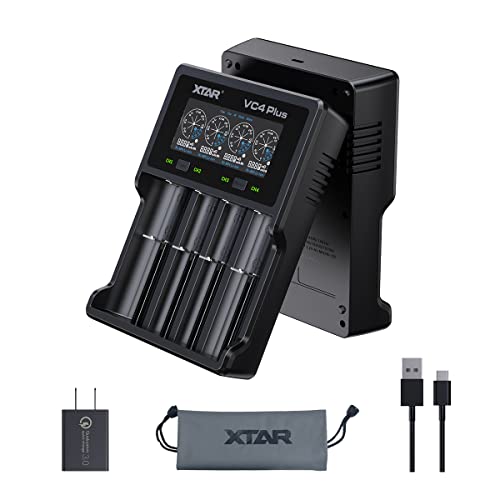
XTAR VC4 Plus Charger — Tinkerer's Bench Unit
The VC4 Plus is the hobbyist’s workbench variant of the VC line: USB-C powered, with customisable charging current, capacity testing, and a recovery function aimed at cells that have been discharged too deeply. That last feature needs careful framing. A quality charger refusing a cell that sits near zero volts is protecting you, because deep discharge damages lithium chemistry internally; a recovery mode that gently coaxes such a cell up to a testable voltage is a diagnostic tool, not a resurrection promise. Use it to evaluate, charge slowly, test capacity — and recycle any cell that needed rescuing more than once, or that warms, or whose capacity comes back a shadow of its rating. The VC4 Plus gives you the instruments; the judgement stays yours.
Day to day, the Plus behaves like its siblings: four slots, clear reporting, room for the long cells, NiMH support for the household drawer. Its audience is the user who enjoys the bench side of the hobby — testing, logging, matching — and for that user the difference between the Plus and the plain VC4 is the difference between a charger and an instrument. If none of that appeals, the VC4 or VC4SL will serve you with less to learn; if it does appeal, this is the most engaging charger in the guide.
- Format: 4 slots, USB-C powered
- Control: customisable charge current
- Tests: capacity testing plus deep-discharge recovery mode
- Chemistries: Li-ion family and NiMH
- Display: per-slot charging information
Strengths
- Recovery mode evaluates over-discharged cells under control.
- Adjustable current suits everything from 16340 to 21700.
- Capacity testing supports matching cells for demanding devices.
Trade-offs
- Recovery is a diagnostic, not a cure — discipline still required.
- Feature depth is wasted on insert-and-forget users.
- USB-C supply quality still governs real-world pace.
Best for: bench hobbyists who test, match and log their cells. Not suited for: anyone tempted to resurrect every dead cell they find.
How do the six chargers divide the work?
| Charger | Slots | Character | Testing | Power |
|---|---|---|---|---|
| Nitecore UMS4 | 4 | Fast and informative | Monitoring data | USB, QC |
| Nitecore UMS2 | 2 | Portable and quick | Monitoring data | USB-C, QC |
| XTAR VC4 | 4 | Gentle and clear | Capacity shown | USB |
| XTAR VC4SL | 4 | Fast with grading | Grade + resistance | QC3.0 adapter included |
| Nitecore UI1 | 1 | Minimal spare | None | USB |
| XTAR VC4 Plus | 4 | Bench instrument | Test + recovery | USB-C |
The pattern to notice: speed and analysis rarely peak in the same box, and the two brands lean opposite ways. Choose Nitecore when your pain is waiting; choose XTAR when your pain is not knowing. The UI1 stands outside the contest entirely, as insurance.
Which charge current should you actually use?
The durable rule of thumb is to charge at roughly half the cell’s capacity per hour or less for longevity — around 1 amp for a typical 18650 — and to treat higher rates as an occasional tool, not a default. Small cells deserve small currents: a 16340 or 14500 fed at a big slot’s maximum is being bullied, and every charger here that offers selectable current expects you to make that match. The cell maker’s datasheet, findable for every genuine cell, states a standard and a maximum charge rate; the maximum is a ceiling for rare need, not a recommendation for Tuesday.
Heat is your feedback instrument. A cell that finishes mildly warm has been worked; a cell that finishes hot has been abused, by rate, by age, or by both. Build the habit of touching cells at harvest — it takes a second, and it is the cheapest monitoring system in this entire guide.
How can you spot a counterfeit or rewrapped cell before it hurts you?
Counterfeiters rewrap low-grade or salvaged cells in copies of famous brands’ skins, so the wrapper proves nothing by itself. The tells are cumulative. Weight is the crudest: a genuine high-capacity 18650 has a characteristic heft, and fakes stuffed with smaller internals or poor materials often weigh noticeably less — a cheap kitchen scale exposes more fraud than any visual inspection. Capacity is the decisive test: run a grading cycle on a charger like the VC4SL, and a cell sold as a premium high-capacity model that measures half its claim has identified itself. Genuine cells cluster tightly around their ratings; fakes scatter.
Provenance beats inspection, though, because it works before money changes hands. Authorised battery dealers stake their business on genuine stock and price accordingly; a listing dramatically cheaper than every specialist, shipping from a storefront that also sells phone cases and garden hose, is telling you its supply chain in plain language. Odd details corroborate: misspelled printing, wrappers in colours the maker never used, capacities beyond anything the named brand sells, and date codes that do not match the model’s production era. One red flag is a warning; two are a verdict. And when a fake is confirmed, do not sell it on or gift it — recycle it, because passing a dangerous cell to a stranger is worse than losing its purchase price.
Why does internal resistance matter, and how do you use the reading?
Internal resistance is the cell’s friction: the opposition inside it that turns some of its energy into heat and makes its voltage sag under load. A fresh, quality 18650 has low resistance and holds its voltage proudly in a demanding torch; as cells age, are overheated, or are simply born mediocre, resistance climbs, and the symptoms arrive in a predictable order — shorter runtimes, dimmer high modes, a vape that feels weak, a cell that warms during ordinary charging. Chargers like the VC4SL that display resistance give you the number behind those symptoms.
Used well, the reading is a management tool rather than a curiosity. Log it when a cell is new, and you own a baseline; re-measure seasonally, and the fleet sorts itself into the strong, the fading and the finished without guesswork. Matching matters most in multi-cell devices, where cells work in series or parallel teams: a high-resistance cell among low-resistance partners becomes the bottleneck and the heat source, so sets should be built from cells of similar age, capacity and resistance, then kept together for life. That is the entire science of cell matching, and it is why the chargers with measurement modes keep appearing in serious kits.
How should cells be matched and managed for multi-cell devices?
Devices that run two, three or four cells at once — powerful torches, big fans, some vapes and many DIY packs — are only as balanced as their weakest cell. The discipline is simple to state: cells that work together should be bought together, be the same model from the same maker, start life together, and never be separated into other duties or mixed with strangers. Enthusiasts call a set “married”, and the metaphor is exact: shared history, shared fate, retirement together.
The reason is divergence. Cells in a team discharge in step only if they began in step; a weaker partner reaches empty first, and in series arrangements can be dragged below safe voltage by its stronger siblings while the device still seems to run. Chargers cannot repair that from outside — per-slot charging refills each cell fully, which helps, but capacity and resistance differences persist into the device. Mark married sets with a band or a letter, charge them together even though the slots are independent, rotate their positions if your device treats slots unevenly, and when one member fails, demote the survivors to single-cell duty rather than remarrying them to a new partner. Single-cell torches are where old sets go to live out their days usefully.
How should you store 18650 cells for months at a time?
Lithium-ion ages fastest at the extremes: stored fully charged and warm, it loses capacity on the calendar even if never cycled. For storage beyond a month or two, the settled practice is a partial charge — roughly forty to sixty percent, which corresponds to a resting voltage around 3.6 to 3.8 volts — in a cool, dry place, inside a proper case. Chargers with displays make hitting that window easy: charge or discharge to the target voltage, then put the cell away and stop thinking about it. Cells stored this way wake up months later having lost very little.
Two storage errors recur. The first is storing cells in the device they power, where parasitic drain can pull them below safe voltage over a season — the torch in the drawer that kills its own cell by spring. Take cells out for long storage, or check the device monthly. The second is the junk-drawer pile: loose cells among metal clutter, terminals exposed to whatever the drawer holds. Cases exist precisely because a drawer is a box of conductors. Tape the terminals of any cell awaiting recycling, too — a dead cell still holds enough energy to make a short circuit interesting.
Which devices are driving 18650 use now, and what do they ask of a charger?
The torch world remains the cell’s heartland, and modern high-output lights are demanding masters: they pull current that separates genuine high-drain cells from pretenders in seconds, and their owners feel charger quality as brightness and runtime. Vaping, though quieter than its peak years, still cycles cells daily and hard, which is why vapers gravitated to fast, informative chargers early — and why the safety culture around wraps and cases is strongest there, a culture every other user group would benefit from copying wholesale.
Beyond those two, the cell turns up in cordless fans on building sites, in video doorbells and cameras whose makers chose replaceable power over sealed batteries, in power banks that let users swap cells, in e-bike and scooter packs built from dozens of welded cells — a professional domain where individual chargers like these serve for testing and sorting rather than pack charging — and in the endless DIY economy of solar lights, model projects and revived cordless tools. Each use asks something slightly different of the charger: the site worker wants pace, the camera owner wants a spare slot and a USB lead, the DIY builder wants measurement. The six picks divide those loyalties cleanly, which is why this guide resists naming one winner for a category whose users want such different things.
How do you rewrap a damaged cell covering safely?
Rewrapping is the one piece of cell maintenance owners are encouraged to do themselves, and it is genuinely simple: the old torn PVC sleeve comes off, a new heat-shrink sleeve of the correct size goes on with the insulating ring preserved at the positive end, and gentle heat from a hair dryer or heat gun shrinks it smooth. The insulator ring is the part that matters most — that small disc separates the positive button from the can, which is the negative terminal, and losing or misplacing it turns a rewrapped cell into a short circuit wearing a new coat. Keep the ring, or replace it with a fresh adhesive one, every single time.
Know the limits of the repair. Rewrapping fixes insulation, nothing else: a dented can, a corroded top, a cell that has vented or run hot is not a candidate, because the damage that matters is underneath the sleeve. Work on one cell at a time on a clear bench, never with metal tools prying near the top cap, and treat any cell whose internals you can see as finished. Done properly, rewrapping extends the honest life of good cells whose only fault is a torn coat — a common injury from tight charger springs and torch battery tubes — and it is a skill worth the ten minutes it takes to learn.
How do heat and cold change lithium charging?
Lithium-ion has a narrower comfort zone than NiMH, and both ends of the thermometer carry specific risks. Charging a cell that is below freezing can plate metallic lithium inside it, permanently damaging capacity and creating an internal hazard that may only declare itself later; quality chargers sense temperature and refuse or throttle in the cold, and owners should do the same manually — let a cell that spent the night in a cold car warm to room temperature before it goes on charge. At the hot end, charging in a sun-baked room or a hot vehicle accelerates every ageing reaction the chemistry has, and a cell that is already warm from hard use should rest before charging, not go straight from torch to slot.
The household rule that covers nearly everything: charge cells at the temperatures you would choose for yourself, in the rooms you live in. The chargers here are bench appliances, not garage ornaments, and the cells reward indoor manners with years of extra service. If a cell ever becomes too hot to hold comfortably during charging, stop, remove it when safe, and retire it — heat on charge is the clearest distress signal this chemistry sends, and it should never be argued with.
What happens to cells at the end of their life?
Retirement, planned well, is boring. A cell whose graded capacity has fallen to a fraction of its rating, whose resistance has climbed, or whose runtime in its usual device has collapsed gets its terminals taped and goes into the battery recycling stream — through a retailer collection point, a household hazardous-waste event, or a dedicated battery recycler, never into general rubbish, where it can be crushed in a collection truck among flammable waste. Tape matters because even a “dead” cell holds residual energy, and the tape is what keeps its last joules from finding a path through a bin of metal.
Transport rules echo the same logic at larger scale: airlines want lithium cells in cabin baggage, in cases, with terminals protected, and they ban them from checked luggage for reasons a moment’s thought about cargo-hold fires makes obvious. Owners who internalise the household version — case, tape, no loose cells, no damaged cells travelling — are already compliant with the spirit of every regulation written on the subject. End-of-life is part of owning this chemistry, and the chargers that measure capacity earn a final point here: they tell you when the end has arrived, in numbers, before a device or a drawer tells you the hard way.
Flat top, button top, protected: which physical variant does your device need?
Three physical variants confuse new buyers more than any specification. Flat-top cells end flush at the positive terminal and are the default for devices with their own contacts and electronics — most modern torches, vapes and packs are built around them. Button-top cells add a small raised nub that mimics a consumer battery’s shape, needed by older torches and devices whose positive contact is recessed or flat; a flat-top in such a device may simply never make contact. Protected cells add the circuit board discussed earlier, usually with a button top, and gain several millimetres that tight battery tubes cannot spare.
The chargers in this guide accept all three — their sliding rails adjust across the full length range — so the constraint lives entirely in your device. Measure before ordering, read the device maker’s cell specification, and remember that “18650” names the bare cell’s dimensions; a protected button-top can be 69 or 70 millimetres long in an 65-millimetre world. Returns in this category are dominated by exactly this centimetre-scale misunderstanding, and it is entirely avoidable with thirty seconds and a ruler.
What does a sensible lithium charging corner look like?
It looks undramatic, which is the point. The charger sits on a hard, clear surface — a bench, a metal tray, a ceramic tile on a desk — with nothing flammable parked on top of it and air around its vents. Cells waiting to charge stand in a case or a rack, not in a heap; charged cells go to a different case or a labelled side of the same rack. A small pair of side cutters, spare wraps and insulator rings live nearby for the maintenance described above, and the recycling tube for dead cells sits within arm’s reach so that retiring a cell is a five-second act rather than a resolution.
Location follows occupancy: a room people pass through, where a smell or a sound would be noticed, rather than a closed cupboard or a garage corner visited weekly. Owners who run many cells add a smoke alarm above the bench, not from fear but from the same logic that puts one above a cooker. Set up once, this corner asks nothing further of you — and it converts the safety section of this guide from advice into architecture.
How does a charger know what kind of cell you just inserted?
Mostly by voltage, read the instant the cell seats. A NiMH cell presents around 1.2 volts nominal; a lithium cell presents 3.6 to 3.7, and a LiFePO4 cell sits between at 3.2. The chargers here measure that signature and select the correct profile — which is why inserting a lithium cell into a NiMH-only charger from another drawer is so dangerous, and why dual-chemistry units like these six earn their place: they remove a whole class of human error by identifying the cell themselves. The exception demanding your attention is LiFePO4 on some models, where a manual setting chooses its lower 3.6-volt full charge; feed a LiFePO4 cell a standard lithium profile and it will be overcharged, so owners of that chemistry must read the manual’s setting instructions once and carefully.
Size, by contrast, the charger cannot know — the sliding rail accepts whatever fits, and a 16340 in a slot set to a 21700’s current is the user’s mistake to avoid. This is the deeper reason selectable current matters and why several picks default conservatively: the charger knows chemistry, guesses nothing about size, and waits for you to tell it how hard to push. Owners who build the habit of checking the current whenever a small cell goes in have understood the machine correctly.
What mistakes do 18650 owners make most often?
Buying cells on price and capacity claims leads the list, and it feeds every other mistake: fake cells run hot, sag under load, and die young, and their owners blame chargers and torches in turn. Second is pocket carry — a loose 18650 against keys is a short circuit looking for a moment, and the resulting venting incidents are the ones that make news. Cases cost almost nothing; use them.
Third is charger neglect of a particular kind: leaving cells charging unattended for days on the assumption that termination makes it fine. Termination does make it safe under normal conditions, but attended charging on a clear, hard surface is the standard the whole hobby runs on, because the rare failure is only cheap when someone is there to unplug it. Fourth is resurrecting the dead — prising cells from dead packs, charging swollen or dented finds, trusting a recovery mode as a pardon. The recycling bin is the correct destination for all of them, and no torch is worth a bench fire.
Final Recommendation
Buy the charger that matches your pain. If waiting is the pain, the Nitecore UMS4 — fed by a proper QC adapter and run at sensible currents — ends it, with the UMS2 as its travelling sibling. If not knowing is the pain, the XTAR VC4SL’s grading turns your fleet into an open book, while the VC4 Plus serves the bench hobbyist who wants to test and evaluate everything, and the plain VC4 remains the calm, gentle default for keepers of good cells. Add a UI1 to your bag whatever else you buy. Then spend as much care on the cells as on the charger: genuine stock from real dealers, wrappers inspected, cases for carry, recycling for the dead. Do those things and an 18650 stops being a small worry and becomes what it should be — the most useful battery you own.
Frequently Asked Questions
Can I charge a 21700 in these chargers?
Yes — every pick here accepts 21700 cells, which is one reason the 18650 category and the 21700 category now share hardware. On some four-slot designs the longest cells fit best in the outer bays; follow the manual’s slot diagram rather than forcing a spring.
What is the difference between protected and unprotected 18650s?
A protected cell adds a small circuit that cuts off over-charge, over-discharge and shorts, at the cost of a few millimetres of extra length. Unprotected cells rely on the device’s electronics. Buy whichever your device was designed for, and check fit before assuming a protected cell suits a tight tube.
Is it safe to leave cells charging overnight?
These chargers terminate properly, so the risk is low — but the hobby’s standard is attended charging on a hard, clear surface, because the rare cell failure is only a small event when someone is nearby. Charge in the evening while you are home and awake, and harvest before bed where you can.
Why does my charger refuse a cell or show an error?
Usually because the cell’s voltage is outside the safe window — most often over-discharged — or its resistance has climbed beyond what the charger accepts. Treat a refusal as information, not defiance: test the cell if your charger offers a recovery or grading mode, and recycle it if it misbehaves twice.
Can these chargers handle AA batteries too?
Yes. All six accept NiMH AA and AAA cells alongside lithium sizes, with the charger detecting chemistry per slot. That dual role is why one of these units can replace both a lithium charger and the household NiMH charger for most drawers.
How long do 18650 cells last?
A genuine cell from a major maker is typically rated for several hundred full cycles before capacity fades to around eighty percent, and calendar age matters too. Gentle charge rates, sane storage and avoiding deep discharge stretch real life considerably; counterfeit cells, by contrast, may be tired the day they arrive.
Can I charge cells I salvaged from an old laptop or tool pack?
We advise against it, plainly. Pack cells have unknown histories, matched-set wear, and often physical damage from the prising and un-welding that salvage requires; their wrappers and tops take the worst of it, exactly where damage is least acceptable. A graded test on an analysing charger can describe a salvaged cell, but description is not safety, and the savings over a new genuine cell are small against the risk carried. Buy fresh cells from authorised dealers and let the pack cells go to recycling whole.
Why do two identical-looking cells perform so differently?
Because the wrapper is the easiest part of a cell to copy and the internals are where performance lives. Differences in electrode quality, electrolyte and manufacturing tolerance separate a major maker’s cell from a rewrap even when the printing matches perfectly. Weight and a graded capacity test, as described earlier, are the owner’s two reliable witnesses.
Should beginners start with an analysing charger or a simple one?
Start with the charger whose information you will actually read. A beginner with a VC4SL who runs one grading cycle per season learns more about cell care in a year than an owner of a simple charger learns in five, because the numbers make ageing visible before it becomes failure. But a beginner who finds menus irritating should take the plain VC4 or a UMS model and charge safely with fewer decisions. The unsafe beginner is not the one with the simple charger — it is the one whose cells came from a suspicious listing, whatever the charger.
What should I do if a cell vents or catches fire while charging?
Unplug the charger if you can do so without reaching across the cell, move away, and let the cell burn out in place if it is on a non-flammable surface clear of other fuel — lithium cell fires are short, fierce and best not carried through a house. Never use water on a burning lithium cell fire in a home setting if it risks spreading; smothering with a metal container or using a suitable extinguisher, then ventilating the space and treating the remains as hazardous waste, is the safer sequence. Afterwards, retire every cell that shared the charger until each is inspected, and replace the charger if it was heat-damaged. Prevention — genuine cells, inspection, attended charging — exists so that this answer stays theoretical.
Do I need a separate charger for LiFePO4 cells?
Not if you choose from this guide — several picks support LiFePO4’s lower voltage profile. What you do need is attention: on chargers where the LiFePO4 profile is a manual selection, set it deliberately every time, because charging a LiFePO4 cell on a standard lithium profile overcharges it, and charging a standard cell on the LiFePO4 profile merely underfills it. The asymmetry makes one direction an inconvenience and the other an abuse, so build the checking habit accordingly.
Related Guides
For the household side of the drawer, our guide to the best AA and AAA battery chargers covers NiMH-only units in depth. Running a big fleet of small cells? See the sixteen-bay charger roundup for microphone and flash fleets. And if your lithium habit extends to RC packs, the affordable LiPo charger guide explains balance and storage charging, which cylindrical-cell chargers do not do.


