Our Top Picks
 Casio Men's Quartz Day-Date Indicator Black Resin DiveAdult0 x 0 x 0 inches0.1 poundsCheck on Amazon


What's inside
- Four families of rotating bezel, and one neighbour that is not family
- The dive bezel in depth: ISO 6425 and what the standard actually requires
- Mechanisms: ratchet clicks, friction rings, and what each feels like over years
- Reading the fine print: click count, backplay, and alignment at twelve
- Insert materials: aluminium, ceramic, sapphire, and steel compared honestly
- Using the ring in ordinary life: cooking, training, travel, and timed work
- Water resistance: the ring is not the seal
- Size and fit: bezel diameter, case diameter, thickness, and the small-wrist question
- Choosing by archetype: five specification profiles and who each serves
- Care, faults, and the questions to ask before buying
- A short history that explains the shapes on sale today
- Bezel timing versus a chronograph: choosing the simpler tool
- A worked specification reading, line by line
- Check prices on Amazon
- Common myths, corrected in one place
As an Amazon Associate I earn from qualifying purchases. This post may contain affiliate links at no extra cost to you.
A rotating bezel looks like decoration until the first time it saves a task. Turn the ring so its marker lines up with the minute hand, and the watch becomes a simple elapsed-time counter that needs no battery, no menu, and no glance at a phone. Turn a different kind of ring to a second time zone, and the same gesture tracks a home clock while the main hands show local time. That small rotating ring is the oldest complication most people will ever own, and it is also one of the most misunderstood parts of a watch specification sheet, because the word bezel covers several unrelated mechanisms that happen to share a circular shape.
A note on how this guide was put together, written for this article alone: every figure, standard, and material property discussed below comes from manufacturer-published specification sheets, technical documentation, and the published text of the relevant international standards, rather than from any claim of having worn, submerged, or handled the watches covered. Readers who later follow retailer links on this page to buy a watch should know that the site may earn a commission on that purchase, and that possibility does not change which mechanisms, materials, or limitations are described here, including the ones that argue against spending more.
Scope matters before anything else. This guide covers traditional watches: mechanical movements and quartz movements in a fixed case, with a physical ring that a wearer turns by hand. A rotating ring on a smartwatch is a different thing in kind, not merely in style. On a device such as a Galaxy Watch, the raised ring is an input controller. It scrolls lists and zooms interfaces through an encoder, and its motion is read by electronics. It does not carry its own independent scale against the dial, it stops working as a timing reference when the screen sleeps or the battery dies, and it has no safety direction, no insert material in the horological sense, and no relationship to a water-resistance standard for diving. Both designs are legitimate. They simply answer different questions, and mixing their vocabulary leads buyers to expect a dive timer from a scrolling wheel or a software interface from a steel ring.
Four families of rotating bezel, and one neighbour that is not family
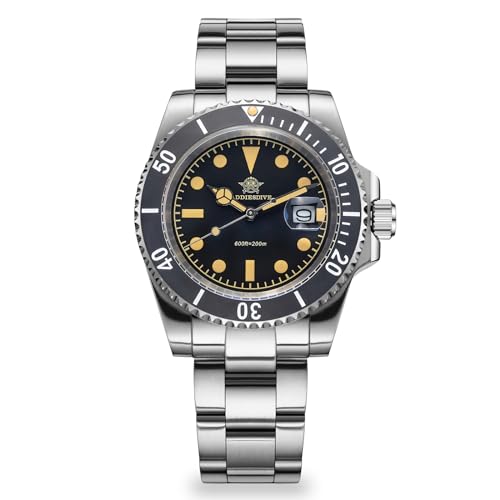
The first family is the dive bezel, the design most people picture. It rotates in one direction only, counterclockwise, and it carries a sixty-minute scale with a luminous marker, often called a pip, at the zero position. The one-way restriction is a safety feature with a specific failure logic. If a diver bumps the ring against a wreck, a rock, or a wetsuit cuff, the ring can only move in the direction that makes the indicated elapsed time longer, never shorter. A longer reading pushes the diver toward the surface earlier than the true bottom time requires. A shorter reading would do the opposite, quietly granting minutes that do not exist. Every other detail of the dive bezel, from its coarse grip to its minute-by-minute first quarter markings, serves use underwater with gloves on and visibility down.
The second family is the GMT bezel. It rotates in both directions, carries a twenty-four-hour scale instead of a sixty-minute scale, and works as a partner to an additional hour hand that completes one revolution per day. Set the main hands to local time, set the twenty-four-hour hand to home time, and the bezel reads home time at a glance. Rotate the ring by the offset of a third city, and the same hand reads that city against the ring while still reading home time against the dial chapter. Bidirectional movement is correct here rather than dangerous, because the ring is a calculator for offsets, not a safety timer, and a traveller needs to move it forward for eastward offsets and backward for westward ones without travelling all the way around the dial.
The third family covers counting bezels, which split into count-up and count-down variants that are easy to confuse in a listing photograph. A count-up bezel is essentially the dive layout without necessarily carrying a diving specification: numbers rise in the direction of rotation, and the wearer reads elapsed minutes directly. A count-down bezel reverses the scale. Its numbers fall, so the wearer sets the marker to the number of minutes remaining and reads time left rather than time spent. Pilots historically valued count-down rings for timed approach segments, and cooks value them for the same reason a kitchen timer counts toward zero. A listing that says only rotating bezel, without stating direction or scale, has told the buyer almost nothing, because a count-down ring used as a count-up timer produces readings that feel plausible and are wrong.
The fourth family is the compass bezel, marked with cardinal and intercardinal points and degree graduations. Used with the hour hand pointed toward the sun in the northern hemisphere, the halfway point between the hour hand and twelve o clock approximates south, and the ring then holds that bearing so the wearer can read directions off the dial while walking. It is a fair-weather navigation aid of real but limited precision. It depends on the correct hemisphere convention, on whether local time matches solar time, and on a visible sun, and it offers nothing at night, under canopy, or in a city of steel that disturbs nothing about the sun method but blocks the view of it. Treat it as a backup orientation tool, not as a replacement for a magnetic compass or a map.
The neighbour that is not family is the slide-rule bezel, found on some pilot watches. It does not time anything. Its two logarithmic scales, one on the ring and one on the dial edge, multiply, divide, and convert units when rotated against each other. It belongs in this guide only to draw the boundary clearly: if a ring carries numbers running into the tens with a logarithmic spacing that crowds at one end, it is a calculator, and judging it by click count, pip alignment, or unidirectional safety misses what it is for.
The dive bezel in depth: ISO 6425 and what the standard actually requires
The letters that separate a dive watch from a watch that merely looks like one belong to ISO 6425, the international standard for divers watches. A watch conforming to that standard must, among other requirements, carry a unidirectional rotating bezel with a scale graduated at least every five minutes and a prominent marker at sixty minutes, be readable in darkness at a stated distance, resist magnetism and shock to stated levels, and survive water-resistance testing beyond its rated depth. The rating itself begins at 100 metres for a watch described as a divers watch under the standard, with 200 metres and 300 metres common in practice. The standard also requires an indication that the watch is running in total darkness, which is why a luminous pip or a luminous seconds hand matters functionally rather than decoratively.
Notice what the standard does not say. It does not require 120 clicks. It does not require a ceramic insert. It does not require a particular case diameter, a helium valve, or a steel bracelet. Marketing pages routinely present those features as though they were the substance of dive readiness, when the substance is a tested case, a protected crown, legible markings, and a ring that cannot be knocked into a shorter reading. A buyer comparing two watches, one rated to the standard with an aluminium insert and one styled after it with a ceramic insert and a lower tested depth, is looking at a genuine instrument beside a costume, whatever the surface materials suggest.
The 120-click pattern became dominant for a practical reason. One full turn divided into 120 detents gives a stop every half minute, which lets a diver, or anyone timing to the nearest half minute, set the marker precisely without hunting between coarse positions. Sixty-click rings stop once per minute and feel more deliberate, with a heavier clunk at each step. Ninety-click rings exist as a middle path. None of these counts changes the scale printed on the insert; the scale is always sixty minutes on a dive bezel. Click count changes the resolution of setting and the sound and feel of the action, which is why two watches with identical printed scales can feel entirely different in the hand.
Why the first fifteen or twenty minutes look different
On many dive inserts, the first fifteen or twenty minutes carry individual minute markers while the rest of the ring shows five-minute blocks with numerals at ten-minute intervals. That dense opening stretch descends from an era when decompression stops were timed in single minutes near the surface. Modern dive computers have taken over that work for most divers, yet the layout persists because it also helps any short timing task. Timing a three-minute rest interval, a four-minute steep, or a two-minute plank is easier when the opening minutes are individually marked. When the whole ring carries only five-minute blocks, short timings become estimation, and a buyer whose real use is intervals of one to ten minutes should weight that opening scale more heavily than the insert material.
Mechanisms: ratchet clicks, friction rings, and what each feels like over years
Under the ring, one of two broad mechanisms governs movement. The ratchet design uses a click spring, a thin piece of shaped steel, sometimes paired with a toothed ring, that drops into successive notches as the bezel turns. Each drop is a click the wearer hears and feels. The geometry of the teeth enforces one-way travel on a dive bezel, because the tooth faces are sloped on one side and steep on the other, so the spring rides up the slope in the permitted direction and jams against the steep face in the forbidden one. On a bidirectional GMT ring, the teeth are symmetric and the spring centres the ring at each stop in either direction. Ratchet action gives the crisp, indexed feel buyers describe as quality, and it holds position firmly, which matters for a safety timer.
The friction design has no teeth. The ring is held by a tension spring or a precisely fitted gasket-like element and can be set at any point in its travel, in either direction, with a smooth resistance. Older pilot and field watches often used friction rings, and the advantage is infinite resolution: a count-down can be set to a fraction of a minute, and a compass ring can be aligned exactly rather than to the nearest detent. The disadvantages grow with age. Friction elements wear and dry, the ring gradually turns more easily than it should, and a ring that drifts under a shirt cuff is worse than a coarse ring that stays where it was left. A vintage friction bezel that spins freely has not become smoother with character; it has lost the property that made it useful.
A third arrangement, appearing on some modern tool watches, uses small ball bearings and springs seated in the case, pressing into recesses under the ring. It produces a softer, more damped click, resists the entry of grit better than an exposed click spring in some designs, and tends to keep its feel longer between services. It is also harder for an independent watchmaker to source parts for than a simple flat click spring. None of the three mechanisms is best in the abstract. The ratchet suits a dive timer, friction suits a compass or a slide-rule-adjacent counting ring where exact alignment matters, and bearing systems suit a buyer who values a damped action and accepts brand-dependent servicing.
Wear shows up in predictable places. A click spring fatigues and the clicks lose definition, becoming a vague shuffle. Grit, especially sand, works under the ring and grinds; the correct response is rinsing under clean running water while gently turning the ring, never prising it off with a blade unless the design is explicitly made for owner removal, as a few are. Salt crystals left after sea use stiffen the action over a season. A ring that was crisp in the shop and gritty after a beach holiday is usually dirty rather than broken, and a buyer who plans real water use should ask how the ring is retained and whether a watchmaker can lift, clean, and re-seat it during a routine pressure service.
Reading the fine print: click count, backplay, and alignment at twelve
Three qualities separate a well-made ring from a careless one, and only one of them appears in most listings. Click count appears, because it is a number. Backplay does not, because it is a fault. Backplay is the small reverse wobble after the ring settles into a detent: turn the ring one click, release it, and a ring with backplay rocks backward by a fraction of a step before the spring holds it. A small amount is normal in mass-produced ratchet systems, where tolerances stack between the toothed ring, the spring, and the case. Excessive backplay makes precise setting annoying, because the marker drifts off the minute hand it was just aligned to, and it tends to worsen as the spring wears. Judging it requires handling the watch, which is one honest reason specification sheets alone cannot settle a purchase between two otherwise similar models.
Alignment is the fault buyers photograph. On a correctly assembled watch, the pip or triangle at zero sits exactly on the twelve o clock marker when the ring is at rest in its top detent. On a carelessly assembled one, it sits visibly half a click to one side, and because the detents are fixed, no amount of turning fixes it: every stop inherits the same offset. Misalignment arises when the insert is pressed into the ring slightly rotated relative to the teeth beneath. It has no effect on timing accuracy in elapsed terms, since the wearer aligns the pip to the minute hand rather than to twelve for real timing, yet it signals assembly care, and on a GMT bezel a half-step offset genuinely does corrupt readings against the dial, because there the ring is read against fixed dial markers. Buyers of GMT models should therefore treat top alignment as a functional check, not a cosmetic preference.
Luminous pips deserve their own scrutiny. The pip may be a small inset dot of luminous compound under a protective dome, a printed triangle filled with compound, or, on some inserts, a fully luminous marker flush with the surface. The compound itself is usually a strontium aluminate pigment, sold under trade names, which charges under light and glows for hours, far outlasting the tritium gas tubes found on a minority of tool watches, which glow without charging but fade over a half-life measured in years and are regulated as a radioactive material in some markets. A pip that glows brightly for ten minutes and fades within the hour is using a cheaper pigment grade or a very thin application. For a diver, sustained glow across a dive matters. For a cook timing pasta, almost any pip is more than sufficient, and paying for the highest grade of luminous material to time noodles is money spent on a specification with no matching task.
Insert materials: aluminium, ceramic, sapphire, and steel compared honestly
The insert is the printed or engraved ring that carries the scale, seated inside the rotating bezel. Its material determines how the scale ages, and the four common materials age in four different ways. Anodized aluminium is the original. A thin aluminium disc is printed, then anodized so the colour sits in a hardened oxide layer. It is light, cheap to produce, and easy to replace, and it scratches. A knock against a door frame can gouge the colour through to bright metal, and strong ultraviolet exposure fades saturated colours over years, which is why vintage aluminium inserts develop the soft, sun-bleached look collectors prize and working divers regard as wear. Replacement inserts for popular models are inexpensive parts, and a watchmaker can swap one during a service, which makes aluminium the most forgiving material over a long ownership.
Ceramic inserts, usually zirconia ceramic, answer the scratching and fading problems directly. Zirconia is extremely hard, far harder than steel, so keys, buckles, and masonry that would scar aluminium slide off it, and its colour is fired through the material rather than printed on a surface, so it does not fade in sunlight. The trade is brittleness. Hardness and toughness are different properties, and ceramic that shrugs off abrasion can crack or chip under a sharp point impact, a drop onto tile being the classic case. A cracked ceramic insert cannot be polished out or touched up; it is replaced as a unit, and for some brands that replacement is a brand-only part at a brand-only price, fitted during a service the owner may not otherwise have needed yet. Ceramic suits a buyer whose enemy is daily abrasion. It suits less well a buyer whose watch will meet concrete from wrist height.
Sapphire inserts take a different approach: a transparent sapphire disc sits over a printed or luminous layer, so the scale is protected beneath one of the hardest transparent materials available. The result can be striking, especially when the numerals themselves are luminous beneath the sapphire and glow through it at night. Sapphire shares ceramic brittleness under impact, adds reflections that can hurt legibility at some angles despite coatings, and costs more to produce because the disc must be grown, cut, and polished rather than pressed. It is most common on higher-end GMT and dive models where the glowing scale is the point. Steel inserts, engraved and sometimes filled with paint or luminous compound, are the quiet option. They scratch like the case around them, which means they age at the same rate as the rest of the watch instead of staying eerily new beside a worn case, they never shatter, and a brushed finish can be refinished. For a field watch expected to look uniformly used in ten years, steel is arguably the most coherent choice.
Hardness numbers without the mythology
Specification pages love hardness figures, quoting Vickers numbers for ceramic and placing sapphire near the top of the Mohs scale, and the numbers are real but incomplete. Mohs ranks scratch resistance only, and Vickers measures indentation resistance; neither measures fracture toughness, which is the property that decides whether an insert survives a drop. A complete reading of an insert specification asks three questions: how easily does it scratch, how does its colour age, and what does replacement involve when the worst happens. A material can win the first two questions and lose the third so badly that lifetime cost favours the humbler option, especially on a watch bought to be used hard rather than kept pristine.
Using the ring in ordinary life: cooking, training, travel, and timed work
Most owners will never time a decompression stop, and the ring earns its place on land. The cooking case is the purest. Align the pip with the minute hand when a dish goes into the oven, and elapsed time reads off the dial without unlocking anything, setting anything, or silencing anything. A count-down ring does the same job in reverse for a cook who thinks in time remaining. The limitation is the sixty-minute ceiling: a slow braise outlasts the scale, and the wearer must note the hour mentally or turn the ring again each hour, at which point a phone timer is honestly better. For tasks between one minute and one hour, which covers a surprising share of timed life, the ring is faster than any application because it is already on the wrist and already running in the sense that the minute hand never stops.
Interval training uses the same gesture with the dense opening scale discussed earlier. Rest periods of one to three minutes, work rounds of a fixed length, and breathing drills all sit inside the first quarter of the ring. A watch with minute-by-minute markers to fifteen or twenty minutes serves this better than a cleaner design with five-minute blocks, even if the cleaner design costs more. Swimmers and surfers add a second requirement, which is that the ring must turn with wet hands and stay put under a wetsuit or rash guard cuff, favouring tall, deeply notched ring edges over low, coin-edge profiles that look refined and slip when wet.
Travel is the GMT ring at work, and its real advantage is not the second zone itself but the third. Two zones can be carried by almost any travel watch with a jumping hour hand. The rotating ring earns its complexity when an itinerary crosses a zone the hands are not set to: a call home from a layover city, a connecting flight timed in a hub zone, a colleague in a fourth place. Rotating the ring by the difference between local and target, reading the twenty-four-hour hand against it, then rotating back, is a mechanical routine that takes seconds and leaves the main setting untouched. The failure mode to guard against is daylight saving change, which alters offsets twice a year and silently invalidates any memorised ring position. Experienced travellers re-derive the offset on arrival rather than trusting the position the ring was left in last trip.
Timed professional work rounds out the picture. A nurse timing a manual pulse or respiration count, a photographer timing a development tray, a teacher timing an examination segment, and a technician timing a curing compound all use the same align-and-read motion. In each case the relevant specification is not depth rating or insert hardness but legibility at arm length, a ring that can be set with one hand while the other is occupied, and markings that survive the chemicals or cleaning agents of that workplace. A specification sheet read through the lens of one specific job is worth more than a ranking read through no lens at all.
best affordable round android smartwatches
Water resistance: the ring is not the seal
A rotating bezel contributes nothing to water resistance, and this is the most consequential misunderstanding in the category. The ring sits outside the sealed envelope of the watch. Water passes under it freely by design, which is why rinsing under it is safe and necessary. The seal lives at the crystal, the case back, and above all the crown. A watch rated at 100 metres has passed static pressure testing equivalent to that depth under laboratory conditions, with the crown as the most likely entry point in real use. A watch rated at 200 metres adds margin, and margin matters because real water exposure is dynamic: a swimming stroke, a wave, or a shower jet momentarily spikes pressure at a gasket far beyond what still immersion at the surface suggests.
The screw-down crown is the feature that turns a rating into a diving capability. The crown threads into the case tube and compresses its gaskets when screwed home, locking the weakest opening shut. A push-in crown relies on gasket friction alone and can be pulled or knocked to a position where its seal is compromised, and operating any crown or pusher underwater on a watch not explicitly designed for it invites water in at the moment of operation. This is why the practical rule runs: 100 metres with a screw-down crown, kept screwed down, is a swimming and snorkelling watch; 200 metres with a screw-down crown and a standard-conforming specification is a diving watch; and a high number printed beside a push-in crown on a fashion model is a number about a laboratory, not about the sea.
Gaskets age regardless of use. The elastomer rings at the crown, case back, and crystal harden and take a set over years, faster in heat, sunlight, and exposure to solvents or sunscreen. Manufacturers therefore recommend periodic pressure testing, commonly every two to three years or at every battery change on a quartz model, where a watchmaker places the closed watch in a pressure chamber and measures case deformation to confirm the seals still hold. A watch that fails is opened, re-gasketed, and retested. Skipping this maintenance converts a 200-metre rating into a historical claim about the day the watch was made. Buyers of used dive watches should treat a recent documented pressure test as part of the value, and buyers of new ones should budget the recurring service as part of ownership, the way a car budget includes tyres.
What depth numbers mean for daily wear
For the large majority of owners, the honest translation of ratings is simple. A 30-metre or 50-metre rating means splash resistance and rain, not immersion, whatever the metre figure suggests to intuition. A 100-metre rating means swimming and showering are within design intent on a maintained watch. A 200-metre rating means recreational scuba within the limits of the diver certification and the standard. Hot water deserves a separate caution: showers and hot tubs combine heat, soap, and steam, which age gaskets and can drive moisture past seals through temperature cycling, and many manufacturers advise against hot showers even for highly rated watches. The ring, meanwhile, should be turned a few times under the tap after salt or sand exposure, which keeps grit from grinding the mechanism and costs nothing.
Size and fit: bezel diameter, case diameter, thickness, and the small-wrist question
Listings quote case diameter, but the rotating ring changes what that number means on the wrist. On many dive watches the bezel overhangs the case slightly, so a watch sold as 41 millimetres may present a ring of 42 millimetres at its widest, while on others the ring sits inside the case width and the crystal and dial feel larger than the number suggests. The dimension that decides comfort across the wrist is not diameter at all but lug-to-lug length, the distance from the tip of one set of lugs to the other, because that span determines whether the case bridges a small wrist or overhangs it. A compact 39-millimetre case with long, straight lugs can wear larger than a 42-millimetre case with short, curved lugs, and no bezel specification compensates for a lug span that exceeds the flat of the wrist.
Thickness interacts with the ring in a specific way. A tall bezel with deep grip notches adds visual and real height, and the total thickness of a dive watch commonly falls between 12 and 15 millimetres, with the ring, crystal, and water-resistant case construction each contributing. Under a shirt cuff, those millimetres matter more than diameter. A GMT intended for travel under business clothing often keeps its ring lower and its total height nearer 12 millimetres, while a professional dive model accepts 14 millimetres or more because grip with gloves outranks cuff clearance. Buyers should read thickness together with intended clothing, a connection specification sheets never make and wrists always do.
For smaller wrists, the encouraging development of recent years is the return of dive and GMT models at 36 to 39 millimetres with proportionally scaled rings, rather than the shrunken-dial approach of earlier decades. The ring on a well-scaled smaller model keeps full-depth grip notches and a full-size pip, because the maker redesigned the component rather than merely narrowing it. The point to check is click resolution: a smaller ring has a shorter circumference, so 120 detents are packed closer together and each click travels less distance under the fingers. Some smaller models therefore use 60 or 90 clicks deliberately, trading resolution for a more positive action at that size, which is sound engineering rather than cost cutting.
Weight completes the fit picture. A steel watch on a steel bracelet concentrates its mass around the whole wrist, while the same case on a rubber strap places the mass on top, and the ring, especially a steel ring with a sapphire insert, adds grams exactly where a top-heavy watch can least use them. Titanium cases and rings answer this directly at higher cost and with a different scratch behaviour, since titanium marks easily but can be refinished and never feels cold or heavy in the same way. None of this appears under the heading bezel in a listing, yet all of it decides whether the ring gets used daily or admired briefly and sold.
Choosing by archetype: five specification profiles and who each serves
Rather than ranking named models that change with every catalogue cycle, it is more durable to define profiles by specification and match them to people. The first profile is the standard-conforming diver: 200-metre rating, screw-down crown, unidirectional 120-click ring, aluminium or steel insert, minute markers through the first twenty minutes, and a documented pressure-test path through local watchmakers. This profile serves the buyer who will genuinely swim, snorkel, or dive with the watch and who values replaceable parts over pristine surfaces. Its weakness is thickness and a utilitarian dial that not every buyer wants at a desk.
The second profile is the traveller GMT: bidirectional 24-hour ring, ceramic or sapphire insert for colour that survives years of sun through aircraft windows, a twenty-four-hour hand, 100-metre rating with a screw-down crown, and a case kept near 12 to 13 millimetres thick. This profile serves the frequent traveller who times nothing underwater beyond a hotel pool and whose real instrument is the offset calculation. Its weakness is the absence of a minute-timing scale, which pushes cooking and interval tasks back to the phone unless the dial chapter carries minute markers the twenty-four-hour hand can be read against approximately.
The third profile is the count-down field watch: bidirectional friction or fine-ratchet ring with a reversed scale, high-contrast dial, modest 38 to 40 millimetre case, and a rating for rain and mud rather than depth. This serves cooks, teachers, medics, and outdoor workers whose timing question is how long is left. Its weakness is availability, since count-down rings are a niche within a niche and are often mislabelled in listings as ordinary rotating bezels, so the buyer must confirm the direction of the numerals in a photograph of the actual scale before ordering.
The fourth profile is the compass field watch: bidirectional ring with degree graduations and cardinal points, a dial designed so the hour hand can be used with the sun method, and a case light enough to disappear on a long walk. This serves hikers who want a backup orientation aid that cannot run out of charge. Its weakness is precision, and the honest buyer treats it as a way to hold a rough bearing between map checks, never as the primary navigation instrument in difficult terrain or poor visibility.
The fifth profile is the desk diver, a recognised and respectable category rather than a joke: dive styling, 100-metre rating, unidirectional ring used almost entirely for cooking, meetings, and parking meters, chosen because the owner likes the legibility and the tactile pleasure of a good ratchet action. This profile serves most actual buyers of dive-styled watches, and naming it honestly improves the purchase, because a desk diver can choose an aluminium insert without anxiety, skip the cost of extreme depth construction, and spend instead on the click feel and alignment quality that will be enjoyed every day.
Care, faults, and the questions to ask before buying
Ownership care for a rotating ring is short and mostly free. Rinse after salt water or sand. Turn the ring fully around a few times a month so the mechanism does not sit in one position and so any early stiffness is noticed while the watch is under warranty. Keep solvents, insect repellent, and strong detergents off the insert print, especially on aluminium. At each pressure service, ask the watchmaker to lift and clean under the ring rather than only replacing gaskets, since grit under the ring is the most common cause of an action that degrades between services.
The faults worth knowing by name are a ring that turns in both directions on a watch sold as a unidirectional diver, which indicates a broken or incorrectly fitted click spring and removes the safety property entirely; a pip offset that the seller dismisses on a GMT model, where offset corrupts readings; a count-down scale sold as count-up; and a ceramic insert with a hairline crack at an edge, which will propagate. Each fault is detectable from clear photographs or a short handling, and each is a reason to walk away rather than negotiate, because each points at assembly or damage beyond the visible symptom.
The questions that cut through a listing are equally concrete. Which standard, if any, does the water rating claim conformance to, and is the crown screw-down. Which direction does the ring turn, how many detents does it have, and does the scale count up or down. What is the insert material, and is a replacement insert available as a part, at what service route. What is the lug-to-lug length and total thickness, not only the case diameter. A seller who can answer all of these is selling a watch. A seller who answers with lifestyle language is selling a photograph, and the difference decides whether the ring on the wrist is an instrument or a costume.
In the end, a rotating bezel rewards the buyer who starts from a task and reads the specification backward from it, because the ring that times a rest interval, holds a bearing across a hillside, and tracks a home clock through three airports is not the most expensive ring or the hardest insert, but the one whose direction, scale, and action match the minute it was bought to measure.
A short history that explains the shapes on sale today
The rotating ring arrived in the early nineteen fifties, when recreational and military diving created a need that no existing watch answered: a diver descending with a finite air supply needed elapsed time visible at a glance, in murk, with gloves, without operating a pusher that might compromise a seal. The solutions that emerged within a few years of each other established the pattern still used now, a unidirectional ring with a luminous zero marker and a minute scale, paired with a high-contrast dial and a case tested well beyond surface pressure. The GMT ring followed a different pressure, the arrival of intercontinental jet travel, which put pilots and then passengers across so many zones in a single day that a second hour hand and a twenty-four-hour ring became practical necessities rather than novelties. Count-down and compass rings have older, quieter roots in military field equipment, where timing an interval to its end and holding a bearing were ordinary tasks long before they were leisure features.
That history explains otherwise puzzling details of modern listings. The dense minute markers in the first quarter of a dive ring are a fossil of decompression practice. The red and blue halves of a classic GMT insert are a day and night division for reading the twenty-four-hour hand, not a brand signature, and the convention only works when the colours divide the ring at six and eighteen. The knurled, oversized ring edge of a professional diver is a glove interface. When a modern watch borrows the look while discarding the logic, keeping the colours but moving the division, or shrinking the grip into a smooth decorative rim, the informed buyer can see exactly which part of the inheritance was understood and which was only copied.
Bezel timing versus a chronograph: choosing the simpler tool
A chronograph measures elapsed time with a dedicated mechanism, pushers, and subdials, and it does so to fractions of a second with a start, stop, and reset that a ring cannot match. For timing a single event longer than an hour, or several events in sequence, or anything needing precision below half a minute, the chronograph is the correct instrument and the ring is a toy by comparison. The ring wins on different ground. It has no mechanism to service beyond its own spring, adds no pushers that can be operated by accident or leak, keeps the dial uncluttered so the time itself stays legible, and can be set with a thumb while the other hand holds a rope, a pan, or a child. Its accuracy ceiling of roughly half a minute with a 120-click action is a real limitation that honest guides should state plainly, and for the large class of tasks measured in whole minutes it is a limitation that never binds.
Cost follows the same logic. A chronograph movement, mechanical or quartz, carries more parts, more servicing time, and more to go wrong than a three-hand movement with a ring, so at any given level of finishing the ring watch is the cheaper instrument to buy and to keep. Buyers who admire chronograph dials should buy one for that admiration, which is a legitimate reason, rather than persuading themselves they need split-second capacity they will use twice. Buyers who need minute timing daily and nothing finer will get more use, and more pleasure, from a well-made ring with a clean action than from a complicated dial whose pushers they never press.
A worked specification reading, line by line
Consider how the ideas in this guide combine on a single representative specification, of the kind listed for a mid-range diver. The line for water resistance reads 200 metres with a standard reference and a screw-down crown, which together say the watch may dive, provided its gaskets are maintained and pressure checks stay current. The bezel line reads unidirectional, 120 clicks, ceramic insert, luminous pip, which says the safety direction is present, the setting resolution is half a minute, the scale will resist scratches and sunlight, and the zero point will be visible in darkness, while leaving open the questions of backplay and top alignment that only handling answers. The case line reads 41 millimetres diameter, 48 millimetres lug to lug, 13.5 millimetres thick, which says the watch suits a medium wrist, will sit tall under a cuff, and should be tried with the intended strap because a bracelet will spread its weight while a rubber strap concentrates it. Read this way, a specification stops being a list of boasts and becomes a set of predictions about daily use, each of which can be checked, and that shift in reading habit is worth more than any single recommendation in this guide.
The same method exposes a weak listing instantly. A watch that advertises a rotating bezel and a depth figure but omits crown type, turn direction, click count, insert material, and lug-to-lug length is asking the buyer to fund the omissions. In a market where serious makers publish all of those figures as a matter of routine, silence on five consecutive functional points is itself information, and it points in one direction.
So choose the ring by the minute it must measure, the water it must survive, and the wrist it must live on, and let every other quality, from fired ceramic colour to the music of a well-cut ratchet, take its proper place as pleasure added to an instrument that already fits its job.
Check prices on Amazon
Live listings for the shortlist in this guide are pulled from Amazon below, so prices and availability are always current at the moment you look.



Common myths, corrected in one place
The first myth is that a higher depth number always means a tougher watch for daily life. Depth testing is static and specific, and a watch rated far beyond diving depths can still have a ring that misaligns, a crown that is awkward with gloves, or gaskets that its owner never maintains, while a modestly rated watch with current seals and a clean mechanism serves its owner flawlessly for decades. The second myth is that ceramic is simply better than aluminium. Ceramic wins on scratches and colour stability and loses on impact fracture and replacement route, and which loss matters depends entirely on whether the watch lives at a desk or on a building site. The third myth is that more clicks always mean higher quality. Click count is a resolution choice interacting with ring size and spring design, and a well-made 60-click action with no backplay is a better mechanism than a sloppy 120-click action that rocks at every stop.
The fourth myth is that a GMT ring shows a second time zone by itself. Without a twenty-four-hour hand or a twenty-four-hour dial, a rotating 24-hour ring has nothing to read against except the ordinary hour hand, which completes two revolutions a day and therefore gives an ambiguous reading across half the day; some watches solve this with a printed day and night division and an accepted convention, but a buyer should confirm which solution a given model actually uses. The fifth myth is that a compass bezel points north. It does not sense anything. It records a bearing derived from the sun and the hour hand, and it will faithfully record a wrong bearing if the wearer uses the southern hemisphere convention in the north, forgets a daylight saving offset, or aligns it carelessly, which is why it belongs in the backup category alongside other methods rather than above them.
Correcting these myths is not pedantry, because each one, believed, steers money toward a specification that does not serve the buyer and away from one that would. The informed purchase in this category is rarely the most expensive one; it is the one where direction, scale, material, seal, and size were each chosen for a stated reason the owner can repeat.
Carry one question into every listing, then: what minute, bearing, or distant clock will this ring actually track on an ordinary Tuesday, because the bezel that answers that question crisply, in the right direction, on a wrist it fits, is the best rotating bezel regardless of what any ranking calls it.
One last practical habit ties the whole subject together: after choosing a watch, spend the first week using its ring for every small timing task that arises, rather than reaching for a phone out of habit. That week teaches the hands the direction of travel, reveals whether the grip works with wet or cold fingers, shows whether the pip can be read in the lighting of the rooms where life actually happens, and settles the question of alignment under real conditions instead of showroom conditions. A ring that has been used fifty times in its first week becomes part of how its owner thinks about time, while a ring admired but never turned remains a decoration competing with the dial. The watches in this category were designed by people solving urgent problems with the materials and standards of their day, and the most respectful way to buy one is also the most practical: understand the problem, check the mechanism against it, and then use the thing daily for the small urgencies of an ordinary life, which is where a humble rotating ring quietly outperforms far grander complications.
And if the ring ever sticks after a day in sand or salt, resist the urge to force it or pry at its edge with a knife, because a patient rinse under a tap, turning it gently back and forth where its mechanism permits, clears most grit without bending a spring or chipping an insert, and a ring treated with that small patience will still be clicking cleanly, marking its minutes honestly, long after louder complications have gone quiet in a drawer.


