Our Top Picks

What's inside
- Two trucks, one name: tray dimensions on the 2WD and 4×4 Slash
- The stock NiMH pack: seven cells, two shapes, and honest limits
- Stepping to 2S LiPo: what 7.4 volts changes and what it does not
- 3S LiPo and the VXL-3s: speed bought with heat
- XL-5 versus VXL-3s: voltage limits and the low-voltage switch that matters
- C ratings without the folklore: a worked example at 5,000 milliamp-hours
- Connectors: the iD plug, the older plug, and the hidden cost of adapters
- Capacity versus weight: how a heavier pack changes the way a Slash flies
- Balance charging, 1C, and the storage charge that saves packs
- Swelling, puncture, and fire: reading a pack’s distress signals
- Unbranded clone packs: cheap capacity and the ways the label can lie
- Check prices on Amazon
- Brushed-motor care when a Titan meets lithium voltage delivery
As an Amazon Associate I earn from qualifying purchases. This post may contain affiliate links at no extra cost to you.
The quickest way to change a Traxxas Slash is not a motor, a tyre, or a shock oil. It is the pack you strap into the tray. The same truck that feels friendly and slightly lazy on its stock nickel-metal hydride battery can feel alert, almost impatient, on a 2S lithium polymer pack, and on 3S it can become a machine that spends its run time trying to tear its own drivetrain apart. Nothing else you can buy in a single box alters weight, voltage, throttle feel, run time, heat, and maintenance obligations all at once. That is why choosing a replacement battery deserves more care than matching a connector and picking the biggest number on a label.
This guide treats the battery as a system decision. Fit comes first, because a pack that does not sit correctly under the hold-down bar will move, chafe, and eventually fail no matter how good its cells are. Then voltage, because the two factory electronic speed controls fitted across the Slash range tolerate very different things. Then current, connectors, weight, and charging, because a lithium pack is not a disposable you use and forget but a rechargeable energy store that asks for a routine. The Slash rewards that routine generously. Driven within the limits set out below, it is durable, fast, and cheap to keep running. Driven on an oversized pack with the wrong gearing and no low-voltage protection, it teaches expensive lessons in a single afternoon.
Readers who buy through links on this page may generate a small commission for the publisher, with no change to the price they pay. Recommendations here follow the truck’s published specifications and the battery makers’ documentation, not any commercial arrangement.
A note on scope. Slash models have been sold for many years in two-wheel-drive and four-wheel-drive forms, with brushed and brushless power systems, and with small running changes along the way. Dimensions and limits quoted here follow the manufacturer’s published specifications for the mainstream models, but a ruler and your own truck’s manual outrank any guide. Measure your tray, confirm your speed control’s exact model, and read the label on your current pack before ordering anything. Thirty seconds with a ruler has saved more hobbyists money than any review ever written.
Two trucks, one name: tray dimensions on the 2WD and 4×4 Slash
The Slash 2WD and the Slash 4×4 share a silhouette and a name, and surprisingly little underneath. The two-wheel-drive truck is built around a moulded tub chassis with the battery laid longitudinally in a central tray, the motor behind the rear axle in a classic rear-drive layout. The 4×4 uses a different chassis with a modular design, a central driveshaft, and its own battery compartment on one side of the tub. Because the trays differ, a pack that drops neatly into one truck may be a struggle in the other, and advice that ignores which Slash you own is advice half given. Always start a battery purchase by naming your exact model.
Published tray dimensions for the mainstream 2WD chassis accommodate packs up to roughly 165 millimetres long, about 48 to 50 millimetres wide, and around 25 to 27 millimetres high in standard trim, while the 4×4 compartment is broadly similar in length but has its own width and height constraints shaped by the driveshaft tunnel and body posts. Treat those figures as a ceiling to verify, not a target to fill. A pack quoted at the maximum length may fit the tray yet leave no room for its leads to exit without a sharp bend, and leads bent sharply at the case, run after run, eventually crack insulation exactly where you cannot see it. Leave a few millimetres for the wires, for the balance lead on a lithium pack, and for the small movements that happen when a truck lands badly, which is to say, often.
Foam spacers are the unsung hardware of this whole subject. Both trucks are supplied with foam blocks intended to position a shorter pack correctly in a longer tray, taking up slack so the pack cannot surge forward under braking or rearward under acceleration. A loose pack is not merely untidy. Its mass becomes a hammer, striking the ends of the tray, stressing the solder joints where its leads meet the cells, and in a lithium pack, denting the pouch or hard case at the corners. Fit the foam so the pack is snug without being crushed, route the leads with a gentle curve, and check after the first run that nothing has shifted or rubbed. Owners who move between a short training pack and a long high-capacity pack should keep both spacer arrangements in the same box as the truck, labelled, rather than improvising with folded cardboard at the track.
Height is the constraint that catches people out, because it is governed not by the tray floor but by the hold-down bar. The Slash uses a pivoting or clipped battery bar that locks over the top of the pack, and its clearance sets a hard limit. A tall pack, particularly a high-capacity hard-case lithium pack or a hump-format nickel pack in the wrong truck, can hold the bar at an angle, prevent its clip from seating, or press the bar against the pack with enough force to mark the case. A bar that is not fully seated will release in a rollover, and a pack ejected at speed across tarmac suffers the kind of damage that ends its life and occasionally starts a fire. If a pack requires force to close the bar, it does not fit, whatever the listing claimed. Some owners raise the bar with extended posts or alternative hold-downs, a legitimate modification when done with proper hardware, but understand that raising the pack also raises mass in the chassis and can interfere with the body shell, whose clearance above the tray is finite. Measure with the body on, not just with the truck naked on a bench.
The stock NiMH pack: seven cells, two shapes, and honest limits
Most Slash trucks left the shop, especially in brushed form, with a seven-cell nickel-metal hydride pack, and understanding that pack explains the truck’s factory manners. Seven cells at 1.2 volts nominal each give 8.4 volts. The pack is built from sub-C cells joined in series, wrapped, and fitted with the manufacturer’s high-current connector. Two formats dominate. A flat pack lays all seven cells in a single row arrangement suited to the tray, while a hump pack places the seventh cell across the top of a six-cell base, raising its height and changing its fit under the bar. The hump exists to add voltage within a footprint designed for six cells, a trick inherited from older chassis, and in a Slash it demands the height check described above every time.
Capacity classes for these packs centre on roughly 3,000 milliamp-hours for the traditional supplied pack and around 5,000 milliamp-hours for the larger optional packs. The difference in run time is real but not proportional to the numbers in the way newcomers expect, because a brushed motor drawing hard will pull the voltage of a smaller, older pack down early, and usable run time ends when voltage sags under load, not when a theoretical capacity is exhausted. A healthy 3,000 pack in a brushed 2WD truck gives a satisfying session measured in the low tens of minutes depending on surface and throttle use. The 5,000 class extends that noticeably and holds voltage a little better in the middle of the run, at the cost of extra weight carried high enough to feel.
Nickel-metal hydride has virtues that lithium marketing tends to bury. It is tolerant of casual treatment, it can be charged on a simple charger without a balance lead, it does not require a storage-charge ritual, and its failure modes are usually gentle declines rather than dramatic events. It is also heavy for its energy, its voltage falls steadily through the run so the truck feels progressively softer, and it self-discharges in storage, so a pack charged last month is not the pack you think it is. For a truck used by a younger driver, shared at a club, or run occasionally without any appetite for battery administration, those trade-offs can still make sense. The stock pack is not a mistake to be corrected on day one. It is a baseline, and driving it for a few weeks teaches you exactly what you want the replacement to improve: punch, duration, consistency, or simply convenience.
Care for a NiMH pack is simple and worth stating because neglect is usually what kills it. Charge it at the rate its documentation specifies, let it cool before charging after a run and cool before running after a charge, and avoid leaving it fully discharged for months, which invites cell reversal inside the series string as the weakest cell is dragged below zero by its partners during self-discharge. If one cell in a seven-cell pack fails, the pack is finished as a unit for practical purposes. Replacing a single cell in a wrapped hobby pack is a specialist job with matched cells and proper welding equipment, not a kitchen-table repair, and a pack that comes off a run with one cell noticeably hotter than the rest is telling you its retirement date.
Stepping to 2S LiPo: what 7.4 volts changes and what it does not
A 2S lithium polymer pack contains two cells in series, each nominally 3.7 volts, giving 7.4 volts nominal and 8.4 volts when fully charged at 4.2 volts per cell. That last figure explains a confusion worth clearing immediately. A fresh 2S pack and a fresh seven-cell NiMH pack both sit near 8.4 volts off the charger, yet the trucks feel different on them, so voltage alone is not the story. The story is voltage under load. Lithium cells have far lower internal resistance than a NiMH string, so when the motor demands a surge of current pulling away from a corner or climbing out of loose dirt, the lithium pack’s voltage dips far less. The truck receives something closer to its full voltage at the exact moment it needs it. Drivers describe the result as punch, and for once the slang is accurate: acceleration sharpens, throttle response feels more immediate, and the truck pulls more consistently from mid-run to the end of the pack.
The discharge curve shapes the whole session differently too. Where NiMH declines in a long slope, so that the last third of a run feels like a different, slower truck, a lithium pack holds a plateau and then falls relatively quickly near the end. That plateau is delightful and dangerous in equal measure, because there is little of the gradual warning that NiMH gives. The truck feels strong shortly before it is time to stop, which is why low-voltage detection, covered in the speed control section below, is not optional equipment with lithium but a core part of the system. Run time on a 5,000 milliamp-hour 2S pack in a Slash typically exceeds the stock NiMH experience by a clear margin, helped by the lower weight of the lithium pack and its ability to deliver its capacity at a useful voltage, but it still depends on gearing, surface, tyre choice, and how much of the run is spent at full throttle on grass, the great consumer of all battery budgets.
Weight drops as performance rises, a rare free lunch. A 2S pack in the common Slash capacities commonly weighs noticeably less than the seven-cell NiMH it replaces, and the truck feels it in direction changes and in the air. The chassis was tuned around a range of pack weights, so no compensating changes are required, but drivers moving from NiMH sometimes add the foam spacers differently or notice the truck riding slightly higher on its springs. Recheck ride height and, if you run on a prepared surface, your lap consistency across the first few packs before blaming the battery for a handling change that is really a ride-height change.
What 2S does not do is transform a brushed truck into a brushless one, or rescue gearing that is wrong for the surface. It also introduces obligations NiMH never imposed: a lithium-capable charger with balancing, a low-voltage cutoff that must be active, storage at partial charge, and respect for a pack that can be damaged by over-discharge in a way NiMH shrugs off. Those obligations are the price of the plateau. Most owners who pay it willingly never go back, but a guide that sells the punch without the routine would be setting up the failures described later in these pages.
3S LiPo and the VXL-3s: speed bought with heat
Three cells in series give 11.1 volts nominal and 12.6 volts fully charged, and fitting that to a brushless Slash equipped with the VXL-3s system produces the headline speeds in the manufacturer’s own literature, figures in excess of sixty miles per hour with the appropriate optional gearing. Those numbers are genuine, and so is everything that comes with them. Current draw rises, the motor and speed control work harder, and the margin for error in gearing, ventilation, and driving style shrinks to something an owner must actively manage rather than assume.
Heat is the governing problem. A brushless motor converts electrical energy it cannot turn into motion into heat, and at 3S power levels a truck geared for top speed on tarmac will overheat in sustained running on grass, in sand, or in stop-start bashing where airflow is poor and throttle demands are constant. Manufacturer guidance and experienced club practice agree on the shape of the answer. Gear down for high-load surfaces, using a smaller pinion, which trades top speed for lower current and cooler running. Keep the motor and speed control within their published temperature limits, checking with an infrared thermometer after a run rather than trusting a fingertip, which lies bravely. Fit the cooling fans the platform supports where recommended. Shorten runs in hot weather. A motor that repeatedly finishes a run too hot to keep a finger on is being damaged a little each time, its magnets losing strength permanently, so that the truck becomes slower across a season for reasons owners often misattribute to tired batteries.
Gearing consequences extend beyond temperature. The taller gearing that makes 3S spectacular multiplies torque reaction through the drivetrain. Slipper clutch settings that were forgiving on 2S become critical, because the slipper is the mechanical fuse protecting the gearbox and driveshafts from shock loads. Set it by the manual’s method, confirm it slips briefly on hard acceleration on a high-grip surface, and recheck it as its pads wear. Tyres balloon more at 3S rotational speeds, changing effective gearing and handling mid-straight, and standard tyres can separate from their beads or tear. Diff fluids, driveshafts, and wheel hexes all live harder lives. None of this argues against 3S. It argues for entering it as a project, with gearing, cooling, and consumables budgeted, rather than as a battery purchase alone.
There is also a venue question. A Slash at 3S speeds needs space, a surface where a loss of control harms nothing, and in organised settings, the permission of whoever runs the track, because many club tracks limit classes to 2S for good reasons of safety and cost. On a small garden or a crowded park path, 3S does not make the truck more fun. It makes it unusable at full throttle and fragile at partial throttle, forever one twitch away from a kerb. The mature judgement, repeated by almost everyone who has owned both, is that 2S is the Slash’s natural habitat and 3S is a special occasion. Keep a 3S pack for the speed-run venue if that discipline appeals, gear and cool for it deliberately, and do your ordinary driving on the voltage the chassis enjoys.
XL-5 versus VXL-3s: voltage limits and the low-voltage switch that matters
The Slash range has shipped with two families of speed control, and confusing them is the most consequential mistake a battery buyer can make. The XL-5 is the brushed unit, fitted to trucks with the Titan 12T 550 motor. It is a durable, waterproofed controller designed around NiMH packs and, in its later versions, it includes a low-voltage detection mode intended to permit 2S lithium use within its stated limits. Its published input range tops out well below 3S territory. A 3S pack on an XL-5 is not an experiment. It is a way to destroy the controller, possibly immediately, and no connector compatibility changes that arithmetic. Check the exact version of your XL-5 in its documentation, because features and lithium support have varied across production, and the training mode and detection settings are selected through a button-and-light sequence that must be performed correctly, not assumed.
The VXL-3s is the brushless controller paired with the Velineon motor system. It accepts a wider voltage range spanning 2S and 3S lithium and the larger NiMH configurations listed in its specification, and it likewise provides low-voltage detection that must be enabled when lithium packs are used. The detection watches pack voltage and, when the threshold approaches, reduces power in a first stage to signal the driver, then cuts drive in a second stage if running continues. That staged behaviour is your cue to stop and drive slowly back, not a licence to squeeze out extra laps. Repeatedly running deep into the cutoff shortens pack life even when it saves the cells from outright damage on the day.
Enabling detection deserves a paragraph of its own because so many failures trace back to it. The setting is not automatic. A controller configured for NiMH, with detection off, will happily run a lithium pack down past the point of recovery, because nothing in the truck knows what chemistry is fitted except the mode you selected. Manufacturer instructions describe the indicator light colour that confirms the mode, and the check takes seconds: every time you fit a lithium pack, confirm the light. Every time the truck changes hands, confirm the light. Every time a controller has been reset, reprogrammed, or replaced, confirm the light. Drivers who use standalone low-voltage alarms plugged into the balance lead gain a second, audible line of defence, a sensible addition for a truck lent to friends or children. Readers speccing a charger for this routine will find the budget end of that market surveyed in the guide at best affordable lipo chargers, and the key requirement in any unit is proper balance charging, covered in its own section below.
Brushed and brushless trucks also differ in how they feel as voltage falls, which affects how you should respond. The brushed system softens progressively and gives plenty of behavioural warning. The brushless system, fed by a lithium plateau and supervised by electronics, can feel strong until intervention arrives. Build the habit of timed runs when you change any part of the system: run a known duration, check pack voltage and temperatures, and set your session length from evidence about your truck rather than from hope. That habit, more than any accessory, separates owners whose packs last for seasons from owners who replace packs every few months and blame the brands.
C ratings without the folklore: a worked example at 5,000 milliamp-hours
No number in the hobby is quoted more and understood less than the C rating. The definition is simple. A pack’s C rating expresses the maximum continuous discharge current as a multiple of its capacity. A 5,000 milliamp-hour pack is a 5-amp-hour pack. At a rating of 25C, its claimed maximum continuous current is twenty-five times five amps, which is 125 amps. At 50C, the same capacity claims 250 amps. Those are the multiplications, and doing them openly is worthwhile because the second figure should provoke a raised eyebrow. Sustained 250 amps through hobby connectors and wiring of this size is not a realistic working condition, which tells you something important about how some ratings are assigned. They are best read as a relative indicator within a maker’s range, and as a ceiling never to be approached, rather than as a measured promise comparable across every brand.
What does a Slash actually draw? A brushless system in a truck of this weight pulls modest average currents across a run, with brief peaks under hard acceleration, wheelspin recovery, and landings where the drivetrain loads suddenly. Peaks in the tens of amps are a reasonable picture, with higher transients possible on high-grip surfaces and aggressive gearing. Against that demand, a quality 25C pack of 5,000 milliamp-hours, honestly rated, has ample headroom, and its voltage will hold up well. A 50C pack from the same maker may hold voltage marginally better under the sharpest transients, run a fraction cooler, and cost more, with the difference most visible to a racer counting tenths. For a basher, the money is often better spent on capacity, a second pack, or tyres. Chasing the largest C number on the shelf is the battery equivalent of buying a speedometer because it shows a higher top figure.
There is a second C figure that must never be confused with the first: charge rate, also expressed in C, and usually much lower. A pack labelled for a maximum charge rate of 2C may be charged at up to ten amps at 5,000 milliamp-hours, while its discharge rating is a separate claim entirely. Charging at the maximum because the label permits it shortens service life compared with gentler rates, and the balance charging section below recommends 1C as the everyday default for good reason. Also note that a higher discharge rating does not make a pack safer to over-discharge, faster to charge, or compatible with a controller whose voltage limit it exceeds. C is one dimension of a specification sheet. Voltage decides compatibility, capacity shapes run time, internal resistance governs how the truck actually feels, and the C claim, treated with calm scepticism, merely confirms the pack is not the bottleneck in a sensibly geared Slash.
Internal resistance is the figure serious buyers wish were printed as prominently. It rises as a pack ages, is abused, or is stored fully charged, and it shows up as a truck that feels flat despite a full charge, a pack that warms in ordinary use, and voltage sag that triggers low-voltage detection absurdly early. Many mid-range chargers can display a per-cell resistance estimate, and recording those figures when a pack is new gives you a baseline against which its decline becomes visible months before it becomes obvious at the throttle. When resistance climbs steeply or one cell diverges from its partner, the pack is approaching retirement regardless of what its label once promised.
Connectors: the iD plug, the older plug, and the hidden cost of adapters
Traxxas packs and trucks use the manufacturer’s high-current connector system, and current-generation packs carry the iD version of that connector. The iD idea is integration: the balance connection for a lithium pack is built into the main connector rather than dangling as a separate small plug, and a compatible iD charger can identify the pack’s chemistry and capacity automatically and set itself accordingly. As a piece of system design aimed at newcomers, it is genuinely thoughtful. It removes two classic errors, charging a lithium pack on a nickel setting and forgetting the balance lead, by making the correct connections the only connections. The trade-off is enclosure in one maker’s ecosystem of chargers and packs, at that maker’s prices, which is why so many owners eventually look beyond it.
Earlier Traxxas equipment used the previous high-current connector without the integrated identification and balance arrangement, with lithium packs of that era carrying a separate balance lead in the familiar style. The two generations are related and adapters and legacy leads exist, but every interconnection in a high-current path deserves scrutiny. The main plug itself, in either generation, is a competent design with large contact area, provided it is clean, fully seated, and undamaged. A plug that has overheated once will have softened or tarnished contacts and will overheat again at lower currents, a spiral that ends in a melted housing on a run you expected to enjoy. Inspect connectors as you inspect packs. Discolouration, looseness, or a plug that comes apart too easily is a retirement signal for the lead, not a quirk to live with.
Adapters are where good systems quietly lose performance. Running a pack with a different connector through an adapter to the truck’s plug adds two more contact interfaces and a short length of extra wire into a path carrying tens of amps. Each interface has resistance. Resistance at current becomes heat and voltage drop, exactly at the moments of peak demand when voltage matters most. A short, well-made adapter used occasionally to test a borrowed pack is a reasonable expedient. A permanent adapter stack as part of your daily running is a tax on every acceleration and a hot spot waiting for a dusty day. The clean solutions are to buy packs terminated for your truck, or, if you commit to another connector standard across a fleet, to have leads changed properly with soldered, insulated joints by someone equipped for the work. Never solve a connector mismatch by trimming a housing, reversing a polarity, or forcing a plug that resists. Lithium packs punish improvisation instantly and without appeal. Owners running several vehicles and larger charging setups may find the multi-output units discussed in best 3 bank chargers a tidier answer than a bench full of adapters and single chargers.
One more connector habit protects everything else in this guide. Disconnect the pack when the truck is stored, every time. A switched-off speed control can still draw a minute current, and across a fortnight that trickle can pull a lithium pack below recovery while it sits in a truck in a garage, a failure discovered only at the next outing and often misdiagnosed as a pack that died on its own. Unplugging takes two seconds and eliminates an entire category of loss.
Capacity versus weight: how a heavier pack changes the way a Slash flies
Capacity is sold as run time, but in a truck that leaves the ground, capacity is also mass, and mass has opinions about handling. Moving from a 5,000 milliamp-hour 2S pack to a physically larger 7,000-plus pack adds run time and adds weight low in the chassis, where its effect on cornering is modest and sometimes even welcome, settling a flighty truck on a loose surface. The same addition changes jumping behaviour in ways a new owner notices on the first session. A heavier Slash leaves a ramp with more momentum and a stronger tendency to keep the attitude it left with. Correcting a nose-high or nose-low flight with throttle and brake, the standard technique where accelerating in the air lifts the nose and braking drops it, still works, but the corrections need to be earlier and more decisive because there is more inertia to persuade.
Nose-heavy landings are the expensive case. A big pack mounted forward, or a pack that has slid forward because its foam spacer was left in the pit box, moves the balance point toward the front bulkhead. The truck dives off jumps, lands on its nose, and transfers the impact into the front arms, shock tower, and body posts. Repeated nose landings also slam the pack itself forward into the end of the tray. The remedies are mundane and effective: position the pack as the manual intends, use the spacers to centre its mass, consider a mid-capacity pack for jumping sessions and keep the marathon pack for trail and field running where the truck stays on its wheels, and practise attitude correction at small jump heights before visiting the skate park. Traction changes too. Extra weight over the chassis presses the tyres into loose surfaces and can improve drive out of corners on dirt, while on high-grip surfaces it adds roll and dulls the initial turn-in. There is no universal best capacity. There is a best capacity for the surface in front of you, which is why experienced owners often own two mid-sized packs rather than one enormous one, gaining a charged spare, a lighter truck, and a natural rotation that rests each pack between runs.
Weight interacts with heat as well. A heavier truck asks more of its motor on every acceleration and climb, drawing higher average current, and on a warm day with tall gearing that can be the difference between finishing a run within temperature limits and finishing it with a fading, heat-soaked motor. When you change pack size, repeat the timed-run check from the speed control section: duration, temperatures, and per-cell voltages afterwards. Data from your own truck on your own surface settles arguments that no forum thread can settle for you, and it takes one afternoon to gather.
Balance charging, 1C, and the storage charge that saves packs
A lithium polymer pack is not one battery. It is two or three cells in series that began life closely matched and will drift apart, slightly, with every cycle. Balance charging exists to manage that drift. Alongside the main charge leads, the pack provides a balance connection, separate on conventional packs and integrated on iD packs, through which the charger can monitor each cell’s voltage individually and adjust the end of the charge so that no cell exceeds 4.2 volts while its partners catch up. Charging without balancing, on a charger that permits it, allows a single high cell to be overcharged while the pack’s total voltage still looks correct, because the charger sees only the sum. Overcharge is one of the few things lithium cells tolerate very badly. Balance charge every time, without exception, and treat a charger that cannot do it as a charger for your NiMH packs only.
Charge rate is expressed in C, as the earlier section explained, and 1C is the rate that should govern ordinary life. For a 5,000 milliamp-hour pack, 1C is five amps, and a balanced charge from a typical post-run state takes roughly forty-five minutes to an hour. Faster rates, where both pack and charger ratings allow them, buy minutes at the cost of heat and longevity, and are best reserved for a race day with a genuine schedule. Slower is kinder still. Charge on a non-flammable surface, with the pack out of the truck, in a room where you are present, and never leave charging packs unattended overnight or while the house is empty. Those sentences appear in every manufacturer’s documentation because the rare failures that do occur become serious only when they happen unwatched on a pile of flammable clutter. A charging area can be as simple as a clear section of concrete floor or a metal tray. It needs to be a habit, not a project. For owners whose charging needs outgrow a basic unit, the higher-output category surveyed in best 10 amp battery chargers covers the point where a single small charger becomes the bottleneck in a day’s running.
Storage charge is the practice that separates packs that last three seasons from packs that fade in one. A lithium cell stored fully charged ages rapidly, its internal resistance climbing and its capacity shrinking, because the high-voltage state accelerates unwanted reactions inside the cell. A cell stored fully discharged risks drifting below its safe minimum. The compromise every manufacturer recommends is a partial charge, around 3.8 volts per cell, which for a 2S pack means roughly 7.6 volts total, at which a healthy pack can sit for months with minimal ageing. Any competent lithium charger has a storage mode that will charge or discharge a pack to that level automatically. Use it whenever the truck will sit for more than a few days. Use it especially before winter, before holidays, and before any of the long pauses that real life imposes on hobbies. Then, before the next run, charge fully, check that the cells arrive at the top closely matched, and note any cell that lagged. Storage is also the moment to record the per-cell voltages in a notebook or a note on the pack’s own label. A pack whose cells agree at rest, at storage, and at full charge is a healthy pack, and you can only know that if you wrote the numbers down.
Temperature frames all of this. Do not charge a pack that is still hot from a run, and do not charge a pack brought in from a freezing car until it has reached room temperature. Charging a cold lithium pack can plate metallic lithium inside the cells, a permanent and hazardous form of damage that no later care reverses. Patience at both ends of the thermometer is part of the price of the performance plateau, and it costs nothing but a short wait.
Swelling, puncture, and fire: reading a pack’s distress signals
Lithium polymer cells announce most of their troubles visibly, if you look. The commonest sign is swelling, often called puffing, where gas generated inside the cell inflates the pouch or pushes against a hard case until seams strain or the case bulges and no longer sits flat. Mild puffing after hard use in an ageing pack is a retirement warning. Pronounced swelling at any age is a retirement order. A swollen pack has suffered internal damage or degradation, its resistance has risen, and continued cycling risks a venting event. Do not attempt to flatten it, pierce it to release gas, or squeeze it back into a tray it no longer fits. Each of those responses has caused injuries in this hobby, documented often enough that no guide should soften the instruction.
Puncture and crush damage are more urgent. A pack torn in a crash, pierced by a stone or a screw, or crushed when a truck lands on it can short internally and vent hot gas and flame, sometimes immediately and sometimes after a delay that lulls owners into carrying it indoors. If a pack is damaged in a run, stop, keep people clear, and if it is safe to do so without handling it directly, move the truck to open ground away from vehicles and dry vegetation. Let a smoking or hissing pack burn out or cool completely in the open rather than carrying it anywhere. Water does not belong in your response to a lithium fire beyond protecting surroundings under professional advice; the practical household answer is distance, time, and then disposal through the hazardous-waste route your local authority specifies for damaged lithium batteries. This is also why a lithium charging bag or a vented metal container earns its place in the kit. Used for charging and storage, a fire-resistant bag does not make a failing pack safe, but it buys time and contains flame long enough to matter, and it costs less than a single replacement pack. Buy one from a reputable maker, use it every charge, and replace it if it is ever scorched.
Retirement criteria deserve to be written as a list you can act on without deliberation in the moment. Retire a pack that is swollen beyond a slight softness, punctured, crushed, or torn. Retire a pack that has been over-discharged below its minimum and will not balance charge normally. Retire a pack with a cell that consistently finishes a charge or a run far from its partners, with damage to its leads or connector, with a burnt smell, or with run time that has collapsed despite correct charging. To retire it, follow local guidance: many authorities ask for terminals to be taped and the pack to be delivered to a battery collection point that accepts damaged lithium, and some manufacturers and hobby shops operate take-back schemes. Do not put a lithium pack, healthy or damaged, in household rubbish or in a general recycling bin. Before disposal, a pack in normal condition may be discharged to storage level for safer handling if your authority advises it, but a damaged or swollen pack should be transported as it is, in a fire-resistant bag or a bucket of sand, with minimal handling. The chemistry that makes these packs so good in a truck demands a respectful exit, and arranging that exit is part of ownership, not an optional extra.
Unbranded clone packs: cheap capacity and the ways the label can lie
Every Slash owner meets the temptation. A pack with a familiar capacity figure, a higher C rating than the famous brands, and a price that undercuts them by a third, sold under a name you have never seen, with reviews that glow in suspiciously similar language. Some budget packs are perfectly serviceable; the market includes honest value brands with real quality control. The problem is telling them apart from the packs whose labels are fiction, because the failure modes of a dishonest lithium pack are not limited to disappointment.
Inflated capacity is the commonest deception. A pack labelled 5,200 milliamp-hours that delivers 4,200 on a charger’s discharge test is not a rounding difference; it is a smaller pack in a larger wrapper, and you paid for run time you will never receive. Owners with a charger that reports charged and discharged capacity can audit a new pack in its first cycles, which is one more reason to buy from a seller with a real returns policy and to test promptly rather than after months on a shelf. Weight is a second tell. Lithium capacity at a given technology level correlates with mass, so a pack claiming high capacity while weighing dramatically less than established equivalents is claiming a breakthrough that its price somehow forgot to mention. Cell matching is the invisible third problem. A pack assembled from unmatched cells drifts out of balance quickly, works its balance leads hard, ages unevenly, and develops the divergent cell that forces early retirement, while a well-matched pack from a maker who grades cells holds its balance with little charger intervention for season after season. Internal resistance tells the same story from the other side: cheap packs often start with higher resistance, sag under load, and deliver a truck that feels flat despite impressive print on the label.
None of this requires buying only the truck maker’s own packs, whose iD convenience carries a premium many owners reasonably decline. It requires buying from brands and sellers with traceable specifications, consistent weights, honest ratings, and warranties they honour, and being suspicious of any listing that promises every superlative at once. The wider charging market makes the same point from the equipment side: guidance covering mixed fleets, such as the survey at best 6v and 12v battery chargers, exists because matching a charger and a pack to a specification, rather than to a slogan, is a transferable skill across the whole hobby. A clone pack that vents in a truck does not merely cost its purchase price. It can cost the truck, the charging area, and the owner’s confidence in the hobby, which is the worst bargain on the shelf at any discount.
Check prices on Amazon
Live listings for the shortlist in this guide are pulled from Amazon below, so prices and availability are always current at the moment you look.

Traxxas 2872X 3-Cell 11.1 Volt 3S 5000 mAh 25C LiPo Battery


Traxxas Battery/Charger Completer Flat Pack with 2-amp Fast Charger and 8.4V NiMH Battery

Traxxas 2970-2SR 2S Completer Pack with 2844R 7.4V 5200mAh 2S LiPo Battery (Lithium Polymer)

Traxxas 2961X Series 5 Power Cell 5000mAh NiMH 7-Cell, 8.4V Battery (hump pack)
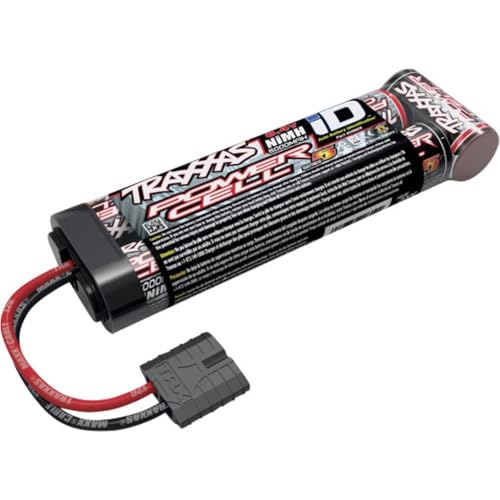
Traxxas 2960X Series 5 5000mAh NiMH 7-Cell, 8.4V Battery (flat pack)


Brushed-motor care when a Titan meets lithium voltage delivery
Owners of brushed Slash trucks who adopt 2S lithium often discover that the battery was not the only component working harder. The Titan 12T 550 is a sealed-can brushed motor, a design chosen for cost, durability, and waterproof running rather than for serviceability, and the sharper voltage delivery of a lithium pack asks more of it on every pull of the trigger. Its brushes and commutator wear as a normal part of operation, and sustained high load, tall gearing, and running in sand or long grass accelerate that wear and the heat that drives it. The motor cannot be opened for the brush replacement that a traditional rebuildable motor allows, so its life is a finite resource to be spent thoughtfully rather than a problem to be repaired later.
Heat discipline comes first, as it did for the brushless system, but with lower thresholds for complacency because a brushed motor’s performance fades gradually and tempts owners to compensate with more throttle. Check motor temperature after runs, gear down for high-load surfaces, and let the truck cool between packs rather than swapping batteries and running continuously through a hot afternoon. Running through water, a party trick the waterproof electronics invite, should be followed by drying and a light oil on the motor bearings as the manufacturer’s care guidance describes, because a wet brushed motor stored damp corrodes internally and sounds rough ever after. Keep the gear mesh set correctly, neither tight enough to load the motor constantly nor loose enough to strip the spur gear under lithium’s sharper acceleration, and inspect the pinion and spur for wear whenever the cover is off. A worn mesh wastes energy as noise and heat and can be mistaken for a tired battery.
Expectations should be set honestly. A brushed truck on 2S lithium is a genuinely enjoyable machine, quicker and more consistent than it was on its stock pack, and for many owners it is the right place to stop. It will not match a brushless truck’s top speed or efficiency, its motor will wear out in a way a brushless motor largely does not, and when it does, that is the natural moment to decide between a like-for-like replacement and the brushless conversion the chassis accepts. What lithium gives the brushed owner immediately is consistency: the same throttle feel at minute ten as at minute two, across a whole season of club evenings, provided the low-voltage detection is on and the storage routine is kept. Treat the motor kindly, and the pairing of an old design and a modern pack turns out to be one of the most likeable combinations in the Slash’s long history.
A closing checklist before you order and before you run
Work through the list in order and most battery mistakes become impossible. Name your exact truck, 2WD or 4×4, brushed XL-5 or brushless VXL-3s, and write down its tray dimensions with the hold-down bar closed and the body fitted. Choose voltage by the controller, never by ambition: NiMH or 2S for the brushed truck within its documented support, 2S as the default for brushless, 3S only with gearing and cooling planned. Pick capacity for the surface and the session, remembering that two mid-sized packs usually serve better than one giant. Confirm the connector, avoid permanent adapters, and budget for a balance charger and a fire-resistant bag in the same purchase as your first lithium pack. On delivery, record the pack’s weight, its per-cell voltages, and its first charge capacity. Before every run, confirm the low-voltage light, check the pack for swelling and damage, seat it with its foam spacers, and route its leads clear of anything that moves. After every run, let it cool, note its resting voltages, and put it to storage charge if the truck will rest for more than a few days.
Fit the pack your Slash can actually hold, feed it the voltage its controller was built for, and charge it like it matters, and the truck will repay you with the one thing every driver is really buying: another clean run tomorrow, on a pack that feels as strong as the day it arrived.


