Our Top Picks


What's inside
- The 6V lantern battery itself
- Lantern types built around the 6V block
- Terminal fit, contact, and the flicker problem
- Runtime math from published figures
- Brightness in honest terms
- Floating and weather-sealed work lanterns
- Alternatives inside the same lantern: D-cell adapters and sleeves
- Storage, shelf life, and date codes
- Safety and disposal
- A buying checklist for lantern and battery together
- Check prices on Amazon
- Pulling the threads together
As an Amazon Associate I earn from qualifying purchases. This post may contain affiliate links at no extra cost to you.
Most rechargeable lanterns ask you to plan around a cable. A lantern built for the classic 6V lantern battery asks you to plan around a spare block in a cupboard instead, and that simple difference explains why the format refuses to disappear. The battery is a chunky square cell with two springs or screw posts on top, the lantern is usually a big-bodied light with a handle you can grip with gloves, and the pairing has served road crews, anglers, campers, farmers, and households riding out blackouts for generations. Choosing well within this old platform is less about pursuing headline brightness and more about matching terminal style, chemistry, and light type to the work the lantern will actually do.
This guide compares lanterns and batteries strictly through published specifications, manufacturer documents, battery datasheets, and standards references. It rests on those published sources rather than on any direct use of the products discussed, so every runtime figure and capacity claim below traces back to a number a maker printed and can be checked against a datasheet. Where makers disagree or publish figures under different conditions, the guide says so and explains which condition matters. If a purchase made through the retailer links on this page results in a sale, the site may earn a commission from the retailer, and that commission is paid by the retailer rather than added to the price the buyer pays.
The short version runs like this. A buyer who wants the longest unattended light from a single battery should pair an alkaline 6V block with an LED lantern or an LED conversion bulb. A buyer who wants a floating work light for a boat, dock, or flooded yard should look at the sealed handheld lanterns that were designed around this battery from the start. A buyer keeping a much-loved old lantern alive should check terminal style before anything else, because a spring-top battery and a screw-terminal lantern do not forgive a mismatch. Everything that follows unpacks those three sentences in the order a careful buyer would actually work through them.
The 6V lantern battery itself
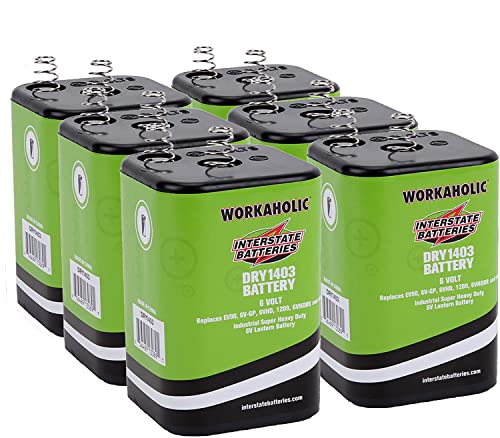
The battery at the centre of this platform carries the IEC designations 4R25 in zinc-carbon form and 4LR25 in alkaline form. The leading 4 signals that four individual cells sit inside the case, wired in series to deliver a nominal six volts. The R or LR portion identifies the chemistry family and cell shape inside, and the 25 is a size code that has been stable for decades. Inside the plastic or coated-card shell, four large cylindrical cells stand side by side, which is why the block feels so much heavier and more substantial than the slim packs used in modern gadgets.
Physically, a typical 4R25 block measures roughly 67 millimetres square across the base and about 115 millimetres tall to the top of the case, with springs or terminals adding a little more height above that. Weight varies sharply by chemistry. Zinc-carbon versions commonly land somewhere around six hundred grams, while alkaline versions, packed with denser active material, often approach or exceed nine hundred grams. That heft matters more than buyers expect, because in many lantern designs the battery is also the ballast: it keeps a floating lantern upright in water and keeps a work lantern planted on a tailgate in wind.
Two terminal arrangements dominate the format, and confusing them is the single most common buying mistake in this category. The spring-top version presents two coiled springs, one for each polarity, which compress against flat contact plates inside the lantern as the base is screwed or latched down. The screw-terminal version presents two threaded posts with knurled nuts or wing fittings, onto which ring or spade connectors inside the lantern are fastened. Some datasheets append suffixes or use related designations such as 4R25X for particular terminal or construction variants, so the suffix on a listing is worth reading rather than skimming.
The format survived a century for unglamorous reasons that still hold. The case is big enough that capacity can be generous without exotic chemistry. The voltage suits simple bulbs and simple circuits, so lanterns need no electronics at all in their most basic form. The block is easy to swap in the dark by feel alone, since it only fits its compartment one or two ways and the springs announce themselves to a fingertip. Standardisation did the rest: once millions of lanterns shared one battery footprint, battery makers kept producing the block, and once battery makers kept producing it, lantern makers had no reason to abandon the cavity their tooling already cut.
Zinc-carbon versus alkaline, in published figures
The capacity gap between the two chemistries is the most important number in this entire guide, and it is larger than the modest difference in shelf presentation suggests. Manufacturer datasheets for zinc-carbon 4R25 blocks typically publish capacities in the region of seven to nine amp-hours at modest discharge rates, with the exact figure sliding downward as the load current rises. Alkaline 4LR25 datasheets, by contrast, commonly publish figures in the region of eighteen to twenty-two amp-hours under comparable low-drain conditions. On paper, then, the alkaline block stores roughly two and a half times the usable energy of the zinc-carbon block, and in a lantern sipping current through an LED, that ratio broadly survives contact with reality.
Voltage behaviour widens the gap further. A zinc-carbon cell’s discharge curve slopes steadily from the moment a load is applied, so a lantern fed by one dims in a long, gradual fade that begins early in the battery’s life. An alkaline cell holds a flatter plateau through the middle of its discharge and falls away more decisively near the end. For an incandescent bulb, which is exquisitely sensitive to voltage, the zinc-carbon fade shows up as a yellowing beam within the first portion of the battery’s rated life. For a regulated LED lantern, the driver circuit masks much of the slope until the battery can no longer sustain the input the driver demands.
Cold weather separates the chemistries again. Published operating ranges for zinc-carbon cells generally stop being flattering well above freezing, and capacity delivered at temperatures near zero degrees Celsius can fall to a fraction of the room-temperature figure. Alkaline cells also lose capacity in the cold, and their datasheets say so plainly, but they retain a larger share of it and recover more gracefully when warmed. A lantern that lives in an unheated barn, a boat locker, or a vehicle through winter is therefore an alkaline application on the published evidence, whatever the zinc-carbon block’s shelf appeal.
None of this makes zinc-carbon pointless. Its legitimate territory is the lantern that gets used in short, predictable bursts close to home, where a battery is a consumable swapped without regret and where a leak discovered early damages nothing precious. Datasheets also tend to credit zinc-carbon with respectable shelf behaviour for its class when stored cool and dry. The error is not buying zinc-carbon; the error is buying it for a lantern whose whole purpose is to work unattended for many hours during the one storm of the year, because that duty cycle is precisely where its published weaknesses concentrate.
Lantern types built around the 6V block
Four broad lantern families share the same battery cavity, and they produce very different light. Treating them as interchangeable because they share a battery is the second most common buying mistake in this category. The families are the classic handheld spotlight-style lantern, the fluorescent area lantern, the modern LED lantern designed natively for the block, and the older incandescent lantern kept current with an LED drop-in conversion. Each family has a distinct beam character, a distinct current appetite, and a distinct set of published specifications worth comparing.
Classic handheld and floating lanterns
The archetypal 6V lantern is a handheld unit with a large round head, a deep reflector, a single bulb behind a clear or lightly diffused lens, and a pivoting or fixed handle on top. The battery loads from below or through a hinged base, and its weight hangs low in the body, which is what gives these lanterns their planted, bottom-heavy feel. Many were built with sealed or gasketed cases and enough internal air volume to float, head up, if dropped in water, a trait their makers have advertised for decades and one that follows directly from the displacement of that big battery cavity.
Light from this family is a beam, not a glow. The reflector gathers the bulb’s output into a central spot with a weaker spill around it, suited to picking out a gate latch, a mooring buoy, a fuse box at the end of a loft, or the far edge of a field. Published beam-distance figures for such lanterns, where makers provide them, are measured to the point where illumination falls to a faint threshold, so the useful working distance is always shorter than the headline number. A buyer comparing two handheld lanterns should weigh the beam figures alongside bulb type and lens size rather than treating the largest distance claim as a verdict.
Construction details separate the durable examples from the disposable ones. Look in the published descriptions for a lens retained by a ring rather than glued, a switch that can be operated with a gloved thumb, and a base closure that compresses the battery springs evenly rather than cocking the block to one side. Makers of the better work-oriented models tend to specify case materials and water-resistance language precisely, while vague listings lean on adjectives. The battery cavity dimensions occasionally differ by a few millimetres between brands, which is why the terminal and fit discussion later in this guide deserves attention before money changes hands.
Fluorescent-tube area lanterns
The fluorescent branch of the family replaces the point-source bulb with a U-shaped or twin tube behind a frosted cover, trading throw for spread. Light leaves the whole face of the lantern rather than a hotspot, so a room, tent, or engine bay is lit evenly with soft shadows. These lanterns were the default answer to power cuts for years, and plenty remain in cupboards, still serviceable, still hungry. Their tubes were commonly rated in the region of seven to nine watts, and the ballast circuitry that strikes and sustains the tube consumes a share of the battery’s energy before any light appears at all.
Two published behaviours define fluorescent ownership. The first is strike behaviour in the cold: fluorescent tubes start reluctantly at low temperatures, sometimes flickering or glowing only at the ends until they warm, and tube datasheets have always acknowledged this. The second is the end-of-life pattern, where an ageing tube blackens at its ends and the lantern’s light output sinks long before the battery is truly exhausted, which leads owners to blame batteries that are innocent. A buyer considering a used fluorescent lantern should budget attention for tube condition and availability, because the tube is a consumable with its own supply chain that has thinned as LED models took over.
Modern LED lanterns designed for the block
Native LED lanterns built around the 6V block take two shapes. Some keep the classic handheld silhouette, with an LED emitter or small cluster sitting at the focal point of a familiar reflector, preserving the beam character while cutting current draw dramatically. Others abandon the beam entirely and wrap emitters around a column or across a panel, producing the omnidirectional glow associated with camping lanterns. The published specification that distinguishes them is not the battery, which is identical, but the optical intent: spot, flood, or a switchable mixture of the two.
Because an LED converts a far larger share of electrical energy into light than a filament does, these lanterns can publish lumen figures that would have been absurd for the platform a generation ago, while drawing currents a filament could not sustain for an hour. Buyers should still read lumen claims with the discipline applied to any light: check whether the figure is quoted for the highest mode only, whether a step-down after some minutes is documented in the manual, and whether lower modes are listed with their own outputs and runtimes. A lantern whose documentation gives a small table of modes, outputs, and hours is making a more checkable claim than one that prints a single large number on the box.
Driver behaviour is the hidden variable. A regulated lantern holds near-constant brightness as the battery declines and then stops, sometimes abruptly, when the block can no longer feed it. An unregulated or simply resistored lantern dims in step with the battery, which is less satisfying on paper but gives a long, graceful warning and squeezes light from a block a regulated model would have rejected. Neither approach is wrong. For a work light, predictability argues for regulation. For an emergency light that must never leave a household fully dark without warning, the slow fade has a genuine claim.
LED drop-in conversions for older lanterns
The conversion path keeps an existing incandescent lantern and replaces only its bulb with an LED module built on the same base. The classic bulb in these lanterns is a screw-base or flange-base krypton or vacuum bulb in the PR family pattern, rated around 4.8 to 6 volts, and conversion modules are sold by base type and polarity rather than by lantern brand. The reflector, lens, switch, and case that the owner already trusts stay in service, and current draw falls to a small fraction of the filament’s appetite.
Two specification traps wait here. The first is polarity: some lanterns wire the bulb socket with the centre contact negative, and an LED module that assumes the opposite polarity will simply refuse to light or will need its leads arranged accordingly, a detail conscientious sellers state in their listings. The second is focus. A filament radiates in nearly every direction and a reflector is shaped around that fact, while many LED modules emit into a hemisphere from a flat board. The resulting beam can show a dark centre or an uneven hotspot even when the total light output is higher. Listings that describe emitter placement or show a beam pattern are more informative than listings that quote lumens alone.
Heat, for once, argues in the conversion’s favour. A filament bulb dumps most of its energy as heat into a reflector and lens designed when that heat was expected, while an LED module of similar light output runs far cooler, reducing the strain on old plastic lenses that have already yellowed. The conversion is therefore often the gentlest life-extension an elderly lantern can receive, provided the socket contacts are clean and the battery springs still hold their temper, subjects the next section takes up in detail.
Terminal fit, contact, and the flicker problem
More 6V lantern disappointment traces back to the two square centimetres where battery meets lantern than to any difference between lantern brands. The connection has to carry the full current of the lamp through a joint that is assembled by hand, in the dark, often with cold fingers, and then left undisturbed for months in a damp shed. Every element of that sentence is a reason the joint deserves respect.
Spring compression and screw posts
On a spring-top battery, contact quality is a function of compression. The lantern’s base or cap drives the springs down by several millimetres as it closes, and that deflection is what generates the contact force keeping resistance low. Springs that have been flattened by a battery left installed for years, or by a heavier block stored inside the lantern, may no longer press hard enough. The symptom is a lantern that lights when held one way and cuts out when set down, because the battery shifts by a hair and the joint opens. Published battery dimensions include a height tolerance, and lantern cavities were designed around the middle of it, so an unusually short block can sit at the edge of the springs’ working range even when everything is new.
Screw-terminal lanterns trade that springiness for a clamped joint. A ring or fork connector slides under a knurled nut, the nut is snugged down, and the connection is then largely indifferent to small differences in block height. The failure mode moves elsewhere: nuts loosen under vibration, connectors creep if they were only finger-tight, and a lantern carried in a vehicle can work a marginal joint open over a season. The remedy is mechanical rather than mysterious. Close the joint firmly, then check it after the first journey rather than assuming it stayed as it was left.
Mixing the two systems with improvised adapters deserves a plain warning. A spring-top block in a screw-terminal lantern, held by foil, coins, or bent wire, creates a high-resistance joint that can heat under load and will certainly flicker. Adapters do exist as moulded parts for some combinations, and a properly made adapter that preserves contact force and polarity is a different matter from a improvised shim. If a listing does not state plainly which terminal style a lantern expects and which style a battery carries, that silence is itself information about the seller.
Corrosion, cleaning, and rattle
Contact surfaces in this platform are usually plain or lightly plated metal, and they live in the worst neighbourhood in the product: directly above a battery that may vent faintly or, at the end of a neglected life, leak. The white or green crust that forms on springs and plates is an electrical insulator wearing a disguise of harmlessness. It raises the resistance of the joint, and the voltage dropped across that resistance is voltage the lamp never sees. On a six-volt system the arithmetic is brutal, because losing half a volt to a dirty joint is losing more than eight percent of everything the battery has.
Cleaning is a specification-free but well-documented maintenance step in manufacturer care notes. Power off and remove the battery first. Dry deposits brush away with an old toothbrush or a fibreglass cleaning pen, and a cotton bud barely dampened with a suitable contact cleaner handles film that brushing leaves behind. Springs bent out of shape can be coaxed back gently with a fingertip or a wooden tool, never levered hard with a screwdriver, because a spring stretched past its elastic range is weaker than the tired one it replaced. Any sign of leaked electrolyte inside the cavity changes the job from cleaning to decontamination, and the safety section below covers that ground.
Rattle is the audible version of the same story. A block that moves inside its cavity announces that something is out of tolerance: a short cell, a compressed foam pad that has taken a permanent set, springs that have lost height, or a latch that no longer pulls the base fully home. Beyond the annoyance, movement frets the contact surfaces against each other, polishing some spots and oxidising others, and it interrupts current in time with footsteps or engine vibration. A thin closed-cell foam pad on the inside of the base, a traditional maker-supplied part in many lanterns, exists precisely to take up this slack, and replacing a perished pad is cheaper than replacing a lantern blamed for flickering.
Runtime math from published figures
Runtime is where marketing and arithmetic collide most visibly in this category, so it is worth doing the sums slowly, in the open, with the published inputs named. A battery’s capacity in amp-hours divided by a lamp’s current draw in amps gives an idealised runtime in hours. Every real-world correction moves the result downward from that ideal, and understanding the corrections is worth more than memorising any single lantern’s claimed figure.
The three loads compared
Start with the filament. A traditional krypton lantern bulb rated near six volts typically draws in the region of half an amp to three quarters of an amp, depending on the specific bulb the lantern was designed around. Against an alkaline block publishing twenty amp-hours at low drain, the naive division suggests something like twenty-seven to forty hours. Against a zinc-carbon block publishing eight amp-hours, the same arithmetic suggests eleven to sixteen hours. Both figures flatter, for a reason built into the datasheets themselves: capacity is usually quoted at a discharge current far gentler than a bulb’s draw, sometimes as low as a few tens of milliamps through a resistor to a defined endpoint voltage. Pull current harder and the delivered capacity shrinks, a behaviour documented in the discharge curves printed in serious datasheets.
The fluorescent tube draws a similar order of current once its ballast losses are counted, commonly landing in the same broad band as a filament or slightly above it on a per-hour basis, while producing more total light spread over a wider area. Its runtime story has an extra chapter, though, because the ballast needs a minimum voltage to strike the tube at all. A battery that could still glow a filament weakly may fail to start a tube, so the fluorescent lantern’s useful runtime ends earlier than its raw capacity arithmetic implies, and the end, when it comes, tends to be a lantern that buzzes or blinks rather than one that glows bravely on.
The LED changes the scale of the problem. A conversion module or native LED lantern producing light comparable to the old filament commonly draws somewhere between a tenth and a third of an amp, with low modes far below that. The same alkaline block that fed a filament for a long weekend can, on the published figures, feed an LED at a modest setting for well over a hundred hours, and at the lowest settings of some multi-mode lanterns the arithmetic runs into territory where the battery’s own self-discharge over the period becomes a line item worth including. This is why the LED branch of the platform has effectively rewritten what a 6V lantern is for: endurance stopped being the constraint, and light quality and fit became the interesting questions.
Why makers’ hour claims flatter
Hour claims on packaging are usually derived, not fabricated, and the derivation is where the generosity hides. A maker takes the battery capacity from a datasheet, often the most favourable published figure at the gentlest discharge rate, divides by the lamp’s current, and prints the quotient. Seldom does the calculation subtract the capacity lost to the higher real discharge rate, the portion of the discharge curve below the voltage where the lamp is usefully bright, or the ageing of a battery that has sat in a warehouse and then a cupboard. Standards for portable light performance, such as the ANSI/NEMA FL 1 framework used widely for flashlights, define runtime as the period until output falls to ten percent of its initial value, which is an honest definition for comparison but one that counts a long, dim tail as runtime. A lantern can therefore meet its printed hours while being usefully bright for a good deal less of them.
The buyer’s countermeasure is to reconstruct the sum from the two published inputs rather than accepting the printed quotient. Find the lamp’s current or wattage in the manual or listing. Find the battery’s capacity at a discharge rate resembling that current, in the battery maker’s own datasheet, noting the endpoint voltage the figure assumes. Divide, then discount the result by a fifth to a third to allow for the effects above, and treat the remainder as a planning figure. A lantern whose seller publishes current draw at all has already distinguished itself from one whose documentation offers only a heroic hour count and a photograph.
Charging habits belong in this conversation only for the lantern’s neighbours on the shelf, since the 6V block itself is a primary battery that is never recharged. Owners who keep rechargeable lights alongside a 6V lantern often ask which charger classes suit the rest of their kit, and the published charger categories are worth a glance before a household ends up with a drawer of incompatible bricks.
best 6v and 12v battery chargers
That guide territory covers combined-voltage chargers, which sit at the larger end of the consumer charging world and share shelf space with the vehicle-battery equipment many lantern owners already keep in a garage.
Brightness in honest terms
Brightness language for lanterns mixes three quantities that buyers routinely conflate. Lumens describe total light produced in all directions. Candela and beam distance describe how concentrated that light is in one direction. Lux describes how much light actually lands on a surface at a given distance. A handheld 6V spotlight lantern and an LED column lantern can publish identical lumen figures and behave nothing alike in a field, because the spotlight concentrates its output into a cone that throws hundreds of metres on paper, while the column lantern spends the same lumens lighting a circle a few metres wide to a comfortable working level.
For the classic beam lantern, the reflector is the product. Its diameter and depth set how much of the bulb’s output is captured and how tight the resulting spot is, and its surface quality decides how much of that light arrives as a clean beam rather than a ringed, blotchy approximation. Lens design matters at the margins: a clear lens preserves throw, a prismatic or frosted lens trades throw for a wider, more forgiving spill, and some lanterns historically offered interchangeable lenses for exactly this reason. Published descriptions that name reflector size or show a beam profile give a buyer something real to compare; a bare lumen number for a beam lantern gives almost nothing, because a filament lantern’s output was traditionally described by bulb specification rather than lumens at all.
For area lanterns, the honest question is how the light behaves at one to three metres, where people actually read, cook, mend, and play cards. Diffusion is the virtue here. A frosted cover, a translucent column, or emitters arranged behind a diffuser all sacrifice peak intensity to buy evenness, and evenness is what makes a light pleasant to live under for an evening. Glare is the failure mode: a bare high-output emitter at eye height in a tent produces impressive specifications and miserable light. Buyers comparing area models should look for published information about diffuser design and the availability of a genuinely low mode, because the low mode is the one an area lantern will spend most of its life using.
Floating and weather-sealed work lanterns
The floating lantern is this platform’s party trick and its most practical virtue in the same gesture. A sealed handheld lantern with a large air-filled body and the battery’s weight low in the hull will, in the designs that advertise the trait, float lens-up if it goes overboard or into floodwater, turning a loss into a retrieval. The physics is mundane: the whole unit’s average density sits below that of water, and the ballast distribution keeps the heavy end down. Makers who claim flotation usually say so in plain terms in their product literature, and buyers for whom the trait matters should look for that plain statement rather than inferring it from a photograph of a lantern near a lake.
Weather sealing language needs the same literal reading. An IP code, where a maker publishes one, divides into protection against solid objects and protection against water, and the water digit carries the practical meaning for a lantern: resistance to splashes is a different promise from resistance to immersion, and both differ from the unquantified claim of being weatherproof. Many classic 6V lanterns predate routine IP publishing for consumer lights, and their literature instead describes gaskets, sealed switches, and water-resistant construction in words. Those words are not meaningless, but they are promises without a test protocol attached, and a buyer planning to leave a lantern out in rain for a season should weight a published IP figure from a current maker more heavily than warm adjectives from any era.
Seals age. The gasket that made a lantern weather-tight when new is a rubber or foam ring that hardens, compresses, and eventually cracks, and the lens and base threads it protects remain perfectly sound while the seal quietly retires. Product literature for better work lanterns sometimes lists gaskets among replaceable parts, which is a quiet marker of a maker expecting its product to be maintained rather than replaced. Owners of older floating lanterns should treat the seal as the lantern’s true expiry date and inspect it whenever the battery is changed, because the battery change is the one moment the seal is already open and its condition is visible for free.
Case materials set the other boundary of work use. The traditional lantern case is a moulded plastic chosen for impact tolerance and electrical insulation, with the better examples using grades that stay tough in cold weather rather than turning brittle. Metal-cased antiques exist and charm collectors, but a metal case conducts, corrodes at seams, and dents in ways that can foul the battery cavity, which is why the mainstream of the platform settled on plastic long ago. Published descriptions that name a polymer or describe drop resistance in concrete terms are, again, more useful than a general claim of ruggedness unaccompanied by any number.
Alternatives inside the same lantern: D-cell adapters and sleeves
A persistent question in this category is whether the block can be replaced by an adapter holding four D cells, which are, after all, the same chemistry in the same series count and nominal voltage. The electrical logic is sound: four D cells in series deliver six volts, and lantern cavities are roughly the right volume. Adapters and sleeves for exactly this swap have been sold for years, and some lantern makers have offered their own. Whether the swap makes sense depends on capacity arithmetic and on the lantern’s contact arrangement, not on the voltage, which genuinely matches.
The capacity comparison surprises many buyers. A quality alkaline D cell publishes a capacity in the region of twelve to eighteen amp-hours at gentle drains, which looks comparable to a 4LR25 block until the series wiring is remembered: cells in series add voltage, not capacity, so the pack’s capacity is that of a single cell, while the block’s four internal cells were sized for the format and its published capacity already reflects the series assembly. In practice the two options land closer than folklore suggests, with the block generally ahead on published figures and well ahead on contact simplicity. The D-cell route pulls in front on availability and on freshness turnover in shops, and it lets a household standardise on one cell size for several devices.
Fit is the deciding factor more often than capacity. An adapter adds its own height and its own contacts to the chain, and a lantern whose springs were marginal with a true block may flicker cheerfully with an adapter stack. Screw-terminal lanterns are fussier still, since the adapter must present something for the connectors to clamp. There is also a housekeeping argument that cuts the other way: four loose D cells in an adapter are four cells to check for leakage and four cells that can be borrowed by another device at the worst moment, leaving the lantern empty. Owners who keep a lantern for genuine emergencies often conclude that a dedicated block, bought fresh and left alone, is the more reliable arrangement precisely because nobody raids it for a toy.
Households that do standardise on loose rechargeable cells for other lights will find their charging shelf growing alongside the lantern shelf, and the smaller-format chargers follow their own published categories.
best aa and aaa battery chargers
Those compact chargers handle the cells that power headlamps and radios, the natural companions of a 6V lantern in any outage kit, and keeping the two systems’ charging needs separate avoids the common muddle of one undersized charger serving everything badly.
Storage, shelf life, and date codes
A lantern battery earns its keep in storage, not in use, because the whole point of the platform is readiness after months of neglect. Shelf life figures in datasheets are therefore among the most decision-relevant numbers a buyer will read. Alkaline 4LR25 blocks commonly publish shelf lives in the region of five to seven years when stored at moderate temperatures, retaining a stated majority of their original capacity across that span. Zinc-carbon blocks publish shorter figures, commonly in the region of two to three years, and their self-discharge proceeds faster at every temperature. Both chemistries discharge themselves more quickly as storage temperature rises, a relationship datasheet storage curves describe with unusual candour.
Date codes are how a buyer audits those claims at the point of purchase. Makers print either a manufacture date, a use-by or freshness date, or a coded batch marking whose key the maker publishes. The formats differ between brands, which is a nuisance, but the principle does not: the freshest stock available is worth choosing even at a small premium, because a lantern battery’s life is spent mostly waiting. Retail listings rarely state dates, so the practical discipline is to buy from channels with visible turnover, to check the code on arrival, and to note the date on the block itself with a marker if the printing is cryptic.
Storing the spare is a small craft of its own. A cool, dry place at ordinary room temperature or a little below suits both chemistries; the old advice about refrigeration belongs to an earlier battery era and modern maker guidance generally advises against it for these cells, citing condensation on terminals when the cold block meets warm air. Keep the block in its original packaging or with a cover over its terminals, because those exposed springs or posts can short against metal shelving or loose tools, and a shorted primary block can grow hot enough to damage itself and its neighbours. Store it upright, away from radiators and sunlit windowsills, and out of the lantern itself if the lantern will sit unused for a season, since a battery stored outside the device cannot leak into it.
Swelling and leakage are the two distress signals to inspect for at every battery change. A block whose case has bulged, whose base sits unevenly, or whose springs carry crust and staining is announcing the end of its safe life. Zinc-carbon cells are the more likely leakers as they age, because their construction historically used the zinc can itself as a consumed part of the cell, and a fully discharged or elderly cell can breach and release its electrolyte into the lantern cavity. Alkaline cells leak less often but not never, typically after deep discharge or long storage past their dates, and their electrolyte leaves the familiar white crystalline residue. Either event calls for the careful cleanup and disposal steps described next, and for honesty about a hard truth: a lantern cleaned promptly usually survives, while one left leaking for a year often does not.
Safety and disposal
The safety rules for primary 6V blocks are short, absolute, and printed in some form on every reputable maker’s packaging. The first is that these batteries are never to be recharged. A primary cell forced to accept charge can generate gas, heat, and pressure its case was never designed to hold, and the outcomes range from leakage to rupture. This applies with full force to anyone who owns capable charging equipment for other battery systems and is tempted to experiment: the block’s chemistry, not the charger’s sophistication, decides the question. Equipment intended for rechargeable vehicle and equipment batteries occupies a different category entirely.
best 12 volt battery chargers
That neighbouring category serves lead-acid batteries in vehicles and machinery, which are built to be recharged, and the contrast between the two systems is the clearest illustration of why a primary lantern block must stay away from any charger output.
The second rule concerns mixing. Never combine an old and a new block’s leftovers by running a lantern on a partly used battery rescued from another device and expecting even behaviour, and in multi-cell adapters never mix cells of different ages, brands, or chemistries in the same series string. In a series arrangement the weakest cell is driven hardest, can be pushed into reversal by its stronger partners, and becomes the likeliest leaker in the set. Uniformity is the whole defence: same type, same age, same history, installed together and retired together.
The third rule is about children and storage rather than electricity. A 6V block is too large to be a swallowing hazard of the coin-cell kind, but its terminals are exposed and its weight can injure a small foot it lands on. Store spare blocks where they cannot roll, fall, or be shorted by the contents of a junk drawer, and treat a damaged block, however new, as waste rather than stock.
Disposal routes depend on jurisdiction, and maker guidance consistently points the same way: a spent lantern battery belongs in a battery recycling stream, not in general household waste, wherever such a stream exists. Many municipalities accept primary batteries at household hazardous waste facilities and collection events, retailers in numerous regions take them back at the counter, and community collection programmes publish drop-off points that a local search will surface. Zinc-carbon cells are treated as ordinary waste in a shrinking number of places and as recyclable battery waste in a growing number, while alkaline cells follow similar local variation, so the honest instruction is to follow the local rule rather than a universal one. Before recycling, tape or bag the terminals of each block, because a bin of loose batteries shorting against each other is a recognised nuisance that collection programmes explicitly ask the public to prevent. A leaking block should travel in a sealed plastic bag, handled with gloves, and be declared to whoever accepts it rather than hidden among clean batteries.
A buying checklist for lantern and battery together
The decisions scattered through this guide compress into a short sequence that a buyer can work through in order, because each answer narrows the next question. Begin with the lantern already owned or the lantern type wanted, since the battery follows the lantern and not the other way round. A household replacing a battery for an existing lantern needs the checklist’s first half. A buyer starting from nothing needs all of it, in order, and will find the platform’s apparent simplicity dissolving into a handful of genuinely consequential choices.
Terminal type first
Confirm whether the lantern expects springs or screw posts, and buy the block that matches, from a listing that states the terminal style in words rather than leaving it to a photograph. If the lantern is already in hand, open the cavity and look: flat plates mean a spring-top block, ring or fork connectors on leads mean screw terminals. If buying lantern and battery together from different sellers, reconcile the two listings before either order is placed. Keep the old block until the new one is fitted and the lantern has run for an evening, because the old block’s exact height and terminal arrangement are the most reliable reference for what the cavity was built around.
Chemistry by use pattern
Match the chemistry to the duty, using the published capacity and shelf figures as the evidence. Intermittent, supervised, close-to-home use with frequent battery changes is zinc-carbon’s defensible territory. Anything stored for emergencies, used outdoors in winter, expected to run all night, or installed in a lantern that would be badly damaged by a leak should be alkaline, and the capacity advantage means the alkaline block usually wins on cost per delivered hour even before its longer shelf life is counted. Buyers running LED conversions should weight alkaline even more heavily, since the LED’s low draw plays directly to the alkaline datasheet’s strengths at gentle discharge rates.
Freshness and brand consistency
Choose the freshest dated stock available, and prefer makers whose datasheets can actually be found and read. Brand consistency matters here in a specific, unglamorous way: a maker who publishes capacity at several discharge rates, states an endpoint voltage, prints a legible date code, and keeps the same designation meaning the same construction across years is a maker whose next block will behave like the last one. That predictability is worth more to a lantern owner than any marginal difference in headline capacity, because the lantern’s job is to work on the one occasion it is grabbed. Avoid unbranded blocks whose listings omit chemistry, capacity, and date information entirely; in a format this standardised, missing specifications are a choice, and not one made in the buyer’s favour.
Round out the purchase with the small items that decide whether the lantern works in five years: a spare bulb or conversion module if the lantern uses one, a replacement gasket if the maker lists one, and a note of the battery’s date code kept with the lantern. Households organising a broader charging shelf for rechargeable cells alongside the lantern kit will encounter high-capacity multi-bay chargers as the natural end point of that organising impulse.
best 16 bay battery chargers
A charger of that size serves workshops and large households cycling many cells at once, and it underlines the division of labour this guide has returned to throughout: rechargeable cells get chargers, while the 6V block gets bought fresh, stored well, and replaced whole.
Check prices on Amazon
Live listings for the shortlist in this guide are pulled from Amazon below, so prices and availability are always current at the moment you look.

Eveready Super Heavy Duty 1209 6 Volt Spring Lantern Battery


Dorcy 41-2081 6V LED Floating Lantern | with 6V Battery


Eveready 1209 6 Volt Super Heavy Duty Lantern Battery Each

EVEREADY 6V Battery, Super Heavy Duty 6 Volt Battery, 2 Count
Pulling the threads together
The 6V lantern platform rewards buyers who think in systems rather than products. The battery’s century-old footprint, the lantern’s optical intent, the joint between them, and the storage habits around both matter more than any single specification printed large on a box. A spring-top alkaline block in a well-sealed LED lantern, bought fresh and stored out of the lantern between seasons, is the configuration the published evidence keeps pointing toward for most households. A cherished old filament lantern with clean contacts and a sound gasket, converted to an LED module that respects its socket’s polarity, is a close second and a more satisfying one. The zinc-carbon block, the fluorescent tube, and the D-cell adapter each retain a narrower honest use, and this guide has tried to draw those boundaries where the datasheets draw them rather than where nostalgia might prefer.
What the platform will not reward is inattention to the small print, because its failures are almost never dramatic component failures. They are a spring that lost its push in 2019, a gasket that hardened two winters ago, a block bought old and stored hot, a joint quietly crusting above a slow leak. Every one of those failures is visible to a buyer or owner who knows to look, and looking takes minutes at a battery change. That, more than any lumen figure, is the argument for this old format in a world of sealed rechargeable lights whose batteries cannot be inspected, swapped, or replaced at a village shop: the 6V lantern can still be understood, maintained, and kept ready by its owner, with nothing more exotic than a datasheet, a toothbrush, and the discipline to check the date code before the storm rather than after it.
Somewhere in a dark hallway on the first blackout of winter, a lantern that was chosen this way will simply switch on, and its owner will never know how many small correct decisions were standing behind that ordinary click.


