What's inside
- Key Takeaways
- Quick Picks
- How did we choose these six IP cameras?
- What actually separates a good 4K IP camera from a mediocre one?
- How do the six compare side by side?
- How should you plan a PoE camera installation?
- What mistakes do buyers make with 4K IP systems?
- Why do wired IP cameras still beat wireless ones for serious coverage?
- How much storage does 4K footage really need?
- Which camera positions matter most on a typical property?
- How should you read night-vision claims before believing them?
- How do you keep a wired system useful year after year?
- What should you check before ordering any of these systems?
- What about audio recording and privacy?
- How do alerts and everyday viewing actually work once it is installed?
- Can you mix cameras from different brands on one recorder?
- Final Recommendation
- Frequently Asked Questions
- Related Guides
As an Amazon Associate I earn from qualifying purchases. This post may contain affiliate links at no extra cost to you.
gizmoverdict.com is reader-supported. When you buy through links on our site, we may earn an affiliate commission.
Where to buy: every system and camera below is sold through Amazon, and each name links to its listing so you can check current availability, included cable lengths and warranty terms before ordering.
Shopping for the best 4k ip cameras usually starts with a disappointment: a phone screenshot from a cheap wireless camera that turns a delivery driver’s face into six grey pixels. Resolution is the fix people reach for first, and 8 megapixels genuinely does change what a recording can prove, but pixel count is only one line of the specification. A 4K sensor behind a narrow lens on a recorder that drops frames will still fail you on the night something actually happens. This guide ranks six wired IP options — two complete Power over Ethernet kits, a dual-lens panoramic camera, a long-range zoom dome, a flexible turret and one honest budget dome — by how their footage holds up when you zoom into a plate, a face or a gate latch at two in the morning.
The picks split into camps. Reolink’s boxed kits suit people who want one purchase to cover a whole property, and its Duo 2V solves the blind-wedge problem above wide entrances. The Jennov PTZ dome is a specialist tool for a long driveway or yard where a fixed camera cannot reach. The unbranded 8MP turret is the flexible add-on for an existing recorder, and the Anpviz dome is the budget entry for a porch or shop interior — it records at 4 megapixels rather than 4K, and we will explain exactly where that compromise shows and where it does not.
One clarification before the rankings: an IP camera earns the name by sending video over a network cable to a recorder or server, which is why every pick here relies on Ethernet rather than your Wi-Fi password. That single design choice removes the two most common failure modes of consumer security — a camera dropping off a congested wireless network, and a battery dying during the week you are away. The trade is installation effort: you will run cable, and a later section walks through planning those runs so the job takes an afternoon rather than a weekend.
Expect to spend your decision energy on architecture rather than on any single camera. A kit with a recorder at its centre behaves like one appliance — one interface, one drive, one set of alerts — while standalone cameras added one by one give flexibility at the price of managing each device separately. Neither route is wrong; the sections below flag which picks belong to which philosophy, so a household that starts with a kit and later adds a specialist camera, as many do, can see in advance how the pieces will live together.
Key Takeaways
- PoE carries power and video on one Ethernet run, so these cameras keep recording through Wi-Fi outages and never need a battery swap.
- The Reolink RLK16-800D8 kit is the most complete single-box answer here: eight 8MP domes, a 16-channel recorder and a 4TB drive already fitted.
- Reolink’s 12MP kit records above 4K, which buys extra cropping room on wide scenes but fills storage noticeably faster.
- A 20x optical zoom PTZ like the Jennov only pays off where one mounting point must watch a long approach; fixed turrets cover ordinary homes better.
- Dual lenses on the Duo 2V stitch a 180-degree view, removing the blind wedge a single wide lens leaves at its edges.
- Budget domes such as the Anpviz trade resolution for price; mount them close to the subject and the footage stays useful.
Quick Picks
| Pick | Badge | Why it earns its place |
|---|---|---|
| REOLINK RLK16-800D8 4K Dome System | Best complete kit | Eight 8MP PoE domes, a 16-channel NVR and 4TB of storage in one carton, with person and vehicle detection on every channel. |
| Jennov 4K PTZ PoE Dome | Best long-range zoom | A 20x optical zoom and 320-foot infrared reach let one camera read detail at the far end of a long drive or paddock. |
| 4K 8MP PoE Turret Camera | Best add-on camera | Full-colour night imaging, a 105-degree 2.8mm lens and H.265 compression make it an easy extra channel on a compatible recorder. |
| REOLINK Duo 2V PoE | Widest coverage | Two lenses merge into one panoramic frame inside an IK10 vandal-resistant housing, ideal above a storefront or yard gate. |
| REOLINK RLK16-1200D8-A 12MP System | Most detail headroom | Twelve-megapixel cameras on the same 16-channel platform, for owners who routinely crop into recorded footage. |
| Anpviz 4MP PoE Dome | Best low-cost dome | A metal IP66 dome with a microphone and 98 feet of infrared, priced for covering secondary spots like a side door. |
How did we choose these six IP cameras?
We started from the questions a recorder must answer after an incident, not from headline megapixels. Can the footage identify a person at the distance the camera actually sits from its subject? Does the system keep recording when the home network is busy or the internet connection drops? How many days of history does the fitted drive hold before it overwrites itself? Picks that scored well on those practical tests stayed; cameras that leaned on inflated digital zoom numbers or phone-app gimmicks did not.
Detection quality mattered as much as resolution. Every Reolink pick here separates people and vehicles from general motion, which is the difference between twelve useful alerts a day and two hundred clips of rain, spiders and headlights sweeping a fence. We also weighted night behaviour heavily, because most footage that matters is recorded after dark: infrared range, colour night modes and how a camera handles a porch light inside its own frame all changed the ordering.
Compatibility decided the add-on picks. A standalone turret or dome only makes sense if it speaks standard protocols a recorder can ingest, so the turret’s H.265 stream and the Anpviz dome’s mainstream PoE standard counted in their favour. Finally, we kept one deliberate below-4K pick. Plenty of readers need a camera for a stockroom or a garage side door where the subject passes within three metres; spending 4K money there buys nothing, and pretending otherwise would make the whole list less honest.
What actually separates a good 4K IP camera from a mediocre one?
Sensor resolution sets the ceiling, but three other things decide whether you reach it. The first is bitrate: a recorder that squeezes an 8MP stream too hard smears exactly the fine detail — plate characters, facial features, the logo on a jacket — that justified buying 4K. The second is lens geometry. A 2.8mm lens sees a wide slice of a yard and spreads its pixels thinly across it; the same sensor behind a 4mm lens concentrates those pixels on a narrower area and identifies subjects further away. Matching focal length to the job matters more than the badge on the box.
The third factor is light handling at the edges of the day. Cameras cross from colour to infrared and back at dawn and dusk, and weaker models hunt between modes or blow out a face standing under a porch light. The full-colour turret in this list takes the opposite approach, using a fast lens and scene illumination to stay in colour overnight, which preserves the colour of a car or a coat — often the detail a description actually needs. None of this appears in a megapixel headline, which is why the pick-by-pick notes below dwell on it.

REOLINK RLK16-800D8 4K Dome System — Best complete kit
Most people shopping this category do not want to become surveillance engineers; they want cameras on the eaves by Sunday and footage they can trust by Monday. The RLK16-800D8 is built for exactly that buyer. Eight 8MP dome cameras, a 16-channel network recorder and a pre-fitted 4TB hard drive arrive in one box, and because the recorder supplies power over the same Ethernet cable that carries video, each camera needs a single run back to the NVR. Label the cables as you pull them through the loft, plug them into the numbered ports, and the recorder finds the cameras itself.
The domes’ smart detection separates people and vehicles from general movement, so the timeline fills with events worth opening rather than every moth that crosses the infrared beam. Domes also sit flatter and look less directional than bullets, which matters on a house: a visitor cannot tell at a glance which way a dome is aimed, and the housing shrugs off casual tampering better than an exposed bullet body. With eight cameras in the carton and sixteen channels on the recorder, you can cover the obvious approaches now and still have room to add a turret at the back fence later without replacing the recorder.
Storage maths is where this kit quietly beats building a system piecemeal. A 4TB drive recording eight 4K channels continuously holds roughly a week and a half of footage depending on bitrate and scene activity, and switching side cameras to motion-based recording stretches that considerably. For a household, a week-plus window is the difference between reviewing an incident when you return from holiday and discovering the drive overwrote it the day before you got home.
- Format: 8-camera PoE kit with 16-channel NVR
- Resolution: 8MP (4K) per dome
- Storage: 4TB hard drive pre-installed
- Detection: person and vehicle smart alerts
- Power: single-cable PoE from the recorder
Strengths
- Nothing else to buy: cameras, recorder, drive and cables in one purchase.
- Eight spare channels leave genuine room to expand coverage later.
- Person and vehicle filtering keeps the alert feed readable day to day.
Trade-offs
- Eight cable runs is a real installation afternoon, not a ten-minute job.
- Dome housings can collect infrared glare if mounted under a bright soffit light.
- Fixed lenses mean placement, not zoom, decides what each camera identifies.
Best for: a homeowner who wants the whole property covered in one purchase and one installation weekend.
Not suited for: renters, or anyone who cannot run Ethernet cable to the camera positions.
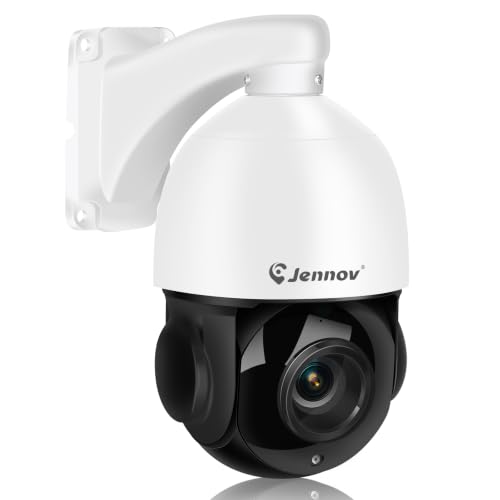
Jennov 4K 8MP PTZ PoE Dome — Best long-range zoom
A fixed camera at the top of a 60-metre driveway records a wide, useless panorama: you can see that a vehicle arrived, but not whose it was. The Jennov speed dome exists for that geometry. Its motorised lens zooms optically to 20x, so the sensor’s full 8 megapixels land on the distant gate rather than being spread across the whole approach, and its infrared array is rated to reach around 320 feet — far beyond the illumination of any turret in this roundup. Pan and tilt motors let one mounting point sweep a yard, a loading area or a small car park.
Used well, this camera works as a sentry rather than a recorder of everything. Set preset positions for the gate, the fuel tank and the barn door, and let patrol mode step between them; when motion triggers at a preset, the dome is already looking the right way instead of mid-sweep. It pairs sensibly with fixed cameras rather than replacing them — let cheap turrets watch the close perimeter continuously, and let the Jennov do the long identification work they cannot.
Two honest cautions belong here. A PTZ can only look one direction at a time, so the moment it zooms into the gate it is blind to the workshop behind it; treat it as a complement to fixed coverage, never the whole system. And a moving, zooming dome is conspicuous — on a quiet rural property that visibility can deter, but on a suburban house it may simply look excessive next to neighbours’ doorbell cameras.
- Format: motorised pan/tilt/zoom PoE dome
- Resolution: 8MP (4K)
- Zoom: 20x optical
- Night reach: infrared rated around 320 ft
- Power: PoE, single Ethernet run
Strengths
- Optical zoom keeps full sensor detail on distant subjects.
- Infrared reach covers approaches no fixed camera here can light.
- Preset positions and patrol tours automate the watching routine.
Trade-offs
- One viewing direction at a time leaves gaps while it zooms elsewhere.
- Moving parts add a maintenance point that fixed cameras never have.
- Overkill for a standard house plot, where it will rarely use its range.
Best for: farms, yards, long driveways and small commercial sites with one tall mounting point.
Not suited for: a typical suburban home, where fixed cameras cover every approach for less fuss.

4K 8MP PoE Turret Camera — Best add-on camera
Not everyone starts from zero. If a recorder already hums in a cupboard and one corner of the property — the bins, the side gate, the gap beside the garage — still goes unwatched, this turret is the sensible way to fill it. It is a single 8MP camera with a 2.8mm lens giving roughly a 105-degree view, an IP67 sealed body, and H.265 compression so its stream does not bully the recorder’s storage. Turret (or eyeball) housings earn their popularity honestly: the ball-and-socket mount aims in any direction without tools, and there is no dome bubble to fog or reflect infrared back into the lens.
Its headline behaviour is full-colour imaging around the clock. Instead of switching to black-and-white infrared at night, it gathers available light — a street lamp, a neighbour’s porch light, its own supporting illumination — and keeps recording in colour. The practical payoff is descriptive detail: the recording shows a navy car and a red jacket, not two shades of grey. On a lit street or a driveway with a lamp, that difference is worth more than another megapixel would be.
Because it is an unbranded unit, check two things before ordering: that your recorder accepts third-party ONVIF-style cameras, and which features travel across. Basic recording and motion flags almost always work; brand-specific smart detection may stay locked to the recorder maker’s own cameras. Bought with that expectation set, it is the cheapest route in this guide to genuine 4K colour footage of one specific spot.
- Format: single PoE turret (eyeball) camera
- Resolution: 8MP (4K)
- Lens: 2.8mm, about 105° field of view
- Night mode: full-colour imaging
- Housing: IP67 weather-sealed; compression H.265
Strengths
- Colour night footage preserves identifying details grey IR footage loses.
- Turret mount aims by hand and avoids dome-glare problems entirely.
- H.265 keeps its share of the recorder’s drive modest.
Trade-offs
- Colour night mode needs some ambient light to work with.
- Recorder-brand smart features may not extend to a third-party camera.
- Sold singly, so multi-camera coverage means buying several units.
Best for: adding one quality 4K channel to a recorder you already own, especially over a lit driveway.
Not suited for: a pitch-black rural yard with no light source for its colour sensor to use.

REOLINK Duo 2V PoE — Widest coverage
Every single-lens camera, however wide its lens, leaves a wedge of blindness at its edges and directly beneath it. Above a shopfront, a warehouse door or a wide farm gate, that wedge is exactly where someone stands to work on a lock. The Duo 2V answers with two lenses side by side whose images the camera stitches into one continuous panoramic frame of roughly 180 degrees. One cable, one recorder channel, and the whole width of the entrance is in frame at once — no gap between two cameras for a subject to slip through, and no second licence or channel consumed.
The housing earns its place on a public-facing wall. An IK10 rating is the top of the impact scale used for enclosures like this, meaning the shell is built to survive deliberate blows that would crack an ordinary dome, and Reolink still fits its person, vehicle and animal detection, so a cat crossing the yard does not page you as an intruder. Colour night vision keeps the panorama usable after dark, which matters because a stitched view that collapses to murk at night would waste the whole concept.
Positioning is the skill with a panoramic camera. Mount it centred on the area you care about and high enough that the stitch line — the seam where the two lenses’ images merge — does not cross faces at standing height. Expect subjects very close to the lens to look stretched at the frame edges; that is geometry, not a fault, and it is why this camera watches entrances and yards better than it reads plates down a road.
- Format: dual-lens panoramic PoE camera
- Resolution: 8MP combined view
- Coverage: roughly 180° stitched frame
- Housing: IK10 vandal-resistant
- Detection: person, vehicle and animal
Strengths
- One camera covers an entrance width that normally takes two.
- IK10 shell suits walls within reach of the public.
- Animal filtering cuts the classic false-alert problem at rural sites.
Trade-offs
- Edge stretching makes it a coverage camera, not an identification camera.
- The stitch seam needs thoughtful mounting height to stay off faces.
- Wide-and-shallow view wastes its talent on long, narrow approaches.
Best for: storefronts, wide gates and yard entrances where one unbroken view matters most.
Not suited for: reading number plates or identifying faces at distance down a driveway.
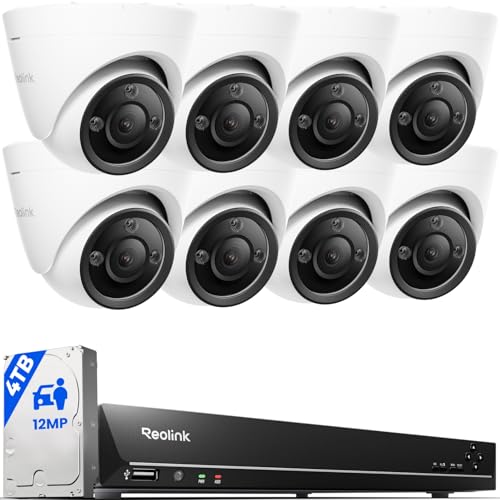
REOLINK RLK16-1200D8-A 12MP System — Most detail headroom
This kit needs an honest label before anything else: its cameras record at 12 megapixels, which is a class above 4K rather than 4K itself. We include it because buyers comparing 4K systems constantly meet it on the same shelf, and because its value is best understood against the 4K kit above. The platform is familiar — sixteen channels, eight dome cameras in the box, a 4TB drive fitted — but each camera captures roughly half again as many pixels as the 8MP version.
Where does that surplus actually show? In the crop. When something happens at the far side of a yard covered by a wide lens, reviewing the footage means zooming into a quarter of the frame. On 8MP footage that crop is soft; on 12MP footage the same crop still carries readable detail — a face shape, a plate’s first characters, the tool in someone’s hand. If your property is large enough that cameras must cover wide areas from few mounting points, that headroom is the difference between footage that describes and footage that identifies.
The cost is storage and it is not subtle. Twelve-megapixel streams fill the same 4TB drive far sooner than the 4K kit’s streams do, so plan on motion-based recording for quieter channels or budget for a larger drive from day one. Buyers with small plots will never crop deeply enough to notice the benefit, and for them the 800D8 above is simply the smarter spend — which is why this system ranks as the specialist’s choice rather than the default.
- Format: 8-camera PoE kit with 16-channel NVR
- Resolution: 12MP per camera (above 4K)
- Storage: 4TB hard drive pre-installed
- Detection: person and vehicle smart alerts
- Power: single-cable PoE from the recorder
Strengths
- Cropping into recorded footage keeps usable detail longer than 4K allows.
- Same proven recorder platform and detection as the 4K kit.
- Suits large plots where mounting points are few and scenes are wide.
Trade-offs
- Streams consume the fitted drive markedly faster than 8MP streams.
- Small properties gain nothing they can actually see for the extra cost.
- Higher bitrates ask more of older network switches and cabling.
Best for: large homes, smallholdings and businesses that review footage by zooming into wide scenes.
Not suited for: compact houses where cameras sit close to their subjects anyway.

Anpviz 4MP PoE Dome — Best low-cost dome
Let us be straight about what this camera is: a 4-megapixel dome in a list of 4K cameras, included because not every mounting position deserves 4K money. A side door, a stockroom aisle, a garage interior — in each, the subject passes within two or three metres of the lens, and at that distance 4MP footage identifies a face perfectly well. Spending the difference across four such positions buys a lot of coverage, and coverage of the right doorway beats resolution on the wrong one.
The hardware is more serious than the price suggests. The housing is metal rather than glossy plastic, sealed to IP66 against driven rain, and a built-in microphone records audio alongside the video — useful in a shop, where a conversation at the till can matter as much as the picture, subject to your local rules on audio recording. Infrared reach of about 98 feet covers a yard or a long room, and standard PoE means it drops onto the same cabling and recorder ecosystem as everything else in this guide.
Its limits appear exactly where you would predict. Ask it to watch a wide car park and the pixels spread too thin to identify anyone at the far rows; ask it to read a plate and it will not. That is not a defect — it is a camera priced for close work being asked to do distant work. Deploy it at choke points where people must pass near the lens, and it performs like a camera costing considerably more.
- Format: single PoE dome camera
- Resolution: 4MP
- Night reach: infrared to about 98 ft
- Audio: built-in microphone
- Housing: metal, IP66 weather-sealed
Strengths
- Metal housing and proper weather sealing at an entry-level price.
- Microphone adds audio context many budget cameras omit.
- Standard PoE makes it an easy extra channel on most recorders.
Trade-offs
- 4MP cannot identify subjects across wide or distant scenes.
- No smart person/vehicle classification of its own.
- Dome bubble needs an occasional wipe to keep infrared images clean.
Best for: close-range choke points — side doors, tills, stockrooms and garage interiors.
Not suited for: wide-area coverage or any position where plates must be read.
How do the six compare side by side?
| Camera | Type | Resolution | Standout trait | Watch out for |
|---|---|---|---|---|
| Reolink RLK16-800D8 | 8-dome kit | 8MP | Complete system, spare channels | Installation effort of eight runs |
| Jennov PTZ Dome | PTZ | 8MP | 20x zoom, 320 ft infrared | Looks one way at a time |
| 4K PoE Turret | Add-on turret | 8MP | Full-colour night imaging | Needs ambient light at night |
| Reolink Duo 2V | Dual-lens | 8MP | 180° stitched panorama, IK10 | Edge stretch on close subjects |
| Reolink RLK16-1200D8-A | 8-dome kit | 12MP | Crop headroom on wide scenes | Fills storage quickly |
| Anpviz Dome | Budget dome | 4MP | Metal IP66 body with microphone | Close-range work only |
Read the table by job rather than by rank. Kits answer “cover my property”; the turret and the Anpviz answer “cover this one spot”; the Jennov and the Duo answer two opposite geometry problems — very long and very wide. Choosing by job first and resolution second is how these six were ordered, and it is how we suggest you shop them.
How should you plan a PoE camera installation?
Start with a sketch of the property and mark approaches, not walls. People reach a house along the drive, the front path, the side passage and the back garden; cameras belong where those routes narrow, angled so a subject walks across the frame rather than straight at the lens, which gives the recording a profile and a face in sequence. Mount between two and a half and three metres high: low enough that faces are not just the tops of heads, high enough that a casual reach cannot redirect the housing.
Cabling decides the shape of the job. Each camera needs one unbroken Ethernet run back to the recorder or a PoE switch, and outdoor runs should use exterior-rated cable with drip loops where the cable enters the housing, so rainwater tracks down the loop instead of into the connector. Measure generously and buy a box of cable rather than pre-cut lengths if you are fitting a kit — the RLK16 systems include cables, but a run that must cross a house diagonally eats length faster than floor plans suggest. Test every camera on a short cable at the recorder before anything is fixed to a wall; a camera that will not pair is a five-minute problem on the floor and a miserable one at the top of a ladder.
Finish with the recorder, not the cameras. Set the timezone and daylight-saving behaviour first, because wrong timestamps quietly ruin footage as evidence. Then walk each camera’s view on the monitor and adjust detection zones: mask out the public pavement and the neighbour’s hedge, draw the zone over the gate and the door, and set person and vehicle alerts only where a person or vehicle would actually concern you. An hour spent here is what separates a system you trust from a system you mute.
What mistakes do buyers make with 4K IP systems?
The classic error is buying resolution and starving it of light and position. A 4K camera mounted at the peak of a gable, twelve metres from the drive, records a beautiful wide shot in which nobody can be identified; the same camera at eave height over the door would have settled the question. Related is the wide-lens trap: choosing the widest view for every position because the preview looks impressive, then discovering the pixels are spread so thin that the extra resolution never reaches the subject.
Storage surprises come second. Buyers fit a kit, set every channel to record continuously at maximum bitrate, and learn a fortnight later that the drive holds four days. Work out your retention target first — most households need a week to a fortnight — then set bitrates and motion recording to meet it, and check the recorder’s own estimate screen a day after installation rather than a month later.
Finally, people forget the network itself. A recorder left on its default password, or cameras hung off a switch that also feeds a houseful of streaming televisions without capacity to spare, undermine an otherwise sound system. Change every default credential, keep the recorder’s firmware current, and give the camera network tidy, labelled cabling you can trace in six months when one channel goes dark and you need to know which run is which.
Why do wired IP cameras still beat wireless ones for serious coverage?
Wireless cameras won the popularity contest because they install in minutes, and for a rented flat or a single door they are often the right answer. But their compromises are structural. A battery camera sleeps to save power and wakes on motion, which means the first second of an event — often the face turning toward the door — can be missed, and a busy week of deliveries can flatten the battery before the quiet week when something actually happens. A mains-powered Wi-Fi camera avoids the battery problem yet still shares airtime with every phone, television and laptop in the house, and its signal must fight through the same exterior wall that keeps your weather out.
A PoE camera has none of those failure modes. It is awake continuously, records continuously, and its connection is a physical cable whose performance does not change when the neighbours buy a new router. That is why the picks in this guide are all wired: the properties that need 4K identification footage are the same properties that cannot afford a camera asleep, buffering or offline at the decisive moment. The honest cost is installation labour, and it is a one-time cost — a cable run done properly serves for a decade, through several generations of camera upgrades on the same wire.
There is also a privacy dimension households increasingly care about. A local recorder keeps footage inside the house, on a drive you physically own, rather than depending on a manufacturer’s cloud subscription to view your own recordings. Both Reolink kits here record locally with no subscription required for the core function, which means the system keeps working — and keeps its history — even if a vendor changes its pricing or shutters a service years from now.
How much storage does 4K footage really need?
Storage is the specification buyers understand least and regret fastest, so it deserves plain numbers. A single 8MP camera recording continuously at a typical bitrate writes somewhere in the region of 60 to 90 gigabytes per day; eight of them will therefore cycle a 4TB drive in about a week to ten days. The 12MP kit’s cameras write appreciably more per hour, which is why its real-world retention on the same drive lands closer to five or six days at full continuous recording. These are planning figures, not promises — a camera watching a busy road compresses worse than one watching a still garden, because compression saves space on whatever does not move.
Three levers change the outcome. Lowering bitrate on overview cameras that exist to show context, while keeping full quality on the door and gate channels, trades pixels where they matter least. Motion-based recording on indoor or rear channels can halve consumption, at the small risk of missing the seconds before a trigger. And H.265 compression, which the turret and both kits support, stores roughly the same image quality in notably less space than the older H.264 standard. Used together, these settings routinely double the retention a naive setup achieves on identical hardware.
Decide your retention target from your life, not from a spec sheet. If you travel for ten days at a time, a system that overwrites at seven days has a hole exactly where you need it; either add drive capacity or trim recording settings until the recorder’s estimate clears your longest absence with margin. Checking that estimate the day after installation — and again after you change any quality setting — takes two minutes and prevents the particular heartbreak of footage that existed until yesterday.
Which camera positions matter most on a typical property?
If budget or cabling limits you to fewer cameras than the full kit, placement order matters more than camera count. The front door comes first: it is the one position every visitor, courier and intruder must occupy, ideally covered from an angle that captures faces rather than the tops of heads. The driveway and any vehicle parking come second, angled along the line of parked cars rather than across it, so a person moving between vehicles stays in frame for several seconds instead of crossing in one.
Third is the rear access — the back door, patio doors or the garden gate from the alley — because experienced intruders prefer the side of the house nobody watches from the street. Fourth, the side passage that connects front and back gardens, a natural corridor that funnels movement into a narrow, easily covered strip where even the 4MP Anpviz dome identifies people reliably at close range. Wide overview cameras of the whole garden come last: they look impressive on a monitor wall, but their footage describes rather than identifies, and they are the natural job for a panoramic camera like the Duo 2V once the choke points are covered.
Height ties the plan together. Around two and a half to three metres balances facial detail against tamper resistance for door and gate positions. Resist mounting at the roofline for anything except genuine overview duties: from six metres, a 4K camera records hats and shoulders in wonderful resolution, and resolution was never the limiting factor — geometry was.
How should you read night-vision claims before believing them?
Night specifications are where camera marketing stretches furthest, so translate them before comparing. An infrared range figure — 98 feet on the Anpviz, around 320 feet on the Jennov — describes how far the camera’s own infrared light can usefully reach in open darkness, not how far away it can identify a person. Identification distance is always far shorter: a figure visible at the edge of infrared range is a silhouette, useful for knowing something moved, useless for saying who it was. As a working rule, expect confident identification at perhaps a third of the headline night range, and plan camera positions so the subjects you care about pass well inside that distance.
Colour night vision plays by different rules. The turret in this list keeps a colour image after dark by gathering ambient light, which means its night performance depends on your street, not just its sensor: a driveway under a street lamp records genuinely useful colour footage, while the same camera facing a pitch-black field has nothing to gather and will fall back to a dim, noisy image. Neither approach is universally better. Infrared gives consistent monochrome reach anywhere; colour gives richer description where light exists. Matching the camera to the lighting you actually have — walk the property at night before ordering — is the cheapest performance upgrade available.
One more behaviour separates thoughtful cameras from cheap ones: how they handle bright points inside a dark frame. A porch light or a car’s headlights can trick a basic sensor into exposing for the light and crushing everything else to black. Cameras with decent wide dynamic range hold detail in both the lit and shadowed areas, which is precisely the situation at a front door at night — a bright lamp above, a face in partial shadow below it. When a listing mentions WDR or HDR for a security camera, that unglamorous line is doing more for your 2 a.m. footage than another megapixel would.
How do you keep a wired system useful year after year?
A PoE system asks little, but not nothing. Twice a year, wipe each lens and dome with a microfibre cloth; the film of dust and pollen that accumulates outdoors scatters infrared light at night and produces the hazy, glowing footage owners often blame on the camera. Clear spider webs from housings for the same reason — a web across the lens reflects the camera’s own infrared straight back into it, washing out the whole frame, and it is the single most common cause of “my night vision suddenly got worse” reports.
Check the recorder’s health screen seasonally: confirm the drive reports no errors, confirm every channel’s last-recorded timestamp is current, and spot-check one clip from a month ago to prove retention matches your settings. Update firmware when the manufacturer offers it, reading the release notes for detection or security fixes, and keep a note of your camera passwords somewhere safer than the default sticker — a recorder reset without those credentials turns a maintenance afternoon into a ladder-climbing expedition to factory-reset each camera in turn.
What should you check before ordering any of these systems?
Walk the property with a tape measure and a phone before money moves. Photograph each intended camera position from the subject’s viewpoint — stand at the gate and look back at the eave — because that reverse view reveals the tree branch, the downpipe and the neighbour’s extension that floor plans hide. Measure each cable route as the cable will actually travel, along walls and through the loft rather than in a straight line, then add slack; the commonest kit-installation frustration is a supplied cable that falls two metres short of the one awkward corner.
Check the recorder’s home with equal care. An NVR wants ventilation, a power socket and a network point if you intend to view cameras on your home network or phone; a sealed cupboard under the stairs cooks drives slowly, and drive failure is the one fault that erases history rather than merely pausing it. If the recorder will sit in a living space, look for fan-noise comments in owner feedback — a small fan that is inaudible in a garage is a genuine irritant beside a television.
Finally, confirm the small print that returns policies are written around: how many cables the kit actually includes and their lengths, whether the drive is fitted or merely bundled, and the warranty length on cameras versus recorder, since they sometimes differ. None of this is glamorous, and all of it is cheaper to learn from a listing page than from a doorstep return.
What about audio recording and privacy?
Only one pick here, the Anpviz dome, records sound, and it raises a question worth answering before installation rather than after a dispute: audio recording is regulated more strictly than video in many places, and the rules differ between a shop floor, a home and a shared driveway. Video of your own property’s approaches is broadly accepted in most jurisdictions; capturing conversations is where consent and signage requirements begin to bite. If you fit the Anpviz where the public passes — a storefront, a pavement-facing door — check your local rules and consider disabling the microphone where it is not clearly permitted.
Camera aim raises the parallel courtesy question. A camera angled to cover your gate that also frames a neighbour’s bedroom window invites conflict no footage is worth. Use the detection-zone and privacy-mask tools both Reolink recorders provide: black out the neighbour’s windows and garden from the recording itself, not just from alerts. A system that respects the street it watches tends to be a system the street tolerates — and tolerance matters the day you ask a neighbour whether their camera, in return, saw anything on the night yours was masked by rain.
How do alerts and everyday viewing actually work once it is installed?
The daily experience of a good system is mostly absence: nothing pings you, because nothing worth pinging happened. Making that true is a settings exercise. On the Reolink recorders, each channel’s person and vehicle detection can be tuned for sensitivity and fenced to a drawn zone, so the front camera reports a person on your path but ignores the pavement beyond the gate, while the driveway channel reports vehicles only during the hours the house is empty. Schedule alerts rather than leaving them permanently on — a system that notifies you about your own family coming home trains you to ignore it within a week.
Reviewing footage is the other half of daily life, and it is where the recorder’s timeline design earns its keep. Smart-event markers let you jump between flagged clips instead of scrubbing hours of empty garden, and synchronised multi-camera playback shows the same moment from the door and driveway cameras together, which is how you reconstruct a sequence — arrival, approach, departure — rather than watching three disconnected fragments. Spend the first week after installation deliberately reviewing one event a day; you will find the one badly aimed camera and the one over-eager alert zone while the ladder is still in the garage, not six months later when the footage actually matters.
Can you mix cameras from different brands on one recorder?
Often, yes, and this list quietly assumes you might: the turret and the Anpviz dome are exactly the sort of additions owners bolt onto a recorder bought earlier. Standard IP protocols let most recorders discover and record a third-party camera’s main stream, so the footage lands on the same drive and timeline as the native channels. What does not always travel is the intelligence layered on top — a recorder’s person detection may process only its own brand’s streams, leaving the guest camera with plain motion detection and the extra alerts that come with it.
The pragmatic approach is to put native cameras where smart alerts matter most — doors, gates, the driveway — and use guest cameras for context positions where continuous recording matters more than classification. Set the guest channels to record around the clock if their motion alerts prove noisy; storage is cheaper than frustration, and a channel that cries wolf gets muted, which is worse than a channel that simply records. Test one guest camera before buying four: an hour spent proving compatibility on your recorder is worth more than any compatibility list, because firmware versions quietly change what works.
Final Recommendation
For most houses, the Reolink RLK16-800D8 is the purchase we would make: it is the only option here that turns one box into a finished, expandable 4K system, and its detection keeps the footage watchable. Add the colour-night turret where a lit driveway needs one better channel, choose the Duo 2V when a wide entrance keeps defeating single lenses, and step up to the 12MP kit only when your plot is big enough that you genuinely review footage by cropping into it. The Jennov belongs on rural and commercial approaches, and the Anpviz earns its keep at close choke points where 4K would be money spent on pixels nobody needs. Buy for the doorway where something will actually happen, and the recording will be there — sharp, timestamped and worth opening — on the one morning you need it.
Frequently Asked Questions
Do I need a special switch for PoE cameras?
The Reolink kits power their cameras directly from the recorder’s built-in PoE ports, so no separate switch is required for the cameras in the box. A standalone camera such as the turret or the Anpviz dome needs either a PoE port on your recorder or switch, or a small PoE injector on its cable run.
How long will a 4TB drive record eight 4K cameras?
Continuously, expect roughly one to two weeks depending on bitrate settings and how busy the scenes are; busy street-facing channels consume more. Switching quieter channels to motion-triggered recording extends retention substantially, and both Reolink recorders show a live estimate as you change settings.
Can these cameras work without an internet connection?
Yes. Recording to the local drive is the core function and continues with the internet unplugged entirely. What you lose without internet is remote viewing on a phone and push alerts; the footage itself keeps accumulating on the recorder at home.
Is 12MP worth it over 4K for a normal house?
Usually not. On a typical plot, cameras sit close enough to doors and gates that 8MP footage already identifies people, and the 12MP kit’s extra pixels mostly cost you storage. The bigger sensor earns its price on wide scenes — long yards, large parking areas — where reviewing means zooming into a small part of the frame.
Will the turret camera work with my existing recorder?
In most cases, yes, provided the recorder accepts third-party cameras over standard IP protocols. Expect recording and basic motion detection to work; the recorder brand’s own smart classification may be reserved for its own cameras, so treat any smart features as a bonus rather than a guarantee.
Where should the first camera go if I can only fit one today?
Over the main entrance, angled to catch faces of people approaching the door, at roughly eave height rather than gable height. Doors are where visitors, deliveries and intruders all converge, and a single well-placed camera there outperforms three impressive ones watching empty lawn. Fit that one properly, live with its footage for a fortnight, and the recordings themselves will show you which blind spot deserves the second camera far more clearly than any plan drawn in advance could.
Can I watch these cameras on my phone from away from home?
Yes — both Reolink recorders and the standalone cameras here support app viewing once the recorder is connected to your home network, and the connection is made by scanning a code on the recorder rather than by opening ports on your router. Live view, playback of recorded events and alert notifications all travel through that app link, while the recording itself stays on the drive at home.
What happens to the system during a power cut?
Recording pauses while power is out and resumes automatically when it returns, because the recorder and its PoE cameras draw from the same supply. Owners who need continuity through cuts put the recorder on a small uninterruptible power supply; since a PoE kit’s draw is modest, even a compact UPS carries the whole system through short outages.
Related Guides
Planning a wider system? Read our guides to the best 4k security cameras, the best 4k outdoor security cameras and the best 8 channel home security cameras for wireless and larger-channel alternatives.
Related guides
- Best 1080p IP Cameras: PoE Domes, Turrets, Bullets and a PTZ That Earn Their Cable
- Best Doorbell Cameras No Subscription: Local Storage Picks, and the Ring/Blink Truth
- Best AC Powered Wireless Security Cameras: Wi-Fi Data, Mains Power, Zero Sleep
- Best 400 FPS High Speed Cameras: The Honest Truth About Burst Slow Motion


