What's inside
As an Amazon Associate I earn from qualifying purchases. This post may contain affiliate links at no extra cost to you.
gizmoverdict.com is reader-supported. When you buy through links on our site, we may earn an affiliate commission.
Where to buy: linked models below lead to their Amazon listings, where you can check price on Amazon and confirm which accessories, cases and spare batteries the current bundle actually includes, since budget bundles change contents more often than the cameras change. The step-up reference at the end is prose only.
The best 4k action cameras inexpensive enough to risk on a handlebar share an open secret, and this guide will trade in it honestly: the 4K on the box is a resolution the sensor can address, not a promise that the footage will rival a flagship. Small sensors, modest lenses and ambitious marketing meet in this tier, and the result, judged fairly, is still remarkable. For a fraction of a premium camera’s cost you get a waterproof, mountable, genuinely 4K-capable recorder that shrugs off the crashes, splashes and salt water that would retire a phone. The trick is knowing which corners the price cut, so your expectations land where the footage will.
Three translations will recur through every review below. First, resolution: many budget sensors capture their sharpest, most honest video at 1080p or 2.7K, with 4K modes that add pixels faster than they add detail. Second, stabilisation: electronic image stabilisation here is a crop and a clever warp, effective on gentle motion, outmatched by the violent shaking of a mountain bike on rock. Third, zoom: every zoom figure in this tier is digital, a crop into the frame that spends resolution to buy reach. None of these make the cameras bad. All of them make an informed buyer dangerous in the best way.
The five linked picks are the budget tier’s current centre of gravity, three generations of AKASO’s long-running EK and Brave lines plus two challengers in Hiicam and a mini body-cam design that stretches the category’s definition. A prose-only step-up reference closes the list, not as a temptation but as a yardstick, so you can see exactly what the extra money buys and decide whether your filming actually needs it. Most readers, honestly assessed, will find their camera in the first five.
A note on the word inexpensive, since it does heavy lifting in this category. It is used here as a tier, not a number: the class of cameras priced for risk, bought to be mounted, lent, drowned and occasionally sacrificed to a great shot. Nothing in this guide prints a static price, because this tier’s prices move with seasons and bundles, but the tier itself is stable, and its bargain with the buyer has not changed in a decade: remarkable capability, honestly limited, at a cost that lets you actually use the thing.
Key Takeaways
- Budget 4K is real resolution with modest detail; 1080p often looks nearly as good.
- Electronic stabilisation smooths gentle motion, not violent trail shaking.
- Every zoom number in this tier is digital cropping, not lens reach.
- Waterproof ratings assume the housing or seals are fitted exactly as instructed.
- Battery life claims are best-case; cold, Wi-Fi and 4K settings shorten them.
- Accessories in the box are this tier’s hidden value, mounts especially.
Quick Picks
| Pick | Badge | Why it earns a place |
|---|---|---|
| AKASO EK7000 4K Action Camera | The budget benchmark | The long-running original with EIS, remote and a mountain of mounts. |
| AKASO Brave 4 Action Camera | Best stills in the budget tier | A step up in refinement with 5x digital zoom and solid EIS. |
| AKASO EK7000 Pro Action Camera | Best budget touchscreen | The EK formula with a touch display and updated stabilisation. |
| Hiicam 4K Action Camera | Best dual-screen budget pick | Front and rear touch screens with a very wide 170-degree lens. |
| Mini Body Cam 4K Waterproof Action Camera | Best wearable long-runner | A mini body-cam form with built-in storage and huge battery claims. |
| DJI Osmo Action (step-up reference) | Step-up yardstick, prose only | What the premium tier adds, so the budget decision is informed. |
How did we choose these budget action cameras?
The first filter was survival of the fittest listing: a camera had to come from a brand or build with a track record long enough to judge, spare batteries and mounts actually available to buy, and a specification that could be cross-checked against owner experience rather than resting on a render and a prayer. The budget tier churns with anonymous models that vanish by spring, taking their apps and accessories with them, and a camera you cannot buy a second battery for is a camera with an expiry date.
The second filter was honesty-adjusted value. Each candidate was weighed on what it delivers at the settings owners actually use: stabilised 1080p and 4K for daylight action, stills good enough for thumbnails and holiday proof, an app that connects without a ritual, and a waterproof claim that survives reading its own conditions. On paper the whole tier looks identical, 4K, EIS, waterproof, remote included. In the hand and on the trail the implementations separate quickly, and the reviews spend their words on exactly those separations.
Third came the accessory economy, because in this tier the camera is half the purchase. AKASO’s long history means its mounts follow the universal action-camera fitting, its cases and batteries are everywhere, and a buyer inherits an ecosystem rather than a gadget. Newer challengers were required to show the same compatibility or compensate with a generous box. A cheap camera orphaned from the mount standard is expensive in the only currency that matters on a trip, which is shots missed while improvising with tape.
Prices in this tier move too quickly for a guide to chase, and bundle contents move with them, so verify the box on the day you order rather than trusting any roundup’s memory, this one included. The cameras themselves change slowly, which is precisely why a well-bought budget model stays satisfying for years after the listing that sold it has been rewritten a dozen times.
The order of the picks also encodes a small editorial judgement worth stating: reliability of the whole arrangement outranks brilliance in any single specification. A budget camera is bought to be present at unrepeatable moments, on a reef, on a descent, at a child’s first solo ride, and a model that is merely good at everything while always working will out-document a temperamental star across any real year of adventures.

AKASO EK7000 4K Action Camera — The budget benchmark
The EK7000 is the camera that built this tier’s reputation, sold for years in numbers that turned it into the default answer to a whole category of questions. Its formula has never changed because it never needed to: 4K30 recording, electronic stabilisation, a waterproof housing rated deep enough for recreational diving, a wireless remote and a box of mounts generous enough to start filming on day one. Rivals have chased it with newer sensors and bigger claims, yet the EK7000’s installed base is itself a feature, because every problem you will ever meet has already been solved publicly by somebody who owns one.
Footage expectations should be set by its generation. In bright daylight the 4K is honest and lively, the colours lean vivid in the way holiday footage forgives, and the EIS smooths walking, paddling and gentle cycling into watchable calm. Push it into violent shaking or dim light and the first-generation stabilisation and small sensor show their age in wobble and grain. None of this surprises anyone who bought it as what it is, a rugged witness for adventures, and its stills serve their real purpose, proof and thumbnails, perfectly well.
The accessory economy deserves emphasis because it compounds. The camera follows the universal mount fitting, so the chest harness from a friend, the suction mount from a car kit and the dive filters from a holiday shop all attach without adapters or prayer. Spare batteries are cheap and everywhere. When a flagship owner and an EK7000 owner both crack a housing on the same reef, one of them is filming again tomorrow for the price of a sandwich, and it is not the flagship owner. Total cost of ownership is this camera’s quiet superpower.
The remote, often dismissed as a gimmick in reviews of rivals, proves its worth in the field. Strapped to a wrist or a paddle, it starts and stops recording without the fumble of gloves on buttons or the battery drain of a live phone connection. Solo users in particular build their whole filming rhythm around it. Combined with the camera’s tolerance for being mounted and forgotten, the remote turns the EK7000 into an honest documentary tool: it records the moments you chose, from angles you could not hold, at a price that lets you risk it.
Age is the only real caveat. The design’s app, menus and stabilisation belong to its era, and buyers who have used a modern flagship will feel the years in the interface. Buyers arriving from a phone, or from nothing, will feel only the capability. As the tier’s benchmark and its safest first purchase, the EK7000 remains the camera against which every other entry in this roundup, including its own descendants, must justify itself.
Longevity reports are the EK7000’s least glamorous and most persuasive review. Units bought for a single holiday refuse to die, migrating to children’s bikes, dashboard duty and the toolbox drawer for filming plumbing repairs in dark cupboards. A camera that becomes household infrastructure has repaid its price in a currency spec sheets cannot denominate. When a successor is eventually bought, it is usually bought alongside the original rather than instead of it, which tells you everything about how this little box ages in real homes.
- Video: 4K at 30fps, lower rates at higher frames
- Sensor: 20MP stills class
- Stabilisation: electronic, EIS generation one
- Waterproof: to 131ft in its housing
- Zoom: 4x digital crop
- Extras: wireless remote, accessory bundle
Strengths
- Accessory ecosystem is enormous
- Proven design with years of owner knowledge
- Remote included as standard
Trade-offs
- EIS is first-generation smoothness
- 4K detail is modest in texture
- App experience is functional, not slick
Best for: First-time action camera buyers wanting the safest budget bet.
Not suited for: Riders needing flagship-grade stabilisation on rough trails.

AKASO Brave 4 Action Camera — Best stills in the budget tier
The Brave 4 is what happened when AKASO’s budget line grew up a little. It keeps the family’s essentials, 4K30 video, EIS, deep waterproofing in the housing, a remote in the box, and polishes the experience around them: a tidier body, a more confident stills side with burst and time-lapse modes that holidaymakers actually use, and handling that feels less like a gadget and more like a camera. In a tier where many models are the same internals wearing different badges, the Brave 4’s coherence is its distinction, the sense that someone at the company uses the thing on their own weekends.
Stills are the honest reason to choose it over the EK7000. Twenty-megapixel captures from a small action sensor will not trouble a photography competition, but the Brave 4’s modes around the sensor are genuinely useful: time-lapse for the campsite sunset and the harbour tide, burst for the exact frame of a jump, and a self-timer that turns the camera into a group-photo machine on a mini tripod. Families who film a trip and photograph it with one device will find this the most willing of the budget picks, and willingness, on holiday, is the specification that decides what gets used.
Video stays within the tier’s honest envelope. Daylight 4K is crisp and colourful, the stabilisation handles the walking-and-kayaking class of motion with composure, and the 5x digital zoom is best understood as a framing convenience for distant subjects you intend to watch rather than scrutinise, since it crops into the frame and spends the resolution it magnifies. Treat zoom as composition, not as reach, and it will never disappoint you. Indoors and at dusk, lower your sights to match the sensor, lower the resolution for cleaner files, and let the footage be atmosphere rather than evidence.
The Brave 4 also inherits the family’s ecosystem advantages in full. Mounts, batteries, housings and filters interchange with the vast AKASO and generic installed base, so the camera slots into an existing kit or starts one that will outlive it. Its own bundle covers the first adventures generously. When the camera eventually retires to a drawer as a backup, its accessories will still be working on its successor, which is the sort of arithmetic budget buyers should perform more often and marketing departments hope they will not.
Choose the Brave 4 if your filming life mixes video and photographs in roughly equal appetite and you want the budget tier’s most rounded manners. It does not chase the EK7000’s rock-bottom positioning or the Pro’s touchscreen, and in exchange it offers the calm competence of a design that has been refined rather than merely revised. For a family holiday camera that also survives the reef and the bike park, that balance is very easy to live with.
The Brave 4 also handles the unglamorous second career of action cameras better than most: mounted in a car as a journey recorder, fixed above a workbench for build videos, or lent to a teenager for a school project. Its stills modes and calm menus make it the family member that gets borrowed, and borrowability is a genuine household specification. Cameras that intimidate sit in drawers; cameras that explain themselves in ten seconds accumulate the family’s visual history almost by accident.
- Video: 4K at 30fps plus lower modes
- Sensor: 20MP stills
- Stabilisation: electronic image stabilisation
- Waterproof: to 131ft with housing
- Zoom: 5x digital
- Extras: remote and accessory kit included
Strengths
- Refined handling over the EK line
- Useful burst and time-lapse stills modes
- Same deep accessory compatibility
Trade-offs
- Still a small sensor at heart
- Digital zoom spends resolution quickly
- 4K30 ceiling, no high-frame 4K
Best for: Holiday filmmakers who also shoot plenty of still photographs.
Not suited for: Slow-motion fans needing high frame rates at high resolution.

AKASO EK7000 Pro Action Camera — Best budget touchscreen
The EK7000 Pro exists because of a complaint every owner of the original knows by heart: changing settings through two buttons and a tiny non-touch display is a small daily tax on enthusiasm. The Pro pays the tax off. Its rear touchscreen turns framing, mode changes and playback review into the tap-and-swipe interactions a phone-raised generation expects, and the difference in willingness to experiment is immediate. Owners of touchscreen cameras simply try more settings, and trying more settings is how a budget camera’s footage quietly improves without a single hardware upgrade elsewhere.
Around the screen, the formula is the family’s trusted one, updated where it counts. Stabilisation is a later generation than the original EK’s, visibly calmer on the walking and cycling footage that dominates real use, and the 4K30 recording carries the same honest character, strong in daylight, modest in texture, forgiving in colour. The remote remains in the box for the moments when the camera is mounted beyond arm’s reach, which is most of the moments an action camera exists for. The waterproof housing keeps the deep rating, and inside that housing, inevitably, the touchscreen goes silent, because water and capacitive glass are strangers.
That single caveat organises the buying decision. Divers and snorkellers will drive the camera by its buttons through the housing exactly as they would the cheaper original, so the Pro’s premium buys them little. Land-based filmers, riders, skiers, vloggers and parents, gain the screen’s full value every session. Know which tribe you belong to before paying for a feature your favourite element will disable. This is the sort of honesty that saves returns, and it costs the Pro nothing with the land tribe, who are the majority of its buyers anyway.
Battery behaviour follows the screen’s appetite. A touchscreen used as a viewfinder drinks faster than a button-driven camera idling in a mount, so the Pro rewards the remote-and-sleep discipline described in the guide above: frame with the screen, then let it go dark and run the camera from the wrist. Spare batteries, cheap and universal across the family’s ecosystem, complete the arrangement. With that rhythm established, the Pro films all day in bursts of attention rather than in one draining continuous stare.
As the EK line’s modern face, the Pro is the easiest budget recommendation for anyone whose filming happens mostly above water. It keeps everything that made the original a benchmark, the ecosystem, the bundle, the remote, the toughness, and removes the one friction its owners complained about for a decade. In a tier full of spec-sheet clones, fixing the actual complaint is a radical act, and it is why this camera, rather than a paper rival with a bigger number, takes the touchscreen slot in this roundup.
A small accessory transforms the Pro more than any setting: a simple cage or frame with a cold shoe. It turns the touchscreen camera into a tiny production rig, holding a small light or microphone for vlog segments while the housing stays ready for water days. Budget rigs like this are where the Pro quietly outclasses rivals with bigger numbers, because its screen makes the rig pleasant to operate and its ecosystem makes the parts cheap enough to experiment with freely.
- Video: 4K at 30fps
- Display: rear touch screen
- Stabilisation: electronic, updated generation
- Waterproof: to 131ft in housing
- Zoom: 5x digital
- Extras: remote control included
Strengths
- Touchscreen transforms setup speed
- Updated EIS over the original EK
- Familiar ecosystem and bundles
Trade-offs
- Touch dies inside the waterproof housing
- Battery appetite grows with screen use
- Still the family’s small-sensor footage
Best for: Users who hate button-driven menus and film mostly on land.
Not suited for: Divers, who cannot use the screen inside the case anyway.
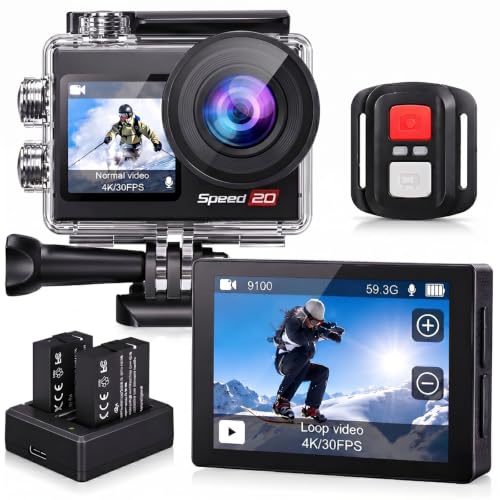
Hiicam 4K Action Camera — Best dual-screen budget pick
Hiicam’s entry attacks the budget tier from the direction of self-filming, and its weapon is a second screen. A front-facing display, still a rarity at this price, ends the oldest frustration in action vlogging: pointing a wide lens at your own face and hoping. With the front touch screen live, a solo creator frames the shot, checks the light on their face and knows the take is good before moving on, rather than discovering a helmet-cam view of their own chin back at the hotel. For the growing class of riders, anglers and travellers who are simultaneously the crew and the cast, that screen is not a luxury; it is the difference between a workflow and a lottery.
The lens doubles down on the immersive brief with a hundred and seventy degrees of view, the widest in this roundup. Landscapes swallow the horizon whole, cockpit and handlebar shots gain a genuine sense of envelopment, and group selfies stop amputating the friends at the edges. The cost is the fisheye character that such width always brings: horizons bow, buildings lean, faces near the edges stretch. Creators who shoot action and scenery will call it style. Anyone filming architecture, products or anything with straight lines that matter should look at the AKASOs’ narrower fields and accept their framing discipline instead.
Core performance sits squarely in the tier’s honest band. The 4K recording and EIS serve daylight action well, the waterproof housing carries the class-standard deep rating, and the included remote covers the mounted-and-far use case. Touch on both screens is a genuine convenience that speeds setup, and Wi-Fi app transfer works in the usual budget fashion, fine for clips, patient for epics. Nothing here embarrasses the price; equally, nothing repeals the small-sensor physics the guide above describes, and low light remains a place this camera visits rather than inhabits.
The diligence paragraph matters more for a newer brand. Confirm before the return window closes that spare batteries are actually purchasable, that the mount fitting matches the universal pattern your other accessories use, and that the app pairs reliably with your specific phone. Hiicam is building its track record now, and early buyers who verify those three mundane things convert a calculated risk into a simple good deal. The camera’s concept is strong enough to deserve that small effort rather than a reflexive pass in favour of older names.
If your filming is substantially of yourself, talking, reacting, presenting the adventure as its host, this is the budget pick designed around your life. The dual screens solve your actual problem, the vast lens flatters your actual scenery, and the price leaves room in the budget for the batteries and mounts that turn a camera into a kit. Just keep it out of the architecture business, where its beautiful wide eye tells beautiful wide lies.
Battery sharing is the question Hiicam shoppers should ask in the product questions before anything else, because the answer decides the camera’s expedition value. If its batteries match a common pattern, spares are a trivial purchase and the dual screens can be used without anxiety. If they are proprietary, price a second battery into the deal from the start and the camera remains a bargain. Either answer is workable; only an unasked question becomes a problem, usually at a trailhead.
- Video: 4K recording with EIS
- Displays: dual touch screens, front and rear
- Lens: 170-degree ultra-wide view
- Waterproof: to 131ft with housing
- Zoom: 5x digital
- Extras: remote control included
Strengths
- Front screen nails selfie framing
- Widest view in this roundup
- Touch on both faces is rare at this tier
Trade-offs
- Newer brand, thinner track record
- Ultra-wide lens bends straight lines
- Verify mount and battery compatibility
Best for: Vloggers and solo creators who film themselves constantly.
Not suited for: Purists wanting natural perspective or a decade-proven brand.

Mini Body Cam 4K Waterproof Action Camera — Best wearable long-runner
This mini body cam stretches the roundup’s definition in a useful direction. It is an action camera by specification, 4K, waterproof, stabilised, but a body camera by vocation: a small wearable unit with storage built in and a battery claim, up to three hundred and fifty minutes, that dwarfs everything else in this list. Its natural owners are not chasing cinematic trail footage. They are cyclists who want the commute witnessed, couriers and event staff whose shifts deserve a record, walkers and anglers who want hours of hands-free capture without a chest harness of straps and mounts. For those missions, runtime and wearability outrank every other line on a spec sheet.
The built-in 64GB storage is the design’s wager, and it cuts both ways with unusual clarity. In its favour: no card to buy, no counterfeit card to curse, no tiny slot to fumble with gloves, and a camera that works the moment it is charged. Against it: when the memory fills, the session ends until you offload, and on a multi-day trip without a laptop that ceiling is a planning constraint rather than a footnote. Owners who film in episodes and offload nightly will never meet the ceiling. Expedition filmmakers will meet it on day two, which is why this camera is a specialist in a roundup of generalists.
Picture quality follows the tier’s physics with a body-cam accent. The stabilisation generation is respectable, the 4K is genuine, and the chest-height viewpoint produces footage that feels like testimony: level, continuous and unembarrassed about being a record rather than a movie. Audio recording is a deliberate part of the design here, since a body camera’s value often lives in what was said as much as what was seen, and users should remember that recording conversations carries legal and courtesy obligations that vary by place and workplace. The camera will capture everything; judgement remains the wearer’s job, as with the security cameras elsewhere in this guide’s family.
Waterproofing and toughness suit its working life. The unit is built to be rained on, knocked against doorframes and worn through a shift without ceremony, and its small size means it actually gets worn, which is the first requirement of any witness. Battery claims should be read as best-case, as always, with resolution and Wi-Fi habits deciding the real figure, but even discounted generously the runtime is this camera’s headline and it survives the discount with room to spare. Few products in the budget tier can say their headline survives honest arithmetic; this one can.
Choose it if your filming is long, wearable and documentary in intent, and the AKASOs if your filming is short, mounted and cinematic in ambition. They share a price tier and almost nothing else, which is exactly why both belong in an honest roundup. The mini body cam is the roundup’s reminder that the best camera is defined by the job, and for the job of simply being there, running, for hours, nothing else here comes close.
Workplace users should establish one habit on day one: a visible recording routine. A body camera that its wearer announces, activates openly and offloads through a known process protects everyone, including the wearer, while a casually worn recorder corrodes trust in a team. The hardware here is neutral and capable; the policy around it decides whether it is remembered as protection or as surveillance, and that decision belongs to people, not to a product page.
- Form: mini wearable body camera
- Storage: 64GB built in
- Battery: rated up to 350 minutes class
- Stabilisation: EIS 2.0
- Waterproof: rated for action use
- Audio: onboard recording for narration and evidence
Strengths
- Exceptional claimed runtime per charge
- No card to buy, lose or counterfeit
- Clips to clothing for hands-free recording
Trade-offs
- Fixed storage cannot be swapped mid-trip
- Body-cam angle is chest-height reality
- Brand support is minimal
Best for: Cyclists, couriers and event staff wanting long hands-free recording.
Not suited for: Filmmakers swapping cards across a multi-day expedition.
DJI Osmo Action (step-up reference) — Step-up yardstick, prose only
This closing entry sells nothing and links nowhere, because its job is measurement. DJI’s Osmo Action family represents what the premium tier actually adds over the five budget cameras above: a substantially larger sensor that gathers more light and detail, stabilisation matured through generations of professional use, colour science that survives grading, and an ecosystem of first-party microphones, mounts and support that treats the camera as a production tool. Put its footage beside a budget pick’s in daylight and the gap is real but modest. Put them beside each other at dusk, on a rough descent, or in an edit where the footage must be pushed, and the gap becomes the price, made visible.
The honest question is whether your filming visits the places where the gap lives. A family filming reefs at noon, trails in summer and birthdays in gardens will capture ninety percent of their memories identically on either tier, because daylight is the great leveller of small cameras. A creator publishing weekly, filming in weather, at night, on machinery that shakes like a paint mixer, lives in the other ten percent permanently, and for them the premium is not vanity but rent on capability they use every single week.
There is also a middle path worth naming: buy the budget camera now, film for a season, and let your own footage tell you whether you are bumping against its ceilings or never approaching them. The mounts and habits transfer upward when you eventually step up, the budget camera retires honourably to the risky mounts the premium one should not visit, and the upgrade, when it comes, is purchased with evidence rather than with the anxiety that a spec sheet comparison is designed to produce.
That is the spirit in which this whole roundup was written. The budget tier is not a waiting room for real cameras; for most owners it is the destination, and a well-chosen inexpensive action camera will document a decade of adventures without apology. The yardstick exists so that the minority who genuinely need more can see precisely what more consists of, and the majority can close the comparison tabs, buy the AKASO or the Hiicam, and go and get their camera wet.
Renting before stepping up is the option nobody mentions and everybody should consider. Premium action cameras rent cheaply for a weekend from camera hire shops in most cities, and one weekend of your own footage, your light, your trails, your edit, settles the tier question more honestly than a month of comparison videos shot by strangers. If the rented flagship’s footage does not visibly transform your output, the budget camera was never your bottleneck, and you have saved the difference for the price of a hire fee.
- Class: premium action camera family
- Sensor: substantially larger than budget rivals
- Stabilisation: mature, wide operating envelope
- Low light: visibly cleaner at speed
- Ecosystem: first-party mounts, mics and support
- Price position: several times the budget picks
Strengths
- Footage quality a clear class above
- Stabilisation trusted by professionals
- Support and accessories are first-rate
Trade-offs
- Costs multiples of every pick above
- Still bound by action-camera physics
- Overkill for daylight holiday filming
Best for: Creators whose income or audience depends on the footage.
Not suited for: Anyone whose filming is daylight, occasional and for family.
How do the budget action cameras compare?
| Model | Standout trait | Watch out for |
|---|---|---|
| AKASO EK7000 4K Action Camera | Benchmark bundle, vast accessories | Early-generation stabilisation |
| AKASO Brave 4 Action Camera | Refined all-rounder, good stills | 4K capped at 30fps |
| AKASO EK7000 Pro Action Camera | Touchscreen EK upgrade | Screen useless underwater |
| Hiicam 4K Action Camera | Dual touch screens, 170 lens | Young brand, heavy distortion |
| Mini Body Cam 4K Waterproof Action Camera | Wearable, huge battery claim | Fixed 64GB storage |
| DJI Osmo Action (step-up reference) | Premium sensor and stabilisation | Premium price to match |
What should you know before filming with a budget action camera?
What does 4K from a small sensor actually look like?
Set the expectation precisely and these cameras will delight you; set it by a flagship demo reel and they will feel like a betrayal. A budget 4K frame holds genuine resolution for composition and cropping, and in bright daylight the footage is crisp, colourful and entirely publishable. What it lacks is the flagship’s fine detail in textures, grass, gravel, distant faces, and its dynamic range in contrasty scenes, where skies blow out sooner and shadows fill with noise earlier. The gap is visible side by side and mostly invisible in isolation, which is why owner satisfaction in this tier is high among buyers who read guides like this one first.
Practical shooters exploit the tier’s real strengths. Film at 4K when you may crop in the edit, since the extra pixels are working room even when they are not extra detail. Drop to 1080p for long sessions, where the files shrink, the batteries stretch and the stabilisation often performs at its best. Treat stills as documentation rather than art and they will serve faithfully. The camera is a witness with a wide eye and a tough shell, and witnesses are valued for being present, not for being painters.
How well does electronic stabilisation really work here?
Electronic image stabilisation reads motion sensors and counter-warps each frame, cropping the edges to buy its margin. On a chest mount during a run, a kayak’s gentle roll or a walking tour, the better implementations in this list produce footage smooth enough to watch without fatigue, a small miracle at this price. The system has hard limits. It cannot invent the pixels a violent shake smeared across the frame, it softens low-light footage where frames expose longer, and on the roughest descents it produces the familiar jelly wobble as the warp loses its argument with physics.
Riding technique is the other half of stabilisation. A helmet mount inherits the rider’s own head stabilisation, the finest gimbal biology provides, while a handlebar mount bolted to the shaking part itself gives the electronics the hardest possible job. Mount high, mount to the body where you can, keep the camera’s own EIS on for ordinary action and off when it is tripod-still, and this tier will surprise you. Expecting software to repeal physics is the only way to be disappointed by it.
What do waterproof numbers require from you?
The depth figures in this tier, commonly around forty metres, describe the camera inside its housing or with its seals perfectly closed, tested in still, clean water. Real water is none of those things. Surf, whitewater and diving entries slam housings with pressure spikes, sand and sunscreen attack seals, and a single hair across an O-ring turns a rated camera into a very small aquarium. The rating is real, but it is a contract: inspect and clean the seal before every water session, close the housing until its latch agrees, and rinse in fresh water afterwards while the case stays shut.
Owners who treat the ritual as part of the sport keep these cameras for years of snorkelling, kayaking and pool duty. Owners who trust the headline and toss the camera into a beach bag of grit learn the rating’s conditions in one expensive minute. Also note the practical sequels: touchscreens do not work underwater, so set the mode before the dive; fogging inside the housing on humid days is normal physics, cured by anti-fog inserts; and the camera alone, out of its case, is splash-resistant at best unless the listing says otherwise in so many words.
How do you get a full day from small batteries?
Budget action cameras sip power by action-camera standards and still drain in roughly an hour to ninety minutes of 4K filming, less in cold weather, less again with Wi-Fi live-viewing through the app. The arithmetic of a day out is therefore batteries, plural, and this tier’s saving grace is that spares are cheap and light. Carry two or three, rotate them through a pocket where body warmth keeps them honest in winter, and let the camera sleep between runs rather than idling with its screen lit like a lantern.
Settings are the other lever. Dropping to 1080p for the long scenic stretches, switching the screen timeout to its shortest, disabling voice control you never use and reserving the app connection for framing checks rather than constant monitoring can stretch a battery across an afternoon. The included remotes on several of these models are not novelties; a wrist remote that wakes and triggers the camera without waking its screen is one of the most effective battery accessories ever bundled, and it costs you nothing you have not already paid.
How do you edit budget footage so it looks its best?
Budget footage rewards a gentle edit and punishes an ambitious one. The files carry less colour information than flagship recordings, so aggressive grading tears them into banding and noise, while a light touch, contrast settled, saturation nudged rather than shoved, keeps them looking like the bright day they were shot on. Cut tightly, because action footage’s real flaw is rarely quality but duration: the forty unbroken minutes of trail that felt epic from the saddle are a screensaver to everyone who was not on the bike.
Sound is the cheapest production upgrade available to this tier. The cameras’ own microphones, especially in housings, are the weakest link in the whole chain, so replace or support them in the edit: music under the action, the original audio dipped beneath it for texture, and silence used deliberately at the moment before a jump or a dive. Viewers forgive a soft image instantly and a muddy soundtrack never, and an afternoon spent learning your editor’s audio tools will lift budget footage further than any camera swap in this price class.
Which mounts should a first kit contain?
Resist the forty-piece mount sets, whose abundance conceals how few pieces any one sport uses. A first kit needs exactly four things: a chest harness for the universal action viewpoint, a helmet mount for the rider’s-eye view, a suction or clamp mount for vehicles and boats, and a small tripod or grip for everything stationary. Those four cover the overwhelming majority of footage beginners actually publish, and each additional mount should be bought later, in response to a specific shot you failed to get, rather than in anticipation of shots imagined in the abstract.
Quality matters most at the joints. A mount that creeps under vibration rewrites your framing mid-run and can walk a camera loose entirely, so tighten every articulation, add the safety tether the kits include and most owners ignore, and re-check the rig after the first rough section rather than at the bottom of the descent. The tether in particular is the cheapest insurance in the entire sport: cameras are lost to gravity and water far more often than they are broken by impact, and a two-gram cord defeats both.
Which mistakes do budget action camera buyers repeat?
Judging the camera by its 4K badge alone
A buyer who shops the badge buys the softest mode the camera owns. The 4K headline on a budget sensor is the mode with the least stabilisation headroom, the shortest battery life and the least forgiving exposure, while the tier’s sweet spots usually sit one rung down. Read reviews for the mode owners actually film in, test your own camera across its settings on the first outing, and let evidence rather than packaging choose your default. The badge got you a fine camera; it should not be allowed to run it.
Mounting once and never checking the angle
Action cameras see the world through a very wide lens that forgives framing sins and commits its own: the classic first-day footage is forty minutes of handlebar, sky or the photographer’s own chin. The fix is a ten-second ritual. Film a short test at every new mount, review it on the phone before the real run, and mark the mount’s position with a pencil line once the angle is right. Wide lenses reward the ritual richly, because when the framing is correct the same width that embarrassed you becomes the immersive view you bought the camera for.
Leaving the protective case on for dry land audio
The waterproof housing that saves the camera at sea muffles it on land, turning commentary into a rumour. Several models here ship with an open or skeleton back door for exactly this reason, and vlog-style users should fit it whenever water is not involved. Better still, learn which of your filming is narration and which is pure action, and dress the camera accordingly each time. A minute of preparation separates footage people watch with the sound on from footage they mute, and muted footage loses half its story.
Buying storage and batteries from the shadiest listing
The budget ecosystem’s one true swamp is its accessories grey market, where memory cards wear famous logos over fraudulent silicon and batteries promise capacities physics declines to provide. The symptoms are always the same: corrupted clips, cameras that die mid-run, a holiday’s footage dissolving into error messages. Buy cards and cells from the platform’s own retail storefront or a named brand’s official shop, format and test them at home, and the tier’s legendary cheapness survives intact, because genuine budget accessories are already inexpensive enough that the fakes save pennies and cost memories.
Final Recommendation
One last discipline separates happy budget owners from the disappointed kind, and it costs nothing. Film something short this week, with the camera you already have or the one that just arrived, and watch it on the biggest screen in the house before reading another review. Your own footage, in your own light, is the only benchmark that was ever going to govern your satisfaction, and in the overwhelming majority of homes it settles the tier question in favour of the cameras above within a single clip.
For most readers the AKASO EK7000 family is the budget tier’s centre of sense: the original for the classic accessory-rich package, the Pro for its touchscreen, the Brave 4 for a step toward better stabilisation and stills. The Hiicam earns its place for dual screens and a fresh take on framing, and the mini body cam serves the quiet niche of wearable, always-on recording. Every one of them will film a holiday, a trail and a reef competently, provided you meet them at their real specifications rather than their advertised ones.
The step-up reference that follows the reviews is there so the decision is informed rather than anxious. If its advantages, sensor size, stabilisation maturity, low-light grace, read like luxuries, buy from the five with confidence and spend the savings on batteries, mounts and the trips themselves. A budget action camera in a waterfall beats a flagship in a drawer every day of the year, and the footage that exists is always, in the end, the best footage.
Frequently Asked Questions
Is budget 4K good enough for YouTube?
For daylight action content, comfortably yes. Viewers judge action footage on framing, energy and smoothness far more than on pixel-level detail, and most watch on phones where this tier’s limitations disappear. Film in good light, stabilise sensibly, keep clips tight in the edit and the channel’s bottleneck will be ideas, not the camera. Low-light and talking-head content is where stepping up shows first, so weigh your actual mix before spending.
Can these cameras replace a phone for holiday video?
They complement rather than replace it. The action camera goes in the sea, on the bike and under the waterfall, places a phone should not follow, and its wide lens and mounts capture viewpoints a handheld phone cannot. The phone remains better for evenings, food and faces. Travellers who carry both, and let each do what it is built for, come home with the fullest record and the fewest regrets, which is the actual goal of holiday filming.
Why does my footage look wobbly despite EIS being on?
Usually the mount, not the menu. A camera bolted to a vibrating surface receives shakes faster and harder than electronic stabilisation can counter, and the warp produces wobble as it fails gracefully. Move the mount to your helmet or chest, tighten every joint in the chain, and confirm EIS is enabled for the mode you are filming in, since some cameras disable it at their highest frame rates or resolutions. The improvement from mounting alone routinely astonishes owners who blamed the camera.
How many memory cards should I carry?
Budget 4K consumes roughly a gigabyte every few minutes at high bitrates, so a day of generous filming can pass a hundred gigabytes without effort. Carry two large, reputable cards rather than a wallet of small ones, format them in the camera, and offload each evening to a phone, tablet or drive so a lost camera never means a lost trip. Counterfeit cards are this tier’s silent plague; buy from the marketplace’s own storefront rather than the cheapest listing with a familiar logo.
Does the remote control really matter?
More than its size suggests. A wrist or handlebar remote lets you start and stop recording without touching the camera, waking its screen or shifting its angle, which saves battery, preserves framing and keeps your hands on the bars or the paddle. For solo riders and skiers it converts the camera from a set-and-forget recorder of everything, mostly dross, into a deliberate recorder of the moments you chose, which also halves your editing time later.
Can I live-stream from a budget action camera?
Some models offer basic streaming or webcam modes over USB or Wi-Fi, and for casual use they work, though setup polish lags far behind the recording experience. If streaming is a core mission rather than a curiosity, test it during the return window with your exact computer and platform. Most owners in this tier are better served recording beautifully and uploading afterwards, which is what these cameras were born doing.
Related Guides
Round out your action setup with these companion guides: Action camera mounts that survive crashes Editing action footage without a fast computer Waterproof camera care after salt water


