What's inside
- Where to buy
- Key Takeaways
- Quick Picks
- How did we choose these best 3d hd projectors?
- Which 3D formats still exist, and which ones will you actually use?
- Why does 3D demand a darker room than 2D?
- Is 1080p still enough in a 4K world?
- What should you know about DLP, color wheels and the rainbow effect?
- How should you think about screens and seating for 3D?
- What does owning a legacy-format projector actually involve?
- Why does 2D performance still decide most of your evenings?
- How should you verify a legacy listing before you pay for it?
- How did 3D go from headline feature to legacy — and why does it linger on projectors?
- How do the six compare side by side?
- What mistakes do 3D projector buyers keep making?
- How should you set up a first 3D screening?
- Final Recommendation
- Frequently Asked Questions
- Related Guides
As an Amazon Associate I earn from qualifying purchases. This post may contain affiliate links at no extra cost to you.
gizmoverdict.com is reader-supported. When you buy through links on our site, we may earn an affiliate commission.
Where to buy
Every linked projector in this guide is sold through Amazon in the United States, and each pick below links to the live listing for that exact model so you can check the current price before committing. A warning that belongs at the top rather than the bottom: several of these machines are older-generation listings, and stock in this corner of the market is finite. When a model you want shows as available, that availability is part of the offer — this is not a category where next season’s refresh is coming to save you.
Let us be honest about what a search for the best 3d hd projectors means in this decade. 3D is a legacy feature. The Blu-ray 3D format has been discontinued, the television industry walked away from 3D panels years ago, and no mainstream projector line is being designed around stereoscopic playback anymore. What remains — and it is genuinely worth having if you own the discs — is a shelf of 1080p DLP projectors that still speak the old languages: frame packing from a Blu-ray 3D player, side-by-side and top-and-bottom from files and broadcasts, through DLP-Link glasses that sync to the screen itself. This guide rounds up the listings that still do it properly, tells you plainly which are previous-generation machines, and teaches the formats so you can keep a 3D library alive rather than landfilling it.
The six picks divide by temperament. The BenQ HT4050 and HT2050 are home-theater projectors from the format’s confident years, tuned for color accuracy in dark rooms. The Optoma HD146X and HD30LV are the living-room all-rounders that carried 1080p DLP into the streaming era. The Optoma HD39HDRx is the bright modern outlier — 4,000 lumens, HDR support, fast refresh — that happens to keep one foot in the 3D world. And the BenQ EH620 is a data projector by trade, 3,400 ANSI lumens of presentation muscle that lists 3D among its abilities and serves buyers whose rooms never go dark. Glasses, remember, are DLP-Link and always sold separately; no listing here bundles them, and any seller implying otherwise is embellishing.
Key Takeaways
- 3D on projectors is a legacy feature kept alive by 1080p DLP machines — Blu-ray 3D is discontinued, so these listings serve existing disc libraries and 3D file collections, not a growing format.
- All six picks are DLP designs, and the glasses they need are DLP-Link active-shutter glasses, sold separately in every case.
- The BenQ HT4050 and HT2050 are older-generation home-theater listings — buy them for their color tuning and their proper frame-packing 3D while they remain available.
- The Optoma HD39HDRx is the modern escape route: 4,000 lumens, HDR, a 120Hz refresh and an 8.4ms response figure at that rate, for rooms and uses beyond the dark theater.
- Frame packing, side-by-side and top-and-bottom are different signals, not quality settings — your source and your projector must agree on which one is being sent.
Quick Picks
| Pick | Badge | Why it earns its place |
|---|---|---|
| BenQ HT4050 | Best color-first 3D theater | An RGBRGB color wheel and Rec. 709 tuning made this the connoisseur’s 1080p machine of its generation, with full 3D home theater support while the listing lasts. |
| BenQ HT2050 | Classic 3D all-rounder | The beloved living-room DLP of its era: 1080p, 3D-ready, 2,200 lumens per its listing, and a picture generations of owners learned to trust in the dark. |
| Optoma HD146X | Best simple 1080p value | A vibrant Full HD home theater projector with the straightforward setup and punchy image that made it a default recommendation for first big screens. |
| Optoma HD30LV | Modern compact 1080p | The newer face of Optoma’s HD line — a 1080p Full HD home projector in a compact body for rooms that want cinema without a permanent installation. |
| Optoma HD39HDRx | Brightest and fastest here | Four thousand lumens, HDR, 120Hz refresh and a listed 8.4ms response at 120Hz, plus 4K input support — the pick for lit rooms and gamers alike. |
| BenQ EH620 | Best for bright rooms | A 3,400 ANSI lumen DLP data projector at 1080p with 3D capability, built for presentations that can moonlight as very large 3D screenings. |
How did we choose these best 3d hd projectors?
The first filter was the feature itself, verified rather than assumed: a pick had to genuinely support 3D playback at 1080p, not merely carry a marketing badge left over from a product family’s history. That single requirement thins the modern market brutally, because most current projectors have quietly dropped stereoscopic support altogether. The second filter was honesty of supply: these had to be real, orderable listings, since a guide to unavailable projectors is a museum catalogue. Where a listing represents an older generation — the HT4050 and HT2050 above all — we say so in its section rather than letting the reader discover it from a manufacture date.
Beyond that, we judged the machines as the 1080p DLP projectors they are: color behaviour in the dark, brightness for the rooms they target, throw and zoom flexibility, fan manners, and the completeness of their 3D implementation across frame packing and the split-frame formats. Brightness and response figures quoted in this guide come from the listings themselves, and where a figure belongs to a specific mode — the HD39HDRx’s response time is quoted with its 120Hz refresh — we keep the two facts attached. The result is a short list by necessity. In a legacy category, six honest machines beat twenty padded ones.
Which 3D formats still exist, and which ones will you actually use?
Frame packing is the connoisseur format and the reason this category survives. A Blu-ray 3D disc sends two full 1080p frames — left eye and right eye — stacked in a single signal, and a projector that accepts frame packing shows you everything the disc holds. If you own Blu-ray 3D discs, this is the compatibility line that matters, and the BenQ theater models built their reputations on handling it properly. Your player matters too: a standard Blu-ray player cannot send a frame-packed signal, so the chain is only as 3D as its weakest link.
Side-by-side and top-and-bottom are the survivors’ formats. Each squeezes both eye views into one ordinary frame — halves side by side, or stacked vertically — trading half the horizontal or vertical resolution for total compatibility with ordinary sources: media players, PCs, some broadcasts and the vast libraries of 3D files enthusiasts have archived over the years. Every machine in this guide that matters speaks these dialects, and they are how most 3D viewing actually happens now that the disc format has ended. The practical lesson is to inventory your own library first. Disc collectors need frame packing above all; file collectors need reliable side-by-side handling; most owners need both, which is precisely what the better listings here provide.
Then there are the glasses, the part of the system newcomers forget until the first screening. These DLP projectors use DLP-Link: the projector embeds a brief synchronization flash in the image itself, and active-shutter glasses read it and alternate their lenses in step. There is no emitter to install, which keeps setup beautifully simple, but the glasses are never in the box with these listings — budget for a pair per seat, buy the DLP-Link type specifically rather than RF or infrared variants meant for other systems, and remember that active glasses dim the picture somewhat, which is one more reason 3D belongs in dark rooms.
Why does 3D demand a darker room than 2D?
Active-shutter 3D is a brightness tax levied at the glasses. Each eye sees the screen only half the time, through a shutter that is never perfectly transparent, so the image that reaches your brain is dramatically dimmer than the same projector’s 2D picture. A machine that feels generous in 2D can feel strained in 3D, and the effect compounds with screen size: the big, immersive image 3D begs for is exactly the image its brightness budget can least afford. This is why the theater-tuned BenQs, with brightness figures that look modest on paper, were always specified for dark rooms — their designers assumed the tax and priced it in.
The practical rules follow. Show 3D at the smaller end of your projector’s comfortable size range, on the highest-gain screen you reasonably can, with the room as dark as you can make it. Keep a lamp-lit living room for 2D and give 3D the full blackout treatment; the depth effect itself also reads better against a dark surround, because your eyes judge the illusion against the room. Buyers whose rooms cannot darken should weight the HD39HDRx’s 4,000 lumens heavily — brute brightness is the only honest countermeasure — or accept that their 3D will be an occasional evening event rather than a daily mode.
Is 1080p still enough in a 4K world?
For 3D, the question answers itself: the surviving 3D ecosystem is a 1080p ecosystem. Blu-ray 3D never moved beyond 1080p per eye, the file formats are 1080p-class, and the glasses-and-brightness arithmetic punishes higher resolutions further. But the answer holds for much 2D viewing too. At typical seating distances on 100-to-120-inch screens, a well-tuned 1080p DLP with good color — the HT4050’s Rec. 709 discipline is the standing example — delivers a picture whose limitations most viewers cannot name. What 4K adds in fine texture, these machines partly repay in color integrity, motion handling and the simple maturity of their designs.
The honest caveats are two. First, streaming interfaces and game consoles now assume 4K outputs; the HD39HDRx accepts a 4K input signal and downconverts gracefully, which keeps it compatible with modern sources in a way the oldest listings are not. Second, if 3D is a side interest rather than the mission, a modern 4K projector without 3D may serve your decade better. This guide is for the reader whose library, nostalgia or curiosity makes 3D the point — and for that reader, 1080p is not a compromise at all. It is the native resolution of everything they love.

BenQ HT4050 — Best color-first 3D theater
The HT4050 was BenQ’s argument that a 1080p projector could be judged like a display, not a light cannon. Its RGBRGB color wheel — six segments, the primaries repeated, no white segment cheating brightness upward — serves Rec. 709 color, the HD standard, with a discipline that made calibration-minded owners loyal for years. In a dark room with a good Blu-ray, the picture has a settled, filmic quality that brighter, cruder machines never find: colors sit where the standard says they should sit, and skin tones stop being an argument.
Its 3D is the full home-theater implementation of its era, frame packing included, delivered with the brightness discipline of a machine designed for blackout rooms. That is the context for everything about it: this is not a living-room toy but a theater component from the years when 3D was a headline feature and projectors were built to honor it. Treat it accordingly — dark room, fixed or semi-fixed placement, a screen you respect — and it returns one of the most satisfying stereoscopic pictures this guide can offer.
The candor paragraph: this is an older-generation listing, full stop. The design predates HDR, smart platforms and 4K inputs, and its stock exists because the model earned a long tail, not because a refresh is coming. Buy it as you would buy a classic car — for the thing it does beautifully, with eyes open about the era it comes from — and check availability with the seriousness the category now requires.
- Light engine: DLP, 1080p Full HD
- Color: RGBRGB color wheel, Rec. 709 tuning
- 3D: full home-theater 3D support, DLP-Link glasses (sold separately)
- Processing: advanced image processing per listing
- Intended rooms: dark, dedicated home theaters
Strengths
- The most color-disciplined picture in this guide — Rec. 709 done properly.
- Proper frame-packing 3D for Blu-ray 3D collections.
- RGBRGB wheel avoids the washed highlights of white-segment designs.
Trade-offs
- An older-generation listing — no HDR, no smart platform, finite stock.
- Dark-room tuning means lit rooms defeat its intentions.
- Glasses are an extra purchase, as everywhere in this guide.
Best for: disc collectors with a dark room who want their 3D library shown with reference color. Not suited for: bright living rooms or buyers who need modern HDR and streaming inside the box. Collectors should check the HT4050’s current Amazon price and availability sooner rather than later — legacy listings do not wait.

BenQ HT2050 — Classic 3D all-rounder
If the HT4050 was the connoisseur’s BenQ, the HT2050 was the people’s. Its listing describes a DLP 3D projector at 1080p with 2,200 lumens and a 15,000:1 contrast figure, and behind those plain numbers sits one of the most recommended home projectors of its generation — the machine a decade of forum threads handed to first-time buyers who wanted a big picture without a big education. It earned that status the unglamorous way: honest color out of the box, a quiet manner, and setup flexible enough for real rooms.
In 3D it does the era’s full repertoire, frame packing from Blu-ray 3D and the split-frame formats from files, through DLP-Link glasses. The 2,200-lumen budget asks for the same dark-room respect as its sibling — 3D’s shutter tax is real — but within a blacked-out room at sensible sizes the HT2050’s picture has the quality that made owners keep it long past upgrade season: balanced, calm, and free of the digital harshness that cheaper DLPs of the period sprayed everywhere.
Like the HT4050, it is an older listing and proud of nothing modern: no HDR pipeline, no apps, no interest in your streaming stick’s 4K output beyond showing it at 1080p. Read it as the category’s honest baseline — the projector that defines what a good 3D HD machine was, available while the tail of its production run lasts. For a dedicated 3D-and-Blu-ray room, that baseline remains remarkably hard to beat at the effort it asks.
- Light engine: DLP, 1080p Full HD
- Brightness per listing: 2,200 lumens
- Contrast per listing: 15,000:1
- 3D: DLP 3D support, DLP-Link glasses (sold separately)
- Intended rooms: dark living rooms and first home theaters
Strengths
- A generation’s default recommendation, with the balanced picture to justify it.
- Complete 3D format support for discs and files alike.
- Friendly setup and manners for first-time projector owners.
Trade-offs
- Older-generation listing — modern features need not apply.
- 2,200 lumens plus the 3D brightness tax means dark rooms only.
- Stock is a tail, not a pipeline; availability can end without ceremony.
Best for: first-time theater builders and Blu-ray 3D owners who want the classic done right. Not suited for: HDR streaming households or sunlit rooms. If it sounds like your room, look at the HT2050 on Amazon and check its price while the listing remains live.

Optoma HD146X — Best simple 1080p value
The HD146X represents Optoma’s long-running HD line at its most distilled: a 1080p Full HD DLP home theater projector described by its listing as vibrant, and remembered by owners as the machine that made a 120-inch picture feel like an ordinary purchase. Its appeal is subtraction. No platform to learn, no calibration odyssey — place it, feed it, and the punchy, saturated DLP image that built Optoma’s living-room reputation fills the wall.
For this guide its relevance is that the HD line carried 3D support through this generation, keeping the door open to DLP-Link viewing alongside everyday 2D. In practice the HD146X splits its life: films and sport in 2D on ordinary evenings, where its vibrancy flatters a room that is dim rather than blacked out, and 3D sessions as events, with the curtains drawn properly and the glasses charged. That dual life is exactly how most surviving 3D projectors actually live now, and the HD146X is shaped for it honestly.
Its limits are the line’s traditional ones. Color accuracy is enthusiastic rather than reference-grade — this is vibrancy as a house style, the opposite pole from the HT4050’s discipline — and black levels in the darkest scenes reflect its living-room brief. Buyers building a shrine to film should look up the page; buyers building a room the whole family uses daily will find this the easiest machine here to live with.
- Light engine: DLP, 1080p Full HD
- Character per listing: vibrant home theater image
- 3D: HD-line DLP 3D support, DLP-Link glasses (sold separately)
- Setup: straightforward table or ceiling placement
- Intended rooms: living rooms, family media rooms
Strengths
- The simplest route here to a big, lively 1080p picture.
- Keeps 3D capability inside an everyday family projector.
- Forgiving in dim rooms where theater-tuned rivals look flat.
Trade-offs
- Vibrant rather than reference-accurate color.
- Black depth trails the dark-room BenQ models.
- 3D still demands darkness its 2D mode does not.
Best for: families wanting one projector for films, sport and occasional 3D nights. Not suited for: calibration purists or black-level obsessives. Family rooms can check the HD146X’s live Amazon price and start measuring the wall.

Optoma HD30LV — Modern compact 1080p
The HD30LV is what Optoma’s HD line grew into: a 1080p Full HD home projector in a compact modern body, from a period when the category’s center of gravity shifted from dedicated theaters to flexible living spaces. Its design assumes the projector shares the room with life — set on a sideboard, carried to a garden wall in summer, stored without ceremony — and that assumption shapes a machine that is easy to place, easy to feed and easy to forgive.
Within this guide it plays the role of the current-production counterweight to the BenQ classics. The 3D capability rides along in a machine whose daily work is streamed film, broadcast sport and console gaming at 1080p, so the buyer keeping a 3D collection alive does not have to dedicate a whole purchase to a legacy feature. That is, increasingly, the sensible way to buy into this category: 3D as a living feature of a modern projector rather than the sole reason for a museum piece.
The compromises are those of its class and price position: it is a living-room instrument, not a reference theater component, and its picture tuning favors brightness and punch over the last degree of color neutrality. In a dark room it entertains handsomely; in a bright one it copes better than the theater BenQs. For mixed modern use with a 3D library in the cupboard, it is the lowest-drama path on this page.
- Light engine: DLP, 1080p Full HD
- Form: compact modern home projector body
- 3D: supported within the HD line’s DLP implementation, DLP-Link glasses (sold separately)
- Use pattern: streaming, sport, gaming and film in flexible rooms
- Intended rooms: living rooms, multipurpose media spaces
Strengths
- Modern, compact and easy to place anywhere in the house.
- 3D capability without dedicating the purchase to a legacy-only machine.
- Everyday streaming and gaming manners at honest 1080p.
Trade-offs
- Living-room tuning, not reference-theater color.
- Like all picks here, glasses cost extra.
- Not the brightest answer for genuinely lit rooms — that is the HD39HDRx.
Best for: modern households whose 3D collection shares time with streaming and games. Not suited for: dedicated dark-theater purists. The easy route is to see the HD30LV’s current price on Amazon and check it against your room’s light.

Optoma HD39HDRx — Brightest and fastest here
Every guide has a machine that breaks its own frame, and this is ours. The HD39HDRx lists 4,000 lumens, HDR support, a 120Hz refresh rate with an 8.4ms response time quoted at that rate, a 1.3x zoom, 4K input support and 26 dB quiet operation — a specification aimed squarely at bright rooms and fast games, from a newer generation than the theater classics above it. Yet it keeps a place in a 3D guide because Optoma’s high-brightness HD line held onto stereoscopic support while others let it go, and because its lumens attack 3D’s core problem — the glasses tax — head-on.
Think through what 4,000 lumens buys a 3D viewer. The shutter tax that shrinks a 2,200-lumen machine to murk still leaves this one with a working picture, at sizes and in rooms the classics cannot attempt. It buys the same freedom in 2D: sport on a Sunday afternoon with the blinds half open, a gaming session that does not require the household to live in a cave. The 120Hz mode and its listed response figure speak to players directly, and the 4K input support means modern consoles and players connect without negotiation — the machine accepts their signal and shows it at its native 1080p.
The trade is the familiar one for brightness-led DLP: color finesse and black depth serve the lumens, not the reverse, and viewers chasing the HT4050’s Rec. 709 calm will find this picture brasher. It is also, self-evidently, a machine with more modern expectations to meet, so confirm the 3D formats in the listing details against your library before ordering. Judged as the bridge between the 3D past and the bright, fast present, nothing else here stands on both banks at once.
- Light engine: DLP, 1080p with HDR support
- Brightness per listing: 4,000 lumens
- Refresh and response per listing: 120Hz, 8.4ms at 120Hz
- Optics and inputs: 1.3x zoom, 4K input support
- Noise per listing: 26 dB quiet operation
Strengths
- Brightness that survives the 3D glasses tax and lit rooms alike.
- Genuinely fast for gaming, with 4K-input compatibility for modern sources.
- Quiet-rated operation for a machine of this output.
Trade-offs
- Color and blacks play second to brightness in its tuning.
- Verify its 3D format support against your specific library before buying.
- Its talents are wasted in a small, perfectly dark theater.
Best for: bright rooms, gamers, and 3D viewers who refuse to blackout their lives. Not suited for: reference-color purists in dedicated theaters. If your room has windows and opinions, check the HD39HDRx price on Amazon and let the lumens argue.
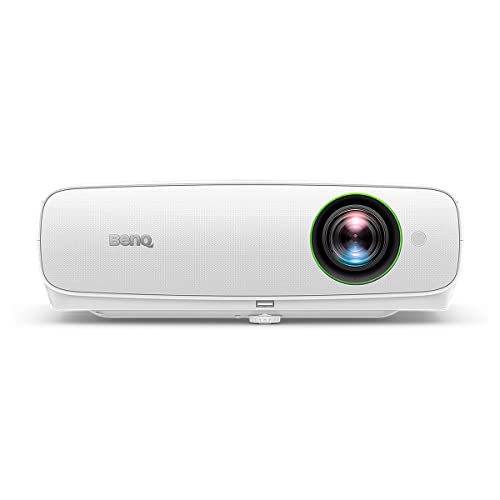
BenQ EH620 — Best for bright rooms
The EH620 arrives in this guide wearing its day job openly: its listing describes a data projector, standard throw, 3,400 ANSI lumens of DLP brightness at 1080p, with 3D in white. This is BenQ’s presentation hardware, built for meeting rooms and classrooms where the lights are fluorescent, the audience is note-taking, and the image must be legible before it is beautiful. Its presence here answers a real reader: the one whose 3D screenings happen in a school hall, a community room or a big bright lounge, where the theater BenQs would drown.
Presentation muscle translates to 3D duty in one decisive way — brightness headroom. The glasses tax that governs this category is paid out of lumens, and 3,400 ANSI lumens pays it with change, letting the EH620 hold a large 3D image in rooms that are dimmed rather than darkened. For a film society, a classroom’s end-of-term screening or a family whose living room never truly goes black, that headroom is the difference between 3D as a pleasure and 3D as a squint.
Set expectations by its trade. A data projector’s tuning serves text, charts and video legibility; color finesse, black depth and quiet manners all rank below punch in its priorities, and its fan speaks with a working machine’s voice. It will show your 3D library bigger and brighter than anything else here in imperfect rooms — and a dedicated theater it will never be. Buy it for the rooms you actually screen in, and it is the most pragmatic pick on this page.
- Light engine: DLP, 1080p (1920×1080)
- Brightness per listing: 3,400 ANSI lumens
- Class: standard-throw data projector
- 3D: listed 3D capability, DLP-Link glasses (sold separately)
- Intended rooms: classrooms, halls, bright lounges
Strengths
- Presentation-grade brightness that funds large 3D images in dim-not-dark rooms.
- Full HD resolution keeps text and video crisp at data-projector sizes.
- Built for institutional duty cycles and shared spaces.
Trade-offs
- Data tuning: color and blacks serve legibility first.
- Fan and case manners of a working projector, not a theater component.
- Overkill, in every sense, for a small blacked-out media room.
Best for: schools, societies and bright-room hosts who screen 3D big. Not suited for: intimate dark theaters chasing reference color. Institutions can check the EH620’s Amazon price and put its lumens to work.
What should you know about DLP, color wheels and the rainbow effect?
Every machine in this guide is a single-chip DLP design, and that shared architecture explains both the category’s survival and its one famous caveat. A DLP projector reflects light off a chip of microscopic mirrors and sequences color through a spinning wheel — red, green, blue and sometimes additional segments flashing in turn while your visual system blends them into a full-color image. The design is compact, bright for its size, sharp in a way that flatters both film and text, and — decisively for this guide — inherently fast, which is why DLP became the natural home of consumer 3D: the chip can alternate left-eye and right-eye images cleanly at the speeds stereoscopic playback demands.
The caveat is the rainbow effect: a minority of viewers, glancing quickly across a high-contrast image, catch a brief fringe of separated color as the wheel’s sequence momentarily unblends. Sensitivity is personal and unpredictable — most people never see it, some see it only in subtitles against black, a few find it genuinely distracting. The HT4050’s RGBRGB wheel is partly an answer, cycling the primaries twice per frame in a pattern that also serves its color purity. If you are buying for a household or a classroom, the democratic solution is a test screening with the actual audience before the return window closes; if you are buying for yourself and have watched DLP happily for years, your eyes have already voted.
It is also worth naming why no LCD or LCoS machine shares this list. Those technologies can do 3D — premium home-theater lines did it beautifully in the format’s prime — but their surviving listings have largely dropped the feature or priced themselves into a different conversation. DLP kept 3D because DLP-Link made it nearly free to include: no emitter hardware, no licensing drama, just firmware and a sync flash. The legacy format’s afterlife runs on that small engineering convenience, which is a useful reminder that features survive on ecosystems, not on merit alone.
How should you think about screens and seating for 3D?
A screen that serves 2D well serves 3D adequately, but the format’s brightness tax argues for choosing with gain in mind. Gain describes how strongly a screen reflects light toward the audience; a modest positive gain concentrates the projector’s hard-won lumens where the viewers sit instead of scattering them to the walls, and in 3D that concentration is worth real money. Matte white screens around unity gain remain the safe default for color honesty, while higher-gain surfaces narrow the viewing cone — fine for a sofa of three, unkind to a wide row of chairs. Retroreflective and specialty 3D screens exist, but for the machines in this guide a good matte screen, honestly sized, beats an exotic one every evening.
Sizing runs opposite to instinct. The same tax that argues for gain argues against the largest image the wall allows: every extra inch of diagonal dilutes the light each eye receives, and 3D that looks dim reads as 3D that looks broken. Experienced owners run their 3D image ten to twenty percent smaller than their 2D image on the same machine, and trade the lost size for depth that actually registers. If your projector has zoom range to spare, that adjustment is free; if it does not, moving the projector or the seating a modest distance achieves the same geometry.
Seating completes the triangle. Sit too close and the split-frame formats reveal their resolution bargain, crosstalk creeps in at the edges of your vision, and eye fatigue shortens sessions; sit too far and the depth effect flattens toward a postcard. The middle distance — where the screen fills a comfortable field of view without demanding head movement — is where the illusion was engineered to live. Angle matters as much as distance: viewers far off the projector’s axis see the weakest version of the effect, so arrange the good seats on the center line and let latecomers take the wings, exactly as cinemas have always done.
What does owning a legacy-format projector actually involve?
Ownership begins with an inventory, and honest owners do it before ordering: count the Blu-ray 3D discs, the archived files, the compatible player already in the rack. That count is the machine’s true content library, and it decides whether this purchase is a restoration or a speculation. Restoration is a fine reason to buy — a shelf of discs represents money spent and pleasures unfinished — but speculation is not, because the format’s supply lines are closing rather than opening. Buy for the library you hold, and every screening is a dividend; buy for a library you imagine, and the projector becomes a monument to a plan.
The second ownership fact is consumables and spares. Glasses multiply: a pair per regular viewer, plus a spare, because a dead battery or a cracked arm should never cancel a screening. Lamp-based machines from the format’s era eventually ask for a lamp, and in a legacy category the wise owner checks that the specific lamp module remains orderable before falling in love with the projector — availability of the projector itself is only half the supply question. None of this is burdensome. It is the ordinary stewardship of any mature technology, closer to owning a record player than a streaming box, and for many readers that tactile, deliberate quality is precisely the appeal.
Finally, there is the social fact: 3D at home is an event format now. Nobody in this decade leaves a projector in 3D mode by default; the glasses come out for occasions, for the disc a friend has never seen properly, for the animated film that turns a room of adults into children. The machines in this guide serve that rhythm perfectly — 2D workhorses by day, time machines by appointment. Buyers who embrace the rhythm get years of distinctive evenings from a modest purchase. Buyers who expect 3D to behave like a television feature will misread a lovely instrument as a broken one, and the fault will not be the projector’s.
Why does 2D performance still decide most of your evenings?
Here is the arithmetic nobody prints on the box: even a devoted 3D household will watch most of its hours in 2D. The discs come out for occasions; the streaming, the sport, the games and the ordinary Tuesday films run flat. A projector bought purely as a 3D instrument but endured as a 2D one is a bad purchase wearing a good costume, which is why this guide weighs the everyday picture as heavily as the stereoscopic party trick. It is also why the modern Optomas compete so strongly here — their 2D lives are current-generation lives, with HDR support on the HD39HDRx and contemporary processing across the line.
Judge the 2D picture on the things flat viewing actually exposes. Color behaviour first: the HT4050’s Rec. 709 discipline and the HT2050’s balanced tuning are not spec-sheet ornaments but the difference between a film looking lit and a film looking filmed. Contrast in real scenes second — not the laboratory figure but the way a night street keeps its lamps and its shadows in the same frame. Motion third: sport and games punish lazy processing, and the HD39HDRx’s high-refresh design exists precisely because modern viewers watch fast things. A machine that wins those three contests in 2D and still opens the 3D door when asked is the rational shape of this entire category.
There is a corollary for the romantics. If your heart is set on a theater BenQ for its 3D, audition its 2D with the same severity, because that is the picture you will actually marry. The good news is that these models earned their reputations in 2D first — their 3D was the bonus feature of their era, marketed heavily but built on projectors that were already excellent. The category’s history runs in your favor: in its prime, 3D rode on the best 1080p machines, not the cheapest, and the listings that survive are disproportionately the good ones.
How should you verify a legacy listing before you pay for it?
Legacy categories attract careless listings, so verification is a buying skill here, not a paranoia. Begin with the model number and read it character by character against the manufacturer’s own archive pages; a single letter’s difference in this era’s naming can separate a 3D model from a sibling that dropped the feature. Confirm the 3D formats by name — frame packing for disc playback above all — in the manufacturer’s specifications rather than the retailer’s bullet points, because retailer copy is routinely inherited from adjacent models and survives long after it stops being true.
Then interrogate the offer itself. Establish whether the unit is new old stock, a return, or a refurbishment wearing new clothes, and what warranty, if any, stands behind it — in this guide we have presented the listings as what they are, but stock in a legacy category changes character over time and the listing page on the day you buy is the only version that counts. Check the lamp situation for lamp-based models: rated life, replacement module availability, and whether the module is a genuine part or a bare bulb in a compatible cage, a distinction that decides brightness and safety alike. Finally, confirm the return path before you need it. A legacy purchase made with a clean return window is an audition; one made without it is a wager. The machines here are worth auditioning properly.
How did 3D go from headline feature to legacy — and why does it linger on projectors?
The short history matters because it explains the shelf you are shopping. Home 3D crested in the early 2010s on a wave of blockbuster cinema, and televisions carried the banner: panels gained the feature, broadcasters trialled channels, and for a few years no flagship set shipped without glasses in the accessories box. Then the wave receded with unusual speed. Broadcasters closed their 3D channels, set makers quietly deleted the feature model year by model year, and the disc format that anchored the premium end was discontinued. The causes were less about picture quality than about friction — glasses to charge, content to hunt for, a living room rearranged around a sweet spot — friction that televisions, as furniture, could not afford.
Projectors inherited the afterlife for structural reasons. A projected image is already an event: the room darkens, the audience settles, the screen is enormous — and enormous is where 3D stops being a novelty and becomes a place. The friction that killed the format on televisions barely registers in a ritual that already involves dimming lights and choosing seats. Add DLP-Link’s near-zero cost of inclusion, and manufacturers kept the feature alive in projector lines long after it vanished from panels. That is the shelf this guide surveys: not a revival, not a corpse, but a stable niche serving libraries and enthusiasts with hardware that was, in its day, genuinely excellent.
The buying moral follows directly. Do not purchase a 3D projector as an investment in a format’s future, and do not let anyone sell you one on that basis. Purchase it as the correct instrument for a collection and a pleasure that exist today, at prices set by a market that has stopped pretending otherwise. Judged on those honest terms, the machines in this guide are not leftovers. They are the mature end of a technology that found its natural home later than it expected — on the biggest screens in the house, in the darkest rooms, by appointment.
How do the six compare side by side?
| Model | Brightness | Resolution | Defining trait | Character |
|---|---|---|---|---|
| BenQ HT4050 | Not headline-quoted in listing | 1080p | RGBRGB wheel, Rec. 709 | Color-first dark theater |
| BenQ HT2050 | 2,200 lumens (listing) | 1080p | 15,000:1 contrast (listing) | Classic all-rounder |
| Optoma HD146X | Living-room class | 1080p | Vibrant HD-line image | Simple family value |
| Optoma HD30LV | Living-room class | 1080p | Compact modern body | Flexible modern 1080p |
| Optoma HD39HDRx | 4,000 lumens (listing) | 1080p, HDR, 4K input | 120Hz, 8.4ms at 120Hz (listing) | Bright and fast |
| BenQ EH620 | 3,400 ANSI lumens (listing) | 1080p | Data-projector build | Bright-room workhorse |
The table tells the category’s story in miniature: two generations coexist here. The BenQ theater pair and the Optoma HD line descend from the years when 3D was a selling point and projectors were specified around it; the HD39HDRx and EH620 are modern brightness machines that retain 3D as one capability among many. Neither generation is the wrong answer — they are answers to different rooms, which is the only question this guide ever really asks.
What mistakes do 3D projector buyers keep making?
The expensive mistake is assuming glasses are included or universal. They are neither: these listings sell glasses separately, and only DLP-Link glasses sync with DLP projectors — the RF glasses from a departed 3D television and the infrared pairs from another system will sit dark while the film plays. Buy the right type, in the number of seats you actually fill, and keep a spare pair’s batteries in mind. The second mistake is source amnesia: a standard Blu-ray player cannot play a Blu-ray 3D disc, a streaming stick will not conjure 3D from services that dropped it, and a projector cannot invent a format the chain never sent. Audit your whole signal path before blaming the last box in it.
Third, buyers screen 3D too big and too bright-roomed, then declare the format disappointing. The glasses tax is physics, not a defect: shrink the image, darken the room, and the same machine transforms. Fourth, they pay theater money for legacy listings without checking what generation they are buying — the HT4050 and HT2050 are excellent and old, and both halves of that sentence matter. Finally, in a category defined by finite stock, they deliberate like it is a television purchase. When the right legacy machine is available at a sane price, availability is a feature; when it is gone, the modern HD39HDRx route remains, and it is a good one.
How should you set up a first 3D screening?
Work the chain in order. Confirm the source first: a Blu-ray 3D disc in a 3D-capable player for frame packing, or a file in side-by-side or top-and-bottom from a media player, and set the projector’s 3D mode to match the format you are sending — auto modes usually find frame packing, while split-frame formats often need to be told. Charge the glasses fully; a dying battery announces itself as flicker that owners misdiagnose as projector failure. Then darken the room properly, more completely than for 2D, and pull the image size in slightly from your 2D habit.
Seat the audience inside the screen’s honest cone, because 3D depth reads best near the center axis and degrades into crosstalk at wide angles. Give eyes ten minutes to settle before judging, keep the first session’s content kind — animation and nature documentaries are the format’s great ambassadors — and check in with your viewers, since a minority finds active-shutter 3D tiring and shorter sessions keep them in the audience. End by noting what worked: the format setting, the size, the seating. A legacy format rewards a household that keeps a small ritual, and punishes only the ones who wing it.
Final Recommendation
Choose by the room and the library you actually have. Disc collectors with a dark room should take the BenQ HT4050 for its color discipline or the HT2050 for its classic balance, and take them while the listings live. Families who want 3D as one pleasure among many should land on the Optoma HD146X or the compact HD30LV. Bright rooms and gamers belong to the HD39HDRx, whose lumens and speed solve problems the classics never addressed, and institutions screening big in imperfect light belong to the EH620. The format may be a legacy, but a library on a shelf is not nostalgia — it is a collection asking to be shown, and one of these machines will show it properly. Whichever you choose, complete the kit in the same order: the right DLP-Link glasses for every seat, a source that truly speaks your formats, and a room you are willing to darken. Get those three things right and the projector — classic or modern — will do the rest for years.
Frequently Asked Questions
Is Blu-ray 3D really discontinued?
Yes. The Blu-ray 3D format has been discontinued as a going concern — new releases dried up and the ecosystem moved on — which is why this guide frames 3D as a legacy feature throughout. Existing discs, however, play exactly as they always did on compatible projectors, and a well-kept collection remains the best 3D content library there is. You are buying playback for what exists, not a bet on what is coming.
Which glasses do these projectors need?
DLP-Link active-shutter glasses, in every case here. The projector embeds a sync flash in the image, the glasses read it directly, and no separate emitter is needed. They are sold separately from all six listings — never assume a pair is in the box — and glasses made for RF or infrared television systems will not work.
What is the difference between frame packing and side-by-side 3D?
Frame packing sends both eyes at full 1080p resolution, stacked into one signal, and is the format of Blu-ray 3D discs. Side-by-side squeezes both views into a single ordinary frame at half horizontal resolution, which makes it compatible with media players, PCs and archived files. Both are legitimate; match the projector’s 3D mode to the format your source is sending.
Why does 3D look dimmer than 2D on the same projector?
Because the glasses tax it. Active shutters show each eye the screen only part of the time, through lenses that absorb light even when open, so perceived brightness falls sharply. The countermeasures are a darker room, a smaller image, or a brighter projector — which is why the 4,000-lumen HD39HDRx and 3,400-lumen EH620 earn their places in a 3D guide.
Can these projectors show streaming services in 3D?
Effectively no, because mainstream streaming services dropped 3D support along with the television industry. Your realistic 3D sources are Blu-ray 3D discs through a compatible player, and 3D files in side-by-side or top-and-bottom form through a media player or PC. Plan your library around those two doors and you will never be disappointed.
How many pairs of glasses should I buy?
One per regular seat, plus one spare. Screenings fail socially before they fail technically — nothing deflates a 3D night like a guest watching a blurry double image bare-eyed — so count your actual audience honestly, including the friend who always comes. Keep the glasses charged between events and stored with the discs, so the ritual of a 3D night is opening a cupboard, not launching a search. DLP-Link glasses are shared across all six projectors here, so a household set serves whichever machine you choose.
Can I watch regular content on a 3D projector?
Yes — 3D is a mode, not a commitment. Every machine in this guide is a full-time 1080p 2D projector that shows streaming, broadcast, games and ordinary Blu-ray exactly as any good HD projector would, and most owners will spend most hours that way. The 3D capability waits quietly in the menu until a disc or file asks for it. Buying from this list never obliges you to watch anything in 3D; it simply refuses to close the door.
Are the older BenQ models risky to buy?
They are older-generation listings, and we present them as such: proven designs with long service histories, finite remaining stock, and none of the modern platform features. The risk is not quality — it is era. If HDR, apps and 4K inputs matter to you, buy the newer Optoma models; if reference-tuned 1080p 3D is the mission, the BenQs remain the connoisseur’s answer while they last.
Related Guides
Readers keeping a legacy format alive often care about brightness next, so our best 4000 lumen plus projectors roundup is the natural next read. If your 3D room doubles as a cinema, the best 1080p home theater projectors guide covers the dark-room class in depth. And gamers drawn to the HD39HDRx’s speed should compare it against the machines in our best 4k gaming projectors coverage before deciding which decade their room belongs to. The modern successor class is ranked in the best 4k hdr projectors. Gamers upgrading from this class should compare the best 4k projectors under a thousand.


