What's inside
- Where to buy
- Key Takeaways
- Quick Picks: Six 1080p Projectors for Real Living Rooms
- How did we choose 1080p projectors for actual home theater?
- How do these 1080p projectors compare on light, colour and lifestyle?
- How big a picture should a living room actually project?
- What should you spend on besides the projector?
- How do you set up throw, alignment and streaming without tears?
- Lamp, LED or laser: which light source fits your life?
- How do you keep a projector image looking its best over years?
- What is the honest upgrade path from a first 1080p theater?
- How do you run a great projector evening, from doorbell to credits?
- What mistakes shrink a home theater before the first film?
- Final Recommendation
- Frequently Asked Questions
- Related Guides
As an Amazon Associate I earn from qualifying purchases. This post may contain affiliate links at no extra cost to you.
gizmoverdict.com is reader-supported. When you buy through links on our site, we may earn an affiliate commission.
Where to buy
The best 1080p home theater projectors occupy the sweet spot of home cinema: genuine Full HD detail on screens that fill a wall, at ownership levels that do not require a dedicated cinema room or a second mortgage. The best 1080p home theater projectors in this verified list divide by philosophy. BenQ’s HT2060 pursues colour fidelity with an LED light source and HDR support, its TH575i chases brightness and smart convenience with a lamp rated at 3800 lumens in its listing, and Epson’s CO-FH02 brings 3LCD brightness and streaming smarts to rooms that refuse to go fully dark. Around those anchors sit a portable Epson and two Nebula capsule machines for theaters that assemble and vanish.
Brightness figures in this guide are quoted only as their listings state them, in the units their listings use, because projector brightness is a field where incomparable numbers breed confident nonsense. A lamp figure in lumens, an LED machine’s colour-led reputation and a 3LCD design’s colour brightness do not collapse into one ranking, and this guide will not pretend otherwise. What can be compared honestly is behaviour: which machine shrugs off a lamp-lit room, which one rewards a darkened room with cinema colour, and which one simply goes where the evening goes.
Why stay at 1080p when 4K projectors fill advertisements? Because at living-room screen sizes and seating distances, a well-fed 1080p image with honest contrast and colour satisfies the eye that came for a film rather than a pixel census, and the money not spent on resolution buys the things audiences actually notice: a proper screen, blackout curtains, sound that matches the picture’s scale. This guide treats 1080p not as a compromise but as the considered allocation, the resolution at which the whole theater, projector plus room plus sound, can be excellent at once.
Six verified machines follow, and their order is a tour of rooms rather than a podium. Begin with the dark-room colour specialist, pass the bright all-rounder and the streaming pragmatist, then meet the portable and capsule machines that trade absolute cinema for the freedom to project anywhere. Somewhere in that tour is the room you actually live in, and the pick that belongs in it matters more than any ranking this page could impose.
One more consideration threads through every pick below and deserves naming before the tour begins: noise, the projector’s own voice. Fans speak during quiet scenes, and machines differ in how politely they do it, with light sources and brightness demands pulling the volume. A theater seated close to a hard-working lamp machine lives a different evening from one seated far from an LED machine in eco manners. No figure in this guide can settle that for you; only the knowledge that the question exists, and a seating plan that respects it, will.
Resolution deserves one clarifying paragraph before the tour, because 1080p is the most misunderstood number in the category. Full HD’s grid was cinema’s own working standard for years of digital projection, and at home its limits appear only when seating creeps unusually close to unusually large screens. What audiences actually judge, within seconds and without vocabulary, is whether faces look alive, whether night scenes hold their shadows, and whether colour feels like the world or like a photocopy of it. Those judgements are governed by contrast, colour and light discipline, which is why this guide spends its attention there and treats the pixel count as the entry ticket it is.
Key Takeaways
- The HT2060 is the dark-room colour pick: 1080p HDR with LED light and DCI-P3 colour named in its listing.
- The TH575i answers bright rooms and mixed use, its listing stating 3800 lumens alongside Google TV convenience.
- Epson’s CO-FH02 brings 3LCD evenness and smart streaming to living rooms that will not fully darken.
- Brightness numbers are quoted only in their listings’ own units; behaviour in your room outranks any figure.
- Budget the room alongside the projector: screen, curtains and sound are what audiences remember.
Quick Picks: Six 1080p Projectors for Real Living Rooms
| Pick | Badge | Why it earns its place |
|---|---|---|
| BenQ HT2060 | Dark-Room Colour Pick | 1080p HDR LED projection with DCI-P3 colour for viewers who dim the lights and mean it. |
| BenQ TH575i | Bright All-Rounder | A listing-stated 3800 lumens with Google TV built in, for rooms that mix film, sport and daylight. |
| Epson EpiqVision Flex CO-FH02 | 3LCD Streaming Pragmatist | Epson’s 1080p smart streaming projector with 3LCD evenness for rooms that stay lived-in. |
| Epson EpiqVision Flex CO-W01 | Portable 3LCD Alternative | A portable 3LCD Epson for big pictures in many places, the flexible understudy in this list. |
| NEBULA Capsule 3 | Theater in a Can | A portable 1080p projector with battery power, small enough that the theater goes where you go. |
| NEBULA Capsule 3 Laser | Laser Capsule Upgrade | The capsule idea with a laser light source, for portable viewers wanting the steadier engine. |
How did we choose 1080p projectors for actual home theater?
We chose from the verified projector pool and scored each machine against evenings rather than laboratories: a film on Friday with the curtains drawn, a match on Saturday with friends and lamps, a streamed series on a white wall in a rented flat. A projector that only excels in a blackened bunker fails most households, and a projector that only excels at noon fails the word theater. The six survivors each own at least one evening completely, and the picks state plainly which evening each one owns.
Light source philosophy carried heavy weight. LED designs promise long, steady service without lamp replacements and switch on with appliance calm; lamp designs deliver the big brightness figures that bright rooms respect, at the price of a consumable lamp somewhere in the machine’s future. Neither is the correct answer outside a room and a diary. We describe each pick’s source and its consequences in its own section, and we refuse, throughout, to convert or compare brightness across technologies with invented equivalences.
Colour and contrast were judged as reputations earned in the right rooms. The HT2060’s listing names HDR and DCI-P3, the wide colour space of digital cinema, which signals where its engineering budget went: not into winning a brightness contest but into making a dark room’s image rich. The Epson entries carry 3LCD’s structural promise, colour and white brightness in step rather than traded against each other. The capsule machines were judged as lifestyle objects entirely, because nobody buys a projector the size of a drinks can to win a contrast argument.
Finally, setup reality filtered everything. Throw distance, zoom flexibility, streaming built in or bolted on, and the simple question of whether the machine can live on a shelf rather than demand a ceiling mount in a rented home, all decided places on this list. Home theater is a hobby of rooms as much as of machines, and a guide that ignores the room sells its readers a projector and abandons them at the wall.
One more piece of judging honesty belongs on the record: this list’s pool is strong on living-room and portable machines and silent on the ultra-short-throw and high-end installation classes, which is why no such machine appears below. Readers whose rooms demand those classes should treat this guide as the foundation of their thinking, room first, light honest, sound budgeted, and carry that thinking into the neighbouring guides where those classes live. A map that names its own edges serves better than one that invents continents.
Hosts planning their first projector evening deserve one paragraph of pure reassurance to close the guidance. The audience is on your side. Guests do not arrive with light meters or opinions about colour spaces; they arrive hoping the evening will feel like an occasion, and a big picture, decent sound and a room that dims are already ninety percent of that feeling. Every machine in this list clears that bar in its own room. Choose yours, prepare the room kindly, and spend the premiere watching your guests instead of your projector, because their faces, lit by the picture, are the review that matters.

BenQ HT2060 — Dark-Room Colour Pick
The HT2060 leads this guide because it understands the assignment in the title: home theater, the lights-down ritual, film as an event. Its verified listing names the ingredients of that understanding, 1080p resolution with HDR support, an LED light source, and DCI-P3 colour, the wide gamut in which digital cinema itself is mastered. In a darkened room those ingredients compose the image that makes guests stop asking about the projector and start watching the film, deep and saturated colour, highlights that bloom without washing, and the sense that the wall has become a window rather than a screen showing its working.
The LED source shapes ownership as much as image. There is no lamp ageing toward a replacement bill in the machine’s foreseeable life, no warm-up patience ritual, and the light behaves with an evenness across years that suits a theater used a few evenings a week for a decade. LED projectors of this class do not chase the raw brightness crowns that lamp machines wear, and this guide will not invent a figure for it; its arena is the dark room, where contrast and colour, not lumens, write the reviews that matter.
Buy the HT2060 if your theater has, or can honestly get, light control: curtains that close, a screen or a prepared wall, seating that faces the picture like it means it. In that room it is the connoisseur’s answer at 1080p, the machine whose compromises all point the same direction, toward the film. In a sunlit open-plan space its virtues would be taxed by physics it never claimed to defeat, and the brighter picks below exist precisely for those rooms, without shame on either side of the choice.
A word about pairing: this machine’s colour deserves a screen that does not argue with it. In a dark room, a neutral screen surface lets the DCI-P3 work arrive as mastered, while strongly tinted or high-gain surfaces rewrite the palette in their own favour. Owners who have invested in the HT2060’s fidelity should treat the wall as the last component of the projector rather than as furniture, even if the investment is only a coat of the right paint, deliberately chosen, on a prepared wall.
Its LED heart also changes the pre-film ritual for the better: no lamp warm-up patience, no cool-down anxiety when the evening ends early, just an appliance that wakes and sleeps like the rest of the room. Rituals shape traditions, and a theater that starts without ceremony gets started more often.
- Resolution: 1080p Full HD, per the verified listing
- Light source: LED, no lamp replacement cycle
- Colour: DCI-P3 named in the listing; HDR supported
- Room: darkened home theater with light control
- Ownership rhythm: long, steady LED service
Strengths
- Cinema colour and HDR for the lights-down ritual
- LED source removes lamp bills and warm-up fuss
- Image richness that guests notice without vocabulary
Trade-offs
- Brightness contest belongs to lamp rivals
- Demands a room willing to darken properly
- Theater-first design, less casual as a daylight display
Best for: Dedicated movie evenings in rooms with curtains, a screen and an audience that came to watch.
Not suited for: Bright open-plan living rooms wanting one display for noon sport and midnight film alike.

BenQ TH575i — Bright All-Rounder
The TH575i is the HT2060’s extrovert sibling, built for the living room as it is actually lived in. Its verified listing states 3800 lumens, a lamp-class brightness figure quoted here exactly as listed and in its own units, alongside Google TV built into the machine. Translation into evenings: this is the projector for the room where the match runs into the movie, where curtains are a suggestion rather than a system, and where the household wants streaming to live inside the projector rather than in a stick, a box and a second remote held together by hope.
Brightness of that class buys forgiveness. Ambient light washes every projector image toward grey, but a bright machine keeps colours standing and faces readable while the room stays social, lamps on, snacks circulating, nobody exiled to darkness for the sake of the picture. Film purists will still dim the room for the Friday premiere, and the TH575i rewards them, but its defining virtue is that it does not require the ritual for the projector to earn its shelf on ordinary days. Versatility, in a family room, is a picture quality of its own.
The lamp inside carries the class’s honest footnote: lamps are consumables with a service life, and a replacement belongs in the long-term budget the way toner belongs in a laser printer’s. Owners who accept that rhythm gain the brightness; owners who cannot abide any consumable should look to the LED pick above and darken their room accordingly. Either way the TH575i stands as this list’s answer for the majority room, the one that hosts everything and specialises in nothing except being watched, constantly, by everybody.
The built-in Google TV deserves a fuller defence than a bullet point, because it changes the machine’s social life. A projector that wakes into the household’s streaming home screen, profiles and all, gets used by every member of the family without a technician’s blessing, and usage is the metric that separates theaters from ornaments. Grandparents can start it. Children can start it. That democratic ease, multiplied across years of evenings, is worth more than a measurable edge in any laboratory contest the machine might lose.
Families should note how this machine handles the projector’s traditional enemy, the impromptu daytime screening: a grandparent’s visit, a rainy afternoon, a match that starts at noon. Brightness is hospitality in those moments, the difference between a picture everyone can follow and an apology with the curtains drawn against the day.
- Resolution: 1080p Full HD, per the verified listing
- Brightness: 3800 lumens, as stated in the listing
- Smart system: Google TV built in
- Light source: lamp class, with replacement in long-term budget
- Room: mixed-use living rooms with ambient light
Strengths
- Brightness that keeps images standing in social rooms
- Streaming built in, no extra box or stick required
- One machine for sport, series and film nights
Trade-offs
- Lamp replacement is a real future cost
- Purist dark-room colour crown sits with the HT2060
- Fan and lamp character suit living rooms over bunkers
Best for: Family living rooms mixing daylight sport, streaming series and weekend films on one machine.
Not suited for: Dark-room purists for whom colour fidelity outranks every other virtue.

Epson EpiqVision Flex CO-FH02 — 3LCD Streaming Pragmatist
The CO-FH02 brings a different engine philosophy to the list: 3LCD, Epson’s three-chip design, in a 1080p smart streaming projector, per its verified listing. The structural promise of 3LCD that matters to households is colour that does not take a back seat to brightness, an image whose coloured areas hold their saturation when the room is not dark, which describes the exact conditions of streamed series, video calls on the big wall and the Sunday afternoon film with curtains merely suggested. It is the pragmatist’s projector, designed for rooms as they are.
Its Flex identity matters too. This is a machine meant to be carried between roles, the living room wall this week, the garden wall for an outdoor screening when the weather and the neighbours allow, the borrowed hall for a presentation that borrows the home machine. Portability at this size class is not the capsule machines’ pocket trick; it is the freedom of a full projector that does not demand a permanent mount, a freedom rented homes and multipurpose rooms understand deeply. Set it on the shelf, align it, stream, and put the room back afterwards.
Choose the CO-FH02 when the household’s viewing is streaming-first and room-flexible, and when Epson’s colour evenness appeals more than BenQ’s dark-room specialisation or lamp brightness. It will not out-cinema the HT2060 in a bunker, and it makes no claim to; its theater is the adaptable one, assembled in minutes wherever the evening lands, and for a great many households that adaptability is the difference between a projector that is used weekly and one that is admired monthly.
Flexibility has a discipline of its own that this machine’s owners learn quickly: a small setup ritual, performed the same way each time, turns a portable projector from a faff into a ceremony. Same shelf, same distance, same two-minute alignment, and the room becomes a cinema with the reliability of a mounted installation while keeping the freedom to move. Households that build that ritual find the CO-FH02’s portability costs them nothing in consistency, which dissolves the usual argument between portable and installed machines entirely.
Its 3LCD evenness has a second beneficiary: the photograph and the chart. Households that project family photographs, club presentations or a child’s artwork find colours behaving as expected in lit rooms, which is why flexible machines like this quietly become the family’s big-screen everything, not merely its cinema.
- Resolution: 1080p Full HD smart streaming, per the verified listing
- Engine: 3LCD three-chip design
- Role: portable full projector for flexible rooms
- Streaming: smart platform built in
- Room: lived-in spaces with ordinary light
Strengths
- 3LCD colour evenness in ambient light
- Carries between rooms, gardens and borrowed halls
- Streaming built in for a one-box setup
Trade-offs
- Dark-room crown belongs to the colour specialist
- Portable role means setup repeats per venue
- Not a pocket machine like the capsules below
Best for: Streaming-first households in rented or multipurpose rooms wanting one flexible, colour-honest projector.
Not suited for: Dedicated cinema rooms chasing the last shade of black.

Epson EpiqVision Flex CO-W01 — Portable 3LCD Alternative
The CO-W01 stands in this guide as the flexible understudy, a portable 3LCD projector from the same EpiqVision Flex family, listed as a portable model in our verified pool. Its resolution class sits below the Full HD headline of its FH02 sibling, and this guide states that plainly rather than dressing it up: readers choosing strictly by the 1080p promise should take the FH02. The W01 earns its paragraph for the households whose real headline is portability with 3LCD colour behaviour, where the picture travels between rooms, relatives and venues and the evening matters more than the pixel count.
There is a genuine constituency for that trade. Presenters who project for community groups, families whose cinema assembles in whichever room is free, teachers of the household who turn walls into whiteboards of video: these users feel resolution less and friction more, and a lighter, simpler machine that is actually carried beats a finer machine that stays mounted in the wrong room. 3LCD’s even colour keeps charts, cartoons and photographs honest in lit rooms, which is where portable projectors spend their working lives.
Read this entry as the guide’s honesty exercise. A list that only crowned its headline specification would hide the W01; a list that serves rooms includes it with its compromise labelled. If your screenings are social, lit and mobile, its balance may fit your diary better than the sharper sibling. If your evenings are films in the dark, the list above has already answered you twice, and this machine’s role is to be the one you recommend to the friend with the travelling show.
The understudy’s strongest constituency may be educators and organisers, the people who project other people’s attention for a living. In classrooms, halls and club rooms, a portable 3LCD machine that renders colour honestly in lit spaces, starts without ceremony and travels without dread is worth more than a finer instrument that lives in one cinema. If the W01’s paragraph reads like a defence, that is because its buyers are usually apologised to by specification culture, and their evenings, busy and social, deserve one machine reviewed in their own terms.
There is dignity in the understudy’s role that this guide wants recorded: most projection in the world is social, portable and lit, done by people whose names never appear in cinema forums. A machine reviewed honestly for that majority is not a lesser entry; it is the list keeping faith with how projectors are actually lived with.
- Engine: 3LCD portable design, per the verified listing
- Resolution class: below the Full HD sibling; check listing for your needs
- Role: mobile projection across rooms and venues
- Streaming: family smart features; confirm per listing
- Room: lit, social, multipurpose spaces
Strengths
- Portable 3LCD colour for travelling projection
- Simpler, lighter commitment than the flagship sibling
- Suits presentations and social screening alike
Trade-offs
- Not the Full HD headline of this guide
- Absolute detail sits with the FH02 and BenQ picks
- Portable convenience trades against cinema depth
Best for: Mobile, social projection in lit rooms where carrying ease outranks pixel counts.
Not suited for: Buyers whose first requirement is the sharpest 1080p film image.

NEBULA Capsule 3 — Theater in a Can
The Capsule 3 rewrites the category’s geography. Its verified listing describes a portable 1080p projector with battery power, in a body closer to a drinks can than to any machine above, and that single fact reorganises what a home theater can be: a ceiling in a child’s bedroom, a tent wall on a camping trip, a hotel room’s blank expanse, the garden fence on the one warm night of the month. The picture is Full HD, the sound and streaming live inside the can, and the theater’s only fixed address is wherever its owner happens to be sleeping.
Physics collects its fee, as always, in brightness and scale. A battery machine cannot flood a sunlit room or a giant screen, and this guide will not pretend its evenings match the BenQ picks in a prepared room. Its evenings are different in kind: spontaneous, intimate, forgiven. A film projected on a bedroom ceiling for a child who cannot sleep is not a lesser cinema experience than the Friday premiere; it is a different art form, and the Capsule’s owners tend to use their projector more, in more places, than the owners of finer machines use theirs at all.
Buy it as a second projector for a household with a main room already served, or as the only projector for a life lived in small flats, caravans and other people’s houses. Judge it by the diary of places you actually watch things, not by the wall you occasionally dream about. For the right life it is not the compromise pick in this list but the revelation, the machine that teaches its owner that home theater was never about the home.
Battery life shapes this machine’s etiquette in a way owners grow fond of: a screening has a natural length, and choosing a film becomes a small act of intention rather than an endless scroll. Households report, in the anecdotal currency of ownership, that capsule evenings feel more deliberate than television evenings, the device charged, the ceiling chosen, the film finished before sleep. Scarcity, carefully packaged, turns out to be a feature that mains-powered abundance cannot imitate.
The capsule also teaches children what a projector is, in the safest possible classroom: a torch with stories inside, pointable at ceilings and sheets, demystified by play. Households raising future film lovers could do worse than let the first cinema a child operates be one they can hold in two hands.
- Resolution: 1080p, per the verified listing
- Power: battery built in for untethered screening
- Form: capsule-sized portable body
- Streaming and sound: integrated for one-object cinema
- Room: bedrooms, tents, hotels and gardens after dark
Strengths
- Goes anywhere, including ceilings and campsites
- Battery freedom removes socket and cable planning
- Invites spontaneous, frequent use in small spaces
Trade-offs
- Brightness suits darkness, not daylight rooms
- Screen scale is modest beside the room machines
- Battery sessions are finite, unlike mains evenings
Best for: Small flats, travellers, campers and second-projector households wanting cinema anywhere after dark.
Not suited for: Main-room theaters with big screens and bright social viewing.
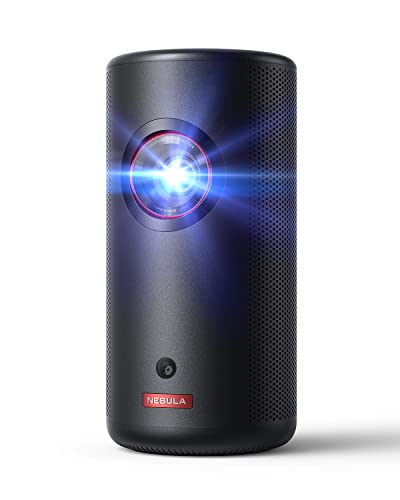
NEBULA Capsule 3 Laser — Laser Capsule Upgrade
The Capsule 3 Laser closes the list by refining its sibling’s idea rather than replacing it. Its verified listing presents a portable mini projector with a laser light source, keeping the capsule form and the battery-powered freedom while changing the engine that paints the picture. Laser sources in portable projectors bring the class’s familiar virtues in miniature: quick readiness, steady behaviour across the source’s life, and an image character that owners describe as composed, the little machine taking itself seriously.
Choose between the two capsules the way you would choose between the two BenQ philosophies in miniature. The standard Capsule 3 is the simple, joyful object; the Laser variant is for the portable viewer who watches often enough, in dark enough places, to care about the engine’s refinement and longevity story. Both remain citizens of the night and the small wall, and neither should be bought to fight a bright living room at noon, a contest this guide has already assigned to the lamp-bright TH575i.
As the list’s final entry it carries the guide’s closing argument in its pocket-sized body. Home theater at 1080p is not one product but a spectrum of evenings, from the HT2060’s darkened ceremony to this can projecting a series onto a caravan ceiling, and the correct purchase is the evening you will actually have most often. The Laser capsule serves the most nomadic version of that evening with the most refined engine the form currently offers its fans.
The laser variant’s ownership story extends beyond any single trip. A light source with a long, steady life suits a machine that may be used in bursts across years, carried, stored, rediscovered each summer, without a lamp ageing on the shelf between adventures. For the caravan, the boat, the holiday house and the student room, that storage-proof patience is the specification that matters, and it is why the Laser earns its premium in this list’s judgement despite sharing its sibling’s silhouette.
And for the grown nomad, the laser capsule’s steadiness across storage and travel makes it the machine most likely to still be delighting its owner in five summers’ time, which, in a category of gadgets bought for one holiday, is the rarest specification of all.
- Light source: laser, per the verified listing
- Form: portable mini capsule body
- Power: battery lifestyle with mains option
- Resolution class: portable Full HD class; confirm listing details
- Room: dark, small and improvised spaces
Strengths
- Laser steadiness inside the travelling form
- Refined engine for frequent portable viewers
- Same go-anywhere freedom as its sibling
Trade-offs
- Premium over the standard capsule for engine refinement
- Still bound by portable brightness physics
- Small-scale cinema, not a main-room replacement
Best for: Frequent travellers and small-space viewers wanting the laser engine in capsule form.
Not suited for: Buyers whose viewing is a fixed, bright, big-screen living room.
How do these 1080p projectors compare on light, colour and lifestyle?
| Pick | Type | Standout trait | Watch out for |
|---|---|---|---|
| BenQ HT2060 | LED home theater | DCI-P3 colour with HDR | Needs real darkness |
| BenQ TH575i | Lamp all-rounder | 3800 lumens as listed, Google TV | Lamp is a consumable |
| Epson EpiqVision Flex CO-FH02 | 3LCD portable | Colour evenness plus flexibility | Setup repeats per room |
| Epson EpiqVision Flex CO-W01 | 3LCD portable | Portability with 3LCD colour | Below Full HD class |
| NEBULA Capsule 3 | Portable battery | 1080p cinema that travels | Darkness required, scale modest |
| NEBULA Capsule 3 Laser | Portable laser | Laser engine, capsule freedom | Portable physics still apply |
The table refuses a single winner because the category refuses a single room. Brightness, quoted only as listings state it, crowns the TH575i for social rooms; colour fidelity crowns the HT2060 for dark ones; flexibility crowns the Epsons; freedom crowns the capsules. A buyer who ranks these machines without naming their room first is not comparing projectors but collecting numbers, and numbers, as the mistakes section warns, are how good money buys the wrong evening.
Light source is the table’s quiet second axis. LED and laser machines promise long, steady service with no lamp in the budget; the lamp machine trades that calm for the brightness bright rooms respect; 3LCD entries argue for colour evenness wherever they land. Read your room’s light honestly, then read the table again, and the shortlist usually writes itself in the margin.
The table also hides a question of permanence that renters and owners answer differently. The BenQ and Epson room machines reward a semi-permanent home, shelf or mount, alignment done once and defended. The capsules reward the opposite philosophy, a theater with no fixed address at all. Neither philosophy is the sophisticated one; each is simply the shape of a life, and the comparison works only when the buyer has first decided which shape is theirs.
How big a picture should a living room actually project?
Work from the seating, not from the wall’s maximum vanity. A picture earns its size when the whole frame sits comfortably in the audience’s view without head-turning, and when the room’s seating distance lets 1080p’s detail resolve into smoothness rather than visible structure. In most living rooms that lands at a generous but not absurd diagonal, the size at which films feel cinematic and football remains readable from the kitchen doorway. Bigger is a temptation with a cost: every added span of diagonal spreads the same light thinner and asks more of the room’s darkness.
Test before committing to screens and mounts. Project onto the bare wall for a week of real evenings, tape the corners of candidate sizes, and live with each for a night. Households discover their true size by watching, not by measuring, and the wall forgives experiments that a purchased screen does not. Only when a size has survived a film, a match and a streamed series should it graduate into a fixed screen, a mount and a permanent claim on the room.
What should you spend on besides the projector?
Sound first, because audiences forgive a modest picture with magnificent sound and resent the reverse with surprising bitterness. Even a single good soundbar transforms projector evenings, anchoring dialogue to the wall and giving the picture a body it cannot grow alone. The projector’s own speakers serve portability and previews; the theater’s voice should live in a device built for the job, placed under the picture and given the same permanence as the screen.
Light control second, because curtains are the cheapest picture upgrade in the entire hobby. Blackout lining behind ordinary curtains lifts every projector in this guide a class upward in perceived contrast, for less than the price difference between any two of them. A screen third: a proper surface flatters colour and brightness evenly, though a smooth, pale wall serves honestly while the household learns its habits. Spend in that order and a mid-list projector in a prepared room will out-show a flagship in a careless one, every evening of the year.
How do you set up throw, alignment and streaming without tears?
Measure the throw before the machine arrives: the distance from lens to wall decides the picture size each model can draw in your room, and product pages describe that relationship for every pick here. Place the projector square to the wall wherever furniture allows, because keystone correction, the digital squaring of a crooked picture, spends resolution to buy convenience. A shelf at the right height, square and centred, is worth more than any correction menu, and it costs a tape measure and an honest afternoon.
For streaming, prefer the simplest chain that works in your household. Machines with platforms built in, the TH575i’s Google TV and the smart Epson and capsule entries, remove boxes and remotes from the equation; machines without them pair happily with a streaming stick that the household already knows. What matters is that starting a film takes one remote and under a minute, because every additional step between the sofa and the opening credits is a tax levied on every evening the theater will ever host.
Lamp, LED or laser: which light source fits your life?
Decide by diary and room together. The frequent viewer in a bright room is the lamp machine’s natural owner, accepting a replacement lamp in the long budget as the price of daylight defiance. The film-night household in a darkenable room belongs to LED or laser, whose steady, lampless service matches a rhythm of precious evenings rather than constant display. The portable viewer takes the capsule engines as they come, battery and miniaturisation setting their terms.
Resist converting the sources into a single brightness league, because the figures are stated in different units and measured under different conventions across this category, a swamp this guide deliberately refuses to drain with invented equivalences. Instead, match the source to the room’s light at your actual viewing hours, which you know precisely and no reviewer can. A machine correctly matched to its room looks brighter than a mismatched flagship, because perceived brightness lives in the contest between projector and ambient light, and the room always fields a team.
How do you keep a projector image looking its best over years?
Treat the lens as the treasure it is: dust it with air and a soft brush rather than sleeves, keep the cap or cover discipline the maker intended, and never let cleaning become scrubbing. Filters and vents, where a model has them, want the occasional gentle attention the manual describes, because a projector that breathes freely runs cooler and quieter, and its fan’s voice, the soundtrack nobody bought, stays in the background of quiet scenes where it belongs.
Revisit alignment and focus with the seasons. Rooms move, shelves settle, and a picture aligned in September can drift a degree by spring, softening one corner in a way audiences feel without naming. A five-minute check against a familiar scene, faces at the frame’s edges, text in a menu, restores the geometry, and owners who build that check into the same rhythm as the curtains’ washing keep their theater perpetually new without spending anything but attention.
What is the honest upgrade path from a first 1080p theater?
Upgrade the room before the resolution, in the order the earlier sections priced: sound, darkness, screen, seating, and only then the projector itself. Most households that follow that order discover their 1080p machine was never the weakest component, and their upgrade itch dissolves into the room’s improvements. The households that skip the order and buy resolution first usually return to the same list afterwards, poorer and wiser, with a finer projector still arguing with sunlight and a television speaker.
When the projector’s turn genuinely comes, the 1080p machine retires honourably rather than ending: to the bedroom, the garden, the grown child’s first flat, the borrowed hall. Good projectors cascade through a family’s life the way good bicycles do, and a buyer choosing among this list’s six is really choosing the first chapter of a long service, which is one more reason to buy the machine that fits the present room rather than the imagined one.
How do you run a great projector evening, from doorbell to credits?
Begin an hour early with the room, not the machine. Curtains drawn before guests arrive so the first reveal is the finished picture, the projector warmed into its evening settings, the film queued to its first frame and the sound checked at the volume the opening scene deserves. Hosts who perform that quiet preparation discover the projector evening’s secret: the technology disappears, and what remains is the oldest social technology of all, people in a darkened room sharing a story at a scale that makes it an event rather than a programme.
Feed the picture well. A theater is only as good as its source, and the same projector will forgive a household many things but not a starved, buffering, low-quality stream on premiere night. Where the evening matters, use the best source the household has, the disc, the high-quality stream, the downloaded file where services allow, and let ordinary nights carry ordinary sources without guilt. Matching source ceremony to occasion ceremony is the connoisseurship this hobby actually rewards, far beyond any specification.
End the evening like a cinema, not like a television. Let the credits breathe for a moment before the lights rise, keep the projector’s fan company while conversation finds its feet, and resist the instant autopsy of the picture quality that turns guests into reviewers. The households whose projector evenings become traditions are the ones that protect the spell for those extra minutes, and their machines, whatever their specifications, are remembered as magnificent. That, in the end, is the performance figure this entire guide has been circling.
One practical footnote for the shelf: leave the projector’s remote in exactly one place, known to the whole household, with spare batteries in the same drawer. More projector evenings die of a missing remote than of any technical fault in this guide’s six machines combined, and the households that solve the remote have solved the true first step of home theater. Small disciplines, faithfully kept, are what separate the theater that hosts fifty Fridays a year from the one that hosts five, and no specification on any box can substitute for them.
The same discipline applies to cables, the theater’s invisible half: one known-good spare lead in the drawer ends the only other class of cancelled evenings, the fifteen-minute scramble behind the shelf while guests make conversation with a blank wall. The theater that is ready is the theater that happens, and happening, weekly, is the only specification that ever really mattered in this entire projector category, full stop.
What mistakes shrink a home theater before the first film?
Buying the projector before measuring the room is the founding error. Throw distance, seating distance and the wall’s real dimensions decide which machines can even draw your picture, and discovering a mismatch after the box opens turns an evening of cinema into a week of returns. Tape measure first, shortlist second, always.
Chasing the largest possible image is the second error. Every diagonal inch spreads the same light thinner, demanding more darkness and punishing ambient light the room cannot banish. A slightly smaller picture with conviction beats a wall-filling wash, and guests remember conviction as quality while remembering wash as disappointment.
Neglecting sound is the third error, and the most common. A projector’s built-in speaker is a courtesy, not a cinema voice, and evenings carried by it feel thin no matter how fine the picture. One decent soundbar, bought with the money saved by choosing 1080p wisely, completes more theaters than any resolution upgrade ever will.
Worshipping a single brightness number is the fourth error. Figures arrive in different units and conventions across brands and light sources, and treating them as one league table manufactures false winners. Judge brightness by the room at your viewing hour, using the figures only as their listings state them, in their own terms.
The final error is mounting permanently before living temporarily. A week of shelf-and-wall experiments teaches a household its true size, height and seating geometry; a ceiling mount installed on day one freezes guesses into plaster. Live with the theater first, let it earn its fixtures, and the permanent version will be right the first time.
Judging a projector in the shop, or from a video of a screen, is an error with its own paragraph because it is so universal. Showroom light, showroom screens and camera-recorded footage all lie in different directions, and none of them is your room at your hour. Buy from sellers whose returns honour a home trial, project onto your own wall for real evenings, and let your room, the only honest reviewer in this category, deliver the verdict.
Final Recommendation
Name your room and the list resolves itself. Dark and devoted: the HT2060, with its LED calm and cinema colour. Bright and social: the TH575i, lumens and streaming in one extrovert package. Flexible and rented: the CO-FH02’s 3LCD pragmatism, with the W01 for the truly travelling show. Nomadic and nocturnal: either Capsule, the Laser for the frequent flyer. Every machine here projects a fine 1080p evening; they simply disagree, honourably, about where an evening happens.
Spend the resolution savings where audiences live, on sound, curtains and a screen the picture deserves, and a 1080p theater stops feeling like the sensible choice and starts feeling like the smart one. The best home theater is the one that fills with people on Friday, and by that measure the finest projector in this guide is whichever of these six gets your household onto the sofa together most often.
Measure your room this week, honestly, in daylight and at your real viewing hour, and let that measurement choose among the six. Then dim the lights, start the film, and let the wall do what walls in this guide were chosen to do, disappear.
Frequently Asked Questions
Is 1080p enough for a large home theater screen?
For most living-room sizes and seating distances, yes, comfortably: a well-fed Full HD image reads as smooth and detailed where audiences actually sit, especially with the colour and contrast strengths of the picks here. Extremely large screens viewed from unusually close seating are where higher resolutions begin to argue their case, and the neighboring guides cover those machines for readers whose rooms truly qualify.
Why do brightness figures differ so much between models?
Because the category measures light in more than one unit and convention, and light sources differ in character: lamp, LED, laser and 3LCD designs each present their output differently. This guide quotes each listing’s figure only in its own terms and advises judging by your room’s light at viewing time, which predicts your experience better than any cross-brand arithmetic.
Do I need a screen, or is a wall enough?
A smooth, pale wall is an honest starting surface and the right place to learn your size and habits for a few weeks. A dedicated screen then earns its money in evenness, colour fidelity and a defined frame that makes the picture feel finished. Buy the screen after the experiments, sized to the picture your room proved it loves.
Can these projectors handle sport and gaming as well as film?
The all-rounders here, particularly the bright TH575i and the flexible Epsons, serve sport and casual gaming happily in social rooms, while the dark-room HT2060 specialises in film. Serious competitive gaming has its own projector class with its own priorities, covered in the gaming projector guides on this site, and readers chasing that standard should start there.
Where should a projector live in a rented home?
On a shelf, a tripod or a bookcase, anywhere square to the wall that avoids permanent fixtures. The portable Epsons and the capsule machines were chosen with exactly this life in mind, assembling a theater in minutes and returning the room untouched afterwards. Measure the shelf’s throw distance before buying, and the rented wall will behave like a cinema that happens to be temporary.
Can I use a projector as my only television?
Many households do, and the bright all-rounders in this guide, above all the TH575i with its stated brightness and built-in streaming, are built for exactly that ambition. The honest conditions are light discipline for daytime viewing and sound worthy of daily use. Households meeting both stop missing the television within a month; households meeting neither should keep the projector for evenings and let a panel carry the noon news.
Related Guides
Projector choices continue in the neighbouring guides on this site, covering mini projectors and higher-resolution gaming models. best 1080p mini projectors best 4k gaming projectors best 2k projectors


