Our Top Picks



What's inside
- The main families of cable management solutions
- Choosing by wall, home and household
- Signal integrity: HDMI length, bends and interference
- Ventilation and heat: the constraint nobody photographs
- A step-by-step installation that respects the rules
- Matching solutions to real rooms
- Floor runs, stand setups and the routes nobody plans first
- Materials, fire awareness and honest product claims
- Planning for change: upgrades, moving house and borrowed rooms
- Judging quality and spending sensibly
- Diagnosing problems by symptom once everything is hidden
- Safety around children and animals, in practical detail
- Check prices on Amazon
- When to call a professional, and what to ask them
As an Amazon Associate I earn from qualifying purchases. This post may contain affiliate links at no extra cost to you.
A television mounted on a wall should look like a picture that happens to move. Instead, most installations resemble a small waterfall of black leads: power cords dropping to the nearest outlet, HDMI cables swinging toward a console, an optical lead nobody remembers installing, and a network cable added later because wireless kept stuttering during films. Cable management is the unglamorous discipline that closes the distance between the photograph in a brochure and the corner of an actual living room. Done well, it is not merely tidier. It protects cables from damage, keeps heat away from equipment, prevents toddlers and pets from treating loose loops as toys, and makes the inevitable day when a streamer gets replaced or a console moves rooms dramatically less miserable.
The subject deserves more respect than the bargain bin of adhesive clips suggests, because some choices carry genuine safety weight. Running the wrong cable inside a wall is not a cosmetic shortcut but an electrical hazard and, in many jurisdictions, a violation of building codes that can surface painfully during an inspection or an insurance claim. Other decisions are reversible experiments: a sleeve can be reopened, a raceway can be repainted, a label can be rewritten. This guide separates those categories clearly. It explains each family of solutions on its own terms, then turns to the constraints that should govern selection, including rented walls, long HDMI runs, ventilation, children, cleaning, and the simple human fact that every connection hidden too cleverly will one day need to be found again in poor light, by touch, while a film night audience waits in the next room.
Begin with a principle that organises everything else: manage cables at the scale of the whole system, not lead by lead. A single beautiful channel descending from the screen means little if five cables erupt sideways at the cabinet in search of separate sockets. Photograph the back of every device before disconnecting anything, count the connections honestly, and sketch where each one starts and ends. That inventory usually reveals surprises, including a cable serving a device retired two years ago and a second power brick feeding nothing at all. Removing dead weight is the cheapest improvement available, and it costs no money, leaves no holes and cannot possibly break a rule. Only after the system is reduced to what genuinely earns a connection does it make sense to choose channels, sleeves or in-wall hardware to hide what remains.
The main families of cable management solutions
Paintable surface raceways and channels
A raceway is a shallow enclosed channel that mounts on the wall surface, carries cables down or across, and closes with a cover that can be painted to match the room. It is the workhorse solution for wall-mounted televisions because it reconciles neatness with reversibility: screws or adhesive strips hold it in place, the cover snaps open when a cable changes, and the whole run can disappear under the same paint as the wall behind it. Vertical drops from a screen to a cabinet are its natural territory, though elbow and tee fittings allow horizontal detours toward a socket. Capacity is the specification that matters and the one most often misjudged. A channel that accepts today’s three cables with force will not accept tomorrow’s fourth gracefully, and overfilled covers bow, pop open at joints and advertise exactly the clutter they were bought to conceal. Buying one size up from the calculated need is rarely regretted.
Installation quality separates a raceway that vanishes from one that draws the eye. Runs should be genuinely vertical or horizontal, checked with a level rather than optimism, because a channel drifting two degrees reads as a mistake from across the room even when nobody can name why. Cuts at corners need to be square, covers should meet without steps, and paint looks best applied to the cover before final fitting, with a spare length kept painted for future repairs. Adhesive mounting suits renters and tiled or delicate surfaces, while screws into studs or proper wall anchors suit heavy, fully loaded channels that will be opened repeatedly. In rooms with baseboards, dropping the raceway to meet the board and then running horizontally along it keeps the eye’s natural path along the skirting, a small staging trick that installers use constantly. Households planning a very large screen, like those surveyed in best 100 inch tvs, should note that wider panels hide wider channels, making raceways even less visible than on modest sets.
In-wall kits and the rules that govern them
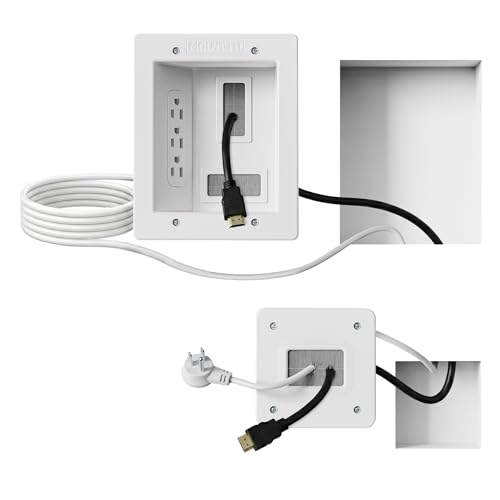
Hiding cables inside a wall produces the cleanest result of all, and it is also where enthusiasm must slow down and read the rules. The power cord supplied with a television is not rated for use inside a wall cavity. Its insulation and construction assume open air, and electrical codes in most places prohibit running such flexible cords through walls, ceilings or floors. The compliant route is a purpose-built in-wall power relocation kit: a system with a recessed inlet near the equipment, a recessed outlet behind the screen, and code-rated wiring connecting them inside the wall, so the television effectively plugs into a proper outlet in its new location while a short, visible cord bridges from a surge protector to the inlet below. These kits exist precisely because the tempting shortcut is forbidden, and reputable versions state their listings and intended use plainly on the packaging.
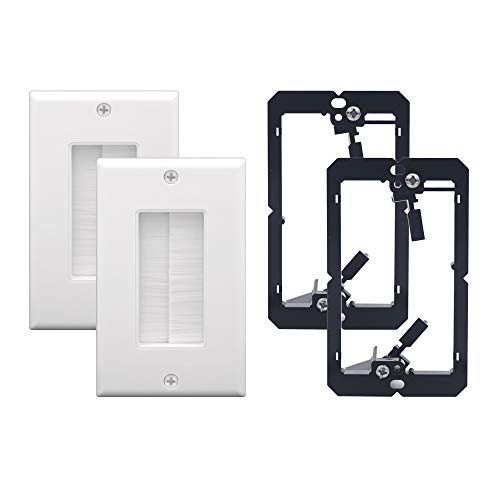
Signal cables face a parallel but distinct set of requirements. Low-voltage leads such as HDMI can pass through walls when the cable itself carries the appropriate in-wall rating for that use, commonly marked with a CL rating, and when openings are finished with brush plates or grommets that protect jackets from sharp drywall edges. Horizontal drilling through studs, fire blocks hidden inside the wall, insulation, and the ever-present possibility of pipes or existing wiring all argue for a stud finder, a cautious pilot inspection and, where any doubt exists, a licensed electrician or low-voltage installer. Exterior walls complicate matters with insulation and vapour barriers, and some jurisdictions require permits or restrict who may alter in-wall power at all. None of this should frighten a competent homeowner away from a listed kit installed exactly as directed, but it should permanently retire the idea of simply threading the television’s own mains lead through a hole and plastering over the evidence.
Power relocation kits as a category of their own
Because confusion is so common, power relocation deserves its own summary. A relocation kit does not extend the television’s cord; it extends the room’s wiring, creating a new outlet position fed through approved conductors, with the equipment then connected by its normal short cord in open air behind the screen. The lower inlet typically sits behind the media cabinet, where a surge protector or power conditioner plugs in conventionally. Some kits integrate a single outlet, others a duplex, and a few include low-voltage pass-through in the same plate for a unified appearance. The practical limits are distance and wall structure: kits cover typical vertical drops between a screen and the cabinet beneath it, not journeys across a room through multiple studs. Measuring the actual path, including the slack needed at both ends, before ordering prevents the particular misery of a kit that falls fifteen centimetres short inside a closed wall.
Sleeves, spiral wrap and fabric braiding
Where cables travel together outside a wall, typically from a cabinet to a television on a stand or between components on open shelving, sleeves gather them into a single visual line. Split fabric sleeves open along their length so cables can enter and leave at intermediate points, which suits a run feeding a soundbar halfway along. Zippered neoprene versions install in seconds and remove just as quickly for cleaning, while braided expandable sleeving slides over connectors and grips snugly for a more tailored finish. Spiral wrap, wound around a bundle by hand, tolerates irregular branches and odd diameters better than any closed sleeve, at the cost of a more utilitarian appearance. All of these share one honest limitation: they organise cables without hiding the route itself, so they reward being routed along furniture edges, behind cabinet legs or under a desk where a single dark line reads as shadow rather than as wiring.
Cable boxes, baskets and the power strip problem
Every tidy installation eventually confronts the power strip: a necessary, ugly cluster of bricks, plugs and indicator lights usually exiled to the floor behind a cabinet, where it collects dust and invites curious fingers. Cable management boxes solve the visual problem by enclosing the strip in a ventilated container with entry and exit slots, turning a tangle into a single object that can be vacuumed around. Ventilation is the non-negotiable detail, because power bricks convert electricity imperfectly and shed the difference as heat, and a sealed decorative box without slots is a small oven. Under-desk or behind-cabinet baskets take the opposite approach, lifting the strip off the floor into open air on a wire tray, which breathes freely, stays invisible from seated positions and makes unplugging one device a matter of reaching rather than excavating. Either approach beats coiling spare cord length tightly around a strip, a habit that traps heat and stresses conductors at every bend.
Velcro ties, clips and labels: the small tools that run the system
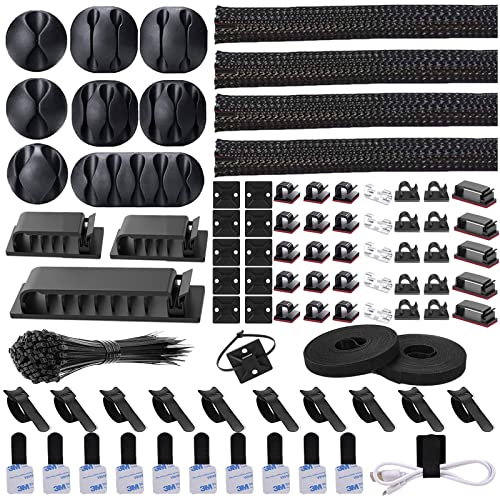
Reusable hook-and-loop ties are the correct default for bundling entertainment cables, and the reasons are practical rather than fashionable. Unlike single-use plastic ties, they open without tools, so a cable can be added at midnight without hunting for cutters near delicate jackets. Unlike both, they can be fastened snugly without crushing: overtightened rigid ties deform cable geometry, and high-speed digital cables are surprisingly sensitive to being pinched, kinked or bent at sharp angles near their connectors. Adhesive clips and screw-down saddles guide individual runs along cabinet backs and wall edges, while a service loop, a deliberate gentle coil of spare length secured behind the cabinet, grants the slack needed to pull a device forward for cleaning or connection changes without disconnecting the entire system. Labels complete the toolkit. A small tag at each end of every cable, naming the device and port, converts future troubleshooting from archaeology into reading, and owners who doubt they will forget are invited to test that confidence against a receiver they last touched three years ago.
Choosing by wall, home and household
Renters and owners face genuinely different menus. A renter’s best friends are adhesive raceways, sleeves, cable boxes and furniture routing, all of which leave with the tenant and restore the room with, at most, a few minutes of paint touch-up where adhesive was persuaded too firmly. Drilling into studs for in-wall work is usually prohibited by leases and unwise even where unmentioned, since restoring a wall cavity installation to original condition costs far more than installing it did. Owners can consider listed in-wall kits and relocation systems, but ownership does not repeal physics or code, and the same prohibitions on running appliance cords inside walls apply in a purchased house. Historic properties add their own cautions, including plaster-and-lath walls that crumble around enthusiastic cutting and, in some regions, rules protecting original fabric that a quick chat with local authorities can clarify before tools come out.
The wall material itself steers technique. Drywall over studs is the forgiving case for both raceways and in-wall kits, offering predictable cavities and easy patching. Brick, concrete and stone demand masonry fixings for surface channels and effectively rule out casual in-wall routing, pushing those rooms toward generous raceways, furniture-integrated paths or floor-level solutions along skirting. Glass partitions, now common in apartments, accept adhesive channels and little else, which makes planning the route to coincide with frames and edges a design exercise rather than a compromise. Owners of sets with integrated smart platforms, including models like those in best 65 roku tvs, often need fewer external boxes and therefore fewer cables, a reminder that the most elegant management sometimes happens at the buying stage, when choosing a television whose built-in services retire a separate streamer and its power brick entirely.
Households with children or animals should read every solution through a safety lens before an aesthetic one. Loose loops at floor level are climbing invitations and chewing targets, and a cable box with a lid that resists small hands, raceways with covers that click positively shut, and routes that keep slack off the floor all reduce risk without constant vigilance. Rabbits, puppies and kittens treat exposed jackets as enrichment, so spiral wrap or conduit in any stretch an animal can reach is cheap insurance against a chewed-through power lead, which is a danger to the animal first and the equipment second. Weight matters too: a television cable bundle tugging at a wall-mounted screen’s ports because nobody provided strain relief can damage sockets over months, and supporting the bundle’s weight with a clip or channel near the set is a five-minute kindness to expensive hardware.
Signal integrity: HDMI length, bends and interference
Cable management fails if the picture suffers, and HDMI is where tidiness and physics most often collide. Passive copper HDMI cables carry high-bandwidth signals reliably over modest distances; as length grows, attenuation erodes the signal until sparkles, dropouts or a blank screen announce the limit, with higher resolutions and refresh rates reaching that limit sooner. For runs beyond a few metres, especially inside walls where replacement is painful, active optical HDMI cables transmit over fibre and shrug off distances that defeat copper, at higher cost and with a directional personality: their connectors are source and display specific, and installing one backwards inside a finished wall is an error nobody forgets. Planning conduit or an accessible path for long runs is the professional habit, because standards evolve and the cable that satisfies today’s console may not satisfy its successor. Buyers assembling high-refresh setups like those discussed in best tvs with hdmi 2 1 and 120hz should be especially conservative, testing the full run at the intended resolution and refresh rate before any wall is closed or channel cover painted.
Bend discipline matters as much as length. Every cable has a minimum bend radius, and forcing a tight right angle behind a wall-mounted screen, simply because the gap is narrow, stresses conductors and connector joints alike. Right-angle adapters and cables with compact heads exist for shallow mounts, and using them beats crushing a standard connector into service. Strain relief follows the same philosophy: a cable should arrive at its port with a gentle curve and no hanging weight, supported by the management system rather than by the solder joints inside the television. Separating power and signal runs is the third rule of thumb. Bundling mains leads tightly against unshielded analogue audio for long parallel distances can invite hum, and while modern digital links resist such interference robustly, sensible separation inside wide raceways, power on one side and signal on the other, costs nothing and removes a whole class of mysterious buzzes from future troubleshooting.
Extending signals between rooms raises the stakes further, and households distributing a source to a distant screen should understand the difference between a long cable and an extender system using structured wiring, each with distinct cost, reliability and upgrade profiles; the background in best 4k uhd hdr hdmi extenders is worth reading before committing to a route that walls will conceal. Whatever the medium, document it. A note taped inside the cabinet recording which cable runs where, its type and its length has rescued more Saturday afternoons than any diagnostic gadget, because concealed infrastructure is only an asset while somebody remembers what was concealed.
Ventilation and heat: the constraint nobody photographs
Equipment cabinets turn cable management into a thermal problem. Consoles, amplifiers and recorders exhaust warm air that must go somewhere, and a beautifully sealed cabinet with cables packed like insulation behind hot components achieves silence at the price of lifespan. Leave breathing room behind devices rather than stuffing spare cable length into the gap where exhaust air travels, route bundles along cabinet sides instead, and treat rear panels with ventilation slots as instructions rather than decoration. Cable boxes containing power strips deserve the same respect, positioned where air circulates and never buried under cushions, rugs or the household’s designated pile of blankets. Heat also explains why coiling excess power cord into a tight bundle is poor practice: conductors carrying load warm up, and a coil sheds that warmth slowly. A loose figure-eight or a shortened lead is the safer answer to surplus length.
Dust follows heat as the second invisible enemy. Bundles resting on floors behind cabinets act as dust traps that are awkward to clean, so raising runs into baskets, channels or sleeves that a vacuum nozzle or cloth can pass over keeps the area maintainable. This matters beyond tidiness for allergy-prone households and for equipment whose cooling fans inhale whatever the room offers. During installation, take the rare opportunity of an empty cabinet to clean thoroughly, check that felt pads or grommets protect cables passing through drilled furniture holes, and confirm no jacket is trapped under a cabinet foot or mount bracket, slowly being sawn by vibration and weight. Small inspections like these, performed while everything is accessible, are the difference between a system that ages gracefully and one that develops an intermittent fault in its third year that nobody can reproduce on demand.
A step-by-step installation that respects the rules
Start by switching everything off at the wall and photographing every connection from several angles, including which HDMI port each device uses, because televisions treat ports unequally and a console returned to the wrong socket may lose its high-refresh or audio-return behaviour. Lay the intended route out temporarily with painter’s tape on the wall and floor, stand back from the usual seating position, and judge the lines honestly in daylight and lamplight before committing to adhesive or screws. Measure the route twice, add a sensible margin for gentle bends and service loops, and only then order channels, sleeves or kits, since a system bought to estimated lengths tends to fail at the final thirty centimetres. Gather the unglamorous tools in advance: a level, a stud finder where screws are planned, a fine saw for channel cuts, labels, hook-and-loop ties and a torch, because peering behind cabinets by phone light while holding a cable in one’s teeth is a rite of passage nobody needs to repeat.
Install the backbone first. Mount the empty raceway or fit the in-wall kit exactly per its instructions, with power work de-energised and, where local rules or personal confidence dictate, performed or inspected by a qualified electrician. Lay cables in without forcing, respecting bend radii, keeping power and signal sensibly separated, and leaving the planned slack at the equipment end. Connect everything while covers are still off, power the system up, and verify the complete experience: every source at its intended quality, audio returning correctly from the television to any soundbar or receiver, network links live, remotes behaving. Only a system proven working earns its covers, paint and final clips, because reopening a painted channel to swap a reversed directional cable is the sort of lesson best learned from other people’s stories. Finish by labelling both ends of every lead, photographing the finished rear arrangement for future reference, and storing spare channel cover, ties and the kit documentation together in the cabinet.
Common mistakes and how they announce themselves
The most frequent error is measuring the route as the crow flies rather than as the cable travels, forgetting the rises into ports, the dips behind cabinet rails and the slack that future servicing demands. It announces itself at the final connection, in the form of a cable that reaches only under tension. The second is burying a connection inside a wall or sealed channel: joints and adapters belong in accessible places, always, because they are the first suspects in any future fault. Third comes the painted-shut raceway, where enthusiastic decorating seals a snap cover permanently and converts a reversible system into archaeology. A related family of errors involves power: overloading a strip because the cable box hides the count, daisy-chaining strips together, or running a space heater from the entertainment outlet because it happens to be near. Each is a reminder that concealment should never outrun comprehension; if a setup cannot be explained clearly to another adult in the house, it is too clever by half.
Signal mistakes form their own catalogue. A directional optical cable installed backwards produces a perfectly tidy, perfectly blank screen. An overlong passive cable may work for menu screens and fail only when a game demands full bandwidth, misleading owners into blaming the console. Audio return problems often trace to a cable landing in a non-audio-return port during reassembly, which is why the opening photographs matter. Network cables pinched under cabinet feet fail intermittently for weeks before dying honestly. The pattern across all of these is that faults introduced during tidying are systematic rather than random, so the remedy is a calm reversal: reopen the route, inspect each segment against the photographs, and change one thing at a time until the symptom moves. Random unplugging, by contrast, manufactures second faults faster than it cures first ones.
Matching solutions to real rooms
A living room built around a wall-mounted screen above a low cabinet is the canonical case, and it rewards the canonical answer: a listed power relocation or in-wall arrangement for owners, a wide paintable raceway for renters, a ventilated cable box or basket inside the cabinet, and labelled, sleeved runs between components. A bedroom television on a stand needs far less theatre; a single sleeve descending behind a leg, a small box for the strip and disciplined ties usually suffice, and money saved there is better spent on blackout curtains. Gaming setups generate the densest cable fields, with multiple consoles, chargers, headsets and network leads in constant rotation, so accessibility outranks invisibility: open baskets, generous raceways with covers that genuinely reopen, and front-facing charging points beat a sealed masterpiece that must be dismantled every time a controller changes.
Media rooms and dedicated home cinemas justify the most infrastructure, including conduit inside walls, equipment racks with vertical management channels, and patch-style planning where every run is documented. The governing idea scales down as well as up: even a two-device setup benefits from deciding where cables are allowed to live and forbidding improvisation elsewhere. Kitchens, bathrooms and other damp or greasy environments argue for minimal, wipeable surface solutions mounted clear of worktops, with no cable boxes resting where spills travel, and professional advice where any doubt about moisture and electricity intersects. Outdoor screens are a specialist world of rated enclosures and weatherproof connections that this guide deliberately does not improvise guidance for; the correct purchase there is equipment designed and listed for outdoor use from the start.
- Inventory and photograph every connection, then remove cables serving retired equipment before buying anything.
- Never run a television’s own power cord inside a wall; use a listed relocation kit or keep power in open air.
- Choose in-wall rated signal cables for concealed runs and finish openings with brush plates or grommets.
- Size raceways one step above today’s need and keep covers reopenable, even after painting.
- Test long HDMI runs at full intended quality before closing walls or fitting covers permanently.
- Bundle with reusable ties, support weight near ports, label both ends and leave a gentle service loop.
- Preserve ventilation around power strips and warm equipment; never coil loaded power leads tightly.
Maintenance is refreshingly light once a system is built properly. Every few months, open the cable box, vacuum its vents, confirm no new brick has been added beyond the strip’s rating, and check that covers still sit flush and clips still grip. When a device changes, resist the temptation to thread its cable through whatever gap presents itself; reopen the proper route, swap the label, update the note in the cabinet and close everything again, a ten-minute discipline that prevents the slow re-tangling every household recognises. Batteries, chargers and temporary holiday lights should never be allowed to colonise the entertainment power strip permanently, because temporary guests in cable systems have a way of becoming load-bearing residents. Treat the installation as finished infrastructure, like shelving, and it will keep paying its quiet dividend every time the room is cleaned, a device is swapped or a visitor admires the screen without ever thinking about wires at all.
Floor runs, stand setups and the routes nobody plans first
Not every difficult run goes down a wall. Many televisions sit on stands opposite seating with a rug between, and the cable that causes the trouble is the one crossing open floor to reach a socket, a router or a subwoofer placed where bass behaves best rather than where wiring is convenient. Low-profile floor cord covers exist for exactly this problem: a rubber or rigid channel with a gently sloped profile that protects the cable, resists heels and chair casters, and announces itself honestly instead of pretending to be flooring. Choose a cover wide enough that it lies flat without curling, route it along the edge of a rug where feet expect a transition, and never solve a floor crossing by running an ordinary lead beneath a rug, where abrasion goes unseen, heat dissipates poorly and a worn jacket can deteriorate for months before anyone notices. Where a crossing is temporary, for a projector evening or a visiting console, a bright reusable cover that everyone can see is safer than a discreet one that catches an ankle in the dark.
Stand-based systems hide their cables differently, using the furniture itself as infrastructure. The back panel of a cabinet, the hollow leg of a stand, the shadow beneath a shelf: these are legitimate routes when cables are secured so they cannot slip into contact with hot rear panels or be pinched by doors and drawers. Drilling a cabinet back for a grommet is a small, permanent kindness that owners often postpone for years while feeding cables through a gap that splinters a little more each time a device is pulled forward. Soundbars deserve a specific mention, because their position directly beneath a screen invites a thicket of short leads, power, optical or HDMI, plus sometimes a separate subwoofer connection, all within a hand’s breadth. A shallow raceway or a fabric sleeve dedicated to that short vertical hop, separate from the main cabinet bundle, keeps the most frequently adjusted connections in the system accessible without disturbing the rest.
Subwoofers and rear speakers introduce the longest signal runs in many rooms, and they reward planning disproportionate to their humble status. Speaker cable is forgiving electrically compared with HDMI, tolerating longer distances with modest losses when the gauge suits the length, which makes skirting-level routing, door-frame detours and even underfloor paths in accessible basements practical. Wireless subwoofer links remove a run entirely, though they add a power lead at the subwoofer’s new home, a trade that surprises owners who imagined wireless meant an end to cables altogether; every wireless audio device still drinks electricity from somewhere. Counting power as part of every supposedly wireless decision is a habit that separates realistic plans from optimistic ones, and it applies equally to streaming sticks that hide behind a screen while quietly occupying an outlet and sometimes a USB port with limited current.
Materials, fire awareness and honest product claims
Cable management products are made from a short list of materials, and their differences matter in ways marketing rarely explains. Rigid PVC raceways cut cleanly, paint beautifully and hold a straight line over long runs, which is why they dominate wall work. Softer rubber floor covers flex instead of cracking under impact. Fabric sleeves resist abrasion and look domestic, while braided polymer sleeving shrugs off the scuffing that happens inside cabinets where devices slide. Metal trunking belongs mainly to commercial and workshop settings, where its durability and inherent resistance to heat justify the effort of cutting it. Whatever the material, claims deserve reading with a cool eye: flame-retardant is not the same as fireproof, a listing mark from a recognised testing body means more than a manufacturer’s own adjectives, and a product intended for low-voltage signal cables should never be repurposed to enclose mains wiring unless it is explicitly rated and listed for that duty.
Fire awareness in this context is mostly about respecting heat and load rather than imagining dramatic scenarios. Power strips have ratings that do not increase because they are hidden inside an attractive box. Heaters, kettles and other high-draw appliances have no business sharing the entertainment strip, however convenient the socket. Damaged cables should be replaced, not sleeved into invisibility; a cover that hides a crushed jacket or a plug with a bent pin converts a visible defect into a concealed one, the exact opposite of what management is for. Smoke alarms, sensible spacing between warm equipment and soft furnishings, and an adult in the house who knows which switch kills power to the entertainment stack remain worth more than any accessory. Installers who work in schools, rentals and care settings apply these rules rigidly, and borrowing their discipline at home costs nothing but a few minutes of thought at the planning stage.
Environmental wear shapes material choice in less obvious rooms. Sunlight through a south-facing window degrades some plastics over years, turning a once-flexible sleeve brittle along the exact stretch nobody touches until it crumbles during a rearrangement. Kitchens add grease vapour that makes adhesive clips surrender early, favouring screw-fixed or furniture-borne routes. Bathrooms and utility spaces add humidity that corrodes cheap connectors hidden inside channels, so any run there should be inspectable without demolition. None of these considerations requires exotic products; they require matching an ordinary product to its actual environment, which is the recurring theme of every durable installation described in this guide.
Planning for change: upgrades, moving house and borrowed rooms
The only certainty about an entertainment system is that it will change. A console generation turns over, a streamer the size of a biscuit replaces a box, a soundbar arrives to correct years of thin television audio, and each arrival tests whether the cable system was designed as infrastructure or as a one-day sculpture. Infrastructure thinking means leaving spare capacity in every channel, one empty socket on the strip, one labelled spare HDMI run where walls are involved, and documentation that survives the installer’s memory. It also means preferring, wherever the difference is small, the solution that opens over the solution that seals. Households that expect to move within a few years should weight reversibility even more heavily, since a raceway that peels away and a cable box that lifts into a packing crate represent money that moves with them, while in-wall work stays behind as a gift to the next occupant, pleasant but unrecoverable.
Moving house offers a rare clean slate and a temptation to overbuild the new room on day one, surrounded by boxes. Resist completing permanent work until furniture has lived in its positions for a few weeks and viewing habits have settled, because the correct route for a screen that migrates one wall to the left is entirely different, and temporary sleeves plus floor covers carry a household gracefully through the experimental period. The same patience suits borrowed and shared spaces: a student room, a relative’s spare room converted for a long stay, a rented annex. In those settings the governing courtesy is leaving no trace, which elevates adhesive channels tested first in an inconspicuous spot, furniture routing and tidy floor-level solutions into the whole strategy, executed neatly enough that nobody experiences the arrangement as a compromise at all.
Offices and hybrid workspaces borrow every technique in this guide and add one demand of their own: the television or large display often shares its wall with a desk, so entertainment and work cabling intermingle and multiply. Separating the two systems visually and electrically, work equipment on its own strip and management path, display and media devices on another, simplifies both troubleshooting and the end-of-day shutdown ritual. Monitor arms, docking stations and laptop chargers introduce daily movement that entertainment cables never face, and any shared channel should reserve its loosest, most accessible section for the leads that move. Video-call backgrounds have quietly become a design brief too; a camera sees the wall behind a worker, not the wall behind the screen, so tidiness efforts should be audited from the camera’s viewpoint before declaring the room finished.
Judging quality and spending sensibly
Price in this category buys fit, finish and forgiveness rather than exotic performance. A well-made raceway has covers that snap with a consistent, confident action along the whole length, fittings whose profiles match the straight sections exactly, and plastic that cuts without chipping. A good cable box has vents placed where warm air actually rises, a lid that stays put when a cat sits on it, and interior room for the largest common power bricks rather than an idealised selection. Sleeves earn their keep through stitching or zips that survive repeated opening, since a sleeve bought for a system that changes yearly will be opened dozens of times. None of these qualities photographs well, which is why specifications, interior dimensions and the experiences documented by other owners deserve more weight than lifestyle images of impossibly empty rooms.
Spending should follow the permanence of the problem. The run behind a main living-room screen, used daily for a decade, justifies the listed in-wall kit, the wider channel and the afternoon of careful fitting. A television in a spare room used on holidays needs a sleeve, four ties and twenty honest minutes. Between those poles sits most of life, and the commonest budgeting error is inverted: lavish concealment for a temporary setup, and a single adhesive clip asked to govern the family’s principal screen. A second error is buying components piecemeal without a system view, accumulating three incompatible channel profiles and a box too small for the strip already owned. Measure the strip, count the bricks, list the cables, and buy the family of parts that answers those numbers in one pass; the modest premium for coherence is repaid the first time a cover needs replacing and the profile still exists to be reordered.
Finally, judge the finished work by the standards of a stranger. Would a guest understand how to switch the system on? Could a housesitter find the one plug that matters? Does the room look calm from the doorway, and does the installation still look calm from behind, where only honesty lives? A cable system that passes those tests has achieved the real goal, which was never invisibility for its own sake. It is a room that invites attention toward films, matches and conversations, equipment that runs cool and safe, and changes that take minutes instead of a weekend. That is a modest ambition with an outsized effect on daily life, and it is available to any household willing to plan one route at a time.
Diagnosing problems by symptom once everything is hidden
Concealment changes troubleshooting, because the first suspect can no longer be glanced at. A methodical household therefore keeps a short mental map of which symptom implicates which stretch of the route. A picture that sparkles or drops out only during demanding scenes, such as a fast game or a bright sporting moment, points toward a signal run operating at the edge of its capability, most often the longest or most tightly bent HDMI lead in the system. Sound that hums steadily regardless of source suggests power and analogue audio sharing too intimate a path, or a ground loop introduced when equipment landed on different circuits. A device that vanishes from the network every evening at the same hour invites questions about heat inside a closed cabinet as temperatures peak, long before it invites a replacement purchase. Working symptom by symptom, and reopening only the section of channel or cabinet that the symptom actually implicates, keeps a tidy system from becoming an intimidating one.
Intermittent faults deserve a particular discipline because they tempt owners into theatrical gestures. Note when the fault occurs, what else in the house is running, and whether touching, warming or moving any part of the route changes it. A connection that fails when the cabinet door closes is announcing a bend or a trapped jacket with admirable honesty. A strip that trips only when a heater and a console share a winter evening is doing arithmetic, not misbehaving. Recording two or three observations before changing anything converts guesswork into evidence, and changing exactly one element per attempt keeps the evidence clean. This is the same patience that professional installers bill for, and it is available free to any owner who resists the urge to unplug everything at once and hope the tangle reassembles itself more kindly.
Safety around children and animals, in practical detail
Because this topic is often reduced to a single warning sentence, it deserves a fuller treatment. Toddlers explore with hands and mouths, travel at floor height, and find precisely the loop of cable that adults stepped over for months without seeing. The practical response is a floor-level audit conducted on hands and knees at a child’s eye line: every reachable lead should be inside a channel, a box, a sleeve or behind furniture that cannot be pulled over, and every power strip should sit inside a container whose lid a determined small child cannot casually flip while an adult makes tea. Button batteries from remotes, spare cables coiled in baskets and charging leads dangling from cabinet edges all belong to the same audit, because a cable system is only as safe as the loosest object orbiting it.
Animals ask different questions. Cats seek warm, enclosed resting places and will colonise a cable box or the sun-warmed space behind a console, shedding hair into vents as rent. Dogs, particularly young ones, chew under stress or boredom, and a lead running along a skirting board at nose height is an engraved invitation. Rabbits are the most relentless cable critics in domestic life, capable of severing an unprotected lead in seconds, and households that keep them learn to treat every reachable run as conduit territory without exception. None of these realities requires banishing animals from viewing rooms; they require routing with the animal’s habits in mind, inspecting accessible jackets during regular cleaning, and replacing any lead whose insulation has been breached rather than taping over damage and returning it to service behind a sofa where nobody will see it fail.
Cleaning routines close the loop between safety and longevity. A system that can be vacuumed around without snagging, whose boxes open for a monthly dusting and whose floor runs lift or part for a mop, stays inspectable, and inspectable systems get inspected. During that same pass, check that raceway covers have not crept open at a joint, that no new charger has joined the strip uninvited, and that labels still describe reality after the year’s swaps. Ten unhurried minutes a few times a year is the entire maintenance contract for a well-built installation, which is a remarkably small price for the combination of calm appearance, cool-running equipment and the confidence that nothing behind the television is improvising.
Check prices on Amazon
Live listings for the shortlist in this guide are pulled from Amazon below, so prices and availability are always current at the moment you look.

When to call a professional, and what to ask them
There is no virtue in treating every part of this subject as a personal challenge. Anything involving new in-wall power beyond a listed kit’s explicit instructions, any wall whose contents are unknown and possibly live, any installation in a rental, a listed building or a home preparing for sale inspection, belongs with a licensed electrician or an experienced low-voltage installer whose work can be documented. Professionals bring more than tools: they bring familiarity with local code amendments, a stud finder’s worth of scar tissue from other people’s walls, and insurance that answers if something goes wrong. Hiring well means asking specific questions in advance, including whether the quoted work covers patching and making good, whether the cable supplied carries the rating the route requires, and whether the finished installation will be photographed and labelled before walls close, so the household inherits knowledge rather than mystery.
The division of labour can also be partial, and often should be. A homeowner might reasonably ask an electrician to establish the in-wall power and outlets, then personally handle raceways, sleeves, labelling and the pleasurable final arrangement of equipment, saving money while keeping every safety-critical element in qualified hands. Conversely, a confident owner may complete surface work throughout a house and still summon help for the single intimidating run through an insulated exterior wall. Judged this way, professional help is not the opposite of doing it yourself; it is one component in a system whose other components are planning, patience and honest measurement. The households with the calmest entertainment corners tend to share exactly that attitude, treating each cable as a small decision with a right owner, and reserving their own effort for the decisions they are genuinely equipped to make well.
One last habit separates installations that stay tidy from those that slowly relapse: a brief commissioning check a week after the work, rather than on the triumphant first evening. By then the household has watched films, played games, cleaned once and discovered the small realities no plan fully predicts, such as a channel cover warmed loose by afternoon sun, a controller charger that migrates nightly, or a cat that has claimed the exact shelf where a bundle was routed. Correcting those details while tools and spare ties are still at hand takes minutes and sets the system’s true baseline. Photograph the settled arrangement, file the measurements and product names with the house documents, and note the date of the work alongside them. Future owners, future installers and your own future self, standing in a different room with a different screen years from now, will all be quietly grateful that somebody treated a few cables with this much respect at the moment it was easiest to do so.
Keep the receipts and packaging of channels, kits and cables until that one-week check has passed, because the commonest reason for a second purchase is a profile that almost fits or a cover whose colour reads differently under evening light than it did in the shop at noon. Returning an unopened spare length is painless; discovering a mismatch after the packaging has been recycled turns a small correction into a fresh expense and another week of visible wiring.
A note on how this guide supports itself, offered plainly: some links in our publishing are affiliate links, and a purchase made through one may return a small commission that funds further research into installation practice and product documentation, without influencing which routing methods are recommended here or adding anything to the price a reader pays.
Measure honestly, respect the rules that protect your home, and the cables behind your television will become what they always should have been: present, safe and entirely forgettable.