What's inside
- Key Takeaways
- Quick Picks
- How Did We Choose These Picks?
- What Does Gaming on a 1080p Panel Actually Feel Like?
- Which Size Belongs in Which Small Room?
- How Should the First Evening With a Small Gaming TV Go?
- The Six 1080p Gaming TVs, Pick by Pick
- How Do the Six Compare Side by Side?
- What Mistakes Do Small-Screen Gaming Buyers Keep Making?
- Final Recommendation
- Frequently Asked Questions
- Related Guides
As an Amazon Associate I earn from qualifying purchases. This post may contain affiliate links at no extra cost to you.
gizmoverdict.com is reader-supported. When you buy through links on our site, we may earn an affiliate commission.
Where to buy: each television below is sold on Amazon, and the names in this guide link to the listings, where the complete title wording, the dimensions and the warranty information can be confirmed before any purchase. Small televisions are bought quickly and kept for years, so the two minutes spent on the listing’s fine print repay themselves many times over for the whole of the set’s long working life.
The best 1080p TVs for gaming live on a shelf the industry has quietly redefined, and this guide begins by saying so plainly. Native 1080p panels were once the mainstream; today they are the small value shelf — 32 to 43 inches, bedroom and dorm and kitchen-counter sizes, priced and built for rooms where a 4K flagship would be furniture rather than fun. Gaming on this shelf is a different discipline from gaming on the high-refresh 4K shelf: the consoles these sets meet are handhelds docked, older machines kept alive, second consoles and party systems, and the virtues that matter are honesty about size, a platform the household can drive, and whatever responsiveness evidence the titles actually provide.
That evidence is thinner here than anywhere else in the television market, and the thinness shapes this whole guide. Almost none of these titles mentions input lag, refresh rate or a game mode — the vocabulary gaming buyers are trained to hunt for simply does not appear on the small value shelf. So the caution lines in the spec boxes below do real work: they mark, pick by pick, exactly which gaming facts the listing declined to state, leaving the maker’s documentation as the place those facts can be confirmed. A guide that invented lag figures for these sets would be more exciting and less true.
Projectors flooded the early research for this keyword and were excluded without regret: a projected image is a fine way to game and a different product from a television, with different light, different lag behaviour and different furniture. What remains is six genuine televisions between 32 and 43 inches, three platforms, two panel sizes that repeat — and a ranking built on what each set honestly is rather than what its shelf neighbours pretend to be.
One more framing note, because readers arriving from the 4K guides may misread this shelf’s modesty as deficiency. These six sets are not failed flagships; they are the current form of the television most households actually buy second — the set for the room where life happens at close range and moderate hours. Their titles’ plainness is the category’s honesty about that job. The guide’s respect for the shelf is genuine, and so is its insistence that gaming claims be earned in the documentation rather than assumed from the category’s big brothers.
Key Takeaways
- Native-1080p televisions are now the small value shelf: every pick here is 43 inches or under, aimed squarely at bedrooms, dorms, kitchens and second rooms of every description.
- No title in this group states an input-lag figure, a refresh rate or a game mode, so the spec boxes route those questions to the maker’s documentation on all six picks without exception or apology.
- Panel size splits the list: the two 43-inch sets serve small-room gaming best, the 40-inch trio is the desk-and-bedroom band, and the 32-inch Insignia is the tight-space option for counters and caravans.
- Platforms divide three ways — Roku TV twice, Fire TV twice, plus VIZIO’s and Samsung’s own systems — and platform familiarity will decide more daily satisfaction than any panel trait here over the set’s long life.
- Casting support is the quiet divider: AirPlay appears in the Westinghouse and VIZIO titles, Chromecast in the VIZIO’s, and headphone-friendly Bluetooth in the Roku Select’s, each solving a different household’s daily friction.
- The Samsung F6000 is the only title here that mentions HDR, and the only one naming a sound technology, which marks it as the feature-led pick of the shelf for buyers that read titles closely.
Quick Picks
| Pick | Badge | Why it made the list |
|---|---|---|
| Westinghouse 43″ Roku TV 1080p | Largest Roku value set | The joint-largest panel here on the Roku platform, with Apple AirPlay 2 and Alexa compatibility stated in the title. |
| INSIGNIA 40″ F40 Full HD Fire TV | Fire TV at 40 inches | A Full HD Fire TV with the Alexa voice remote and free live TV, the straightforward Amazon-platform option. |
| Roku 40″ Select Series 1080p | Headphone mode included | Roku’s own 40-inch set with a voice remote and Bluetooth Headphone Mode, a late-night gaming courtesy in the title. |
| VIZIO 43″ D-Series Full HD | Casting both ways | AirPlay and Chromecast both built in, the only title here fluent in both phone ecosystems at once. |
| SAMSUNG 40″ F6000 Full HD | Feature-led 40 incher | HDR and Object Tracking Sound Lite headline a 2025 Samsung with Knox Security and the One UI Tizen platform. |
| INSIGNIA 32″ F40 1080p Fire TV | Smallest true 1080p here | A 32-inch Full HD Fire TV for the tightest gaming corners, where most 32-inch sets quietly drop below 1080p. |
How Did We Choose These Picks?
The first filter was resolution honesty, and it eliminated more of the shelf than readers might expect. Small televisions are frequently sold with HD wording that conceals a 720p-class panel, so every pick here had to state Full HD or 1080p in its own title — the Westinghouse, both Insignias, the Roku, the VIZIO and the Samsung all print the claim where it can be held to account. A gaming screen that cannot render the console’s native 1080p output one-to-one has failed before the first frame, whatever else it promises.
A related trap was watched for and deserves naming: the bundle of the resolution claim with a much larger-sounding number elsewhere — a contrast figure, a motion figure, a marketing diagonal — designed to borrow confidence. The titles admitted here keep their numbers modest and their claims separable, which is why several read as almost plain beside the category’s louder listings. Plainness, on a shelf with this much wording sleight of hand, is a feature the guide weighted deliberately.
The second filter was size truth. The shelf runs from 24 to 43 inches, and the guide concentrated on the band where gaming actually happens in small rooms: 43 inches for the small living room, 40 for the bedroom and desk wall, 32 for the counter, the caravan and the crowded dorm. Smaller sets exist and serve televisions’ other jobs, but a gaming guide owes its readers panels a split-screen session can survive on. The third filter was platform credibility — a named smart system with a maintained app catalogue, because a small gaming TV spends most of its hours as a streaming screen.
What could not be filtered on was responsiveness, because the titles refuse to discuss it. That refusal is itself reported throughout: this guide ranks on size, resolution honesty, platform, casting and the few feature claims titles do make — HDR on the Samsung, headphone mode on the Roku, dual casting on the VIZIO — and treats lag as a documentation question for whichever finalist a reader chooses. Readers for whom measured lag is the whole purchase will find the specialist shelf surveyed in best 1080p tvs with low input lag, where that single statistic is the entry ticket.
Price positioning was deliberately not a filter, beyond the shelf’s own nature. Every set here lives in the value tier by category, and within it the differences buy features — a casting system, a headphone mode, an HDR claim — rather than a different class of object. The guide therefore spends no words ranking the six by cost and many ranking them by fit, because a small television’s price is forgotten in a month while its platform is used every day for a decade.
What Does Gaming on a 1080p Panel Actually Feel Like?
Better than the resolution wars suggest, for a reason of arithmetic. Modern consoles and handhelds render a great deal of their libraries at or near 1080p internally, whatever the display attached, so a native 1080p panel shows those games at a one-to-one mapping — no scaling artefacts, no processing guesswork, each rendered pixel landing on exactly one physical pixel. At 40 and 43 inches, viewed from a bed or a sofa at small-room distances, that directness reads as sharpness. The 4K shelf wins on detail headroom and HDR spectacle; the 1080p shelf’s counter-virtue is that nothing stands between the console’s frame and the glass.
The feel of play, though, is governed by responsiveness rather than resolution, and here the shelf’s silence becomes the buyer’s homework. Input lag on small value televisions varies enormously between models and between picture modes on the same model; the game or PC mode buried in a settings menu can transform a set, and its existence is precisely what these titles do not state. The practical ritual is therefore fixed: choose on the evidence in this guide, then read the finalist’s documentation for its game-mode and lag story, then verify in the first evening by playing something whose timing the hands already know — a rhythm game, a fighting game, a familiar platformer. The hands are honest instruments, and they deliver their verdict in one session.
Frame rates deserve a clarifying word, because small-panel buyers often import the wrong anxiety. A 1080p panel of this class is a fixed-cadence display in the way its larger siblings increasingly are not: it shows what the console sends at the console’s own rhythm, without variable-refresh diplomacy. For the libraries these rooms play — docked handheld titles, older-console catalogues, party games — that rhythm is steady by design, and the absence of VRR from every title here costs less than the same absence would cost on the flagship shelf. Match the anxiety to the library, not to the marketing of a different category.
Sound completes the small-room picture. At these sizes the built-in speakers are modest by physics, which is why the titles’ audio details deserve attention when they appear: the Roku Select’s Bluetooth Headphone Mode is a genuine gaming feature in a shared bedroom, and the Samsung’s Object Tracking Sound Lite is at least a named attempt at directional audio. A small television plus the household’s existing headphones is the small-room gaming rig more often than any soundbar, and the picks that acknowledge the headphone life earn their acknowledgement here.
There is one more experiential truth the specification debate misses: at these sizes and distances, consistency beats spectacle. A panel that wakes instantly, lands on the right input, resumes the game where it slept and never surprises its owner mid-session delivers more pleasure across a year than a panel with a superior picture and a quarrelsome interface. Small-room gaming is a habit, not an event, and habits are built from friction removed. Read the per-pick sections with that lens and the ranking explains itself: the features this guide celebrates — casting, headphone mode, a friendly platform — are friction removers wearing specification clothing.
Which Size Belongs in Which Small Room?
The 43-inch pair — Westinghouse and VIZIO — are small living-room televisions. At that diagonal a 1080p panel holds together from a sofa two metres away, split-screen sessions stay legible for both players, and the set can carry a room’s film nights without apology. These are the picks for the flat, the annexe, the first home: one screen doing every job in a room that has space for exactly one screen.
The 40-inch trio — Insignia F40, Roku Select and Samsung F6000 — is the bedroom and desk-wall band. Forty inches suits the foot of a bed, a wide desk’s back edge or a spare-room wall, distances of a metre and a half to two metres where 1080p remains clean and the panel does not dominate the room’s other purposes. The differences inside the trio are platform and features rather than size, which is why their per-pick sections argue about remotes, casting and HDR instead of inches.
The 32-inch Insignia is the specialist: the kitchen counter, the caravan, the workshop, the dorm desk where the television shares space with the work itself. Its Full HD panel is its headline virtue — the 32-inch class is where makers most often slip a lower resolution past the buyer — and at the distances these rooms impose, a foot or two, 1080p at 32 inches is genuinely crisp. It is the smallest screen in this guide and, in its intended rooms, frequently the right one.
A boundary case deserves honesty: the desk. A 40 or 43-inch 1080p television pressed into service as a primary computer monitor sits at the edge of its competence, because text at desk distance exposes the resolution in a way games at sofa distance do not. As an occasional big screen for a laptop — presentations, video, a strategy game on the wall — the 43-inch pair serve happily. As an eight-hour text instrument, the resolution argues for the 4K shelves. This guide’s gaming brief is the ground these sets hold best, and the size advice above assumes the sofa, the bed and the counter rather than the spreadsheet.
How Should the First Evening With a Small Gaming TV Go?
Begin with the input, not the apps. Connect the console, find the input’s picture settings, and hunt the menus for anything named game, PC or low-latency — the documentation’s index is the map, since the titles never mention whether such a mode exists. Switch off the processing that advertises itself for film: motion smoothing, noise reduction and dynamic contrast all cost time between the controller and the glass, and on a small panel their picture benefits are modest anyway. What remains is the set’s honest speed, whatever it turns out to be.
Then calibrate the room rather than the specifications. Small gaming televisions live at odd angles — the foot of a bed, a counter’s end, a desk’s corner — and viewing angle is the small panel’s quiet weakness, with colours and contrast shifting as the viewer moves off centre. Sit where play will actually happen, not where the photograph looks best, and adjust the stand or mount to face that seat. If two seats matter, split the difference and accept the compromise knowingly; a panel aimed between two players serves both better than a panel aimed perfectly at one.
Finish with sound and light. Pair the headphones the room’s schedule demands — the Roku Select’s stated Bluetooth Headphone Mode makes this a menu item rather than a project — and check the game’s audio through them at the volume of a real session. Then play the familiar test game, the one whose jumps and beats the hands know by heart, for fifteen honest minutes. That quarter hour, inside the return window, is the only lag measurement this shelf reliably offers, and it outranks every figure a listing could have printed.
Light deserves its own sentence in small rooms, because small televisions sit close to lamps, windows and kitchen brightness that a main-room set never faces. Play once in the room’s brightest hour and once in its darkest before settling the picture settings; a panel adjusted only at midnight will glare at breakfast, and one adjusted only at noon will glare at midnight. Two saved picture modes, one per light, is the small-room version of the flagship’s adaptive HDR — achieved with ten minutes of honesty instead of a processor.
The Six 1080p Gaming TVs, Pick by Pick
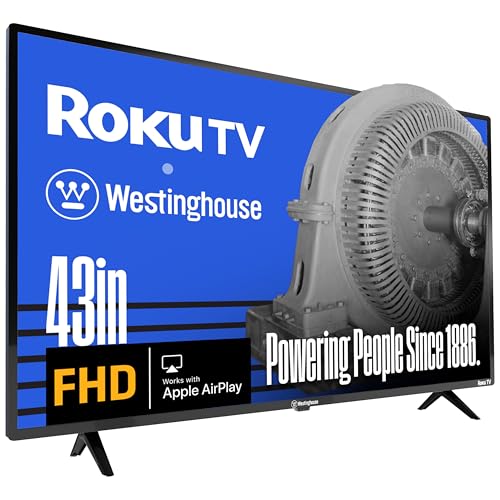
Westinghouse 43″ Roku TV 1080p — Largest Roku value set
The Westinghouse title is a short sentence with everything in its place: a Roku TV, 43 inches, smart, 1080p Full HD, Apple AirPlay 2, Alexa. For a gaming household the Roku platform is the substance — an interface every visitor can drive, an app catalogue that covers the streaming life, and a home screen that treats the console’s input as a first-class tile rather than a buried menu. At 43 inches this is the small living room’s version of the formula, the largest panel on this shelf wearing the friendliest software.
AirPlay 2 earns its mention for a gaming-adjacent reason: the phone is where gameplay clips, screenshots and strategy videos live, and a set that receives them without a cable turns the television into the room’s shared screen for the whole gaming conversation, not just the matches. Alexa compatibility, meanwhile, is the household-politics feature — the set answers to the voice ecosystem many homes already run, even though Roku’s own remote handles the daily driving.
The silences are the shelf’s usual ones, recorded without drama in the spec box: no refresh figure, no game mode, no lag number. A buyer with competitive online sessions should treat the documentation read as the purchase decision itself. A buyer furnishing a small room for docked handheld play, party games and streaming will find the Westinghouse’s stated virtues — size, platform, casting — are exactly the ones their evenings will use.
There is a longevity argument quietly embedded in this pick. Roku’s platform is updated as a service rather than as a model year, so a set bought on this shelf tends to keep its interface current long after its panel generation dates — and small televisions are precisely the ones households keep longest, migrating from main room to spare room to student flat. The Westinghouse’s stated facts are few, but the platform fact is the one that compounds.
- Panel as titled: 43-inch, 1080p Full HD
- Smart platform as titled: Roku TV
- Casting/voice as titled: Apple AirPlay 2, Alexa compatible
- Refresh rate: Not stated in the listing title — verify with the maker’s documentation
- Game mode / input lag: Not stated in the listing title — verify with the maker’s documentation
Strengths
- The largest panel here paired with the interface households find easiest.
- AirPlay 2 makes the phone’s clips and photos part of the room’s screen life.
- Full HD is stated plainly, with no HD-wording ambiguity to decode.
Trade-offs
- No gaming-specific feature of any kind is named in the title.
- Responsiveness must be established from the documentation and the first evening’s play.
- Roku’s platform offers less tinkering depth than the Android-based alternatives elsewhere.
Best for: small living rooms and flats where one 43-inch screen must serve console, streaming and visitors with equal ease. Check price on Amazon once the maker’s documentation has supplied the game-mode facts.
Not suited for: competitive sessions judged on a published lag figure — this headline publishes none, so the manual carries the entire responsiveness case.

INSIGNIA 40″ F40 Full HD Fire TV — Fire TV at 40 inches
The Insignia F40’s title runs: a 40-inch class F40 Series LED Full HD smart Fire TV, voice remote with Alexa, free and live TV. It is the Amazon-platform counterpart to the Westinghouse — same shelf, same honesty about resolution, different ecosystem. Fire TV households get their apps, their watchlist and their voice assistant in the bedroom or spare room without learning a second interface, and the free-and-live-TV emphasis suits the rooms these sets retire to, where broadcast and ad-supported channels fill the idle hours.
For gaming, the F40’s story is the platform and the size. Forty inches at the foot of a bed is the classic second-console geometry: the older machine, the docked handheld, the party system that migrates rooms. Fire TV’s gaming-adjacent virtue is its app store’s breadth for the streaming half of the evening, and the Alexa remote means the set can be driven from under a blanket, a virtue no specification table captures and every bedroom understands.
Nothing in the title speaks to responsiveness, HDR or sound, and the guide declines to lend it any of those virtues. Its position in this list is the honest middle: a Full HD panel of the most useful small size, on a major platform, from a house brand with a retail support channel — a combination whose value is its lack of surprises. Buyers that prize a stated feature should look at the Samsung or the Roku Select; buyers that prize an uneventful purchase should start here.
Second-room economics also speak for this set. The bedroom television is where households least forgive friction and least reward spectacle: it must wake fast, find the input, resume the episode and accept the console, all through half-closed eyes. Fire TV’s resume habits and the voice remote’s blanket-level usability are the F40’s real specification sheet, written in behaviour rather than numbers. The title’s brevity, read this way, is a promise that nothing about the set will be complicated.
- Panel as titled: 40-inch class LED, Full HD
- Smart platform as titled: Fire TV, Voice Remote with Alexa
- Streaming as titled: Free & Live TV
- HDR: Not stated in the listing title — verify with the maker’s documentation
- Game mode / input lag: Not stated in the listing title — verify with the maker’s documentation
Strengths
- Full HD stated outright at the bedroom’s most useful size.
- Fire TV continuity for households already inside Amazon’s ecosystem.
- House-brand backing gives a small purchase a clear service path.
Trade-offs
- The title names no picture feature beyond the resolution itself.
- Gaming responsiveness is entirely a documentation question.
- No casting technology is mentioned for phone content.
Best for: bedrooms and spare rooms in Fire TV households, where the second console and the evening’s streaming share one uncomplicated screen. Check price on Amazon after a look at the documentation’s picture-mode pages.
Not suited for: a gaming corner assembled on stated features — the headline offers size, resolution and platform, and the rest must be excavated.

Roku 40″ Select Series 1080p — Headphone mode included
Roku’s own Select Series title contains the shelf’s most considerate gaming-adjacent phrase: Bluetooth Headphone Mode. The full headline — a 40-inch Select Series smart TV, 2026, 1080p Full HD, Roku TV, flat screen LED, voice remote, Wi-Fi and Bluetooth Headphone Mode, streaming live local news, sports and movies — is a portrait of a set designed by people who understand small rooms. Headphone Mode means the game’s audio travels to the player’s headphones while the room sleeps, works or studies; in a shared bedroom or a thin-walled flat, that is not a convenience but the difference between playing and not playing.
The rest of the proposition is Roku orthodoxy executed at 40 inches: the simple interface, the voice remote for search, the live-and-local emphasis that makes the set a complete television rather than a console’s accessory. As a gaming display its stated virtues are the panel’s honest Full HD and the audio courtesy; its responsiveness, like every pick here, lives in the documentation. But note what the title’s priorities reveal — Roku built this set for the rooms gaming actually happens in after childhood, shared and scheduled and negotiated, and equipped it accordingly.
Model-year wording places this as the 2026 iteration of the line, the freshest design on the shelf alongside the Samsung. Buyers choosing between the Select and the Westinghouse are choosing size and one feature: the Westinghouse gives two more inches and AirPlay, the Select gives the headphone life. Households with sleeping children in the next room already know their answer.
Think of the dorm room this set will actually inhabit. One resident games after midnight while another sleeps four feet away; the Headphone Mode is the treaty that makes the arrangement survivable. The same feature serves the night-shift worker gaming at noon in a shared house and the parent catching an hour after the children’s bedtime. Features that solve scheduling problems outlast features that solve specification envy, and the Select’s title is the only one on this shelf that names one.
- Panel as titled: 40-inch LED, 1080p Full HD
- Smart platform as titled: Roku TV, Voice Remote included
- Audio as titled: Bluetooth Headphone Mode
- Refresh rate: Not stated in the listing title — verify with the maker’s documentation
- Game mode / input lag: Not stated in the listing title — verify with the maker’s documentation
Strengths
- Bluetooth Headphone Mode is the shelf’s most practical shared-room gaming feature.
- Roku’s own hardware and platform pairing keeps the interface story simple.
- The 2026 model-year wording marks the current iteration of the line.
Trade-offs
- No picture feature beyond Full HD is claimed in the title.
- Responsiveness evidence must come from the documentation, as with the whole shelf.
- Two inches smaller than the 43-inch pair, a real difference for split-screen.
Best for: shared bedrooms and flats where late sessions must be silent ones, and the console shares the screen with everyday streaming. Check price on Amazon with the documentation’s game-mode section read first.
Not suited for: split-screen party play as the main event — at 40 inches with no stated gaming features, the 43-inch pair serves that room better.

VIZIO 43″ D-Series Full HD — Casting both ways
The VIZIO D-Series title makes a claim none of its shelf-mates can match: Apple AirPlay and Chromecast built in, together, in a 43-inch Full HD 1080p smart TV with Alexa compatibility, model D43f-J04, a 2022 model. Dual casting is the mixed-household feature — the iPhone and the Android phone both reach the screen natively, no dongle, no favouritism — and in a gaming household it means every player’s clips, captures and couch-coaching videos land on the big screen by the same gesture.
VIZIO’s own smart platform is the set’s centre of gravity, and the 2022 model year is stated in the title with unusual candour. That year cuts both ways: the design is a known quantity with a long retail history, and its software generation is older than the 2026 Roku and 2025 Samsung beside it. Buyers that cast more than they browse the native interface will barely notice; buyers that live inside the platform’s app catalogue should weigh the generation honestly.
On gaming evidence the title is as silent as the shelf — no refresh, no game mode, no lag figure — so the D-Series earns its place on size and casting rather than on play. That is a legitimate place to earn: the 43-inch panel is the small living room’s size, and the household that games socially, phones full of clips, gathered around one screen, is precisely the household this set was specified for.
The D-Series also rewards a word about secondhand and hand-me-down logic, because 43-inch sets migrate. A television whose casting speaks both phone languages survives being inherited by any household member, gifted to any student, or reassigned to any room without a compatibility conversation. That portability of purpose is invisible in specification tables and decisive in real homes, and it is the deepest reason this 2022 design holds its place among newer rivals.
- Panel as titled: 43-inch, Full HD 1080p
- Casting as titled: Apple AirPlay and Chromecast built in
- Voice as titled: Alexa compatibility
- Model year as titled: 2022 model (D43f-J04)
- Game mode / input lag: Not stated in the listing title — verify with the maker’s documentation
Strengths
- Both major casting systems built in, unique on this shelf.
- The 43-inch size suits the small living room’s sofa distances.
- The model year is printed in the title, letting buyers judge the generation themselves.
Trade-offs
- The 2022 software generation trails the newest picks here.
- No gaming feature is named; responsiveness is documentation territory.
- VIZIO’s platform catalogue is narrower than Roku’s or Fire TV’s.
Best for: mixed-phone households in small living rooms, where casting carries the social half of gaming and 43 inches carries the matches. Check price on Amazon once the documentation has answered the picture-mode questions.
Not suited for: daily life inside a smart platform’s app store — the older generation and smaller catalogue will be felt within a week.

SAMSUNG 40″ F6000 Full HD — Feature-led 40 incher
The Samsung F6000’s title is the most decorated on this shelf: a 40-inch class Full HD smart TV, 2025 model, with HDR, Object Tracking Sound Lite, Knox Security and One UI Tizen. Each phrase is a department the other titles leave unstaffed. HDR is the headline for gaming: it is the only set here whose title promises high-dynamic-range rendering at all, and for the modern console library — graded HDR-first — that promise separates the F6000 from a shelf of SDR panels, however honest their resolutions.
Object Tracking Sound Lite is Samsung’s attempt to make a small set’s audio follow the action, a Lite edition of the technology from its larger lines; in a 40-inch bedroom set, any directional ambition is welcome, since the alternative is the flat centre-weighted sound small panels default to. Knox Security, meanwhile, is the grown-up feature: a named security platform on a television that will hold the household’s streaming accounts, a consideration buyers rarely weigh until an account behaves strangely. One UI Tizen is the interface tying it together, familiar to any Samsung household.
The gaming silences persist — no refresh, no game mode, no lag figure in the title — and the guide records them in the box without subtracting the HDR achievement. The F6000 is the pick for the buyer who reads this shelf and asks which set tries hardest on picture: the answer is the one that printed HDR when none of its neighbours did. Whether its game mode rewards the console is the documentation’s final word, and Samsung’s manuals, to the brand’s credit, usually have one.
There is a buyer’s-profile point to close on. The F6000 asks more of its owner than the shelf’s simpler sets — menus to explore, sound modes to audition, picture settings per input — and returns more for the effort. Households that set a television once and never open the settings again will experience a fraction of what its title promises; households that enjoy the calibration hour will find the F6000 the only set here that keeps rewarding it. Choose according to which household is yours.
- Panel as titled: 40-inch class Full HD
- HDR as titled: HDR stated
- Audio as titled: Object Tracking Sound Lite
- Platform/security as titled: One UI Tizen, Knox Security
- Game mode / input lag: Not stated in the listing title — verify with the maker’s documentation
Strengths
- The only HDR claim on the shelf, aimed at the modern HDR-first game library.
- A named sound technology gives the small panel an audio ambition its rivals skip.
- Knox Security addresses the account-safety side of a connected television.
Trade-offs
- No responsiveness figure or game mode is stated, despite the feature-rich title.
- Tizen’s app catalogue differs from Roku and Fire TV households’ habits.
- Feature density at 40 inches assumes a buyer that will explore the menus.
Best for: picture-led small-room gaming, especially HDR-capable consoles in bedrooms where the set is the room’s only screen. Check price on Amazon after the documentation confirms the game-mode behaviour behind the HDR claim.
Not suited for: responsiveness claims without a documented figure — for all its features, this title’s gaming-speed story is as undocumented as the shelf’s plainest set.

INSIGNIA 32″ F40 1080p Fire TV — Smallest true 1080p here
The smallest pick carries the shelf’s most quietly important claim. The Insignia 32-inch F40 title states “1080P Full HD” in a size class where that phrase cannot be assumed — 32-inch televisions are the industry’s favourite place to sell a lower-resolution panel under warm wording — and pairs it with Direct LED backlighting, Fire TV, a voice remote with Alexa and free live TV. A true 1080p panel at 32 inches, viewed at the half-metre to metre distances of counters and desks, is a crisp instrument, and for the docked handheld or the retro library it is honestly all the resolution the room can use.
The rooms define the pick: the kitchen where a console lives beside the cookbooks, the caravan and the camper, the workshop bench, the dorm desk where the television is also the monitor’s understudy. In those rooms the F40’s Fire TV platform brings the streaming life, the Alexa remote brings hands-free control when the hands are occupied — a kitchen virtue disguised as a specification — and the Direct LED wording at least names the backlight’s arrangement, a small candour several larger titles here decline.
Its limits are geometry, not honesty. Thirty-two inches makes split-screen a negotiation and cinematic games a smaller experience, and no gaming feature is stated, as with the whole shelf. But the guide keeps a place for the correctly-sized tool: the buyer whose room is genuinely small is not buying a lesser television, they are buying the one that fits, and among 32-inch options the F40’s stated Full HD panel is the first fact to insist on.
Retro and handheld libraries deserve the closing word for this pick, because they are its natural citizens. Older consoles output at resolutions a 1080p panel handles without strain, handhelds dock to exactly this class of screen, and the small diagonal flatters lower-resolution sources that a giant panel would expose. The F40 will never host a flagship launch night; it will host a thousand ordinary evenings of play in rooms the flagships cannot enter, and its title’s plain Full HD promise is precisely the credential those evenings require.
- Panel as titled: 32-inch class Direct LED, 1080P Full HD
- Smart platform as titled: Fire TV, Voice Remote with Alexa
- Streaming as titled: Free & Live TV
- Refresh rate: Not stated in the listing title — verify with the maker’s documentation
- Game mode / input lag: Not stated in the listing title — verify with the maker’s documentation
Strengths
- True Full HD stated in the size class most prone to resolution sleight of hand.
- Direct LED backlighting is named, a small honesty about the panel’s construction.
- Fire TV and voice control suit hands-busy rooms like kitchens and workshops.
Trade-offs
- Thirty-two inches constrains split-screen and cinematic scale alike.
- No gaming feature is stated; responsiveness rests on the documentation.
- The size that fits a counter will feel small if the room grows.
Best for: kitchens, caravans, workshops and dorm desks where a true 1080p panel must fit a genuinely small space. Check price on Amazon with the room’s measurements confirmed against the listing’s dimensions.
Not suited for: a main gaming room of any size — the diagonal, not the panel quality, is the binding constraint on every session.
How Do the Six Compare Side by Side?
| Pick | Size | Platform | Distinguishing claim in title | Gaming evidence in title |
|---|---|---|---|---|
| Westinghouse 43″ Roku TV | 43-inch | Roku TV | Apple AirPlay 2 | None stated |
| INSIGNIA 40″ F40 | 40-inch | Fire TV | Free & Live TV | None stated |
| Roku 40″ Select Series | 40-inch | Roku TV | Bluetooth Headphone Mode | None stated |
| VIZIO 43″ D-Series | 43-inch | VIZIO smart platform | AirPlay + Chromecast built in | None stated |
| SAMSUNG 40″ F6000 | 40-inch | One UI Tizen | HDR, Object Tracking Sound Lite | None stated |
| INSIGNIA 32″ F40 | 32-inch | Fire TV | 1080P Full HD at 32 inches, Direct LED | None stated |
The comparison table’s last column is the most honest in this guide’s whole television programme: six times, the same two words. That uniformity is the shelf’s character, and buyers should let it recalibrate their method — on this shelf, one does not choose the best gaming television so much as choose the best small television and then verify its gaming manners in the documentation. The distinguishing-claims column is therefore where the choosing happens: casting, headphone mode, HDR, size. The neighbouring sizes and their own trade-offs are surveyed in best 43 1080p tvs and best 1080p 32in tvs for readers measuring a specific room.
Notice, too, what the size column quietly proves: the shelf has standardised on two diagonals, 43 and 40, with the 32 as the outlier for tight spaces. That standardisation is good news for buyers — stands, mounts and wall spaces planned for one brand’s 43 will fit another’s, and the platform decision can be made without a furniture decision riding on it. Choose the diagonal by the room’s tape measure, then choose the badge by the household’s habits, and the table becomes a two-step filter instead of a six-way argument.
What Mistakes Do Small-Screen Gaming Buyers Keep Making?
The first mistake is trusting the letters HD. On the small shelf, HD, HD Ready and Full HD describe different panels, and only the full phrase — or the explicit 1080p in every title here — guarantees the resolution a console outputs. The second mistake is importing 4K-shelf expectations: hunting for refresh headlines and VRR logos on a shelf that does not print them, and rejecting honest sets for failing a vocabulary test their category never sat. Judge this shelf by its own evidence — size, resolution honesty, platform, casting, the occasional feature like the Roku’s headphone mode or the Samsung’s HDR.
A related error is assuming the newest model year automatically wins the shelf. The 2022 VIZIO in this guide out-casts two newer rivals, and the house-brand sets out-simple them; small televisions change slowly, and a mature design with the right stated feature beats a fresh design without it. Read the titles, not the calendar — the same rule the flagship shelves demand, applied at a size where the marketing is quieter and the differences are easier to miss.
The third mistake is skipping the first-evening test. Because lag is undocumented at title level across this shelf, the buyer’s own hands are part of the measurement equipment: play the timing-sensitive game already mastered, in the set’s game or PC mode if the documentation names one, while the return window is wide open. The fourth mistake is buying the room’s second size — the 40-inch set for a room that measured for 43, the 32 for a counter that would have taken 40 — because small televisions are kept for a decade and the missing inches are missed weekly. Measure the space, then buy the largest honest panel it holds.
A fifth mistake is treating the small television as a temporary purchase and starving it of setup. The bedroom set that gets ten minutes of picture adjustment, a paired set of headphones and a sensible stand angle will outserve a flagship that was never configured, because small rooms magnify setup sins: the wrong angle is sat in every night, the un-paired headphones are missed every midnight session. Small televisions repay care at the same rate as large ones; they merely receive it less often.
Final Recommendation
For the small living room, choose between the 43-inch pair on casting and platform: the Westinghouse for Roku households with iPhones, the VIZIO for mixed-phone homes that cast from both ecosystems. For the bedroom, the Roku Select’s headphone mode is the single most lived-with feature on this shelf, with the Samsung F6000 the picture-led alternative for HDR consoles and the Insignia F40 the Fire TV household’s straightforward answer. For the genuinely small space, the 32-inch Insignia’s true Full HD panel is the pick, bought with open eyes about its diagonal.
Whichever name wins, run the ritual this shelf demands: read the finalist’s documentation for its game-mode story, test responsiveness on the first evening with a game the hands already know, and keep the receipt until that test is passed. The step up, for readers whose rooms and budgets grow, is surveyed in best 55 inch tvs for gaming, where the vocabulary of refresh and VRR returns in full — but a small room honestly served by one of these six will not feel like a compromise, because the right size at the right distance beats the flagship specification in the wrong room every evening of the year.
And keep the shelf’s perspective when the upgrade itch arrives. A household that games happily for years on a 40-inch panel at the foot of a bed has not been deprived; it has been correctly equipped, and the money the flagship would have taken is still available for the games themselves. That is the small value shelf’s whole philosophy, and these six sets — plain titles, honest resolutions, platforms people can drive — are its current best expression. The itch, when it comes, should be answered by a bigger room first and a bigger specification second.
Frequently Asked Questions
Is 1080p still enough for gaming?
For the consoles and rooms this shelf serves, yes. Much of the current game library renders at or near 1080p internally, handhelds dock at that output, and older consoles were built for it — a native panel displays all of that without scaling. At 32 to 43 inches and small-room distances, the result is sharp. Players with the newest consoles and a large room are shopping a different shelf, and this guide’s 4K companions serve them. The resolution question is really a distance question wearing a number: pixels per degree of vision decide sharpness, and small panels viewed closely can match large panels viewed from afar on exactly that measure.
Why does no title here state an input-lag figure?
Because the small value shelf is marketed on size, platform and price-position rather than on gaming statistics, and its titles reflect that. The absence is a category habit, not proof that the sets are slow — several may perform respectably in their game modes. It does mean the figure cannot be verified from the listing, which is why this guide routes the question to the maker’s documentation and to a first-evening hands-on test.
Does a game mode matter at this size?
It is usually the single largest responsiveness lever a small television offers, because it strips the picture processing that adds delay. Whether a given model provides one, and what it is called in the menus, is documentation information — the titles here do not say. When testing a new set, find that mode first, enable it for the console’s input, and only then judge the set’s manners.
Which platform is best for a small gaming TV?
The one the household already speaks. Roku’s interface is the simplest for mixed and visiting users, Fire TV suits Amazon-centred homes, the VIZIO leans on casting from phones, and Samsung’s Tizen suits Samsung households. The console does not care which platform surrounds its input; the humans changing inputs at midnight care enormously, and their fluency decides more evenings than any panel trait on this shelf. Grandparents, guests and tired partners are the real user test, and the platform they can drive unaided is the correct answer for the room they share.
Can a 32-inch TV really be a gaming screen?
In the rooms it is built for, entirely. At counter and desk distances a true 1080p 32-inch panel is crisp, a docked handheld fills it happily, and retro libraries look native on it. Its limits are social and cinematic — split-screen crowds it, film nights shrink — so it belongs where one player sits close, which describes a great deal of the world’s gaming more honestly than the flagship advertisements do.
What about older consoles and retro libraries?
They are this shelf’s home crowd. Older consoles were designed for 1080p and below, and a native panel of this class displays them without the scaling strain a 4K set imposes on low-resolution sources. Players whose libraries lean retro should still check the documentation for the set’s handling of older input signals and any game-mode behaviour, but the size and resolution match is fundamentally kind: these televisions and those consoles were made for each other.
Related Guides
Continue along the small-screen shelf with best 43 1080p tvs for the size class at its most complete, and best 1080p smart tvs for the platform-first survey of the same territory.
Related guides
- Best 1080p IP Cameras: PoE Domes, Turrets, Bullets and a PTZ That Earn Their Cable
- Best 43 1080p TVs: Why 43 Inches Went 4K — and Where True Full HD Survives
- Best Doorbell Cameras No Subscription: Local Storage Picks, and the Ring/Blink Truth
- Best AC Powered Wireless Security Cameras: Wi-Fi Data, Mains Power, Zero Sleep


