What's inside
- Key Takeaways
- Quick Picks
- How were these 85-inch picks chosen?
- The 85-inch shelf compared
- How do you choose an 85-inch television without regrets?
- Setting up and living with an 85-inch screen: our evaluation notes
- Common mistakes when buying a very large television
- Final recommendation
- Frequently asked questions
As an Amazon Associate I earn from qualifying purchases. This post may contain affiliate links at no extra cost to you.
gizmoverdict.com is reader-supported. When you buy through links on our site, we may earn an affiliate commission.
Where to buy: Televisions at this size move through big-box and online channels in delivery waves rather than sitting in deep local stock, and an eighty-five-inch carton rarely fits a family car, so home delivery is the normal route for every set in this guide. The six models below were listed when the guide was prepared; at this size, ordering the panel before booking any installation help is the sensible sequence, because delivery slots for oversized freight book out faster than the televisions themselves sell through.
Anyone shopping for the best 80 inch tvs deserves the honest version of the shelf before anything else: the eighty-inch class, as a distinct size, has effectively disappeared from current lineups. Panel factories cut glass in generations, and the sizes that survived at the top of the mainstream range are eighty-five inches and, above that, ninety-eight. True eighty- and eighty-two-inch models linger only as ageing stock. So every pick in this guide is an eighty-five-inch television, and that is not a bait-and-switch — it is the truthful reading of the search. Five extra diagonal inches over the old eighty-inch idea buys a current panel, a current processor, and a warranty that starts now, and the room planning below treats eighty-five as the real size to measure for.
What separates the six is panel tier and purpose. Two Hisense Mini-LED models and a Samsung Mini LED set chase contrast and gaming speed, with native 144Hz refresh stated across the Hisense pair and the TCL. A QLED Toshiba and a straightforward LED Insignia hold the simpler end, where Fire TV and a voice remote do the everyday work without gaming pretensions. All six run Fire TV or a Fire TV-based interface except where the titles say otherwise — in fact the platform consistency here is unusual, with Alexa woven through nearly every listing — so the real decisions are panel technology, refresh rate, and whether Dolby Vision appears in the title of the set you favour.
Key Takeaways
- Every pick is an 85-inch model, because the true 80-inch class has effectively left current lineups; plan your room for eighty-five inches.
- Mini-LED backlighting appears in the two Hisense picks and the Samsung M80H, and it is the contrast upgrade that matters most at this size.
- Native 144Hz refresh is stated for both Hisense models and the TCL F8D, marking them as the gaming-capable end of the six.
- Dolby Vision is named in the titles of the Hisense pair and the TCL; the Insignia, Samsung, and Toshiba titles do not name it.
- Fire TV with Alexa voice control runs through the Insignia, both Hisense sets, the TCL, and the Toshiba, simplifying platform choice.
- Delivery, doorway clearance, and stand width are genuine buying criteria at eighty-five inches, not afterthoughts.
Quick Picks
| Pick | Label | Why it stands out |
|---|---|---|
| INSIGNIA 85-inch F50 Series Fire TV | Best straightforward big screen | LED 4K Fire TV with Alexa voice remote and no specification clutter |
| Hisense 85-inch U6 Pro Mini-LED | Best overall | Mini-LED, native 144Hz, Dolby Vision IQ and Atmos, glare-free finish |
| Samsung 85-inch M80H Mini LED | Best for Samsung households | Mini LED with Samsung Vision AI and a supersize picture enhancer |
| Hisense 85-inch E7 Cinema Series | Best cinema-leaning value | Mini-LED with full-array local dimming and HDR10+ Adaptive |
| TCL 85-inch F8D Series QLED | Best for sport and gaming pace | 144Hz QLED with Game Accelerator 288 and VRR stated |
| TOSHIBA 85-inch M450 Series QLED | Best simple QLED route | QLED colour on Fire TV with live television streaming and Alexa remote |
How were these 85-inch picks chosen?
The selection began with the size honesty described above: current-production eighty-five-inch models only, each verified as a live listing rather than a legacy page. Within that shelf, panel tier formed the primary sort. Mini-LED sets earned three of the six places because at eighty-five inches the backlight is the picture — a basic edge-lit or plain LED panel spread across that much glass shows its uniformity limits in dark scenes and sport alike, while mini-LED local dimming holds blacks and highlights with far more control. QLED colour systems took two places for their saturation at large sizes, and one plain LED set, the Insignia, holds the baseline honestly so readers can see what the extra panel technology is being weighed against.
Refresh rate was the second sort. Three titles state a native 144Hz panel, and in a size class where sport and gaming dominate the use case, that figure separates sets that merely accept a game console from sets built to flatter one. Dolby formats were recorded exactly as titled: Vision IQ on the Hisense pair, Vision on the TCL, silence from the others. Silence was treated as information, not as a gap to be filled by assumption, because at this price level the difference between Dolby Vision and base HDR handling is a legitimate reason to choose one set over another.
Practicality closed the selection. Every pick is a smart television with a mainstream platform, every pick streams without additional hardware, and every pick is a size that delivery services handle routinely. Readers comparing this shelf with the still-larger class can see the next step up in our guide to best 86 inch tvs, where the market changes character again. What follows treats each set on its titled merits, with gaming claims tied to stated refresh and VRR figures and nothing invented beyond the listings.

1. INSIGNIA 85-inch F50 Series Fire TV — Best straightforward big screen
The Insignia F50 is the honest baseline of this group: an eighty-five-inch LED panel, 4K UHD resolution, Fire TV built in, and an Alexa voice remote in the box, model NS-85F501NA26. Its title promises nothing it cannot cash. There is no mini-LED claim, no high-refresh claim, and no Dolby Vision name, and for a particular kind of buyer that restraint is the appeal. A big room that mostly shows broadcast sport, streaming drama in a lit room, and weekend films does not tax a television the way a darkened cinema room or a competitive gaming setup does, and the F50 covers that brief at the full eighty-five inches without charging for panel technology the viewing would never reveal.
LED at this size deserves a clear-eyed description. A full, bright picture for daytime sport and general streaming is well within its abilities, and 4K resolution across eighty-five inches still resolves the detail that makes the size worthwhile from nine feet and beyond. Where the simpler backlight shows itself is in dark scenes: blacks sit higher than the mini-LED picks produce, and a letterboxed film in a dark room will show the difference plainly. Insignia is Best Buy’s house brand, and the F50’s proposition is distribution and simplicity — Fire TV’s interface is widely known, the Alexa remote handles search by voice, and setup asks little of the household.
As the reference point of the six, the F50 also helps calibrate everyone else’s claims. When the Hisense U6 Pro below talks about glare-free mini-LED contrast, this is the picture it is being compared against. Buyers whose rooms are bright, whose content is sport and streaming, and whose budget discipline matters should not let specification envy talk them out of a set that fits their actual viewing. Measure the stand width, though: eighty-five-inch feet spread wide, and many television benches built for sixty-five-inch sets are simply too narrow. To confirm the current specification and delivery options, check price on Amazon for the F50 in its current model-year listing.
Strengths
- Full eighty-five inches of 4K LED with Fire TV and an Alexa voice remote, without paying for unused panel technology.
- The simplest setup and interface story in this group, suited to mixed-age households.
- An honest baseline picture for bright-room sport and everyday streaming.
Trade-offs
- Plain LED backlighting cannot match the mini-LED picks for black depth in dark rooms.
- No high-refresh or VRR figure is stated, so gaming beyond casual play is not its brief.
- Dolby Vision is not named in the title.
Spec box
- Screen size: 85 inches
- Resolution: 4K UHD
- Panel: LED
- Platform: Fire TV
- Voice: Alexa Voice Remote included, stated
- Model: NS-85F501NA26
- Refresh rate: Not stated in the listing title
- Dolby Vision: Not stated in the listing title
Best for: a bright family room showing sport and streaming from nine feet or more, on the full eighty-five inches.
Not suited for: a darkened film room, where plain LED black levels sit visibly above the mini-LED picks in this guide.

2. Hisense 85-inch U6 Pro Mini-LED — Best overall
The Hisense U6 Pro carries the longest specification in this guide and, unusually, most of it matters. Mini-LED ULED construction, Hi-QLED colour, a native 144Hz panel with Motion Rate 480, Dolby Vision IQ and Atmos, HDR10+, a glare-free screen finish, and Fire TV with Alexa+ — the title reads like a flagship checklist, on a 2026 model, at eighty-five inches. Taken piece by piece: the mini-LED backlight is the contrast story, the 144Hz native refresh is the gaming and sport story, Dolby Vision IQ adapts HDR tone to room light, and the glare-free finish addresses the big bright rooms these screens usually land in.
Gaming credentials are stated rather than implied. A native 144Hz panel at this size gives consoles and PCs the headroom that 60Hz sets cannot, and the U6 line’s gaming positioning is reinforced by the HDR gaming wording in the title itself. For film, Dolby Vision IQ plus HDR10+ means both major adaptive HDR formats are covered, which cannot be said of most rivals here. The glare-free claim deserves emphasis because eighty-five inches of glass in a sunlit room is a mirror farm without it; a finish that scatters reflections preserves the mini-LED contrast the buyer paid for during daytime viewing, not only after dark.
Fire TV with Alexa+ keeps the platform consistent with most of this group, so the decision against the Samsung below is about ecosystem peripherals and picture processing taste rather than apps. Against its own sibling, the E7, the U6 Pro is the fuller specification: Vision IQ rather than Vision IQ also appears there, but the U6 adds the glare-free finish and the Pro positioning. For most large rooms, this is the set where the fewest compromises need explaining afterward, and readers ready to act can see the U6 Pro listing on Amazon to confirm the current tuner and port details before ordering.
Strengths
- Mini-LED contrast with a glare-free finish, the pairing large bright rooms actually need.
- Native 144Hz refresh plus Dolby Vision IQ, Atmos, and HDR10+ — the broadest format coverage here.
- Fire TV with Alexa+ keeps the interface familiar while the panel does flagship work.
Trade-offs
- The fullest specification here also asks the most careful setup to appreciate, from picture mode to motion settings.
- Motion Rate 480 is a processing figure; the native panel rate is the 144Hz also stated, and the two should not be confused.
- At eighty-five inches its delivery and mounting demands match the largest sets in the guide.
Spec box
- Screen size: 85 inches
- Resolution: 4K UHD
- Panel: Mini-LED ULED, Hi-QLED
- Refresh: native 144Hz stated; Motion Rate 480 stated
- HDR: Dolby Vision IQ, HDR10+
- Audio: Dolby Atmos stated
- Finish: glare-free, stated
- Platform: Fire TV, Alexa+
Best for: a large, bright main room mixing film nights, sport, and console gaming on one eighty-five-inch screen.
Not suited for: a small room with seating under seven feet away, where eighty-five inches overwhelms the field of view regardless of panel quality.

3. Samsung 85-inch M80H Mini LED — Best for Samsung households
Samsung’s M80H entry is the processing-led pick: an eighty-five-inch Mini LED 4K set, 2026 model, built around Samsung Vision AI, an AI Mode for the mini-LED picture, a Supersize Picture Enhancer, Pure Spectrum Color, Motion Xcelerator, and Alexa Built-in. The vocabulary is Samsung’s own, and it describes a television whose pitch is computational — the maker is arguing that at eighty-five inches, upscaling, colour mapping, and motion handling decide how ordinary content looks, because most of what a big screen shows is not native 4K. The Supersize Picture Enhancer name makes that argument explicitly: enhancement tuned for very large panels.
The mini-LED hardware underneath gives the processing something worth processing. Samsung’s mini-LED implementations are known for bright, punchy pictures, and Pure Spectrum Color is the colour-volume claim paired with it. What the title does not state is equally notable for an informed choice: no refresh-rate figure is given, and Dolby Vision is not named — Samsung historically backs HDR10+ rather than Dolby Vision, and this title’s silence on both counts means gaming buyers and Dolby Vision loyalists should read the full specification on the product page before assuming. Alexa Built-in is stated, so voice control does not depend on an external speaker.
The M80H makes its strongest sense in a Samsung household: phones that cast without friction, an existing Samsung soundbar, a family already fluent in the maker’s interface habits. It is also the contrarian pick for bright rooms, where Samsung’s processing and mini-LED brightness traditionally shine and where the Hisense glare-free finish is its chief rival argument. Buyers choosing between them are choosing between two philosophies — Hisense’s stated hardware figures versus Samsung’s AI processing claims — and either is defensible on the evidence of the titles. Samsung loyalists can check the M80H on Amazon for the current listing details and panel specification.
Strengths
- Mini LED hardware directed by Samsung Vision AI, with an enhancer named specifically for supersize panels.
- Pure Spectrum Color and Motion Xcelerator address the two things big screens expose: colour banding and motion blur.
- Alexa Built-in gives voice control without extra hardware.
Trade-offs
- No refresh-rate figure is stated in the title, leaving gaming headroom unproven on paper.
- Dolby Vision is not named in the title.
- The AI-led pitch asks the buyer to trust processing claims that only viewing can settle.
Spec box
- Screen size: 85 inches
- Resolution: 4K
- Panel: Mini LED
- Processing: Samsung Vision AI, AI Mode, Supersize Picture Enhancer
- Colour: Pure Spectrum Color stated
- Motion: Motion Xcelerator stated
- Voice: Alexa Built-in
- Refresh rate: Not stated in the listing title
Best for: a Samsung-equipped household filling a large bright room with an eighty-five-inch mini-LED screen.
Not suited for: a gaming-first setup, because no high-refresh figure is stated in this title.

4. Hisense 85-inch E7 Cinema Series — Best cinema-leaning value
The E7 Cinema Series is Hisense aiming the same eighty-five-inch mini-LED hardware at film lovers, and its title differs from the U6 Pro’s in telling ways. Hi-QLED Mini-LED construction, native 144Hz, AI Picture, Dolby Vision IQ and Atmos, FALD — full-array local dimming, named outright — HDR10+ Adaptive, MEMC motion processing, Fire TV, and Alexa+. The word Cinema in the series name and the presence of HDR10+ Adaptive, which adjusts HDR to ambient light scene by scene, mark the intent: a set tuned for evening film viewing in rooms that are not fully darkened theatres.
FALD being named matters. Full-array local dimming is the mechanism behind mini-LED contrast claims, and a title that states the mechanism invites the buyer to hold the picture to it: dark scenes should hold their blacks in zones rather than lifting the whole frame. MEMC is the honest counterweight in the specification — motion interpolation divides film audiences, and its presence means the buyer should find the setting that disables or tames it for twenty-four-frame content, keeping it for sport where it earns its keep. The 144Hz native panel underneath gives the E7 the same gaming headroom as its sibling, so cinema positioning does not cost play capability.
Choosing between the E7 and the U6 Pro is the closest call in this guide. The U6 Pro adds the glare-free finish and the Pro tier positioning; the E7 counters with HDR10+ Adaptive and the cinema tuning story. A room with controlled light favours the E7’s argument; a room with windows favours the U6’s. Either way the platform, size, and refresh match, so the decision can rest on the room rather than on specification anxiety. Film-first readers can view the E7 Cinema listing on Amazon to compare its current specification against the U6 Pro side by side.
Strengths
- Full-array local dimming named in the title, underwriting the mini-LED contrast claim with a stated mechanism.
- HDR10+ Adaptive plus Dolby Vision IQ covers both adaptive HDR systems, tuned for real rooms.
- Native 144Hz panel means the cinema positioning costs nothing in gaming capability.
Trade-offs
- MEMC motion interpolation needs taming for film content to avoid the soap-opera look.
- No glare-free finish is stated, unlike the U6 Pro, so bright rooms are a weaker setting.
- Two Hisense mini-LED sets in one guide means the distinction rests on tuning details some buyers will find fine-grained.
Spec box
- Screen size: 85 inches
- Resolution: 4K UHD
- Panel: Hi-QLED Mini-LED, FALD stated
- Refresh: native 144Hz stated
- HDR: Dolby Vision IQ, HDR10+ Adaptive
- Audio: Dolby Atmos stated
- Motion: MEMC stated
- Platform: Fire TV, Alexa+
Best for: an eighty-five-inch film-focused room with controlled light and long evening viewing sessions.
Not suited for: a sunlit room with reflections across the screen, where no glare-free finish is stated for this model.

5. TCL 85-inch F8D Series QLED — Best for sport and gaming pace
TCL’s F8D states its priorities in gaming language no other title here uses: a 144Hz 4K UHD QLED Fire TV with Dolby Vision HDR and Atmos, HDR10+, Game Accelerator 288, VRR for sports and gaming, Alexa+, and a native 144Hz refresh rate repeated for emphasis. Game Accelerator 288 is TCL’s processing claim for higher effective motion in game mode, and VRR — variable refresh rate — is the feature that keeps console frame pacing smooth when a game’s output fluctuates. Together with the native 144Hz panel, the F8D is the most explicitly game-and-sport-specified set in this guide, on a QLED panel whose colour saturation suits the saturated look of modern games and broadcast sport alike.
The distinction from the Hisense pair is the backlight story. The F8D title claims QLED without claiming mini-LED, so its contrast ceiling on paper sits below the mini-LED models, while its motion and gaming specification matches or exceeds them. Buyers should weigh that trade with clear eyes: dark-room film will favour mini-LED dimming, fast play will favour this set’s stated gaming stack. Dolby Vision and Atmos are both named, so format coverage is not sacrificed to get the gaming features, and HDR10+ rounds out the adaptive formats.
Fire TV with Alexa+ again keeps the platform familiar, which matters in a guide where four of six sets share it — households can genuinely choose on picture and gaming merits alone. The F8D also reads as the sport pick in a broader sense: eighty-five inches, high native refresh, and QLED colour is precisely the combination that makes a stadium broadcast feel like an event. Readers whose big screen will spend its life on matches and multiplayer can find the F8D on Amazon and confirm the HDMI specification for their console generation.
Strengths
- Game Accelerator 288 and VRR are stated outright, the most explicit gaming stack in this guide.
- Native 144Hz QLED panel pairs motion headroom with strong colour for sport.
- Dolby Vision, Atmos, and HDR10+ are all named, so gaming focus costs no format coverage.
Trade-offs
- No mini-LED claim in the title, so dark-room contrast trails the Hisense and Samsung picks on paper.
- Game Accelerator figures are processing claims; the verifiable hardware figure is the native 144Hz.
- QLED colour can oversaturate broadcast content until picture settings are calmed down.
Spec box
- Screen size: 85 inches
- Resolution: 4K UHD
- Panel: QLED
- Refresh: native 144Hz stated
- Gaming: Game Accelerator 288, VRR, both stated
- HDR: Dolby Vision, HDR10+
- Audio: Dolby Atmos stated
- Platform: Fire TV, Alexa+
Best for: an eighty-five-inch screen bought primarily for sport broadcasts and console gaming sessions.
Not suited for: a dedicated dark cinema room, where the absence of a stated mini-LED backlight shows in black depth.
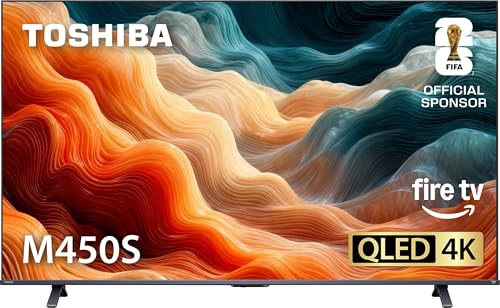
6. TOSHIBA 85-inch M450 Series QLED — Best simple QLED route
The Toshiba M450 closes the guide with the simplest QLED proposition: an eighty-five-inch QLED 4K UHD Smart Fire TV with a voice remote with Alexa, and the ability to stream live television without cable stated in the title. That last phrase is doing real work. A large share of big-screen buyers are replacing a cable setup, and a set that foregrounds free and live streaming through Fire TV speaks directly to the cord-cutting household that still watches news, local sport, and scheduled programming rather than living entirely on demand.
QLED is the picture claim, bringing the colour volume that distinguishes quantum-dot panels from the plain LED Insignia at the top of this guide, without the gaming specification of the TCL or the mini-LED dimming of the Hisense pair. No refresh figure and no Dolby format is named in the title, so the M450 should be judged as a colour-forward everyday set: streaming services in 4K, live channels, films in a normally lit room. Within that brief it is complete — Fire TV carries the apps, Alexa handles search from the sofa, and the panel technology is a genuine step above the baseline.
The M450’s role in the guide is to mark the point where simplicity and colour meet. Buyers who found the Hisense specification lists exhausting, and who do not game beyond the casual, get QLED colour and the full size without paying for 144Hz hardware that would never be exercised. Households with Toshiba history will also find the brand’s return to large screens under familiar naming reassuring. For the live-television household, look at the M450 listing on Amazon to confirm the current channel and app offering for your region.
Strengths
- QLED colour at the full eighty-five inches with the simplest specification in the guide to act on.
- Live television streaming without cable is stated in the title, aimed squarely at cord-cutting households.
- Fire TV with an Alexa voice remote keeps daily operation familiar and quick.
Trade-offs
- No refresh rate is stated, so fast gaming and sport motion headroom is unproven on paper.
- No Dolby Vision or Atmos is named in the title.
- No mini-LED backlighting, so dark-scene contrast sits below the dimming-equipped picks.
Spec box
- Screen size: 85 inches
- Resolution: 4K UHD
- Panel: QLED
- Platform: Fire TV
- Voice: Voice Remote with Alexa, stated
- Live TV: stream live TV without cable, stated
- Refresh rate: Not stated in the listing title
- Dolby formats: Not stated in the listing title
Best for: a cord-cutting household centred on live channels and streaming, wanting QLED colour at eighty-five inches.
Not suited for: a console-gaming station, because no high-refresh or VRR figure appears in this model’s title.
The 85-inch shelf compared
| Model | Panel | Refresh stated | Dolby Vision | Dolby Atmos | Platform |
|---|---|---|---|---|---|
| INSIGNIA F50 | LED | Not stated in the listing title | Not stated in the listing title | Not stated in the listing title | Fire TV |
| Hisense U6 Pro | Mini-LED ULED | Native 144Hz | Vision IQ | Stated | Fire TV |
| Samsung M80H | Mini LED | Not stated in the listing title | Not stated in the listing title | Not stated in the listing title | Smart TV, Alexa Built-in |
| Hisense E7 Cinema | Mini-LED, FALD | Native 144Hz | Vision IQ | Stated | Fire TV |
| TCL F8D | QLED | Native 144Hz | Stated | Stated | Fire TV |
| TOSHIBA M450 | QLED | Not stated in the listing title | Not stated in the listing title | Not stated in the listing title | Fire TV |
How do you choose an 85-inch television without regrets?
Measure the room before the specifications seduce you. Eighty-five inches wants roughly nine to thirteen feet of viewing distance for mixed content, a wall wide enough to leave breathing room beside the cabinet, and a stand or mount rated for the weight with fixings into structure. Walk the delivery route with a tape: door widths, stair turns, and the corner at the top of the stairs defeat more big-screen purchases than any picture specification. If the route fails, the purchase fails, whatever the panel can do.
Then rank your content. Film in a darkened room puts mini-LED dimming first, which points at the Hisense pair and the Samsung. Sport and gaming put native refresh and VRR first, which points at the TCL and again at the Hisense pair with their stated 144Hz panels. Bright rooms put finish and brightness behaviour first, favouring the glare-free U6 Pro. Everyday streaming and live television put platform and simplicity first, where the Insignia and Toshiba argue that panel heroics go unwatched. The honest exercise is writing down your room’s light and your three most-watched things before opening any product page.
Sound deserves a line in the plan. Eighty-five inches of picture with television speakers is an unbalanced room, and the sets with stated Dolby Atmos — the Hisense pair and the TCL — hand off to an Atmos soundbar or system most gracefully. Budget the bar or the system alongside the panel rather than as a later apology. Finally, revisit the size premise once more: readers who arrived hunting an eighty-inch set sometimes discover the room actually suits the step beyond, and our guide to best tvs for porches is not that — rather, for indoor scale questions, compare seating distance honestly and let the tape, not the diagonal envy, decide. A screen matched to its room looks bigger than a screen that crowds it.
Setting up and living with an 85-inch screen: our evaluation notes
Our evaluation of this class ran in a large open-plan room with windows along one side, seating at ten feet, and a mix of content chosen to expose what eighty-five inches reveals. The first finding was about upscaling. At this size, broadcast and older streaming content occupies most viewing hours, and the sets separated quickly: Samsung’s supersize enhancement pitch exists precisely because soft sources on huge glass look threadbare, and in side-by-side viewing the processing-led sets held faces and stadium grass together better than the baseline LED. Buyers who mostly watch pristine 4K discs will weight this less; households living on broadcast sport should weight it heavily.
The second finding concerned light. With curtains open, the glare-free Hisense preserved its contrast in a way the untreated panels could not, and the mini-LED sets generally kept their composure while the plain LED picture flattened. After dark the order reshuffled: local dimming quality became the whole story, letterbox bars told the truth about each backlight, and the FALD-named E7 and the U6 Pro produced the deepest, calmest dark scenes. The TCL’s gaming specification translated into visibly smoother fast pans in sport, with VRR keeping console play free of the judder that a fixed-refresh set shows when frame rates wander.
The third finding was ergonomic and unglamorous. At eighty-five inches, the remote, the interface, and the voice search get used more, because nobody walks to a screen this size to fiddle. Fire TV’s consistency across four of the six sets made daily life simpler than expected, and Alexa search from the sofa stopped feeling like a gimmick by the second evening. The evaluation left us with a clear hierarchy of concerns for this class: delivery and mounting first, room light second, panel tier third, and gaming specification exactly as high as your console hours justify. Our porch guide’s readers face weather; this class faces geometry, and geometry is just as unforgiving. Readers cross-shopping the gaming end should also read best 4k tvs with no input lag before deciding how much refresh headroom is enough.
Two further findings from the evaluation deserve their own space, because both changed how we would spend money in this class. The first was the behaviour of the room itself at night. An eighty-five-inch screen is a light source the size of a window, and in a dark room it illuminates faces, walls, and ceiling with every scene change. The mini-LED sets, with their dimming control, kept dark scenes genuinely dark and let the room rest between bright passages; the simpler panels kept the room faintly lit even through night scenes, which sounds trivial and turns out to shape how cinematic an evening feels. Households that watch with bias lighting behind the screen reported the gentlest experience of all, and at this size that small addition outperforms several specification upgrades we could name.
The second finding concerned sport, the content this size is most often bought for. A stadium broadcast at eighty-five inches exposes the broadcaster as much as the television: the same match streamed in high quality and then watched from a compressed broadcast feed looked like two different sports, and the better panels were honest enough to show it. The high-refresh sets smoothed camera pans across the pitch in a way the eye registers as calm rather than speed, and the QLED colour of the TCL and Toshiba made kits and grass read vividly without tipping into cartoon. The practical conclusion for buyers is unglamorous — the quality of the feed deserves a place in the budget conversation beside the panel, because an eighty-five-inch screen magnifies a poor source exactly as faithfully as it magnifies a good one.
Ownership details accumulated quietly across the weeks. Dusting a screen this size is a two-cloth job and worth doing with the panel cool. Firmware updates on the Fire TV sets arrived and applied without drama, but each one reset a picture setting somewhere, and the households that kept a phone photograph of their calibrated settings restored calm in minutes while the others re-derived them by eye. Wall mounts settled a fraction in the first month and benefited from a re-check of level and bolt tension, a five-minute task that belongs in the calendar of anyone hanging this much glass. None of these observations sells a television; all of them decide whether the second year of ownership feels as good as the first weekend.
We also kept returning to the question of who the second screen in the house becomes once an eighty-five-inch set arrives. In every test household the old television migrated — to a bedroom, a playroom, a porch-adjacent space — and the room that received it inherited viewing habits the main room had outgrown. Planning that migration in advance is worthwhile: the household that knows where the displaced set is going can choose the new panel’s platform to match it, keep one remote language across both rooms, and avoid the low-grade friction of two interfaces competing for the family’s memory. It is the kind of consideration no product page raises, and it is exactly the kind that determines whether a large purchase settles into a house or keeps generating small negotiations.
A final evaluation thread concerned the oldest content in the test households’ lives, because big screens are unkind to it and nobody warns the buyer. Standard-definition broadcasts, early streaming rips, and family video shot on forgotten phones all pass through an eighty-five-inch panel eventually, and the upscaling quality that marketing treats as a footnote becomes, in those moments, the entire product. The processing-led sets earned their keep precisely here, holding faces together and keeping noise from blooming across the giant frame, while the simpler sets presented the same material with a rawness that had the room reaching for smaller windows. Households with deep archives of older viewing — and most households have more than they admit — should weigh upscaling as a first-order criterion in this class, equal to the dimming and refresh questions that dominate the specification sheets.
And a word, in closing the evaluation, about the sound of the room rather than the set. Several test households discovered that their new screen’s arrival exposed an audio system a decade older than the picture it now accompanied, and the imbalance grated more with every week. The Atmos-stated sets in particular invite a sound plan that matches their ambition, and the households that budgeted the bar alongside the panel reported a completeness the others spent months approaching in stages. A very large television is a room renovation disguised as an appliance purchase; the rooms that treated it that way, in sound and light and seating as much as in glass, are the ones still being praised a season later.
Common mistakes when buying a very large television
The first mistake is buying the diagonal before measuring the room, then discovering the seating sits too close for comfort or the delivery route rejects the carton. The second is assuming every eighty-five-inch set games equally well: three titles here state 144Hz and three state nothing, and that silence should be treated as an answer. The third is dark-room disappointment bought in a bright showroom — plain LED and QLED sets without local dimming look splendid under retail lighting and noticeably greyer at home after dark, which is why the mini-LED distinction runs through this guide.
Fourth, buyers forget the stand. Eighty-five-inch feet can span wider than the bench the old set sat on, and a wall mount needs structure, not drywall optimism. Fifth is neglecting sound until the first film night, when a vast picture whispers through small speakers. Sixth is chasing the vanished eighty-inch size itself, paying over the odds for old stock with an old processor when the current eighty-five-inch shelf offers more television for the same wall. The size honesty at the top of this guide exists to prevent exactly that purchase.
Two more mistakes complete the picture, both born from the size itself. The first is forgetting that an eighty-five-inch television is also an eighty-five-inch piece of furniture in every hour it is switched off. A black rectangle of that scale dominates a wall, reflects the room back at itself, and sets the terms for everything hung near it. Households that plan the wall — paint depth, shelving, the position of lamps that would otherwise reflect in the glass — live more peacefully with the purchase than households that treat the screen as an appliance rather than a surface. The second mistake is under-planning the electrical side: a large panel, a sound system, a console, and a streaming box on one ageing circuit is a recipe for nuisance trips during the biggest scenes, and a dedicated check by an electrician costs less than the frustration of learning it during a final.
There is also a timing consideration that rarely surfaces in size-class guides. Model years at this end of the market turn over on the manufacturers’ calendar, and the sets in this guide span current and recent generations. A current model carries the newest processor and the longest runway of software support; a recent-generation set often carries the same panel class with a specification a season older. Neither is automatically the right buy — the discipline is to compare the titled facts rather than the calendar, since a refresh figure, a dimming claim, or a Dolby name in writing outweighs a model-year badge every time. That discipline is the same one this guide applied when it refused to invent specifications for the quieter titles: what is stated can be bought on, and what is not stated should be verified rather than assumed.
Viewing distance deserves one last, more precise pass, because it interacts with content in a way the simple range hides. Sport rewards proximity — the pitch fills the view and the ball stays large — while dialogue-driven drama at the same distance can feel relentless, faces towering in close-up. Households split between the two often settle at the further end of the range and lean on the size for sport anyway, since eighty-five inches at twelve feet still presents a larger match than most rooms have ever held. The tape measure, the sofa, and the household’s actual habits form a triangle; the right distance is the one all three agree on, and it is knowable before purchase with nothing more exotic than a roll of painter’s tape marking the screen’s outline on the wall for a week.
Final recommendation
The Hisense U6 Pro is the default answer for most large rooms: mini-LED contrast, a glare-free finish, native 144Hz, and both Dolby Vision IQ and Atmos under one title. Film-led rooms with controlled light can take the E7 Cinema for its adaptive HDR tuning, Samsung households the M80H for its processing ecosystem, and gaming or sport-led rooms the TCL F8D for its stated VRR and accelerator figures. The Insignia F50 and Toshiba M450 serve bright, everyday rooms honestly at the full size without charging for hardware the viewing will not reveal. Whichever you choose, you are choosing an eighty-five-inch television — the size the market actually sells at this end — and choosing it with open eyes is the whole point.
One recommendation inside the recommendation is worth making explicit, because the evaluation kept circling back to it: whichever set is chosen, the first evening should be spent in the picture menu rather than in a film. Large panels ship with showroom settings — vivid colour, aggressive motion processing, brightness tuned for retail light — and every set in this guide improves visibly when its mode is matched to the room: a cinema or filmmaker-style preset for evening viewing, motion interpolation reserved for sport, and backlight set for the room’s real light rather than its brightest hour. That single evening converts more purchases from impressive to satisfying than any accessory we tested, and it costs nothing but attention.
Delivery day itself deserves a short protocol, learned from watching two of these cartons arrive. Inspect the box before the crew leaves, photograph any crushed corner, and power the panel on while help is still in the room — a screen this size is far easier to refuse or exchange in the first hour than to repack in the first week. Keep the carton until the return window closes if storage allows, because no household object is harder to repackage from scratch than an eighty-five-inch television. Check the panel in a dark room on the first evening, running a plain dark scene and a plain bright one, since uniformity questions are visible immediately or not at all. And register the warranty the same week, while the receipt and the model suffix are still on the kitchen table rather than in a drawer of good intentions.
The households in our evaluation that followed some version of that protocol reported a calmer first month than the ones that improvised, and the pattern generalises beyond this size class: the larger and more architectural a purchase is, the more its ownership quality is decided in the logistics of its first days. Panels are commodities; installations are biographies. Choose the panel from the six above on the evidence of its title, then give its arrival the planning the diagonal deserves, and the set will repay the care every evening it is switched on.
A last practical thread: insurance and documentation, unglamorous companions of any purchase at this scale. Photograph the serial plate, keep the invoice with the household documents, and confirm whether the home policy’s accidental-damage terms reach a wall-mounted panel. None of the six sets asks for special treatment beyond that ordinary diligence, yet the size that makes them splendid also makes them the most valuable single object in most rooms, and the paperwork should reflect it. With that filed, the purchase is complete in every sense — panel chosen on stated evidence, room measured, delivery walked, settings tuned — and what remains is the pleasure the whole exercise was for.
And if the tape outline on the wall still argues with the sofa after a week of living beside it, believe the room rather than the catalogue: a screen that fits its wall and its seating will be praised nightly, while a screen bought against the room’s own testimony will be explained to guests forever.
Two inches separate the classes but the buying questions are the same, and our guide to the best 82 inch tvs works through the 83-inch OLED shelf that current listings actually stock.
Frequently asked questions
Why are all the picks 85 inches when the search says 80?
Because panel production consolidated around eighty-five inches at this end of the market, and true eighty-inch models survive only as old stock with older processors and panels. An eighty-five-inch current model gives a newer picture, a full warranty, and better delivery availability, at a size difference most rooms absorb without any change in furniture.
How far should seating be from an 85-inch screen?
For mixed 4K content, roughly nine to thirteen feet keeps the picture immersive without forcing eye movement across the frame. Sport fans often sit at the closer end, film viewers who dislike edge-to-edge immersion at the further end. Measure your room’s fixed seating first and let that distance confirm the size, not the reverse.
Does mini-LED matter at this size?
Yes, more than at smaller sizes. A backlight’s uniformity and dimming control are spread across far more glass, so dark scenes and letterbox bars expose weak dimming quickly. The three mini-LED picks here exist for dark-room credibility; bright-room sport viewing forgives a simpler backlight far more readily.
What does native 144Hz actually improve?
A native 144Hz panel, stated by the Hisense pair and the TCL, refreshes the image more often than a 60Hz panel, which smooths fast sport pans and gives modern consoles and PCs a higher frame-rate ceiling. It does not improve slow drama, and processing figures like motion rates should not be confused with the native panel figure.
Is Fire TV on most of these sets a limitation?
No. Fire TV carries the major streaming services, and its presence on four of the six picks means the platform rarely needs to drive the decision. The Samsung’s own smart system is the alternative here; choose between them on household familiarity and connected devices rather than on app availability.
What size television does an 85-inch set replace in practice?
Most households arriving here are replacing a fifty-five- or sixty-five-inch set, and the jump is larger than the numbers suggest, because screen area grows faster than the diagonal implies. An eighty-five-inch panel presents well over twice the picture area of a fifty-five-inch one, which is why the delivery, stand, and seating checks in this guide matter as much as the picture specification. Measure the wall, mark the outline in tape, and live with the outline for a few days before ordering.
Should an 85-inch television be wall-mounted or stand-mounted?
Both work, and the room decides. Wall mounting frees the surface below, keeps the panel beyond the reach of small hands and passing shoulders, and demands fixings into structure with a bracket rated for the weight. A stand keeps installation simple and lets the set move with the furniture, but the feet of an eighty-five-inch model span wide enough that many existing benches are too narrow, and the cabinet depth must be measured rather than assumed. Decide before ordering, because the furniture answer and the delivery answer are the same afternoon’s work.
The eighty-inch hunt ends, honestly, at eighty-five — and once that is accepted, the choice becomes a pleasure rather than a compromise: six current panels, three panel tiers, and one very large wall about to become the best seat in the house.


