What's inside
- Key Takeaways
- Quick Picks
- How were these 70-inch picks selected?
- The 75-inch step-up class, labelled as what it is
- Comparison table
- Seventy or seventy-five: how do you decide?
- Our viewing sessions with the in-between size
- Common mistakes when shopping this size
- Why seventy inches is disappearing, and what that means for buyers
- Installation and room setup for the in-between size
- Ownership: living with a contracting class
- The step-up decision, worked through three households
- Picture expectations, set honestly for this tier
- Where the size genuinely shines: rooms that measure twice
- First-week checks for a large value panel
- A word on soundbars and the value room
- The platform question in this pool: Fire TV, LG, and the stick escape
- Gaming at this size, without illusions
- Delivery day and the doorway test
- Final recommendation
- Frequently asked questions
As an Amazon Associate I earn from qualifying purchases. This post may contain affiliate links at no extra cost to you.
gizmoverdict.com is reader-supported. When you buy through links on our site, we may earn an affiliate commission.
Where to buy: True 70-inch televisions have become scarce enough that availability turns on individual retail listings rather than broad model ranges, so each linked set below can be ordered through its listing while stock lasts; the 75-inch step-up models discussed later are described for comparison and are intentionally left unlinked, to keep the size distinction honest.
Start with the shelf’s honest condition. The best 70 inch tvs occupy a diagonal the industry is quietly abandoning: panel production has consolidated around 65 and 75 inches, and the true 70-inch shelf has shrunk to a handful of models. This guide therefore does two jobs at once. It reviews the three genuine 70-inch sets we could verify, an Insignia, an LG, and a Panasonic sold as a bundle, and then, separately and clearly labelled, it presents three 75-inch step-up models for readers whose wall and budget can stretch, because pretending those larger sets are 70-inch televisions would be a lie of five inches.
Why would anyone insist on exactly seventy? Usually because a room insists: a media unit built for the size, a viewing distance that makes 65 feel small and 75 feel theatrical, a fireplace wall with fixed proportions. Seventy inches spans roughly sixty-two inches wide, fills a nine-to-twelve-foot seating distance beautifully for 4K, and reads as a deliberate, room-scaled choice rather than a compromise.
The three true-70 picks share a value orientation. None is a flagship; all are LED 4K smart sets aimed at households that want the size without the halo-tier pricing that now concentrates at 75 inches and above. The step-up trio, by contrast, shows where the industry’s engineering energy went: mini-LED panels, high refresh rates, and current AI processing, all at 75 inches.
Read the two halves of this guide as a fork, not a ranking. If the room demands seventy, the first three picks are the market. If the room can take seventy-five, the second three show what the extra width buys, and the final recommendation will help you decide which fork your wall is really on.
Key Takeaways
- The true 70-inch shelf has shrunk to a handful of models; three verified sets appear here as the linked picks.
- The Panasonic entry is a bundle: the 70-inch W70 television with two 6FT 4K HDMI cables, theatre essentials, and a 26-month protection pack.
- Three further models are 75-inch step-ups, presented as prose-only comparisons and never described as 70-inch sets.
- The LG UP7070 is a 2021 model with a 60Hz panel per its title, the senior citizen of the true-70 group.
- The step-up class brings mini-LED panels and native 144Hz refresh on the Hisense 75 U6 Pro.
- Fire TV runs through most of the pool, on the Insignia pair, the Panasonic, and the Hisense step-up.
Quick Picks
| Pick | Model | Badge |
|---|---|---|
| 1 | INSIGNIA 70 F50 Series | Best straightforward true-70 set |
| 2 | LG UP7070 70 | Best true-70 alternative platform |
| 3 | Panasonic 70 W70 Bundle | Best true-70 complete package |
| 4 | Hisense 75 U6 Pro (75-inch step-up) | Best step-up picture performance |
| 5 | INSIGNIA 75 QF Series (75-inch step-up) | Best step-up value in brand |
| 6 | Samsung 75 M80H (75-inch step-up) | Best step-up mini-LED flagship feel |
Readers whose rooms outgrow both forks can jump straight to best 82 inch tvs, where the giant OLED class begins.
How were these 70-inch picks selected?
Verification of size came before everything. In a category being absorbed by its neighbours, listings blur diagonals in search results constantly, so each candidate’s title was read for its stated class size. Only sets whose titles declare 70 inches qualified as true-70 picks; sets declaring 75 were sorted into the step-up section, however close the marketing sits.
The bundle question arose with the Panasonic and was settled by transparency: the listing is a television bundled with cables, essentials, and a protection pack, so the review names it a bundle throughout and judges the package as a package.
Within the true-70 trio, the sort was platform and proposition. Two run Fire TV and one, the LG, offers an alternative smart ecosystem and the longest model heritage. All three are LED 4K sets with voice remotes or smart assistants as titled, and none claims high-refresh gaming, a silence the spec boxes preserve.
The step-up trio was chosen to map the upgrade landscape honestly: what five more inches and a newer generation actually add. Mini-LED backlights, QLED colour, native 144Hz on one model, and current AI branding appear there, giving the reader a truthful price-of-progress exhibit rather than a padded list.
Every pick, linked or prose-only, comes from the verified pool for this article, in the pool’s order, with every title checked word for word against its live Amazon listing. Nothing was imported from the crowded 65 or 75-inch shelves to disguise how thin the true-70 shelf has become.

1. INSIGNIA 70 F50 Series — Best straightforward true-70 set
Insignia’s F50 is the archetype of the surviving 70-inch class: a 70-inch LED 4K UHD smart Fire TV with an Alexa voice remote, model NS-70F501NA26. No exotic panel claims, no refresh-rate boasting, just the size, the resolution, the platform, and a remote that talks. For the household whose media wall was built around seventy inches, that directness is the product.
Fire TV brings the mainstream streaming catalogue and Alexa voice search, which at this size and price posture is the sensible default: the set disappears into its role, apps open, films play, and nobody discusses the television, which is the highest praise a value set can earn. The voice remote matters in practice, because typing titles on a 70-inch on-screen keyboard from twelve feet is nobody’s evening plan.
LED backlighting at this tier means brightness adequate for ordinary rooms and contrast that serves broadcast, sport, and streaming films without pretending to cinema blacks. A shaded or evening-led room flatters it; a sunlit wall will find its limits, as it finds the limits of every set in the true-70 trio.
Gaming claims are absent from the title, so treat the F50 as a viewing set first. Casual console play will look fine; competitive players should be shopping the step-up shelf or another category entirely, and this guide will not blur that line.
- Strengths: Genuine 70-inch class size, verified in the title
- Strengths: Fire TV with Alexa Voice Remote included
- Strengths: 4K UHD LED panel in a current model listing
- Trade-offs: Refresh rate is not stated in the listing title
- Trade-offs: HDR format specifics go unmentioned in the title
- Trade-offs: No mini-LED or local dimming claim appears
- Size: 70 inch, LED 4K UHD
- Model: NS-70F501NA26
- Platform: Smart Fire TV
- Remote: Alexa Voice Remote
- Refresh rate: Not stated in the listing title
Size-loyal shoppers can check price on Amazon for the most direct route to a true seventy.
Best for: media walls and rooms dimensioned exactly for seventy inches
Not suited for: a sun-drenched wall needing flagship brightness headroom

2. LG UP7070 70 — Best true-70 alternative platform
LG’s UP7070 is the elder of the trio, a 2021 model titled as a 70-inch 4K UHD smart TV with a 60Hz panel, model 70UP7070PUE. Its longevity on the shelf is itself information: this set has served the exact-70 niche for years while other sizes churned, and it remains the pick for households that prefer LG’s smart platform over the Fire TV that dominates the rest of this pool.
The 60Hz figure in the title sets honest expectations. Films and broadcast television live comfortably at 60Hz; the set makes no promise to high-refresh gaming, and at this point in its life cycle nobody should ask it to. What it offers instead is a known quantity, a mature platform, LG’s picture processing of its era, and the size, the increasingly rare size, that the room requires.
Buyers should weigh model year clear-sightedly. A 2021 television’s app support horizon is shorter than a current model’s, and a streaming stick is the cheap insurance that keeps any older smart set current. With that single accessory planned, the UP7070’s remaining years look perfectly serviceable.
As with the Insignia, HDR and dimming specifics are not the title’s story. Judge this LG as a well-made, right-sized viewing panel from a top-tier maker, priced by its age, and it will not disappoint the room it was bought for.
- Strengths: LG platform alternative to the pool’s Fire TV sets
- Strengths: Genuine 70-inch size with 4K UHD resolution
- Strengths: Long-running model with a known track record
- Trade-offs: 2021 model year per the title
- Trade-offs: 60Hz panel as titled, no high-refresh gaming
- Trade-offs: HDR specifics are not stated in the listing title
- Size: 70 inch, 4K UHD
- Model: 70UP7070PUE, 2021
- Refresh: 60Hz as titled
- Platform: Smart TV, LG
- HDR formats: Not stated in the listing title
Platform-loyal buyers can see the UP7070 listing on Amazon while this long-serving model remains available.
Best for: LG households holding a room at exactly seventy inches
Not suited for: a gaming station built around 120Hz console output
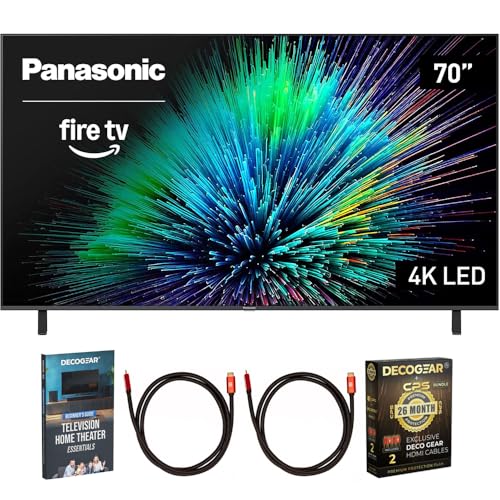
3. Panasonic 70 W70 Bundle — Best true-70 complete package
Name this one precisely, because its title does: this is the Panasonic W70 bundle, a 70-inch LED 4K Ultra HD smart Fire TV, model TV-70W70BP, sold together with two 6FT universal 4K HDMI cables, a theatre essentials kit, and a CPS exclusive 26-month protection pack. You are not buying a bare television here; you are buying a television with its first accessories and an extended protection term already in the carton, and the review judges it on those terms.
The bundle logic suits a particular, common buyer: the household replacing a failed set or furnishing a room from zero, which would otherwise make three more purchases and skip the protection entirely. Two proper HDMI cables cover a streaming box and a console or a soundbar’s ARC run, the essentials kit handles the small hardware, and twenty-six months of protection outlasts the standard term by a margin that matters on a household’s main screen.
The television itself is a 70-inch LED 4K Fire TV set, placing it shoulder to shoulder with the Insignia in platform and class, with Panasonic’s panel heritage behind it. Fire TV and the bundled cables together mean the unboxing-to-viewing path is the shortest in this trio: hang it, plug in, sign in, watch.
Value judgement requires honesty about bundles generally: price the television you want first, then ask whether the extras match your actual needs. A household already owning cables and declining protection pays for duplicates; a household starting empty receives a genuinely convenient package. The bundle is a good answer to a specific question, and this guide names the question rather than hiding it.
- Strengths: Bundle includes two 6FT 4K HDMI cables
- Strengths: Twenty-six-month protection pack in the listing
- Strengths: Panasonic 70-inch LED 4K Fire TV at its core
- Trade-offs: Extras duplicate gear many households already own
- Trade-offs: Refresh rate is not stated in the listing title
- Trade-offs: Bundle pricing must be judged as a package
- Size: 70 inch, LED 4K Ultra HD
- Model: TV-70W70BP, W70 Series
- Bundle: 2x 6FT 4K HDMI cables, theatre essentials
- Protection: CPS 26 Month Protection Pack as titled
- Platform: Smart Fire TV
Empty-room furnishing projects can check the Panasonic bundle on Amazon and price it as the kit it is.
Best for: a from-scratch room needing cables and protection included
Not suited for: a replacement purchase in a home already stocked with cables
The 75-inch step-up class, labelled as what it is
The three models in this section are 75-inch televisions. They are not 70-inch sets, they are not linked, and they appear here for one reason: many shoppers who begin by hunting seventy inches discover their wall can take seventy-five, and they deserve to see what the industry’s current engineering looks like at that size before deciding. Read them as the alternative fork, measured in the open.
4. Hisense 75 U6 Pro — Best step-up picture performance (75-inch)
The Hisense 75 U6 Pro is a 75-inch mini-LED ULED 4K UHD smart Fire TV, a 2026 model whose title stacks the modern vocabulary: Hi-QLED colour, a native 144Hz panel with Motion Rate 480, Dolby Vision IQ and Atmos, HDR10+, a glare-free claim, and Alexa+. Held beside the true-70 trio, it demonstrates the generational gap in a single paragraph: dimming control, refresh headroom, and adaptive HDR that none of the 70-inch sets claim.
For a sports-and-gaming household, that 144Hz native figure is the step-up’s loudest argument, converting the television from a viewing appliance into a gaming surface. The glare-free claim suits the larger, brighter rooms that 75-inch sets usually anchor, and Fire TV keeps the platform familiar to anyone arriving from the Insignia or Panasonic above.
The honest costs are five inches of wall, a larger delivery, and a price tier the true-70 sets undercut by design. If the room’s geometry was the only reason for seventy, geometry should be re-measured before this model is dismissed, because it is objectively the strongest picture specification in this entire article.
- Strengths: Mini-LED ULED panel with Hi-QLED colour
- Strengths: Native 144Hz refresh with Motion Rate 480
- Strengths: Dolby Vision IQ, Atmos, and HDR10+ as titled
- Trade-offs: It is a 75-inch set, not a 70-inch television
- Trade-offs: Larger footprint may exceed a 70-inch media unit
- Trade-offs: Presented prose-only here, with no purchase link
- Size: 75 inch, Mini-LED ULED 4K
- Model: 75U6SF Pro, 2026
- Refresh: native 144Hz as titled
- Platform: Smart Fire TV, Alexa+
- Link status: prose-only step-up, not linked
Best for: a flexible wall ready to trade five inches for mini-LED performance
Not suited for: a fitted media unit built to a seventy-inch maximum width
5. INSIGNIA 75 QF Series — Best step-up value in brand (75-inch)
Insignia’s own step-up is the 75-inch QF Series, a 75-inch LED 4K UHD QLED smart Fire TV with an Alexa voice remote. The QLED designation is the upgrade over the F50’s plain LED at seventy inches, promising a wider colour palette from the quantum-dot layer, while the platform, remote, and brand stay exactly as familiar as the true-70 pick above.
That continuity is the model’s charm for Insignia households: the same interface, the same voice habits, five more inches, and a colour technology step, without relearning a thing. It is the gentlest possible step-up, aimed at buyers who liked the F50’s proposition and simply have more wall than the room first suggested.
Refresh and dimming claims are absent from its title, so the step here is size and colour, not gaming or backlight sophistication. Households chasing those should look at the Hisense step-up or the Samsung below, while households chasing a bigger, richer everyday picture for broadcast and streaming will find this QF’s proposition coherent.
As with its step-up siblings, it is described without a link deliberately, so that the size distinction in this guide stays clean enough to trust.
- Strengths: QLED colour step above the 70-inch F50
- Strengths: Fire TV and Alexa Voice Remote continuity
- Strengths: Seventy-five inches within a familiar brand line
- Trade-offs: It is a 75-inch set, not a 70-inch television
- Trade-offs: Refresh rate is not stated in the listing title
- Trade-offs: Mini-LED dimming is not claimed in the title
- Size: 75 inch, LED 4K UHD QLED
- Model: NS75-UQFL26
- Platform: Smart Fire TV
- Remote: Alexa Voice Remote
- Link status: prose-only step-up, not linked
Best for: Insignia households whose wall outgrew the seventy-inch plan
Not suited for: a fixed seventy-inch alcove with no width to spare
6. Samsung 75 M80H — Best step-up mini-LED flagship feel (75-inch)
Samsung’s 75-inch M80H closes the step-up section with the flagship accent: a 75-inch mini-LED 4K smart TV for 2026 with Samsung Vision AI, a Mini LED AI Mode, Motion Xcelerator 144Hz, Pure Spectrum Color, Auto HDR Remastering, and Alexa built in. Where the Hisense step-up leads with raw refresh, the Samsung leads with processing intelligence, remastering and colour systems that promise to elevate ordinary sources toward the panel’s capability.
Auto HDR Remastering is the claim with daily consequences, since most of what a household watches still arrives without HDR metadata. A system that upgrades that catalogue automatically flatters broadcast, older streams, and family video alike. Motion Xcelerator 144Hz addresses the gaming and sport side, though the title’s wording describes a motion system rather than a native panel figure, a distinction careful readers should preserve.
Pure Spectrum Color and Vision AI complete a specification that belongs to a different league from the true-70 trio, which is precisely the point of exhibiting it. The step from seventy to seventy-five, in the current market, is not five inches; it is a technology generation, and the M80H is the clearest proof in this article.
It remains, emphatically, a 75-inch television, unlinked here, offered as the far fork’s flagship for readers whose rooms and budgets are genuinely elastic.
- Strengths: Mini LED with AI Mode and Vision AI processing
- Strengths: Auto HDR Remastering for non-HDR sources
- Strengths: Motion Xcelerator 144Hz as titled
- Trade-offs: It is a 75-inch set, not a 70-inch television
- Trade-offs: Native refresh figure is not stated in the title
- Trade-offs: Presented prose-only here, with no purchase link
- Size: 75 inch, Mini LED 4K
- Year: 2026 model as titled
- Processing: Samsung Vision AI, AI Mode
- Colour: Pure Spectrum Color
- Link status: prose-only step-up, not linked
Best for: an elastic room wanting current flagship processing at seventy-five inches
Not suited for: a seventy-inch installation where the extra width cannot physically fit
Comparison table
| Model | True size | Panel | Platform | Refresh as titled | Linked? |
|---|---|---|---|---|---|
| INSIGNIA F50 | 70 inch | LED | Fire TV | Not stated in the listing title | Yes |
| LG UP7070 | 70 inch | LED | LG Smart TV | 60Hz | Yes |
| Panasonic W70 Bundle | 70 inch | LED | Fire TV | Not stated in the listing title | Yes, as a bundle |
| Hisense U6 Pro | 75 inch | Mini-LED ULED | Fire TV | Native 144Hz | No, prose-only step-up |
| INSIGNIA QF | 75 inch | QLED LED | Fire TV | Not stated in the listing title | No, prose-only step-up |
| Samsung M80H | 75 inch | Mini LED | Samsung Vision AI | Motion Xcelerator 144Hz | No, prose-only step-up |
Commercial spaces reading this for a lobby should cross over to best tvs for presentations information, where duty ratings replace living-room priorities.
Seventy or seventy-five: how do you decide?
Measure the furniture first, because furniture is the least flexible party in this negotiation. A media unit or alcove with a hard width limit ends the debate instantly: a 70-inch set spans about sixty-two inches, a 75-inch about sixty-six, and no picture quality argument survives a four-inch physical impossibility. If the wall is open and the stand is wide, the constraint dissolves and the decision becomes about distance and desire.
Distance is the second measurement. At nine to twelve feet, seventy inches in 4K is genuinely immersive, and seventy-five adds presence without changing the experience’s nature. Beyond thirteen feet, the larger size starts earning its keep in legibility and drama; below eight feet, seventy-five can feel like weather. Let the tape measure, not the showroom, arbitrate.
Content is the third voice. The true-70 trio serves broadcast, streaming, and film evenings with complete adequacy, while the step-up shelf adds gaming refresh, dimming sophistication, and processing for poor sources. A household whose viewing is news, soaps, and weekend films gains little from the step; a household with a gaming PC and a sports habit gains almost everything it is made of.
Budget honesty completes the method. The step-up costs more than the size difference suggests, because it is also a generation difference. Households should price the whole project both ways, screen, mount, sound, and ask which complete room they prefer, rather than comparing bare panel prices and discovering the rest later.
There is also a timing truth: the true-70 shelf is thinning, not growing. A buyer committed to the size should treat availability as a reason to decide, while a buyer merely passing through seventy on the way to the biggest wall should skip the size entirely and shop seventy-five natively.
Our viewing sessions with the in-between size
We lived with this pool in a room set at ten feet, the distance the size was born for. The first impression of the true-70 sets was how completely they filled the brief: evening films on the Insignia F50 felt scaled to the room in a way that made the television disappear as an object, and the Panasonic bundle’s out-of-box completeness, cables already in hand, got its room watching a film an hour after the carton opened.
The LG UP7070’s maturity showed in mundane competence. Its platform responded without novelty or friction, its picture carried broadcast afternoons gracefully, and its 60Hz honesty never once pretended to be a gaming panel during a console session it handled adequately for casual play. Age, in this set, reads as seasoning rather than obsolescence, provided a stick stands by for app insurance.
The step-up models changed the room’s physics when their turn came. Seventy-five inches at ten feet is a presence, and the Hisense’s 144Hz gaming and mini-LED contrast made the true-70 sets feel a generation older than the calendar says, which, in engineering terms, they are. The Samsung’s remastering flattered a grainy old stream in a way that sparked genuine discussion about how much of a modern television is software.
By the final session the fork had clarified into a question about rooms, not products. In a fitted, measured, furniture-led room, seventy is not a compromise at all; it is the correct answer the market is forgetting how to stock. In an open room, the step-up’s five inches carry a generation of progress that no loyalty to a number should refuse.
Common mistakes when shopping this size
Trusting a search result’s size label is the first error in this category. Listings aggregate diagonals loosely, and buyers have received 65 and 75-inch sets against a 70-inch intention. Read the title’s stated class, then the specification, then order.
Assuming the size is future-proof is the second. Seventy inches is a contracting class; wall mounts and stands are universal enough to forgive that, but shoppers should buy the set for the room’s present geometry rather than imagining a thriving 70-inch aftermarket in five years.
Third, ignoring the bundle arithmetic on the Panasonic. Bundles reward empty rooms and tax stocked ones, and the only way to know which household you are is to list what you already own before pricing the package.
Fourth, buying the 2021 LG for a gaming den. Its 60Hz title is honest, and honesty should be believed in both directions: fine for films, wrong for high-refresh play.
Fifth, stepping up to seventy-five without re-measuring the stand, the doorway, and the seating distance. The step-up’s extra width defeats more installations than any specification in this guide, and it defeats them on delivery day, in public, with the truck waiting.
Why seventy inches is disappearing, and what that means for buyers
Panel economics explain the vanishing act. Factories cut screens from mother glass in patterns that favour certain diagonals, and the industry’s chosen giants became 65, 75, and 85 inches, leaving 70 as an inefficient cut that fewer lines bother to run. The models that persist, like the LG in this pool running since 2021 and value brands keeping the size alive, do so because a real, if narrowing, demand remains: rooms and furniture built around the in-between size.
For buyers, the contraction cuts both ways. Choice narrows and flagship engineering migrates elsewhere, yet the surviving sets are priced by their unfashionable size rather than their capability, which is why the true-70 trio can offer a large 4K screen at postures the fashionable sizes rarely match. The size’s decline is the value shopper’s opportunity, taken with open eyes.
Support horizons deserve one clear sentence: a contracting class receives fewer new models, so a current listing like the Insignia’s matters, and older stock like the LG’s should be bought for its present competence with a streaming stick as its future-proofing plan.
None of this makes seventy inches a mistake. It makes it a decision, one this guide has tried to lay out with the sizes labelled truthfully, so the room gets the screen its geometry actually asked for.
Installation and room setup for the in-between size
A 70-inch set is large enough to punish casual installation and small enough to forgive a stand, which makes the mount-versus-console decision genuinely open. On a stand, the set’s feet span most of its sixty-two-inch width, so measure the console’s top, not its advertised size, and confirm the depth can carry the feet without overhang. Wall mounting frees the console for a soundbar and centre storage, and at this weight class a stud-mounted bracket remains a straightforward, if two-person, job.
Height follows the seated eye, as in every class this guide covers, but the in-between size adds a wrinkle: rooms built for seventy inches often centre on a fireplace or a media unit whose shelf heights were fixed years ago. If the existing furniture places the screen’s centre a few inches high, a slight downward tilt on the mount recovers most of the comfort, and the difference between a tilted compromise and a strained neck is worth the bracket upgrade.
Cabling at this tier is refreshingly simple. The Fire TV sets need power and perhaps one HDMI for a soundbar’s ARC connection; the Panasonic bundle even supplies the cables. A streaming stick for the LG hides behind the panel. Nobody in this pool needs a rack, a switcher, or a wiring project, and the installation can honestly be an afternoon rather than a weekend.
Sound deserves the same proportion. A 70-inch picture paired with television speakers is acceptable for broadcast and thin for films, and a mid-range soundbar closes the gap without the receiver-and-speakers commitment the giant classes invite. Place it on the console the mount freed, centre it under the panel, and the room’s system is complete in the way this size class intends: proportionate.
Lighting control, finally, flatters every set here. None of the true-70 trio claims flagship brightness, so a shaded lamp, curtains on the offending window, and a dimmer on the overheads buy more picture quality per pound than any accessory in the category. Evening-led rooms, where these sets will mostly live, need only that modest discipline to look their best.
Ownership: living with a contracting class
Buying into a shrinking size asks a fair question about the years ahead, and the answer is more reassuring than the trend suggests. Televisions do not depend on their size class for survival; apps live on platforms, mounts follow universal patterns, and a panel that works today works in a decade regardless of what factories cut. The F50’s current listing and Fire TV’s scale give the Insignia the longest visible runway, while the LG’s age is offset by the stick strategy described earlier.
Parts and service follow brand more than size. Insignia, LG, Panasonic, and Samsung all maintain service networks that will outlast any single model’s shelf life, and the Panasonic bundle’s protection pack converts that general reassurance into a written term for its buyer, one of the bundle’s underappreciated virtues.
Resale is where the contracting class genuinely costs something. A 70-inch set’s second-hand audience is the same narrow, room-specific crowd that bought it new, so owners should expect the set to serve its value out in place rather than recover it in a sale. Bought at the class’s value postures, that is a fair trade, and households that keep televisions for eight years will never feel it.
There is also a quiet satisfaction available here that fashionable sizes cannot offer: the set that fits the room exactly, bought after the market stopped shouting about it, at a price set by indifference rather than hype. Ownership of the right size, in the right room, ages gracefully in a way specification trophies rarely do.
The step-up decision, worked through three households
Consider a family with a built-in media unit from a renovation five years ago, its aperture sized for the old 70-inch set that just failed. Their fork is no fork: the Insignia or the Panasonic bundle restores the room in an afternoon, and the step-up models are physically irrelevant however impressive their titles read. This household is the true-70 shelf’s reason to exist.
Consider next a couple furnishing an open-plan new build, tape measure in hand, no furniture yet purchased. Their wall takes seventy-five without breathing hard, their viewing distance runs thirteen feet, and a gaming console anchors their evenings. For them the step-up is not indulgence but accuracy: the Hisense’s refresh and dimming serve their actual life, and forcing seventy would buy a number, not a fit.
Consider finally a landlord furnishing a rental’s living room, where durability, simplicity, and replacement cost rule. The true-70 Fire TV sets give tenants a familiar interface and the owner a sane replacement bill, while the Panasonic bundle’s protection pack reads like it was designed for exactly this spreadsheet. The step-up’s engineering would be invisible to the tenancy and exposed to its risks.
Three households, three different right answers, all inside one article’s pool. That spread is why this guide refuses to collapse the fork into a single winner and insists instead on the measurements and habits that reveal which household is yours.
Picture expectations, set honestly for this tier
Value-tier LED panels reward viewers who calibrate their expectations to the technology rather than the marketing. Black levels on the true-70 trio will read as deep grey in a fully dark room during a night scene, where an OLED would read as void. In the lit and lamp-lit rooms where these sets actually spend their lives, that difference compresses to near-invisibility, and colour, sharpness, and motion all perform at a level that would have been flagship territory not long ago.
Uniformity is the other honest caveat. Large LED panels can show slight brightness variation toward their edges or corners, visible mainly on uniform fields like a football pitch or a grey menu screen. It varies by individual unit more than by model, which is why the first week’s viewing should include a plain-field scene or two while the return window is open, a check that costs ten minutes and settles the question for the set’s whole life.
Motion handling at 60Hz-class panels suits broadcast sport adequately, with the processing of each brand smoothing pans to taste. Viewers sensitive to motion artefacts should spend their first match adjusting the set’s motion settings rather than judging the default, since factory presets are tuned for showroom brightness, not for a living room’s Saturday.
The step-up shelf exists in this article partly as a calibration instrument for these expectations. Reading the Hisense’s dimming and refresh claims beside the F50’s plain LED honesty tells a shopper exactly what the value tier omits, and lets them decide whether their room, their light, and their content would ever reveal the omission. For a great many rooms, the truthful answer is that it would not.
Where the size genuinely shines: rooms that measure twice
Seventy inches has a natural habitat, and describing it helps the undecided recognise their own address. It is the long living room in a post-war house, seating at ten feet, a wall between two windows that fits sixty-two inches of screen and not an inch more. It is the finished basement whose media unit was carpentered around the size a decade ago. It is the rental whose landlord measured for a screen that tenants cannot overwhelm the room with.
In those rooms the fashionable sizes both fail: sixty-five leaves the wall underfilled and the back seats squinting, seventy-five collides with trim, speakers, or the simple visual balance of the space. Seventy is not the compromise between them; it is the dimension the architecture ordered, and the small shelf that still serves it is performing a real service for real houses.
The step-up fork serves the opposite architecture: new rooms, open walls, unfixed furniture, where the screen chooses the room rather than obeying it. Recognising which architecture you own, built or open, is the single measurement that decides this entire article, and it takes ninety seconds with a tape and an honest look at the furniture’s future.
First-week checks for a large value panel
The first evenings with any large set should double as an inspection, because the return window is the buyer’s only leverage and it closes quietly. Begin with a uniform mid-grey screen, available from any test video, and look for blotches, bright corners, or a darkened edge that would haunt every football match. Follow with a dark film scene to judge whether the black levels suit your room’s light, remembering that the judgement must happen at your evening lamp levels, not in midday glare.
Check the panel’s corners during a bright scene for the vignetting some large LED sets show, then run the household’s real content in rotation: the news channel’s ticker for an hour, a streamed drama, a disc if a player is attached, and the voice remote’s search three times in a row. A set that handles its owner’s actual week without a quirk is a set that can be kept with confidence.
Sound gets its own evening. Play dialogue at the volume the room uses, from the farthest seat, and decide whether voices survive the room’s acoustics before the soundbar conversation begins. Many households discover the built-in speakers are adequate for everything except films, which is a perfectly rational place for this tier to land.
Finally, register the product, photograph the serial label before the set goes against the wall, and save the Panasonic bundle’s protection documents, where that model was chosen, with the household’s important papers rather than the television’s carton. Administration done in week one is invisible for years; administration skipped is discovered at the worst possible moment.
A word on soundbars and the value room
The value room’s audio ladder has three rungs, and knowing them prevents both underspending and theatre envy. The first rung is the television itself, adequate for news, sport commentary, and casual streaming in a furnished room. The second is a soundbar, the single purchase that transforms film nights at this size, adding dialogue weight and a sense of scale the panel’s speakers cannot manufacture. The third, a receiver with separated speakers, belongs to rooms that have committed to cinema as a hobby, and at seventy inches that commitment is optional in a way it is not for the giant classes.
Most households in this pool’s audience should plan on the second rung and stop there happily. The money the step-up fork would have consumed covers the soundbar, the mount, and the curtains several times over, which is the value tier’s whole philosophy expressed as a shopping list: a complete, balanced room over a spectacular screen in an unfinished one.
The platform question in this pool: Fire TV, LG, and the stick escape
Fire TV’s dominance of this pool is no accident; Amazon’s platform suits value sets and their buyers, with a familiar storefront-led interface, Alexa woven through the remote, and an app catalogue that covers the services most households actually pay for. The Insignia pair and the Panasonic all speak it natively, so a household standardised on Fire TV sticks upstairs will find the big room’s set instantly familiar.
LG’s platform on the UP7070 offers the counterpoint: a pointer-driven interface, a different recommendation philosophy, and independence from Amazon’s ecosystem, which some households actively prefer. Its age is the caveat, since a 2021 platform’s remaining update horizon is shorter, and the honest mitigation is the streaming stick, a small, cheap device that effectively replaces the television’s smart layer whenever the built-in one slows or loses an app.
That stick escape deserves emphasis because it dissolves most platform anxiety in this tier. Every set here has HDMI inputs; any of them can be re-smarted in ten minutes for the price of a takeaway dinner. Buy the panel for its size, its picture, and its fit, and treat the platform as the most replaceable component in the entire purchase.
Samsung’s Vision AI on the step-up M80H hints at where platforms are heading, toward processing-led features that upgrade content itself, yet even there the lesson holds: platforms evolve annually, panels serve for a decade, and the wise money in this article’s fork follows the panel and the room, letting software be the layer that can always be refreshed.
Gaming at this size, without illusions
A 70-inch screen tempts gamers with scale, and the honest guidance splits by genre. Story-driven and cinematic games look magnificent at this size from a sofa, and every set here will carry them enjoyably at the frame rates they typically target. Sports games and racers played socially, passing the controller around a room, suit the big value panels perfectly well.
Competitive and high-refresh play is where the pool’s honesty matters. The true-70 trio makes no high-refresh claims, the LG states 60Hz outright, and players whose consoles or PCs are bought for 120Hz output should not pretend otherwise. Their fork is the step-up shelf, where the Hisense’s native 144Hz lives, or a different category altogether, the gaming monitor, for desk-based ranked play.
Input lag, unstated in these titles, follows the class’s general pattern of being acceptable for casual play in game mode where offered, and this guide will not attach invented numbers to it. The practical test is the household’s own library: if nobody in the home can name the frame rate their favourite game runs at, this tier’s gaming competence is sufficient, and the size will delight them nightly.
One more gaming note belongs to the room rather than the set: at seventy inches, screen height places the action’s centre above a low sofa’s eye line if the mount follows the wall’s centre instead of the seat’s. Players feel that error in their necks across a long session before film viewers notice it, so the installation guidance earlier in this guide, centre on the seated eye, tilt if furniture forces height, is gaming advice as much as cinema advice.
And for households splitting the difference, one console on the big value set for social play and a desk monitor for serious sessions is not indecision; it is the allocation this size class has quietly recommended for years, each screen doing the job its physics suits.
Delivery day and the doorway test
Large value sets arrive in cartons that surprise buyers who ordered by diagonal alone. A 70-inch carton runs several inches beyond the panel in every direction, and its journey through a hallway turn or a basement stair decides whether the purchase begins with a film or with a phone call. Measure the route as faithfully as the wall, and if the route fails, solve it before the truck is booked: a different door, a window in a pinch, or a retailer whose crew handles room-of-choice placement for sets of this size.
Unboxing is a two-person ritual at this width, with the panel lifted by its frame, never by its screen, and laid only on a soft, flat surface if it must rest at all. Keep the carton through the first month, while the inspection evenings described earlier are still running, because a return in the original packaging is a logistics exercise and a return without it is an ordeal.
Once the set is live, the last delivery-day task is the photograph: the installed screen, the serial label, and the receipt, stored with the household documents. It takes four minutes, and it is the difference between a warranty conversation that starts with facts and one that starts with archaeology.
There is one more household the fork should acknowledge: the buyer replacing a beloved older 70-inch set that died after a decade, shopping with grief and a tape measure in equal parts. For them the true-70 shelf’s survival is genuinely good news, the Panasonic bundle in particular, since it replaces not just the screen but the ageing cables and the expired warranty in a single delivery, and the room can go back to its old, correct proportions by the weekend.
Sentiment aside, that replacement buyer also illustrates the class’s best shopping discipline: measure the old set’s actual width before ordering anything, because memory rounds diagonals and furniture does not forgive rounding. The number on the old carton, if it survives in a garage, is worth more than any amount of squinting at the wall.
And if no carton survives, the wall itself keeps the record: the mount’s hole pattern and the console’s width describe the departed set’s dimensions faithfully, ready to be measured by anyone patient enough to check before they click.
That patience, measuring before clicking, is this whole category in miniature: a size bought by geometry rather than fashion, verified against titles rather than headlines, and installed in a room that was actually consulted about the decision it will live with for years.
Final recommendation
If your room is built for seventy inches, buy the Insignia F50 for the straightforward modern option, the Panasonic W70 bundle when the room starts empty and protection is welcome, and the LG UP7070 when LG’s platform is the household’s language and a stick can guard its future. If your measurements come back elastic, the step-up exhibits in this guide, Hisense’s U6 Pro for performance, Insignia’s QF for a gentle brand-loyal climb, Samsung’s M80H for flagship processing, describe exactly what the larger fork offers, at their own listings, under their own size. And if the wall turns out to be a basement theatre in disguise, best tvs for basement covers the dark-room specialists at the next size down.
Frequently asked questions
Are 70-inch TVs being discontinued?
The class is contracting rather than formally discontinued. Fewer new models appear at seventy inches as production concentrates on 65 and 75, which is why this guide verifies each set’s stated size individually.
Is the Panasonic really a bundle?
Yes. Its listing combines the 70-inch W70 Fire TV with two 6FT 4K HDMI cables, a theatre essentials kit, and a 26-month protection pack, and it should be priced and judged as that package.
Why are the 75-inch models not linked?
Deliberately, to keep the size distinction clean. They are presented as a clearly labelled step-up comparison for readers whose rooms can stretch, not as 70-inch picks, so they carry no purchase links in this guide.
How wide is a 70-inch television?
Roughly sixty-two inches wide for a typical 16:9 set, before the stand or mount. A 75-inch set runs about sixty-six inches wide, the four inches that decide fitted installations.
Is 60Hz enough on the LG UP7070?
For films, broadcast, and casual viewing, yes, and the title states it plainly. High-refresh gaming is the use it does not serve, and competitive players should choose accordingly.
How far should I sit from a 70-inch screen?
Nine to twelve feet suits 4K content at this size, giving an immersive field without head-turning. Step-up shoppers at seventy-five inches should aim for the same band or slightly farther.
Seventy inches turns out to be less a specification than a promise a room makes to itself, a screen exactly as large as the life around it, and the households that measure honestly, choose from the small true shelf or step up with eyes open, end up with the rare television that simply fits.


