What's inside
- Key Takeaways
- Quick Picks: Mini, Wide, Square and I-Type — Six Ways to Fill a Guest Book
- How We Chose These Picks
- Why Does Print Size Decide Whether a Guest Book Works?
- How Do You Run the Station So the Book Fills Instead of Fading?
- What Should the Album and Page Plan Be, Format by Format?
- Should a Big Wedding Run Two Cameras Instead of One?
- How Should Prints Be Handled in the Minutes While They Develop?
- How Do You Make the Station Work for Children, Grandparents and the Camera-Shy?
- Six Guest-Book Cameras Compared on the Two Numbers That Matter
- What Happens to the Book After the Wedding Decides How You Build It?
- How Far Ahead Should the Station Be Planned, and What Is the Rehearsal?
- Which Guest-Book Mistakes Do Couples Only Discover at Midnight?
- How Do Venue and Season Change the Right Choice?
- Final Recommendation
- Frequently Asked Questions
- Related Guides
As an Amazon Associate I earn from qualifying purchases. This post may contain affiliate links at no extra cost to you.
gizmoverdict.com is reader-supported. When you buy through links on our site, we may earn an affiliate commission.
Where couples order the guest-book camera: all six cameras and bundles below are sold through Amazon, and each name links to its listing so you can check exactly how much film the bundle includes before the station goes on your wedding checklist.
Couples hunting for the best polaroid cameras for wedding guest books are really shopping for a memory machine, and the first thing to know is that “Polaroid” in that search is the generic word for any instant camera. The modern guest-book station is just as likely to run on Fujifilm’s Instax system as on a camera wearing the Polaroid name, and that is good news, because it widens the choice to the formats that actually decide whether the book works: the size of the print that lands in the album, and the cost of the film inside every single shot your guests take. Those two variables — print size and film cost per shot — matter more than any camera feature, and this guide ranks by them openly, without quoting prices, because film economics change while print sizes are forever.
Here is the shape of the decision. Mini prints are small, playful and economical per shot, which suits a big wedding where two hundred guests will each want a turn and a copy. Wide prints are the closest thing to a classic instant photograph, big enough for a handwritten message beside the image and for faces to stay faces in a group shot. Square prints sit between, with a composed, album-friendly shape that suits a design-led wedding. The six picks below cover all three formats across Instax Mini, Instax Wide, Instax Square and Polaroid’s own I-Type film, several of them as bundles that arrive with film and an album already in the box.
One practical truth before the rankings: a guest book is a system, not a camera. The camera, the film supply, the album, the pens, the sign that explains the ritual and the cousin appointed to reload at nine in the evening are one machine with six parts, and it fails at its weakest part rather than its dearest. This guide reviews the cameras properly, then spends real space on the station around them, because that is where guest books are actually won.
Key Takeaways
- Guest-book fit turns on print size and film cost per shot: Mini for volume, Wide for messages and groups, Square for a composed album look.
- Four of the six picks are bundles with film included — count the sheets in the listing before comparing anything else.
- The Instax WIDE 400 bundle offers the largest prints here, the format closest to the classic guest-book photograph.
- The Instax Square SQ40’s format suits design-led weddings whose book will live on a shelf, not in a drawer.
- Polaroid’s own Now bundle serves couples who want the original name and its larger I-Type prints.
- Whichever camera you choose, appoint a film-and-battery attendant; unattended stations die quietly by the second hour.
Quick Picks: Mini, Wide, Square and I-Type — Six Ways to Fill a Guest Book
| Pick | Badge | Why it made the cut |
|---|---|---|
| Fujifilm Instax Mini 12 Bundle | Big-wedding volume bundle | The friendliest Mini camera with a 50-sheet film pack and album in the box, ready for a long guest list. |
| Fujifilm Instax Mini 41 Bundle | Vintage-look Mini bundle | A retro-styled Mini with 40 sheets of film, a case and a 64-pocket album for a styled station. |
| Polaroid Now (3rd Gen) + Film Bundle | The original name | Polaroid’s current I-Type camera bundled with 16 colour photos, for couples set on the classic badge and bigger prints. |
| Fujifilm Instax WIDE 400 Bundle | Largest prints | Wide-format instant prints with room for faces and handwriting, bundled with a 20-exposure film pack. |
| Fujifilm Instax Square SQ40 | Square-format choice | A square-print Instax with automatic exposure, for an album that looks composed rather than collected. |
| Fujifilm Instax Mini 13 | Newest Mini, camera only | The latest Mini camera in Clay White, for couples who want to choose their own film and album separately. |
How We Chose These Picks
We judged instant cameras the way a wedding will: not by studio specifications but by what a slightly merry guest, holding the camera for the first time at nine in the evening, can produce with it. Automatic exposure mattered more than manual control. The film format’s size and running cost mattered more than the camera’s feature list. Bundles were credited honestly for the film and albums actually stated in their listings, because a guest-book station consumes film the way a dance floor consumes energy, and the couple who counts sheets in advance has a book at midnight while the couple who assumed is photographing the last hour with a phone.
We also kept the set honest about brands. The keyword says Polaroid; the market says instant, and the ranking includes the one current Polaroid bundle alongside the Instax family that dominates real wedding stations, with the format of every pick stated plainly so a couple can choose by print rather than by nostalgia.
Why Does Print Size Decide Whether a Guest Book Works?
An instant print in a guest book does two jobs at once: it is a photograph and it is a page. As a photograph it must be big enough to hold the people in it — a Mini print of a table of eight is a crowd scene in miniature, charming but anonymous, while a Wide print of the same table keeps every face recognisably itself. As a page it must share space with handwriting, because the book’s treasure is the combination: the image of the moment beside the words written in it. Couples consistently underestimate how much of the album’s real estate the messages need, and overestimate how large a small print feels once it is glued down among them.
That is why this guide treats format as the first decision and the camera as the second. A couple with forty guests and a literary circle of friends will write epics; give them Wide or Square prints and an album with breathing room. A couple with two hundred guests and a party-first crowd needs throughput and economy; Mini prints at volume, with the book designed as a joyful mosaic rather than a gallery, will delight them more and bankrupt nobody. The formats are not better and worse. They are answers to different weddings, and the six picks below are labelled by the wedding they fit.
Film cost per shot is the silent partner of the same decision. Every guest who presses the button spends a sheet, and guests press buttons the way they visit the bar — repeatedly and with friends. A format whose film runs dearer per shot demands either a bigger film budget, a gentle rationing system, or a smaller guest list at the station. None of that is a reason to avoid a format; all of it is a reason to choose with open eyes, which is why each review below names its format’s appetite plainly.
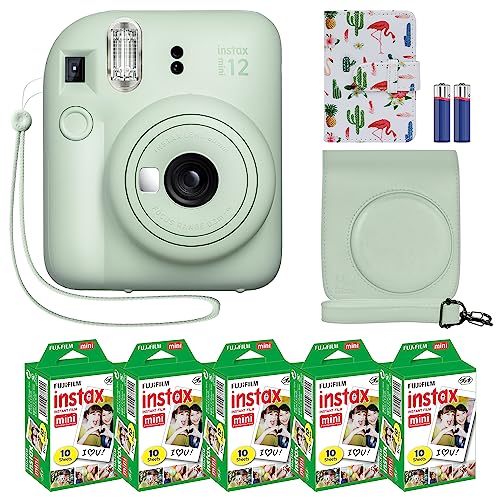
Fujifilm Instax Mini 12 Bundle — Big-wedding volume bundle
The Mini 12 is the camera that has probably filled more guest books than any other object on Earth, and this bundle shows why: the camera in Mint Green, a MiniMate accessory bundle with a custom case, a Fujifilm Instax film value pack of 50 sheets, and a flamingo-design photo album to put the prints in. Read that as a station in a box. Fifty sheets is the number that matters — enough for the first wave of guests without a reload panic — and an included album removes the classic failure of prints accumulating in a shoebox while the couple waits to buy a book someday.
The Mini 12 itself is the friendliest camera in the ranking for first-time hands: point, shoot, and the camera handles the thinking, which at a wedding is precisely the correct division of labour. Its close-up habits suit the selfie pairs and table groups that dominate guest-book photography, and the Mini format’s economy per shot means the couple can be generous — second attempts, copies for guests to keep, a page of outtakes — without watching the film counter like a meter.
The format’s limit is the one this guide keeps repeating: Mini prints are small, and in the album they read as moments rather than portraits. For a big, loud, joyful wedding that is not a flaw but a style — a book that feels like the night felt. For a small wedding of devoted writers, the same prints will feel cramped by the third page, and the Wide and Square picks below exist for that couple.
- Camera, as listed: Fujifilm Instax Mini 12 instant camera, Mint Green bundle
- Film included, as listed: Fujifilm Instax film value pack, 50 sheets
- Accessories, as listed: MiniMate accessory bundle and compatible custom case
- Album, as listed: Flamingo designer photo album included
- Print format: Instax Mini (format of the included film)
Strengths
- Fifty sheets included carries the station through its busiest first hours
- Album in the box means prints have a home from the first shot
- Mini economy lets guests retake and keep copies without rationing
Trade-offs
- Small prints crowd when guests write long messages beside them
- Group shots lose individual faces at Mini scale
- Themed album styling may not match every wedding’s design
Best for: large weddings wanting a generous, high-volume Mini station in one purchase. Not suited for: intimate weddings whose guests will write essays beside each photograph.
See the Mini 12 bundle listing on Amazon to confirm the film count in the current offer.

Fujifilm Instax Mini 41 Bundle — Vintage-look Mini bundle
The Mini 41 bundle is the styled sibling of the volume pick. The camera wears a vintage black design, and the bundle builds a station around it: a Fujifilm value pack of 40 sheets, a Shutter accessories bundle, a vintage-style compatible carrying case, and a black photo album with 64 pockets. The album detail deserves attention — pocket albums change the guest-book ritual for the better, because prints slide into pockets instead of waiting for glue, which means guests assemble their own pages on the night and the book is finished when the dancing ends rather than begun.
Sixty-four pockets also impose a useful honesty: the book’s size is known in advance, and a couple can plan the station around it, film supply matched to pages. Forty sheets included is a strong start against that capacity, and the Mini format’s per-shot economy keeps the refill arithmetic gentle for a mid-size wedding. The vintage styling is not vanity either — the camera sits on the station table as part of the decor, and a camera that looks like an heirloom gets handled with a respect that a toy-coloured one sometimes does not.
It shares the Mini family’s one structural caveat: small prints, small handwriting space. Couples choosing this bundle should design the ritual around it — short messages, big personalities, a fine pen provided at the station — and the book will read as intended. Ask it to host long letters and the format, not the camera, will be the constraint that frustrates.
- Camera, as listed: Fujifilm Instax Mini 41 instant camera, Vintage Black
- Film included, as listed: Fujifilm value pack, 40 sheets
- Accessories, as listed: Shutter accessories bundle and vintage-style compatible carrying case
- Album, as listed: Black photo album, 64 pockets
- Print format: Instax Mini (format of the included film)
Strengths
- Pocket album lets guests finish their own pages on the night
- Vintage styling makes the camera part of the station’s decor
- Forty sheets included is a well-judged start against the album’s capacity
Trade-offs
- Mini print size still limits message space per page
- Pocket count caps the book; huge weddings will overflow it
- Styled bundle duplicates items a couple may already own
Best for: mid-size, design-conscious weddings wanting a self-finishing pocket album. Not suited for: very large guest lists whose print count will swamp 64 pockets.
Check the Mini 41 bundle on Amazon for the exact accessories in the current set.

Polaroid Now (3rd Gen) + Film Bundle — The original name
Some couples want the word Polaroid on the camera, and for them this is the honest way to have it: Polaroid’s own Now camera, third generation, in black, bundled with I-Type colour film for 16 photos. The I-Type format is the classic instant shape at a substantially larger size than Instax Mini, which changes the guest-book physics completely — a Polaroid print holds a group properly, carries a message across its famous border, and feels in the hand like the object the whole instant revival is nostalgic for. If the book is meant to be an heirloom displayed rather than a memento stored, this format argues for itself every time a page is turned.
The bundle’s film count is where the couple must engage their brains: 16 photos is a starter, not a station supply, and I-Type film’s per-shot cost sits at the premium end of this ranking’s formats. The correct purchase pattern is this bundle as the foundation plus a deliberate additional film order sized to the guest list, with the station’s attendant briefed that every frame is precious. Weddings that run Polaroid stations successfully treat the camera as the portrait instrument — one considered shot per group, beautifully lit by the venue’s own glow — rather than as a free-for-all.
Handled that way, the Now earns its place beyond nostalgia. Guests recognise the ritual instantly, queue for it willingly, and treat the resulting print with a care that Mini’s abundance does not always inspire. Scarcity, properly managed, is a feature: it makes each page of the book feel chosen.
- Camera, as listed: Polaroid Now 3rd Generation I-Type instant camera, black
- Film included, as listed: 16 colour photos (I-Type film bundle)
- Print format: Polaroid I-Type, larger classic instant format
- Album included: Not stated in the listing title — verify with the maker’s documentation
- Extra film required for a full station: plan separately (see review)
Strengths
- The genuine Polaroid name and ritual guests instantly understand
- Large classic prints hold groups and border handwriting beautifully
- Managed scarcity makes every page feel deliberate
Trade-offs
- Sixteen included shots is a foundation, not a wedding’s supply
- Premium per-shot film cost demands a planned additional order
- An unmanaged Polaroid station runs dry faster than any other here
Best for: couples set on authentic Polaroid prints and willing to budget film deliberately. Not suited for: a hands-off station expected to run itself all night on the bundle alone.
Open the Polaroid Now bundle listing on Amazon and plan your extra film from its contents.

Fujifilm Instax WIDE 400 Bundle — Largest prints
If the guest book is the point, the WIDE 400 is the format purist’s answer. Instax Wide prints are the largest in this ranking — twice the Mini’s presence on the page — and this bundle pairs the camera with a 20-exposure film pack to start. The camera’s listed features read like a wedding station’s requirements written in advance: automatic exposure so guests cannot mis-set it, a self-timer for the group that wants everyone in, a close-up lens for the couple portraits and the ring-and-hands details, and an angle adjustment accessory that helps the camera sit happily on a table or stand at the station.
On the page, Wide changes what a guest book can be. A Wide print of a table group keeps every face, and the format leaves genuine room beside or beneath it for the message, the date and the small drawing that the best guest books accumulate. Albums built around Wide prints read less like scrapbooks and more like the wedding album’s informal sibling — the book guests actually ask to see again at anniversaries.
The economics and logistics scale with the prints. Wide film costs more per shot than Mini, the camera is the largest here to accommodate its format, and twenty exposures is a beginning that a busy station will consume early — plan the refill supply as deliberately as with the Polaroid. For weddings up to a comfortable mid-size, or for any wedding where the book outranks the dance floor in the couple’s memory budget, this is the pick this guide would put on its own family’s table.
- Camera, as listed: Fujifilm Instax WIDE 400 instant camera bundle
- Film included, as listed: 20-exposure film pack
- Features, as listed: Automatic exposure and self-timer
- Accessories, as listed: Close-up lens and angle adjustment accessory
- Print format: Instax Wide — the largest prints in this ranking
Strengths
- Largest prints hold group faces and handwritten messages together
- Self-timer and close-up lens cover the station’s two classic shots
- Automatic exposure keeps guest-operated results consistent
Trade-offs
- Twenty included exposures need a planned refill for a full evening
- Wide film’s per-shot cost exceeds the Mini format’s
- The camera’s size suits a station table better than passing hand to hand
Best for: weddings where the guest book is a centrepiece and prints must carry messages. Not suited for: enormous guest lists needing the cheapest possible cost per memory.
View the WIDE 400 bundle on Amazon to confirm the film pack and accessories included.

Fujifilm Instax Square SQ40 — Square-format choice
The SQ40 is the designer’s pick, and its argument is a shape. Instax Square prints land between Mini and Wide in size, in the square format that generations of instant photographs made iconic, and an album of squares arranges itself with a tidiness the rectangular formats never quite achieve — grids align, pages breathe, and the book looks composed even when its contents are gloriously chaotic. For a wedding whose aesthetic has been planned down to the napkin fold, that compositional discipline is not a small thing; the guest book is the one design element the guests themselves will author, and the square format is the strongest frame a couple can give them.
The camera itself is sold without a bundle in this listing, which cuts both ways honestly: the couple chooses their own film quantity and album rather than inheriting a stranger’s guess, and must remember to actually make those choices. The SQ40’s automatic exposure keeps guest operation simple, and the Square film’s per-shot cost sits between Mini’s economy and the premium formats — a middle path in running costs as in size.
Choose the SQ40 when the book’s afterlife matters most: displayed on a shelf, revisited at anniversaries, photographed for the couple’s own social pages. Its prints are large enough for faces and a line or two of handwriting, small enough to keep a mid-size wedding’s film budget sane, and shaped like the instant photographs the whole tradition is remembered by.
- Camera, as listed: Fujifilm Instax Square SQ40 instant camera
- Print format: Instax Square
- Film included: Not stated in the listing title — verify with the maker’s documentation
- Exposure, as listed: automatic exposure class (see listing for detail)
- Album included: Not stated in the listing title — verify with the maker’s documentation
Strengths
- Square format composes into the tidiest album pages of any pick
- Print size balances faces, messages and film economy
- Camera-only purchase lets the couple spec film and album themselves
Trade-offs
- Film and album are separate decisions the bundle picks make for you
- Square albums are a narrower market than Mini accessories
- Mid-size prints still ask writers to be briefer than Wide allows
Best for: design-led weddings building a display-worthy square album. Not suited for: couples who want the entire station to arrive in one box.
See the SQ40 listing on Amazon and pair it with Square film and an album of your choosing.

Fujifilm Instax Mini 13 — Newest Mini, camera only
The Mini 13 is the newest chapter of the Mini story, sold here as the camera alone in Clay White. A camera-only listing is a different kind of offer from the bundles above it: nothing is assumed, nothing is duplicated, and the couple — or the wedding planner who has done this forty times — builds the station from the film counts and album they actually intend. For a planner with a cupboard of Mini accessories, or a couple whose station design is already fixed, that clean starting point is worth more than a bundle’s convenience.
As the current Mini generation, it carries the format’s established virtues into their latest form: the friendliest possible guest operation, the Mini economy per shot that forgives enthusiasm, and a colourway — Clay White — chosen to sit quietly inside a wedding’s palette rather than shout over it. Guest-book stations live in photographs of the wedding itself, and a camera that harmonises with the styling will appear in the professional gallery looking like it belonged there.
The discipline is procurement: film, album, pens and a reload plan must all be on the checklist, because the box brings none of them. Couples who enjoy that control will find this the most elegant Mini route; couples who want the station solved in one order should take the Mini 12 bundle and its fifty sheets instead.
- Camera, as listed: Fujifilm instax mini 13 instant film camera, Clay White
- Print format: Instax Mini
- Film included: Not stated in the listing title — verify with the maker’s documentation
- Album included: Not stated in the listing title — verify with the maker’s documentation
- Bundle accessories: Not stated in the listing title — verify with the maker’s documentation
Strengths
- Current Mini generation in a wedding-friendly colourway
- Clean slate for planners building a bespoke station
- Mini per-shot economy keeps a long guest list affordable in film
Trade-offs
- Everything else — film, album, pens — is a separate purchase
- Mini print size carries the format’s usual message-space limit
- No bundle savings for first-time buyers starting from zero
Best for: planners and couples assembling a custom Mini station. Not suited for: anyone hoping one order completes the guest-book setup.
Check the Mini 13 listing on Amazon for the camera’s current availability.
How Do You Run the Station So the Book Fills Instead of Fading?
Placement is destiny. Put the station where guests queue naturally — near the bar’s orbit, on the way to the dance floor, never in a corridor of exile — and light it with whatever warm light the venue offers, because instant cameras forgive almost everything except a dark corner. The sign matters more than the camera: a short, warm instruction in the couple’s voice, explaining the ritual in three lines — take a photo, keep one copy if the format allows, stick one in the book and write beside it — outperforms any amount of hovering explanation. Provide the pen you want used, attached to the table by a ribbon if history is any guide, and the album open at the first empty page rather than closed in shrink-wrap ceremony.
Then staff it, lightly. The attendant is not a photographer; they are a host for one small ritual — greeting the hesitant, reloading film before it runs out rather than after, rescuing the print that emerged face-down in a drink’s condensation ring, and gently moving the station’s queue along when the dance floor calls. A bridesmaid, a cousin, a planner’s assistant: the role rotates happily in half-hour shifts. Every failed guest book this guide’s research has ever heard of failed the same way — a wonderful camera, an empty film chamber, and nobody whose job it was to notice.
Film logistics deserve one paragraph of arithmetic. Count the guests, assume the enthusiastic fraction will shoot twice, add the couple’s own pages and the photographer’s test frames, and buy film to that number plus a margin — then put the margin somewhere the attendant controls, because film left in open piles walks away as souvenirs. The bundles in this ranking state their included sheets plainly; the couple’s only task is to believe them and plan the top-up before the week of the wedding, when every other task also arrives.
What Should the Album and Page Plan Be, Format by Format?
Match the book to the print, not the other way round. Mini prints reward density: a pocket album like the Mini 41 bundle’s 64-pocket book, or a scrapbook page where a dozen small moments cluster around a theme — the college friends, the work table, the cousins — with handwriting running in the margins as commentary. Wide prints reward space: fewer per page, room for the message to sit beside the faces it describes, and pages that can carry one large moment each like chapters. Square prints reward the grid, four to a page in disciplined ranks, with the writing underneath in a single line each — a format that flatters short, witty guests and forgives brief ones.
Whichever format you choose, seed the book before the wedding begins. The couple’s own first page — a photograph of them at the venue that morning, a welcome line in their hand — shows every guest what a finished page looks like and quietly sets the standard of effort. A blank book intimidates; a begun book invites. Add the date and venue on the inside cover in the same hand, and the heirloom has its title page before the first guest arrives.
Should a Big Wedding Run Two Cameras Instead of One?
Past a certain guest count, yes — and the reasoning is queueing, not luxury. A single station develops a line at exactly the moments the reception peaks, and a line at a guest-book station behaves worse than a line at the bar, because the ritual takes longer than pouring a drink and the people waiting are holding a pen, a print and a plate of canapés in some combination. Two cameras halve the wait and, just as usefully, insure the ritual: a camera dropped, jammed or simply exhausted of battery at a one-camera wedding ends the book, while at a two-camera wedding it becomes a story the attendant tells while fetching the spare.
The elegant pattern is a mixed pair rather than twins. A Mini bundle as the high-throughput workhorse — cheap per shot, endlessly reloadable, forgiving of volume — beside one large-format camera, Wide or Polaroid, hosted by the attendant for considered group portraits. Guests flow through the Mini station freely all night, and the big prints accumulate as the book’s chapter headings, the whole table gathered in a single generous frame at the top of each section. The formats stop competing and start editing each other, and the film budget divides rationally: volume where volume is cheap, ceremony where ceremony pays.
Smaller weddings gain less from the pair and should usually spend the second camera’s budget on film for the first. The threshold is honestly judged by the couple’s own parties: if your people queue patiently and the list sits under a hundred, one well-staffed station will serve beautifully, and the book will have the unity of a single format’s voice from cover to cover.
How Should Prints Be Handled in the Minutes While They Develop?
Instant prints ask for a small etiquette that the station’s sign can teach in one line. The emerging print should be kept out of direct light while it develops, handled by its borders, and never shaken — the famous gesture belongs to an earlier film chemistry and does a modern print no favours at all. A shallow tray or a designated developing plate at the station gives prints a safe minute to finish, keeps them off wet tablecloths, and creates the small ceremony of returning to collect your photograph, which guests reliably enjoy more than being handed it instantly.
Once developed, the print’s enemies are fingerprints on the image area, heat, and being sealed into a pocket or glued while still faintly tacky. The attendant’s quiet routine — prints to the tray, tray to the album in batches, a breath of drying time between — prevents the smeared and stuck pages that couples discover with dismay on the first anniversary. None of this requires expertise; it requires the station to have been thought about as a physical process, with a surface, a tray and a pair of hands assigned to it, rather than as a camera left hopefully on a table.
Temperature deserves one sentence of its own, because winter weddings and summer marquees both test film: very cold slows development and mutes it, very warm rushes it. Keep the film stock and the loaded camera at room comfort — an inside pocket for the spare pack at a January wedding is not fussiness but chemistry — and the evening’s prints will match each other from first dance to last.
How Do You Make the Station Work for Children, Grandparents and the Camera-Shy?
A guest book succeeds when it includes the whole room, and the whole room includes people a bare camera intimidates. Children are the easy win: give them the job of photographing the adults for one page — a children’s-eye view of the wedding, knees and laughter and all — and that page becomes a family treasure while freeing their parents to write. The Mini cameras’ simplicity and economy make them the natural children’s instrument, with the attendant as supervisor and the film budget pre-forgiving their enthusiasm.
Grandparents and the camera-shy need the opposite treatment: an invitation rather than an instrument. The attendant who offers to take the photograph, seats the couple of sixty years together, and hands them the pen with the page already turned has understood the station’s real craft. Many older guests write the book’s most treasured messages precisely because handwriting is their native medium; the station’s job is to remove every obstacle between them and the page, including the mild technological stage fright a blinking instant camera can cause in someone who last used one in 1974 — and who will, with two sentences of guidance, remember exactly how it works and feel the pleasure of the remembering.
Build one line into the sign for all of them: there is no wrong page. The outtakes, the blurred dances, the photograph of the cake taken by a six-year-old at cake height — couples consistently report these among the pages they love most, because the professional album already holds the perfect version of the day, and the guest book’s glory is the imperfect one.
Six Guest-Book Cameras Compared on the Two Numbers That Matter
| Camera | Print format | Film in the box as listed | Station personality |
|---|---|---|---|
| Instax Mini 12 Bundle | Instax Mini | 50 sheets, plus album | Generous volume for a big wedding |
| Instax Mini 41 Bundle | Instax Mini | 40 sheets, plus 64-pocket album | Styled, self-finishing pages |
| Polaroid Now (3rd Gen) Bundle | Polaroid I-Type | 16 colour photos | Classic large prints, managed scarcity |
| Instax WIDE 400 Bundle | Instax Wide | 20 exposures | Largest prints for messages and groups |
| Instax Square SQ40 | Instax Square | Camera only — plan film separately | Composed, display-worthy album |
| Instax Mini 13 | Instax Mini | Camera only — plan film separately | Newest Mini for a bespoke station |
What Happens to the Book After the Wedding Decides How You Build It?
Think about the book at its fifth anniversary, not its first morning. Instant prints are physical objects with physical futures: they prefer cool, dry, dark storage, they dislike attics and damp garages, and an album kept on a living-room shelf will outlive one exiled to a storage box through nothing more exotic than stable air. Couples who know the book will be displayed choose formats and albums accordingly — the Square’s composed grids and the Wide’s generous pages reward display, while a dense Mini mosaic rewards the browsing it will get at family gatherings. Neither afterlife is better; the mistake is building a display book and storing it, or a browsing book too fragile to be handled by the grandchildren it was made for.
Digitise the book in its first month, while every face is identifiable and every scrawl legible to someone present. A phone photograph of each page, stored with the wedding’s digital archive, insures the irreplaceable against fire, flood and the ordinary entropy of paper — and lets the couple share pages with the guests who wrote them, a thank-you gesture of unusual warmth. The original remains the treasure; the copy is the insurance, and making it is an hour’s pleasant work with the wedding still fresh.
The camera’s own afterlife belongs in the same thought. An instant camera bought for a wedding does not retire: it becomes the household’s celebration camera, appearing at birthdays, holidays and the arrival of children whose first guest book, in a sense, the wedding book was. Couples choosing between the picks here might weigh that future honestly — the Mini that served two hundred guests will serve a family for a decade of smaller parties, and the Wide that anchored the book makes anniversary portraits with the same generous frame. Buy the camera your life after the wedding can also use, and the purchase stops being a wedding expense at all.
How Far Ahead Should the Station Be Planned, and What Is the Rehearsal?
Put the camera decision on the same timeline as the other physical orders — with the stationery, not with the week-of errands — because the bundles in this ranking occasionally sell through in peak season and because the station deserves one genuine rehearsal. The rehearsal is a small party or a family dinner where the actual camera, loaded with actual film, is handed to people who have never used it, with the actual sign propped beside it. Watch where they hesitate. Every hesitation is a sentence the sign needs, a pen that fails, a step in the ritual nobody understood — discovered in your kitchen rather than at your reception, which is the entire point.
The rehearsal also calibrates the film arithmetic with evidence instead of optimism. Count the shots a dozen friendly people take in an hour of celebration and multiply honestly toward your guest list and your evening’s length; the number will be larger than the hopeful estimate and smaller than the fear, and either way it will be yours. Order to it, brief the attendant from it, and pack the station box — camera, film, album, pens, sign, tray, spare batteries where the model uses them — as a single sealed unit in the week before, so that on the day itself the guest book is one box carried in, not nine decisions remade.
Which Guest-Book Mistakes Do Couples Only Discover at Midnight?
The empty chamber, first and always: film that ran out at nine and a book that stops mid-evening, its last pages blank in a way that looks like the guests stopped caring. The cure is arithmetic plus an attendant, both covered above, and it is worth repeating because no other mistake is as common or as preventable. Second is the pen failure — a marker that bleeds through the album page, a ballpoint that skips on glossy sleeves — prevented by testing the exact pen on the exact album a week early, a two-minute rehearsal almost nobody does.
Third is the station placed where the venue’s light is worst, producing a book of murky faces that no camera on this list could have saved from that corner; scout the station’s light at the same hour as the reception, not at the midday viewing. Fourth is asking guests for essays: the prompt on the sign shapes the writing, and “leave us a message” beside a Mini print produces panic, while “one line for the couple” produces forty perfect lines. Design the ask to the format and the book fills with writing that fits it.
How Do Venue and Season Change the Right Choice?
A garden wedding in long evening light is instant film’s ancestral home: every camera in this ranking will produce glowing prints outdoors, and the choice can be made purely on format and film economics. The venues that discriminate are the dark ones — the candlelit barn, the winter hotel ballroom, the evening-only celebration — where automatic exposure earns its keep and the station’s own light becomes part of the equipment. A small warm lamp at the station, chosen to flatter rather than to interrogate, does more for a dark venue’s guest book than any camera upgrade, and it costs less than a single pack of Wide film.
Season works on the guest list’s behaviour as much as on the light. Summer weddings spread guests across lawns and terraces, and a station placed at the single indoor point may be discovered late; consider the attendant carrying the Mini on a round of the tables at one set point in the evening, harvesting pages from the settled groups. Winter weddings concentrate everyone indoors, the station thrives in one place, and the book fills early enough that a second album — or the discipline of one print per guest until everyone has a page — becomes the planning question. Read your own floor plan and your own calendar before choosing, because the same camera is a different purchase in June’s garden and December’s ballroom.
Destination weddings add the final variable: everything travels. A Mini bundle’s compactness flies happily, film should ride in hand luggage rather than checked holds wherever security scanning is a concern, and the couple should confirm the venue can offer the station a table, a lamp and an outlet’s worth of civilisation. The Polaroid and Wide cameras travel too, with a little more ceremony. None of this is difficult; all of it is the kind of detail that separates the guest book that happened from the one that was planned.
Final Recommendation
Choose the format for the wedding you are actually having, then let the camera follow. A large, exuberant guest list belongs to the Mini bundles — the 12 for volume, the 41 for styled self-finishing pages, the 13 for a bespoke build. A book meant to be a centrepiece belongs to the WIDE 400’s generous prints or the Polaroid Now’s classic ones, with film budgeted as deliberately as the flowers. The SQ40 serves the couple whose album will live on display. Whichever you pick, staff the station, seed the first page, and buy more film than your arithmetic says. Years from now the dress will be boxed and the cake a legend, but the book — faces and handwriting, moment by moment — will still be opening on your shelf, and it will be exactly as good as the evening you planned for it.
Frequently Asked Questions
How much film should we buy beyond the bundle?
Work from the guest count, and treat the rehearsal figure — shots per dozen guests per hour, measured at your own test gathering — as the multiplier rather than guessing from other couples’ weddings. Film is the one wedding supply that cannot be improvised on the night itself: the florist can be telephoned, the cake can be forgiven, but an empty film chamber at nine o’clock is empty in every photograph of the station thereafter. Order early enough that the delivery itself is not a wedding-week anxiety, and keep the top-up packs with the attendant rather than in a venue office whose keyholder has gone to dance. assume most guests will appear in at least one print and the enthusiastic will shoot twice, then add the couple’s pages and a safety margin. The bundles state their included sheets — 50, 40, 20 and 16 across this ranking — so subtract that figure from your estimate and order the rest before the wedding week.
Can guests keep a copy of their photo?
Yes, if the film budget is planned for it — shoot two of the same pose, one for the book and one for the guest. The Mini format’s economy makes this generosity cheapest; with Wide or Polaroid prints it becomes a deliberate luxury to offer at a hosted station rather than an open invitation.
Which format is best for group photos of whole tables?
Wide, then Polaroid I-Type. Larger prints keep faces recognisable in a group of eight or ten, where a Mini print turns the same table into a charming but anonymous crowd. If your wedding is built around big table groups, format size should drive the choice.
Do we need a professional photographer if we have a guest-book camera?
They do different jobs, and the healthiest way to hold the two in one budget is to see the instant station as the guests’ gift to the couple rather than as coverage of the couple. Money moved from photography to film is not saved money; it is money spent twice on the same memories and missing from both. The weddings that glow in retrospect funded each properly at its own scale — the professional for the definitive record, the instant camera and its film for the participatory one — and the guest book’s charm depends on never being asked to be something grander than itself. The instant station captures the guests’ own view of the night in their own hand; the professional captures the couple, the ceremony and the portraits no guest station can. Couples who treat the instant camera as a complement rather than a substitute are the ones happy with both.
Should the couple appear in the guest book too?
Absolutely, and early. The seeded first page described earlier is the formal version, but the living version is better: the attendant should steal the couple for one unposed station photograph in the middle of the evening, mid-joy rather than mid-portrait-session, and that print — slightly breathless, entirely real — usually becomes the book’s most loved page. Couples also belong in the ritual as participants rather than patrons; a groom working the station for ten minutes, taking photographs of his own guests and writing on their pages, turns a provided entertainment into a shared one, and guests respond by filling the book with an enthusiasm that no sign can manufacture.
What pens work on instant prints and album pages?
Test before the day, and then buy several of the winning pen rather than one: pens wander at weddings with the inevitability of tide, and the station should hold a small fleet of identical, proven pens so that no guest is ever invited to improvise with whatever a handbag offers. Tie the nicest one to the album if sentiment demands it, by all means — but let the working pens be plentiful, replaceable and already tested on the book’s own paper. a fine permanent marker writes on most instant print borders without smearing, and a smooth gel or archival pen suits album pages and pocket sleeves. The only universal rule is the rehearsal — the exact pen, on the exact album, a week early.
Related Guides
More wedding-day technology reading from our team: best instant cameras, best photo printers for events and best cameras for weddings.
Patience with small, fleeting subjects is the shared skill here, and our guide to the best live nest cameras for filming hummingbird nesting slows it down to garden speed.
Celebrations are concerts with better cake, and the low-light craft in our guide to the best nikon cameras for concert photography transfers to the reception floor directly.
Related guides
- Best Kids Smartwatches for Texting and Calling: Six Watch-Phones Under Parent Control
- Best Fast Charge Qi Wireless Chargers: Qi2 at 15W and Qi2.2 at 25W
- Best Airbnb Security Cameras: Compliant Outdoor Cameras and Noise Sensors for Hosts
- Best 5.5 Inch Android Phones: Compact Phones That Still Fit One Hand


