What's inside
- Key Takeaways
- Quick Picks: Tour Cameras, a Wide Compact and a Phone Kit, Ranked for Listing Day
- How We Chose These Picks
- Why Did the Virtual Tour Rewrite the Real Estate Camera Brief?
- How Do You Shoot a Room So It Looks Bigger Without Lying About It?
- What Does a Complete Listing Shoot Cost in Time, Realistically?
- Which Listing Types Should Steer You to Which Pick?
- Why Do Exteriors and Twilight Shots Deserve Their Own Plan?
- What Happens to the Files After the Shoot Matters as Much as the Shoot?
- How Should a Small Team Standardise on One of These Systems?
- The Six Real Estate Picks Compared on Workflow, Not Just Numbers
- How Do You Prepare a Seller and a House for Camera Day?
- What Should the Total Budget Include Beyond the Camera Itself?
- What Goes Wrong on Listing Shoots More Often Than Camera Failure?
- How Will You Know the Camera Is Earning Its Keep?
- Can a Tour Camera Help With Floor Plans and Measuring, Too?
- Final Recommendation
- Frequently Asked Questions
- Related Guides
As an Amazon Associate I earn from qualifying purchases. This post may contain affiliate links at no extra cost to you.
gizmoverdict.com is reader-supported. When you buy through links on our site, we may earn an affiliate commission.
Where agents order their listing gear: every camera in this ranking is sold through Amazon, and each name links to its listing so you can verify the bundle contents, storage included and seller terms before the camera goes on your expense card.
Anyone searching for the best point and shoot cameras for real estate in the current market deserves an honest reframing before the rankings begin. The classic compact camera still matters for listing stills, but the modern realtor workflow runs on two rails at once: 360-degree capture that becomes a virtual tour a buyer can walk through from another state, and a wide-angle camera for the bright, composed still photographs that headline the listing page. This guide ranks both routes together, because agents do not buy cameras for their own sake — they buy booked showings, and each format earns its place by producing a different part of that result.
That is why four of the six picks are 360 cameras, why one is a genuine wide-angle compact, and why the last is a complete virtual-tour kit built around a phone. It is also why you will not find the flood of no-name compacts here that advertise enormous megapixel numbers on the box. Those cameras were considered and rejected as a class: their lenses and sensors cannot hold a straight ceiling line or a clean window exposure, and a listing photograph that looks cheap costs more in buyer confidence than the camera saved. Every pick below comes from a verified listing by a maker with a real product line behind it.
Judge the ranking by your own listing mix. A volume agent shooting three homes a week needs the fastest tour workflow, which points at the Theta X or the Insta360 line. A luxury agent whose stills run in print needs the Theta Z1’s larger sensors and RAW files. A solo agent starting out needs the Kodak’s honest simplicity for stills or the Asteroom kit’s guided path to a first tour. The reviews spell out which is which, in those terms, rather than pretending one camera wins a job that is actually two jobs.
Key Takeaways
- Real estate imaging is now two products — a walk-through virtual tour and a set of headline stills — and this ranking covers the cameras behind both.
- The Ricoh Theta Z1’s dual 1-inch sensors and RAW capture make it the quality ceiling for tour work.
- The Theta X and Insta360 X5 compete on speed and convenience, the currencies a busy listing week actually runs on.
- The Kodak PIXPRO FZ55 is the only true compact stills camera here, kept honest by its 28mm wide-angle lens.
- The Asteroom kit suits an agent whose phone is good and whose tour experience is zero.
- Whichever route you choose, a tripod, a spare battery routine and a decluttered room matter more than the last increment of resolution.
Quick Picks: Tour Cameras, a Wide Compact and a Phone Kit, Ranked for Listing Day
| Pick | Badge | Why it made the cut |
|---|---|---|
| Ricoh Theta Z1 51GB | Quality-first tour camera | Dual 1-inch sensors and RAW files give tours and stills a level of window detail the smaller-sensor rivals cannot match. |
| Ricoh Theta X | Fast everyday Theta | Higher-resolution 360 capture in a quicker, simpler body, bundled here with a large memory card to start shooting immediately. |
| Insta360 X5 | Most versatile 360 | 8K 360 capture, strong low-light behaviour and replaceable lenses for an agent who also films walkthrough reels. |
| Insta360 X3 | Proven tour workhorse | A mature 360 platform with a big touchscreen and single-lens 4K mode that doubles as a conventional action camera. |
| KODAK PIXPRO FZ55 (28mm wide) | The honest compact | A real point-and-shoot with a 28mm wide-angle lens for listing stills, at a complexity level a new agent masters in an afternoon. |
| Asteroom 360 Virtual Tour Kit | Guided first tour | A tripod, rotator and fisheye lens kit that turns a phone into a structured virtual-tour rig. |
How We Chose These Picks
We judged candidates against a listing shoot as it actually unfolds: arrive at an unfamiliar house, work room by room against the clock, expose interiors where bright windows and dim corners share every frame, and deliver files that a portal, a brochure and a phone screen all accept without a fight. Cameras were scored on the capture format the listing title states, the sensor claims behind it, and whether the package includes what an agent needs on day one. The unbranded high-megapixel compacts failed that test at the first hurdle — a headline megapixel figure with no credible lens or sensor behind it produces listing photographs that actively harm a sale.
We also insisted the ranking answer the question agents actually ask, which is not “which camera is best” but “which camera makes my listings look expensive by Friday.” That meant weighting workflow speed alongside image quality, treating the virtual tour as a first-class deliverable rather than a novelty, and keeping one straightforward compact in the set for the large number of agents whose market still runs on excellent stills alone.
Why Did the Virtual Tour Rewrite the Real Estate Camera Brief?
A decade ago the listing camera’s job ended at twenty-five good stills. Then portals began rewarding listings that held a buyer’s attention, relocation buyers began shortlisting homes they would never physically tour until offer day, and the 360 walk-through moved from luxury garnish to expected equipment in many markets. A 360 camera changes the geometry of the job: instead of composing one careful frame per doorway, the agent places the camera at a room’s centre, steps out, and captures the entire space in a single exposure that software later stitches into a navigable tour. One placement per room, no missed corner, no return visit because the dining room shot was cropped too tight.
The still photograph did not die in that transition; it changed jobs. Stills became the advertising — the hero image on the portal, the brochure cover, the social post — while the tour became the inspection. That division of labour is why this guide refuses to crown a single format. The strongest listing package pairs a tour camera’s completeness with stills that have genuine wide-angle reach and enough dynamic range to hold a sunlit window and a shaded hallway in the same frame, and the six picks below divide those duties in different proportions for different kinds of practice.
There is a client-management dividend too. Sellers watch their home being photographed, and a methodical 360 workflow — camera on a slim stand, room by room, no furniture climbed over — reads as professional in a way that phone snapshots never do. The equipment is part of the service an agent is selling to the seller as much as to the buyer, which is a legitimate reason to prefer a recognisable camera system over the cheapest object that records an image.

Ricoh Theta Z1 51GB — Quality-first tour camera
The Theta Z1 is the camera this category’s professionals measure against, and its listing states the reason plainly: dual 1-inch sensors. Sensor size is the whole game in interior 360 work, because every tour frame contains the brightest window and the darkest corner of a room simultaneously, and a larger sensor holds detail at both ends of that spread instead of forcing a choice between blown glass and muddy shadows. The Z1 also captures RAW in DNG format, which hands the agent or their editor the full file to correct exposure and colour room by room — the difference between a tour that looks like the house and a tour that looks like a guess.
Its 23MP photo output and 4K video cover the deliverables a premium listing needs, and Ricoh explicitly positions it for real estate, virtual tours and Google Street View work, which matters when a brokerage wants the same camera earning money on commercial spaces and street-level captures too. The 51GB capacity in this version suits an agent shooting several homes between downloads, since RAW 360 files are not small and a full card mid-shoot is an unforced error.
The Z1 asks for its quality in return: it is the considered, deliberate tool of this set rather than the fastest, and its workflow rewards an agent who processes tours as a craft step instead of an afterthought. For high-value listings where the seller expects visible production quality, that trade is not a compromise at all — it is the product being sold.
- Sensors, as listed: Dual 1-inch sensors
- Photo output, as listed: 23MP photos, RAW (DNG) capture
- Video, as listed: 4K video
- Storage, as listed: 51GB version
- Intended uses, as listed: Real estate, virtual tours and Google Street View
Strengths
- Large dual sensors hold window and shadow detail that smaller 360 cameras surrender
- RAW files let an editor rescue a mixed-light room instead of reshooting it
- Purpose-built for property work rather than adapted from an action camera
Trade-offs
- Deliberate, processing-led workflow is slower than the app-driven rivals
- Premium positioning makes it hard to justify for occasional listings
- RAW discipline demands storage and backup habits a casual user may skip
Best for: agents handling premium listings where tour quality is part of the pitch to the seller. Not suited for: occasional sellers photographing one home and wanting the simplest possible afternoon.
See the Theta Z1 listing on Amazon to confirm the current bundle and capacity before ordering.
Ricoh Theta X — Fast everyday Theta
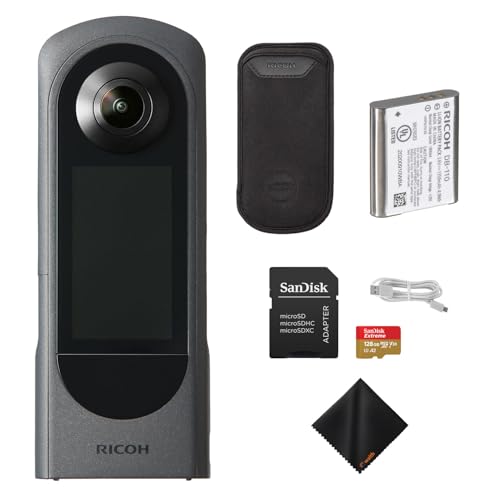
Where the Z1 is the studio instrument, the Theta X is the daily driver. Its listing leads with 5.7K video and a dual 48MP sensor arrangement aimed at immersive content, and the bundle offered here adds a 128GB high-speed memory card and adapter plus a cleaning cloth — a small thing, but the kind of small thing that separates a camera that works on Friday from a camera that waits for accessories. For an agent whose week is a conveyor of listings, that out-of-the-box completeness and the Theta line’s straightforward capture rhythm matter more than the last degree of shadow finesse.
In practice the X suits the tour-first workflow: place, capture, move, with the camera’s own handling doing the heavy lifting and the files flowing into the tour platforms agents already use. The stills it produces serve perfectly well as supporting listing images, and its video resolution gives walkthrough clips room to be reframed for portal and social formats. It is the Theta to buy when the diary, not the darkroom, is your constraint.
The honest comparison is with its own sibling. The Z1’s larger sensors keep an edge in brutal mixed light and in RAW flexibility, so an agent whose listings justify an editing pass should still look up the ranking. An agent whose listings justify speed should stop here — the X returns its cost in hours saved across a season of tours.
- Video, as listed: 5.7K video
- Sensors, as listed: Dual 48MP sensor arrangement
- Bundle, as listed: 128GB Extreme UHS-I microSDXC card with SD adapter and cleaning cloth
- RAW capture: Not stated in the listing title — verify with the maker’s documentation
- Intended platform fit: Not stated in the listing title — verify with the maker’s documentation
Strengths
- Fast, uncomplicated capture rhythm built for multi-listing weeks
- Bundle includes the large memory card the workflow needs from day one
- Higher video resolution leaves room to reframe clips for different portals
Trade-offs
- Smaller sensors than the Z1 concede some mixed-light shadow quality
- Less RAW-centred than the flagship for agents who grade every room
- Tour-platform subscriptions remain a separate ongoing cost of the workflow
Best for: busy agents producing tours at volume who value minutes per room. Not suited for: perfectionist editors who want the largest sensors and full RAW control.
Check the Theta X bundle on Amazon for exactly what the current set includes.

Insta360 X5 — Most versatile 360
The X5 arrives from the action-camera world carrying specifications that translate surprisingly well to property work: waterproof 8K 360 capture, a stated emphasis on low-light performance, replaceable lenses, a three-hour battery, a built-in wind guard and stabilisation driven by a triple AI chip design. Translate those into a listing day and they read as durability and stamina — a camera that survives being knocked off a stand onto a driveway, shoots a full schedule without a battery swap, and keeps walkthrough footage smooth as you carry it from room to room rather than repositioning a tripod for every shot.
Its signature party trick, the invisible selfie stick effect, has a genuine property use: mounted on a slim pole, the X5 appears to float through a home, producing the drifting, gimbal-like walkthrough clips that portals and social feeds reward, with the pole erased from the frame. Combined with its 360 stills for tour building, one device covers the tour, the reel and the teaser clip — a consolidation that suits solo agents who are photographer, videographer and editor in the same afternoon.
The caveats are about ecosystem rather than image quality. Insta360’s flow leans on its own app and editing habits, which an agent already settled into a Theta-based tour pipeline will have to learn rather than assume. And a camera this capable invites scope creep — filming cinematic extras while the essential tour waits. Discipline the workflow and the X5 is arguably the most future-proof single purchase in this ranking.
- Video, as listed: 8K 360-degree capture, waterproof design
- Low light, as listed: Leading low-light performance positioning
- Lenses, as listed: Rugged and replaceable lens design
- Battery, as listed: 3-hour battery
- Audio and stabilisation, as listed: Built-in wind guard, stabilisation, triple AI chip design
Strengths
- Floating walkthrough footage from the invisible-stick effect elevates listing reels
- Replaceable lenses turn a driveway drop from a write-off into a repair
- Long battery life covers a full multi-home shooting day
Trade-offs
- App-centred workflow differs from dedicated tour-camera pipelines
- Feature depth tempts time spent on extras while core deliverables wait
- Action-camera ergonomics are less purpose-shaped for tripod tour work
Best for: solo agents who shoot tours, walkthrough reels and social clips with one device. Not suited for: brokerages standardised on a Theta pipeline who need identical files from every agent.
Open the X5 listing on Amazon to review the current package and protection options.

Insta360 X3 — Proven tour workhorse
The X3 is the previous generation of the same idea, and maturity is its argument. Its listing specifies 5.7K 360 capture with Active HDR video, a 4K single-lens mode, waterproofing, FlowState stabilisation, a 2.29-inch touchscreen and AI editing support. For real estate, the detail that quietly matters most is that single-lens mode: flip the X3 from 360 tour duty to a conventional wide camera and it shoots the straightforward walkthrough or the quick exterior clip without a second device in the bag, while the large touchscreen makes reviewing a room capture on site a glance rather than a squint.
Because the platform has been in agents’ and creators’ hands for years, its tour-software compatibility, accessory range and troubleshooting knowledge are all settled ground. A team standardising on the X3 buys predictability: known file behaviour, known battery rhythm, known results in the portals that matter. The AI editing assistance trims the least enjoyable hour of the listing week, the first assembly of clips, even if a careful agent still reviews the output before a seller sees it.
Against the X5 it concedes the newer low-light emphasis, the replaceable lenses and the longer battery claim, and those concessions are real on a heavy schedule. What it returns is a lower-commitment entry into the same workflow, which for an agent testing whether tours move their listings is often the commercially correct answer: prove the format with the proven camera, then upgrade with evidence in hand.
- Video, as listed: 5.7K 360 Active HDR video
- Single-lens mode, as listed: 4K single-lens camera mode
- Screen, as listed: 2.29-inch touchscreen
- Stabilisation, as listed: FlowState stabilisation, waterproof body
- Editing, as listed: AI editing support
Strengths
- Single-lens 4K mode doubles the camera as a conventional walkthrough tool
- Mature platform with settled software compatibility and accessories
- Large touchscreen makes on-site review fast and reliable
Trade-offs
- Older generation gives ground to the X5 on low light and battery claims
- Lenses are not the replaceable design of the newer model
- Still an app-led workflow that tour traditionalists must learn
Best for: agents adopting 360 tours now who value a proven, well-understood platform. Not suited for: heavy daily shooters who will immediately want the newest model’s stamina.
Look at the X3 listing on Amazon to compare its current offer against the newer model.
KODAK PIXPRO FZ55 (28mm wide) — The honest compact
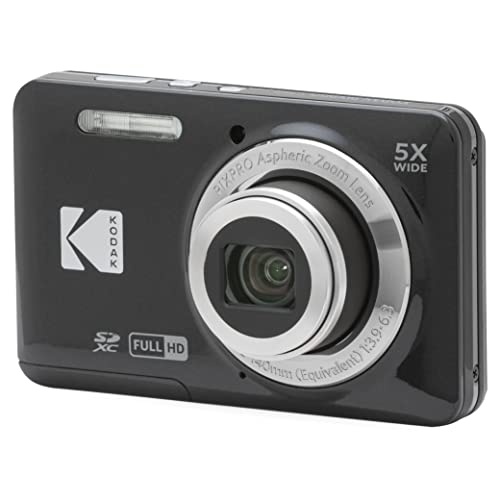
After four 360 cameras, the FZ55 is the pick that answers the keyword in its classic sense: a point-and-shoot compact for stills. Its listing is refreshingly specific — a 16MP compact with 5x optical zoom, 1080p Full HD video, a 28mm wide-angle lens, a 2.7-inch LCD and a rechargeable Li-ion battery. That 28mm wide end is the line that earns it a place in a professional’s bag, because interior stills live and die at the wide end: a wide lens photographs a bathroom without amputating the vanity and makes a modest bedroom read as a room rather than a corridor. The white-label compacts rejected from this guide advertise resolution; this Kodak advertises the focal length that actually does the work.
Its working style suits the stills-led agent. Raise it, frame the room from the doorway corner, half-press, shoot — no stitching, no tour platform, no app. Files go straight to the listing, the brochure and the sign board. For rentals, land, commercial units and the many markets where buyers still decide from photographs alone, that directness is not a limitation but the entire requirement, and the FZ55 meets it with a brand name and a coherent specification behind it.
Set expectations correctly and it will not disappoint. A compact sensor works harder in a north-facing room than the Theta Z1’s large sensors do, video is Full HD rather than 4K, and there is no tour hiding inside it. It is the stills half of the modern workflow, bought honestly — and paired later with any 360 pick in this ranking, it completes the full package without a wasted dollar of overlap.
- Sensor, as listed: 16MP compact digital camera
- Lens, as listed: 5x optical zoom with 28mm wide-angle
- Video, as listed: 1080p Full HD video
- Screen, as listed: 2.7-inch LCD
- Battery, as listed: Li-ion rechargeable battery
Strengths
- Genuine wide-angle lens frames small interiors without distortion tricks
- Zero-workflow stills go straight from card to listing
- Simple operation an assistant or new agent can be trusted with
Trade-offs
- No 360 capture, so tours require a second device eventually
- Compact sensor concedes low-light finesse to the larger-sensor picks
- Full HD video trails the 4K-and-above video elsewhere in the ranking
Best for: stills-led agents, rentals and land listings, and as the stills partner to a future 360 camera. Not suited for: agents whose portals effectively require a virtual tour on every listing.
View the PIXPRO FZ55 listing on Amazon to confirm colour and current availability.

Asteroom 360 Virtual Tour Kit — Guided first tour
The Asteroom kit takes the opposite bet from every camera above it: your phone is already a fine camera, so what you actually lack is the rig and the method. The kit bundles a tripod, a digital camera rotator and a fisheye lens for the phone, inside Asteroom’s virtual-tour system for real estate. The rotator is the quietly important piece — it turns the phone through a measured rotation at a fixed height, which is what separates a stitchable, level tour from the wobbling panorama a handheld sweep produces, with horizons that sag and door frames that bend.
For a first tour, the guided structure is the value. The agent follows the system’s room-by-room flow instead of inventing a process under a seller’s gaze, and the result is a presentable 3D-style tour from equipment that fits in a shoebox and a phone that was already in their pocket. The listing is transparent that the Asteroom phone case is not included and is purchased separately, so read the bundle contents carefully and budget for the case that fits your handset before the first booking depends on it.
The ceiling of the route is the phone itself: its sensor, its age and its battery set the quality limit, and a flagship camera like the Theta Z1 will out-resolve it in difficult light. But as an entry ramp — prove tours win listings in your market before buying a dedicated camera — nothing in this ranking asks less commitment for a complete, sellable result.
- Kit contents, as listed: Tripod, digital camera rotator and fisheye camera lens
- Platform, as listed: Asteroom 360 virtual tour system for real estate
- Phone case, as listed: Not included — purchased separately on Amazon
- Camera sensor: Not stated in the listing title — verify with the maker’s documentation (capture uses your phone)
- Tour hosting terms: Not stated in the listing title — verify with the maker’s documentation
Strengths
- Rotator produces level, stitchable captures a handheld phone sweep cannot
- Lowest-commitment route to a complete, presentable virtual tour
- Uses the phone camera an agent already owns and understands
Trade-offs
- Image quality is capped by whichever phone you mount in it
- The required phone case is a separate purchase to plan for
- Dedicated 360 cameras outpace it as listing volume grows
Best for: agents shooting their first tours and teams testing the format before standardising. Not suited for: high-volume practices whose phones vary and whose tours must match exactly.
Read the Asteroom kit listing on Amazon closely for the full contents list before ordering.
How Do You Shoot a Room So It Looks Bigger Without Lying About It?
Wide-angle discipline is the ethics and the craft of listing photography in one lesson. Stand in the doorway or the corner that shows the room’s longest honest diagonal, keep the camera level and at about chest height, and let the wide lens do the spatial work. A level camera keeps walls vertical; tilt it down for a dramatic angle and the room leans, buyers feel the manipulation, and trust — the currency a listing photograph trades in — quietly leaves. Shoot two walls rather than three where you can, because a frame showing two walls reads larger and calmer than a corner-crammed three-wall squeeze.
Light the room the way a buyer will experience it at a showing: curtains open, every lamp on, and exposure set for the middle of the room rather than the window. On the 360 cameras this becomes placement discipline — centre of the room, lens at standing eye height, agent out of sight around a corner with the remote or timer doing the work. On the Kodak it is the doorway routine above. Either way, the unglamorous preparation outranks the equipment: beds made, counters cleared, toilet seats down, cars moved from the drive. A ten-minute declutter improves a listing more than the price difference between any two cameras in this guide.
What Does a Complete Listing Shoot Cost in Time, Realistically?
Budget the workflow, not just the camera. A practiced 360 shoot of a typical home runs one placement per room with a minute of settling and capture at each — the tour of an ordinary house is a half-hour discipline once the rooms are ready, with processing and tour assembly happening back at the desk. Stills add their own pass: the doorway routine room by room, plus the exterior at the light’s best moment, which sometimes means the stills camera earns a second short visit at dusk for the hero shot that sells the click.
The picks divide that time differently. The Theta X and the Insta360 pair minimise minutes inside the house; the Z1 moves some of its cost to the editing desk in exchange for quality; the Asteroom kit spends a little more time per room while its user learns the rotation routine; the Kodak spends nothing on processing and everything on the agent’s eye at the moment of capture. None of these is the wrong answer — but an agent choosing a camera should choose the time profile as knowingly as the specification, because the diary is where listing photography is truly paid for.
Which Listing Types Should Steer You to Which Pick?
Match the camera to the stock. Luxury and architect-designed homes justify the Z1: their buyers zoom into tours, their sellers compare production values, and their price points absorb a slower, finer workflow without blinking. Volume suburban listings justify the Theta X or X3, where the tenth tour of the week must take the same twenty minutes as the first. Mixed practices that also market themselves with video — agent brands built on walkthrough reels — are the X5’s natural home. Rentals, land, auction and commercial units, where speed and clarity beat atmosphere, are served completely by the Kodak’s stills or an Asteroom tour. And the agent who is simply unsure whether tours matter in their patch should start with the Asteroom kit, gather a season of evidence, and let enquiry rates rather than enthusiasm pick the upgrade.
Why Do Exteriors and Twilight Shots Deserve Their Own Plan?
Interior tours win the shortlist, but the exterior photograph wins the click, and the two jobs stress a camera differently. The front elevation is shot from the street in whatever weather the appointment allows, often with the sun in precisely the wrong place, and it must hold sky, brick and shadowed porch in one frame. Every pick here can make that photograph; the discipline is timing. Shoot the front when the sun is on it rather than behind it, even if that means the exterior pass happens on arrival for one listing and on departure for the next, and keep the camera dead level so the house stands square instead of leaning into the road.
Twilight is the premium version of the same idea: a twenty-minute window when the sky holds a deep blue, every interior light glows amber through the windows, and an ordinary house photographs like a magazine cover. The larger-sensor picks — the Z1 for a 360 twilight capture, or a stills pass composed carefully — handle that balance most gracefully, but even the Kodak can produce a credible dusk hero from a tripod with the timer doing the work. Agents who build one twilight visit into a premium listing’s schedule routinely find it outperforms every other image in the set, which is why the camera decision should include a simple question: which of these will I actually still be carrying, charged and ready, at seven in the evening?
Weather writes the last exterior rule. The Insta360 pair’s waterproofing, listed for both the X5 and X3, turns a drizzling appointment from a cancellation into a shoot, and in relocation markets the agent who delivers on a grey day rather than rescheduling earns a reputation that compounds. Match the camera to your climate as honestly as to your listings.
What Happens to the Files After the Shoot Matters as Much as the Shoot?
A tour camera’s work is only half done when the shutter closes. The files enter a pipeline — stitching, tour assembly, portal upload, stills selection, colour correction — and the picks differ sharply in how much pipeline they demand. The Z1’s RAW files are an invitation to craft: an editor can balance each room’s mixed lighting deliberately, and premium brokerages build exactly that step into their service. The Theta X and the Insta360 cameras push toward the opposite philosophy, assembling and polishing inside their apps so the agent’s desk time shrinks to review and upload. Neither is superior in the abstract; the error is buying one philosophy and staffing for the other.
Stills have their own pipeline honesty. The Kodak’s files are ready almost as they land, which suits an agent uploading from the car. The Asteroom system’s processing lives in its platform, which suits an agent who wants the tour hosted and assembled in one place and accepts a platform relationship as part of the deal. Whichever route you choose, build the unglamorous back half of the pipeline on day one: a folder convention per listing, a backup that happens before the card is reused, and a naming habit that lets an assistant find the dining room tour in six months when the seller relists. Cameras get replaced; archives are forever, and a listing archive is a future instruction waiting to be won.
Finally, review output the way a buyer will meet it — on a phone, on a portal page, at arm’s length. A tour that impresses on a desktop monitor but stutters on a mid-range handset fails at the exact moment of use, and the time to discover that is before the seller is sent the link, not after.
How Should a Small Team Standardise on One of These Systems?
Brokerages feel camera choice at team scale, where the virtues change. A team needs identical files from every agent, a tour style a buyer recognises across the brand’s listings, and a training burden a new hire can absorb in a week. That logic favours the settled platforms: a Theta-based standard for its consistency, the X3 for its maturity, or the Asteroom system where the guided process itself is the standard and the agent’s phone hardly matters. The X5’s creative range, a virtue for a solo brand-builder, becomes a governance question on a team, where one agent’s floating cinematic reel sits oddly beside another’s plain tour.
Standardisation also decides the accessories and the spares. One system means one pool of tripods, stands, batteries and cases that any team member can grab, and one camera’s failure on a listing day becomes a borrow rather than a cancellation. The purchase that looks cheapest per agent — everyone buying something different on offer — is usually the most expensive per brokerage by the second season. Pick the system your volume and your brand can defend, document the room routine that goes with it, and let consistency do the marketing.
The Six Real Estate Picks Compared on Workflow, Not Just Numbers
| Camera / kit | Capture as listed | Package shape | Working identity |
|---|---|---|---|
| Ricoh Theta Z1 51GB | Dual 1-inch sensors, 23MP, RAW DNG, 4K | Camera, 51GB version | Quality ceiling for premium tours |
| Ricoh Theta X | 5.7K video, dual 48MP sensors | Camera with 128GB card bundle | Fast daily tour production |
| Insta360 X5 | 8K 360, waterproof, replaceable lenses | Camera, 3-hour battery | Tour plus floating walkthrough reels |
| Insta360 X3 | 5.7K 360 HDR, 4K single-lens | Camera, 2.29-inch touchscreen | Proven all-round tour platform |
| KODAK PIXPRO FZ55 | 16MP stills, 28mm wide, 1080p video | Compact camera | Direct stills with genuine wide angle |
| Asteroom 360 Kit | Phone-based 360 via fisheye and rotator | Tripod, rotator, lens (case separate) | Guided entry into virtual tours |
How Do You Prepare a Seller and a House for Camera Day?
The best listing photographs are made the day before, in the instructions the agent gives the seller. A simple preparation list — every light bulb working and matched in warmth where possible, blinds open and level, personal photographs thinned rather than removed entirely, cars off the drive, bins out of sight, pets arranged to be elsewhere for an hour — converts shoot day from negotiation into execution. Sellers cooperate better when the reason is explained in buyer terms: a camera sees a room the way a stranger does, without the owner’s memories softening the clutter, and every object left in frame is a sentence in the story the listing tells.
Walk the house once with the camera off. Note the rooms where the light fights you, the mirror that will catch your reflection on a 360 capture, the window whose view is the neighbour’s wall rather than the garden the description celebrates. Decide the tour’s starting room and the stills order in that walk, so the equipment comes out of the bag into a plan instead of a improvisation. On 360 shoots, agree the hiding places in advance — the spots, usually just inside the next doorway, where you stand during each capture — because a tour punctuated by a crouching agent in alternating corners undermines the professionalism the whole exercise exists to project.
Finish with the seller’s expectations set as carefully as the rooms: when the tour will be live, where the stills will appear, and what retakes are realistic. The camera systems in this guide all deliver quickly by historical standards, but a seller promised an impossible hour will judge a same-day tour as late. Under-promise by half a day and the workflow you actually bought — the Z1’s considered edit or the Theta X’s same-afternoon turnaround — lands as a pleasant surprise instead of a grievance.
What Should the Total Budget Include Beyond the Camera Itself?
Price the system, not the box. A tour workflow needs a slim stand that hides well in 360 frames, a second battery or a charging routine that survives a three-listing day, memory capacity matched to the file sizes your chosen format produces, and usually a tour platform subscription that recurs whether you shoot or not. The stills workflow needs its own smaller kit: a tripod for twilight work, a microfibre habit for front elements, and an editing application if the brokerage’s presentation standard includes corrected verticals and balanced windows. Agents who budget only for the camera discover these costs one listing at a time, each as an emergency.
Against those costs, set the return honestly. One additional instruction won partly on the strength of a listing presentation, or one sale shortened by a month because relocation buyers could tour properly, repays an entire camera system. That arithmetic is why the ranking resists the false economy of the rejected no-name compacts: the saving they offer is small, singular and immediate, while the cost they impose — listings that look cheaper than the homes they describe — recurs on every property they touch. Buy the honest tool once, insure it if your volume justifies it, and let it work.
What Goes Wrong on Listing Shoots More Often Than Camera Failure?
Reflections, first of all: the photographer appears in every bathroom mirror and dark window, a rookie signature that 360 shooters must plan around by hiding properly during capture and stills shooters by angling off the glass. Second, the half-ready room — one unmade bed or crowded counter in an otherwise polished tour tells buyers the home is hard to keep, which is the opposite of the story being sold. Third, mixed colour temperatures left uncorrected, where tungsten lamps and daylight windows split every room into orange and blue halves; the RAW and HDR-capable picks exist partly to rescue exactly this.
Two business mistakes complete the list. Shooting a tour before confirming which platform the brokerage will host it on wastes an afternoon to incompatible formats. And treating the camera as the whole investment — no tripod routine, no spare battery, no backup of the day’s files — converts a professional service into a favour. The equipment in this ranking is the smaller half of a credible listing package; the routine around it is the larger half.
How Will You Know the Camera Is Earning Its Keep?
Measure the listing, not the gadget. Watch the portal numbers a camera change is supposed to move: click-through from search results, which answers to the hero still; time spent on the listing page, which answers to the tour; and enquiry-to-viewing conversion, which answers to whether the presentation matched the house honestly enough that visitors arrived pre-sold rather than misled. An agent who tracks even roughly will know within a season whether the 360 investment changed anything, and in which price bands it changed it — knowledge that turns the next equipment decision from opinion into bookkeeping.
Upgrade when the evidence names the bottleneck. If tours are loved but stills look thin beside rival listings, the missing piece is the wide-angle stills half, not a newer tour camera. If stills delight and buyers ask for tours you cannot supply, the Asteroom user graduates to a Theta and the Theta user has no decision left to make. If the constraint is hours — tours queuing unedited while new instructions wait — the fix is workflow class, the X or the Insta360 app pipeline, rather than resolution. Cameras are replaced for reasons; the photographers and agents who get value from this category are the ones who can state their reason in one sentence before they spend.
And keep the replaced camera. A previous tour camera makes a flawless backup, a second agent’s training tool, or the rental-listing unit whose loss would not sting. In a business where a dead camera on listing day costs a seller’s confidence, depth on the bench is part of the system you bought.
Can a Tour Camera Help With Floor Plans and Measuring, Too?
Increasingly, yes — and this secondary use quietly changes the value calculation. A methodical 360 pass through a home, captured room by room at a consistent height, is the raw material from which several tour platforms derive floor plans and room dimensions, turning one visit into three deliverables: the tour, the stills set and the plan that portals display beside them. The requirement is capture discipline rather than extra equipment: complete coverage with no skipped rooms, doorways included rather than avoided, and the camera kept level so the geometry the software reconstructs stays true. Agents who shoot with the plan in mind — an extra placement in awkward L-shaped rooms, another viewpoint across the kitchen — find the derived plans markedly more reliable than those reconstructed from a hurried tour.
Treat the plan as a draft to be verified rather than a survey, and say so to sellers; a camera-derived layout is a marketing document, not a legal measurement. Even with that caveat, the workflow is a genuine argument for the dedicated 360 picks over improvised phone panoramas, because consistency of capture is what the reconstruction feeds on. It is one more reason the modern answer to the real estate camera question is a small system rather than a single snapshot tool.
Final Recommendation
Decide which deliverable your market pays for, then buy the pick that produces it with the least friction. Premium listings point to the Theta Z1, volume points to the Theta X, video-led personal brands point to the X5, cautious adopters to the X3 or the Asteroom kit, and stills-led practices to the Kodak without a moment of apology. Many strong agents will end with two of these — a tour camera and the little wide-angle compact — because the listing itself has two faces. Start with the face your buyers see first, and let the camera that earns the next showing be the one you reach for.
Frequently Asked Questions
Do I really need a 360 camera, or are stills enough?
It depends on your market’s portals and price band. Look at the ten listings most comparable to yours: if the majority carry a tour, the question has already been answered by your competitors, and the remaining decision is only which system in this ranking fits your pace and your price band. If almost none do, a tour becomes a differentiator you can sell to sellers in the listing presentation itself — the rare case where the camera is also the pitch. Where tours are standard on comparable listings, lacking one quietly filters your home out of relocation buyers’ shortlists. Where they are rare, excellent stills still carry the listing — which is why the Kodak holds its place here.
Can one of these cameras replace my phone for listings?
Yes — that is the point of the dedicated picks. Beyond the imaging itself, a dedicated camera separates work from the device that also carries your messages, your banking and your family photographs, and that separation shows up in small professional ways: no notification banners over a capture, no personal photo roll one swipe away from a seller, and a battery whose charge is the shoot’s business rather than the day’s. Agents who make the switch rarely describe the image quality as the main gain; they describe the calm of a tool that does one job, in the same way, on every listing. A phone is a fine sensor wrapped in a distracting, inconsistent workflow; the Theta and Insta360 cameras give you level placement, repeatable exposure and tour-ready files, and the Kodak gives you a true wide lens the phone’s digital tricks imitate poorly.
Why were the very cheap high-megapixel compacts excluded?
Because their headline numbers are not supported by their lenses or sensors, and because a listing is a promise: photographs that misrepresent a home’s light and space manufacture viewings that end in disappointment, which sellers remember long after they forget the camera’s price. Listing photographs expose the gap immediately — bent ceiling lines, smeared window detail and colours no correction fully repairs. A modest honest camera outperforms them where it counts.
How many rooms can I tour on one outing with the 360 picks?
A whole home per placement routine, with the X5’s three-hour battery claim and the Z1’s 51GB capacity both aimed at multi-home days. The practical limit is room preparation, not the camera.
What about rentals, land and commercial units — do they need the same gear?
They need the same honesty at a different scale. Rental listings turn over fast and forgive a stills-only package, which is the Kodak’s home ground, while land and development plots benefit from a 360 capture at the plot’s centre that lets a distant buyer understand aspect and surroundings in a way three photographs cannot. Commercial units sit between the two: tenants’ agents walk space mentally, so a straightforward tour from any of the 360 picks earns its place. The mistake is applying a residential luxury workflow to stock that rewards speed, or a rental-speed workflow to a home whose price demands ceremony.
How do I keep myself out of 360 photographs?
Plan the hiding place before each capture, not during it. Stand in the next room’s doorway, behind the door swing, or below the camera’s stitch line if the platform supports a nadir patch, and trigger with the timer or the phone app from concealment. Review the first room’s capture at full size before continuing — if you appear once, you will appear in every room shot with the same routine, and it is far cheaper to fix the routine in room one than to edit a whole tour.
Should a new agent start with the Asteroom kit or a dedicated camera?
Start with the kit if budget or uncertainty dominates; its guided rotation teaches correct tour habits. Move to a Theta or Insta360 when tour volume makes the phone’s limits — battery, consistency, quality ceiling — a weekly rather than theoretical problem.
Related Guides
Round out your listing toolkit with our neighbouring guides: best 360 cameras, best cameras for product photography and best tripods for cameras.
Venues are documented twice in this business: once for the listing, once for the party, and our guide to the best polaroid cameras for wedding guest books handles the party half.
A property portfolio has a fixed twin — the building that never sleeps — and our guide to the best ip cameras for warehouse covers the watching systems for it.
The same fast, honest low-light judgement a listing agent needs indoors is what our guide to the best nikon cameras for concert photography demands of stage-side bodies.


