What's inside
- Key Takeaways
- Quick Picks
- How did we judge these best affordable 4k cameras?
- What does ‘affordable’ actually buy in each camera class?
- How can a small budget produce footage that looks expensive?
- When should an affordable camera be upgraded rather than accessorized?
- How do these cameras handle the rooms where life actually happens?
- What should a buyer check in the first weekend with a new camera?
- How does an affordable camera fit a household that already owns phones?
- Which accessories earn their money at this tier, and which are decoration?
- Comparison Table
- Common Mistakes
- Final Recommendation
- Frequently Asked Questions
- Related Guides
As an Amazon Associate I earn from qualifying purchases. This post may contain affiliate links at no extra cost to you.
gizmoverdict.com is reader-supported. When you buy through links on our site, we may earn an affiliate commission.
Where to buy: Linked picks lead to the Amazon listings verified for this guide. One pick below is included for its price honesty rather than its resolution, and it is labeled as such wherever it appears.
The best affordable 4k cameras occupy the most contested ground in photography, because ‘affordable’ is a tier described in words, not a number printed on a specific product — and because 4K itself means different things in different bodies. In a mirrorless camera it is a serious video mode cropped from a large sensor. In an action camera it is a wide, stabilized shout at the world. In a budget compact it can be anything from a genuine mode to a hopeful interpolation, and telling those apart is worth more than any single recommendation in this guide.
So the six picks are arranged by honesty of purpose. Canon’s EOS R100 is the real system camera at the tier’s sensible end. Sony’s ZV-1 is the creator’s compact whose 4K was designed, not added. AKASO’s EK7000 is the action camera whose price rewrites what risk means. Panasonic’s ZS99 is the travel zoom that happens to shoot proper 4K. Kodak’s FZ55 is here under a flag of complete candor: it records video at 1080p, not 4K, and earns its place as the ultra-budget stills camera for buyers willing to trade resolution for simplicity. And a Panasonic 4K point-and-shoot rounds out the list as the vlogging-leaning compact alternative.
Who should read on? Anyone whose phone has started to feel like a ceiling: the parent whose videos deserve better light, the traveler whose zooms dissolve, the beginner creator whose channel has outgrown a webcam’s manners. Affordable 4K is not about buying the future cheaply. It is about buying the specific capability your actual footage lacks, at the tier where that capability first becomes honest — and this guide’s job is to mark exactly where that line falls for each kind of camera.
Key Takeaways
- ‘Affordable’ here is a relative tier, judged against what each camera class normally costs — not a printed price on any pick.
- The EOS R100 is the only true interchangeable-lens system in the list, and its 4K is a cropped mode best used deliberately.
- Sony’s ZV-1 was engineered around creators, so its 4K, microphone, and flip screen work as one thought rather than three features.
- The AKASO EK7000’s value is permission: 4K footage from a camera inexpensive enough to mount where expensive cameras fear to go.
- Kodak’s FZ55 records 1080p video only; it is included, clearly labeled, as the budget stills-first trade-off pick.
- Panasonic’s ZS99 proves a travel zoom can offer genuine 4K alongside a 30x lens in a pocket body.
Quick Picks
| Pick | Badge | Why it earns a place |
|---|---|---|
| Canon EOS R100 with RF-S 18-45mm Kit | The real system camera of the tier | An APS-C mirrorless body on Canon’s RF mount with 4K video, bought for photographs first and a lens future second. |
| Sony ZV-1 | The creator’s compact | A one-inch sensor, a bright zoom, a proper microphone input, and a flip screen, all aimed at people who talk to their camera. |
| AKASO EK7000 | The fearless action camera | 4K30 recording, a waterproof case, and a remote, at a tier that lets you mount it on the surfboard without a prayer. |
| Panasonic LUMIX ZS99 | The traveling 4K zoom | A 24-720mm lens and genuine 4K video in a jacket-pocket body built for trips rather than studios. |
| KODAK PIXPRO FZ55 | The budget trade-off (1080p video) | A simple 16-megapixel compact with a 5x zoom for stills-first buyers; included honestly because its video is Full HD, not 4K. |
| Panasonic 4K Point and Shoot Vlogging Camera | The compact vlogging alternative | A travel-minded Panasonic compact with 4K video per its listing, aimed at casual creators who want one small camera. |
How did we judge these best affordable 4k cameras?
Listings were verified on 2026-11-25, and each camera’s video claim was read against its actual recording specification — the discipline that placed the FZ55 in this guide with a 1080p label rather than a borrowed 4K halo. In the affordable tier more than anywhere, headline resolution and delivered resolution part company quietly, and a guide that does not check is merely typesetting the marketing.
We then judged each camera inside its own class’s economics. An action camera is affordable against action cameras; a system camera against systems. Cross-class price comparisons produce nonsense — of course the AKASO costs a fraction of the Canon; it also cannot change lenses, and the Canon cannot be taped to a helmet. What matters is whether each pick is the honest representative of its class at the friendly end of that class’s range, and whether its 4K is the real mode its buyer imagines.
Finally, we weighted the footage’s destination. Most affordable-4K buyers publish to platforms that compress generously, watch on phones and televisions, and forgive a great deal — which raises the value of good light handling, stabilization, and sound, and lowers the penalty for a cropped 4K mode or a modest bitrate. The reviews below keep asking where the video will actually live, because a camera judged against cinema standards it will never meet is a camera misjudged.

Canon EOS R100 with RF-S 18-45mm Kit — The real system camera of the tier
The R100 is what happens when a serious camera system decides to have a ground floor. An APS-C sensor of about 24 megapixels, Canon’s RF mount shared with bodies costing many times more, and a kit zoom that covers the everyday range — the stills proposition is complete and honest, and it is the stills that justify this camera in an affordable guide. Photographs from the R100 belong to the same family as photographs from its expensive siblings in a way no compact here can claim, because the sensor and the mount, the two things that cannot be upgraded later, are the real ones.
Its 4K video requires the honest sentence: on the R100, 4K is a cropped mode, taking a narrower window of the sensor and asking more of the lens’s center and the shooter’s framing. Used knowingly — a deliberate setup, a tripod or a steady rest, a subject framed with the crop in mind — it produces genuinely sharp 4K clips for the family archive and the occasional upload. Used as a walk-around video mode, the crop’s tightness and the rolling character of the readout will frustrate. This is a stills camera that can shoot 4K, which is a different and perfectly respectable thing from a video camera, provided the buyer hears the distinction before the purchase rather than after.
The body’s simplicity is the other trade, and it is mostly a fair one. A fixed rear screen, modest burst speed, and autofocus a generation behind Canon’s detection-rich models keep the tier honest; the viewfinder is proper, the grip is secure, and the whole camera weighs little enough to be carried daily, which is the first virtue any camera can have. Beginners learn real photography on it because its limitations are the instructive kind — framing, light, timing — rather than the arbitrary kind.
Buy the R100 when photographs lead and video follows, and when the RF mount’s future is part of the attraction: the second lens, bought in a year, is where this camera’s value compounds. Buy the ZV-1 instead when the camera will spend its life facing its owner. The R100’s 4K is a tool in the kit, not the headline, and a guide that pretended otherwise would be selling the badge over the camera.
- Sensor: APS-C CMOS, about 24 megapixels
- Mount: Canon RF interchangeable lenses
- Video: 4K in a cropped mode; strong Full HD
- Kit: RF-S 18-45mm zoom included
Strengths
- Real system sensor and mount at the tier’s friendly end
- Stills quality with genuine editing headroom
- Light, simple body that teaches photography properly
Trade-offs
- 4K mode is cropped, limiting walk-around video
- Fixed screen and modest burst speed
- Autofocus lacks the newest subject-detection richness
Best for: a photography-first beginner who wants 4K available and a lens system to grow into
Not suited for: a video-first creator, who should take the ZV-1’s purpose-built design instead

Sony ZV-1 — The creator’s compact
Most cameras have video added to them; the ZV-1 had a creator added to its design brief. Everything about it answers the person who films themselves: a one-inch sensor behind a bright 24-70mm equivalent zoom, a screen that flips fully forward, a microphone input and a proper directional mic under a wind muff, and autofocus that treats a human face — and a product held up to the lens — as the two most important objects in the world. Its 4K is recorded with the seriousness of a camera meant to publish, because publishing is literally what it is for.
The one-inch sensor is the quiet hero. It gathers light at a level the pocket zooms here cannot approach, so indoor filming — the kitchen counter, the desk review, the hotel room — holds together without the smeared, over-processed look that small sensors produce under lamps. The bright lens helps twice: once for exposure, once for the gentle background separation that makes a talking-head frame look produced rather than captured. For a creator whose entire studio is a corner of a room, these are not luxuries; they are the production value itself.
Sony’s creator-specific touches repay attention because they solve real filming-day problems. A background-defocus switch trades depth for clarity of subject without menu archaeology. Product showcase behavior shifts focus to an object presented to the camera and back to the face without hunting. A tally light confesses when recording is live. None of these appear on a specification chart’s front row, and all of them matter more across a year of weekly uploads than a marginal difference in bitrate ever will, because value was the lesson and the lesson was learned in full, the honest way, by using the thing daily, in real light, on real days, until its strengths and limits were simply known by heart, without a single chart consulted.
The debits are the compact camera’s eternal ones: no viewfinder worth the name for stills work in bright sun, a zoom range that ends where travel photography begins, battery life that asks for spares on a filming day, and no weather sealing for a camera that will inevitably be carried everywhere. As a stills camera it is very good within its lens’s reach and irrelevant beyond it. As the affordable tier’s creator instrument, it stands alone in this guide — the one pick whose 4K was the point from the first sketch.
- Sensor: 1-inch stacked CMOS, about 20 megapixels
- Lens: 24-70mm equivalent with bright aperture
- Video: 4K HDR recording, creator-focused
- Audio: microphone input and directional mic with wind muff
Strengths
- Purpose-built creator design: flip screen, mic input, product focus
- One-inch sensor keeps indoor footage clean and separated
- Face and eye autofocus that simply refuses to lose the presenter
Trade-offs
- Zoom range too short for travel and wildlife ambitions
- Battery life demands spares on long filming days
- No meaningful weather sealing or viewfinder for bright-day stills
Best for: vloggers, reviewers, teachers, and anyone whose camera mostly faces its owner
Not suited for: travel photographers needing reach, or stills shooters wanting interchangeable lenses

AKASO EK7000 — The fearless action camera
The EK7000’s specification sheet — 4K30 recording, a 20-megapixel stills claim, electronic stabilization, a remote control, and a waterproof housing rated for serious depth — reads like a camera several tiers above its station, and the honest review begins by asking what its tier buys and what it cannot. What it buys is the thing no other pick here offers: permission. This is a camera you mount on a kayak, a child’s bicycle helmet, a dog’s harness, or a surfboard leash with genuine equanimity, and footage shot without fear has a life in it that careful footage rarely matches.
The 4K itself deserves calibrated praise. In bright outdoor light — this camera’s native element — the EK7000 produces vivid, watchable 4K30 clips whose stabilization smooths the trail and the paddle stroke into something a family will actually rewatch. Its sensor and processing are modest, so dusk, interiors, and mixed light expose the gap to premium action cameras quickly: noise rises, detail softens, colors strain. The camera does not hide this; its price announced it. Judged as a daylight adventure recorder, it overdelivers. Judged as a low-light instrument, it was never entered in that contest.
The kit philosophy matters at this tier. A waterproof case, mounts, and a wrist remote in the box mean the camera works on day one at the lake rather than after an accessory pilgrimage, and the remote in particular changes what a solo adventurer can capture — the camera on the tripod at the rapid’s edge, the shutter fired from the boat. Battery swaps are quick, the app is serviceable, and the whole ecosystem assumes, correctly, that its owner would rather be outside than in a menu.
Set the EK7000 beside the premium action cameras it imitates and the differences are real: stabilization finesse, dynamic range, low-light grace, and build refinement all favor the expensive names. Set it beside the alternative most of its buyers actually face — no action camera at all, because the premium one felt too precious to risk — and the AKASO wins the only comparison that matters. Some footage exists because this camera was cheap enough to be brave, and existence is the first quality of any photograph.
- Video: 4K30 recording with electronic stabilization
- Housing: waterproof case for deep submersion per listing
- Extras: remote control and mounts in the box
- Stills: 20-megapixel claim per listing
Strengths
- Fearless pricing unlocks mounts and moments other cameras skip
- Complete day-one kit with case, mounts, and remote
- Bright-light 4K footage is vivid and genuinely watchable
Trade-offs
- Low light exposes the modest sensor quickly
- Stabilization and dynamic range trail premium action cameras
- Audio inside the waterproof case is muffled by design
Best for: adventurers, parents, and water-sports households wanting 4K without preciousness
Not suited for: filmmakers needing low-light quality, refined stabilization, or production audio

Panasonic LUMIX ZS99 — The traveling 4K zoom
A travel camera is judged by a ruthless standard: it must be present. The ZS99 passes by fitting a jacket pocket while carrying a 24-720mm zoom and genuine 4K video, a combination that covers the traveler’s whole visual life — the cathedral’s width, the distant steeple’s detail, the street performer’s close-up, the clip of the train window’s passing valley — without a bag, a lens decision, or a moment of negotiation with a travel companion’s patience. Panasonic has spent generations refining exactly this formula, and the ZS99’s polish shows in the handling details competitors skip.
Its 4K does double duty in a way worth understanding. Beyond straightforward clips, Panasonic’s 4K photo modes extract still frames from high-resolution bursts, which rescues the moments travel is made of and timing ruins: the gull’s takeoff, the grandchild’s cannonball, the flag snapping once in the wind. A traveler returns with the frame that got away, pulled honestly from footage the camera was already recording. It is the feature owners mention a year later, long after bitrate discussions have faded, because it changes what a holiday archive contains.
The small sensor’s covenant applies here as everywhere: daylight is this camera’s kingdom, and the far end of the zoom in particular wants sun. In the generous hours the ZS99 is a delight; at dusk the wise owner zooms less, leans on the wider range, and lets the scene’s atmosphere carry the frame. Night markets and candlelit interiors will test it past its comfort, and the R100’s big sensor or the ZV-1’s bright lens will win those specific evenings. No honest guide pretends one affordable camera wins all the hours; this one wins the traveling ones.
Against the Panasonic point-and-shoot that closes this list, the ZS99 is the photographer’s version: control ring, tilting screen, a zoom with genuine ambition, and handling that rewards intention. Against the R100 it trades the system future for presence. The traveler who has once left a big camera in a hotel safe for three consecutive days already knows which of those virtues is worth money, and it is not the theoretical one.
- Lens: 24-720mm equivalent, 30x optical zoom
- Video: 4K recording with still-extraction modes
- Design: pocketable body, tilting screen, control ring
- Sensor: small-format compact sensor
Strengths
- Pocket presence means the camera is there for the moment
- 4K photo modes rescue fast travel moments from bursts
- Huge zoom range covers a trip’s entire visual range
Trade-offs
- Small sensor fades at dusk and at the long end
- Fixed lens ends the growth path a system offers
- No weather sealing for a camera sold to the outdoors
Best for: travelers who want real 4K and real reach from a pocket
Not suited for: beginners intending to grow into interchangeable lenses and manual craft
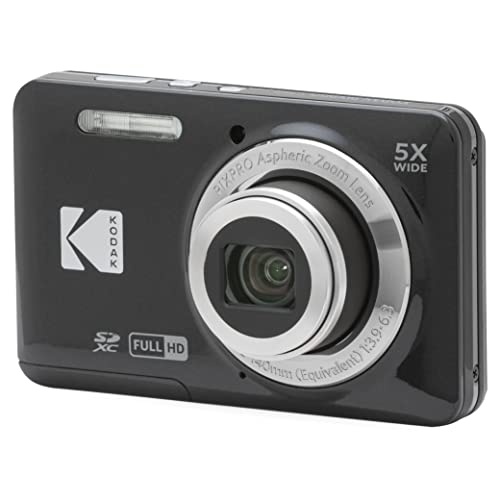
KODAK PIXPRO FZ55 — The budget trade-off (1080p video)
Candor before everything: the FZ55 records video at 1080p Full HD. It is not a 4K camera, and it sits in this guide — linked, because it is a legitimate product honestly sold — as the deliberate trade-off pick for a specific buyer: the one whose budget is the smallest in the room, whose need is a simple real camera for stills, and who would rather own an honest 1080p compact than stretch painfully toward a 4K badge on a worse everything else. If your purpose in this guide is 4K video, skip this review with our blessing; the other five picks are your list.
As a stills camera for its tier, the FZ55’s virtues are simplicity’s virtues. Sixteen megapixels, a 5x optical zoom beginning at a usefully wide 28mm, a small body that disappears into a bag or a glovebox, and operation simple enough to hand to a grandparent or a child without a tutorial. It takes the photographs that phones complicate: the school play from row twelve with real optical zoom, the family gathering without a notification in sight, the holiday where a dedicated camera is also a small act of digital abstinence. Its files will not survive forensic cropping, and they were never promised to.
The limits form a single honest paragraph. The small sensor and modest lens produce their best work in daylight and acceptable work indoors with flash; the video, again, is 1080p; the build and screen are tier-appropriate rather than delightful; and there is no growth path, no system, no upgrade story. A buyer who understands they are purchasing a finished, finite tool — like a good pair of scissors — can be perfectly served by it. A buyer purchasing a beginning will outgrow it within the year and should save toward the R100 instead.
Why does a 4K guide carry this pick at all? Because ‘affordable’ pressure is real, and the worst outcome in this category is a buyer so fixated on the 4K badge that they buy a no-name camera whose 4K is fiction. The FZ55 is the honest floor: a known brand’s simple compact that does exactly what its box says. Between a truthful 1080p camera and a fictional 4K one, this guide chooses truth every time, and says so in the open so the choice is the reader’s too.
- Sensor: 16 megapixels per listing
- Lens: 5x optical zoom from 28mm wide
- Video: 1080p Full HD — not 4K
- Design: compact, simple point-and-shoot
Strengths
- The honest floor of the category: simple, small, and truthful
- Real optical zoom beats phone cropping for school and family events
- Operation anyone in the family can manage without instruction
Trade-offs
- Video is 1080p, disqualifying it for genuine 4K needs
- Small sensor limits low light and cropping headroom
- No growth path or system future of any kind
Best for: stills-first buyers on the tightest budget, and families wanting a simple shared camera
Not suited for: anyone whose actual requirement is 4K video — five other picks serve it

Panasonic 4K Point and Shoot Vlogging Camera — The compact vlogging alternative
The final pick is the generalist’s compact: a Panasonic point-and-shoot whose listing leads with 4K video and travel vlogging, positioned for the casual creator who wants one small camera that photographs the trip and films it too, without a system’s commitments or a flagship compact’s tier. Where the ZS99 is Panasonic speaking to photographers, this model speaks to the holidaymaker who has started filming — the canal-side update, the market walk-through, the hotel-room recap — and wants those clips in genuine 4K from a camera that asks nothing in return but a charged battery.
Expectations should be set by class, and set fairly. A compact of this station offers a small sensor and a friendly automatic temperament: point, record, and let the camera’s judgment carry the exposure while you carry the moment. In daylight and bright interiors — travel’s home turf — that bargain produces cheerful, shareable 4K that embarrasses no one. In dim restaurants and night streets it will lean on its processing and show the strain, as every camera in its class does, the ZV-1’s bright one-inch design being the exception that proves the rule at a different tier.
Its photographic side is the snapshot’s honorable tradition: wide scenes, group frames, the sign, the menu, the view from the room. A compact like this is often bought as a household’s second camera — the one that goes to the beach, the festival, the school trip — precisely because its loss would sting less than a system’s, and its presence is guaranteed by its size. There is a real photographic philosophy in that: the camera that attends everything, at good-enough quality, builds the archive a family actually keeps.
Choose it over the ZS99 when video and simplicity lead and the long zoom does not tempt; choose the ZS99 when photography and reach lead. Choose it over the ZV-1 when the budget is firm and the filming is casual; choose the ZV-1 when the channel is the point. As the list’s closing pick it represents the largest tribe of real buyers — people who want their trips in 4K from a camera that fits the trip — and it serves that tribe without pretension.
- Video: 4K recording per listing
- Role: travel and casual vlogging compact
- Design: point-and-shoot simplicity
- Sensor: compact small-format class
Strengths
- One small camera covers a trip’s stills and 4K clips
- Automatic temperament suits casual creators perfectly
- Household-second-camera pricing courage: it goes everywhere
Trade-offs
- Small sensor strains in dim scenes, as its class does
- Photographic controls and zoom ambition are modest
- Not the creator instrument the ZV-1 is for serious channels
Best for: casual travelers and beginning vloggers wanting simple, genuine 4K
Not suited for: photographers wanting reach and control, or creators needing mic inputs and flip screens
What does ‘affordable’ actually buy in each camera class?
Affordability is a ratio, not a figure: what the class normally costs, divided by what this honest example costs. In mirrorless systems, the friendly end buys yesterday’s conveniences wrapped around today’s sensor and mount — the R100’s exact formula. In compacts, it buys the previous generation’s polish, which is why the ZV-1, a mature design, can be the creator bargain of this list. In action cameras, it buys the specification without the refinement, the EK7000’s whole personality. Reading each pick against its own class’s ceiling keeps the word ‘affordable’ honest; reading them against each other makes it meaningless.
The trap at this tier is the camera that is affordable against no class at all — the unbranded 4K promise whose specification dissolves under the first firmware screen. Every pick here, including the FZ55 with its candid 1080p, comes from a maker with a reputation to lose and a listing that survived verification. In the affordable tier, provenance is a feature, and arguably the first one to shop for.
Also count the whole purchase, not the headline. The system camera wants a card, a bag, eventually a lens; the action camera wants mounts its box may or may not include; the creator compact wants a spare battery and perhaps a microphone the input so invitingly accepts. Affordable ownership is the sum of the first year, and the picks above were chosen partly because their first years stay predictable — no proprietary surprises, no accessory toll roads between the box and the first good footage.
How can a small budget produce footage that looks expensive?
Light is the great subsidy. Every camera in this guide improves dramatically when its owner films near windows, in open shade, or in the hour after sunrise rather than under a kitchen’s single bulb at midnight — and light, unlike lenses, is free. The affordable camera’s owner who learns to schedule and position for light will out-film the careless owner of a flagship, a sentence that sounds like comfort and is actually the industry’s worst-kept professional secret.
Stability is the second subsidy. A small tripod, a railing, a stack of books under the camera — anything that removes the hand’s tremor from 4K footage, where every shake is rendered in high definition. The ZV-1 and ZS99 carry stabilization, the EK7000 smooths electronically, and all of them still reward a planted camera for the shots that matter. Viewers forgive softness sooner than seasickness; spend steadiness before resolution, always.
Sound is the third, and the most neglected. Audiences abandon bad audio long before they abandon soft video, which is why the ZV-1’s microphone provisions punch so far above its tier and why every other pick’s owner should film close to the subject, shield the camera from wind with a body or a wall, and keep clips short enough that the sound never has time to annoy. Affordable footage looks and sounds expensive when its maker respected light, steadiness, and ears — in that order, at any price.
When should an affordable camera be upgraded rather than accessorized?
Accessorize while the limitation is circumstantial: not enough reach for one trip, not enough light for one room, not enough battery for one long day. A borrowed lens, a rented light, a spare cell answer those, and the camera remains the right camera. Upgrade when the limitation is constitutional — when the sensor’s ceiling is the ceiling of every photograph, when the cropped 4K pinches every production, when the autofocus loses the subject your life is actually about. Constitutional limits do not respond to accessories, and money spent pretending otherwise is the affordable tier’s most common waste.
The tell is repetition. One disappointing evening is weather; the same disappointment across a season, in the same light, with technique improving and results not following, is the camera filing its resignation. At that point the honest move is the next tier, bought with the knowledge your affordable camera taught you — which is, in the end, the deepest service these six picks provide. They are not compromises to apologize for. They are the education itself, with footage as the diploma.
How do these cameras handle the rooms where life actually happens?
Laboratory comparisons are shot in kind light; birthdays are not. The affordable camera’s true examination is the living room at 8 p.m. — one ceiling light, a window gone black, subjects who will not hold still or repeat the moment. Here the order of this guide reshuffles itself instructively. The ZV-1’s bright lens and one-inch sensor keep faces clean and shutter speeds sane. The R100’s larger sensor follows, especially once a faster lens than its kit zoom is mounted. The compacts and the action camera fall back on processing, flash, and forgiveness, in roughly that order.
None of this makes the daylight cameras bad purchases; it makes them scheduled purchases. A household whose filming life is gardens, beaches, sidelines, and holidays will rarely meet the living-room test at full strength, and the EK7000 or ZS99 will serve them for years without the topic arising. A household whose life is kitchen-table uploads meets the test weekly, and should buy for it directly. The affordable tier punishes only one sin reliably: buying for a life you do not lead.
Flash deserves its unfashionable sentence. The built-in flashes on the compacts here, used directly, produce the harsh party snapshot everyone recognizes; bounced where a ceiling allows, diffused by a tissue in an emergency, or dialed down to fill shadows rather than replace light, they become genuinely useful. Affordable cameras reward small techniques out of all proportion, because their margins are where technique lives. The owner who learns flash compensation on an FZ55 has learned a skill that transfers to every camera they will ever own.
White balance is the other quiet teacher. Mixed household light — warm lamps against blue window dusk — confuses automatic settings on cameras at every tier, and the affordable ones simply confess it sooner. Learning to set a custom balance, or to shoot a gray card’s photograph for later correction, lifts indoor footage from amateur to intentional in one evening’s practice. These are not consolation skills for cheap cameras. They are photography, arriving early because the equipment declined to hide them.
What should a buyer check in the first weekend with a new camera?
Film the same thirty seconds with every video mode the camera offers and watch the results on the largest screen you own. The differences between a camera’s 4K modes — crop, frame rate, stabilization behavior — are invisible in menus and obvious on a television, and knowing which mode your camera means by 4K is the foundation of using it well. Note, too, how long a continuous clip can run before the camera stops or warms, because event filming is planned around that number or ruined by it.
Photograph a patient subject — a pet, a plant, a partner bribed with tea — at every sensitivity setting, and study where your own tolerance for noise sits. That personal threshold, not a reviewer’s, decides your camera’s usable range, and it differs honestly between a parent printing family albums and a seller photographing products for a shop. Set the camera’s auto-sensitivity ceiling to your number afterward, and the machine will respect your taste at 11 p.m. without being asked.
Test the unglamorous logistics while the return window is open: how the files transfer, whether your computer and editing app digest the format happily, how the battery truly lasts across one of your real days, and whether the grip and controls suit your hands at the end of that day rather than in the shop’s first minute. Affordable cameras are returned for these frictions more than for image quality, and every one of them is discoverable in a weekend of honest use.
Finally, make something finished. One edited clip, one printed photograph, however small — because a camera’s first completed work predicts its year better than any specification. The picks in this guide were chosen to make that first finish easy: the ZV-1 flatters a first upload, the EK7000 a first adventure reel, the R100 a first print worth framing. If the weekend ends with a finished thing and a list of what to try next, the purchase has already succeeded.
How does an affordable camera fit a household that already owns phones?
The phone is not the enemy in this story; it is the reason these cameras must justify themselves, and each pick justifies differently. The R100 justifies by depth — files that survive editing, lenses that change the picture’s nature. The ZV-1 justifies by production — sound, screen, and focus arranged around a presenter. The EK7000 justifies by courage, the ZS99 by reach, the Panasonic compact by presence, and even the FZ55 justifies by separation: a camera that is only a camera, immune to messages, present at the school play in a way a phone, however good, socially is not.
Households thrive when the division of labor is explicit. The phone keeps the spontaneous, the shared, and the immediately posted. The camera takes the deliberate: the trip, the project, the child’s season of sport, the channel’s weekly episode. Trouble begins when a camera is bought to replace the phone at the phone’s own game — it will lose on convenience every day — or when the phone is asked to do the camera’s deliberate work and the archive thins to whatever a pocket computer managed between notifications.
Children, interestingly, often settle the question. A child handed the FZ55 or the EK7000 owns the experience in a way a borrowed phone never grants: no accounts, no messages, a device whose whole soul is looking. Many family archives’ most beloved frames were made by the youngest photographer present, from knee height, without permission or polish. An affordable camera in a household is sometimes less an instrument than an invitation, and invitations compound across summers in ways no specification predicts.
Which accessories earn their money at this tier, and which are decoration?
The spare battery is the only universal answer. Every camera here will, on its best day — the wedding, the summit, the tournament — run dry before the day does, and a second cell bought with the camera costs little and rescues everything. After that, the honest list shortens quickly: a card fast enough for the camera’s best video mode, a small case that fits the bag you already carry, and a wrist strap for the compacts that will otherwise meet pavement within the year.
Class-specific accessories follow the same discipline. The EK7000 earns a floating grip for water work and a handful of adhesive mounts for the places it was bought to go. The ZV-1 earns a small tripod that doubles as a grip, because its owner films at arm’s length and at desks. The R100 earns nothing at first except time — its accessory is a lens, and lenses are not accessories but chapters. The ZS99 and its Panasonic cousin earn a pouch and a spare battery and then, pointedly, a plane ticket.
Decoration, by contrast, is easy to recognize: it photographs well in the unboxing and solves no problem the owner has met yet. Filters for effects the editing app does free, elaborate rigs for a camera bought for its smallness, bags larger than the camera’s whole philosophy — the affordable tier’s accessory catalog is a museum of good intentions. Buy after the need, in the order the need announces itself, and the kit stays as light as the budget that inspired it.
One purchase straddles the line and deserves a ruling: the extended warranty and accidental-damage cover. For the action camera that will be mounted on a surfboard, the arithmetic can genuinely favor it. For the shelf-kept compact, it is usually a tax on anxiety. Judge by where the camera will actually live — the same rule, the reader will notice, that chose the camera itself.
Software closes the list, and mostly it is free. The makers’ transfer apps, a capable free editor, and a cloud folder for the finished work cost nothing and organize everything. Money spent learning one editor well outperforms money spent collecting three, at this tier as at every other.
Comparison Table
| Pick | Class | Video truth | Buy it for |
|---|---|---|---|
| Canon EOS R100 Kit | Mirrorless system | 4K, cropped mode | Photographs and a lens future |
| Sony ZV-1 | Creator compact | Full creator-grade 4K | Filming yourself, indoors and out |
| AKASO EK7000 | Action camera | 4K30, daylight’s friend | Adventure without preciousness |
| Panasonic ZS99 | Travel zoom | Genuine 4K plus photo modes | Trips, reach, and presence |
| KODAK PIXPRO FZ55 | Budget compact | 1080p — not 4K | Simple stills on the tightest budget |
| Panasonic 4K P&S | Casual compact | 4K per listing | One small camera for a whole trip |
Common Mistakes
Trusting a 4K badge without reading the mode. Cropped, interpolated, and frame-rate-limited 4K all wear the same two characters. This guide checked each pick’s actual specification; do the same for any camera not listed here, especially unbranded ones.
Buying the system camera for video alone. The R100 is a stills instrument with a 4K tool included. Video-first buyers served by it exist, but they are the deliberate, tripod-minded minority; the talking-to-camera majority belongs with the ZV-1.
Expecting daylight cameras to perform at midnight. The EK7000 and both Panasonic compacts are creatures of generous light. Plan night footage around their limits — closer, steadier, brighter scenes — rather than discovering them during the one unrepeatable evening.
Letting the FZ55’s honesty confuse the mission. It is a fine budget stills camera and a 1080p video camera. Bought for 4K by a reader who skipped its label, it becomes an unfair disappointment; bought knowingly, it is the category’s truthful floor.
Spending the whole budget on the body. Cards, batteries, a bag, and for the R100 an eventual lens are part of the purchase. An affordable camera that cannot leave the house for want of a memory card is the least affordable outcome of all.
Gifting follows the same logic as buying, with the recipient’s life substituted for your own. The EK7000 is the rare gift that cannot really miss — a teenager, a kayaker, and a new parent all find their use for it by the second weekend. The ZV-1 is the precise gift, life-changing for the niece actually building a channel and puzzling for the one who merely mentioned filming once. Precision gifts require evidence; when evidence is thin, give the camera whose uses are widest, and include the memory card, because a camera that cannot record until Tuesday is a story the giver did not intend to tell.
There is also the secondhand dignity of this whole tier to acknowledge. Affordable cameras circulate — sold on, handed down, lent for a season — more than any other class of photographic equipment, and a well-kept ZV-1 or R100 beginning its second household’s archive is the category working exactly as designed. Buy the camera whose build and brand will survive that circulation, and its cost divides by every year and every owner it serves. Cheaply made is expensive; affordably made, passed along, is nearly free.
Keep expectations in writing, odd as that sounds. When the box arrives, note what you bought the camera to do — the channel, the trips, the child’s matches — on the first page of the notebook or the first file in the folder. A year later that sentence grades the purchase fairly, immune to the forums’ seasonal conviction that last year’s camera is suddenly inadequate. Most affordable cameras pass their own examination easily. It is the unexamined upgrade urge that fails, expensively, on schedule.
A last word on storage, because 4K’s appetite surprises every new owner once. An afternoon of clips from any camera here can outweigh a year of phone photographs, and the household that has not decided where footage lives — which drive, which folder logic, what gets deleted and what is sacred — will decide it badly at midnight before a trip, with a full card blinking. Decide on the calm weekend of setup: a roomy card in the camera, a home drive with space to grow, and a rule for ruthless deletion of the footage that served its moment. Archives are curated or they are landfills, and 4K accelerates the verdict.
Back that archive up once, anywhere, before it becomes irreplaceable. The affordable camera’s footage is disproportionately precious — first channels, first trips, children at ages that do not repeat — and a single copy on a single drive is a risk no tier justifies. The cloud folder, the second drive at a relative’s house, the boring discipline of copying after each big day: choose the version your household will actually perform, because the best backup system is the one that happens.
Charge the batteries the night before, every time, and make it a household ritual rather than a hope. More affordable-camera outings are lost to a flat cell discovered in the car park than to every technical limitation in this guide combined, and the ritual costs eleven seconds. The camera that is charged, carded, and sitting by the door is, by the only metric the archive cares about, the best camera in this entire list.
Likewise, clean the lens with the cloth that lives in the case, not the shirt that happens to be present. Front elements at this tier are small, exposed, and disproportionately responsible for the hazy look owners blame on sensors. Ten seconds of care, repeated, is the whole maintenance department of the affordable camera — one more reason this tier, honestly bought and lightly maintained, serves ordinary households better than its reputation suggests.
And when the camera has served its season, pass it on deliberately rather than drawer-ing it indefinitely. A niece, a school club, a neighbor’s teenager — the affordable camera’s second life is part of its value, and the household that gives it away with its charger and its one-paragraph blessing has understood the tier better than any specification ever taught, and better than most flagship owners ever will.
Final Recommendation
Decide what the camera is for, in one sentence, and the list resolves itself: photographs and a future — the R100; filming yourself — the ZV-1; adventure without fear — the EK7000; travel with reach — the ZS99; a whole trip in one small camera — the Panasonic point-and-shoot; and stills on the tightest honest budget — the FZ55, with its 1080p worn openly. Affordable was never about spending the least; it is about spending where your own footage will notice, and stopping there. The reader who buys by that rule will find, a year from now, that the cheap camera was the expensive-looking archive all along.
Frequently Asked Questions
Is the Kodak FZ55 a 4K camera?
No. It records 1080p Full HD video, and it appears in this guide explicitly as the budget stills-first trade-off, labeled wherever it is mentioned. Buyers who need 4K should choose any of the other five picks.
Which affordable 4K camera is best for vlogging?
The Sony ZV-1, by design: flip screen, microphone input, bright lens, and autofocus built around faces and presented products. The Panasonic point-and-shoot serves casual travel vlogging well at a friendlier tier.
Is the Canon R100’s 4K good enough?
For deliberate, well-framed clips, yes — it is sharp, genuine 4K from a window of a large sensor. For walk-around filming it is limited by its crop. Stills-first buyers get the better end of this camera; video-first buyers should compare the ZV-1.
Can the AKASO EK7000 really shoot 4K?
Yes, 4K30 per its specification, and in bright outdoor conditions the footage is vivid and watchable. Its limits are the affordable action class’s limits — low light, dynamic range, and stabilization finesse — not the resolution claim itself.
What matters more than 4K at this tier?
Light, stability, and sound, in that order, followed by the honesty of the camera’s other specifications. A well-lit, steady 4K clip from any pick here will out-watch a dark, shaking clip from a camera twice the price.
Should I buy a used premium camera instead?
A confident buyer can do very well used, particularly with creator compacts a generation old. First-time buyers gain warranty, simplicity, and a known history from the new picks here — and the education these cameras provide is the same either way.
Related Guides
Keep reading with best budget vlogging cameras with microphone inputs, how to light a room for video without buying lights, and action cameras compared for family adventures.


