What's inside
- Where to buy
- Key Takeaways
- Quick Picks
- How did we choose these picks?
- Which of these cameras suits older and first-time photographers?
- How do the six compare as two-hundred-dollar propositions?
- Why does a camera at this price still beat a phone for some people?
- What about printing photographs from a camera at this price?
- How do you get photographs worth keeping from a budget compact?
- How do stills and video divide the work in this tier?
- Which mistakes do buyers at this budget repeat?
- Final Recommendation
- Frequently Asked Questions
- What does a complete travel kit around one of these cameras look like?
- What should you check in the first week of ownership?
- When should you save past this tier instead of buying in it?
- Related Guides
As an Amazon Associate I earn from qualifying purchases. This post may contain affiliate links at no extra cost to you.
gizmoverdict.com is reader-supported. When you buy through links on our site, we may earn an affiliate commission.
Where to buy
All six cameras below are sold on Amazon’s US store at the listings linked here, and all six live inside the budget this guide is named for — check price on Amazon for the current figure on each, since prices in this tier move often, and pay attention to what each box includes, because at this level the card and batteries in the box are a real share of the value.
The best 200 dollar cameras occupy the most argued-over ground in photography. Two hundred dollars is exactly the amount at which a phone’s defenders ask why a camera should exist at all, and exactly the amount at which a camera can still answer: with a real optical zoom that reaches instead of cropping, with a device that can be handed to a child or a grandparent without a contract’s worth of anxiety, with batteries and cards that swap in seconds, and with the simple creative discipline of a tool that only takes pictures. The six cameras in this guide make that answer in two dialects — Kodak’s established compacts, with genuine zoom lenses and decades of camera-making behind the badge, and the newer compact crowd, with flip screens, big bundled kits and headline numbers that need the honest translation this guide provides.
So let the translation happen up front. In this tier, megapixel counts on the newcomer boxes are file sizes as much as resolutions, “zoom” figures with an X in the teens are digital crops rather than lens reach, and the video story that matters is 1080p, whatever else the box advertises. Against that, the Kodaks offer the tier’s rarest honesty: optical zooms of 4X and 5X that magnify with glass, and sensors whose modest numbers describe what they actually capture. Neither dialect is a scam; they are different products for different buyers, and the reviews below sort them by the jobs they genuinely do — the family camera, the teen’s first camera, the travel spare, the gift that gets used.
Key Takeaways
- The Kodak PIXPRO FZ55 is the most complete camera here: a real 5X optical zoom, rechargeable battery and 1080p video in a compact that behaves like a proper camera.
- The FZ45 trades the rechargeable battery for AA power — the traveller’s friend, since its fuel is sold in every shop on earth.
- Kodak’s PIXPRO C1 adds a 180-degree flip screen to the established-brand formula, aimed at casual vloggers and selfie-framers.
- The Camkory is the kids’ pick: a complete kit with card and two batteries, in a finish and at a price that forgive a learning curve.
- The QIVORO and the teen-focused FHD compact compete on bundles and screens — judge them by their kits and their 1080p footage, not their zoom arithmetic.
- At this budget, technique and light beat specifications: every camera here rewards a close subject and a bright day far more than a settings menu.
Quick Picks
| Pick | Badge | Why it is here |
|---|---|---|
| KODAK PIXPRO FZ45 | Best for travel simplicity | A 4X optical zoom, 27mm wide lens and AA batteries — the camera that never waits for a charger. |
| KODAK PIXPRO FZ55 | Best all-round compact | 5X optical zoom, rechargeable power and 1080p video — the most camera-like camera in the guide. |
| KODAK PIXPRO C1 | Best with a flip screen | A 180-degree flip screen on an established compact, for selfies and casual vlogging. |
| Camkory Digital Camera FHD 1080P | Best for kids | Card and two batteries included, simple controls, and a price that makes it a safe first camera. |
| QIVORO Digital Camera, 4K | Best bundled newcomer | A 32GB card in the box, autofocus assistance and anti-shake, for casual point-and-shoot use. |
| Digital Camera, FHD 1080P for Teens | Best teen gift | An anti-shake compact with a card included, aimed squarely at young creators on a family budget. |
Check price on Amazon from the links above — in this tier the spread between listings often comes down to the bundle, so compare the boxes as carefully as the cameras. A listing that looks cheaper by a small margin and arrives without the card its rival includes is not cheaper in any sense that survives the first week of ownership, and the reviews below keep returning to the box contents for exactly that reason: at two hundred dollars, completeness is not a luxury feature. It is a measurable share of what the money buys, and the buyers who count it are the ones whose cameras are filming on the first morning rather than waiting, cardless and patient, for a second delivery to complete a purchase they thought they had already made.
How did we choose these picks?
We applied the same discipline this budget demands of its buyers: separate the optics from the arithmetic. An optical zoom — Kodak’s 4X and 5X lenses — moves glass to magnify, and every pixel of the result is earned. A digital zoom crops the sensor’s output, and at this tier’s resolutions the crop spends quality the image cannot spare beyond its gentlest settings. Picks were scored first on which kind of reach they offer, because it is the specification that decides whether the camera can photograph a stage, a pitch or a bird at all, or merely enlarge the middle of a frame it already had.
Power and completeness came next, because at two hundred dollars the ownership costs are proportionally huge. A camera that runs on AAs can be refuelled anywhere on earth and never dies waiting for a proprietary charger; a camera with a card and a second battery in the box is a finished purchase, while one without is a down payment. We credited both philosophies where they appear and noted, in each review, exactly what else the buyer will need. Sensor honesty was scored the same way: the Kodaks’ 16MP and 13MP figures describe real capture, and where a newcomer’s headline number relies on interpolation, the review says so and redirects attention to the 1080p footage that is the product actually being sold.
We also weighed the afterlife of each purchase: whether spare batteries and cards will be findable in three years, whether the brand answers its support mail, and whether the camera’s way of working is standard enough that a different household member can pick it up cold. Established lines win that test by definition, which is part of the Kodaks’ strong showing here; the newcomers answer with kit completeness today, and their reviews advise buying the spares early, while their listings are current and their accessories are everywhere. A camera is a small promise about the future, and we scored the credibility of the promise alongside the quality of the present.
Finally, we chose for the jobs this tier truly serves. Nobody in this guide is a professional’s primary camera, and pretending otherwise would corrupt every verdict. These are first cameras, family cameras, travel spares, glovebox cameras, gifts — roles where being present, simple and unprecious beats being excellent. The six below are the ones whose compromises land where those roles never notice, and whose strengths land exactly where they do.

KODAK PIXPRO FZ45 — Best for travel simplicity
The FZ45’s defining decision is printed on its specification in two letters: AA. This compact runs on AA batteries, and in a tier of proprietary packs and forgotten chargers, that is a philosophy. A traveller’s FZ45 refuels at an airport kiosk, a beach shop, a petrol station at midnight; a parent’s FZ45 is never the camera that died during the school play because its unique battery was left in a charger in another country. Around that freedom sits a proper little camera: a 16MP sensor, a 4X optical zoom starting at a genuinely useful 27mm wide angle, 1080p Full HD video, and the simple, legible controls of Kodak’s Friendly Zoom line, a family that has been making uncomplicated compacts for years.
The trade-offs are the honest companions of the design. AA power means buying batteries or — the grown-up answer — a set of rechargeables and treating them as the camera’s own. The 4X zoom is real but modest; it reframes a scene rather than reaching across a valley. Low-light performance is the tier’s usual story: the small sensor and a compact lens ask for daylight and forgive little after dark, and the video, while a clean 1080p, is a record rather than a production. None of this diminishes the FZ45’s specific genius, which is availability. The best camera is famously the one you have with you; the FZ45 extends the proverb — it is the one that is also awake when you reach for it, anywhere on earth, for the price of two batteries from a corner shop.
- Sensor: 16MP compact sensor
- Lens: 4X optical zoom, 27mm wide angle
- Video: 1080p Full HD
- Power: AA batteries — available worldwide
- Screen: 2.7-inch class rear display
Strengths
- AA power is a superpower for travel, festivals and forgetful households.
- Real optical zoom with a usefully wide 27mm starting point.
- Established compact design with simple, honest controls.
Trade-offs
- Battery costs accumulate unless you adopt rechargeable AAs.
- 4X reach reframes rather than truly zooms to distant subjects.
- Evening and indoor footage is soft and grainy, as across this tier.
Best for: travellers, festival-goers, grandparents and anyone whose camera must never wait for a charger. Not suited for: distant wildlife, stage filming or night photography.
Check price on Amazon.
KODAK PIXPRO FZ55 — Best all-round compact
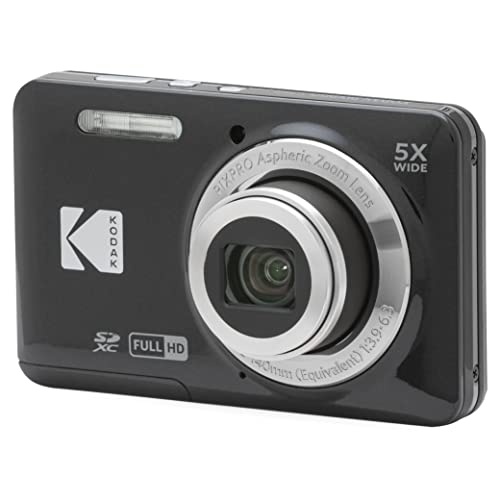
If the FZ45 is the traveller’s answer, the FZ55 is the household’s: the same Friendly Zoom philosophy with the two upgrades most owners ask for. The optical zoom stretches to 5X — still glass, still honest, now with a little more pull for the pitch and the stage — and the power becomes a rechargeable lithium battery, ending the AA purchases in exchange for remembering one charger. The 16MP sensor records 1080p Full HD video, the lens starts at a 28mm wide angle that suits interiors and group shots, and the whole camera slips into a jacket pocket with the easy manners of a compact that knows its job is to be present.
Judged against its sibling, the choice is a personality test. The FZ55 is the better camera in the studio of specifications: more reach, tidier power, the same honest sensor story. The FZ45 is the better camera in the field of real life, where chargers are forgotten and batteries die at altitude. Both share the tier’s ceiling — low light is a negotiation, video is 1080p and proud of it, and the autofocus is a compact’s autofocus, adequate for scenes that hold still and unhurried about scenes that do not. For the family that wants one camera, kept in a drawer, charged and ready for birthdays, holidays and the dog’s best moments, the FZ55 is this guide’s default recommendation at the tier — the most complete expression of what two hundred dollars of camera honestly buys.
- Sensor: 16MP compact sensor
- Lens: 5X optical zoom, 28mm wide angle
- Video: 1080p Full HD
- Power: rechargeable lithium battery
- Form: pocketable compact body
Strengths
- The longest honest optical reach in the guide.
- Rechargeable power keeps running costs at zero.
- A balanced, complete compact from an established camera line.
Trade-offs
- One proprietary battery and charger to keep track of.
- Low-light ability remains the tier’s limitation.
- Autofocus pace suits still scenes better than sport.
Best for: families wanting one dependable compact for everything ordinary and most things special. Not suited for: action sports, dark venues or professional delivery.
Check price on Amazon.

KODAK PIXPRO C1 — Best with a flip screen
The C1 is Kodak’s answer to the creator era, built inside the same honest compact philosophy: a 13MP sensor, a fixed 26mm wide lens, 1080p video — and a 2.8-inch screen that flips 180 degrees to face the subject. That screen is the camera’s whole argument. It makes the C1 the only established-brand pick here that frames a selfie or a piece to camera properly, and the fixed wide lens suits exactly that work: a face, a desk, a room, a travel moment narrated to the lens. Where the FZ cameras zoom with glass, the C1 stays wide and simple, trading reach for the vlogger’s essential feedback loop.
The fixed lens deserves its honest paragraph. There is no optical zoom to lean on; moving closer is the zoom, and digital assistance beyond that spends the 1080p image’s limited spare detail quickly. The 13MP figure is, refreshingly, the kind of modest number that describes a real sensor rather than a marketing ambition, and stills are sized for sharing rather than exhibition. Battery and card arrangements follow the modern compact pattern — confirm the listing’s inclusions before assuming. For the casual creator who wants Kodak’s reliability with a screen that turns, or the traveller who films themselves as much as the scenery, the C1 is the tier’s most modern-feeling honest camera.
- Sensor: 13MP compact sensor
- Lens: 26mm fixed wide lens
- Screen: 2.8-inch, 180-degree flip screen
- Video: 1080p Full HD
- Audience: casual vloggers and selfie-framers
Strengths
- The flip screen brings creator framing to an established compact.
- Wide fixed lens suits faces, desks and travel narration.
- Honest specifications from a known camera line.
Trade-offs
- No optical zoom — reach is your feet or a quality-spending crop.
- Fixed lens limits distant and compressed compositions.
- Low-light performance is the class standard, no more.
Best for: casual vloggers, travellers who narrate, and selfie-first shooters wanting a real camera brand. Not suited for: anyone whose subjects live at a distance.
Check price on Amazon.
Camkory Digital Camera FHD 1080P — Best for kids
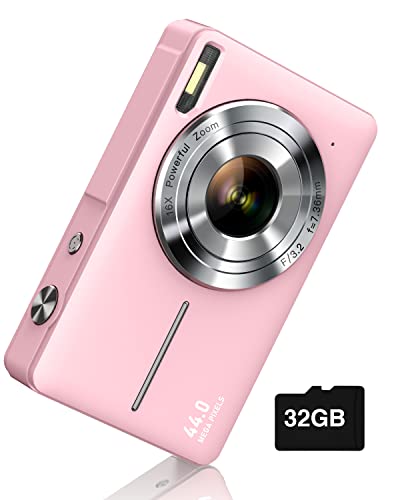
The Camkory knows its owner: a child or young teenager with a new interest in filming their world, and a parent who has correctly decided that the learning camera should not be the expensive one. The kit is the pitch — a 32GB card and two batteries in the box, anti-shake assistance, simple controls and a pink finish in this listing that signals its audience without apology. The camera records FHD 1080p video, takes everyday stills, and offers a 16X zoom figure that this guide will translate once more, because parents deserve the translation most: it is a digital crop, useful for gentle reframing, not a lens that reaches the far end of a football pitch.
Within those honest bounds, the Camkory does its job well. It is light enough for small hands, simple enough to operate without a supervising adult becoming the camera department, and cheap enough that its inevitable encounters with gravity are educational rather than expensive. The image quality is the newcomer class’s: bright-daylight footage that families will happily watch, indoor footage that wants every lamp in the room on, and stills for sharing rather than printing. Buy it as what it is — the camera equivalent of training wheels, complete in the box — and it will teach framing, patience and storytelling to exactly the person it was bought for. Buy it expecting a sports telephoto, and the disappointment belongs to the expectation, not the camera.
- Video: FHD 1080p
- Zoom: 16X digital — gentle reframing only
- In the box: 32GB card and two batteries
- Assists: anti-shake for handheld clips
- Audience: kids and young teens
Strengths
- Complete kit — nothing else to buy before the first filming day.
- Simple, light and sized for young owners.
- A safe price for a camera that will be dropped, lent and learned on.
Trade-offs
- Digital zoom cannot substitute for reach at sports and stages.
- Indoor and evening quality needs generous light.
- Build is light-duty, matched to its price and purpose.
Best for: children’s first camera and family filming on a careful budget. Not suited for: distant subjects, dark venues or demanding image quality.
Check price on Amazon.

QIVORO Digital Camera, 4K — Best bundled newcomer
The QIVORO represents the newcomer class at its most complete: a portable point-and-shoot with a 32GB card in the box, autofocus assistance, anti-shake, a 2.8-inch IPS screen and an 18X zoom figure on the listing. Apply this guide’s standing translation — the honest deliverables are 1080p-class video and shareable stills, the zoom is digital and best kept gentle, and the “4K” in the name is a mode to treat as a bonus rather than the product — and what remains is a sensibly bundled casual camera whose screen is a small cut above the class norm and whose kit respects the buyer by arriving whole.
The autofocus assistance deserves a calibrated word, because in this class the term spans everything from a genuine contrast system to a hopeful label. Expect help with a steady, central subject in decent light, and expect to help it back — half-press patience, steady hands, subjects that are not sprinting — the way compact shooters have collaborated with their cameras for decades. Low light, again, is the boundary the whole tier shares. The QIVORO’s case rests on completeness and price: for a buyer who wants a pocketable camera for holidays, family events and casual clips, and who reads this guide’s translations as the terms of sale, it is a fair and functional choice.
- Video: 1080p as the working mode; 4K-labelled mode included
- Screen: 2.8-inch IPS display
- In the box: 32GB SD card included
- Assists: autofocus assistance and anti-shake
- Zoom: 18X digital — use gently
Strengths
- Card included and a better-than-average screen for the class.
- Compact, simple point-and-shoot manners.
- A complete casual kit at a keen price.
Trade-offs
- Headline numbers exceed the honest capture; plan around 1080p.
- Autofocus needs cooperative subjects and light.
- Night performance is the tier’s familiar weakness.
Best for: casual holiday and family filming with a complete kit. Not suited for: fast action, dark scenes or zoom-dependent subjects.
Check price on Amazon.
Digital Camera, FHD 1080P for Teens — Best teen gift
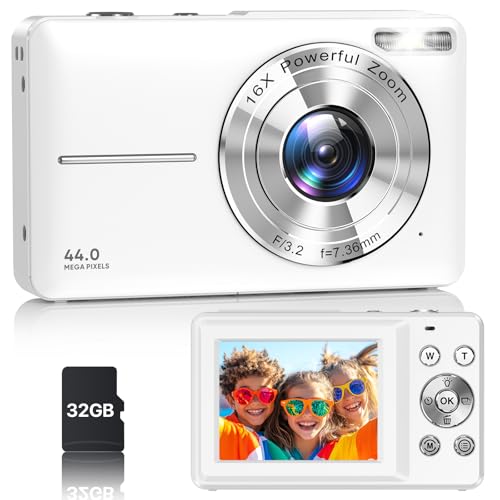
The last pick addresses the teen market in its own name, and its formula mirrors the Camkory’s with a slightly older accent: FHD 1080p recording, anti-shake for handheld filming, a memory card included in the box, a 16X digital zoom for framing, and point-and-shoot simplicity throughout. It is a gift-shaped camera — complete on opening, forgiving in use, priced so that a teenager can own it outright rather than borrow a parent’s phone under supervision — and for the first year of a young creator’s output, those are the specifications that decide whether filming becomes a habit.
The class honesty applies in full, one final time: small sensor, digital zoom, daylight as the home territory, stills for the feed rather than the wall. What distinguishes a good purchase in this corner of the tier is not a specification but a match — the teen who films friends, pets, skate attempts and day-in-the-life clips at conversational distance will be well served, and the teen who dreams in telephoto sports photography should be pointed at the Kodaks’ optical zooms instead, or at saving toward a different class entirely. As a first, own, complete camera, this is a respectable place for a young photographer to begin, and beginnings are what this entire tier is for.
- Video: FHD 1080p
- Zoom: 16X digital zoom
- In the box: SD card included
- Assists: anti-shake for handheld use
- Audience: teens and young creators
Strengths
- Complete, gift-ready kit with card included.
- Simple operation that hands ownership to the teen, not the parent.
- Anti-shake helps handheld clips stay watchable.
Trade-offs
- Digital zoom limits distant subjects severely.
- Image quality ceilings are the newcomer class’s ceilings.
- A keen teen will outgrow it — which is its purpose, and its limit.
Best for: teen gifts and first owned cameras for casual filming. Not suited for: sports reach, low light or long-term serious use.
Check price on Amazon.
Which of these cameras suits older and first-time photographers?
A significant share of this tier is bought for parents and grandparents, and the criteria invert when the buyer is choosing for someone else’s confidence. Button size and legibility matter more than menu depth; a screen that reads clearly in garden sunlight matters more than its resolution; and the winning camera is the one whose owner photographs the grandchildren this Sunday without telephoning for instructions. On those criteria the Kodaks lead the guide — their Friendly Zoom line was designed for exactly this owner, with uncluttered controls, an honest automatic mode that can simply be left alone, and, in the FZ45’s case, batteries that any shop can replace when the charger inevitably goes missing.
The newcomers ask more of a new owner: denser feature lists, smaller print, apps that promise more than they explain. For a confident teenager that density is entertainment; for a reluctant photographer it is a reason the camera stays in its box, and a camera in a box has a resolution of zero. If you are buying for someone else, weight simplicity as this guide weights the sensor in a dash camera — as the specification everything else depends on — and consider doing the unglamorous setup yourself before the gift is given: card formatted, date set, batteries charged, one test photograph taken together. That ten minutes is the difference between a camera that documents a family and a camera that decorates a drawer.
There is a dignity point here too, worth stating plainly. An older photographer who carried film cameras for forty years is not a beginner; they are an expert being handed an unfamiliar interface. The compacts that respect that — real buttons, a real shutter, menus that stay out of the way — earn a loyalty the spec-sheet winners never see. The FZ55 in a grandfather’s jacket pocket will out-produce, over a decade of family life, cameras with ten times its paper specification that its owner never learned to love.
How do the six compare as two-hundred-dollar propositions?
| Camera | Reach | Power | Screen | Kit character |
|---|---|---|---|---|
| KODAK FZ45 | 4X optical zoom | AA batteries | Fixed rear screen | Camera-first; batteries anywhere |
| KODAK FZ55 | 5X optical zoom | Rechargeable | Fixed rear screen | The complete compact |
| KODAK C1 | Fixed 26mm wide | Rechargeable class | 180-degree flip | Creator-leaning compact |
| Camkory FHD | 16X digital | Two batteries included | Fixed rear screen | Card plus spares in box |
| QIVORO 4K | 18X digital | Check listing | 2.8-inch IPS | 32GB card included |
| FHD for Teens | 16X digital | Check listing | Fixed rear screen | Card included, gift-ready |
The table divides the guide in two with unusual clarity. The left-hand path — Kodak — buys optical truth: smaller numbers that describe real glass. The right-hand path buys completeness: bigger numbers that describe file sizes, wrapped around kits that arrive ready. Neither path is the wrong one; they serve the traveller and the teenager, the household and the gift-buyer, and the reviews above exist to walk you down the right one.
Why does a camera at this price still beat a phone for some people?
Begin with the zoom, because it is the argument with physics on its side. A phone’s zoom beyond its optical range is a crop wearing confidence; the Kodaks’ lenses genuinely magnify, and for the school play, the holiday viewpoint and the garden bird, glass reach is the difference between a photograph and a suggestion of one. Continue with the hand-over test: a camera in this tier can be given — to a child for the afternoon, to a grandparent for the trip, to a friend for the wedding’s candid table shots — without handing over your messages, your banking app and your entire digital life in the same gesture. Phones are identities now; cameras are still just cameras, and that simplicity has become a feature.
Add the ergonomics of dedication. A camera in this class has one job, a shutter button under the right finger, a battery that swaps in seconds and a card that files the day away without touching a cloud account. It does not interrupt a take with a call, does not demand an update at the viewpoint, and does not fill its storage with anything except photographs. For older users especially, the single-purpose tool is not a limitation but a relief — the camera that only takes pictures is the camera whose manual nobody needs.
And close with the creative argument, which is the one photographers actually grow on. A limited camera teaches: you walk closer because the zoom ends, you wait for light because the sensor asks for it, you compose because the frame is all you get. Generations of photographers learned on less than the worst camera in this guide. A phone will out-photograph these compacts in the dark and out-share them everywhere — and a young photographer will still learn more, faster, from a season of carrying the compact, because its limits are honest teachers and its photographs are unmistakably theirs.
What about printing photographs from a camera at this price?
Printing is where modest cameras are judged most harshly and, handled well, acquit themselves best. The honest physics: a small sensor’s file, printed at the sizes family photographs actually live at — the envelope print, the framed desk photograph, the album page — looks entirely respectable, because those sizes do not interrogate a file the way a poster does. Daylight photographs from any pick here will print pleasingly at modest dimensions, and the Kodaks’ honestly captured pixels hold up better under enlargement than interpolated files of larger nominal size, which is the megapixel lesson one final time, taught by paper.
The practical rules are few. Print the photographs you love rather than testing the ones you doubt; choose the frames where the light was kind, because printing forgives grain less than screens do; and let a proper lab or a decent home printer do the work rather than the instant kiosk at its most aggressive sharpening. If a photograph matters — the one portrait of a grandparent, the one frame of the children at an age they have already left — print it twice, once for the wall and once for the album, because paper is the only backup medium in this entire guide that has never once asked for a password, a subscription or a compatible port, and the cameras in this tier, for all their modesty, produce files entirely worthy of that permanence when their owners work inside the light the cameras ask for. A wall of small, well-chosen prints from a two-hundred-dollar camera will give a household more pleasure than a hard drive of masterpieces from a flagship nobody prints — the tier’s philosophy, framed and hung.
How do you get photographs worth keeping from a budget compact?
Light first, as it is first in every tier of photography and doubly so here. Small sensors are daylight instruments: shoot birthdays by the window, take the group shot outside, and treat indoor evenings as the camera’s challenge mode, where a steady hand, a braced elbow and a subject near a lamp will rescue more frames than any mode dial. Flash on these compacts is a near-field tool — honest within a few metres, hopeless across a hall — so move the group toward the camera rather than asking the light to travel.
Distance second. Every camera in this guide is at its best between a portrait’s length and a room’s width. Optical zoom owners can reach a little further with honour; digital zoom owners should treat their zoom as a last resort and their feet as the primary lens control. Hold the camera with both hands, tuck the elbows, and let the anti-shake assistance finish the job your posture started — compact blur is almost always movement, not focus, and it is the most curable fault in this tier’s photographs.
Composition is the free upgrade nobody in this tier believes in, because it cannot be printed on a box. Fill the frame with the subject instead of photographing the room the subject happens to be in. Put the horizon level and low, the face in the upper third, the background behind the subject rather than growing out of their head. Every camera here has a screen that shows you exactly what you are about to keep — the discipline is merely looking at the edges of it before the shutter, where the distractions live, instead of only at the centre, where the subject smiles. Ten seconds of edge-checking per photograph will do more for a family’s archive than the difference between any two cameras in this guide.
And curation last, because it is the cheapest quality upgrade ever sold. Shoot generously — cards are large and moments are brief — then keep ruthlessly. The family archive that gets watched is the edited one: the best fifth of a holiday, named and backed up, rather than four hundred frames in a folder nobody opens. A two-hundred-dollar camera plus the discipline to choose is a better photographic instrument than a flagship plus a drawer of unexamined abundance, and it is not close.
How do stills and video divide the work in this tier?
Buyers often ask which of these cameras is “for video” and which “for photos,” and the honest answer is that the tier divides the labour by screen and lens rather than by mode dial. The C1, with its flip screen and wide fixed lens, is the natural video-first camera: it frames a narrator, holds a room, and treats stills as a bonus. The FZ55, with the longest optical reach and no flip screen, is the stills-first camera: it photographs the world in front of it, and its 1080p video is a capable record when the moment moves. The FZ45 splits the difference with a traveller’s priorities, and the three newcomers are video-leaning all-rounders whose stills serve the feed.
Video technique at this level repays the same two investments as stills: light and closeness. A 1080p frame from any of these cameras, well lit and steadily held, intercuts happily with phone footage in a family film; the same frame in a dark hall announces its budget. Keep clips short and purposeful — the discipline of the small card era, which these cameras’ owners would do well to revive — and let the flip screen, where fitted, do the framing work it exists for. Sound follows the class rule: the built-in microphones serve a voice at conversational distance in a calm room, and the wind is nobody’s friend.
Stills technique divides by zoom type. Optical owners should use the full range confidently — the lens was built for it — while remembering that the long end magnifies handshake as faithfully as the subject, so brace, breathe and use the anti-shake. Digital owners should photograph at the wide end and crop later on the computer, where the crop is reversible and considered, rather than in the camera, where it is neither. That single habit — shoot wide, decide later — is worth more image quality than any specification difference inside this entire guide.
Which mistakes do buyers at this budget repeat?
The first is shopping by the biggest number on the box, which in this tier reliably selects the camera whose numbers describe its files rather than its photographs. The second is the opposite snobbery — dismissing the whole tier because a phone exists, and thereby missing the optical zoom, the hand-over freedom and the learning that these compacts genuinely offer. The third is forgetting the kit arithmetic: a camera without a card, or with one battery and a big day planned, is a purchase that completes itself later at worse prices and worse moments.
The fourth mistake is aiming the camera outside its territory on its first outing — the dark concert, the distant match — and returning a tool that was never built for that evening. The fifth is neglecting the two-minute disciplines: format the card in the camera, keep the lens clean, charge or stock the batteries before the event rather than during it. Budget cameras forgive almost everything except being asked, unprepared, to do a flagship’s job at a flagship’s moment. Inside their territory, prepared, they are — as this guide has argued throughout — remarkably complete little instruments.
Final Recommendation
Choose the Kodak FZ55 for the household drawer and the FZ45 for the road; choose the C1 if your filming faces you as often as it faces the world. Choose the Camkory for a child, the QIVORO for a complete casual kit, and the teen compact for the gift that starts a habit. Choose none of them for the dark, the distant or the professional — and choose any of them, confidently, for the bright, the close and the personal, which is where most of the photographs a life actually keeps have always been taken.
One last word on the budget itself, since it is in the title and deserves a defence. Two hundred dollars is not the price of a failed flagship; it is the price of a finished tool for a defined job, and the cameras in this guide that respect the definition — the Kodaks with their honest glass, the newcomers with their complete kits — deliver finished work inside it. Spend the money on the match, keep the change for cards, batteries and a pouch, and go and take the photographs. The tier’s whole argument, in the end, is that the photographs were never waiting for a bigger budget. They were waiting for a camera that was present, charged and understood — and that camera, whichever of these six it is, is now a decision away rather than a savings plan. Make the decision the way this guide has tried to teach: by the light you film in, the distance you stand at, the hands the camera will live in and the box it arrives in — four honest questions that no headline number can answer for you, and that together point, every time, at the right small camera for the life it is about to document — the birthdays and beaches, the school stages and garden birds, the grandparents at the table and the teenagers behind the lens, all of it waiting, patiently and in good light, for a camera that was simply there. Two hundred dollars spent inside this tier’s honest territory buys more real photography than the same money spent apologising outside it.
Frequently Asked Questions
Is a $200 camera better than my phone?
At some things, genuinely: optical reach on the Kodaks, hand-over freedom, swappable power and cards, and single-purpose simplicity. At others — night photography, instant sharing, computational polish — a recent phone wins clearly. The honest answer is that they are different tools, and this tier earns its place beside the phone rather than against it.
What does optical zoom do that digital zoom cannot?
An optical zoom magnifies with the lens, so the full sensor captures the magnified scene and the detail is real. A digital zoom crops the image the sensor already captured, enlarging fewer pixels — useful for gentle reframing, destructive when pushed. At this budget, that distinction is the single most important line in any specification, which is why the Kodaks’ modest optical figures outrank the newcomers’ large digital ones.
Are the high megapixel numbers on the newcomer cameras real?
The files are that size; the captured detail is that of a small compact sensor, with interpolation bridging the difference. Judge those cameras by their 1080p video and their daylight stills at sharing sizes — the honest products — and the megapixel figure becomes what it should be: a file dimension, not a promise.
Which of these is best as a gift?
Match the gift to the person: the Camkory for a child, the teen compact for a teenager, the QIVORO for a casual adult, and the Kodak C1 for anyone who films themselves. In every case, prefer the listing whose box includes the card — a gift that works on the morning it opens is worth more than a marginally better camera that waits a week for accessories.
What accessories are actually worth buying at this tier?
Three, in order: a pouch that fits, because lenses and screens decide lifespans; a second memory card, because the first will be full or forgotten at the worst moment; and power spares matched to the camera — rechargeable AAs for the FZ45, a second battery for the lithium models. Everything beyond those three should wait until your photography asks for it by name, because at this budget the accessory drawer is where good intentions go to be stored, and the camera itself, carried daily, is the only upgrade that compounds.
Can these cameras record good video?
They record good 1080p in good light at close range — the family, travel and casual-vlogging brief — and they struggle in the dark and at distance, like every camera in their class. The flip-screen C1 is the natural video pick for self-framing; the FZ55 is the natural pick for filming the world in front of you.
Do I need a memory card, or is one included?
It depends on the pick, and the difference is scored throughout this guide: the Camkory, QIVORO and teen compact include a card in the box, while the Kodak listings should be checked individually. If your chosen camera arrives without one, a modest card from a reputable listing is the correct purchase — this tier’s 1080p files are small, and capacity matters less than authenticity, since counterfeit cards fail in ways that take photographs with them.
Which is better for a grandparent, the FZ45 or the FZ55?
The FZ45, for most grandparents, on the strength of its power: AA batteries can be replaced at any shop by anyone, and the camera can never be stranded by a lost proprietary charger. The FZ55 is the better camera where a household will keep it charged — more zoom, no battery purchases. Decide by who will actually manage the charging, and be honest in the answer.
How long will a camera at this price last?
Years, with the small care this guide describes: a pouch, a clean lens, batteries stored sensibly and cards formatted in-camera. The Kodaks carry an established line’s support behind them; the newcomers ask you to buy spares early while their accessories are plentiful. Either way, the limiting factor is rarely the camera’s life — it is whether its owner keeps carrying it, and that is decided by the match this guide has tried to make.
What does a complete travel kit around one of these cameras look like?
The camera is the beginning of the kit, not the kit, and at this tier the additions are gloriously cheap. A pouch that actually fits — measure, because “compact case” spans multitudes — protects the lens and screen that decide the camera’s lifespan. A second card, formatted and waiting in the pouch, turns a full card at a viewpoint from a deletion crisis into a ten-second swap. Power deserves the third slot in the bag: rechargeable AAs and their small charger for the FZ45, the camera’s own charger and a power bank for the lithium models, with the universal travel adapter that serves everything you own rather than a proprietary brick per device.
For the filming members of this tier — the C1 above all — a pocket tripod the size of a pen transforms the output: tabletops, walls and railings become studios, and the flip screen makes the framing check a glance. A microfibre cloth lives in the same pouch, because the smear of sunscreen that ruins a day’s photographs costs nothing to prevent and everything to repair in editing software that cannot invent the detail it veiled. Total the kit honestly and it adds a modest fraction to the camera’s price while doubling its usefulness — the arithmetic this entire tier rewards, and the reason the complete-box listings scored so well in our selection.
One habit completes the travel setup: the nightly offload. Photographs that exist only on a card in a camera in a rucksack are one loss away from being a story instead of an album, and every camera here can hand its day to a phone, a tablet or a laptop in minutes. Do it with the day’s last drink in hand, delete nothing in the field, and let the editing wait for home — the traveller’s version of the discipline this guide prescribed for the family archive, and the cheapest insurance in all of photography.
What should you check in the first week of ownership?
Week one is for verdicts, while returns are easy and habits are unformed. Charge everything, format the card in the camera, set the date — future you, searching an archive, will bless present you for the timestamps — and then photograph your actual life at its actual distances and lights: the kitchen, the garden, the school run, the dog. Read the results on the largest screen you own, not the camera’s, because that is where the tier’s truths live. If the photographs please you there, the camera has passed the only examination that matters.
Test the edges deliberately rather than discovering them at an event. Film thirty seconds in your dimmest room and learn what the grain looks like, so you can plan light instead of hoping. Zoom to the maximum — optical or digital — at a detailed subject and see where your personal tolerance for softness sits; every owner has one, and knowing yours converts the zoom from a disappointment into a tool with a known range. Try the battery honestly: a day of your real use, counted in shots, beats any figure in any listing, including this guide’s.
And set up the archive before the first occasion worth keeping. One folder, named by date and place; one backup, somewhere that is not the camera; one habit of offloading while the day is fresh. Cameras at this price are bought for the photographs of people who will not stay the age they are — the archive is the product, the camera merely its instrument, and the owners who understand that in week one are the ones whose two hundred dollars are still paying out in a decade.
When should you save past this tier instead of buying in it?
Honesty requires the exit door to be as visible as the entrance. Save past two hundred dollars if your photography lives at night — concerts, evening sport, candlelit anything — because no camera in this guide will follow you there, and the money is better held toward a larger sensor than spent discovering the boundary. Save if your subjects are distant and fast: birds, athletes, aircraft. Save if the camera is for paid work of any kind, where reliability and files are professional obligations rather than family pleasures.
Buy inside the tier, without a backward glance, if the opposite list is yours: daylight, closeness, family, travel, learning, gifting. The mistake is not buying a modest camera; the mistake is buying a modest camera for an immodest job and blaming the camera in the review you leave. This guide has drawn the territory as carefully as it can — bright, near, personal, patient — and inside that territory these six are not compromises. They are the correct instruments, at the correct price, for the photographs most lives actually contain.
Related Guides
More camera guidance: best 1080p vlogging cameras with flip out screens for the creator-focused shelf, best 1080p cameras for the step up in sensor size, and best 20 megapixel cameras when stills resolution leads the brief and the budget stretches beyond this tier’s honest ceiling into larger sensors and longer glass.
Related guides
- Best Balancing Stabilizers for Mirrorless Cameras: Payload, Balancing and Native Vertical Shooting
- Best 1080p IP Cameras: PoE Domes, Turrets, Bullets and a PTZ That Earn Their Cable
- Best Basic Phones Camera Buyers Can Trust: Flip Phones and Simple Handsets That Still Take a Photograph
- Best Sony Full Frame Cameras for Astrophotography: Sensitivity vs Resolution


