What's inside
- Key Takeaways
- Quick Picks
- How did we tier these best 600 dollar photography cameras?
- Should the money go to the body or to the lens?
- How does a beginner get good photographs in the first month?
- What changes when the same money buys used instead of new?
- How do the mounts behind these cameras shape the next five years?
- What do the numbers on the box not tell a first-time buyer?
- How should a new owner set up the camera on day one?
- Which genres flatter each tier station most honestly?
- Comparison Table
- Common Mistakes
- Final Recommendation
- Frequently Asked Questions
- Related Guides
As an Amazon Associate I earn from qualifying purchases. This post may contain affiliate links at no extra cost to you.
gizmoverdict.com is reader-supported. When you buy through links on our site, we may earn an affiliate commission.
Where to buy: The linked picks go to Amazon listings verified for this guide on 2026-11-25. Street pricing drifts week to week, so treat the figure in this guide’s title as a neighborhood, not a fence.
The best 600 dollar photography cameras cluster around a milestone every photographer recognizes: the moment a phone stops being enough. At this tier — and we will use the $600 figure only as that tier’s frame, never as a printed price for any single product — real interchangeable-lens systems begin, with real sensors, real viewfinders, and lenses you can grow into. It is also the tier where the most consequential decision in photography hides in plain sight: whether the money should feed the camera body or the glass in front of it.
Our answer, argued throughout this guide, is that the lens usually deserves the larger share of a beginner’s loyalty. Bodies age quickly and depreciate honestly; a good lens serves three bodies across a decade. That is why this list is tiered with unusual candor. The Canon EOS R100 anchors the sensible floor. The EOS R50 is the balanced center most buyers should aim at. The EOS R7 bundle is the deliberate stretch, priced by its ambition above the tier’s heartland. The full-frame EOS RP tempts with sensor size, the Rebel T7 offers the old DSLR road at entry cost, and Panasonic’s ZS99 asks whether you wanted a system at all.
Photography, note, is the brief — stills first. Several picks shoot perfectly serviceable video, and we mention it where it matters, but this guide ranks cameras the way a stills shooter lives with them: autofocus you can trust on a moving child, files that survive editing, controls that stop being mysterious by the second month, and a lens mount that will still make sense when the upgrade itch arrives in year three.
Key Takeaways
- The $600 neighborhood is a tier frame, not a promise: kits drift above and below it, and the lens-versus-body split matters more than the exact total.
- Canon dominates this list because its RF system currently owns the entry tier, from the R100 floor to the R50 sweet spot.
- The EOS R7 bundle is a stretch pick — buy it for wildlife and action headroom, knowing it leaves the tier’s center behind.
- A full-frame EOS RP at this level buys sensor size with yesterday’s pace; the faster APS-C bodies often serve beginners better.
- Money saved on the body and spent on a second lens — a fast prime especially — improves photographs more than any body upgrade at this level.
Quick Picks
| Pick | Badge | Why it earns a place |
|---|---|---|
| Canon EOS R50 with 18-45mm Lens Bundle | The balanced center of the tier | Canon’s friendliest serious camera: modern autofocus, a helpful feature set, and a bundle that starts a real RF system without overshooting the brief. |
| Canon EOS R100 with RF-S 18-45mm Kit | The sensible floor | The least expensive honest entry into interchangeable-lens photography here, keeping the essentials and trimming the extras. |
| Canon EOS R7 Bundle with Two Zooms and Telephoto | The deliberate stretch | A high-speed APS-C flagship-class body with a multi-lens bundle for buyers whose subjects run, fly, and play sport. |
| Canon EOS RP with RF 24-105mm Lens Kit | Full-frame at the tier’s edge | The compact full-frame temptation: a big sensor and a versatile kit zoom for shooters drawn to low-light and depth. |
| Canon EOS Rebel T7 with 18-55mm Lens Kit | The DSLR road, still open | An honest optical-viewfinder DSLR starter whose vast used-lens world is its real argument. |
| Panasonic LUMIX ZS99 | The no-system alternative | A pocketable 30x zoom for photographers who suspect they never wanted interchangeable lenses at all. |
How did we tier these best 600 dollar photography cameras?
We verified each listing on 2026-11-25 and then sorted by role rather than by headline, because at this level the roles diverge sharply. A first system camera must teach, forgive, and grow; a stretch camera must perform; an alternative must justify refusing the system idea entirely. Comparing them as if they were six flavors of the same product would produce a tidy table and useless advice, so each review below argues from its pick’s actual station in a photographer’s life.
Stills credentials led the judging: sensor quality in the light beginners actually shoot in, autofocus behavior on faces and movement, burst and buffer for family sport, and the honesty of the kit lens, since most buyers live with that lens longer than they plan to. Video was noted, not weighted — a deliberate stance for a photography brief, and one we flag because hybrid shooters should weight it themselves and may land on the R50 even faster.
The mount question shadowed everything. A body is a three-year decision; a mount is a ten-year one. Canon’s RF ecosystem dominates this tier’s new-camera shelves, and its entry bodies share lenses with its flagships, which is why so many picks wear the same badge. That is a market fact, not brand worship, and the ZS99 and T7 are here precisely to give the system-skeptic and the bargain-hunter respectable exits.

Canon EOS R50 with 18-45mm Lens Bundle — The balanced center of the tier
If one camera in this guide will be bought by the most readers and regretted by the fewest, it is the R50. Canon aimed it with unusual precision at the photographer graduating from a phone: a compact mirrorless body, an APS-C sensor with real editing headroom, autofocus that recognizes people and animals and quietly does the hardest part of family photography, and guidance woven through the menus so the camera teaches while it shoots. The bundle form in the verified listing wraps the 18-45mm kit zoom into a ready start, and the whole package feels modern in a way the tier’s older designs cannot imitate.
What elevates the R50 above its cheaper sibling is not the sensor — the family resemblance there is close — but the experience around it. A vari-angle touchscreen that flips for selfies, vlogging, and awkward low angles; subject-detection autofocus that finds an eye and stays with it through a playground’s chaos; cleaner high-ISO files than the DSLR generation managed; and a body small enough that it actually gets carried. Photography is a contact sport between intention and presence, and the R50’s size is a photographic feature, not a lifestyle garnish.
The kit lens deserves the standard honest paragraph. The RF-S 18-45mm is a competent daylight companion — light, stabilized, and sharp enough while you learn — and it is also the first thing a growing photographer should outgrow, ideally into a fast prime that transforms indoor family photographs more than any body swap could. Budget for that second lens from the start, even if it arrives at Christmas, because the R50 plus a bright prime is a combination that punches a full tier above its station.
Video, though secondary in this brief, is a genuine R50 strength, with oversampled 4K from its sensor’s richer readout and the flip screen hybrid shooters crave. If your ambitions split evenly between stills and clips, the argument for this camera over everything else here becomes close to unanswerable. It is the center of the tier because it refuses to be bad at anything a beginner will attempt in the first two years, and that refusal is rarer than any specification.
- Sensor: APS-C CMOS, about 24 megapixels
- Mount: Canon RF, accepting RF-S and RF lenses
- Screen: vari-angle touchscreen
- Kit: 18-45mm zoom in bundle form per listing
Strengths
- Subject-detection autofocus makes family and pet photography dramatically easier
- Flip screen serves vlogging, selfies, and low angles equally
- Modern RF mount grows from this body to Canon’s flagships
Trade-offs
- Kit zoom is a starter to outgrow, dim in indoor light
- Small body means small battery and a grip big hands must adapt to
- No in-body stabilization; the lens carries that duty
Best for: the phone graduate who wants one modern camera to learn photography properly, stills first with video in reserve
Not suited for: wildlife specialists needing reach and speed above all, who should stretch to the R7

Canon EOS R100 with RF-S 18-45mm Kit — The sensible floor
The R100 exists to answer a fair question: how little can a genuine system camera cost before it stops being genuine? Canon’s answer keeps the essentials with discipline — the same RF mount as its flagships, an APS-C sensor around 24 megapixels, 4K video on the specification sheet, and a body light enough to shame the DSLRs it replaces — while trimming the touchscreen gymnastics, the fancier detection modes, and the general plushness of the R50. What remains is a real camera, and for a buyer whose alternative is another year of phone photography, that reality is the whole point.
Living with the R100 teaches photography the slightly older way, and there is no shame in it. You compose through a proper viewfinder, you learn what the dials do because the screen will not do everything for you, and the autofocus — competent, center-weighted in spirit — asks you to place your subject rather than trusting the camera to find it anywhere in the frame. Generations of photographers learned exactly like this and emerged with stronger habits than the assisted generation sometimes develops. The R100 is a stricter teacher and a cheaper one, and some students prefer both facts.
Where the savings show is in speed and sparkle. Burst shooting is modest, the video is the cropped and simpler kind, and the fixed rear screen gives up the flip tricks that make the R50 so sociable. None of that prevents a single excellent photograph; all of it shapes the daily texture of ownership. The sensible reading is that the R100 is the floor of the system, bought deliberately — often to leave room in the budget for the second lens this guide keeps preaching about, a trade we endorse without hesitation.
Paired with that future prime, an R100 kit becomes the thinking bargain of this list: mount, sensor, and lens path all correct, with the compromises parked in convenience rather than in image quality’s foundations. Buy it if the budget is firm and the lens plan is real. Stretch to the R50 if the flip screen, the detection autofocus, and the friendlier video matter to your actual subjects — children and pets vote for the R50 with their feet, usually at speed, indoors, in terrible light.
- Sensor: APS-C CMOS, about 24 megapixels
- Mount: Canon RF — the flagship-shared system
- Video: 4K in simplified form
- Design: the lightest, simplest body in Canon’s R line
Strengths
- Lowest honest entry into a flagship lens system
- Viewfinder-centered shooting builds real photographic habits
- Leaves budget room for the second lens that matters more
Trade-offs
- Fixed screen and simpler autofocus trail the R50 clearly
- Burst speed and video are trimmed to entry level
- Fewer creature comforts for social and hybrid shooting
Best for: a firm-budget beginner who plans to spend the savings on a fast prime lens
Not suited for: shooters of fast children, pets, and indoor sport who need detection autofocus and a flip screen
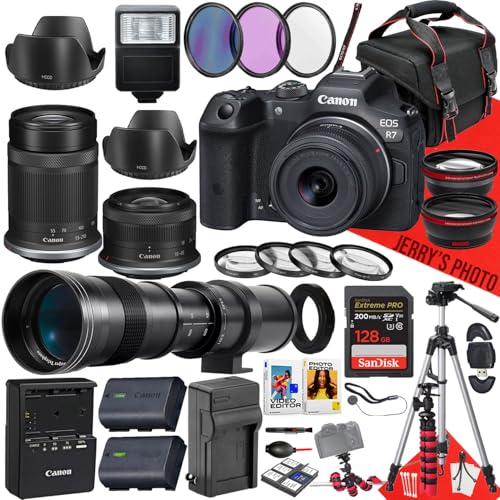
Canon EOS R7 Bundle with Two Zooms and Telephoto — The deliberate stretch
Every tier guide needs one pick that breaks the tier on purpose, clearly labeled, for the reader whose needs were never really inside it. The R7 is that pick. Canon’s APS-C flagship-class body brings a denser sensor of about 32 megapixels, in-body stabilization, weather sealing, dual card slots, and autofocus descended directly from the company’s professional sports cameras — and the verified bundle wraps it with the 18-45mm and 55-210mm zooms plus a long third-party telephoto, a whole wildlife-and-sport wardrobe in one box. Its station relative to the $600 frame is honestly stated: this is the stretch, bought by leaving the tier’s heartland behind.</p
Why would a beginner stretch? Because some subjects punish entry cameras in ways no technique repairs. Birds in flight, a striker at the far post, a dog mid-agility-course — these demand tracking autofocus that predicts, burst rates that harvest moments, and a sensor whose crop-friendly resolution survives telephoto hunger. The R7’s APS-C sensor is an advantage here rather than a compromise: its crop magnifies lenses, so the bundle’s telephotos reach further than the same glass on full frame, and the whole system stays carryable in a way full-frame wildlife rigs never are.
The bundle’s long third-party telephoto should be read with a grown-up eye. Lenses of its class trade refinement for reach — slower focusing, gentler contrast — and it will show a new photographer both the thrill of genuine telephoto framing and the reasons serious telephotos cost what they do. As an included tutor it is valuable; as a permanent solution it will eventually argue its owner into the RF telephoto zooms, which is a fine and predictable journey. The two Canon zooms, meanwhile, cover the everyday range with stabilization and manners.
Buy the stretch only if the subjects demand it, because the R7’s surplus is specialized: speed, sealing, and resolution density that family photography rarely touches. The buyer who stretches for status gets a heavier bag and a lighter wallet; the buyer who stretches for birds gets a camera that will not be the reason a shot was missed for the next five years. That distinction — need versus appetite — is the most valuable sentence in this entire guide, and the R7 is where we chose to spend it.
- Sensor: APS-C CMOS, about 32 megapixels
- Stabilization: in-body, coordinating with lens IS
- Bundle: two Canon zooms plus long telephoto per listing
- Build: weather-sealed, dual card slots
Strengths
- Professional-grade tracking autofocus and burst behavior
- Dense sensor crops generously for wildlife and sport
- Bundle covers wide-to-telephoto in a single purchase
Trade-offs
- Sits well above the tier’s center in relative cost
- Included long telephoto is a tutor, not a final lens
- Capability surplus goes unused by gentle subjects
Best for: the beginner whose true subjects are birds, wildlife, and field sport, buying once for years
Not suited for: family and travel shooters, whose needs the R50 meets at the tier’s honest center

Canon EOS RP with RF 24-105mm Lens Kit — Full-frame at the tier’s edge
The EOS RP is the temptation this tier always contains: full frame, the sensor size of professional dreams, in the most compact and approachable body Canon has made for it, kitted here with the versatile RF 24-105mm variable-aperture zoom. What the big sensor buys is real — shallower depth of field for portraits that separate a face from a room, cleaner files as light dies, and a certain rendering richness that experienced eyes recognize. For the photographer whose heart is set on available-light portraits and moody interiors, the RP’s argument is emotional as much as technical, and emotional arguments are legitimate in a hobby.
The counter-argument is pace. The RP belongs to the first generation of Canon’s mirrorless full-frame line, and its autofocus, burst speed, and video — 4K in a cropped, contrast-detect form — move at that generation’s gentler tempo. A toddler does not care about your sensor’s dimensions; she cares, in effect, whether the camera found her eye before she turned. The R50, with a smaller sensor and a newer brain, wins that race most days, which is why this guide ranks the full-frame camera fourth in a photography list rather than first.
The kit zoom shapes the RP experience more than buyers expect. The 24-105mm range is genuinely useful — one lens for the street, the landscape, and the family gathering — but its variable aperture surrenders, in dim rooms, much of the light advantage the big sensor promised. The classic RP graduation is the same as every other pick’s here, only more so: a fast RF prime transforms this camera, letting the sensor breathe at last. Price that second lens into the full-frame dream before committing, because full-frame glass is where the system’s real cost lives.
Choose the RP if your photography is deliberate — portraits, interiors, landscapes, the considered frame — and the full-frame look is the thing itself that you want. Choose anything newer if your subjects move like they mean it. The RP has made many photographers happy for years, and its used-market afterlife is honorable; it simply asks its buyer to want what it is actually good at, which is a fair request for any camera to make.
- Sensor: full-frame CMOS, about 26 megapixels
- Kit lens: RF 24-105mm variable-aperture zoom
- Body: the most compact in Canon’s full-frame line
- Video: 4K in cropped form
Strengths
- Full-frame rendering for portraits and low-light interiors
- Compact body keeps the big-sensor format approachable
- Kit zoom covers an unusually wide working range
Trade-offs
- First-generation pace in autofocus, burst, and video
- Kit lens aperture limits the low-light advantage indoors
- Full-frame lenses raise the system’s long-term cost
Best for: deliberate shooters of portraits, interiors, and landscapes who specifically want full-frame rendering
Not suited for: parents and pet owners whose subjects demand modern detection autofocus and speed

Canon EOS Rebel T7 with 18-55mm Lens Kit — The DSLR road, still open
The Rebel T7 is the oldest idea in this guide and still, for a certain buyer, a shrewd one. It is a DSLR: an optical viewfinder showing the world through the lens by mirror and glass, a 24-megapixel APS-C sensor, Full HD video, and the EF-S 18-55mm kit zoom. Its technology generation is plainly yesterday. Its argument is the ecosystem behind it — the EF lens world is the largest used market in photography, decades deep, where fast primes and sturdy zooms change hands for gentle money at every camera fair and online marketplace on earth.
Shooting through an optical finder is a distinct pleasure that mirrorless has not replicated: no lag, no battery drain, the scene itself rather than a screen’s opinion of it. Beginners raised on the T7 learn exposure by consequence, because the finder does not preview it, and many educators still prefer that discipline. The camera’s autofocus through the finder is simple — a modest spread of points — and through the rear screen it is slower still, so the T7 teaches a centered, deliberate style whether it means to or not.
The honest debits are equally plain. Video stops at Full HD and behaves like an afterthought, the burst rate suits portraits rather than sport, and Canon’s future plainly belongs to the RF mount, so every EF lens bought is bought into a system whose new development has ended. For a teenager’s first camera, a school’s photography club, or a buyer planning to feast on used glass for two years and then decide, those debits are acceptable rent. For a buyer seeking a five-year platform, the R100 rents the same lessons inside the living system.
We include the T7 without embarrassment and without illusion. It has introduced more people to photography than any other camera shape in history, its kit is complete and honest, and its photographs — in daylight, at family distances, through that clear finder — remain genuinely good. Just buy it for what it is: the inexpensive door into a vast, finished library of lenses, not a ticket to photography’s future tense.
- Sensor: APS-C CMOS, about 24 megapixels
- Finder: optical pentamirror viewfinder
- Video: Full HD recording
- Kit: EF-S 18-55mm zoom
Strengths
- Access to the enormous, affordable used EF lens market
- Optical viewfinder shooting with long battery life
- A complete, gentle-priced introduction to real photography
Trade-offs
- Video and live-view autofocus belong to an older era
- The EF system is complete but no longer developing
- Burst speed and AF coverage limit action work
Best for: students, clubs, and bargain hunters planning to build a used-lens kit
Not suited for: buyers wanting a developing platform, modern video, or fast subject tracking

Panasonic LUMIX ZS99 — The no-system alternative
One pick in every system-camera guide should interrogate the premise, and the ZS99 does it with a smile. It asks the reader: did you actually want interchangeable lenses, a bag, a mount to be loyal to — or did you want good photographs of trips and grandchildren from something that fits a jacket pocket? If the honest answer is the second, this Panasonic, with its 24-720mm zoom, 4K video, tilting screen, and control ring, is not the consolation prize. It is the correct camera, and the five system cameras above are the detour.
Its photographic character suits the traveler-photographer precisely. In daylight — the light of viewpoints, markets, and coastal walks — the long zoom frames what feet cannot reach, the wide end swallows architecture whole, and 4K photo modes pluck stills from bursts when a moment moves too fast for a shutter press. The sensor is small, so dusk and interiors ask for the wider, brighter part of the range and a steady hand, but travel life is mostly lived in the generous hours anyway, and this camera is optimized for exactly those hours with a candor the system cameras could learn from.
The deeper argument is behavioral. System cameras demand decisions forever — which lens today, which to buy next, what the kit is worth — and for many owners that hobby-within-the-hobby is the joy. For others it is friction that quietly keeps the camera home. The ZS99 removes the entire layer: one camera, one pocket, no mount politics, no second-lens budget haunting the purchase. Its owner photographs more, sooner, with less, and several professionals keep a camera of exactly this class as their off-duty instrument for that reason.
Buy the ZS99 if your photography is a companion to a life rather than a project of its own, and revisit the system question in two years with real evidence about your habits. Buy any Canon above if the project is the point. Both decisions are photography; only one of them requires a bag, and there are years — new babies, big trips, small apartments — when the bag is precisely what a life cannot accommodate.
- Lens: 24-720mm equivalent, 30x optical zoom
- Video: 4K recording with still-extraction modes
- Design: pocketable body, tilting screen, control ring
- System: none — fixed lens, no mount commitment
Strengths
- One pocketable camera ends every lens decision permanently
- Huge zoom range covers travel subjects end to end
- No second-lens budget or bag required, ever
Trade-offs
- Small sensor limits dusk, indoor, and telephoto finesse
- No upgrade path; growth means a different camera
- No viewfinder-class handling for deliberate work
Best for: travelers and family photographers who want photographs without a system to manage
Not suited for: anyone who already knows they want interchangeable lenses and manual growth
Should the money go to the body or to the lens?
Spend a hypothetical budget both ways and compare the photographs. A flagship body behind a dim kit zoom produces, in a lamplit living room, slow shutter speeds, raised sensitivity, and faces smeared by motion. A humble R100 behind a fast prime produces, in the same room, a shutter speed that freezes the laugh, an aperture that melts the cluttered background, and a file that looks like the memory felt. Glass shapes light before the sensor ever votes, which is why experienced photographers sound like a proverb on this subject: bodies are rented, lenses are married.
The exception proves the rule by naming its subjects. Autofocus lives in the body, and for birds, sport, and sprinting toddlers, body capability — the R7’s tracking, the R50’s detection — is not a luxury layered over the lens but the precondition of the photograph existing at all. So the refined advice runs: fund the lens first for still subjects and available light; fund the body first when the subject’s motion is the problem. Most beginners’ subjects are people in rooms, which is why the lens usually wins the argument in this tier.
There is a third claimant on the budget that guides mention too rarely: the unglamorous kit of bag, spare battery, cards, and a cleaning cloth, plus the printing of photographs. A printed album teaches a beginner more about their own eye than any upgrade, because paper is honest about what the photograph actually contains. Reserve a slice of the tier for the life around the camera, and the camera itself will be used more, carried more, and judged by results rather than by longing.
How does a beginner get good photographs in the first month?
Pick one subject you love and one hour when the light loves it back, and repeat that appointment weekly. The repetition strips away novelty and forces growth: the same grandchild, garden, or street corner, photographed again, shows you what changed in your seeing rather than in your circumstances. Every camera in this guide is capable of a superb photograph under that discipline, and none is capable of rescuing its absence. Gear questions shrink to their proper size within a month of honest practice.
Learn the three exposure controls as one idea rather than three chapters. Aperture is how much of the scene is sharp and how fast the lens drinks light; shutter speed is how motion is written; sensitivity is the price paid when the first two cannot balance the room. Modern cameras will happily automate all three, and the beginner’s task is not to wrestle them manually forever but to understand what the automation chose, so that when it chooses badly — the backlit portrait, the smeared dancer — you know which lever to reach for.
Shoot far more than feels reasonable and edit with a cold eye. The delete key is the cheapest tuition in photography. Keep the frames that surprise you, study the ones that failed for one named reason each — too slow, too far, light behind — and let next week’s session answer exactly those failures. A camera at this tier, used this way, produces a year-one portfolio that embarrasses many an expensive camera used as a talisman. The instrument matters; the itinerary matters more.
What changes when the same money buys used instead of new?
The used market rewrites this tier’s map entirely, and honesty requires saying so. Yesterday’s enthusiast bodies, retired by upgraders, offer sealing, speed, and sensors that embarrass new entry cameras, and the EF lens library behind the T7 exists because of that churn. The costs are real but different: no warranty warmth, unknown shutter histories, batteries of uncertain age, and the buyer’s own knowledge as the only inspection department. A confident buyer with a knowledgeable friend should absolutely shop used at this level.
New purchases buy a different bundle: warranty, current autofocus science, video that matches modern expectations, and a mount with a future. For a first camera — bought by someone who cannot yet judge a used body’s health — those are not soft comforts but the substance of the purchase. Our list is a new-camera list because its readers are, by the guide’s premise, at the beginning. Let the second camera be the used adventure; let the first be the reliable teacher.
Whichever road you take, resist the parallel purchase of everything at once. A body, its kit lens, and time will tell you what you actually photograph, and that knowledge is the only safe basis for the second lens, the tripod, or the flash. The photographers who spend this tier wisely look, from outside, almost slow — one considered addition per season — while their archives quietly outgrow the frantic collectors’. Slowness, at $600, is not a budget failure. It is the strategy.
How do the mounts behind these cameras shape the next five years?
A camera body is a purchase; a mount is a residency. Canon’s RF mount, shared by the R100, R50, R7, and RP here, means the lens a beginner buys this Christmas fits the flagship that same photographer might rent in five years, and the secondhand shelf for that mount deepens every season. This continuity is the quiet reason one brand fills so much of this tier: not that its entry bodies are magically superior in every row of a chart, but that money spent inside its ecosystem keeps working as the photographer grows, instead of being stranded by an upgrade.
The EF world behind the T7 teaches the opposite lesson with equal clarity. It is a finished civilization of glass — magnificent, affordable, and no longer building. A buyer can feast there for years at gentle prices, and many do, but every lens is a citizen of a country whose capital has moved. For a student on a two-year horizon that is irrelevant; for a buyer imagining a decade, it is the whole decision. Neither answer is wrong. Confusing the two horizons is the only real error available at this tier.
Third-party lenses complicate the picture pleasantly. Independent makers have historically filled the gaps the big brands priced high — fast primes, quirky zooms, macro specialists — and their support for a mount signals that mount’s health. When shopping any system at this level, glance at the third-party shelf before committing: a mount with rivals competing to serve it will treat your wallet better across ten years than a mount with a single, unhurried landlord.
Adaptation deserves its sentence too. Canon’s EF-to-RF adapters let yesterday’s EF glass work on today’s R bodies with surprising grace, which softens the T7’s dead-end problem for anyone who later migrates: the lenses can follow, the body cannot. A household that starts on the Rebel and graduates to an R body in three years has not wasted its lens money, merely its finder nostalgia. Knowing that bridge exists turns the DSLR road from a cul-de-sac into a scenic detour, and several picks in this guide become easier to choose with that map in hand.
What do the numbers on the box not tell a first-time buyer?
Megapixels headline every listing here and matter least among the headline numbers. The spread between the R100’s sensor and the R7’s denser one is real — cropping freedom, print size at the margins — but a beginner’s photographs will be limited by light, lens, and timing for years before resolution files a complaint. Buyers seduced by the biggest number routinely underfund the lens that would have improved every single frame, which is the tier’s most expensive reading error.
Video specifications mislead the stills buyer in the opposite direction: a camera can wear a proud 4K badge while delivering that video in a cropped, gentle form unsuited to serious work, as several picks here honestly do. Since this guide ranks for photography, we treated those badges as footnotes — but a hybrid buyer must read the fine print per model, because the same two characters on two boxes describe different instruments. The R50’s video is a feature; the RP’s is a courtesy. Knowing which you are buying is the entire game.
Kit lens ranges hide their meaning in plain sight. An 18-45mm and an 18-55mm sound interchangeable, and for learning they nearly are; what matters is that both are daylight lenses whose apertures dim as they zoom, shaping the beginner’s first indoor disappointments. The numbers that would actually predict those evenings — maximum aperture at the long end — sit in smaller print than any megapixel count. Train your eye to find aperture, autofocus behavior, and stabilization before resolution, and you will read every future camera box like a professional.
Finally, weight and dimensions are specifications too, and the most predictive of all. The camera whose size fits your daily bag gets carried; the technically superior camera that stays home produces no photographs whatsoever. Every pick in this guide was weighed partly on this invisible axis, which is why the compact R50 and the pocket ZS99 keep defeating larger theoretical rivals in real households. Your future archive cares about presence, not potential.
How should a new owner set up the camera on day one?
Resist the urge to photograph something precious immediately. Spend the first hour on administration: charge the battery fully, format the card in the camera, set the clock, choose RAW plus JPEG if the body allows both, and turn on the grid lines that will quietly teach composition for months. Photograph the room you are sitting in at every ISO setting and study the results at full size, so the camera’s noise character becomes a known quantity rather than a nasty surprise at a birthday.
Then simplify the machine to your level. Program modes and scene settings exist to be used without shame while the fundamentals settle; the sin is not automation but unexamined automation. Pick one semi-automatic mode — aperture priority for most still subjects — and live in it for a month, watching what the camera chooses and occasionally overruling it. The R50’s guided interfaces accelerate this apprenticeship; the T7’s plainer manners enforce it. Both roads reach the same literate photographer by different weather.
Set up the unglamorous safety nets as well: a folder routine on your computer named by date, a second copy of anything irreplaceable, and a card habit that never formats until the copies are verified. Beginners lose more photographs to housekeeping than to bad exposure, and the loss is always discovered after the card has been reused. Ten minutes of system on day one is the cheapest insurance in this entire guide, and it pays out in the currency photographers actually care about — the pictures themselves, still existing, years later.
End the day by making one deliberate photograph of somebody you love, in the best light your home offers, and printing it if you possibly can. That print becomes the baseline the next year is measured against, and it converts the purchase from an object into a practice. Cameras at this tier are bought for a decade of such baselines, each quietly better than the last, and the first one matters out of all proportion to its technical quality.
Which genres flatter each tier station most honestly?
Street photography rewards the small and the quick-witted: the R50 with a compact prime, or the ZS99 riding in a coat, both disappear into a city’s rhythm in a way the sealed R7 never attempts. Portraits reward the opposite virtues — the RP’s sensor rendering, a fast lens, and time — and punish haste, which is why the same budget reads as generous in a studio corner and thin on a sideline. Matching genre to station is not pedantry; it is the difference between a camera that feels like an ally and one that feels like an apology.
Landscape work is this tier’s great democrat, because tripods and patience erase most body differences. An R100 at dawn on a steady support, stopped down and deliberate, will out-photograph an R7 handheld at noon by a careless owner, and the print on the wall will not confess which body made it. Beginners drawn to landscape should therefore fund the tripod and the alarm clock before the body upgrade, a sentence that sounds like a joke and is actually the genre’s whole professional secret.
Family documentary — the genre most buyers at this tier actually practice — sits between the poles: indoors, unrepeatable, lit by lamps and love. It rewards detection autofocus, a fast lens, and a camera small enough to be present at breakfast. That is the R50’s home ground and the reason it anchors this guide’s recommendation, but notice how the verdict was reached: by the genre’s demands, not by a specification beauty contest. Name your genre honestly and the tier sorts itself.
Macro and product hobbies deserve a footnote of encouragement, because every body here can serve them with the right lens, and the lens is genuinely the story in close-up work. A beginner smitten by insects or Etsy listings should invert the usual budget without guilt: modest body, serious macro glass, patient light. The tier’s flexibility — the fact that one mount can pivot from toddlers to tarantulas with a lens swap — is the deepest argument for system cameras at this price, and the ZS99’s fixed lens is the only pick that cannot follow you there.
Whatever the genre, give the choice a season before judging it. Cameras reveal themselves across weather, subjects, and moods, and the first month’s frustrations are usually the photographer’s tuition rather than the equipment’s verdict. The tier is forgiving: every pick here can be grown with, sold onward, or handed down. Buy the one whose station matches your subjects, and let the year arbitrate.
Comparison Table
| Pick | Sensor | Station in the tier | First second lens to dream of |
|---|---|---|---|
| Canon EOS R50 Bundle | APS-C | Balanced center | A fast RF prime for indoor life |
| Canon EOS R100 Kit | APS-C | Sensible floor | The same prime — that is the plan |
| Canon EOS R7 Bundle | APS-C, denser | Deliberate stretch | A serious RF telephoto zoom |
| Canon EOS RP Kit | Full-frame | Sensor-size temptation | A fast RF prime to free the sensor |
| Canon EOS Rebel T7 | APS-C DSLR | Legacy road | A used EF fast prime, gently priced |
| Panasonic ZS99 | Small compact | No-system alternative | None — that is its philosophy |
Common Mistakes
Spending the whole tier on the body. A flagship body behind only a kit zoom is a sports car on bicycle tires. Hold back enough for the second lens, or buy the humbler body that leaves the lens fund intact.
Chasing sensor size past your subjects. Full frame flatters deliberate, still subjects and taxes everything else in cost and lens weight. Moving children vote for autofocus generation over sensor dimensions every time.
Judging the kit lens as the system’s ceiling. Every kit zoom here is a starting tutor, deliberately modest. Condemning a mount because its bundled lens is dim is like judging a language by its phrasebook.
Buying the stretch without the subjects. The R7’s gifts are specialized. Purchased for status, it is a heavier, costlier R50; purchased for birds and sport, it is five years of not missing.
Never printing anything. A year of photography that lives only on a phone screen teaches half its lessons. Print the best frame each month and the eye sharpens on evidence rather than on gear forums.
A word about gifts, because this tier is where cameras are most often bought for someone else. A gifted camera succeeds when it matches the recipient’s patience, not the giver’s ambition: the ZS99 for the traveler who never asked for a hobby, the R100 for the teenager whose interest is real but unproven, the R50 for the new parent whose subjects are about to move very fast. Include the memory card, the small bag, and — most valuable of all — an afternoon of your own time to set it up together. The unglamorous extras decide whether the box becomes a camera or a closet monument.
And a word about patience with prices, stated without printing any: this tier’s kits are bundle-shaped, and bundles breathe. A configuration that sits above the frame this month may settle into it next season wearing a different lens pairing, and a configuration inside the frame may be a stripped variant missing the accessory you assumed. Read what the specific listing contains — body, lens, bundle extras — with the same care you would give the camera’s own specification, because at this level the box’s contents are half the product.
Students should also know that education discounts, school programs, and manufacturer refurbished channels exist across this industry and can move a station within reach without changing which station is right. Refurbished bodies sold by the maker with a warranty are the thinking buyer’s shortcut — yesterday’s tier at yesterday’s price with tomorrow’s support — and they pair beautifully with the lens-first philosophy argued throughout this guide.
Keep the receipt, register the warranty, and write the serial number somewhere that is not the box in the recycling. Cameras at this level travel, get lent, and occasionally get lost, and the household that can produce its paperwork in one minute is the household whose insurance conversation goes well. It is a dull paragraph to end the advice on, and dull paragraphs are frequently the ones that save a purchase.
One more habit separates the owners who thrive at this tier: a small notebook, paper or phone, where settings experiments and their results live. Photography’s lessons evaporate quickly when they are only felt; written down, they compound. Three lines after each serious session — what the light was, what you chose, what you would change — will do more for your second year than any accessory catalogued anywhere in this guide.
Borrow a tripod before buying one, if the genre tempts you. A single dawn with a borrowed support teaches whether your temperament enjoys the slow ceremony, and the answer — not the catalog — should decide that purchase too, as it should every considered addition to the kit you are slowly, deliberately building across seasons of actual use rather than a single afternoon of retail excitement and hopeful guessing about subjects you may never actually photograph.
Final Recommendation
Most readers should buy the R50 bundle, reserve the difference for a fast prime within the year, and spend the saved anxiety on photographs. The firm-budgeted should take the R100 and the same lens plan without a flicker of shame, the wildlife-hearted should stretch to the R7 knowing exactly why, and the deliberate portraitist may follow the RP’s full-frame pull with open eyes. The T7 serves its students and the ZS99 its travelers, each honestly. At this tier the winning move was never finding the perfect camera; it is choosing the camera whose compromises sit where your photographs will never notice, and then going out to make the photographs.
Frequently Asked Questions
Is the figure in the title a hard budget ceiling?
No — it frames a tier. Kits drift above and below the mark with seasons and bundles, and this guide prints no per-product prices for exactly that reason. Judge each pick by its station: floor, center, stretch, or alternative.
Which pick is best for photographing children and pets?
The R50, for its subject-detection autofocus, flip screen, and modern pace in indoor light — ideally paired later with a fast prime. The R7 exceeds it for outdoor sport and wildlife, at the stretch station described above.
Does full frame matter at this level?
It matters for specific pleasures: portrait separation and low-light rendering, which the RP offers. It does not automatically produce better photographs, and its lens costs compound. Buy it as a chosen aesthetic, not as a default assumption of seriousness.
Can these cameras shoot good video too?
The R50 is the strongest hybrid here, with the R100 and ZS99 offering simpler 4K and the RP a cropped form. This guide ranked for stills; a video-first buyer should weight the R50 even more heavily and read its video specification closely.
What second lens should a beginner buy first?
A fast prime near the classic portrait-and-street focal lengths, in whichever mount the body uses. It transforms indoor family photography, teaches aperture by experience, and retains value across body upgrades.
Is a DSLR like the T7 a mistake in the mirrorless era?
Not for its intended buyer. It is a complete, inexpensive teacher with access to a vast used-lens market. It is only a mistake when bought expecting a developing platform or modern video, neither of which it claims to be.
Related Guides
Keep reading with best camera lenses to buy after your first kit zoom, how to learn exposure with any beginner camera, and mirrorless vs DSLR for a first serious camera.


