What's inside
- Key Takeaways
- Quick Picks
- How Did We Judge a Range Where Four Bodies Share a Sensor?
- What Actually Changed Between GFX Generations?
- How Should You Read a Camera Bundle Before Trusting It?
- How Does the GF Lens Catalogue Divide the System?
- What Should a Full-Frame Photographer Expect on Switching?
- How Do Working GFX Owners Actually Configure Their Kits?
- Which Fujifilm Body Matches Which Photographer? A Side-by-Side Reading
- How Do You Actually Shoot With a GFX Body Day to Day?
- What Goes Wrong When People Buy Into GFX?
- What About Renting, Used Bodies and the Upgrade Ladder?
- Final Recommendation
- Frequently Asked Questions
- Related Guides
As an Amazon Associate I earn from qualifying purchases. This post may contain affiliate links at no extra cost to you.
gizmoverdict.com is reader-supported. When you buy through links on our site, we may earn an affiliate commission.
Where to buy: Fujifilm’s GFX bodies reach Amazon through a mixture of Fujifilm’s own storefront presence, authorised dealers and bundle specialists who package bodies with lenses, cards and bags. Several picks in this guide are bundles, and each review names exactly what its bundle adds — and what those extras are realistically worth — because a kit is only a bargain when the parts inside it are parts you would have bought anyway.
The best Fujifilm medium format cameras now span three generations of one idea: take the GFX sensor, wrap it in a body that behaves like a serious mirrorless camera, and price the result below every historical notion of what medium format should cost. The current range runs from the 102-megapixel flagships down through a fixed-lens outlier to two legacy bodies that still sell because the files they make never got the memo about being old. Choosing between them is less about resolution — four of the six picks share variants of the same 102-megapixel sensor — than about which generation’s autofocus, stabilisation and handling matches your subjects.
Bundles complicate the picture in a useful way. Fujifilm’s own body-only boxes sit alongside dealer kits that add the lens you were going to buy, or a memory card too small for the files the camera makes, or a tripod better suited to a phone. This guide treats each bundle as its own product: the GFX100S II appears twice, once married to the finest portrait lens in the GF catalogue and once in a leaner accessory kit, because those are genuinely different purchases aimed at genuinely different photographers.
It also helps to say who this range is not for, before the reviews spend your time. If your photography is defined by speed — sport, wildlife at the long end, photojournalism under deadline — even the fastest body here will feel like a compromise wearing a beautiful sensor, and Fujifilm’s own high-end APS-C and the full-frame flagships of other systems serve that work better. The GFX range assumes your subjects can be approached deliberately: portraits that sit, landscapes that wait, products that hold still, streets that reward patience. Inside that assumption it is the most rewarding system in photography; outside it, no sensor size compensates.
One promise before the details: nothing here will pretend a legacy body is a current one. The original GFX 50S that closes the list is a 2017 camera with contrast-detection autofocus and no in-body stabilisation, and it is recommended — warmly, but with its age printed on the label — as the legacy entry it is. Fujifilm’s medium format story is strong enough that it does not need its history airbrushed.
Key Takeaways
- Four of the six picks use 102-megapixel sensors; the differences that matter are autofocus generation, stabilisation strength and video depth, not resolution.
- The GF 110mm f/2 bundle turns the GFX100S II into a complete portrait kit in one purchase — the lens is the prize, the accessories are packing material.
- Bundle arithmetic needs suspicion: a 64GB card holds only a few hundred uncompressed 102MP raw files, so card extras are a starting point, not a solution.
- The GFX100RF is the range’s eccentric: fixed lens, leaf shutter, built-in ND, and the only GFX body designed for daily carry.
- The original GFX 100S remains the value sleeper — same sensor family as the flagships, previous-generation pace.
- The 2017 GFX 50S is a legacy doorway: no stabilisation, patient autofocus, and files that still justify the format in good light.
Quick Picks
| Pick | Badge | Why it earns its place |
|---|---|---|
| Fujifilm GFX100S II with GF 110mm f/2 bundle | Best overall kit | The current 102MP body paired in one box with the portrait lens most GFX owners eventually buy anyway. |
| Fujifilm GFX100 II bundle | Best flagship bundle | The flagship body with a properly sized CFexpress card, spare battery and reader — extras chosen by someone who has used the camera. |
| Fujifilm GFX100RF Silver bundle | Best street kit | The fixed-lens 102MP camera in silver, bundled for photographers who will carry it everywhere and change nothing. |
| Fujifilm GFX100S II body bundle | Best body bundle | The same 100S II body in a lighter accessory kit, for buyers who already own GF glass or prefer another first lens. |
| Fujifilm GFX 100S | Best previous-generation value | The original 102MP S body: flagship files, gentler pace, and a used-era price while new stock lasts. |
| Fujifilm GFX 50S | Best legacy entry | The 2017 original that started the system — 51.4MP, no IBIS, and the cheapest honest way into GF lenses. |
How Did We Judge a Range Where Four Bodies Share a Sensor?
When resolution stops separating cameras, the judging moves to everything around the sensor. We weighted autofocus generation first, because the gap between the current subject-detection system and the older contrast-led designs is the difference between a camera that tracks a bride down an aisle and one that prefers its subjects stationary and cooperative. Stabilisation came next — eight stops in the current bodies, six in the original 100S, none at all in the 50S — because handheld usability at 102 megapixels is decided there. Video, viewfinder quality, body size and control layout filled out the assessment.
Bundles were judged as bundles. We asked three questions of every kit: is the headline extra something this camera’s buyer genuinely needs, is it sized correctly for the camera it accompanies, and would the kit still make sense if the soft bag and cleaning cloth were valued at nothing? That last question is the honest one. Most bundle accessories are worth close to nothing; the kits that survive the test do so because of a lens, a properly sized card or a spare battery — items with standalone prices you can verify.
Finally, we kept the generations in their lanes. A previous-generation body can be the smartest buy in a guide without being described as current, and a legacy body can be worth recommending without its limitations being softened. Fujifilm’s range rewards that honesty, because the upgrade path inside the system is real: lenses bought for the oldest body here mount and work on the newest.
What Actually Changed Between GFX Generations?
The first generation — the GFX 50S of 2017 and its 50R sibling — proved the concept with a 51.4-megapixel sensor, contrast-detection autofocus and no in-body stabilisation. The files were revelatory; the handling was deliberate to a fault. The second generation, opened by the GFX100 in 2019 and refined into the GFX 100S of 2021, doubled resolution to 102 megapixels, added phase detection across the sensor, fitted proper stabilisation and made the camera a plausible working tool rather than a tripod instrument.
The current generation — GFX100 II, GFX100S II and the GFX100RF — is defined less by its sensor, which evolves the 102-megapixel design with faster readout, than by its intelligence: subject-detection autofocus that recognises people, animals, birds, vehicles and aircraft, stabilisation up to eight stops, and video that ranges from the 100S II’s 4K/30p to the flagship’s 4K/60p and 8K options. A photographer choosing between generations is really choosing an autofocus era. Static subjects forgive every generation; moving subjects forgive only the current one.
How Should You Read a Camera Bundle Before Trusting It?
Separate the kit into three piles. Pile one is the item with a real standalone price and a real role in your work: the GF 110mm f/2 in our top pick is the clearest example in this guide, a lens with its own reputation and resale value. Pile two is the correctly sized consumable — the flagship bundle’s 128GB CFexpress card and spare battery belong here, because a 102-megapixel body genuinely eats both. Pile three is everything else: the flexible mini tripod, the cleaning kit, the generic bag. Pile three is not worthless, but it should be priced at zero in your head, because a flexible vlogging tripod under a kilogram-plus medium format body is a photo accessory in the same sense that a bicycle pump is a compressor.
Then compare the kit against the body-only listing plus pile one bought separately. Sometimes the bundle wins clearly; sometimes the body-only route with your own choice of first lens wins. What the comparison protects you from is the bundle whose price quietly exceeds both — they exist, and the only defence is arithmetic done before the purchase rather than after the box arrives.

Fujifilm GFX100S II with GF 110mm f/2 bundle — Best overall kit
Most camera kits deserve suspicion; this one deserves a portrait photographer’s full attention, because the extra in the box is the GF 110mm f/2 R LM WR — the lens that functions as the GFX system’s portrait flagship and the single piece of GF glass most often named when owners describe falling for the format. At its 87mm-equivalent field of view and f/2 aperture on a sensor this large, subject separation reaches a quality that full-frame fast primes gesture toward and do not reach. Pairing it with the GFX100S II body in one purchase is simply the portrait kit, bought the way portrait photographers actually assemble it.
The body half of the kit needs no apology. The 100S II carries the 102-megapixel sensor, eight-stop stabilisation and subject-detection autofocus of the current generation in an 883-gram body, which matters more in portraiture than in most genres: sessions are handheld, mobile and long, and a lighter flagship sensor leaves the photographer’s arms fresh for the final set. Eye-detection autofocus holds focus at apertures where the depth of field is measured in eyelashes, and the stabilisation permits handheld work at the shutter speeds natural light in studios and homes actually provides.
Now the honest bundle arithmetic. The 64GB memory card in this kit is a starter, not a solution: uncompressed raw files from this sensor can exceed 200 megabytes, so the card holds a few hundred frames — a portrait session, not a wedding. The flexible vlogging tripod should be valued at nothing for this camera; it is a tabletop phone accessory that wandered into the wrong box. Buy the kit for the lens and the body, price the card as a free first week of shooting, and budget separately for the fast, large media the camera deserves. Judged that way — the only honest way — the kit is the strongest single purchase in this guide.
- Body: GFX100S II, 102MP BSI sensor, IBIS to 8 stops
- Lens included: GF 110mm f/2 R LM WR, 87mm-equivalent portrait prime
- Autofocus: subject detection with eye AF for shallow-depth portraiture
- Media included: 64GB card — a starter, sized for hundreds of raw files
- Also in box: flexible vlogging tripod and accessory extras (value them at zero)
- Video: 4K/30p from the body when a clip is needed
Strengths
- The included 110mm f/2 is the lens portrait buyers would choose first anyway.
- Current-generation autofocus and stabilisation in the lighter flagship body.
- One purchase completes a working portrait setup rather than starting a shopping list.
Trade-offs
- The bundled card is undersized for the sensor; real media costs follow immediately.
- A fixed portrait focal length is a commitment — no wide or standard lens is in the box.
- The accessory filler inflates the kit’s apparent generosity beyond its real value.
Best for: portrait photographers entering GFX who know the 110mm is their lens and want body and glass settled in a single decision. Not suited for: landscape or architecture shooters, for whom the kit’s entire premium sits in a lens pointed at the wrong subjects.
One session-level detail seals the recommendation. Portrait sittings live or die on tethering and review: clients and art directors want to see the frame large, immediately, and this body drives a tethered workflow with the stability commercial sets require, while its film simulations give the review screen a finished-looking preview that sells the shot in the room. Add the lens’s weather sealing for location work in unreliable light and weather, and the kit covers the portrait photographer’s actual calendar — studio days, location days, and the dim churches and register offices in between — without a second body entering the conversation.

Fujifilm GFX100 II bundle — Best flagship bundle
The flagship body arrives in this kit with its consumables already thought through, which is rarer than it should be. The 128GB CFexpress Type B card is the correct type and a workable size for the GFX100 II’s appetites — this body records 4K/60p and 8K video and writes raw files at eight frames per second, and it is precisely the camera for which an undersized bundled card would be an insult. A spare Green Extreme battery, a card reader, a shoulder bag and a cleaning kit round out a package assembled by someone who appears to have shot an assignment with the camera first.
The body itself is the system’s summit: 102 megapixels, eight-stop stabilisation, the 9.44-million-dot viewfinder that can tilt on its adapter for low work, subject-detection autofocus across people, animals and vehicles, and a video specification — 4K/60p, 8K/30p, internal ProRes — that makes it the only GFX body a production can be built around. Commercial photographers buy this camera because it covers the stills contract and the motion addendum with one sensor, one colour pipeline and one lens set.
Value the bundle the disciplined way. The card, reader and spare battery have genuine standalone prices and genuine daily roles; the bag is a serviceable starter you may outgrow; the cleaning kit is a cleaning kit. Even pricing the soft items at zero, the kit’s logic holds, because its extras answer the flagship’s real running costs rather than decorating the listing. If the GFX100 II is your body, this is the form in which to buy it — then spend your lens budget deliberately, because the kit pointedly and correctly leaves glass to you.
- Body: GFX100 II flagship, 102MP, IBIS to 8 stops
- Media included: 128GB CFexpress Type B card plus card reader
- Power: spare Green Extreme battery included alongside the standard pack
- Video: 4K/60p and 8K/30p with internal ProRes recording
- Viewfinder: 9.44M-dot EVF, tiltable with the optional adapter
- Carry: shoulder bag and cleaning kit included as starter accessories
Strengths
- Extras match the flagship’s actual consumption: fast card, spare power, fast ingest.
- The body’s video depth is unmatched anywhere in the Fujifilm medium format range.
- Subject-detection autofocus finally suits events and commercial pace alike.
Trade-offs
- No lens is included, so the kit’s price is the beginning of the system spend.
- The bag is a starter item most professionals will replace within a year.
- It is the heaviest body in this guide once fully dressed for work.
Best for: commercial and hybrid professionals who want the flagship shooting stills and motion from day one, with its running gear already in the box. Not suited for: photographers still deciding on their first GF lens, who should price the body-only route and keep the glass budget uncommitted.
Productions choose this body for a less glamorous reason than its sensor: continuity. When the same camera shoots the campaign stills and the motion cutdowns, colour science, lens rendering and depth-of-field character match across deliverables without a colourist’s rescue work, and clients increasingly write that match into briefs. The tilting viewfinder adapter, an accessory many owners buy within the first month, completes the package for low-angle product and fashion work. It is the most complete single camera Fujifilm has ever sold, and the bundle simply removes the first week’s worth of accessory errands from its ownership.

Fujifilm GFX100RF Silver bundle — Best street kit
The silver finish is not a trivial detail on this camera, whatever the specification sheet implies. The GFX100RF is a fixed-lens, rangefinder-styled instrument that photographers carry the way they carry a beautiful object — visibly, daily, into situations where a black professional body would change the room’s behaviour. In silver, bundled here as the street kit, it leans fully into that identity: 102 megapixels behind a fixed 35mm f/4 lens with a leaf shutter, a built-in ND filter for bright streets, a physical aspect-ratio dial on the top plate, and a total weight of 735 grams that makes the phrase medium format sound like a category error.
The street photographer’s case builds itself. The leaf shutter is quiet enough for candid work at close range and syncs flash at any speed for fill on sunlit corners. The ND filter lets the lens stay near its characterful apertures in hard light without a filter wallet. The aspect dial — switching between 3:2, square, panoramic and other crops as a physical act — changes composition habits in the field, and the digital teleconverter crops to longer equivalent focal lengths while keeping resolution most cameras cannot match uncropped. The bundle’s accessories play support; the camera is the kit.
Honesty requires the fixed lens be treated as the decision it is. You are marrying a 28mm-equivalent view of the world, and your feet become the zoom. There is no in-body stabilisation, so technique and the leaf shutter’s gentleness carry low-light work, and f/4 is the fastest the lens will ever be. Photographers who think in one focal length — and street photography’s history suggests the great ones often did — will experience these limits as a frame rather than a cage. Everyone else should buy an interchangeable body and keep walking.
- Sensor: 102MP behind a fixed 35mm f/4 lens (28mm-equivalent)
- Shutter: leaf type, quiet, flash sync at all speeds
- Filter: built-in ND of about 4 stops, switchable in the field
- Weight: 735g — the carry-everywhere body of the range
- Composition: physical aspect-ratio dial and digital teleconverter crops
- Finish: silver, bundled as the street configuration
Strengths
- Medium format files from a camera that genuinely gets carried every day.
- Leaf shutter discretion suits candid work better than any focal-plane body here.
- The aspect dial and ND filter are working tools, not styling exercises.
Trade-offs
- The focal length is fixed for the life of the camera.
- No in-body stabilisation to rescue slow handheld exposures.
- f/4 maximum aperture caps low-light ambition and subject separation.
Best for: street, travel and documentary photographers who compose at one focal length and want the format’s files without the format’s burden. Not suited for: portraitists, sports shooters or anyone whose notebook of ideas spans focal lengths — the interchangeable bodies exist for them.
There is a lineage worth naming: this camera is the digital heir of the fixed-lens medium format rangefinders that photojournalists and travellers prized on film, and it behaves like one — aperture ring on the lens, shutter dial under the finger, composition through a bright electronic finder with the frame’s shape chosen by a dial rather than a menu. Photographers raised on that tradition describe an immediate fluency; photographers raised on zooms describe a month of adjustment followed by the same fluency. Either way, the silver bundle is the configuration that understands its own romance and prices it fairly.

Fujifilm GFX100S II body bundle — Best body bundle
Same body as the top pick, different philosophy of purchase. This GFX100S II kit skips the portrait lens and bundles the body with a 64GB memory card and a video tripod, aiming squarely at the buyer who already owns GF lenses — the upgrader from an earlier GFX body — or who has a different first lens in mind: the wide zoom for architecture, the standard zoom for events, the macro for product work. For that buyer, the 110mm kit above charges for glass they do not want; this kit keeps the body’s price of entry as clean as a bundle gets.
The body’s virtues bear repeating in their own words because they are the reason two kits in this guide share it. The 102-megapixel sensor with eight-stop stabilisation and current subject-detection autofocus, in a weather-sealed 883-gram shell, is the most carryable full-strength GFX camera Fujifilm has made. Its 4K/30p video is a competent extra rather than a headline, its viewfinder is good rather than flagship, and its burst rate suits every genre short of professional sport. It is the body the range’s centre of gravity now sits on.
Judge the extras plainly. The 64GB card is, again, a first session rather than a media strategy for files of this size. The video tripod is the more interesting inclusion — a real tripod, unlike the flexible mini in the portrait kit — though hybrid shooters should check its head and height against their own working style before valuing it. Neither extra justifies the kit alone; the kit justifies itself by not forcing a lens on you. If your lens decision is already made or already owned, this is your box.
- Body: GFX100S II, 102MP, IBIS to 8 stops, weather sealed
- Included media: 64GB memory card — starter capacity for this sensor
- Included support: video tripod (check head and height against your style)
- Lens: none included — the point of this kit
- Autofocus: current-generation subject detection
- Video: 4K/30p for occasional motion work
Strengths
- Keeps the lens decision — and its budget — entirely in the buyer’s hands.
- The range’s best-balanced body: flagship files without flagship bulk.
- A real tripod in the box beats the novelty supports bundled elsewhere.
Trade-offs
- You still need a lens before the camera takes a single photograph.
- The card is starter-sized for 200MB-class raw files.
- Video tops out at 4K/30p, so committed hybrid shooters should look up-range.
Best for: existing GFX owners upgrading bodies and new entrants whose first lens is a wide, a zoom or a macro rather than the portrait prime. Not suited for: first-time shoppers hoping to open one box and start shooting — the 110mm kit is assembled for exactly that wish.
Upgraders from the original 100S will find this body’s improvements concentrated exactly where their old camera annoyed them: autofocus that finds faces instead of being told where they are, stabilisation that forgives the last hour of a long day, and a processor that reviews a burst before patience becomes part of the workflow. Keeping your existing GF lenses through that upgrade is the system’s central economic promise, and this bundle is priced for the people cashing it in. It is not the exciting kit in this guide; it is the correct one for the largest number of real buyers.

Fujifilm GFX 100S — Best previous-generation value
The original GFX 100S is the guide’s quiet bargain: the 102-megapixel sensor generation that redefined the system, in the compact S body that made it portable, at the kind of pricing that appears when a successor has taken the flagship shelf. Its stabilisation reaches six stops rather than eight, its autofocus predates the subject-detection era while remaining phase-detect and genuinely capable for posed and landscape work, and its 4K/30p video is period-correct. None of those gaps touches the file, and the file is why you are here.
Working photographers keep recommending this body for a specific reason: medium format value lives in the sensor and the glass, and both are fully present here. The same GF lenses mount, the same tonal depth develops, the same enormous prints come off the same printer. What the previous generation asks in return is pace — autofocus that tracks a walking subject with less conviction, a viewfinder and processor that feel a generation old because they are, and a buffer that clears at yesterday’s speed. For landscape, studio, architecture and deliberate portraiture, those are taxes on impatience, not on quality.
Availability is the practical footnote. This is a body whose new stock thins as the successor’s grows, so the listing’s presence is itself part of the recommendation: while it lasts, it is the cheapest route to this sensor in a body with stabilisation and weather sealing. When it goes, the same logic will apply to the used market, where this model is destined to be a long-lived favourite. Buy it with eyes open about its generation and it will not disappoint; buy it expecting the current flagship’s manners and the misunderstanding is yours, not the camera’s.
- Sensor: 102MP BSI — the generation that defined the modern GFX system
- Stabilisation: in-body, up to 6 stops
- Autofocus: phase detection, pre-subject-detection generation
- Video: 4K/30p, period specification
- Body: compact S form factor, weather sealed, about 900g
- Mount: full GF compatibility with every current lens
Strengths
- The full 102MP file quality at previous-generation pricing.
- Stabilised and sealed — a working body, not a fragile bargain.
- Every current GF lens mounts and performs as designed.
Trade-offs
- Autofocus tracking belongs to an earlier era; moving subjects test it.
- Six-stop stabilisation and a slower buffer trail the current bodies.
- New stock is finite and will not be replenished forever.
Best for: landscape, studio and architecture photographers who want this sensor’s files and can trade autofocus vintage for a substantial saving. Not suited for: event and wedding shooters whose income depends on tracking focus through chaotic, moving scenes.
Studio owners discovered a second career for this body that its successor’s arrival created: as the tethered second camera. Mounted over a product set or dedicated to a copy stand, its identical files integrate invisibly with the flagship’s output, and its price makes dedicating it to one station rational in a way a current body never quite is. Architecture photographers make a parallel case — tripod work erases every one of its generational gaps, leaving only the sensor, the tilt-shift lenses and the saving. Previous-generation value is a cliché in camera guides; in this specific body it happens to be arithmetic.
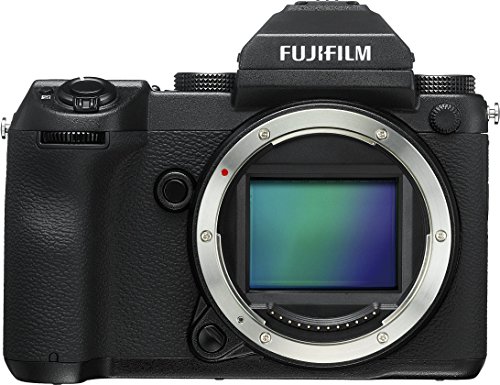
Fujifilm GFX 50S — Best legacy entry
Every system has a first chapter, and the GFX 50S is Fujifilm’s: the 2017 body that carried a 51.4-megapixel sensor into a market that assumed medium format digital would stay a five-figure curiosity. Its rangefinder-influenced design, detachable electronic viewfinder and tilting screen were the system’s founding statements. Nearly a decade on, the founding statement still photographs — the sensor’s files, at base ISO in kind light, carry the tonal smoothness that sold the entire concept, and the GF mount on its front accepts every lens Fujifilm has made since.
The legacy label must be worn honestly, so here is what 2017 means in practice. There is no in-body stabilisation at all: shutter speeds must respect the megapixels, or a tripod must do the respecting. Autofocus is contrast-detection only, accurate and unhurried, suited to landscapes, still life and cooperative portraits. Video stops at Full HD and belongs in the emergency column. The detachable viewfinder, futuristic in its day, is lower in resolution than anything else in this guide. A buyer who needs any of those sentences to be false should stop reading here and buy the GFX100S II bundle above.
And yet the recommendation stands, for a defined photographer: the deliberate one. Film-era medium format shooters, landscape photographers who already live on tripods, and newcomers who want to learn the format’s disciplines while investing their real money in GF lenses will find this body a rational doorway. Lenses bought for it serve every newer body in this guide when the upgrade comes. The 50S is not a shortcut around the system’s cost — it is a rescheduling of it, body money deferred so lens money can lead, and for the right photographer that is the smartest order of operations in this entire article.
- Sensor: 51.4MP, the founding GFX generation
- Stabilisation: none — tripod or shutter-speed discipline required
- Autofocus: contrast detection only, accurate and deliberate
- Video: Full HD only
- Viewfinder: detachable EVF, an original design feature of the model
- Mount: GF — full access to the modern lens catalogue
Strengths
- The lowest-cost body that still opens the complete GF lens system.
- Base-ISO files retain the tonal character that built the format’s case.
- A mature, understood design with a decade of community knowledge behind it.
Trade-offs
- No stabilisation whatsoever — technique or tripod, no third option.
- Contrast-only autofocus rules out moving subjects as a serious use.
- Age brings battery, service and wear considerations a new body avoids.
Best for: tripod-based landscape and still-life photographers, and system newcomers who want their budget concentrated in lenses that outlast bodies. Not suited for: handheld shooters, event work, video of any ambition, or anyone who hears the word legacy as a synonym for bargain rather than a description.
Practical ownership notes close the case. Batteries for this generation remain available and affordable, the detachable viewfinder means a damaged finder is a replaceable part rather than a repair bill, and the body’s shutter and dial layout taught a generation of owners habits that transfer directly to the current bodies. Treat it as the system’s apprenticeship — a year or two of learning the format’s patience on the 50S leaves a photographer genuinely ready to extract everything from a flagship, lenses already bought, disciplines already learned. Few cameras in any system offer a clearer account of what they are for.
How Does the GF Lens Catalogue Divide the System?
A body decision inside GFX is really a lens decision wearing a disguise, so the catalogue deserves its own map. The portrait shelf holds the GF 110mm f/2 from our top kit and the faster, costlier 80mm f/1.7, between them covering the two classic portrait distances with rendering that made the system’s reputation. The standard shelf is anchored by the 32-64mm zoom — the lens many working kits are built around — and the compact 50mm f/3.5 pancake that turns any GFX body into a deliberate walk-around camera. Landscape and architecture photographers look to the wide zooms, the 100-200mm telephoto zoom and the tilt-shift pair, which bring perspective control that no rival medium format system currently matches natively.
Two properties of the catalogue matter beyond the focal lengths. First, it is complete in a way medium format ranges historically were not: a professional can cover weddings, architecture, product and portraiture without leaving the mount or adapting a single lens. Second, its pricing, while serious, is consistently the gentlest in the modern format — the same money that buys one lens in the Swedish system often buys a GFX lens and most of another. That arithmetic is why this guide’s kits keep steering budget toward glass: inside GFX, glass is where the system’s value compounds.
What Should a Full-Frame Photographer Expect on Switching?
The first week teaches three lessons, usually in this order. Depth of field is the first: at equivalent framing and aperture, the larger sensor renders visibly shallower focus, so the f/2.8 habits of full-frame life become f/4 habits, and group portraits demand a re-learned discipline of stopping down and arranging planes. The second lesson is pace. Even the current bodies start, focus and review at a tempo below flagship full-frame manners, and the photographer who shoots a GFX body like a sports mirrorless will manufacture disappointment; the one who slows down half a beat discovers the files reward exactly that.
The third lesson arrives at the computer. Files are two to four times the size of full-frame raws, culling slows, exports lengthen, and the backup folder grows at a rate that turns storage from an afterthought into a budget line. None of this is hidden cost in the dishonest sense — it is the format’s physics, disclosed in every review including this one — but photographers who plan for it describe the switch as an upgrade, while those who discover it describe the same switch as a burden. The cameras are identical in both stories; the planning is the variable.
How Do Working GFX Owners Actually Configure Their Kits?
Patterns repeat across the owners we hear from, and they are worth more than another specification table. The portrait configuration is the 100S-class body with the 110mm f/2 and the 80mm or a standard zoom as its partner — precisely the logic of our top kit, extended by one lens. The landscape configuration pairs the same body class with the wide zoom and the telephoto zoom, skipping fast primes entirely, because apertures live at f/8 and beyond where zooms are at their best. The commercial configuration centres the GFX100 II, tethered, with the standard zoom for volume and one fast prime for hero frames.
Notice what none of these configurations does: none leads with the flagship body plus a single compromised lens, and none treats the rangefinder RF as a system starter — its owners buy it after their interchangeable kit exists, as the camera for everything outside the assignment. The legacy bodies slot in as second bodies and as teaching cameras, roles their pricing makes rational. Configure like the owners and the range’s logic — sensor first, glass second, body generation third — stops being this guide’s opinion and becomes simply how the system is used.
Which Fujifilm Body Matches Which Photographer? A Side-by-Side Reading
| Pick | Sensor | Stabilisation | Autofocus era | What the box adds |
|---|---|---|---|---|
| GFX100S II + GF 110mm kit | 102MP | 8 stops | Subject detection | The portrait lens itself, plus a starter card |
| GFX100 II bundle | 102MP | 8 stops | Subject detection | 128GB CFexpress card, spare battery, reader |
| GFX100RF Silver bundle | 102MP fixed lens | None — leaf shutter | Current generation | The street configuration in silver |
| GFX100S II body bundle | 102MP | 8 stops | Subject detection | Starter card and a video tripod, no lens |
| GFX 100S | 102MP | 6 stops | Phase detection, earlier era | Body only — the value is the price |
| GFX 50S | 51.4MP | None | Contrast detection only | Body only — the system’s founding design |
The autofocus-era column is the table’s honest core. Everything else — resolution, stabilisation, even price — can be argued around, but a photographer whose subjects move needs the current generation’s subject detection, and a photographer whose subjects hold still can save substantially by ignoring it. Read your own diary of shoots against that column and the shortlist usually writes itself.
How Do You Actually Shoot With a GFX Body Day to Day?
New owners benefit from a handful of working habits that the format rewards. Shoot raw plus a film-simulation JPEG: the simulations are good enough that the JPEG often becomes the delivered preview while the raw waits for the frames that matter, and the pairing costs little on modern cards. Use the stabilisation, but respect its limits — at 102 megapixels, pixel-level sharpness still prefers a braced stance and a shutter speed a stop faster than the reciprocal rule suggests, particularly with the longer GF lenses. And learn the aspect-ratio tools: the sensor’s size makes cropping to 4:5, square or the XPan-style panoramic ratio a compositional choice with resolution to spare, rather than the act of desperation it is on smaller sensors.
Focus technique deserves its own sentence in each generation’s dialect. Current bodies: trust the subject detection, but confirm with a magnified check on the frames that carry the session — depth of field at f/2 on this sensor is thin enough that an eyelash’s difference is a real distance. Earlier bodies: use single-point autofocus placed deliberately, or focus manually with peaking on static work, and treat the contrast system’s hunting in dim light as information that the light, not the camera, has become the problem. Video shooters on the flagship should budget media by the hour rather than the day — 8K and high-bitrate 4K consume cards at a rate stills habits never predict.
Finally, build the ingest ritual before the first big shoot, not after it: two card readers, a checksum-verified copy to the working drive, a second copy before any card is formatted, and a catalogue structure that assumes tens of thousands of very large files. Owners who describe GFX ownership as effortless have almost always industrialised this hour of the week; owners who describe it as a burden are usually improvising it. The cameras in this guide are the enjoyable part of the system — the discipline around them is what makes the enjoyment sustainable.
What Goes Wrong When People Buy Into GFX?
The most common regret is lens sequencing. A buyer stretches for the flagship body, discovers the GF lens prices afterwards, and spends a year shooting a great sensor through a borrowed-feeling compromise. The kits in this guide exist partly as a corrective: the 110mm bundle and the previous-generation 100S both represent the alternative philosophy — let the glass lead, let the body follow — and photographers who buy that way almost never describe regret.
Second is underestimating the file pipeline. A GFX raw file is not a slightly larger full-frame file; at 102 megapixels uncompressed it can exceed 200 megabytes, and a day’s shooting becomes a storage event. Cards, readers, drives and backup all scale, and the 64GB cards bundled in two of these kits should be read as the first paragraph of that story, never the whole of it.
A fourth error is subtler and specific to this range: buying the GFX100RF as a system substitute. It is a complete camera and a delightful one, but owners who purchase it hoping it will cover portrait commissions or architectural work discover the fixed lens’s limits at the worst possible moment — mid-brief. The RF is the second Fujifilm body for most of its happiest owners, or the only body for photographers whose work genuinely lives at one focal length. Mistaking it for a flexible system starter is the one purchase in this guide that cannot be corrected by adding a lens later, because there is nowhere to add one.
Third is expecting the legacy bodies to behave like current ones. The GFX 50S has no stabilisation and contrast-only autofocus; the original 100S tracks with a previous generation’s conviction. Both are recommended in this guide with those facts attached, and both disappoint only the buyers who skipped the facts. Fujifilm’s own upgrade path is the consolation: every lens and most habits transfer upward when the time comes.
What About Renting, Used Bodies and the Upgrade Ladder?
Fujifilm’s range has an unusually legible second-hand ladder, and smart buyers use it. The pattern repeats: a flagship launches, the previous body drops, and photographers whose subjects are static buy a generation behind at a fraction of launch pricing — the original GFX 100S in this guide is riding exactly that curve while new stock remains. Renting before buying deserves repeating in this system’s context because the rental answers the format’s real questions — file size, pace, depth of field — in your own workflow rather than in a reviewer’s. A weekend with the 100S II and the 110mm will teach a portrait photographer more than a month of comparison charts.
The upgrade ladder inside GFX is also genuinely climbable, which is rarer than marketing suggests. Because the mount, batteries’ broad logic and handling language persist across generations, moving from a 50S to a 100S II is an afternoon’s adjustment rather than a re-education, and every lens transfers at full value. Plan the ladder when you enter it: buy lenses at the level of the photographer you intend to become, buy bodies at the level of the photographer you are, and let the bodies climb toward the glass over time. That single discipline explains most satisfied long-term owners of this system.
Final Recommendation
Buy the GFX100S II with the GF 110mm f/2 kit if portraiture is anywhere near the centre of your work — it is the rare bundle that assembles the system the way its owners actually assemble it. Take the flagship bundle if your practice spans motion as well as stills, the body-only 100S II kit if your lens plan is already written, and the GFX100RF if the camera you need is the one that is simply always there. Let the previous-generation 100S tempt you if your subjects hold still and your arithmetic is honest, and let the 50S introduce you if lenses matter more to you than bodies. Fujifilm built the most complete medium format system of the digital era; whichever door you choose, the rooms beyond it are the same ones — so choose the door that leaves you the most to spend on what hangs in them.
Frequently Asked Questions
Is the GF 110mm f/2 worth building a kit around?
For portrait photographers, yes — it is the lens most associated with the GFX look: an 87mm-equivalent field of view, f/2 on a large sensor, and rendering that separates subjects with a softness faster full-frame primes imitate. If portraits are occasional rather than central, the standard zoom covers the focal length more flexibly, and the body bundle above leaves that choice open.
How long does a 64GB card actually last in a 102MP GFX body?
Not long. Uncompressed raw files can exceed 200 megabytes each, so a 64GB card holds on the order of a few hundred frames — a portrait session or a landscape morning, not an event day. Compressed raw stretches the card considerably, and most owners treat bundled cards as starters and buy fast, large CFexpress or SD media as part of the real system cost.
Can the original GFX 50S use modern GF lenses?
Yes, fully. The GF mount has not changed, and current lenses mount, focus (manually assisted by the body’s contrast system) and expose correctly on the 50S. That compatibility is the foundation of the legacy-entry argument: glass bought today for the oldest body in this guide remains glass for whichever current body eventually replaces it.
Why does the GFX100RF have no stabilisation?
Its design priorities were size, weight and the leaf-shutter lens. A leaf shutter’s gentle action introduces far less vibration than a focal-plane shutter, and Fujifilm judged that — plus sensible shutter speeds — sufficient for the camera’s street and travel brief. Photographers who handhold in dim light as a matter of routine should choose a stabilised body instead.
Do bundle accessories ever change which kit to buy?
Only when the accessory is a lens, a correctly sized fast card or a spare battery — items with real standalone prices that match the body’s real consumption, like the CFexpress card in the flagship kit. Bags, cleaning kits and novelty tripods should never swing a decision: price them at zero, compare the remaining contents against body-only listings, and let that arithmetic choose. If a kit wins only when its filler is valued generously, it does not win.
Is Fujifilm still developing the GFX system?
Yes — the current generation arrived in two waves (the flagship and 100S II, then the RF), the lens roadmap continues to fill specialist gaps such as tilt-shift, and the system’s sales success is the worst-kept secret in the industry. A mount with this catalogue depth and this release cadence is a safe place to build a kit; your lenses are considerably more likely to outlast your bodies than the reverse.
How many lenses does a GFX kit actually need?
Two cover most professional work honestly: a standard zoom or fast standard prime for the everyday, and one specialist — the 110mm for portraits, a wide zoom for architecture, the telephoto zoom for landscape compression. A third lens usually serves a genre the photographer is growing into rather than one they practise. The system’s economics reward that restraint, because each GF lens is a serious purchase; the kits in this guide are structured around getting the first one right.
Should I buy the previous-generation GFX 100S or save for the 100S II?
Decide by subject movement. Static and posed work — landscape, studio, architecture, deliberate portraiture — is served fully by the 100S and its identical-resolution files, and the saving buys meaningful glass. Moving subjects, events and any professional tracking work justify the II’s subject-detection autofocus outright. The sensor will not arbitrate this argument; your diary will.
Related Guides
Fujifilm’s system sits inside a wider medium format landscape covered elsewhere in our camera section. Compare across brands in our full medium format camera roundup covering both living systems, step back for the format’s foundations in our explainer on medium format sensors and the photographers they suit, and then browse our guide to the best portrait lenses across camera systems to see what the GF 110mm is really competing against.
Related guides
- Best Kids Smartwatches for Texting and Calling: Six Watch-Phones Under Parent Control
- Best Fast Charge Qi Wireless Chargers: Qi2 at 15W and Qi2.2 at 25W
- Best Airbnb Security Cameras: Compliant Outdoor Cameras and Noise Sensors for Hosts
- Best 5.5 Inch Android Phones: Compact Phones That Still Fit One Hand



[…] Best Fujifilm Medium Format Cameras: GFX Bodies and Bundles Compared […]