What's inside
- Key Takeaways
- Quick Picks
- How Did We Separate Built-In Assistant From Cast-Compatible?
- What Does Chromecast Built-In Actually Do, Then?
- Why Does Wi-Fi Beat Bluetooth for a Home Speaker, Anyway?
- How Do Ears and Receivers Compare Across the Six?
- How Do You Architect a Google Assistant Home From These Parts?
- What Goes Wrong in Google Assistant Speaker Buying?
- What Should You Test in the First Fortnight of a Voice-Controlled Home?
- How Do Guests, Children and Grandparents Fit Into a Voice Home?
- Final Recommendation
- Frequently Asked Questions
- Related Guides
As an Amazon Associate I earn from qualifying purchases. This post may contain affiliate links at no extra cost to you.
gizmoverdict.com is reader-supported. When you buy through links on our site, we may earn an affiliate commission.
Where to buy: The six speakers below link to their own Amazon listings, and every capability quoted in this guide — assistant support, casting, multiroom, battery life — comes from those listing titles. No prices and no star ratings are printed anywhere in this guide.
The best wifi speakers that work with Google Assistant divide into two species that shop listings love to blur, and this guide exists to unblur them. The first species has Google Assistant built in: a microphone, a wake word, a speaker that hears “Hey Google” and answers — the Google Nest Audio and Nest Mini, the JBL Authentics 200 and the Sony SRS-RA3000 all claim the assistant in their titles, by name or by built-in voice-assistant language. The second species receives music cast to it: the RIVA Arena and the Audio Pro A15 W carry Chromecast in their titles, which means a phone or a separate assistant device can send them audio over Wi-Fi, but the speaker itself does not listen. Both species work with Google Assistant in the honest senses their titles describe; they differ in where the ears live, and confusing the two leads to a speaker that cannot hear a word.
One clarification belongs at the front door: Amazon’s Echo speakers are Alexa-only devices. No Echo appears among these picks, and nothing in this guide should be read as an Echo running Google Assistant — the two assistants are rival platforms, and a speaker’s allegiance is printed in its title for close readers. That is the reading skill this whole category demands. “Works with” can mean built-in ears, a cast target, or compatibility through a separate hub, and the six titles here contain the first two meanings in a four-to-two split.
Beyond the assistant question, the six divide by ambition. The Nest Audio arrives as a three-pack — a multiroom system in one box. The Nest Mini is the compact endpoint. The JBL Authentics 200 is the design-led living-room speaker carrying both Google Assistant and Alexa in its title, a rare dual citizen. The Sony wraps the assistant in its 360 Reality Audio spatial format. The RIVA Arena is a 50W multiroom speaker with six drivers and both Chromecast and AirPlay 2. The Audio Pro A15 W is the portable of the group — Wi-Fi multiroom that can leave the socket, with up to 19 hours of battery in its title. Voice first, then rooms, then music: the reviews below keep that order.
Key Takeaways
- Built-in Google Assistant — the speaker itself hears and answers — is claimed in the titles of the Nest Audio, Nest Mini, JBL Authentics 200 and Sony SRS-RA3000.
- The RIVA Arena and Audio Pro A15 W are Chromecast species: they receive casts over Wi-Fi and join multiroom playback, but their titles claim no built-in assistant microphone.
- The Nest Audio 3-Pack is a whole multiroom starter system in one purchase, with stereo sound and voice control across three rooms from day one.
- The JBL Authentics 200 is the dual-assistant pick — Alexa and Google Assistant both named in its title, with multi-room playback and automatic self tuning.
- The Audio Pro A15 W is the only portable here: Wi-Fi multiroom with up to 19 hours of battery and an IPX2 rating in its title.
- No Echo belongs in this category: Amazon’s speakers are Alexa-only, and none is presented here as a Google Assistant device.
Quick Picks
| Pick | Badge | Why it earns its place |
|---|---|---|
| Google Nest Audio (3-Pack) | Multiroom in one box | Three smart speakers with Google Assistant, stereo sound and voice control — a three-room system with no ecosystem decisions left to make. |
| Google Nest Mini (2nd Generation) | The compact endpoint | A small smart speaker with Google Assistant built in, for the rooms where voice presence matters more than musical scale. |
| JBL Authentics 200 | The dual-assistant design piece | Retro-styled smart speaker with built-in Wi-Fi, Bluetooth and both Alexa and Google Assistant, plus multi-room playback and automatic self tuning. |
| Sony SRS-RA3000 | The spatial-music option | 360 Reality Audio over Wi-Fi and Bluetooth, in a speaker whose title states it works with Alexa and Google Assistant. |
| RIVA Arena | The cast-powered multiroom speaker | A 50W Wi-Fi and Bluetooth speaker with six drivers, multiroom audio, Chromecast and AirPlay 2 — a receiver of streams, by design. |
| Audio Pro A15 W | The portable multiroom guest | A portable Wi-Fi and Bluetooth multiroom speaker with Chromecast, AirPlay 2, an IPX2 rating and up to 19 hours of battery life. |
A note on the keyword’s own wording before the details begin: shoppers type “work with Google Assistant” because the marketplace taught them to, and the phrase hides the very distinction this guide draws. Treat every “works with” claim you meet elsewhere with the question this guide now asks automatically — does it hear, or is it sent to? — and the category becomes legible at a glance.
Read the badge column as the guide’s thesis in miniature: four speakers that listen, two speakers that receive, and six different ideas of what a Wi-Fi speaker is for.
How Did We Separate Built-In Assistant From Cast-Compatible?
By reading titles the way contracts are read — for what they actually promise. A built-in assistant claim names the assistant as a feature of the speaker: the Nest speakers carry “Assistant” and “Google Assistant” in their titles, the JBL names Google Assistant among its built-in voice assistants, and the Sony states it works with Google Assistant as a voice-controlled speaker. A cast claim names the transport instead: Chromecast in the RIVA and Audio Pro titles describes how music arrives, not how commands are heard. Where a title named only the transport, this guide credits only the transport, and the spec boxes of those two picks state the built-in-assistant gap in the standard form.
The distinction is not pedantry, because the two species fail differently. A built-in speaker with its network down loses its voice but keeps its Bluetooth; a cast speaker with no assistant device in the house is a superb wireless speaker awaiting orders it cannot hear. Households that already own an assistant endpoint — a Nest Mini in the kitchen, say — can legitimately choose cast speakers for the music rooms and let the one listening device command them all. Households starting from zero must buy ears before they buy cast targets, or the system’s voice will live in exactly one room. The selection below therefore spans both species deliberately, arranged so a reader can assemble either architecture: assistant speakers everywhere, or a few ears commanding several fine receivers.
What Does Chromecast Built-In Actually Do, Then?
Casting is a handover. The phone selects the music, the speaker takes over the stream directly from the network, and the phone is freed — its battery spared, its notifications silenced, its owner able to leave the room without carrying the music away in a pocket. That architecture is why cast speakers like the RIVA Arena and the Audio Pro A15 W can sound like serious hi-fi: they are network streamers with amplifiers and drivers attached, fed by the same services the phone uses, at Wi-Fi quality rather than Bluetooth’s compressed convenience. Multiroom casting extends the handover to groups, so several cast speakers play one stream in step across a home.
A worked example fixes the idea better than any definition. The household is cooking; the phone is charging in the hall; the RIVA Arena stands in the dining room. A Nest Mini on the kitchen counter hears the request, Google Assistant selects the playlist, and the stream is cast to the Arena, which plays it through six drivers at network quality while the Mini falls silent. Three devices, three roles — ear, brain, voice of the music — and the system’s elegance is that no single box had to be all three. The same evening run on a built-in speaker collapses the roles into one unit, which is simpler and, for many rooms, sufficient. Architecture is the choice between those two evenings, made room by room.
What casting does not do is listen. A Chromecast speaker has no wake word in its brief; the command to play must come from a phone’s screen or from a separate assistant speaker on the same network, which then directs the cast. This is a perfectly respectable division of labour — arguably the audiophile’s division, keeping microphones out of the music rooms — provided it is chosen knowingly. The two cast picks in this guide are therefore reviewed as what they are: excellent wireless music speakers that work with Google Assistant through the network, not assistant speakers in their own right. Their spec boxes say so in so many words, because the difference between the two species is the single most expensive misunderstanding in this category.

Google Nest Audio (3-Pack) — Multiroom in one box
Most multiroom systems are assembled anxiously, one speaker per payday, with compatibility checked at every step. The Nest Audio 3-Pack abolishes the anxiety by selling the system outright: three Google smart speakers in one bundle, with Bluetooth, Wi-Fi, Assistant, stereo sound, voice control and smart home integration all named in its title. Three rooms wake up on day one with the same voice, the same grouping logic and the same sound signature — the kitchen, the main bedroom and the living room, covered by a single decision. For a household committed to Google’s assistant, this is the shortest distance between a bare house and a speaking one.
Buying three at once also disciplines the network. Three speakers joining a home’s Wi-Fi on the same afternoon expose a weak router immediately, in setup rather than in service — a mercy, because the fix (a better-placed or better router) then precedes the household’s dependence on the system instead of interrupting it. Households assembling a system one speaker a year often meet the same wall later, mid-habit, and curse the newest speaker for the network’s old sins.
The stereo sound claim in the title unlocks the bundle’s second configuration: two of the three can stand as a stereo pair in the main room while the third serves a bedroom, giving the home both a listening post and an endpoint in one purchase. Nest Audio’s design brief, in Google’s own line, is the music-sized step above the Mini — a speaker intended to be listened to, not merely spoken to — and a stereo pair of them is a legitimate main-room system for ordinary listening. The third unit then does what single speakers cannot: it makes the assistant’s presence feel like a property of the house rather than of a gadget.
There is a rhythm argument for the bundle that single-speaker purchases cannot make. A home’s voice system becomes habitual only when it is present in the rooms where life happens, all at once, from the same week — a lone speaker in the kitchen teaches the household to walk to the kitchen, while three posts teach it to speak from wherever it stands. Habits formed in the first month are the system’s real installation, and the three-pack is the only pick here that installs the habit and the hardware in the same afternoon.
Smart home integration in the title completes the picture: these are control points as much as speakers, and three of them distribute that control across the home’s lived geography. The bundle’s honest limitation is its uniformity — three identical speakers suit three ordinary rooms, while a home theatre or a serious listening chair will want a different class of device at its centre. But as the foundation layer of a Google Assistant home, nothing else in this guide covers so much floor with so little deliberation.
- Configuration: 3-pack bundle of smart speakers stated in the title
- Assistant: Google Assistant built in, with voice control stated in the title
- Connection: Wi-Fi and Bluetooth stated in the title
- Sound: stereo sound stated in the title — units can serve as a stereo pair
- Role: multi-room wireless home speaker system with smart home integration
- Colour and finish details: the title names the bundle format; confirm finish options with Google documentation
Strengths
- A complete three-room assistant system in a single, compatibility-free purchase.
- Stereo pairing inside the bundle gives the main room a real listening setup.
- Identical units mean identical behaviour — the household learns one speaker, three times.
Trade-offs
- Uniform speakers cannot specialise; a theatre room or audiophile corner needs another class of device.
- The bundle commits the household to Google’s ecosystem in one stroke.
- Three endpoints may exceed a small flat’s needs, where a single unit would serve.
Best for: a house or large flat standardising on Google Assistant across its main rooms at once.
Not suited for: a single-room need, or a home theatre’s centrepiece.
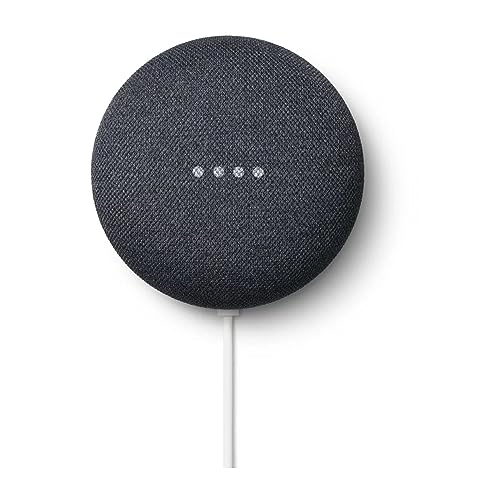
Google Nest Mini (2nd Generation) — The compact endpoint
The Nest Mini is the assistant in its smallest honest form: a puck of a speaker whose title promises a smart speaker with Google Assistant, second generation, in Charcoal. Its musical ambitions are modest and it would be a disservice to pretend otherwise — this is a voice terminal with a speaker attached, sized for the rooms and moments where voice is the point: the bedside alarm and morning briefing, the bathroom’s getting-ready radio, the hallway endpoint that catches commands between rooms, the child’s room where questions outnumber songs.
Smallness is a placement superpower. The Mini fits the shelf edges, socket-side counters and crowded desks where a Nest Audio cannot, and its second-generation maturity means the microphone manners and setup flow have been refined by an enormous installed base. In a system architecture it plays two roles with equal ease: the starter speaker for a household testing whether voice control suits its life, bought singly and forgiven if the experiment fails; and the satellite for a committed household, sprinkling ears into the rooms the music speakers do not reach, so the cast targets elsewhere in this guide always have a commander nearby.
There is a domestic detail the Mini solves better than any rival in this guide: the borrowed room. Guest bedrooms, a teenager’s den, the garage workbench — spaces that want occasional voice service without a permanent, prominent device. The Mini’s puck scale and single-cable simplicity make it the speaker that can be deployed for a visiting parent’s week and returned to a drawer afterward, or left in place unnoticed for years. Infrastructure that can be invisible is infrastructure that survives redecoration, and the Mini is the most invisible ear here.
That second role deserves emphasis, because it redeems the Mini from being merely the cheap option. A home built on RIVA and Audio Pro cast speakers still needs listening posts, and the Mini is the economical, unobtrusive ear that completes such a system. Buy it as a music speaker and it will disappoint by design; buy it as the voice of a house whose music lives elsewhere, and it is the most efficient purchase in this guide.
- Assistant: Google Assistant built in, stated in the title
- Generation: 2nd Generation stated in the title
- Format: compact smart speaker
- Finish: Charcoal stated in the title
- Role: voice endpoint for small rooms and system satellite duty
- Multiroom grouping: the title names the assistant and the speaker; confirm grouping specifics with Google documentation
Strengths
- The smallest, simplest way to put a listening Google Assistant in a room.
- Completes cast-based systems as an affordable voice commander.
- A mature second-generation design with a refined setup routine.
Trade-offs
- Music playback is background class; it is not a listening speaker.
- One Mini alone does not create a multiroom music system.
- Its voice-first brief duplicates what larger Nest speakers already do in rooms they occupy.
Best for: bedsides, bathrooms, hallways and the satellite-ear role in a cast-based home.
Not suited for: a room’s main music, at any volume past a podcast.

JBL Authentics 200 — The dual-assistant design piece
The Authentics 200 is the diplomat of this guide: a retro-styled smart home speaker whose title names built-in Wi-Fi, Bluetooth and voice assistants — Alexa and Google Assistant, both — with multi-room playback and automatic self tuning. Dual-assistant support is rarer than it should be, and its value is strategic: a household can change its assistant allegiance, or run a divided house where different members prefer different voices, without the speaker becoming furniture. In a category where allegiance is usually permanent, the JBL keeps the future open.
Self tuning deserves its paragraph, because placement is where handsome speakers go to sound ordinary. A design piece will be put where it looks right — asymmetric, near a wall, beside a lamp — and room acoustics punish asymmetry with boom and blur. A speaker that measures its surroundings and corrects its own output forgives the interior designer’s decision, and the forgiveness is audible precisely in the rooms where the speaker will actually live. It is the rare feature that serves the eye by rescuing the ear.
The retro styling is the second argument, and it is not frivolous. Smart speakers mostly look like appliances; the Authentics line dresses its technology in a hi-fi heritage wardrobe, and in a living room that styling decides whether the speaker sits proudly on the sideboard or hides behind the television. White and gold, per this listing’s title, is the lighter of its personalities — a speaker meant to be seen in a bright room. Automatic self tuning is the acoustic counterpart of the diplomacy: the speaker adjusts its output to its placement, forgiving the sideboard’s acoustics and the corner’s alike, which suits a design piece that will be placed by eye first and by ear second.
The dual-assistant claim deserves one more layer of honesty: at any given moment, a speaker like this is typically configured for one assistant as its active voice, with the other available through setup rather than simultaneously on call. The value is therefore choice and reversibility, not a household shouting two wake words at one box. Even so framed, the insurance is real — platforms rise, households merge, preferences change, and the Authentics 200 is the only pick in this guide whose voice can follow the household through any of those turns.
Multi-room playback in the title places it in the system conversation, and Bluetooth keeps it useful for direct phone pairing and guests. Judged whole, the Authentics 200 is the pick for the household that wants one handsome, capable, non-committal smart speaker in its main room — Google Assistant today, options tomorrow, and a sound-and-design brief that does not depend on either.
- Assistants: Alexa and Google Assistant both stated in the title — dual-assistant support
- Connection: built-in Wi-Fi and Bluetooth stated in the title
- Playback: multi-room playback stated in the title
- Tuning: automatic self tuning stated in the title
- Style: retro style smart home speaker; White/Gold finish stated in the title
- Role: design-led main-room smart speaker
Strengths
- Dual assistants insure the purchase against a household’s change of allegiance.
- Retro design earns a visible place in a furnished living room.
- Automatic self tuning forgives placement chosen by eye.
Trade-offs
- A single design-led speaker is a room’s feature, not a whole-home system.
- Households certain of one assistant pay for diplomacy they may never use.
- Its styling is a commitment — it will be noticed, for better or worse.
Best for: a main room seeking one handsome smart speaker with Google Assistant and an open future.
Not suited for: invisible, endpoint-style coverage across many small rooms.

Sony SRS-RA3000 — The spatial-music option
Sony’s entry stakes its claim on how music occupies a room: 360 Reality Audio, the company’s spatial format, delivered over Wi-Fi and Bluetooth by a wireless speaker whose title states it works with Alexa and Google Assistant. Where the other picks treat the assistant as the headline and sound as the supporting act, the RA3000 reverses the billing — it is a music-format speaker that also answers to Google’s voice. For a home where listening leans into the spatial catalogue, that reversal is the whole appeal: the assistant is present, but the room-filling, ambient sound design is the reason for the purchase.
Spatial audio in a single wireless speaker is an exercise in dispersion: sound shaped to spread evenly rather than to beam at one chair, so a room is filled rather than a seat served. That character suits the RA3000 to the social rooms — the open kitchen-diner, the studio flat’s single space — where listeners move and no sweet spot exists. Its title’s “works with” language for both assistants places it in the built-in voice family as Sony frames it, and the dual-allegiance again buys flexibility for households not ready to marry one platform.
Placement for a dispersion design inverts the usual advice. A directional speaker wants a clear line to the listener; a room-filling design wants a central, uncluttered position with air on all sides, so its shaped sound can spread as designed. Tucked into a bookcase, the RA3000’s signature virtue is smothered; given a sideboard’s open centre, it performs the trick its format promises. Buyers drawn to its spatial brief should audit the intended shelf for that openness before the purchase, because the speaker’s best room is one with a place of honour available.
The honest boundaries: a spatial single speaker is an ambience instrument, not a stereo stage, and critical listening with a defined soundstage belongs to paired speakers elsewhere in this guide. Nor does the title promise the multiroom grouping language the JBL and the cast speakers carry. The RA3000 is a room’s atmosphere with a voice attached — a specific, sophisticated brief, executed by the company that invented much of the format’s vocabulary.
- Sound format: 360 Reality Audio stated in the title
- Assistants: works with Alexa and Google Assistant stated in the title
- Connection: Wi-Fi and Bluetooth wireless stated in the title
- Finish: Black stated in the title
- Role: spatial, room-filling music speaker with voice control
- Multiroom grouping: not claimed in the title; confirm system options with Sony documentation
Strengths
- Spatial dispersion fills social rooms evenly, without a sweet spot to defend.
- Dual-assistant compatibility keeps platform options open.
- A music-first brief from a company with deep audio-format heritage.
Trade-offs
- Ambient spatial sound is not a substitute for a true stereo pair’s imaging.
- The title makes no multiroom promise, so system growth needs verification.
- Its spatial catalogue rewards listeners whose services and tastes use the format.
Best for: open social rooms built around atmosphere-first music with Google Assistant on call.
Not suited for: critical stereo listening, or a documented multiroom build-out.

RIVA Arena — The cast-powered multiroom speaker
The RIVA Arena is the guide’s clearest cast-species exemplar, and its title is a streamer’s manifesto: a Wi-Fi Bluetooth speaker for the home, 50W, multiroom audio, AirPlay 2, Chromecast, six drivers, and support for Spotify and more streaming. Nothing in that list claims a microphone, and this guide credits none — the Arena works with Google Assistant the way a fine receiver does, by accepting casts that an assistant device or a phone directs to it. Its spec box records the built-in-assistant absence in the standard form, not as a defect but as a definition.
Judged by its own definition, the specification is formidable. Six drivers in a home speaker signal a design spending its budget on sound rather than on voice hardware; 50W is a real room’s output class; dual casting ecosystems — Chromecast for the Google and Android world, AirPlay 2 for the Apple world — make it the rare speaker a mixed-device household can share without negotiation. Multiroom audio in the title puts it in grouped systems, and Spotify support named outright acknowledges where most streams begin. RIVA built its name on exactly this brief: the wireless speaker as a piece of audio equipment first.
Six drivers deserve a translation for readers counting cones. A multi-driver layout lets a compact enclosure divide the frequency labour — dedicated paths for the low, middle and high ranges, doubled for width — so a single box can sound composed at volumes where a lone full-range driver starts to shout. In a cast target the benefit compounds, because the source material arrives at network quality and the speaker’s own hardware becomes the only limit on what the room hears. The Arena’s driver count is therefore not decoration; it is the audible part of its spec sheet.
The ownership pattern follows: the Arena belongs in the room where music matters most, commanded by a phone or by a Nest Mini stationed within earshot. Households that understand that division will find it the most purely musical speaker in this guide. Households that expected it to answer questions will find it silent — which is why this review, and its spec box, are at such pains to define it correctly before the purchase rather than after.
- Output: 50W stated in the title
- Drivers: 6 drivers stated in the title
- Casting: Chromecast and AirPlay 2 stated in the title
- Playback: multiroom audio; Spotify and more streaming stated in the title
- Connection: Wi-Fi and Bluetooth stated in the title
- Built-in Google Assistant: Not stated in the listing title — verify with RIVA documentation; the title claims Chromecast reception, not a built-in assistant
Strengths
- Six drivers and a 50W class make it the music room’s serious wireless option.
- Chromecast plus AirPlay 2 serves mixed-device households without favouritism.
- Multiroom audio lets it group with a wider wireless system.
Trade-offs
- No built-in assistant is claimed, so voice control needs a phone or a separate assistant speaker.
- Its talents are musical; as a smart-home control point it is a bystander.
- One device that hears and plays means choosing the built-in picks instead.
Best for: the main music room of a Google household, commanded by phone or a nearby Nest endpoint.
Not suited for: hands-free voice control from the speaker itself.

Audio Pro A15 W — The portable multiroom guest
Every other speaker in this guide is furniture; the Audio Pro A15 W is a guest that can stay the night anywhere. Its title describes a portable Wi-Fi and Bluetooth multiroom speaker with AirPlay 2, Chromecast, an IPX2 rating and up to 19 hours of battery life — a combination that redraws the multiroom map, because a speaker that carries its network music to the garden, the bathroom shelf or the spare room without a cable is a multiroom system with a movable room. Audio Pro, a Swedish multiroom specialist, built the A15 for exactly that heresy: the system speaker that travels.
The 19-hour battery figure in the title is the enabler — a full waking day of music away from the socket, so the speaker’s home position can be the kitchen while its afternoons belong to the terrace. IPX2, a light splash-resistance class, suits the bathroom and the covered outdoor spot without pretending to weatherproofing; this is a house speaker that tolerates excursions, not an outdoor speaker that visits houses. Chromecast membership keeps it inside the Google household’s casting groups while it roams, and AirPlay 2 keeps the Apple devices in the family equally welcome.
Audio Pro’s multiroom heritage matters here in a way a spec list cannot show: the company’s systems are built around groups that hold their synchronisation across a whole evening, through the network’s ordinary weather. A roaming member of such a system is a sterner test than a fixed one — it rejoins from the garden, reappears in the bathroom, settles back into its group — and a specialist’s experience with exactly those manoeuvres is the A15 W’s invisible specification. The visible ones are generous; the invisible one is why they hold together in practice.
Like the RIVA, its title claims no built-in assistant, and its spec box says so plainly: the A15 W works with Google Assistant by receiving its casts, commanded by phone or by a listening Nest elsewhere in the home. Within that definition it is the guide’s most flexible object — the speaker that fills whichever room currently lacks one, then returns to its charger like a well-trained animal. For a home with more rooms than speakers, that flexibility can outweigh a fixed endpoint’s permanence.
- Format: portable Wi-Fi and Bluetooth multiroom speaker stated in the title
- Battery: up to 19 hours of battery life stated in the title
- Casting: Chromecast and AirPlay 2 stated in the title
- Environment: IPX2 rating stated in the title — light splash resistance
- Finish: Black stated in the title
- Built-in Google Assistant: Not stated in the listing title — verify with Audio Pro documentation; the title claims Chromecast reception, not a built-in assistant
Strengths
- Portability turns one speaker into several rooms’ worth of coverage.
- Nineteen hours of battery frees it from the socket for a full day’s roaming.
- Dual casting ecosystems welcome both Google and Apple households.
Trade-offs
- No built-in assistant is claimed; voice control arrives through other devices.
- IPX2 tolerates splashes only — it is not a poolside or rain speaker.
- A roaming speaker is, by definition, sometimes in the wrong room.
Best for: a home with more rooms than speakers, seeking multiroom music that can move.
Not suited for: permanent outdoor duty, or hands-free voice from the unit itself.
Why Does Wi-Fi Beat Bluetooth for a Home Speaker, Anyway?
Bluetooth is a leash: the phone must stay within a room or two of the speaker, the stream compresses to fit the link, and the phone’s every notification arrives as an interruption in the music. Wi-Fi cuts the leash in three places. Range becomes the house’s whole network rather than a radio’s short reach, so the phone in a pocket upstairs still feeds the speaker downstairs. Quality rises, because the speaker pulls the stream from the network at full fidelity instead of accepting a phone’s compressed relay. And the phone is liberated — free to leave, to call, to run dry — because after the handover the speaker streams for itself. Every pick in this guide carries Wi-Fi for those reasons, with Bluetooth kept as the convenient side door for guests and quick pairings.
The cost of the freedom is dependence. A Wi-Fi speaker is a network citizen, with a network’s failure modes: the router reboot that silences a Saturday, the dead corner where a speaker’s stream stutters while the phone beside it shows full signal, the new router whose settings quietly exile every speaker in the house until each is reintroduced. Households adopting Wi-Fi audio should budget a little respect for the infrastructure — a router placed centrally, a network name that survives hardware changes, passwords recorded where the household can find them. The speakers in this guide are not fragile, but they are citizens, and citizens need the state to function.
There is also a privacy geometry to the Wi-Fi home that Bluetooth never raised. Listening speakers hear within their rooms; cast speakers do not hear at all; and a household can draw its own map between those poles — ears in the kitchen and bedroom, pure receivers in the study and the children’s rooms, a portable that hears nothing anywhere. The six picks here were chosen to make that map drawable at several budgets and tastes, which is a more useful service than any single speaker’s specification.
How Do Ears and Receivers Compare Across the Six?
| Pick | Google Assistant route | Also aboard | Format | Defining claim |
|---|---|---|---|---|
| Nest Audio (3-Pack) | Built in | Bluetooth, stereo sound | Three-room bundle | Multiroom system in one box |
| Nest Mini (2nd Gen) | Built in | — | Compact endpoint | Smallest listening post |
| JBL Authentics 200 | Built in (with Alexa) | Bluetooth, multi-room playback | Retro living-room speaker | Dual assistants; self tuning |
| Sony SRS-RA3000 | Works with (with Alexa) | Bluetooth | Spatial music speaker | 360 Reality Audio |
| RIVA Arena | Chromecast reception | AirPlay 2, multiroom audio | 50W, six drivers | Music-first cast target |
| Audio Pro A15 W | Chromecast reception | AirPlay 2, multiroom | Portable, 19-hour battery | Roaming multiroom speaker |
The first column is the guide in one glance: four speakers hear the assistant themselves, two receive its casts — and a good system can be built from either column, or from a deliberate mixture of both.
How Do You Architect a Google Assistant Home From These Parts?
Start with ears, because a voice system is defined by where it can be spoken to. The natural listening posts are the rooms where hands are busy or distance is long: the kitchen above all, then the main bedroom, then the living room. A Nest Mini covers a small post economically; a Nest Audio covers a post that also plays music; the three-pack covers the standard house in one stroke. Place each post where a normal voice reaches it from the room’s working positions — the counter, the bedside, the sofa — and test with the kettle on and the television playing, because a post that only hears in silence will fail at the exact moments it is needed.
Naming is the unglamorous discipline that makes the architecture usable. Give each speaker the name of its room, in the words the household actually uses — not “Living Room Speaker 2” but the name a tired person will say at midnight — and keep the names stable when speakers move, or move the names with them. Voice systems fail socially on naming more than on any technology: a command addressed to a room the system calls something else is a command that echoes. Spend ten minutes on the names at setup and the system will feel intelligent for years; skip them and it will feel haunted by its own defaults.
Then place the music. The main listening room deserves the household’s best wireless speaker, and the choice among the JBL, the Sony and the RIVA is a choice of character: the JBL for a voiced, design-led, self-tuning centre; the Sony for spatial ambience across an open room; the RIVA for a six-driver cast target under a phone’s or a Nest’s command. The Audio Pro A15 W floats over the whole plan as the flexible reserve, filling the room the fixed system forgot. Grouping follows the architecture: cast groups for music across rooms, assistant posts for commands within them, and the discipline of keeping every speaker on the same network segment so the groups hold.
Finish with the failure rehearsal. Kill the router for one minute and watch what the household loses — voice, casts, groups — and what it keeps: Bluetooth paths, downloaded music, manual light switches. A system understood in failure is a system owned; a system only ever seen working is a surprise awaiting a deadline. The six speakers in this guide are all capable citizens of such a system, provided each is asked to do the job its title actually describes.
What Goes Wrong in Google Assistant Speaker Buying?
The category’s signature error is the one this guide opened with: buying a cast speaker expecting a listening one. The titles are the only defence, and they reward literal reading — Chromecast in a title means reception, an assistant named as built in means ears. The second error is the mirror image: filling a house with listening endpoints and no serious music speaker, then concluding that smart audio sounds thin. Ears and music are separate purchases, and a balanced home budgets for both.
The third error is allegiance confusion — assuming any smart speaker speaks to any assistant. Echo speakers are Alexa-only; the dual-assistant JBL and Sony are the exceptions that prove the rule, and even they were chosen here because their titles say so. The fourth error is network neglect: Wi-Fi speakers are only as good as the Wi-Fi, and a house with a struggling router will blame six innocent speakers for one guilty access point. The fifth is grouping optimism — expecting speakers from rival ecosystems to join one multiroom choir. Within Google’s casting world the groups in this guide cohere; across rival platforms, they politely ignore one another, and a purchase plan should be drawn inside one world at a time.
What Should You Test in the First Fortnight of a Voice-Controlled Home?
Test the commands the household will actually live on, at the hours it will live on them. The morning test: from the bed, half awake, ask for the weather and the first calendar item, and notice whether the bedroom’s post hears a sleep-thick voice without a shout. The cooking test: hands occupied, kettle roaring, extractor fan at full — set a timer by voice from the stove, because that single success is the kitchen post’s entire job description. The evening test: fill the main room with conversation, start music by voice from the sofa, then lower it by voice when talk turns serious; a system that needs a phone for the lowering has failed the evening’s real requirement.
Test the casts with the same rigour. Send the same album to the RIVA or the Audio Pro from two different phones, walk the phone out of the house’s Wi-Fi and back, and confirm the music’s indifference — that indifference is the cast architecture’s proof. Group the rooms and walk the boundaries between them, listening for the step where one speaker hands the ear to another; a well-grouped home has no such step, only a continuous climate of sound. Finally, test the silence: the household should know how every speaker is muted, unplugged or privacy-switched before a guest’s first overnight stay, not during it. A fortnight of such tests converts a pile of purchases into a known system, and the knowledge is the difference between a smart home and a home with gadgets in it.
How Do Guests, Children and Grandparents Fit Into a Voice Home?
A voice-controlled home is a shared instrument, and its other players arrive with different fluencies. Guests face a house that answers to a wake word they may not know, in rooms whose speaker names — the household’s private geography of “Kitchen”, “Study”, “Spare” — are invisible to them. The courteous system keeps its manual paths alive: light switches that still switch, a Bluetooth pairing route on speakers like the JBL, the Sony, the RIVA and the Audio Pro for a guest’s own phone and music, and a host who demonstrates the two commands a guest actually needs rather than delivering a seminar. Voice homes fail socially when they make visitors feel illiterate in someone else’s kitchen; they succeed when the technology reads as hospitality.
Children take to voice instantly and supervise it never, which cuts both ways. A Nest Mini in a child’s room is a question-answering, story-starting, timer-setting companion of real value, and the same openness argues for the household’s content settings being arranged deliberately rather than discovered accidentally. Grandparents, often the surprise beneficiaries, gain the most from the screened and simple end of the ecosystem — large targets, forgiving microphones, one wake word — and from a family that sets the system up for them rather than gifting the box and the burden together. The six speakers here span that human range as surely as they span the acoustic one: endpoints for the small rooms of the young and the old, music systems for the rooms in between, and a portable to carry the whole arrangement to wherever the family has gathered this week.
Final Recommendation
Build the house in the order this guide has argued: ears first, music second, flexibility last. A household starting fresh should take the Nest Audio 3-Pack as its foundation — three listening rooms, stereo in the main one, no compatibility questions — or the Nest Mini as the modest first post of a slower build. Give the main room its character with the JBL Authentics 200 where design and dual-assistant insurance appeal, or the Sony SRS-RA3000 where spatial ambience is the brief. Add the RIVA Arena where music deserves a six-driver cast target under command, and the Audio Pro A15 W where the system’s rooms outnumber its sockets. A Google Assistant home is not a pile of gadgets but a division of labour — speakers that hear, speakers that sing, and one roaming guest — and with the labour divided honestly, the house answers.
Frequently Asked Questions
Will an Amazon Echo work with Google Assistant?
No. Echo speakers are Alexa-only devices, which is why none appears among this guide’s picks and why no Echo is described here as a Google Assistant speaker. The dual-assistant exceptions in this guide are the JBL Authentics 200 and the Sony SRS-RA3000, whose titles name both assistants explicitly.
What is the difference between a built-in assistant and Chromecast built-in?
A built-in assistant means the speaker has microphones and answers voice commands itself — the Nest speakers, the JBL and the Sony in this guide. Chromecast built-in means the speaker receives music cast from a phone or directed by a separate assistant device — the RIVA Arena and the Audio Pro A15 W. The first hears; the second is sent to.
Can the cast speakers be voice-controlled at all?
Yes, indirectly: a Google Assistant speaker or phone on the same network can direct music to a Chromecast target by voice. The cast speaker itself does not listen, so the household needs at least one true assistant endpoint — a Nest Mini is the economical commander — for hands-free control of the system.
Is Bluetooth still useful on a Wi-Fi speaker?
Daily. Bluetooth is the guest path — a visitor’s phone paired in seconds without joining the home network — the travel path for the portable A15 W, and the fallback when the network is being repaired. Every pick in this guide that lists Bluetooth carries it for exactly those unglamorous rescues, and a speaker with both radios is simply harder to silence.
Can these speakers form multiroom groups together?
Within the casting and Google ecosystem, the titles support the idea: the Nest bundle is a multiroom system outright, the JBL claims multi-room playback, and both cast speakers claim multiroom audio. Exact group membership across brands should be confirmed in the makers’ current documentation, since grouping features evolve by software.
Do the cast speakers work when the internet is down?
Casting depends on the home network, and streaming services depend on the internet beyond it, so an outage narrows every Wi-Fi speaker in this guide to its local paths — Bluetooth pairings and any locally stored sources. The assistant speakers lose their voice in the same outage, since the assistant itself is a cloud service. Understanding this in advance keeps a household’s essentials manual underneath the smart layer, and treats the outage as a quiet evening rather than a system failure.
Which pick should a small flat start with?
One listening speaker sized to the main room: a single Nest Audio class device or the JBL Authentics 200 where design matters. A small flat needs one good ear and one good voice of music in the same box; the Mini alone under-serves the music, and the three-pack over-serves the floor plan.
Related Guides
The connected home’s other rooms raise the same built-in-versus-cast questions, and the neighbouring guides answer them in kind: see smart speakers with screens for kitchens and desks for the display branch of the family, multiroom audio systems explained for whole homes for the grouping architecture in depth, and portable Wi-Fi speakers for gardens and terraces for the roaming end of the category.


