What's inside
- Key Takeaways
- Quick Picks: Best 6×8 Speakers
- How Did We Choose These 6×8 Picks?
- Are 6×8 and 5×7 Actually the Same Opening?
- How Do the Six 6×8 Routes Compare Side by Side?
- What Should Ford and Mazda Owners Check Before Ordering?
- How Do 6x8s Behave on a Rear Shelf or Quarter Panel?
- What Does the Mustang Cabin Teach About This Size?
- How Should You Handle a Factory-Amplified Ford System?
- Why Do Truck Doors Punish Speakers Differently?
- What Is the Right Order for a Whole-Car 6×8 Refresh?
- How Does an Amplifier Change the 6×8 Conversation?
- What Should the First Week With New 6x8s Sound Like?
- Why Does This Fleet Generate So Much Conflicting Fitment Advice?
- How Do You Keep a Working Truck System Alive for Years?
- Does the 6×8 Still Make Sense Against Modern Round Sizes?
- What Role Do Grilles and Door Cards Play in the Result?
- How Should You Budget the Whole Job, Not Just the Speakers?
- What Mistakes Do 6×8 Buyers Keep Making?
- Final Recommendation
- Frequently Asked Questions
- Related Guides
As an Amazon Associate I earn from qualifying purchases. This post may contain affiliate links at no extra cost to you.
gizmoverdict.com is reader-supported. When you buy through links on our site, we may earn an affiliate commission.
Where to buy: Below, four picks link to listings verified through this site’s own product pool: Kicker’s CSC68, Infinity’s REF-8632CFX, Pioneer’s TS-A6880F and JBL’s Club 864F. Two disciplines of naming apply. The Infinity’s model code is REF-8632CFX, printed correctly at every mention, and the JBL is the Club 864F — the current model, successor to the Club 8622F that no longer lists. Two further seats are prose-only: a Rockford Fosgate class route, and the honest account of when a 5×7 belongs in a shared opening instead.
The best 6 by 8 speakers serve one of car audio’s most loyal fleets: the Ford and Mazda cars and trucks that carried the 6×8 oval in their doors and rear quarters for decades. If you own an F-Series truck, a Mustang, an Explorer, a Mazda B-series or any of the long list of their relatives, this is your size, stamped into the metal by the factory and waiting behind the door card. The 6×8 is a genuinely useful format — meaningfully more cone area than the 5.25 and 6.5 rounds fitted to smaller cars, in an oval that packages into doors and pillars the way the bigger 6×9 never could.
The size carries one persistent confusion, and this guide confronts it in the open rather than in a footnote: 6×8 and 5×7 openings are close cousins, and a great many speakers are built to serve both. Some cars were stamped for one and are documented as the other; many aftermarket designs carry mounting patterns for both sizes on a single basket. That dual citizenship is convenient, but it is not identity. A true 6×8 uses the full opening and its full cone area; a 5×7 fitted to a shared opening leaves some of that area unclaimed. The picks below are labelled by what they actually are, and one prose-only seat is reserved for the honest case for the smaller size.
The verified bench divides by philosophy in the usual useful ways. Kicker’s CSC68 is the dual-fit all-rounder, engineered from the start for both openings. Infinity’s REF-8632CFX is the clarity candidate, a Reference-series design in the true 6×8 shape. Pioneer’s TS-A6880F stacks four ways of drivers into the oval for listeners who like their range covered in slices. JBL’s Club 864F — the current Club model for this size — brings the liveliest mainstream voicing. Around them, the prose picks cover the Rockford class and the 5×7 question itself, because in this size the fitment decision is half the purchase.
Key Takeaways
- The 6×8 is the Ford and Mazda house size, carried by decades of trucks, Mustangs and SUVs; its oval area beats the common round sizes it replaced.
- 6×8 and 5×7 share many openings and many dual-fit speakers, but they are not the same size — a true 6×8 claims cone area a 5×7 leaves behind.
- All four linked picks are genuine 6×8 designs: Kicker CSC68, Infinity REF-8632CFX, Pioneer TS-A6880F and JBL Club 864F.
- Model names are printed exactly: REF-8632CFX for the Infinity, and Club 864F for the current JBL, successor to the discontinued Club 8622F.
- Dual-fit baskets are a convenience, not a compromise, when the mounting pattern seals properly against your specific opening.
- Truck doors dominate this size, so depth, moisture discipline and grille clearance deserve as much attention as voicing.
Quick Picks: Best 6×8 Speakers
| Pick | Badge | Why it earns its place |
|---|---|---|
| Kicker CSC68 6×8 Speakers (2 Pack) | Best all-round 6×8 | A CS-series dual-fit design that serves 6×8 and 5×7 openings with one balanced, factory-power-friendly pair. |
| Infinity REF-8632CFX 6×8 Speakers | Best for clarity | Reference-series voicing in the true 6×8 shape, for owners who want detail from their truck or Mustang doors. |
| Pioneer TS-A6880F 6×8 4-Way Speakers | Best layered design | A four-way A-series oval dividing the range into slices, with Pioneer’s lively mainstream balance. |
| JBL Club 864F 6×8 Speakers | Best current JBL — Club 864F | The present Club model for this size, successor to the 8622F, voiced for energy on factory power. |
| Rockford Fosgate Punch 6×8 Class | Prose-only: the authority route | Rockford’s step-up class offers a firmer, more controlled take on the size for owners building beyond a simple swap. |
| The 5×7 Route in a Shared Opening | Prose-only: when smaller is honest | Some openings documented as 6×8 are happier with a true 5×7; this seat explains how to tell, and why it is not a defeat. |
How Did We Choose These 6×8 Picks?
Selection began with the verified pool and a strict rule: linked seats go only to genuine 6×8 designs, never to 5×7 speakers wearing the larger size as a courtesy. Four pairs cleared that bar, and they cover the size’s real decision space — the dual-fit all-rounder, the clarity design, the layered four-way and the lively current JBL. The prose-only seats were then assigned to the two questions a linked bench cannot answer: what the step-up Rockford class offers owners building further, and when the smaller cousin size is the truthful fit for an opening.
Judging weighted truck reality. This size lives disproportionately in working vehicles — pickups whose doors slam a thousand times a year, whose cabins are loud, whose speakers serve talk radio at dawn and music at dusk. Composure at volume, sensitivity to factory power and mounting robustness therefore counted alongside the usual clarity measures. A pair that only shines in a quiet sedan would be a poor ambassador for a size whose natural home has a load bed behind it.
We also read every listing name twice. This corner of the catalogue is dense with near-identical model codes, superseded models still circulating in old advice, and sizes rounded in whichever direction flatters the seller. The names in this guide are the names on the verified listings, corrected where the pool established the truth — the Infinity code and the current JBL model in particular — because in this size, buying the right speaker starts with calling it the right thing.
Are 6×8 and 5×7 Actually the Same Opening?
No — but they are close enough to have confused two generations of buyers, and the confusion is partly the industry’s own doing. The two ovals differ by roughly an inch in one dimension. Ford and Mazda stamped both sizes across their ranges, sometimes in the same model line in different years or trims, and the aftermarket responded with dual-fit baskets whose mounting tabs serve either opening. A dual-fit speaker is a legitimate engineering answer; the confusion begins when a true 5×7 speaker, with a 5×7 cone, is described as a 6×8 because it can be screwed into the larger hole.
The difference you can hear is cone area and seal. A true 6×8 fills the opening with piston; a 5×7 in the same opening gives back some low-end ease and depends entirely on its mounting arrangement to seal the difference. In many real doors the practical gap is modest, which is why the prose-only seat later in this guide treats the smaller size as an honest option rather than a failure. But modest is not zero, and a buyer paying for the larger size is entitled to receive it — which is why every linked pick here is a genuine 6×8 design.

Kicker CSC68 6×8 Speakers (2 Pack) — Best all-round 6×8
The CSC68 is the size’s natural first recommendation, because it was designed for the exact reality this article describes: a CS-series coaxial pair whose basket serves both 6×8 and 5×7 openings, so the long Ford and Mazda fleet — with its trim-by-trim variations — is covered by one honest product. In a true 6×8 opening it is a true 6×8 speaker, using the full cone area; in a 5×7 door it fits without drama. That dual citizenship, engineered rather than improvised, is why it anchors this bench.
Its sound follows the CS brief: a step of refinement above Kicker’s entry lines, with the family warmth intact and better control when the volume rises to truck-cab levels. On factory power — which is what nearly every door in this fleet offers — it plays with an ease that flatters talk, country, rock and the compressed streams of a working day. The low end is the oval’s honest midbass, full enough to satisfy without a subwoofer for most owners, and the top end stays composed on long drives.
Ownership details suit the fleet: mainstream mounting depth for the size, a fitment record across the Ford and Mazda range that few rivals can match, and behaviour documented in exactly the trucks and cars you are likely to own. If your opening is 6×8 and your brief is one pair that simply gets everything right, the CSC68 is the purchase this article keeps returning to.
At a glance
- Size truth: true 6×8 coaxial, dual-fit basket also serving 5×7 openings; sold as a 2 pack
- Role: all-round factory replacement across the Ford and Mazda fleet
- Character: warm CS balance with control at working volume
- Installation posture: mainstream depth; verify which of the dual patterns your door uses
- Ownership note: CS series is Kicker’s established step-up line
Strengths
- Genuine 6×8 cone area with engineered dual-fit convenience
- Composed at the volumes truck cabins demand
- Deepest fitment record in the size across Ford and Mazda vehicles
Trade-offs
- Clarity seekers will find the Infinity a step ahead in detail
- Dual-fit tabs demand a careful seal check in either opening
- Warmth can thicken in small, quiet cabins at high volume
Best for: Ford and Mazda owners wanting one balanced pair that fits the fleet’s variations without adapters or anxiety.
Not suited for: listeners building a clarity-first system; the Reference-series Infinity below argues that brief better.
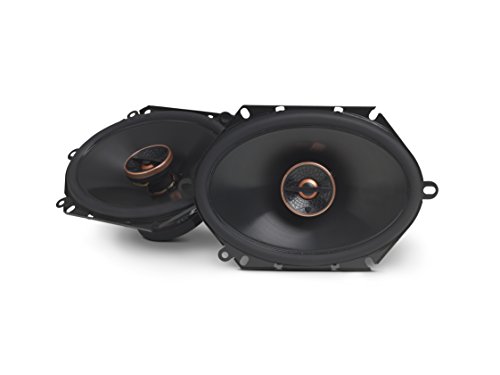
Infinity REF-8632CFX 6×8 Speakers — Best for clarity
The model code first, printed as the listing prints it: REF-8632CFX. Codes in this size are a thicket of near-twins, and this article uses the correct one at every mention so that the speaker praised here is the speaker that arrives. What arrives is Infinity’s Reference-series entry in the true 6×8 shape — the clarity candidate for the Ford and Mazda fleet, voiced for detail and separation in doors that more often get offered brute force than finesse.
The Reference balance changes what a truck door can be. Voices separate from instrumentation, acoustic detail survives the cabin, and the top end extends without the screech that gives budget clarity a bad name. The oval’s low end remains present and honest, though it is voiced as a foundation for the clarity above it rather than as the main event; bass-led listeners should weigh that priority honestly against the Kicker’s fuller warmth.
In a Mustang or a quiet SUV cabin, this is the pair that makes the size sound sophisticated. In a working truck it still performs, but its virtues are the first thing road noise taxes, so the noisier the cab, the more the all-rounder above closes the gap. Fitment is true-6×8 and mainstream, and the pair rewards the sealed, deadened door prep that any clarity-led speaker deserves.
At a glance
- Size truth: true 6×8 two-way coaxial, Reference series
- Model truth: REF-8632CFX — the code printed on the verified listing
- Character: detailed, separated, with the low end as foundation
- Installation posture: true 6×8 fitment; sealed mounting rewards its voicing
- Ownership note: Reference is Infinity’s established step-up car line
Strengths
- Finest detail and separation available in this size on this bench
- Top end extends without budget-class harshness
- True 6×8 shape with the correct, verifiable model identity
Trade-offs
- Low end is a foundation, not a headline; bass-first listeners take note
- Road noise taxes its virtues sooner than the warmer pairs
- Demands a sealed mount to show its best
Best for: Mustang, SUV and quiet-cab owners who want their 6×8 doors to resolve as well as they punch.
Not suited for: loud working trucks and bass-led briefs, where the Kicker all-rounder spends its budget more usefully.

Pioneer TS-A6880F 6×8 4-Way Speakers — Best layered design
Pioneer’s A-series answer to the 6×8 is a four-way design, and it wears that architecture as its argument: the oval woofer below, then the range above divided among midrange, tweeter and an additional high-frequency driver, each working a narrower slice than a single small driver could manage alone. For listeners who find two-way designs coarse at the top of the range, the TS-A6880F offers a spread, layered presentation that has kept this style of Pioneer in the size for years.
The voicing is the A-series mainstream: lively, present, and tuned to flatter the factory head units and compressed sources of the fleet it serves. In a truck door it keeps talk intelligible and music awake at working volumes; on a rear shelf or quarter panel it fills the cabin with a complete, nothing-missing sound. Its low end is respectable rather than dominant — the budget here is visibly shared among more drivers — and owners whose brief is bass first should read the Kicker and JBL first.
The four-way caveat is the one this guide applies to every layered design: the highest slice lives where road noise rules, so the full architecture is best appreciated in quieter cabins and at moderate volumes. Within those conditions the Pioneer is a coherent, likeable speaker with the deepest mainstream distribution in the size. Buy it for the layered top end, in a cabin calm enough to hear it.
At a glance
- Size truth: true 6×8 four-way coaxial
- Role: layered-design factory replacement for doors and rear quarters
- Character: lively and complete, with the top end spread across drivers
- Installation posture: standard footprint; check the driver cluster clearance under grilles
- Ownership note: A-series is Pioneer’s mainstream step-up car line
Strengths
- Layered top end appeals to listeners who find two-ways coarse
- Complete, nothing-missing presentation at moderate volumes
- Mainstream distribution and fitment familiarity across the fleet
Trade-offs
- Highest driver’s contribution fades under road noise
- Bass is respectable, not dominant; budget is shared four ways
- Cluster clearance deserves a check in shallow rear quarters
Best for: moderate-volume listeners in calmer cabins who enjoy layered-driver designs from an established line.
Not suited for: bass-first and loud-cabin briefs, where simpler pairs spend the same money more audibly.

JBL Club 864F 6×8 Speakers — Best current JBL — Club 864F
The name carries news, so it goes first: the current JBL Club model for this size is the Club 864F, and that is the speaker assessed here. It succeeds the Club 8622F, which no longer has a listing; advice and reviews describing the 8622F belong to the predecessor. The 864F itself is JBL’s mainstream Club design in the true 6×8 shape — a two-way coaxial voiced with the brand’s characteristic energy, sized by its own title at 6×8, and aimed squarely at waking up factory Ford and Mazda systems.
Energy is the honest summary. The Club balance is present and forward, tuned so that a standard head unit in a noisy cab still delivers music with its pulse intact. Talk cuts through, choruses arrive, and the oval low end underneath is full and willing. Against the Infinity it trades resolution for life; against the Kicker it trades warmth for spark. In the working trucks that dominate this size, that trade frequently matches the brief better than either rival’s.
As the current model it also carries the practical advantage of a live listing and current production behind it, which matters for warranty, for matching a second pair later, and for the simple confidence that the speaker reviewed is the speaker sold. Owners who want the lively route through this size, under the correct current name, will find the Club 864F an easy recommendation to act on.
At a glance
- Size truth: true 6×8 two-way coaxial — 152x203mm by its listing
- Model truth: Club 864F, current successor to the discontinued Club 8622F
- Character: energetic and present on factory power
- Installation posture: mainstream 6×8 fitment for the Ford and Mazda fleet
- Ownership note: Club is JBL’s mainstream car line
Strengths
- Liveliness that survives noisy truck cabins
- Current model with a live listing and production behind it
- Full, willing low end under the energetic balance
Trade-offs
- Resolution trails the Infinity Reference design
- Forward balance can fatigue on bright material over long, quiet drives
- Older Club 8622F reviews describe the predecessor, not this speaker
Best for: working-truck and lively-system owners who want the current JBL, correctly named, on factory power.
Not suited for: quiet-cabin detail hunters; the REF-8632CFX above serves that brief with more finesse.
Rockford Fosgate Punch 6×8 Class — Prose-only: the authority route
Rockford Fosgate’s Punch class has long been the step-up address in oval sizes, and this guide keeps a prose-only seat for its 6×8 offerings because owners building beyond a simple swap will meet the class early in their research. The class temperament is authority: firmer control of the cone at travel, a presentation that stays organised when the music gets dense, and construction aimed at owners who intend to add amplification later rather than live forever on head-unit power.
That last trait is the honest dividing line. On factory power alone, the Punch class can sound slightly restrained beside the lively mainstream pairs on this bench, because its designs assume headroom the factory radio does not provide. Give it a modest amplifier and the relationship inverts: control becomes the virtue the whole system is built around, and the class pulls ahead of the swap-grade pairs in composure. It is a builder’s route, priced in patience as much as money.
No verified listing for the class sits in this site’s pool, so the guidance here is deliberately structural: if your plan includes amplification within the year, research this class model by model, verifying size and depth per listing. If your plan is a one-afternoon swap on factory power, the linked bench above will satisfy you sooner and cheaper. Knowing which of those owners you are is the entire content of this pick.
At a glance
- Size truth: class includes true 6×8 members — verify per model
- Role: step-up route for owners planning amplification
- Character: controlled and organised, assuming power the factory may not give
- Installation posture: check depth carefully; step-up motors run larger
- Ownership note: covered without a link because no pool listing is verified for it
Strengths
- Control at travel that swap-grade pairs cannot match once amplified
- Composure in dense music suits system builders
- Established class with a long record in oval sizes
Trade-offs
- Can sound restrained on factory power alone
- No verified listing here; per-model research is required
- Depth and magnet size demand more careful fitment checks
Best for: owners with an amplifier in the plan who want the size’s step-up class researched properly.
Not suited for: one-afternoon swappers on factory power; the linked pairs satisfy that brief immediately.
The 5×7 Route in a Shared Opening — Prose-only: when smaller is honest
This final seat is not a product but a permission slip, argued honestly: some openings documented as 6×8 are, in specific trims and years, happier with a true 5×7 speaker. The smaller oval’s mounting pattern sometimes matches the factory holes exactly where a dual-fit 6×8 basket requires adaptation, its shallower typical depth clears window mechanisms that a larger motor would threaten, and in shallow rear quarters its cone can seal against a surface the bigger basket bridges awkwardly. Fit is a physical fact, not a badge of honour, and a perfectly fitted 5×7 will outplay a badly fitted 6×8 every day of the week.
The cost is known and bounded: some cone area, and with it some low-end ease at volume. In a door that also houses a separate factory tweeter, or in rear-fill duty where the front stage carries the system, that cost can shrink to inaudibility. The way to decide is measurement, not loyalty — pull the factory speaker, compare both patterns against the holes and the depth you actually have, and let the door vote.
What this route is not is an excuse for sellers to ship a 5×7 against a 6×8 order and call it equivalent. Chosen by the owner, with the trade understood, it is good engineering judgement. Imposed by a listing that rounded the size up, it is the dishonesty this entire article is organised against. The difference is who made the decision, and with what information.
At a glance
- Size truth: a true 5×7 is smaller than 6×8 — chosen knowingly, never substituted silently
- Role: the correct answer for specific trims, shallow quarters and exact-pattern openings
- Character: perfect fit over maximum area, where the door demands it
- Installation posture: often the shallowest, easiest seal in a shared opening
- Ownership note: a fitment route, not a product; no link by design
Strengths
- Exact factory-pattern fit in the trims where 6×8 baskets need adaptation
- Shallower depth clears tight window and quarter-panel spaces
- A sealed 5×7 beats a leaking 6×8 on real roads
Trade-offs
- Gives up cone area and some low-end ease at volume
- Requires honest measurement to justify; not a default shortcut
- Must never be a seller’s silent substitution for a 6×8 order
Best for: owners whose measured opening, depth or pattern genuinely favours the smaller oval.
Not suited for: anyone whose door accepts a true 6×8 cleanly — take the area the opening offers.
How Do the Six 6×8 Routes Compare Side by Side?
| Pick | Size truth | Leads on | Gives away |
|---|---|---|---|
| Kicker CSC68 (2 Pack) | True 6×8, dual-fit, linked | All-round balance and fitment record | Absolute detail |
| Infinity REF-8632CFX | True 6×8, linked | Clarity and separation | Bass emphasis |
| Pioneer TS-A6880F | True 6×8 four-way, linked | Layered top end | Benefit in loud cabins |
| JBL Club 864F | True 6×8, current model, linked | Energy on factory power | Fine resolution |
| Rockford Punch class | True 6×8 members, prose-only | Control once amplified | Factory-power immediacy |
| The 5×7 route | True 5×7 in shared openings, prose-only | Perfect fit in specific doors | Cone area |
The table is organised around the size truth because in this class the size truth is where purchases go wrong. Once every route is standing at its real dimensions, the remaining choice is the pleasant one: which character you want in your doors, and how much of the fleet’s noise it has to survive.
What Should Ford and Mazda Owners Check Before Ordering?
Begin with the trim, not the model. The same truck or car line carried different audio packages across its years — base systems with a lone full-range door speaker, mid systems with separate tweeters, premium systems with factory amplification and sometimes unusual impedance. Each variant accepts a replacement pair differently, and the fitment database that knows your model may not know your trim. The factory speaker itself is the reliable witness: its size, its connector, its label and the depth behind it answer most of the questions this purchase asks.
Then check the door’s working parts. Window travel behind the speaker, the moisture barrier’s condition, and the state of the wiring boot between door and body all decide whether the swap is an hour or a weekend. Trucks in particular live hard lives in their doors: dust, water and a decade of slams degrade the environment any new pair must survive. Budget the small consumables — clips, gasket material, a sheet of deadening per door — into the same order as the speakers, and the job finishes the day it starts.
Finally, confirm which of the shared sizes your opening truly is. The 6×8 and 5×7 discussion earlier in this guide is not academic in this fleet; both sizes genuinely occur, sometimes within one model’s production run. Measure the factory unit across its mounting face and note the hole pattern. That single measurement, taken before money moves, is worth more than any amount of post-purchase adaptation.
How Do 6x8s Behave on a Rear Shelf or Quarter Panel?
Not every 6×8 in the fleet lives in a door. Mustangs and several Ford cars carried the size at the rear, where it works as a foundation pair playing into the boot volume, and the judging lens changes with the address. Rear pairs are heard mostly as weight, warmth and coverage for rear passengers; the imaging finesse that matters in a front door matters less, and composure at volume matters more. The Kicker all-rounder and the Pioneer layered design both suit that duty well, for different reasons — one for balance, one for completeness.
Rear quarters and shelves add their own installation character. Access is often through the boot or by folding seats rather than by removing a door card, mounting surfaces are thinner, and the sun through the rear glass taxes materials the way it does on any deck. Seal and shade are the watchwords: a gasket under the basket, grilles kept in place against the glass, and a check of the surrounds every few summers.
Owners sometimes discover their car carries the size at both ends, which raises the matching question this fleet asks often. Matching pairs front and rear give one cabin character and simplify everything; a clarity pair in front with a warmer pair behind is the connoisseur alternative. Either is defensible. What is not defensible is a loud, bright rear pair overwhelming a modest front stage, because the music will live behind your head for the life of the car.
What Does the Mustang Cabin Teach About This Size?
The Mustang is the size in its most flattering environment: a relatively compact cabin, doors close to the listeners, and a rear pair near enough to matter. In that cabin the differences between this bench pairs are unusually audible. The Infinity separation flatters acoustic and vocal recordings at the volumes a coupe invites; the JBL energy suits the car character so well it feels like a factory option that should have existed; the Kicker balance is the one that disappears into long drives most completely.
The coupe also exposes installation sins quickly. Its doors are not deep, its rear quarters are tight, and its owners are likelier than truck owners to listen critically at rest as well as at speed. Depth checks and cluster clearances, which this guide keeps repeating, are not abstractions in this car. Measure the quarter panels before falling for the tallest driver cluster on the bench.
None of that makes the Mustang a special case requiring special products. It makes it the size honest classroom: a cabin quiet and close enough to reveal what each philosophy on the bench actually bought. Truck owners can read the same verdicts with a noise discount applied; Mustang owners should read them at face value.
How Should You Handle a Factory-Amplified Ford System?
A share of this fleet — premium trims especially — runs a factory amplifier with its own tuning, and sometimes door speakers of unusual impedance chosen to suit it. Replacing speakers inside such a system changes two variables at once: the transducer and the load the amplifier sees. The audible result can be a balance shifted by the factory equalisation that was drawn for the old speakers, and a volume change that has nothing to do with the new pair quality.
The disciplined approach is identification before purchase. Read the factory speaker label during your measurement visit; if the system is amplified and proprietary, favour the more sensitive, smoother pairs on this bench, which integrate most gracefully with tuning you cannot adjust, and set your expectations for a settings session afterwards. Base systems, by contrast, are the simple swaps the size is famous for.
Where the factory amplifier itself is dying — a common age-related failure in this fleet — replacing speakers alone will disappoint, and the honest project is amplification first. A guide that sells speakers as the cure for a failing amplifier is selling a second disappointment to follow the first. Diagnose the system, then spend where the fault actually lives.
Why Do Truck Doors Punish Speakers Differently?
A truck door is a working surface. It slams harder, seals worse, admits more dust and water, and vibrates across a broader range of surfaces than a car door ever meets. Speakers installed there live a mechanical life as much as an acoustic one: mounting screws work against constant shock, baskets endure temperature swings in thin, uninsulated metal, and terminals corrode in damp that a garaged sedan never sees.
The installation answers are correspondingly physical. Use every mounting point the basket offers, torque in a cross pattern, and consider a thread-locking compound where the fleet experience recommends it. Protect terminals, keep drainage holes clear so the door does not store the water it admits, and reseal the moisture barrier as if the speakers lives depended on it — because they do.
Product choice follows the same logic. This is why the all-rounder with the deep fitment record anchors this guide rather than a more delicate design: in a working door, proven mounting and known behaviour are performance characteristics. The clarity pair remains a fine choice for the trucks that live gently, but the fleet average argues for robustness first, and the bench is ordered with that average in mind.
What Is the Right Order for a Whole-Car 6×8 Refresh?
Front doors first, because they carry the soundstage and because their result teaches you what your cabin rewards. Live with the front pair for a few weeks of real driving before committing the rear money; the lesson will either confirm the matching-pair plan or argue for a different character behind you, and either answer is cheaper learned in that order.
Do the door work in matched sessions. Whatever sealing, deadening and barrier repair the left door receives, the right door receives in the same sitting, because asymmetric preparation builds an asymmetric stage that no balance control fully repairs. Photograph the first door before disassembly; the second door will go faster and better for the reference.
Rear speakers come last in the sequence and should be judged from the driver seat, not from beside the open quarter panel where they sound most impressive. Set the fader so the rear underpins, then forget the system for a month. A refresh that stops asking for attention after a month was done right, and in this fleet that quiet success is the normal reward for doing the simple things in the right order.
How Does an Amplifier Change the 6×8 Conversation?
Every linked pair in this guide was chosen to satisfy on factory power, but the oval format rewards amplification handsomely when the day comes. The larger cone has more to give under control: midbass tightens and gains definition, and the whole presentation stays composed at volumes where a head unit amplifier begins to smear. Owners planning that day should note which picks were built with headroom in mind — the step-up class covered in prose, and the mainstream pairs with the strongest motors — because a speaker bought for stage one should not need replacing at stage two.
Sequence protects the budget. Amplify the front doors first, where the listeners and the soundstage are, and let the rear continue on head-unit power until the cabin tells you otherwise. Set gains for control rather than conquest; a 6×8 driven into clipping sounds worse than the same speaker did on the factory radio, and the fault will be misdiagnosed as the speaker by everyone except the person who set the gain.
There is also a legitimate never in this conversation. Many fleet owners — particularly in working trucks — will live happily on factory power for the remaining life of the vehicle, and the bench was chosen so that never is a respectable answer. Amplification is an option the size rewards, not a toll the size charges.
What Should the First Week With New 6x8s Sound Like?
Expect the sound to move twice: once when the surrounds loosen over the first hours of real play, and once when your ears stop comparing every note with the factory balance they memorised over years. The first movement is small but real, mostly a freeing of the low end. The second is larger, and it is why verdicts delivered in the first ten minutes of a swap are the least reliable in car audio.
Use the week diagnostically. Hunt the buzz that follows bass notes into one door and not the other, the rattle that only a particular road surface summons, the channel that plays thinner than its twin. Those are installation findings — a loose clip, an unsealed corner, a polarity error — and they are all cheapest in the first week, while the job is fresh and the trim tools are still in the car.
Keep three familiar recordings in rotation across the week: one voice, one bass line, one dense chorus. By the seventh day the comparison that matters is not against a rival speaker in a shop but against your own truck or car as it was. If voices sit clearer against the road and the low end holds together at speed, the size has done what it promised, and the upgrade can be pronounced finished.
Why Does This Fleet Generate So Much Conflicting Fitment Advice?
Because the fleet genuinely varies. Long production runs, mid-cycle audio changes, regional variants and a partnership era in which two brands sold related vehicles mean that two owners of apparently identical trucks can open their doors to different speakers. Advice that was accurate for one is honestly reported and honestly wrong for the other, and forums accumulate both without labels.
The escape from the confusion is always the same: your door is the document. One loosened door card, one measured factory speaker, one photograph of the connector and label outweighs a hundred confident posts about a truck that may not be your truck. This guide repeats the measurement advice because the fleet, uniquely, demands it — the 6×8 world is where fitment folklore goes to be believed, and where a tape measure earns its keep weekly.
Sellers contribute their share by listing dual-fit products under whichever size the buyer searched for. The product may be blameless; the description is the problem. Read the stated dimensions and the mounting pattern on the listing itself, and let the search box be a starting point rather than a specification.
How Do You Keep a Working Truck System Alive for Years?
Longevity in this fleet is a maintenance habit, not a product feature. Once a year — many owners tie it to a service interval — open nothing, but listen deliberately: one door at a time at moderate volume, hunting the early buzz of a loosening mount or the dullness of a surround beginning to harden. Caught early, both are cheap; caught late, they are a new pair.
Water is the other slow enemy. Keep the door drains clear, repair a torn moisture barrier when you find one for any reason, and treat a wet door card as a diagnosis rather than a nuisance. The speakers in this guide come from lines with long production histories partly because survival in this fleet is a record to be earned, and no record survives a door that stores its own weather.
Finally, drive the system the way you want it to last: volume for the road you are on, not for the car park you just left. Clipping on hot afternoons, when materials are stressed and factory amplifiers run out of manners soonest, ages tweeters faster than any other habit. The fleet rewards owners who treat the volume knob as a tool rather than a trophy, and it rewards them for a decade at a time.
Does the 6×8 Still Make Sense Against Modern Round Sizes?
Owners cross-shopping a vehicle change sometimes ask whether they will miss the oval. The honest answer is that modern 6.5 component systems in newer cars can out-resolve anything in this article — at several times the installed cost, in cars designed for them. Within the fleet that carries the size, the comparison never arises: the opening is the opening, and the 6×8 fills it with more area than any round that could be adapted into it.
That is the size enduring virtue. It asks nothing exotic of the car, it serves factory power gracefully, and its aftermarket remains deep because the fleet remains enormous. Technologies around it have changed — sources, head units, streaming quality — while the door stampings have not, and a good pair bought today will still be the right answer when the next source arrives. Few audio purchases can promise that kind of stability, and it is worth naming as a virtue in itself.
What Role Do Grilles and Door Cards Play in the Result?
The factory grille is not a neutral window. Its perforation pattern, its distance from the cone and any fabric or foam behind it all filter the sound, usually gently at the top end, and its rigidity decides whether it joins the music as a buzzing accompanist. When a new pair sounds duller than expected in the car but impressed in every other context, the grille deserves a look before the speaker takes the blame: a replacement driver sitting closer to the card than the factory unit can be half-muffled by a grille it nearly touches.
Clearance is the mechanical half of the same question. Taller driver clusters — the layered designs on this bench especially — need air between the tweeter assembly and the card, and a cluster pressed against a grille will buzz, distort and eventually wear. A thin spacer that restores clearance usually improves the seal as a side effect, which makes it the rare fix that pays twice. Check the gap with the card offered up before final fastening, and the discovery costs minutes instead of a second disassembly.
How Should You Budget the Whole Job, Not Just the Speakers?
The speakers are the headline cost, but the finished job has a supporting cast that decides its quality: gaskets or sealing tape, deadening for the door skins, a bag of replacement trim clips in the correct size for your fleet, harness adapters where the factory plugs are proprietary, and the small consumables — tape, ties, contact cleaner — that separate a tidy installation from a improvised one. Together they are a modest fraction of the speaker cost, and omitting them is the classic false economy of this size.
Time is the other budget line. A pair fitted calmly in a morning, with the doors treated and the barriers resealed, outperforms a premium pair thrown in over a lunch break in every way that survives the first week. Owners who price their own Saturday honestly usually conclude that the mainstream pair plus the full supporting cast is a better purchase than the step-up pair alone — a conclusion this guide endorses for every size it covers, and for this hard-working fleet most of all.
What Mistakes Do 6×8 Buyers Keep Making?
Accepting a 5×7 against a 6×8 order. The sizes are cousins, not twins. If the listing said 6×8, the box should contain a 6×8; the smaller size is a legitimate choice only when the owner makes it knowingly.
Ordering by a near-miss model code. This catalogue is dense with similar codes. The Infinity here is the REF-8632CFX; a transposed digit is a different product. Copy codes character for character from the listing, never from memory.
Buying the predecessor’s reputation. The JBL Club 8622F no longer lists; the current speaker is the Club 864F. Reviews of the old model are history, and the purchase should be judged on the model that actually ships.
Ignoring the slam factor. Truck doors live violently. Mounting that would survive a sedan can loosen in a work truck; use every mounting point, torque evenly, and re-check after the first week of slams.
Skipping the moisture barrier. In doors this size serves, a torn barrier left unsealed is a slow leak aimed at your new speakers. Reseal it as part of the job, every time.
Final Recommendation
For most of the Ford and Mazda fleet, the Kicker CSC68 is the pair to buy: a true 6×8, dual-fit where the fleet varies, balanced everywhere. The Infinity REF-8632CFX is the clarity upgrade, the Pioneer the layered alternative, and the JBL Club 864F — the current model, under its correct name — the lively one. Build beyond a swap and the Rockford class awaits your amplifier; measure a door that truly prefers the smaller oval and take the 5×7 route without a flicker of shame. The 6×8 has served working cars for decades by being the right shape in the right door — honour that simplicity by fitting it honestly, sealing it properly, and letting it work.
One last fleet-specific habit is worth adopting before the tools come out: do one door completely — measured, fitted, sealed, tested — before touching the second. The first door is where every surprise in your particular trim lives, and it is far better discovered with the car still half assembled and the reference of an untouched door beside you. The second door then takes half the time and inherits every lesson, which is the closest thing installation work offers to a guaranteed improvement.
Frequently Asked Questions
Is a 6×8 speaker the same as a 5×7?
No. They are neighbouring oval sizes that share many openings and many dual-fit aftermarket designs, which is the source of the confusion. A true 6×8 carries more cone area and fills the larger opening with piston; a 5×7 fitted there gives some of that area back and relies on its mounting to seal the difference. Either can be the right purchase — the error is only in pretending they are identical, or in a seller substituting one for the other silently.
Which cars use 6×8 speakers?
The size is most associated with Ford and Mazda: F-Series trucks, Mustang, Explorer and many of their relatives carried it in doors and rear quarters across long production runs, and Mazda shared much of that hardware in the partnership years. Other makers used it sporadically. Because trims vary, the factory speaker in your own door remains the final authority on what your specific car uses.
Is the JBL Club 864F a new name for the Club 8622F?
It is the successor model, not a rename. The Club 8622F no longer has a listing; the Club 864F is the current Club design for the 6×8 size and the speaker this guide assesses. Treat 8622F reviews as predecessor history — useful background, not a description of the product that ships today.
What is the correct model code for the Infinity 6×8?
REF-8632CFX, as printed on the verified listing and used throughout this guide. Similar-looking codes circulate in listings and forums, and a single wrong digit identifies a different product. When ordering, match the code on the product page character for character against the name you intended to buy.
Do 6×8 speakers need an amplifier?
The linked picks here were chosen to perform on factory power, which is what the fleet overwhelmingly has. Amplification is the step-up route — it is what the Rockford Punch class is waiting for — and it adds control once speakers and sealing are right. It is not a prerequisite for a satisfying swap, and it cannot rescue a leaking mount or a mis-sized speaker.
Can a dual-fit speaker really serve both 5×7 and 6×8 openings?
Yes, when the dual fitment is engineered into the basket, as with the Kicker CSC68 in this guide: the mounting pattern provides correct holes and sealing faces for both sizes. What dual-fit does not change is the cone — in a 6×8 opening you get the full 6×8 piston from a true dual-fit 6×8 design. Verify which pattern your door uses and seal accordingly, and the convenience is real rather than rhetorical.
Related Guides
From this shelf, continue with best 6.5 speakers for less than 100 dollars best 6×9 car speakers best 6 inch ceiling speakers.


