What's inside
- Where to buy
- Key Takeaways
- Quick Picks
- How did we choose these smart speakers?
- Why is the ecosystem the real purchase?
- Which bluetooth smart speakers should be compared head to head?
- How do you build a whole-home setup from these speakers?
- What mistakes do smart speaker buyers repeat?
- How do these speakers age over years of ownership?
- What about children, guests and other real household complications?
- Which single speaker should a first-time buyer start with?
- Final Recommendation
- Frequently Asked Questions
- Related Guides
As an Amazon Associate I earn from qualifying purchases. This post may contain affiliate links at no extra cost to you.
gizmoverdict.com is reader-supported. When you buy through links on our site, we may earn an affiliate commission.
Where to buy
All six speakers here are sold through Amazon’s US store, and all six arrive ready to join a platform as much as a room. That is the first thing to understand about this category: a smart speaker is a subscription-free but account-bound device, and every pick below needs Wi-Fi and a free account with its maker’s ecosystem before its smart features wake up. The Bluetooth in the category’s name is real, but on most of these it is the side door — a way to play audio from a phone — while the house itself is built on Wi-Fi, voice assistants and multi-room streaming. Buy the ecosystem first and the speaker second, and you will buy once.
The best bluetooth smart speakers therefore sort by allegiance before they sort by sound. Amazon’s three entrants here — the Echo Dot, the Echo Dot Max and the Echo Studio — live in Alexa’s world, with its smart-home reach and its routines. Google’s Nest Mini speaks for Google Assistant and a household already built on Google services. Sonos’s Era 100 plays a longer game: a music-first speaker that works with Alexa, streams over Wi-Fi in the Sonos multi-room system, accepts Bluetooth when asked, and pairs with its own kind for stereo or home-theatre surrounds. JBL’s Authentics 300 refuses to choose, running Alexa and Google Assistant in the same cabinet — the only pick here that does — and adds a battery, making it the one genuinely portable smart speaker of the six.
Why does the allegiance matter so much? Because smart speakers compound. The first one is a novelty that tells the weather; the third one is infrastructure — lights, locks, routines, a household’s shared timers and lists — and infrastructure is miserable to migrate. Features that look decisive on a product page, a slightly bigger driver or a cleverer light ring, fade within a month. The ecosystem decision is still there in year three, which is why this guide spends its honesty there and treats sound quality as the tiebreaker it mostly is at this size — with two honourable exceptions, the Studio and the Era 100, where the audio ambition is the point of the product.
Key Takeaways
- Choose the assistant before the speaker: Alexa, Google Assistant or the Sonos platform is a household-level commitment that outlasts any single device.
- Every pick needs Wi-Fi and an account to be smart; Bluetooth alone turns most of them into ordinary small speakers with unrealised potential.
- The Echo Dot remains the default room-filler for Alexa households — small, cheap to multiply, and good enough that bedrooms and kitchens stop needing anything else.
- The Echo Studio is the sound-first Alexa speaker, with immersive spatial audio and an integrated smart-home hub; the Echo Dot Max is the newer, bigger-voiced middle step.
- Sonos’s Era 100 is the music lover’s route: Wi-Fi multi-room, stereo pairing, surround duty with a Sonos soundbar, and Bluetooth as a guest path.
- JBL’s Authentics 300 is the diplomat and the traveller — both major assistants in one cabinet, and a battery that frees it from the wall socket for hours at a time.
Quick Picks
| Pick | Badge | Why it earns its place |
|---|---|---|
| Amazon Echo Dot (5th Gen) | Best default smart speaker | The small Alexa sphere that bedrooms, kitchens and offices actually need, with sound a clear step beyond its tiny predecessors. |
| Amazon Echo Studio | Best-sounding Alexa speaker | Amazon’s flagship room speaker: immersive Dolby Atmos spatial audio and a built-in smart home hub in a graphite cabinet. |
| Google Nest Mini (2nd Gen) | Best for Google households | The compact Google Assistant puck for homes already living in Google’s services, in a fabric charcoal finish. |
| Sonos Era 100 | Best for music systems | A Wi-Fi and Bluetooth speaker that pairs for stereo, serves as soundbar surrounds, and joins the Sonos multi-room world. |
| JBL Authentics 300 | Best portable smart speaker | Dual voice assistants, retro JBL styling and up to eight hours of battery — the smart speaker that can leave the socket. |
| Amazon Echo Dot Max | Best new middleweight | Amazon’s newest Dot-class speaker with room-filling sound and nearly twice the bass of the standard Dot brief. |
How did we choose these smart speakers?
We started with the decision that cannot be undone at the till: the platform. Each pick was assessed as a citizen of its ecosystem first — how the assistant handles the household’s real requests, how the speaker behaves as the second or third device in a home, how gracefully it joins multi-room groups — and only then as a loudspeaker. That ordering reflects how these devices are actually lived with. A smart speaker is touched by voice a dozen times a day and listened to critically perhaps once a week; a guide that ranked them purely as audio equipment would be answering a question few buyers are asking.
Sound still earned its section in every pick, because the category has quietly split into two classes. The small pucks — Dot, Nest Mini — are voice devices with music capability, honest background-and-podcast speakers. The Studio, Era 100 and Authentics 300 are music devices with voice capability, built to be a room’s actual speaker. Confusing those classes is the commonest disappointment in the category, so each pick below states plainly which class it belongs to and what that means at real volumes in real rooms.
We also weighed the exit costs and the entrance costs. Entrance: an account, Wi-Fi, an app, and the household’s patience for setup — all six picks keep this painless, though Sonos asks for the most deliberate setup in exchange for the most capable music system. Exit: what happens when you change your mind in three years. The JBL’s dual assistants are the hedge made hardware, and they are scored as such. No pick here makes medical or safety claims, and none should be bought as a safety device; they are convenience and music equipment, and this guide keeps them in that lane.
Why is the ecosystem the real purchase?
A voice assistant is a household employee hired by the whole family at once. It holds the shopping lists, the timers with names, the routines that dim the hall at bedtime, the smart-home devices it has been introduced to, and the music services it has been taught. Switching assistants later means retraining all of that — possible, and people do it, but it is a weekend of small frictions rather than a settings toggle. The speaker hardware, by contrast, is the cheap part of the system and the part most easily replaced. This inversion — cheap box, expensive commitment — is the category’s central fact, and it is why the first smart speaker a household buys deserves more deliberation than its price suggests.
The three ecosystems here have distinct temperaments. Alexa’s strength is breadth: the widest smart-home compatibility, skills and routines of endless variety, and Amazon’s own services woven tightly through. Google Assistant’s strength is the household already living on Google — calendars, photos, Nest devices, Android phones — where the assistant’s knowledge of that world makes its answers feel personal. Sonos is not primarily an assistant at all; it is a music system that admits Alexa as a guest, and its strength is audio architecture: rooms that play together, speakers that pair and unpair into new roles, a platform built by people who think in systems of speakers rather than single devices.
Bluetooth’s place in this picture deserves the honesty the category title demands. On the Echo and Nest speakers, Bluetooth is principally a way in for a phone’s audio — a podcast from an app the speaker does not natively support, a guest’s playlist — not the main road. On the Era 100 it is a designed-in second transport beside Wi-Fi. On the JBL, paired with the battery, it is half the product’s identity: a portable speaker that happens to be smart at home. Shoppers whose true need is a rugged Bluetooth speaker for the garden or the beach are reading the wrong guide; shoppers who want a home speaker that can also take a Bluetooth feed when asked are reading exactly the right one.
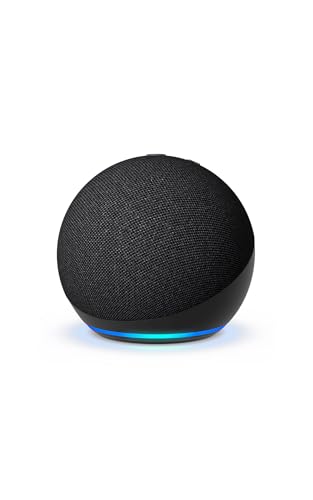
Amazon Echo Dot (5th Gen) — Best default smart speaker
The fifth-generation Dot is the speaker this category is measured by, because it is the one already sitting in millions of bedrooms, kitchens and offices doing the unglamorous work: alarms that actually wake people, timers named for pasta and laundry, news briefings with coffee, a child’s questions answered patiently at homework hour. Amazon describes it as a vibrant-sounding speaker for bedrooms, dining rooms and offices, and that positioning is accurate in a way marketing rarely is — this generation’s larger sound genuinely fills a small room with podcasts and background music at a quality its ancestors only gestured at. It is not a party speaker and does not pretend to be; it is the room’s voice, with music as a well-executed second job.
The Dot’s deepest strength is multiplication. Alexa households grow by accretion — one Dot proves the concept, then a second appears in the kitchen, a third in a child’s room — and the platform rewards that growth with whole-home announcements, grouped music and routines that span rooms. Buying the Dot is therefore less like buying a speaker and more like adopting the household’s default interface, at a price low enough that the adoption can happen one room per birthday. The spherical design and fabric finish help it disappear into domestic space in a way a black box never would, which matters for a device whose job is to be everywhere.
Its limits are the limits of its size and price. Bass is a suggestion rather than a presence, a full-volume attempt at a bass-heavy playlist will expose the small driver immediately, and a large open-plan room will swallow it. Households whose main listening happens in the living room should treat the Dot as the satellite it is and look at the Studio, the Dot Max or the Sonos for the main seat. But as the default answer to “we want Alexa in this room,” the fifth-generation Dot has no serious rival in this guide — it is the pick the others are compared against, and most rooms need exactly it.
Setup, for the record, is the category at its most painless: plug in, open the app, join the Wi-Fi, and the Dot is answering questions inside a few minutes. That ease is a designed feature, not an accident — the Dot is often a gift, given to relatives whose technical patience varies, and a device that survives being set up by its recipient without a support call from the giver has passed a test no laboratory measures. The fifth generation’s years in service have also produced an enormous body of household knowledge: whatever routine, skill or smart-home combination you want, someone has built it on exactly this hardware.
- Assistant: Alexa, including the Alexa+ generation of features
- Form: compact spherical speaker for bedrooms, dining rooms, offices
- Connectivity: Wi-Fi for smart features; Bluetooth for phone audio
- Power: mains-powered, always listening for its wake word
- Role in system: the satellite speaker of an Alexa household
Strengths
- The easiest, cheapest credible way to put a full voice assistant in a room.
- Sound quality that finally suits background music, not just speech and timers.
- Multiplies gracefully — grouped music, announcements and routines reward second and third units.
Trade-offs
- Small-driver physics: no real bass, and large rooms outrun it.
- An Alexa commitment — households on Google should not start here.
- Needs Wi-Fi and an Amazon account to be anything more than a Bluetooth speaker.
Best for: Alexa households furnishing bedrooms, kitchens and offices one room at a time. Not suited for: main-room music duty or Google Assistant homes.

Amazon Echo Studio — Best-sounding Alexa speaker
The Studio is what happens when Amazon builds an Echo to be listened to. It is the flagship of the line: a substantially larger cabinet in graphite, designed for immersive sound with Dolby Atmos spatial audio processing, and carrying a built-in smart home hub so it can anchor a household’s connected devices as well as its music. Where the Dot is a voice that plays music, the Studio is a speaker that takes voice requests — the distinction is audible within one song. Spatial processing gives recordings a sense of architecture, the low end has genuine furniture in it, and the whole performance holds together at volumes that would reduce the small pucks to shouting.
That ambition repositions the Studio’s competition. It is not really competing with the Dot — households buy Dots around a Studio, not instead of one — but with the Sonos Era 100 and with the idea of a separate hi-fi altogether. Against Sonos, the Studio argues Alexa natively and deeply, hub included, in one box with no second app mediating. Against a component system, it argues simplicity: one cabinet, voice control, streaming built in. Listeners who want the best sound Amazon’s ecosystem offers, in the room where listening actually happens, have exactly one candidate in this guide, and this is it.
The honest costs are size, price and singularity. The Studio occupies real shelf or sideboard space, costs a multiple of a Dot, and — unlike the Era 100 — does not pair with a twin for true stereo or graduate into soundbar surround duty within a wider speaker architecture. It is a destination speaker, complete as bought. For the Alexa household whose living room deserves a proper voice, that completeness is the appeal; for the household still deciding its allegiances, the commitment should be recognised as the flagship purchase it is.
The hub deserves a sentence of its own, because it changes the Studio’s place in the house. That hub means the Studio can serve as the connective tissue for compatible lights, plugs and sensors, rather than merely reporting to a hub elsewhere. In practice the household’s Alexa centre of gravity moves to the living room’s best speaker, which is where it belonged all along. Buyers assembling a first serious smart home around Alexa can let the Studio be that centre and skip a separate hub purchase entirely — a consolidation worth remembering when its price is compared against speakers that are only speakers.
- Assistant: Alexa, including the Alexa+ generation of features
- Audio: immersive spatial sound with Dolby Atmos processing
- Extra role: integrated hub for compatible smart home devices
- Finish: graphite
- Connectivity: Wi-Fi for smart features and streaming; Bluetooth input
Strengths
- By far the fullest sound in the Alexa line — a real room speaker, not a puck.
- Built-in smart home hub makes it the anchor of an Alexa household, not just an endpoint.
- Spatial audio processing gives film and music a genuine sense of scale.
Trade-offs
- A flagship price and footprint next to the Dot’s pocket change and teacup size.
- No stereo pairing or surround graduation path of the Sonos kind.
- Deepens an Alexa commitment at exactly the price where commitment should be deliberate.
Best for: Alexa households that want one proper speaker in the main room. Not suited for: multi-room stereo builders, who should look at Sonos.
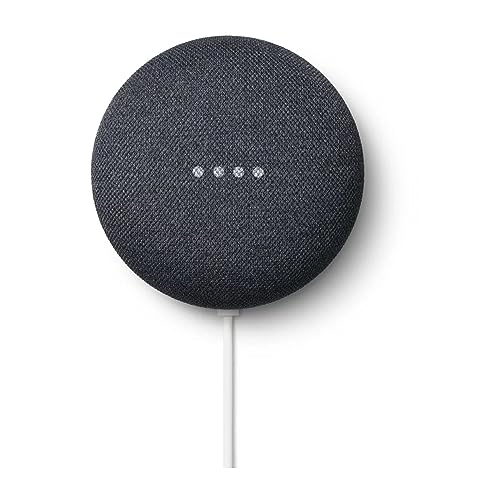
Google Nest Mini (2nd Gen) — Best for Google households
The Nest Mini is Google’s answer to the same question the Dot answers: what does a voice assistant for a small room look like when it is designed to disappear? The second-generation Mini is a fabric-covered puck — this listing in charcoal — that sits on a shelf or hangs on a wall and puts Google Assistant within earshot of the kitchen, the bedroom or the bathroom mirror. Its sound brief is speech and background: news, podcasts, timers with voices, music at the level a small room asks for while people do other things. Judged on that brief it is a complete success, and judged as a music speaker it was never entered in the contest.
The Mini’s real argument is citizenship. A household running on Google — Android phones, Google calendars, Nest cameras and doorbells, YouTube Music or Spotify tied to Google accounts — finds the Mini speaks its language natively, answers with its own data, and joins routines that span the services the family actually uses. Voice match distinguishes household members, so calendars and lists stay personal even on a shared kitchen device. For that household, choosing the Mini over a Dot is not brand loyalty; it is data gravity, and it is decisive. For a household with no Google commitments, the same logic runs in reverse and the Dot’s broader smart-home web usually wins the room.
Proportion is the caveat to carry away. The Mini is the smallest, simplest device in this guide, priced and built as a satellite, and Google households wanting a main-room music speaker will need to look beyond this list’s Google entry — the Mini cannot be stretched into that role by optimism. Within its role, though, it is close to faultless: cheap enough to multiply, discreet enough to put anywhere, and smart in the specific way its ecosystem is smart. Google homes furnishing secondary rooms should buy these without overthinking, and spend their deliberation budget on the main room instead.
There is a small, telling detail in the Mini’s design: it is as much a piece of fabric as a piece of electronics, with its controls hidden under the cloth and its presence announced by lights that glow through the weave. Google understood that a device destined for bedrooms and kitchens succeeds by resembling the room’s soft furnishings more than its gadgets. That discretion has a practical side — a Mini on a kitchen shelf does not read as surveillance equipment to guests the way a camera-eyed device can — and it makes the Mini the easiest smart speaker in this guide to place in someone else’s home, which is where a great many of them end up, as gifts that stay.
- Assistant: Google Assistant
- Form: compact fabric puck, shelf or wall friendly
- Finish: charcoal
- Connectivity: Wi-Fi at the centre, Bluetooth for direct phone playback
- Role in system: the satellite speaker of a Google household
Strengths
- Native citizen of a Google household — calendars, Nest devices and accounts align.
- As discreet as a smart speaker gets; disappears into a room’s soft furnishings.
- Voice recognition for different household members keeps shared spaces personal.
Trade-offs
- The most modest sound here — speech and background only, by design.
- No upgrade path within this guide to a Google main-room speaker.
- Pointless in an Alexa household; the ecosystem logic is absolute.
Best for: Google Assistant households adding voice to secondary rooms. Not suited for: main-room music, or any room in an Alexa-committed home.

Sonos Era 100 — Best for music systems
The Era 100 comes from the opposite direction to every other pick here: Sonos builds music systems, and this is the smallest full citizen of theirs — a compact speaker in black that streams over Wi-Fi in the Sonos multi-room platform, accepts Bluetooth when a guest or an offline moment asks, carries Alexa built in for voice, and holds two party tricks no Echo can match. A pair of Era 100s becomes a true stereo system with a soundstage a single cabinet cannot fake. The same speakers can serve as rear surrounds for a Sonos soundbar, turning a television setup into a genuine home-theatre rear stage. Roles, in the Sonos world, are assignments rather than destinies, and the Era 100 is the most reassignable speaker in this guide.
As a music device it is engineered with a seriousness the pucks do not attempt: stereo separation is the system’s native language even from one cabinet’s paired drivers, the tuning is done with the room in mind through Sonos’s correction tools, and the platform behind it — grouping rooms, queueing from every major service, holding a whole house in sync — is the most mature multi-room architecture in consumer audio. Households that listen deliberately, album by album, will feel the difference in kind, not just degree. This is the pick for the reader whose question was never really “which assistant” but “which speaker system will still be growing with me in five years.”
The costs are equally characteristic. The Era 100 is the most expensive small speaker here, its setup is the most deliberate — a Sonos account, the app, a system to initialise rather than a device to plug in — and its voice life is Alexa-shaped, so Google households get the music platform without their assistant of choice. Bluetooth, though present, is the secondary transport; buyers wanting a purely Bluetooth speaker are paying for a Wi-Fi architecture they will not use. None of that dents the recommendation for its intended reader. It dents it only for readers who wanted a puck and wandered into a platform.
Sonos’s room-tuning approach is worth a moment, because it addresses the Era 100’s real working conditions. Small speakers live on bookshelves, in corners, against walls — placements that bend any speaker’s sound — and the platform’s correction tools measure the room’s effect and compensate. The result is a small speaker that sounds considered in positions where rivals sound accidental. Owners moving an Era 100 between rooms, or from single duty to a stereo pair, re-run the process and the speaker re-learns its job. It is the kind of invisible engineering that separates a music platform from a collection of devices, and over years of rearranged furniture it quietly compounds.
- Assistant: Alexa built in, within the Sonos platform
- Connectivity: Wi-Fi multi-room streaming and Bluetooth
- Roles: single speaker, stereo pair, or soundbar surrounds
- Finish: black
- Platform: Sonos system — app and account setup required
Strengths
- Stereo pairing and surround duty give one purchase several system careers.
- The most mature multi-room music platform in the guide behind it.
- Music-first engineering that rewards deliberate listening, not just background play.
Trade-offs
- The priciest small speaker here, and Sonos ownership is a platform commitment of its own.
- Voice control is Alexa-flavoured; Google households lose their native assistant.
- Setup is a system initialisation, not a plug-and-play puck moment.
Best for: music-led households building a multi-room system that can grow into stereo and surround. Not suited for: buyers who just want a cheap voice in the kitchen.

JBL Authentics 300 — Best portable smart speaker
The Authentics 300 is the diplomat of this guide and its only traveller. JBL builds it in a retro-styled cabinet that nods to the company’s heritage designs, gives it both Alexa and Google Assistant — available together, a combination no other pick here offers — and then does the thing no other pick does at all: it fits a battery rated for up to eight hours, so the smart speaker can leave its socket and work the garden, the workshop or the other end of the house. At home on Wi-Fi it is a full smart speaker with multi-room company manners; away from the plug it is a substantial portable Bluetooth speaker with a voice-assistant education.
The dual-assistant design deserves more than a bullet point, because it dissolves this guide’s central dilemma for a specific kind of household: the mixed one. Homes where one partner lives on Google and the other on Alexa, or where the smart-home devices accumulated across both worlds, normally have to pick a winner and exile the loser. The Authentics 300 declines to hold that election. Each assistant handles what it is asked to handle, and the speaker stays neutral territory. For mixed households, that is not a novelty feature; it is the difference between a speaker everyone uses and a speaker half the house routes around.
Portability has honest edges. Eight hours is a working day of background music, not a weekend festival, and a battery device is heavier than its mains-only equivalents because it is carrying its power station with it. The retro styling, delightful to some, is a deliberate aesthetic that will not dissolve into every room the way a fabric puck does. And as a portable it competes in spirit with dedicated rugged Bluetooth speakers that shrug off weather the JBL was not built to ignore — it is a house-and-garden traveller, not a kayak companion. Within its true brief, though, it is unique in this guide: the smart speaker for households that cannot, or will not, swear allegiance.
The Authentics name is a deliberate piece of JBL archaeology — a nod to the company’s classic speaker designs, translated into a cabinet with a handle-friendly, room-friendly form. That heritage cuts both ways in the best sense: the styling gives the speaker a permanence that gadget-shaped rivals lack, so it can sit in a living room as furniture for a decade, while the electronics inside keep it current. For buyers tired of technology that looks obsolete in three years, a smart speaker dressed as a classic is a genuinely different proposition — and the battery means its good looks are not chained to the one corner of the room with a free socket.
- Assistants: Alexa and Google Assistant, both on board
- Battery: up to 8 hours of portable play
- Connectivity: Wi-Fi smart features and multi-room; Bluetooth
- Style: retro JBL heritage design
- Power: mains at home, battery away from the socket
Strengths
- Both major assistants in one cabinet — the mixed household’s peace treaty.
- A real battery makes it the only pick that can work away from a wall socket.
- JBL’s music-first voicing and heritage styling give it presence the pucks lack.
Trade-offs
- Battery life suits a day, not a weekend — and the battery adds carry weight.
- Retro looks are a statement, not a disguise.
- Not a rugged outdoor speaker; its travels are house, garden and workshop, not riverbank.
Best for: mixed-assistant households and anyone wanting one smart speaker that can move rooms freely. Not suited for: buyers furnishing many rooms cheaply, where pucks multiply for the same money.

Amazon Echo Dot Max — Best new middleweight
The Echo Dot Max is Amazon’s newest answer to a question the original Dot created: what if the room is bigger than a bedroom? Positioned above the standard Dot in the current line, the Dot Max is built for room-filling sound with nearly twice the bass of the standard Dot brief, aimed at living rooms and open spaces where the classic puck’s voice gets lost. It keeps the Dot family’s essential character — Alexa at the centre, designed for the newest generation of the assistant — while conceding, in hardware, that one size of Echo no longer fits every room it is asked to serve.
For an Alexa household, the Dot Max tidies the range into a sensible ladder. Small rooms take Dots; the main room takes either the Dot Max for a fuller voice at a moderate step up, or the Studio when the ambition is flagship sound and hub duties together. That ladder matters because the commonest Alexa mistake is scattering standard Dots into rooms too big for them and concluding the platform sounds thin. The Dot Max exists so the platform’s middle rung is a real speaker rather than a puck at full stretch, and living-room listeners who live on streamed music, radio and podcasts will hear the bass difference in the first minute.
Being the newest model carries the usual two-sided ledger. On one side, the longest support future in the Dot family and hardware designed for where Alexa is going rather than where it has been. On the other, a shorter track record than the fifth-generation Dot’s years of household service, and a price that asks the buyer to be sure the room genuinely needs the extra voice — in a small bedroom, the Max’s advantage evaporates and the standard Dot remains the rational buy. Choose by room size, honestly measured, and the Dot Max is exactly the middleweight its name promises.
The Dot Max also clarifies something about how these ranges evolve: the “Dot” in its name is now a promise about simplicity rather than size. It sets up like a Dot, behaves like a Dot and asks Dot-level effort from its owner, while sounding like a speaker from the class above. That is a shrewd piece of product design for the households Amazon knows best — ones that loved the Dot’s ease and simply outgrew its voice as their rooms, families and listening grew. If that sentence describes your house, the Max was drawn around it, and the standard Dot’s years of goodwill transfer to it without friction.
- Assistant: Alexa, newest-generation hardware
- Audio: room-filling sound with nearly twice the standard Dot’s bass brief
- Form: Dot-family speaker sized for living rooms
- Connectivity: Wi-Fi for smart features; Bluetooth for phone audio
- Role in system: the main-room step between Dot satellites and the Studio
Strengths
- Fills a living room where a standard Dot sounds lost, without jumping to flagship size.
- Newest hardware in the family, with the longest support runway.
- Keeps the Dot formula — simple, voice-first, easy to live with — at a bigger scale.
Trade-offs
- Wasted in small rooms, where the cheaper Dot already does the whole job.
- A shorter service record than the long-running fifth-generation Dot.
- Still a single-point speaker — no stereo pairing path of the Sonos kind.
Best for: Alexa households whose living room outgrew the standard Dot. Not suited for: bedrooms and small offices, where it is capability without a use.
Which bluetooth smart speakers should be compared head to head?
| Speaker | Ecosystem | Class | Standout ability | Best room |
|---|---|---|---|---|
| Echo Dot (5th Gen) | Alexa | Voice-first puck | Cheap, graceful multiplication | Bedroom, kitchen, office |
| Echo Studio | Alexa | Music-first flagship | Spatial audio plus smart home hub | Main living room |
| Google Nest Mini | Google Assistant | Voice-first puck | Native Google household citizenship | Secondary rooms in Google homes |
| Sonos Era 100 | Sonos + Alexa | Music system speaker | Stereo pairing and surround duty | Any room in a growing system |
| JBL Authentics 300 | Alexa + Google | Portable smart speaker | Dual assistants and a battery | Wherever the day moves |
| Echo Dot Max | Alexa | Middleweight | Room-filling Dot with real bass step | Living rooms beyond Dot range |
The ecosystem column eliminates before the class column ranks: a Google household’s shortlist starts with the Nest Mini and the JBL, an Alexa household’s with the three Echos and the Sonos, and a mixed household’s with the JBL alone. Only within those honest shortlists does sound class decide.
How do you build a whole-home setup from these speakers?
Start with the room where listening is deliberate, and put the real speaker there: a Studio in an Alexa home, an Era 100 — with a second pencilled in for stereo — in a music-led one, the Dot Max where the main room is modest. Then furnish the satellite rooms with pucks of the same allegiance: Dots around a Studio, Nest Minis in a Google home. Satellites are where timers, alarms, announcements and questions live, and their sound demands are genuinely small; over-buying satellites is the commonest budget error in the category, and it starves the main room of the speaker it deserved.
Then do the unglamorous work that makes a smart home feel smart rather than scattered. Name rooms consistently in the app and teach every household member the names. Put music services, lists and calendars on the account the household actually shares. Build two or three routines for the moments that recur daily — the morning briefing, the bedtime wind-down, the leaving-the-house sweep — rather than twenty routines nobody remembers. Set the speakers’ locations in the app to match the physical rooms so announcements and groups behave as expected. An afternoon of this administration is worth more than a second flagship speaker, and it is the difference between a house with smart speakers and a smart house.
Finally, place for the microphone as well as the driver. A smart speaker buried behind a television or beside a clattering dishwasher will mishear its household into quiet resentment. Ear-level-ish placement, a little clear air around the cabinet, and distance from the room’s loudest appliance make voice recognition feel telepathic; the opposite makes the same hardware feel deaf. The speakers in this guide all hear well when they are placed as if hearing mattered — because for a device you talk to, it does.
What mistakes do smart speaker buyers repeat?
The first is buying the speaker and discovering the ecosystem: a Dot gifted into a Google household, a Nest Mini in an Alexa home, each device technically excellent and practically exiled. The second is class confusion — expecting a puck to be a party speaker, or buying a Studio to answer kitchen timers, when the guide’s two classes exist precisely to prevent both disappointments. The third is treating Bluetooth as the main event: these are Wi-Fi citizens, and a buyer who never intends to connect the account and the network is purchasing a fraction of each device and should buy a dedicated Bluetooth speaker instead.
Fourth, scattering before anchoring — four pucks in four rooms and nothing worth listening to in the room where listening happens. Fifth, privacy by vibes: smart speakers are microphones with a mute, and households should use the mute controls, review their voice settings, and place devices with the same deliberation they would give any connected camera or mic. That is not an argument against the category; it is the ordinary hygiene of owning it, and every ecosystem here provides the controls — the owner’s job is simply to visit them once, deliberately, rather than never.
How do these speakers age over years of ownership?
A smart speaker is unusual among audio products in that its most important component — the assistant — lives in the cloud and keeps learning after the purchase. The speaker you buy this year will answer questions next year with a newer brain, gain features in overnight updates, and gradually become a slightly different product without ever leaving the shelf. That is the category’s quiet bargain, and it cuts in the owner’s favour more often than not. It also means the hardware decisions that matter are the durable ones: a driver that sounds good, a cabinet that survives the room, microphones that hear clearly, and a maker whose platform will still be maintained when the device is old enough to be furniture.
The same cloud logic carries the category’s one real risk, which honest guides should name: a smart speaker’s fate is tied to its platform’s. Features can change, services can be folded, and a device whose maker loses interest becomes a Bluetooth speaker with memories. The defence is the one this guide has applied throughout — buy into platforms with deep, current commitment. Amazon, Google and Sonos each have their entire household strategy resting on these devices, and JBL’s dual-assistant design hedges even that bet by hosting two platforms in one cabinet. Obsolescence in this category arrives slowly and announces itself; the owners caught out are usually those who bought an unknown platform’s puck for its price alone.
Practically, ownership settles into a rhythm. The speakers ask for nothing — no charging except the JBL’s battery, no maintenance beyond a dust and the occasional Wi-Fi password change rippling through the house’s devices. They accumulate small duties until the household’s day is quietly threaded through them: wake-ups, weather, timers, the evening news, the lights. The measure of a good smart speaker purchase, three years on, is not whether it still impresses anyone. It is whether the household would bother replacing it the week it died — and for the right ecosystem match among these six, the answer is always yes, immediately, with the same model if it still exists.
What about children, guests and other real household complications?
Real households contain people who did not choose the ecosystem, and the speakers handle them better than their reputations suggest. Children are the power users nobody predicted: a Dot in a child’s room becomes an alarm clock, a storyteller, a homework oracle and a music player that never needs a screen, with parental controls in each platform to bound what it can buy, play or repeat. The voice-first design that adults treat as convenience is, for a child, simply the first interface that was ever built at their height — and households consistently report the kitchen speaker fielding more questions from the under-tens than from everyone else combined.
Guests are the other test, and here the Bluetooth fallback earns its keep at last. A visitor’s music enters through Bluetooth without accounts, invitations or the household’s streaming services being disturbed, and the speaker returns to its duties afterwards. Guest rooms are the one place a household might deliberately break its own allegiance — a speaker there serves strangers, not the family’s data — though consistency still wins for announcements and routines. The deeper point is that these six devices were all designed by companies that understand shared domestic space; none of them demands a household of enthusiasts, and the best compliment their owners pay them, usually within a month, is that visitors stop noticing them entirely.
Which single speaker should a first-time buyer start with?
Every ecosystem in this guide has a correct first purchase, and it is rarely the flagship. The first speaker’s job is to test the household’s fit with the assistant — whether the family actually talks to it, whether its answers match the household’s services, whether the routines get used or forgotten by February. That test should be run at puck prices: a Dot in an Alexa-curious home, a Nest Mini in a Google one. A household that falls for the platform can then build upward with the main-room speaker chosen knowingly, and the puck retires honourably to a bedroom. A household that does not has learned so at the cost of a takeaway dinner, which is exactly what a first purchase is for.
The exceptions prove the rule by their circumstances. The music-led household already knows its answer and should start with the Era 100, because its test is not the assistant but the platform’s sound. The mixed household should start with the JBL, because its test — can one speaker serve two allegiances — is the whole question. And the household replacing a dead Dot with years of Alexa routines already built has no test left to run; it should buy the Dot Max or the Studio its room deserves. First purchases are for the undecided, and the most useful thing a guide can do is refuse to sell them a flagship for a question a puck can answer.
Final Recommendation
If the household is still debating at the end of this guide, let one practical tiebreaker decide: look at the phones, calendars and connected devices already in the house, and count. The ecosystem with the higher count is the one whose assistant will know the most about your lives on day one, and day one is when households decide whether a smart speaker is a marvel or a paperweight. Allegiance chosen by inventory is rarely regretted.
Decide the household’s allegiance and the rest of this guide reads itself. Alexa homes: the Echo Dot for every secondary room, the Dot Max for a living room of ordinary ambition, the Studio where the main room deserves a flagship and a hub. Google homes: Nest Minis in the secondary rooms without a second thought, and the JBL Authentics 300 as the main-room speaker that keeps the household’s options — and its second assistant — alive. Mixed or undecided homes should start with that same JBL, the only pick that refuses to make the household choose. And the music-led household, the one that thinks in albums and rooms rather than assistants, should build on the Sonos Era 100 and let its speakers change roles as the system grows — the one purchase here that is genuinely a beginning rather than an answer.
Frequently Asked Questions
Do these speakers work without Wi-Fi?
Only in a reduced form. The smart features — voice assistant, streaming, routines, multi-room — all require Wi-Fi and the maker’s account. Without them, most picks fall back to being Bluetooth speakers for a phone, which wastes most of what you paid for. The JBL’s battery makes it the most useful offline, as a portable Bluetooth speaker, but even it is designed as a Wi-Fi citizen.
Can I mix Alexa and Google speakers in one house?
You can, and many households do, but the systems will not cooperate: groups, routines and announcements stay inside each ecosystem. The smoother route for a genuinely mixed household is hardware that hosts both assistants, which in this guide means the JBL Authentics 300. Otherwise, pick one platform per household and let the other go, however good its speakers look in isolation.
Which of these can pair for real stereo?
The Sonos Era 100 is the clear answer — two of them form a true stereo pair, and they can also serve as surrounds for a Sonos soundbar. Amazon’s speakers can be grouped for multi-room playback, which is synchronised sound in several rooms, not the same thing as a stereo image in one. Buyers whose main-room plan is a stereo pair should start with Sonos.
Are smart speakers always listening?
They listen locally for their wake word and begin transmitting audio to their service when they believe they have heard it, or when their button is pressed. Every ecosystem here provides microphone mute controls and settings for reviewing and deleting recordings. Use the mute when a conversation demands it, and review the privacy settings once at setup — ordinary hygiene for a connected microphone.
Is Bluetooth sound quality worse than Wi-Fi on these speakers?
Wi-Fi streaming is generally the fuller path: it carries the services natively at their best quality and frees the phone from being the source. Bluetooth is the convenient fallback — a guest’s phone, an unsupported app, the JBL away from home. For the background and podcast duty most of these speakers perform, few listeners will hear a practical difference; for deliberate listening, prefer Wi-Fi where the speaker offers it.
Can these speakers make and take phone calls?
Several can, within their ecosystems — Alexa devices can call other Alexa devices and, with the household’s setup, phone numbers; Google devices handle calls through their own services; the details shift as platforms evolve. Treat calling as a welcome bonus rather than a reason to buy, and keep a real phone within reach for anything urgent, since a smart speaker is a convenience device and not a lifeline.
How many smart speakers does a house actually need?
Fewer than the marketing implies. One real speaker in the main room, plus a puck in each room where voice is genuinely used — kitchen, main bedroom, perhaps a child’s room — covers most households completely. Beyond that, additional speakers serve announcements and symmetry more than need. Add rooms one at a time, when a specific duty appears, and the system will stay useful rather than merely extensive.
Can a smart speaker replace a soundbar or hi-fi?
The flagship-class picks — the Echo Studio and the Sonos Era 100, especially a stereo pair of the latter — cover a small room’s music and television duties respectably for many listeners. They do not replace a dedicated soundbar’s dialogue clarity for film fans or a component hi-fi for committed listeners. Treat them as excellent room systems, and let enthusiasts keep their separates without an argument.
Related Guides
For music with no assistant attached, the best floor standing stereo speakers guide covers the traditional two-channel route, while the best bicycle speakers roundup takes Bluetooth audio outdoors and onto the handlebars. The same multi-room question at commercial scale — restaurants, lobbies, whole floors — is answered with transformer taps in the best 70v ceiling speakers. Height channels are the other direction a living-room system can grow, compared in the best add on atmos speakers.


