What's inside
- Key Takeaways
- Quick Picks
- How Did We Size Panels for Trips Instead of for Brochures?
- From 14W to 45W: Matching Panel Size to Trip Length
- Why Does the Power Bank Matter More Than the Panel?
- How Should a Panel Be Carried and Deployed on the Trail?
- What Mistakes Leave Solar Kits in the Gear Cupboard?
- How Does Forest Walking Differ From Alpine Walking for Harvest?
- What Does a Week of Real Harvest Planning Look Like?
- Final Recommendation
- Frequently Asked Questions
- Related Guides
As an Amazon Associate I earn from qualifying purchases. This post may contain affiliate links at no extra cost to you.
gizmoverdict.com is reader-supported. When you buy through links on our site, we may earn an affiliate commission.
Where to buy: All six picks below are folding solar panels sold through Amazon — pure panels, every one, with no battery inside. That sentence is the most important one in this guide: a solar panel converts sunlight into power while the sun shines and stores nothing, so each of these panels is designed to charge a separate power bank during the day, and the power bank charges the phone whenever it is needed. No 12V battery or RV kit appears here as a pick; those are vehicle systems wearing a similar name.
The search for the best solar panel chargers for backpacking is really a search for grams that earn their place. A backpacker audits every object against the distance it must be carried, and a solar panel is an auditable luxury: it weighs something every mile, and it repays that weight only in sunlight, only when deployed, only into a battery that can hold the harvest. The six panels in this guide span 14W to 45W of rated output, and the spread is not a quality ladder — it is a set of answers to different trip lengths, different latitudes and different appetites for power. A weekend walker’s phone-and-headtorch diet and a thru-hiker’s camera-and-navigation diet do not want the same panel, and pretending otherwise is how panels end up resold.
The wattage on a folding panel needs the same honest translation as every figure in this site’s charger guides. The rating describes output under strong, direct, well-angled sun — a laboratory noon. On a trail, the panel hangs from a pack at a compromise angle, passes under tree cover, and works mornings and afternoons at slanting light, so the harvested energy across a day is a fraction of the nameplate multiplied by the hours. That is not deception; it is astronomy. The practical consequence shapes the whole method of solar backpacking: the panel’s real job is to fill a power bank steadily whenever the sun allows, and the bank — bought separately, carried always — smooths the weather into a reliable nightly charge for the phone.
Because the bank is a separate purchase, the panel’s ports matter as much as its watts. The titles here divide between USB-A-only designs and panels offering USB-C with Power Delivery figures — 25W PD stated on two of them — and a modern power bank charges fastest from the port that speaks its language. A panel and a bank are a system, and this guide reads them as one: panel sized to the trip, bank sized to the devices, ports matched between them. The sections below keep returning to that system view, because a panel judged alone is a panel misunderstood.
Weatherproofing is the third axis, and the titles state it with unusual completeness: IP68 on three picks, IPX5 on one, IPX4 on the smallest. A backpacking panel lives outdoors by definition — strapped to a pack in passing showers, laid on damp grass at lunch, folded away with morning dew still on it — so a stated water rating is not a garnish here but a core specification, and the spread between IPX4 splash resistance and IP68 sealing maps onto the spread between fair-weather weekend use and committed all-season travel.
Key Takeaways
- Every pick is a pure folding panel with no battery: panels make power in sunlight and store none, so a separate power bank is a required part of the system.
- Rated watts run from 14W to 45W; trail harvest is a fraction of the rating once angle, shade and slanting light take their share.
- Two panels state 25W Power Delivery over USB-C — the port a modern power bank fills fastest from.
- Water ratings are stated across the list: IP68 on three panels, IPX5 on the SOLUPUP, IPX4 on the smallest BigBlue.
- The lightest panel states its weight outright — 0.84 lbs — and calls itself pocket-size; the 45W panel claims pocket-size too, at the top of the power range.
- Panel size should follow trip length and device diet, not ambition: an oversized panel is weight carried for watts the weather may never let it make.
Quick Picks
| Pick | Badge | Why it is here |
|---|---|---|
| BigBlue 28W Solar Panel Charger with Dual USB-C and USB-A | The established all-rounder | 28W with both USB-C and USB-A ports and a title that names power banks among its targets — the classic backpacking panel formula. |
| BigBlue 35W Solar Charger, PD 25W USB-C, IP68 | Fast-charge panel, sealed | 35W with a stated 25.4% efficiency, PD 25W over USB-C and an IP68 rating — the specification leader of the BigBlue line here. |
| BigBlue Ultra-light 25W Solar Panel, 0.84 lbs, IP68 | Lightest stated weight | 25W at a stated 0.84 lbs with IP68 sealing — the weight-conscious pick that still carries real output. |
| BigBlue 14W Tiny Solar Charger, IPX4 | Smallest panel | 14W through a single USB-A port at 5V/2.4A max — a minimal top-up panel for short trips and light diets. |
| SOLUPUP 30W Foldable Solar Panel Charger, IPX5 | Mid-size alternative brand | 30W folding panel with USB-C and USB-A and an IPX5 rating, sized between the ultralight and the big chargers. |
| GEYOTO 45W Solar Panel Charger, PD 25W, IP68 | Highest rated output | 45W with PD 25W USB-C and IP68 sealing in a pocket-size claim — the panel for heavy diets and short winter days. |
How Did We Size Panels for Trips Instead of for Brochures?
The sizing method in this guide starts from the device diet and works backwards. A phone used sparingly — maps checked, messages sent, aeroplane mode between — sips a few percent of a power bank per day, and a modest panel replaces that sip easily in any decent weather. A phone used as camera, navigator and notebook drinks a bank in a day or two, and the panel must harvest at a rate that keeps pace across mediocre weather, not just perfect weather. The wattage tiers in this list map onto that spectrum: the 14W panel serves the sipper on short trips, the 25W to 30W panels serve the middle diet, and the 35W and 45W panels serve heavy diets, high latitudes and short winter days where the harvest hours shrink.
Stated facts drove every placement, as elsewhere on this site. Wattage, port sets and PD figures come from the titles; efficiency is claimed by exactly one title (25.4%, on the BigBlue 35W) and credited only there; weight is stated by exactly one title (0.84 lbs, on the ultralight 25W) and likewise credited only there, with other panels’ weights recorded as not stated rather than estimated from their dimensions. Water ratings are stated on five of the six titles, and the one silence — the original 28W panel — is recorded as a silence.
Two boundaries were held firmly. First, panels with integrated batteries were not mixed into this list even where they share vocabulary, because a battery-panel hybrid is a different system with different weight and failure logic; every pick here is a pure panel that presumes a separate bank. Second, 12V panels and kits aimed at vehicle batteries and RV roofs were excluded outright: their wattage figures look similar, their connectors and purpose are entirely different, and a backpacker sold a 12V kit has bought a boat anchor shaped like a panel.

BigBlue 28W Solar Panel Charger with Dual USB-C and USB-A — The established all-rounder
The 28W BigBlue is the panel that defined this product class for backpackers, and its title reads like the class’s founding document: 28W of high-efficiency panel, dual USB-C and USB-A ports, and a target list that names the system correctly — iPhone, iPad, Samsung Galaxy, power bank, GPS. That last pair of targets matters. A panel that names the power bank among its intended devices understands its own job: harvest into storage during the day, and let the storage serve the gadgets at night. The dual-port layout supports the rhythm directly, one port for the bank and one for a device taking a lunchtime sip in full sun.
Twenty-eight watts sits at the historical sweet spot of the category, and the reasoning still holds. In strong sun, a panel of this size fills a mid-sized power bank across a day’s walking with capacity to spare for the phone’s own top-up at camp; in mixed weather it fills the bank partially, which is why the bank’s size — not the panel’s peak — is what carries a trip through a grey day. The folding format straps to a pack’s back panel, hangs from a tent loop, or spreads on a rock at lunch, and years of production have made this design the reference against which the newer, lighter and stronger panels in this guide define themselves.
Its title’s silences are the honest counterweight: no water rating is stated, and no weight is published in the listing title, so both are recorded below as documentation checks. A buyer planning a wet-season trip should weigh the IP68 picks heavily; a buyer counting grams should weigh the ultralight. The 28W remains the answer for the broad middle — established design, dual modern ports, and a wattage that matches a typical bank-and-phone system without excess in either direction.
- Rated output: 28W
- Ports: dual USB-C and USB-A per listing title
- Stated targets: iPhone, iPad, Samsung Galaxy, power bank, GPS
- Water rating: Not stated in the listing title — verify with BigBlue documentation
- Weight: Not stated in the listing title — verify with BigBlue documentation
- Storage: none — pure panel, requires a separate power bank
Strengths
- The class-defining formula: 28W, both modern port types, and the power bank named as a target.
- Dual ports let a bank and a device drink simultaneously in strong sun.
- A long-established design with the folding format every rival imitates.
Trade-offs
- No water rating in the title — wet trips need a documentation check.
- No stated weight, so gram-counters cannot place it precisely from the listing.
- No PD figure is stated for its USB-C port.
Best for: a buyer seeking the proven middle path — a 28W dual-port panel feeding a power bank across a week of mixed trail weather.
Not suited for: ultralight kits counting every gram, or wet-season trips where a stated IP68 rating is the safer ground.

BigBlue 35W Solar Charger with PD 25W USB-C, IP68 — Fast-charge panel, sealed
The upgraded 35W BigBlue is the specification leader of this guide, and uniquely, its title publishes an efficiency figure: 25.4%, high efficiency stated outright. Efficiency is the quiet variable in solar — two panels of the same wattage rating harvest alike by definition, but a more efficient panel reaches its rating from a smaller surface, which means less area strapped to the pack and less sail in the wind. Combined with 35W of rating, a stated PD 25W output over USB-C, a USB-A port beside it, and an IP68 waterproof rating, the title assembles the most complete specification in this list, aimed at iPhone and Android phones, iPads and power banks on camping and backpacking trips.
The PD 25W figure deserves its paragraph. Power Delivery is the fast-charging language modern power banks speak, and a bank that can accept a PD input fills markedly faster during the short windows when a panel is producing well — the clear midday hour at a lunch stop, the sunny evening at camp. A panel without PD feeds the same bank at a gentler negotiated rate, and across a week the difference is a bank that is full by dinner against a bank that is nearly full. For heavy device diets, that difference compounds daily, which is why the PD picks sit at the serious end of this guide.
IP68 sealing completes the profile: this is the panel for trips where weather is a plan rather than a hope. Strapped outside the pack through a shower, spread on wet ground at a misty camp, folded away damp — the rating covers the life a backpacking panel actually lives. The trade is the usual one at this tier: more panel, more capability, and a weight the title does not state, to be confirmed in the documentation whenever the base weight is already negotiated to the gram.
- Rated output: 35W
- Efficiency: 25.4% stated in the listing title
- Ports: USB-C with PD 25W stated; USB-A
- Water rating: IP68 stated in the listing title
- Stated targets: iPhone/Android, iPad, power bank, camping, backpacking
- Weight: Not stated in the listing title — verify with BigBlue documentation
- Storage: none — pure panel, requires a separate power bank
Strengths
- The only stated efficiency figure here — 25.4% — meaning rated power from less surface.
- PD 25W fills a modern power bank fast during short strong-sun windows.
- IP68 sealing for panels that live outside the pack in real weather.
Trade-offs
- Weight unstated in the title; ultralight buyers must check the documentation.
- 35W is more panel than a weekend sipper’s diet can spend.
- Its advantages assume a PD-capable bank; an older USB-A-only bank cannot use the fast path.
Best for: a buyer seeking a sealed, efficient panel that fast-fills a modern power bank for a camera-and-navigation device diet.
Not suited for: minimal weekend kits, or a system whose power bank lacks a USB-C PD input.

BigBlue Ultra-light 25W Solar Panel, 0.84 lbs, IP68 — Lightest stated weight
This is the panel that publishes the number backpackers actually shop by: 0.84 lbs, stated in the title beside the words ultra-light and pocket-size. In a discipline where a toothbrush is sawn in half to save grams, a maker willing to print a weight in the headline is speaking the customer’s language, and 0.84 lbs for a 25W IP68 panel is a genuinely competitive figure — real output, real sealing, at a weight a week-long kit can absorb without a committee meeting. The port set keeps the modern shape, USB-A and USB-C together, and the stated targets are the backpacking core: phones, tablets and power banks.
Twenty-five watts at this weight reframes the sizing conversation. The traditional ultralight answer was a tiny 10W-class panel and a prayer; this panel offers two and a half times that harvest at a weight the prayer used to cost. On a sunny traverse it keeps a middle-diet system — phone for navigation and photographs, headtorch, earbuds — in comfortable surplus, filling the bank by day and leaving the evenings free of power anxiety. IP68 sealing, again stated, means the weight saving was not bought by surrendering the weather rating, which is the corner ultralight gear most often cuts.
The title does not state a PD figure for its USB-C port, and the spec list records that; a bank paired with this panel may fill at standard USB-C rates rather than the PD pace of the 35W and 45W picks. That is the honest price of the weight, and for most middle-diet trips it is a price paid in minutes across a long sunny afternoon rather than in outcomes. Judged on the axis its title chooses — watts per carried gram, sealed — this is the most backpacker-literate pick in the guide.
- Rated output: 25W
- Weight: 0.84 lbs stated in the listing title
- Water rating: IP68 stated in the listing title
- Ports: USB-A and USB-C
- Stated targets: backpacking, hiking, camping; phones, tablets, power banks
- PD output figure: Not stated in the listing title — verify with BigBlue documentation
- Storage: none — pure panel, requires a separate power bank
Strengths
- A stated 0.84 lbs for 25W — the best published watts-per-gram story in this guide.
- IP68 sealing retained despite the weight discipline.
- Pocket-size fold suits packs without a large flat back panel.
Trade-offs
- No PD figure stated; a fast-fill bank may charge at standard rates.
- 25W serves a middle diet; camera-heavy or winter trips will out-drink it.
- Pocket-size panels have less area to catch slanting morning and evening light.
Best for: a buyer seeking a sealed 25W panel at a published 0.84 lbs for week-long trips on a middle device diet.
Not suited for: heavy power diets or short winter days, where the 35W and 45W panels earn their extra carry.
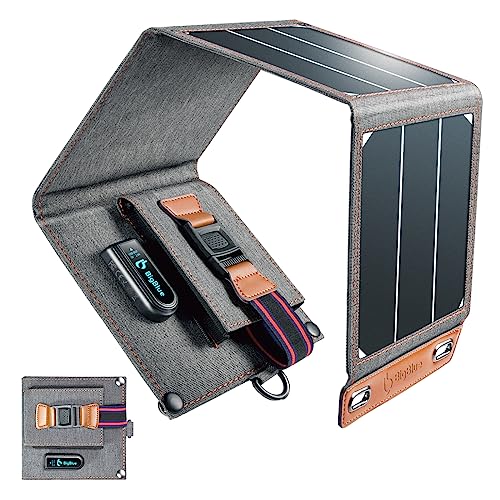
BigBlue 14W Tiny Solar Charger, IPX4 — Smallest panel
The 14W BigBlue is the minimalist’s answer, and its title is admirably blunt about the shape of the offer: a tiny upgraded panel, a single USB-A port, a stated maximum of 5V/2.4A, and IPX4 waterproofing. Fourteen watts will not run a device-hungry expedition, and this panel does not claim otherwise. What it does is keep a light system alive indefinitely: a phone in aeroplane mode, checked for maps and messages, topped up through a small power bank across a long weekend — the panel trickling into the bank whenever the pack faces the sun, the bank repaying the phone at night.
The single USB-A port defines the system’s era and its simplicity. There is no PD to configure and no port choice to make; the panel feeds a bank or a device at the gentle universal rate, and its stated 5V/2.4A ceiling is the honest arithmetic of that rate. Older banks and simpler devices pair with it naturally. A modern PD bank will accept its feed at standard pace and be grateful, if not hurried. For fast-mover trips — two nights, light diet, small pack — that simplicity at minimal size is the entire argument, and it is a good one.
IPX4 is the rating to read correctly: splash resistance, proof against rain sprayed from any direction, short of the immersion tiers above it in this guide. For a fair-weather weekend panel that retreats into the pack when the weather turns serious, IPX4 is proportionate. For a trip that expects to charge through days of rain at high latitude, it is not, and the IP68 picks exist for that reader. Small, honest and sufficient are this panel’s three virtues, in that order.
- Rated output: 14W
- Ports: 1 USB-A, 5V/2.4A max stated in the listing title
- Water rating: IPX4 stated in the listing title
- Stated targets: hiking; iPhone, tablet, Samsung, LG and similar devices
- USB-C port: none — USB-A only per listing title
- Weight: Not stated in the listing title — verify with BigBlue documentation
- Storage: none — pure panel, requires a separate power bank
Strengths
- The smallest commitment in the guide — a genuine top-up panel for light diets and short trips.
- Its single-port simplicity leaves nothing to configure or mismatch.
- IPX4 splash resistance covers fair-weather trail life honestly.
Trade-offs
- 14W cannot sustain a camera-and-navigation diet; it maintains a frugal one.
- USB-A only, at a stated 2.4A ceiling — no fast path into a modern bank.
- IPX4 is splash-tier, not the immersion-tier sealing of the IP68 picks.
Best for: a buyer seeking a tiny top-up panel for short trips and a frugal phone, carried almost without noticing it.
Not suited for: long expeditions, heavy device diets, or trips planned around sustained wet weather.

SOLUPUP 30W Foldable Solar Panel Charger, IPX5 — Mid-size alternative brand
The SOLUPUP breaks the BigBlue procession with a 30W folding panel carrying USB-C and USB-A ports and an IPX5 rating, its title naming camping, hiking and backpacking in one breath. Thirty watts is a well-chosen middle: visibly more harvest than the 25W ultralight for the diets that strain it, short of the big panels’ carry. For a thru-hike section or a week of basecamp day walks, a 30W panel feeding a mid-sized bank is the configuration that quietly never becomes a story — the bank is full most evenings, the phone never rations, and the panel is forgotten, which is the highest praise trail infrastructure earns.
IPX5 sits between the splash tier and the immersion tiers: protection against water jets, a meaningful step beyond IPX4 for a panel that will be rinsed by rain on a pack and laid out in wet grass. It is not the IP68 of the sealed picks, and the spec list records the figure exactly as stated so the comparison stays honest. The title states no PD figure for its USB-C port and no weight, both recorded as documentation checks; the panel’s case rests on its wattage tier, its dual ports and its rating, which is a respectable case at the middle of the range.
Brand diversity has a practical value in this category beyond novelty: SOLUPUP’s fold geometry, grommet placement and cable arrangement differ from BigBlue’s, and pack fit is a physical question — how a folded panel rides a particular pack, where its ports fall when strapped — that no specification settles. One brand’s fold may ride a given pack awkwardly while the other’s sits exactly right, and at the 30W tier the electrical difference between the two is small enough that fit can honestly decide.
- Rated output: 30W
- Ports: USB-C and USB-A
- Water rating: IPX5 stated in the listing title
- Stated targets: camping, hiking, backpacking; portable phone charging
- PD output figure: Not stated in the listing title — verify with SOLUPUP documentation
- Weight: Not stated in the listing title — verify with SOLUPUP documentation
- Storage: none — pure panel, requires a separate power bank
Strengths
- 30W hits the middle diet’s sweet spot with both modern port types.
- IPX5 jet resistance is a real step above splash-tier panels.
- A different fold geometry from the BigBlue line, for packs that fit it better.
Trade-offs
- No PD figure stated for the USB-C port.
- Weight unstated in the title — the ultralight comparison needs the documentation.
- IPX5 stops short of the immersion-tier sealing of the IP68 picks.
Best for: a buyer seeking a 30W dual-port panel for week-long middle diets, in a fold that suits packs the BigBlue shape rides awkwardly.
Not suited for: gram-counted ultralight kits, or systems built around a PD fast-fill bank.

GEYOTO 45W Solar Panel Charger, PD 25W, IP68 — Highest rated output
The GEYOTO closes the list at the top of the power range: 45W of panel, a stated PD 25W output over USB-C with USB-A beside it, IP68 sealing, and a pocket-size claim in the title that should be read as ‘folds small for its class’ rather than as a literal trouser pocket. Forty-five watts is the answer to the hard versions of the backpacking power problem — the short winter day with four usable sun hours, the high-latitude trip where the sun skims, a camera kit whose batteries join the phone in the nightly queue, the two-person trip where one system feeds two phones. In those conditions, harvest rate is survival rate for the device diet, and this panel harvests half again as fast as the 30W tier when the sun cooperates.
The PD 25W pairing is what makes the wattage usable rather than theoretical. A big panel feeding a bank through a slow port bottlenecks at the port; the GEYOTO’s stated PD output lets a modern bank drink at the pace the panel can pour during the good hours, which on a winter trip may be a single midday window. Phones, tablets and power banks are all named targets in the title, and the IP68 rating equips the panel for the same wet reality as the sealed BigBlues. This is, on stated figures, the most capable panel in the guide.
Capability has its invoice, and it is paid in carry. The title does not state a weight, and a 45W panel’s area and structure set a floor under what it can weigh; the documentation check in the spec list is therefore not a formality for this pick but the deciding datum for any buyer near a weight budget. The GEYOTO’s natural home is a trip whose diet or daylight genuinely demands 45W — on such a trip, the weight is the price of a system that works. For a weekend sipper, the same panel is a monument to a problem they do not have.
- Rated output: 45W
- Ports: USB-C with PD 25W stated; USB-A
- Water rating: IP68 stated in the listing title
- Stated targets: phones, tablets, power bank, camping, backpacking
- Form claim: pocket-size fold per listing title
- Weight: Not stated in the listing title — verify with GEYOTO documentation
- Storage: none — pure panel, requires a separate power bank
Strengths
- The highest harvest rate here — built for short days, high latitudes and heavy diets.
- PD 25W lets a modern bank actually use the panel’s pace in short sun windows.
- IP68 sealing matches the wettest trips in this guide.
Trade-offs
- Weight unstated in the title, and 45W of panel sets a real floor under it.
- Far more panel than a light weekend diet can spend.
- Its pocket-size claim describes the fold, not a literal pocket carry.
Best for: a buyer seeking maximum harvest for winter days, high latitudes or a camera-heavy diet, feeding a PD power bank.
Not suited for: ultralight weekend kits, where the 25W panel at a stated 0.84 lbs is the proportionate answer.
From 14W to 45W: Matching Panel Size to Trip Length
| Pick | Rated output | Ports | Water rating | Weight stated |
|---|---|---|---|---|
| BigBlue 28W | 28W | Dual USB-C + USB-A | Not stated in title | Not stated in title |
| BigBlue 35W PD | 35W | USB-C PD 25W + USB-A | IP68 | Not stated in title |
| BigBlue 25W Ultra-light | 25W | USB-A + USB-C | IP68 | 0.84 lbs |
| BigBlue 14W Tiny | 14W | USB-A (5V/2.4A max) | IPX4 | Not stated in title |
| SOLUPUP 30W | 30W | USB-C + USB-A | IPX5 | Not stated in title |
| GEYOTO 45W | 45W | USB-C PD 25W + USB-A | IP68 | Not stated in title |
Read down the wattage column with trip lengths in mind. Two to three nights on a light diet: the 14W row, or no panel at all and a bigger bank. A week in mixed weather on a middle diet: the 25W, 28W and 30W rows, separated by weight disclosure, rating and fold fit. Long trips, heavy diets, winter or high latitude: the 35W and 45W rows, where the PD column starts to matter as much as the wattage column, because short sun windows reward fast drinking as much as wide panels.
The weight column is the table’s confession: exactly one panel in six publishes its weight in its title, in a category sold to the most weight-literate customers in outdoor gear. The ultralight BigBlue deserves the credit its row shows, and every other row’s silence deserves the documentation check its spec list prescribes. A panel’s weight is knowable before purchase; it simply does not always live in the headline, and a guide that estimated the missing five would be inventing the very numbers its readers plan their backs around.
Why Does the Power Bank Matter More Than the Panel?
It is the counterintuitive heart of solar backpacking: the component that makes the electricity matters less than the component that keeps it. Sunlight arrives on the sun’s schedule — a blaze at noon, nothing under the afternoon tree cover, a slanting gift in the evening — while devices drink on the hiker’s schedule, mostly at night. The power bank is the translator between those two schedules, and its capacity decides how much weather the system can absorb. A large bank behind a modest panel rides out two grey days on stored surplus; a small bank behind a huge panel wastes the noon blaze it cannot hold and starves by the second grey evening.
Sizing follows from that logic. The bank should hold at least two full phone charges for a weekend system and more for a long trip, because its job is to be the reservoir the weather fills irregularly. The panel should then be sized to refill the reservoir at the rate the diet drains it, across average weather rather than perfect weather — which is why this guide’s middle panels cluster where they do, and why the honest failure mode of solar kits is almost never a small panel but a small bank. Buy the reservoir first, in imagination, and the panel’s correct size usually announces itself.
Port matching completes the system. A PD-capable bank behind the 35W or 45W panel drinks at PD pace in the good windows; the same bank behind a USB-A-only panel drinks gently and needs longer windows. None of this makes one component ‘better’ — it makes the pairing the product. Every verdict in this guide was written about a panel, but every one of them silently assumes the bank that completes it, and the first purchase decision in this category is really a pair of decisions taken together.
How Should a Panel Be Carried and Deployed on the Trail?
Three deployment patterns cover most trail life. The first is pack-mounted: the panel strapped or clipped to the pack’s back, harvesting while walking. It asks nothing of the day’s schedule and harvests at whatever angle the trail provides — mediocre at noon in open country, poor in forest, surprisingly decent across a long exposed ridge. The second is the camp deployment: panel angled toward the sun on a rock or hung from a line, harvesting hard during the stationary hours of morning and evening, adjusted once or twice as the sun moves. The third is the lunch-stop spread, an hour of full-face sun at the day’s peak, which for PD-equipped systems can be the single most productive hour of the day.
Angle is the free wattage in all three patterns. A panel lying flat at midday in summer loses little; the same panel flat at 9 a.m. loses much of what the low sun offered, where a tilted panel — propped on a pack, a boot, a folded sit-pad — recovers it. The two-minute habit of propping and occasionally re-aiming a camp panel routinely out-harvests a larger panel left flat and forgotten. Cable management matters in miniature: keep the bank in the panel’s shade while it charges, because a bank baking in direct sun beside its panel charges worse and ages faster — the harvester wants the sun, the reservoir wants the shadow, and a metre of cable lets both have their way.
At night the panel’s job is done and its care is simple: fold it dry where possible, or dry it at the first opportunity, keep the ports clear of grit, and stow it where sharp kit cannot score its face. Panels are tougher than they look — the ratings in this guide describe genuinely weather-hardy objects — but a scratched or delaminated face is a permanent tax on every future harvest, and it is almost always a packing injury rather than a weather one.
What Mistakes Leave Solar Kits in the Gear Cupboard?
The first is buying watts for the brochure day: sizing the panel for perfect noon sun and discovering the trail average across a week of mixed weather, when the system needed sizing for the average. The second is the missing reservoir — plugging the phone straight into the panel, watching it charge and discharge with every cloud, and concluding solar does not work; the bank was the missing half of the product. The third is the reverse mismatch, a huge bank behind a tiny panel, carried at full weight and never filled, a reservoir so large the stream cannot raise it.
Fourth is confusing this category with vehicle solar: the 12V panel kit bought for a backpack, with its battery clamps and rigid frame, is the classic wrong-object purchase, and it is why this guide states its boundary so plainly — no 12V kit here is a pick. Fifth is neglecting the bank’s own pre-trip charge: a solar system should leave home with the reservoir full, the panel as top-up rather than as the sole source from hour one. Sixth is deploying and forgetting — the flat panel under the moving sun, the bank roasting beside it — small negligences that together halve a system’s real harvest and get blamed on the panel’s rating.
How Does Forest Walking Differ From Alpine Walking for Harvest?
Terrain rewrites a panel’s day as surely as weather does. Below a tree canopy, direct sun arrives in flecks and short clearings; a pack-mounted panel harvests in sips, and the system’s centre of gravity shifts to the stationary deployments — the lunch spread in a clearing, the camp panel in the evening gap in the trees. In open alpine country the equation inverts: the pack-mounted panel works all day at honest angles, ridgelines offer hours of unobstructed light, and even the middle panels in this guide can run a surplus that a forest week would never see. The same 25W panel is a marginal forest tool and a generous alpine one, which is why trip planning for solar begins with a map and not with a catalogue.
Desert and high-plateau travel add a third pattern: abundant sun, abundant heat. The panel thrives and the bank suffers if it bakes, so the shade discipline for the reservoir becomes the day’s main skill, and a panel with the area to harvest quickly during the cooler morning hours earns its size. Coastal travel adds salt air and damp to the calculation, pushing the sealed IP68 picks forward. None of these terrains changes the guide’s rankings within a diet tier — but each changes which tier a given diet lands in, and a hiker moving between terrains across a long trail should size for the stingiest terrain the route contains, not the most generous.
What Does a Week of Real Harvest Planning Look Like?
Take a concrete middle case: a seven-day trip, one phone working as navigator and camera, a headtorch, a mid-sized power bank, and the 28W or 30W tier of panel. Day one starts with the bank full from home — the pre-charge this guide insists on — so the panel’s first job is merely to replace a day’s drinking, which a few decent hours accomplish. Days two and three repeat the rhythm: panel on the pack through the open stretches, spread at lunch, angled at camp, bank hovering between half and full. The system’s health is measured at the bank each evening, not at the panel at noon, and a bank that ends each day no lower than it started is a system in balance.
The grey day arrives, as it does, on day four. The bank, entering it at three-quarters, absorbs the whole shortfall and ends the day at a third — no rationing, no drama, because the reservoir was sized for exactly this. Day five’s sun, whenever it returns, refills at the panel’s pace across the day, and by day six the system is whole again. Notice what never happened: the phone was never plugged into the panel, never sat in the sun, never waited on the weather. That unremarkable week is the product these six panels sell, and the difference between the tiers is simply how much grey the system can absorb and how heavy a diet it can carry through it.
Final Recommendation
Build the system in the right order: diet first, reservoir second, panel third. A light diet on short trips takes the 14W panel or the 25W ultralight and a modest bank. The broad middle — a week, a phone that works for its living, mixed weather — takes the 25W at its published 0.84 lbs, the established 28W, or the 30W SOLUPUP, by weight, rating and fold. Heavy diets and hard light take the PD pair, the 35W for efficiency and the 45W for maximum harvest, each behind a bank that can drink at their pace. The sun is free; the carrying is not — and the right panel is the smallest one whose harvest the trip’s worst ordinary day cannot out-drink.
Frequently Asked Questions
Can a solar panel charge a phone directly, without a power bank?
Physically yes, in strong sun, and practically it is the worst way to use one. Clouds interrupt the charge, the phone heats in the sunlight it needs to sit in, and the energy made at noon cannot be saved for the evening. Every pick in this guide is a pure panel with no storage, designed around the bank-first method: panel fills bank by day, bank fills phone whenever needed. Direct charging is an emergency improvisation, not a system.
How much power does a 28W panel really make on the trail?
Its rating is a strong-sun figure; trail reality is a daily total shaped by angle, shade, season and latitude. Expect the panel to deliver its best during clear midday hours and a fraction of its rating at the day’s edges, and plan by the day rather than the hour: a mid-size panel in decent weather fills a mid-size bank across a day of mixed deployment, which is the unit of planning every verdict here uses.
What size power bank pairs well with these panels?
One holding at least two full phone charges for short trips, and more for long ones — the reservoir must absorb two grey days for the system to feel reliable. Match its input to the panel’s best port: a PD-capable bank behind the 35W or 45W panels, a standard USB-C or USB-A bank behind the rest. The bank is bought separately from every pick here, since none of the six panels stores power.
Will these panels work in winter or at high latitude?
Yes, with the sizing adjusted for shorter, slanting days: that is precisely the case for the 35W and 45W picks, whose harvest rate compensates for fewer sun hours, and for disciplined camp deployment with careful angling. Cold itself does not harm a panel’s output; the scarce resource is daylight, and the bank’s reservoir role grows as the days shrink.
What do the IP ratings on these panels mean for trail use?
IPX4, on the smallest panel, resists splashing — fair-weather rain and spray. IPX5, on the SOLUPUP, resists water jets. IP68, stated on three panels, is the immersion-tier sealing defined by the maker, for panels living outside the pack through sustained wet weather. Choose the tier that matches the trip’s honest weather expectation, and remember the ports and the connected bank deserve shelter whatever the panel’s own rating.
Does panel colour or finish affect the harvest?
Negligibly for any decision in this guide. The cell surface and its efficiency do the work, and the stated efficiency figure on the BigBlue 35W is the only finish-adjacent number any title here publishes. Choose by watts, ports, rating and weight; the panel’s looks will take care of themselves on the back of the pack.
Can these panels charge a camera or a GPS as well as a phone?
Anything that charges over USB can drink from them, and the original 28W panel’s title names GPS units among its targets outright. Cameras usually join the system through the bank rather than directly — the camera’s battery charges from USB in the evening like everything else — and small devices such as headtorches, watches and earbuds sip from the bank’s spare capacity without troubling the sizing at all. The diet that matters is the sum of every device’s nightly draw, and the camera is simply the guest that makes the middle tier’s case.
What cable should connect the panel to the bank?
The one that matches the panel’s best port to the bank’s best input — USB-C to USB-C for the PD and modern panels here, USB-A to the bank’s input for the 14W — kept short enough to let the bank rest in the panel’s shade while they work together. A spare cable weighs almost nothing and belongs in the kit, because the cable is the system’s single point of failure: panels and banks both survive trips that a frayed connector quietly ends. Test the spare at home during the dress rehearsal, not at the first camp.
Should a panel be carried at all on a two-night trip?
Often not, and the guide’s honesty requires saying so. A power bank sized for two nights of a light diet weighs less than most panel-plus-bank systems and asks nothing of the weather. The panel earns its carry as trips lengthen — from roughly the fourth or fifth day on a middle diet, earlier for heavy diets, later for frugal ones. The 14W tiny panel exists near that boundary as the hedge: light enough to carry ‘just in case’ on a long weekend, honest enough about its limits to be left home without regret when the bank alone will do.
How long do folding panels last in regular trail service?
The cells themselves degrade very slowly; the honest wear points are the hinges, the fabric backing, the port housings and the cable, all of which age by handling rather than by sunlight. A panel folded and packed with reasonable care serves for years of trips, and its retirement usually comes from a torn hinge or a damaged port rather than from tired cells. That longevity is another argument for buying the right tier once: a panel sized correctly at purchase remains the right panel across seasons of routes, and its cost per trip falls to very little.
Do these panels charge on cloudy days at all?
Yes, at reduced rates that vary with the cloud’s thickness — bright overcast can still yield a useful fraction of a panel’s output, while dark storm cloud reduces the harvest to a trickle. This is the reservoir’s moment: the bank carries the devices through the grey spell at full service, and the panel’s cloudy-day contribution quietly extends the bank’s endurance rather than replacing the sun. Planning that assumes zero cloudy harvest and treats whatever arrives as a bonus is the conservative habit this guide recommends.
What should be tested at home before the first trip?
A full dress rehearsal on a sunny day: charge the bank from the panel on a balcony, a garden or a windowsill with real sun, and time how the bank’s indicator moves across two hours. That single test verifies the cable, the ports, the bank’s input behaviour and the panel’s basic health while a return is still easy, and it teaches the hands the folding and attachment routine before the trail teaches it the hard way. A panel that has never been unfolded until the first camp is a panel whose surprises all arrive at the least convenient address.
Can one panel serve two hikers?
Yes, and it is one of the better economies in group travel: a shared system in the 30W to 45W tier, behind a generously sized bank, feeds two phones on ordinary diets more efficiently than two small private systems, because the shared reservoir smooths both hikers’ usage together. The discipline it demands is social rather than electrical — agree the bank’s nightly order of service, and let the heavier user carry the panel. The GEYOTO and the BigBlue 35W are the natural shared picks here, with the SOLUPUP as the lighter shared option for frugal pairs.
How should the panel be attached to a pack?
Flat against the pack’s back or top lid, face outward, secured at enough points that it cannot flap or fold over its own face — carabiner loops, straps or the pack’s own compression cords all serve. A flapping panel harvests unevenly and wears at its hinges; a panel folded over itself harvests nothing and can crease. Check the attachment at every stop for the first day, because a new panel-pack pairing always has one strap that loosens, and losing a panel to a trail is the most expensive deployment error in this guide.
Is a bigger panel always better for a long thru-hike?
No — a thru-hike punishes weight daily and rewards adequacy. Beyond the size that keeps the reservoir full in average weather, extra watts harvest energy the diet cannot spend, carried at a cost the legs pay every mile. Most long-distance systems settle in this guide’s middle tier for exactly that reason; the big panels earn their carry on short trips with heavy diets, winter light, or two people’s devices on one system.
Related Guides
For the reservoir half of the system and other carried power, see our multi device chargers guide for home-base charging, our MagSafe chargers for iPhone 13 Pro roundup for magnetic charging at the desk, and our on board chargers for boats guide for the other great off-grid charging discipline.
Related guides
- Best 3D Art Tablets
- Best Balancing Stabilizers for Mirrorless Cameras: Payload, Balancing and Native Vertical Shooting
- Best Canon Point and Shoot Digital Cameras: PowerShot Picks From Pocket Compacts to Travel Zooms
- Best Basic Phones Camera Buyers Can Trust: Flip Phones and Simple Handsets That Still Take a Photograph


