What's inside
- Key Takeaways
- Quick Picks
- How Did We Choose Speakers for a Room That Moves?
- Why Do RV Speakers Sound Thin, and What Actually Fixes It?
- How Should You Plan the Rig’s Zones Before Buying Anything?
- How Does the Road Itself Treat a Speaker Over the Years?
- How Do the Six Sets Divide the Rig Between Them?
- How Do You Replace RV Ceiling Speakers Without Making a Mess of the Ceiling?
- What Mistakes Turn an RV Speaker Upgrade Into a Disappointment?
- What Should the First Evening After an Upgrade Sound Like?
- Final Recommendation
- Frequently Asked Questions
- Related Guides
As an Amazon Associate I earn from qualifying purchases. This post may contain affiliate links at no extra cost to you.
gizmoverdict.com is reader-supported. When you buy through links on our site, we may earn an affiliate commission.
Where to buy: The six speaker sets below link to their own Amazon listings, and every specification quoted in this guide — driver size, wattage class, water resistance — is taken from those listing titles. No prices and no star ratings are printed anywhere in this guide.
Finding the best sounding RV speakers starts with accepting what an RV is: a thin-walled box that vibrates, flexes, bakes in storage lots and freezes at altitude, with a ceiling barely thick enough to hold a speaker at all. The six picks in this guide are all flush-mount designs built for that reality — speakers that sit inside the ceiling or wall cavity of a motorhome, travel trailer or camper, or in the weather-exposed zones of a boat, rather than portable Bluetooth boxes that rattle around the dinette. Every one of them is a wired, passive-style installation speaker in the RV and marine tradition: cut the hole once, mount the speaker flush, wire it to the rig’s head unit or amplifier, and let it serve for the life of the interior.
That format is the dividing line of this guide, and it excludes some tempting alternatives on purpose. A portable Bluetooth speaker is a fine travel companion, but it is not an RV speaker system: it occupies counter space in a room where counter space is measured in inches, it needs charging from the same batteries the rig is rationing, and it plays from wherever it was last set down. Ceiling speakers in a home belong to a different category too — residential in-ceiling models assume deep joists, drywall and a climate-controlled house, none of which describe a trailer. The picks below were chosen from listings whose titles speak the RV language directly: flush mount, slim profile, water resistant, marine and RV compatible.
Sound quality in an RV is a modest, honest pursuit. The room is small, the listening distances are short, and the background noise ranges from a whisper-quiet desert evening to a motorway’s roar that no speaker should try to outshout. What “best sounding” means here is clarity at conversational volume, enough body that music does not arrive thin, and construction that still sounds clean after five summers of heat cycles. The six sets divide by size and duty: 5-inch and 5.25-inch dual-cone designs for standard ceiling cutouts, a slim-profile option for shallow cavities, a larger 6.5-inch indoor unit for the main living space, and two waterproof marine-grade sets for exterior or wet-zone mounting.
Key Takeaways
- All six picks are flush-mount RV or marine speakers — wired installations that live in the ceiling, wall or exterior mount, not portable Bluetooth boxes.
- Driver sizes split the guide: 5-inch and 5.25-inch sets suit standard RV ceiling cutouts, while the Furrion’s 6.5-inch format serves the main cabin where a larger cutout is possible.
- Water resistance is the exterior dividing line — the Magnadyne, Herdio and Jensen sets claim it in their titles, making them candidates for outdoor and wet-zone positions.
- The Magnadyne slim-profile pair exists for shallow ceiling cavities, the recurring installation problem in trailers with minimal roof depth.
- Two sets add LED lighting — the RecPro pair and the Herdio pair — combining the speaker grille with a light source in one ceiling fixture.
- None of the six titles states an impedance figure, so matching the speakers to the rig’s head unit starts with the maker’s documentation, not the listing.
Quick Picks
| Pick | Badge | Why it earns its place |
|---|---|---|
| RecPro 2 Pack RV Flush Mount Speakers (5.25", Black, Blue LED) | The RV-native replacement | A two-pack of 5.25-inch flush-mount speakers with blue LED lighting, sized and styled as direct replacements for factory RV ceiling speakers. |
| Magnadyne 5-inch Water Resistant Outdoor Speakers (White) | The weather-ready classic | Dual-cone 5-inch speakers with a 25W peak rating in the title and explicit marine and RV compatibility, in white for bright ceilings. |
| Magnadyne 5-inch Water Resistant Slim Profile Dual Cone Speakers (Pair) | For shallow ceilings | A slim-profile pair that answers the trailer ceiling’s depth problem while keeping water resistance and dual-cone simplicity. |
| Furrion 6.5" 30-Watt Indoor Wall-Mount/Ceiling Speaker (FS65W, White) | The main-cabin upgrade | A 6.5-inch, 30-watt flush-mount speaker from an RV-industry brand, sized for the living area where most listening happens. |
| Herdio 5.25 Inch 160W Waterproof Marine Speakers (Pair, Black) | The high-output marine set | A 2-way waterproof pair with LED lights and a low-profile slim build, rated in a higher output class and aimed at boats, RVs and off-road vehicles alike. |
| Jensen MS5006BR Black 5.25" Dual Cone Waterproof Speakers | The marine veteran | A waterproof dual-cone pair from a brand with deep marine and RV roots, in black for darker interiors and exterior mounts. |
A word on colour before the details: white grilles dominate this guide because white ceilings dominate the RV world, and the two black sets — the RecPro and the Jensen, plus the black Herdio pair — serve the rigs trimmed in darker tones and the exterior mounts where a white grille would weather into visibility. Match the ceiling you have, not the ceiling in the brochure, and the installation will look factory-intended either way.
Two of the six are Magnadyne designs and two carry LED lighting; the overlaps are deliberate, because RV ceilings present the same few problems everywhere and different owners solve them in different orders.
How Did We Choose Speakers for a Room That Moves?
The first filter was format honesty. A pick had to be a flush-mount or surface installation speaker whose title addressed the RV, marine or outdoor world directly — the environments sharing thin panels, moisture and vibration. Residential ceiling speakers were set aside even when their paper specifications looked prettier, because a speaker designed for a drywalled house has no reason to survive a trailer’s roof cavity in August, and its mounting assumes a depth most RV ceilings cannot offer.
The second filter was coverage of the real installation map. An RV needs speakers in distinct zones: the main cabin ceiling, the bedroom, sometimes a wet-adjacent position near the shower or galley, and sometimes an exterior mount under the awning. The six picks were spread across those zones — indoor-focused sets for the cabin, water-resistant and waterproof sets for the exposed positions, a slim set for the shallow bedroom ceiling, and two LED-equipped sets for ceilings where the speaker can double as a light. The third filter was replacement logic: most RV speaker purchases are not new builds but swaps for tired factory units, so standard sizes and pair packaging mattered, because a replacement that fits the existing cutout is worth more than a superior speaker demanding new holes in a thin ceiling.
Finally, every claim in the reviews below is fenced by its title. Sizes, wattage classes and water language come from the listings; mounting depth and impedance, which no title here states, are flagged for verification with the maker rather than invented.
Why Do RV Speakers Sound Thin, and What Actually Fixes It?
Factory RV speakers earn their poor reputation honestly. They are usually small dual-cone drivers — a single cone with a smaller whizzer cone handling the highs — chosen by the rig’s builder for cost and depth, then mounted in a ceiling cavity that acts as a shallow, resonant box. The result is the familiar trailer sound: audible, intelligible, and about as full as a phone call. Upgrading works, but the levers are specific. A larger driver moves more air and restores body; the jump from a tired 5-inch factory unit to the Furrion’s 6.5-inch format is the single biggest step available in this guide. A 2-way design, like the Herdio set, separates the high frequencies onto a dedicated tweeter and cleans up vocal clarity. And the cavity matters as much as the cone: a speaker mounted firmly, sealed against its cutout, with the cavity’s loose wiring secured so it cannot buzz, will sound better than a finer speaker rattling in an oversized hole.
Television deserves a special word, because for many rigs it is the main programme. Dialogue clarity is a midrange virtue, and it is where tired factory drivers fail first: cones stiffened by heat and dust smear consonants, and the volume creeps up scene by scene until the music swells arrive as an assault. A fresh set — even a same-size replacement — restores the consonants, and the volume settles back to a single setting for the whole film. Owners frequently report that a speaker swap felt like a television upgrade, and the report is accurate: the picture never changed, but the programme’s intelligibility did, and intelligibility is most of what television sound is.
Expectations should stay calibrated to the room. An RV cabin is perhaps the smallest listening space in audio, and at three metres of distance even modest speakers fill it. The goal is not concert volume; it is music and film dialogue that stay clear and pleasant at the levels a campsite evening allows, from a system that draws its power from the rig’s audio head unit and asks nothing of the battery bank beyond that. Every pick below is judged against exactly that goal.

RecPro 2 Pack RV Flush Mount Speakers (5.25", Black, Blue LED) — The RV-native replacement
RecPro sells to the RV trade, and this two-pack reads like a part ordered from the rig’s own catalogue: 5.25-inch flush-mount speakers, black, with blue LED lighting built into the fixture. The 5.25-inch size is the workhorse dimension of RV ceilings — the likeliest match for the cutouts a factory left behind — and the two-pack packaging matches the way ceiling speakers are actually replaced, in pairs, zone by zone. For a rig with factory speakers that have yellowed, crackled or given up, this set is the shortest path back to a working ceiling.
The blue LED is the feature that will sell or sink it, and it deserves a fair hearing. Combining light and speaker in one flush fixture suits the RV ceiling, where every fitting competes for the same shallow real estate and a combined unit halves the holes. Blue ambient light in the evening cabin is a deliberate aesthetic — the marine world uses it because it preserves night vision better than white glare — and in a bedroom zone it can serve as the gentle light left on after the main lights die. In a main cabin where warm white light rules, the blue will either become a signature or an annoyance, and the honest advice is to decide which before ordering a ceiling’s worth.
Fit is the RecPro’s home ground. RV ceilings are rarely flat in the way a house ceiling is flat; they curve gently, they carry seams and trim, and a flush fixture designed by an RV supplier expects those irregularities in a way a residential fitting does not. The black finish suits the darker trim schemes of many motorhomes and toy haulers, and in a bunk zone the blue LED doubles as the night light that keeps midnight navigation gentle. Small mercies, correctly aimed, are what replacement parts are for.
As a sound proposition, the RecPro pair is the straightforward replacement class: dual-purpose fixtures restoring factory positions with fresh drivers. Owners chasing the largest audible step should look at the 6.5-inch Furrion for the main cabin and keep the RecPro pair for the zones — bedroom, bunk area, second ceiling pair — where its size matches the existing holes and its light earns its place.
- Configuration: 2-pack of flush-mount speakers stated in the title
- Size: 5.25-inch stated in the title
- Lighting: blue LED stated in the title — speaker and light in one fixture
- Finish: black stated in the title
- Intended fit: RV flush-mount ceiling positions, as factory-style replacements
- Power rating: Not stated in the listing title — verify with RecPro documentation
Strengths
- Sold as a pair in the standard RV ceiling size, matching how replacements are actually bought and fitted.
- The combined LED fixture reduces ceiling clutter in a roof with no room to spare.
- An RV-trade brand’s fit and styling, aimed at factory positions rather than adapted to them.
Trade-offs
- Blue light is a fixed aesthetic commitment; there is no warm-white alternative in this design.
- The title states no power figure, so head-unit matching must be confirmed from the maker’s documentation.
- As a replacement-class driver it restores the factory sound concept rather than enlarging it.
Best for: a trailer ceiling refresh where factory speakers have failed and the cutouts are standard 5.25-inch positions.
Not suited for: the main cabin of a rig whose owner wants the largest possible step up in driver size.

Magnadyne 5-inch Water Resistant Outdoor Speakers (White) — The weather-ready classic
Magnadyne’s name runs through decades of RV and marine dashboards, and this 5-inch set carries the brand’s traditional formula: a dual-cone driver, water-resistant construction, a stated 25W peak power figure, and explicit compatibility language naming both marine and RV use. The dual-cone design is the honest workhorse of this category — one cone for the body of the sound, a smaller whizzer cone for the highs, no crossover network to fail in a hot roof cavity. In a ceiling that bakes all summer in a storage lot, simplicity is a reliability feature, and the dual-cone’s survival record across the industry is its credential.
The water resistance in the title widens its map beyond the cabin ceiling. Positions that defeat ordinary speakers — the galley ceiling under a roof vent, the wall near the shower, an exterior mount under the awning’s edge — are this set’s natural territory. White finish suits the bright ceilings fitted to most RV interiors, where a white grille disappears and a black one announces itself. The 25W peak figure in the title is modest and should be read as a class marker: these are speakers for the head unit’s own amplifier, played at cabin levels, not for an external power amplifier’s ambitions.
Condensation is this set’s daily opponent, and it is worth picturing precisely: a cool morning, the kettle on, the shower used, and the ceiling’s surface carrying a film of moisture that finds every grille. A water-resistant driver behind that grille treats the film as weather rather than as damage, season after season. Speakers without the claim can survive such mornings too, but they survive them on luck and ventilation; this set survives them by design brief.
Between the two Magnadyne sets in this guide, this is the standard-depth, standard-duty choice — the one for ceilings with normal cavity depth and zones with weather exposure. Its slimmer sibling below exists for the ceilings that cannot take a standard speaker’s depth; this one exists for everywhere else the rain, steam or spray can reach.
- Size: 5-inch stated in the title
- Design: dual cone stated in the title
- Power: 25W peak power stated in the title
- Environment: water resistant, with marine and RV compatibility stated in the title
- Finish: white stated in the title
- Mounting depth: Not stated in the listing title — verify with Magnadyne documentation
Strengths
- Water resistance qualifies it for wet-adjacent and exterior positions the indoor sets cannot serve.
- Dual-cone simplicity has nothing to fail in a heat-cycled roof cavity.
- White finish blends into the standard bright RV ceiling.
Trade-offs
- The 25W peak class caps its ambitions at head-unit power and cabin volume.
- A 5-inch dual-cone will not match a larger 2-way design for vocal clarity.
- Depth is unconfirmed by the title, so shallow ceilings should choose its slim sibling instead.
Best for: wet-zone and exterior-adjacent positions in a rig with standard ceiling depth and a factory head unit.
Not suited for: the main listening position of an owner planning an amplifier upgrade.

Magnadyne 5-inch Water Resistant Slim Profile Dual Cone Speakers (Pair) — For shallow ceilings
Every trailer owner who has removed a ceiling speaker and found two inches of space behind it understands this product instantly. The slim-profile Magnadyne pair takes the formula of the set above — 5-inch dual-cone drivers, water resistance, RV and boat duty — and compresses the depth, so the speaker fits the shallow cavities that slide-out ceilings, curved trailer roofs and bedroom headliners impose. Its title names RVs, boats and the outdoors in one breath, and the pair packaging again matches replacement reality.
Depth is the invisible specification of RV audio. A ceiling’s available cavity is fixed by the rig’s construction — roof structure above, interior panel below — and no amount of sound quality matters if the magnet meets the roof skin before the grille meets the ceiling. Slim designs trade some low-frequency authority for that fit, because a shallower driver has less room to move air; in a bedroom zone or a slide-out ceiling, that trade is not a compromise but the entire point. Music and television sound at sleeping-cabin levels ask little of bass and much of fit.
Slide-out rooms deserve their own sentence in this depth discussion, because their ceilings are structural sandwiches with services threaded through them, and their speakers endure an extra mechanical life: every extension and retraction of the room flexes the panel the speaker is clamped to. A slim, light fixture stresses that panel least, and its mounting ring spreads what stress remains. Owners of slide-heavy rigs should treat the slim format not as a fallback but as the engineered answer to a moving ceiling.
Choose between the two Magnadyne sets by measuring, not by preference: pull one existing speaker, measure the cavity depth honestly, and let the number decide. Where depth allows, the standard set’s fuller design is the default. Where the tape measure says shallow, this slim pair is not the consolation prize — it is the only correct answer in the guide, and its water resistance still qualifies it for the steamy positions near a compact RV bathroom that a purely indoor speaker should avoid.
- Size: 5-inch stated in the title
- Profile: slim profile stated in the title — reduced mounting depth for shallow cavities
- Design: dual cone stated in the title
- Environment: water resistant stated in the title, for RVs, boats and outdoors
- Sold as: a pair stated in the title
- Exact depth figure: Not stated in the listing title — verify with Magnadyne documentation
Strengths
- Fits the shallow ceilings and slide-out roofs that reject standard-depth speakers.
- Keeps water resistance in the slim format, serving bathroom-adjacent zones.
- Pair packaging suits the zone-by-zone replacement pattern.
Trade-offs
- A slim driver surrenders some low-end body by physical necessity.
- The exact depth must be confirmed against the maker’s figures before ordering — slim is a relative term.
- Dual-cone clarity sits below a 2-way design at the main listening position.
Best for: slide-out ceilings, curved roofs and bedroom headliners where cavity depth is the binding constraint.
Not suited for: a main cabin with generous depth, where a larger or standard design gives more sound for the same hole-cutting effort.

Furrion 6.5" 30-Watt Indoor Wall-Mount/Ceiling Speaker (FS65W, White) — The main-cabin upgrade
Furrion builds electronics for the RV industry itself, and this 6.5-inch flush-mount speaker is the guide’s clearest step-up pick for the main living space. The size is the argument: a 6.5-inch driver moves meaningfully more air than the 5-inch class, and in the small theatre of an RV cabin that translates to fuller voices, warmer music and film dialogue that no longer sounds telephonic. Its title states a 30-watt rating and a flush-mount design for wall or ceiling positions in an RV, camper or trailer — an indoor speaker, honestly labelled, for the zone where the roof stays dry and the listening happens.
The indoor designation deserves respect rather than disappointment. Exterior and wet-zone positions need the water-resistant sets elsewhere in this guide; the main cabin needs the best sound, and indoor designs spend their budget on the driver rather than on sealing. White finish again suits the standard ceiling. The FS65W model name in the title is a small practical gift: it lets an owner match or replace a single unit years later with certainty, and lets a rig already fitted with Furrion audio keep its family together.
Pair it thoughtfully with the zones behind it. A main cabin upgraded to 6.5-inch clarity will expose the bedroom’s tired factory pair by contrast, the way a new lens exposes an old screen — which is an argument not against the Furrion but for sequencing: cabin first, then the sleeping zones with the standard-size sets in this guide, each step making the next step’s value obvious. Systems improve best in an order the ear can follow.
The installation question is the cutout. A 6.5-inch speaker needs a larger hole than the 5.25-inch factory standard, so this pick suits new installations, remodels, or ceilings where the owner is willing to enlarge the opening carefully — in a thin RV ceiling panel, a measured, patient cut with the cavity checked for wiring first. Where that willingness exists, this is the set that changes the cabin’s sound rather than merely renewing it, and it anchors the sensible two-tier plan: Furrion scale in the living area, standard-size replacements in the sleeping zones.
- Size: 6.5-inch stated in the title — the largest driver in this guide
- Power: 30-watt stated in the title
- Mounting: indoor wall-mount/ceiling with flush-mount design stated in the title
- Application: RV, camper or trailer stated in the title
- Finish and model: white, FS65W, stated in the title
- Water resistance: not claimed in the title — this is an indoor speaker; verify with Furrion documentation before any exposed placement
Strengths
- The largest driver here gives the main cabin the fullness the 5-inch class cannot.
- An RV-industry brand’s indoor design, spending its budget on sound rather than sealing.
- A stated model number makes future matching and single replacements straightforward.
Trade-offs
- The 6.5-inch cutout may require enlarging factory holes in a thin ceiling panel.
- No water resistance is claimed, so exterior and wet-zone positions are off its map.
- Sold for the indoor cabin; a whole-rig plan still needs other sets for the remaining zones.
Best for: the main living area of a motorhome or trailer, where one pair carries films, music and conversation.
Not suited for: under-awning exterior mounts or any position that weather can reach.
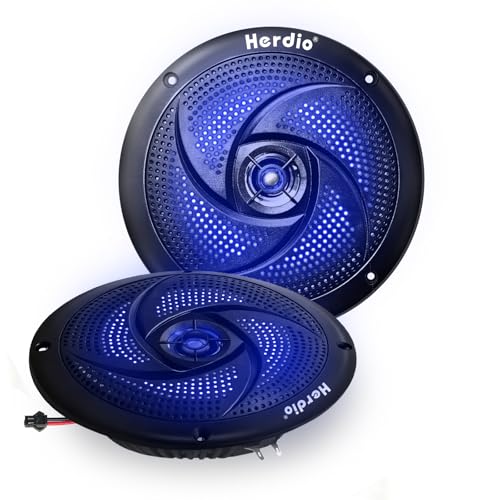
Herdio 5.25 Inch 160W Waterproof Marine Speakers (Pair, Black) — The high-output marine set
The Herdio pair is the guide’s muscle: a 5.25-inch, 2-way, waterproof marine set carrying a 160W figure in its title, with LED lights and a low-profile slim build, aimed by its own title at boats, RVs, ATVs, UTVs and golf carts. That vehicle list tells the design story — this is a speaker for machines that live outdoors, get hosed down, and vibrate for a living. The 2-way architecture separates it from the dual-cone sets: a dedicated tweeter handles the highs, which is where vocal clarity and the sparkle of acoustic music live, while the main cone handles the body.
The 160W title figure should be read as its output class rather than a literal promise, but the class itself is information: this set is built to be driven harder, in noisier settings, than the 25W-peak Magnadyne class. On an RV, that maps to the exterior position — the under-awning mount competing with a campsite’s ambient life — or to a toy hauler’s garage zone, where the audience is spread out and the doors are open. The LED lights join the RecPro pair in doubling the fixture’s duty, here in a black finish that suits exterior mounts and darker interiors alike.
On a boat-adjacent note, the set’s stated suitability for ATVs, UTVs and golf carts hints at its vibration tolerance — vehicles that shake far harder than a motorhome at cruise. An RV exterior mount lives a gentler life than a trail machine’s dashboard, and a speaker specified for the harsher posting brings margin to the easier one. Margin, in equipment that must survive unattended summers in a storage lot, is never wasted.
The slim, low-profile build is the quiet enabler: output-class speakers often demand depth, and this set’s title claims the shallow-friendly format alongside the power. Between this Herdio pair and its garage-guide cousins elsewhere in the Herdio line, the family resemblance is deliberate — but in the RV context the waterproofing and the vehicle list make this set the exterior and high-energy zone’s candidate, leaving the indoor cabin to the Furrion.
- Size: 5.25-inch stated in the title
- Design: 2-way, weather resistant, stated in the title
- Power figure: 160W stated in the title — read as the set’s output class
- Environment: waterproof marine design stated in the title
- Profile: low-profile slim style stated in the title
- Extras: LED lights stated in the title; black finish; sold as 1 pair
Strengths
- A 2-way design gives clearer highs than the dual-cone sets at any volume.
- Waterproof marine construction suits exterior, awning and toy-hauler positions.
- The highest output class in the guide, for open-air and noisy zones.
Trade-offs
- Its talents are wasted at whisper volume in a small bedroom zone.
- Realising its output class asks more of the amplifier than factory head units always give.
- Black finish shows against the white ceilings fitted to most RV interiors.
Best for: exterior mounts under the awning, toy-hauler garages, and rigs doubling as the campsite’s entertainment centre.
Not suited for: a quiet bedroom ceiling where a dual-cone replacement is the proportionate tool.

Jensen MS5006BR Black 5.25" Dual Cone Waterproof Speakers — The marine veteran
Jensen’s marine and RV audio lineage stretches back decades, and the MS5006BR is the traditional article: a 5.25-inch dual-cone speaker, waterproof, in black, built for the boats and RVs the brand has supplied for generations. In a category full of newcomers, that lineage is a practical virtue — mounting conventions, cutout sizes and the expectations of installers all grew up around speakers exactly like this one, so a replacement project involving the Jensen is the most predictable afternoon in the guide.
The waterproof claim in its title places it with the exterior-capable sets: cabin ceilings that see condensation, walls in wet zones, and mounts outside the rig are all fair territory. Dual-cone construction keeps the formula simple and durable — no crossover to cook in a hot cavity, no delicate tweeter dome to dent during installation in an awkward overhead position. The black finish, coded BR in the model name, suits the darker interiors of many motorhomes and the exterior mounts where white would glare.
There is also the question of the spares shelf. A rig that tours far from cities benefits from speakers built on long-running, widely fitted designs, because a replacement found mid-journey will match the surviving units in size and character. The Jensen’s traditional format is exactly that kind of insurance: the least exotic object in this guide, and deliberately so. Exotic is a quality for the home system; on the road, standard is a feature.
Against the Magnadyne 5-inch set, its closest relative here, the Jensen counters with the 5.25-inch standard size and the waterproof wording where the Magnadyne says water resistant — a distinction in language worth noting without over-reading, since neither title publishes a test standard. The deciding factors are the mundane ones that decide most replacements: the existing cutout’s size, the ceiling’s colour, and the depth behind it. On those honest grounds the Jensen remains what it has been for years — the default marine-grade replacement, neither the flashiest nor the weakest pick in this guide, and likely the one still working in a decade.
- Size: 5.25-inch stated in the title
- Design: dual cone stated in the title
- Environment: waterproof stated in the title
- Finish: black stated in the title
- Model: MS5006BR stated in the title
- Power rating: the title gives no figure, so confirm the rating in Jensen’s published specifications before pairing with an amplifier
Strengths
- A marine-grade waterproof build from one of the category’s longest-serving brands.
- Standard 5.25-inch sizing matches the commonest RV ceiling cutouts.
- Dual-cone durability suits overhead installation and hot roof cavities.
Trade-offs
- No power figure in the title, so system matching needs the maker’s documentation.
- Dual-cone highs sit below the Herdio’s 2-way clarity at the main position.
- Black grilles stand out against bright ceilings where the white sets disappear.
Best for: a like-for-like waterproof replacement in a standard cutout, inside or outside the rig.
Not suited for: an owner chasing the largest driver or a dedicated tweeter’s clarity in the main cabin.
How Should You Plan the Rig’s Zones Before Buying Anything?
Walk the rig with a notebook before a single listing is opened, and map the ceiling as it is: which positions exist, which are occupied, which zones have no speaker at all. Most rigs reveal the same three territories. The main cabin is the social room — films, music, conversation — and it deserves the best pair aboard, which in this guide means the Furrion’s 6.5-inch scale or a healthy standard-size pair. The sleeping zones are intimate and undemanding: television murmur, morning radio, an audiobook at pillow volume, all served honourably by the 5-inch class. The exterior and wet territories are defined by exposure rather than by listening, and they belong to the sets whose titles claim water protection.
The map also exposes the gaps worth money. Many rigs leave the exterior silent, forcing campers to carry a portable speaker for the awning’s evenings; a waterproof pair mounted outside ends that errand permanently and keeps the music where the chairs are. Other rigs duplicate effort — two mediocre pairs in the cabin, none in the bedroom — and the zone plan corrects the balance by moving the upgrade money to where ears actually spend their hours. Counting zones before counting watts is the difference between a system and a pile of speakers.
One more line belongs on the map: the head unit’s reach. Zones are only real if the rig’s audio system can feed them, separately or together, so the plan should note how the existing head unit handles its speaker outputs and whether a zone currently silent needs wiring run to it. Running wire through an RV’s walls and ceiling is the fiddliest job in the whole project — do it once, during the same opening of the ceiling as the speaker swap, and run a spare pair of conductors while the path is open. Future owners, and future you, will be grateful.
How Does the Road Itself Treat a Speaker Over the Years?
An RV speaker’s enemies are not the ones in a house. Vibration comes first: thousands of miles of expansion joints, gravel spurs and washboard forest roads, shaking every screw and solder joint in the ceiling. A flush-mount speaker survives it by being clamped evenly to its panel with its wiring secured, which is why the installation guidance in this guide dwells on clips and cable ties — a loose wire inside a ceiling cavity is a buzz waiting for the right stretch of road, and a speaker ring torqued down unevenly is a rattle with a schedule. The dual-cone designs hold an advantage here that rarely appears in specifications: fewer parts, no crossover board, nothing delicate to shake apart.
Heat comes second, and it is the silent one. A closed rig in a summer storage lot can hold temperatures that soften adhesives and age plastics years ahead of the calendar, and the ceiling — inches below a sun-baked roof — is the hottest address in the vehicle. Marine and RV-rated designs exist precisely for this punishment; their materials are chosen for roofs and cockpits rather than for drywalled bedrooms. Cold completes the cycle at altitude and in northern winters, stiffening surrounds and testing every seal. The practical defence is modest: ventilation when the rig is stored, a cover or shaded storage where possible, and speakers whose design brief — printed in these titles as marine, RV and outdoor language — already assumed the worst.
Moisture finishes the list, arriving as condensation more often than as rain. Warm cabin air meeting a cold ceiling on an autumn morning wets every fitting from the inside, which is why even interior positions benefit from the water-resistant sets and why the unclaimed indoor sets belong in the main cabin’s dry centre rather than above the shower or the galley. Read the titles’ water language as a map of where each set expects to live, and the rig will reward the respect with speakers that simply never become a project again.
How Do the Six Sets Divide the Rig Between Them?
| Pick | Size | Design | Water language in title | Best zone |
|---|---|---|---|---|
| RecPro 2 Pack | 5.25-inch | Flush mount with blue LED | None claimed | Bedroom and secondary ceilings |
| Magnadyne 5-inch | 5-inch | Dual cone | Water resistant | Wet-adjacent and standard ceilings |
| Magnadyne Slim | 5-inch | Dual cone, slim profile | Water resistant | Shallow and slide-out ceilings |
| Furrion FS65W | 6.5-inch | Indoor flush mount, 30W | None claimed — indoor | Main cabin |
| Herdio Marine | 5.25-inch | 2-way with LED, 160W class | Waterproof | Exterior and toy-hauler zones |
| Jensen MS5006BR | 5.25-inch | Dual cone | Waterproof | Standard replacement, in or out |
One pattern in the table deserves a final underline: size follows the room’s importance, protection follows the room’s exposure, and no row is asked to win both contests at once — which is precisely how a whole rig should be specified, zone by zone, rather than by crowning one set and repeating it everywhere.
Read the water column as a zoning map rather than a quality ranking: the sets claiming protection go where weather reaches, and the indoor sets spend their design budget on the cabin’s sound instead.
How Do You Replace RV Ceiling Speakers Without Making a Mess of the Ceiling?
Preparation decides everything, because the ceiling panel is thin, the cavity is shallow and the wiring above it is a mystery until seen. Kill the power to the audio system first — the rig’s 12V house system feeds the head unit, and a shorted speaker wire can take a fuse or worse. Remove one existing speaker and study the scene before touching the rest: measure the cutout diameter and the cavity depth, note the wire colours and which is positive, and check whether the cavity holds insulation, ducting or a wiring loom the new speaker’s magnet must clear. That single reconnaissance answers the size, depth and wiring questions for the whole rig.
Fitting follows the evidence. Match the new set to the existing cutout where possible; where a larger speaker like the Furrion demands a bigger hole, mark the circle twice, cut once, and cut with a fine blade at patient speed, because thin ceiling panels chip and tear under haste. Connect with the polarity consistent across every speaker — reversed polarity on one of a pair thins the bass of both, a classic cause of an upgrade that mysteriously disappoints. Seal the speaker’s flange to the ceiling so the cavity’s air works for the driver instead of leaking around it, secure any loose cable inside the cavity so road vibration cannot turn it into a buzz, and drive the screws into the panel firmly but not brutally; the material is closer to thick card than to timber.
Photograph every cavity before it closes. The ceiling of an RV accumulates modifications across owners and years — a wire rerouted here, a duct added there — and the next project, whether a light fitting or a vent fan, will open a panel somewhere near today’s speakers. A phone photograph of each open cavity, labelled with the zone and the date, turns the next owner’s guesswork into a map, and costs ninety seconds while the panel is already open. The same photographs document the installation if a warranty or an insurer ever asks what lives above the ceiling.
Test before the tools go away. Play something familiar at cabin volume, walk the rig, and listen at each zone for rattles, buzzes and one-sided sound. A rattle found now is a foam pad or a tightened clip; a rattle found at a campsite is a season of annoyance. Finally, keep the old speakers until the new ones have survived a journey — road vibration is the examiner no driveway test can simulate, and a speaker that stays silent and solid over two hundred miles of highway has passed the only audition that matters.
What Mistakes Turn an RV Speaker Upgrade Into a Disappointment?
The commonest is ordering by driver size alone and discovering the cutout mismatch with the ceiling already open. Measure the hole and the depth first; the slim Magnadyne exists because depth, not diameter, is the measurement owners skip. The second mistake is ignoring polarity during a multi-speaker swap, then blaming the new speakers for the thin, hollow result. The third is placing an indoor speaker in an exposed position — the Furrion is an indoor design by its title, and an under-awning mount in driven rain will shorten its life no matter how good it sounded in the cabin.
The fourth mistake is expecting a speaker swap to fix a weak source. Factory head units vary, and a tired head unit feeding new speakers still serves tired sound; if the whole system disappoints after a speaker upgrade, the head unit is the next suspect, not a second speaker swap. The fifth is chasing volume. An RV at a campsite is a neighbour at ten metres, and the speakers in this guide reach antisocial levels in a small cabin long before they reach their limits — clarity at modest volume is the upgrade worth buying, and every pick here was judged on exactly that.
What Should the First Evening After an Upgrade Sound Like?
Judge the new ceiling the way the rig will actually use it: at anchor, in the evening, at the volume of a conversation held slightly above a whisper. Put on a recording with a voice you know well — a familiar singer, a favourite film’s opening scene — because the ear detects wrongness in voices faster than in any instrument. What a good RV upgrade delivers at that moment is not drama but absence: the absence of the old thinness, of the crackle on loud syllables, of the need to keep nudging the volume between dialogue and score. Film dialogue is the sternest test in a small cabin, since it lives in the midrange where dual-cone and 2-way designs differ most, and a set that keeps whispers intelligible without shouting the explosions has passed the audition that matters.
Then test the zones separately. Bedroom speakers should be judged from the pillow, not the doorway; exterior speakers from the camp chairs, with the awning out and the evening’s ordinary noises around. Note any position where one speaker dominates its pair — a sign of a wiring or placement asymmetry worth correcting while the tools are still aboard. Finally, drive. Twenty miles of mixed road will audition the installation’s mechanical honesty in a way no parked test can: buzzes appear at particular speeds, rattles at particular surfaces, and each one is a five-minute fix with a clip or a pad if caught on the first journey rather than the fifth.
Keep expectations anchored to the room and the evening. The finest outcome in RV audio is a system the travellers stop noticing — music under conversation, films that need no subtitles at home volume, a ceiling that does its work invisibly for years. Every pick in this guide was chosen toward that invisibility, and the first quiet evening, with a familiar voice sounding simply like itself, is the receipt.
Final Recommendation
Build the rig’s sound by zones and the choices settle themselves. Put the Furrion 6.5-inch pair in the main cabin, where its size buys the fullness that films and music have been missing. Replace sleeping-zone and secondary ceilings with the RecPro pair where its LED light earns the fixture, or the Jensen pair where waterproof durability leads. Give shallow and slide-out ceilings to the slim Magnadyne, the only design here shaped for them, and hand the wet-adjacent positions to the standard Magnadyne set. Reserve the Herdio pair for the exterior and the toy hauler, where its output class and waterproofing belong. An RV already carries everything its owners own into small, hard-won spaces — its speakers should be the one system that never asks for attention again, only for a favourite album and a quiet evening at the end of the road.
Frequently Asked Questions
Can I install home ceiling speakers in an RV instead?
It is physically possible and practically unwise. Residential ceiling speakers assume deep joists, drywall fixing and a climate-controlled house; RV ceilings offer shallow cavities, thin panels, vibration and heat extremes. The sets in this guide are designed and titled for the RV and marine environment, and that design brief is the difference between a season and a decade of service.
Will new speakers make a motorway journey quieter inside?
No speaker should be asked to fight road noise, and none of these will win that fight at legal speeds. Their gift appears when the engine stops: at the campsite, the rest area lunch, the evening at anchor. Owners who travel with the radio loud against motorway roar should know that habit costs hearing over years; the better pattern is modest volume on the road and the system’s real quality saved for the stillness it was bought for.
Are these speakers powered by the RV’s 12V system?
Indirectly. Flush-mount speakers like these are wired drivers fed by the rig’s head unit or an amplifier, and that head unit runs on the 12V house system. The speakers themselves draw no separate power connection; the amplifier in the chain is where the power matching happens, which is why the maker’s documentation matters for ratings no title states.
What size are factory RV ceiling speakers, usually?
The 5-inch to 5.25-inch class dominates, which is why four of the six sets here live in that range and why measuring your own cutout still matters — “usually” is a starting guess, not a measurement. The 6.5-inch Furrion is the deliberate exception for owners enlarging a main-cabin position.
Should I replace all the rig’s speakers at once?
Rarely. Zones age at different rates and matter unequally, so the staged plan in this guide’s recommendation — main cabin first, sleeping zones next, exterior when the season calls for it — spreads the cost and the ceiling-opening labour across projects. The exception is a full interior remodel, where every panel is already open and the wiring can be renewed in the same pass.
Do the LED-equipped speakers need extra wiring?
A light needs power, so an LED fixture’s installation involves more than the speaker pair alone; the exact arrangement is a documentation question for the RecPro and Herdio sets respectively. Plan the wiring while the ceiling is open rather than discovering the requirement with the speaker in hand.
Why do two sets claim waterproof and others claim only water resistant?
The titles use the makers’ own words, and this guide preserves the distinction without inventing test standards behind either phrase. Treat “waterproof” sets as the first candidates for exterior positions, “water resistant” sets as suited to splash and steam zones, and unclaimed sets as indoor equipment — then confirm the specifics in the maker’s documentation before an exposed installation.
Related Guides
Life on the road runs on a dozen small systems working quietly, and the neighbouring guides treat the rest of the rig with the same fit-first logic: see 12V entertainment upgrades for motorhomes and trailers for the screens and sources that feed these speakers, marine speakers for boats and open cockpits for the fully exposed end of the waterproof world, and compact Bluetooth speakers for travel for the portable companion this guide deliberately left off the ceiling.


