What's inside
- Key Takeaways
- Quick Picks
- How Did We Judge DJ Speakers Differently From Party Speakers?
- Why Does a Party Punish Speakers That Sound Fine at Home?
- How Does a Room Change What a DJ Speaker Must Do?
- How Do the Six Systems Stack Up for a Working Party?
- How Do You Set Up a Party Rig That Survives the Night?
- What Mistakes End Parties Early?
- How Should a DJ Grow a Rig Across a Season of Parties?
- How Do You Keep a Party Loud Where It Should Be and Safe Where It Must Be?
- Final Recommendation
- Frequently Asked Questions
- Related Guides
As an Amazon Associate I earn from qualifying purchases. This post may contain affiliate links at no extra cost to you.
gizmoverdict.com is reader-supported. When you buy through links on our site, we may earn an affiliate commission.
Where to buy: The six PA systems below link to their own Amazon listings, and the only specifications quoted in this guide — wattage class, mixer channels, linking, the one stated SPL figure — are taken from those listing titles. No prices and no star ratings appear anywhere in this guide.
The best speakers for DJing at parties are not big Bluetooth speakers; they are powered PA loudspeakers, a different species with a different job. A DJ speaker must take a signal straight from a mixer or controller, amplify it internally, project it across a room full of sound-absorbing dancers, and do it for five hours without thermal sulking or a blown driver. All six picks in this guide are powered designs in that tradition: five are single powered loudspeakers built around 10-inch, 12-inch or 15-inch woofers, and one — the EXOTON S-1503 — is a line-array column system standing over a powered 15-inch subwoofer. None of them is a passive box awaiting an amplifier, and none is a party speaker with a lightshow where its mixer should be.
The titles divide the six along the lines a working DJ actually cares about. Mixer provision comes first: the JBL EON715 and the ALTO TS415 each carry a 3-channel digital mixer in their titles, the ALTO TX410 a 2-channel mixer, so a microphone and a controller — or a controller and a backup phone — can live on the speaker itself when a separate DJ mixer is not in the rig. Linking comes second: the TS415 names TWS Bluetooth streaming and wireless loudspeaker linking, the Mackie Thump15v4 names wireless speaker linking, the TX410 names TWS — the mechanisms by which a second cabinet joins the first without a cable run across the dancefloor. Scale comes third: 350W in the compact TX410, 1300W to 2500W classes in the 15-inch flagships, an 1800W combo set from PRORECK with stands included, and the EXOTON’s column-plus-subwoofer architecture with the guide’s only stated SPL figure, 125dB.
A word of discipline about wattage before the reviews: PA wattage figures are peak-oriented marketing classes, not a common currency. A 2500W title and a 1300W title do not mean one speaker is twice as loud as the other; loudness lives in sensitivity, dispersion and the SPL a cabinet can actually produce, and only one title here prints an SPL. This guide therefore treats wattage as a size class — compact, mid, flagship — and judges each speaker on its format, its mixer, its linking and its fitness for a party’s real geography.
Key Takeaways
- All six picks are powered PA designs — amplification built in — spanning a compact 10-inch cabinet, a 12-inch combo set, three 15-inch flagships and a column-array system with a powered subwoofer.
- Onboard mixers divide the field: 3-channel mixers in the JBL EON715 and ALTO TS415 titles, a 2-channel mixer in the ALTO TX410, letting a mic and a controller plug straight into the speaker.
- Wireless linking is claimed by the ALTO pair and the Mackie — TWS or wireless loudspeaker linking in their titles — while the JBL, PRORECK and EXOTON titles stay silent on it.
- The EXOTON S-1503 prints the guide’s only SPL figure, 125dB, and the only subwoofer — the low-end architecture parties feel as much as hear.
- The PRORECK Party 12 is the complete-kit pick: a powered 12-inch system sold as a combo set with speaker stands and Bluetooth, USB, SD and FM playback aboard.
- The ALTO TX410’s monitor mode makes it the double-duty pick — a compact main for small parties and a wedge for the DJ booth or a performer.
Quick Picks
| Pick | Badge | Why it earns its place |
|---|---|---|
| JBL EON715 | The professional all-rounder | A 1300-watt 15-inch powered PA speaker with Bluetooth 5.0 streaming and control, a 3-channel digital mixer and a backlit LCD. |
| ALTO TS415 | The linking flagship | A 2500W 15-inch powered speaker with a 3-channel mixer, TWS Bluetooth streaming, wireless loudspeaker linking, DSP and app control. |
| ALTO TX410 | The compact double-agent | A 350W 10-inch powered speaker with TWS Bluetooth, a 2-channel mixer and a monitor mode for booths, rehearsals and small rooms. |
| Mackie Thump15v4 | The party-proven 15 | A 1400W 15-inch powered loudspeaker with Bluetooth and DSP, app control and wireless speaker linking, aimed by name at DJs and events. |
| PRORECK Party 12 | The complete kit in a box | A 12-inch 1800W 2-way powered PA combo set with Bluetooth, USB, SD, FM, a remote and speaker stands included. |
| EXOTON S-1503 Line Array Column DJ System | The subwoofer statement | A line-array column over a 15-inch powered subwoofer, 2000W with 125dB SPL stated, built for DJs, live events and stages. |
A note on what this guide deliberately left out: passive PA cabinets, which need a separate power amplifier, were excluded not from snobbery but because the party DJ’s modern rig is built on powered convenience — fewer boxes, matched amplification, DSP guarding each driver — and every title in the shortlist confirmed the powered direction. Likewise, consumer party speakers with lightshows appear here only where, as with the PRORECK kit, they arrive as a genuine powered PA system with stands and sources aboard.
The badge column tells the strategic story: three ways to be a flagship, one compact professional, one complete kit, and one system that brings its own subwoofer to the argument.
How Did We Judge DJ Speakers Differently From Party Speakers?
By the signal chain. A party speaker begins at a phone; a DJ speaker begins at a performance — a controller’s outputs, a microphone for the host, a backup source for the moment the laptop falters. Picks therefore earned their places on what their titles say about inputs and mixing: channels counted, Bluetooth treated as the convenience input rather than the main act, and app control and DSP read as the modern DJ’s setup tools. A speaker with a 3-channel mixer can run a small party alone — controller on one channel, microphone on another, phone on Bluetooth — and that self-sufficiency is a professional feature no lightshow can imitate.
The second criterion was the pair question. Parties outgrow single speakers, and the route to two matters: wireless linking where titles claim it, matched purchases where they do not. The third was format honesty — driver size and architecture matched to room scale, with the column system’s dispersion and the subwoofer’s low end weighed as the different instruments they are. Throughout, the fencing rule held: power, channels, linking and SPL are quoted only where a title prints them, and the one SPL figure in this guide belongs to the EXOTON alone.
Why Does a Party Punish Speakers That Sound Fine at Home?
Bodies. A living room of furniture absorbs some sound; a dancefloor of fifty people absorbs enormously more, and it absorbs the clarity first — the high frequencies that carry a vocal’s intelligibility and a hi-hat’s sparkle — leaving the DJ with a muffled room and a volume knob as the only remedy. PA speakers exist to answer that absorption with headroom and projection: efficient drivers, horn-loaded high frequencies aimed at the crowd, and amplifiers sized to run for hours at working level rather than minutes at demonstration level. The 15-inch flagships in this guide are not large for vanity; they are large because a woofer that moves air easily at party level lasts the night without strain.
Feedback is the third punishment, and it belongs to the microphone moments — the speeches, the karaoke heroes, the host with the announcements. A microphone in front of a speaker is a loop awaiting its frequency, and the defences are geometric before they are electronic: the mic stays behind the mains’ line, the singer is aimed away from the cabinets, the level is set at soundcheck with the mic in the hand that will hold it, at the distance that hand will hold it. Every pick in this guide with a microphone channel will feed back in a careless geometry and behave in a careful one; the difference is the operator, which is why the guide keeps returning to setup as a feature no title can print.
Duration is the second punishment. A party set runs four to six hours at levels a home speaker visits for one song, and heat is the tax on every watt of it. Powered PA cabinets are built as thermal systems — amplifiers with heatsinking, drivers with voice coils sized for sustained work, protection circuitry in the DSP watching the limits. The third punishment is logistics: speakers are lifted onto stands, cabled in the dark, rained on during load-out and stored in garages. The professional formats in this guide assume that life. Choosing them for a party is not overkill; it is matching the tool to the shift it will actually work.

JBL EON715 — The professional all-rounder
The EON715 is the guide’s reference professional: a 1300-watt, 15-inch powered PA speaker from JBL’s long-running EON line, with Bluetooth 5.0 streaming and control, a 3-channel digital mixer and a backlit LCD in its title. Each element of that list answers a working need. The 15-inch format is the party standard — enough cone to move a room’s air, in one cabinet a single person can still lift onto a stand. The 3-channel mixer means the speaker can host the night: controller, microphone for announcements and toasts, and a third path for the backup source, all gained and balanced at the cabinet when no external mixer is in the rig.
Weight and handles decide more professional purchases than brochures admit, and a 15-inch cabinet’s working life is measured in staircases: the venue’s fire-escape load-in, the hall’s stage steps, the car boot’s lip at 1 a.m. A cabinet that one person can carry safely, gripped properly, at the end of a six-hour night is a cabinet that survives its career without a dropped corner or a strained back. The EON line’s long attention to exactly this ergonomics is part of why the name recurs in rental stock — the unphotogenic virtues compound.
The backlit LCD is the detail that separates a tool from a toy in a dark venue. Settings that live behind an app are fine at soundcheck; at midnight, with a cable fault or a feedback ring to chase, a screen on the speaker itself — readable, immediate, independent of a phone’s battery — is the professional’s preference, and JBL’s inclusion of it signals the audience the EON line serves. Bluetooth 5.0 streaming covers the cocktail hour and the requests-from-the-floor moments, while control over Bluetooth lets the DJ adjust from the room rather than from behind the stack.
There is a lineage consideration with the EON name that working buyers weigh instinctively: rental houses and venues stock the line, which means a DJ who owns one can often hire its twin for the big night rather than buying a pair for a calendar with two big nights a year. Compatibility with the world’s existing stock is an invisible specification, and the EON715 carries it by birth. A rig that can grow by rental for exceptional rooms and by purchase for ordinary ones is a flexible business as well as a good sound.
Its title makes no wireless-linking claim, and this guide credits none — a second EON715 joins by cable in the classic arrangement, which working DJs have run for decades and which never drops a radio link mid-set. Judged as the single-cabinet foundation of a serious party rig, the EON715 is the pick with the fewest asterisks: professional format, professional mixer, professional interface, from the line that helped define the category.
- Format: 15-inch powered PA speaker stated in the title
- Power class: 1300-watt stated in the title
- Mixer: 3-channel digital mixer stated in the title
- Interface: backlit LCD stated in the title
- Streaming and control: Bluetooth 5.0 stated in the title
- Maximum SPL: Not stated in the listing title — verify with JBL documentation
Strengths
- A 3-channel mixer lets the cabinet run a small party’s whole signal chain.
- The backlit LCD keeps setup and troubleshooting on the speaker, not on a phone.
- The EON line’s 15-inch format is the category’s proven party standard.
Trade-offs
- No wireless linking is claimed in the title; a pair joins by cable.
- A 15-inch cabinet is a deliberate lift onto a stand — plan the load-in accordingly.
- Its professional brief is wasted on a living-room disco for six people.
Best for: a working DJ or serious host building a one-or-two cabinet rig around a proper mixer-equipped speaker.
Not suited for: casual garden parties where a consumer party speaker’s simplicity rules.

ALTO TS415 — The linking flagship
The TS415 carries the largest number in this guide — 2500W in its title — and pairs it with the guide’s most complete connectivity brief: a 3-channel mixer, TWS Bluetooth streaming, wireless loudspeaker linking, DSP and ALTO app control. Read the number as a flagship class marker and the rest as the substance. The linking claims are the headline for party work: a second TS415 can join wirelessly as a stereo or distributed partner, which transforms load-in — no long XLR run across the venue, no cable taped across a doorway — and lets a DJ widen a system in the minutes before doors when a cable route would take an hour.
ALTO’s positioning of the TS line is worth a word for buyers cross-shopping the flagships: the brand built its reputation by putting professional feature lists — real mixers, real DSP, real linking — into cabinets priced for the working DJ rather than the touring company, and the TS415’s title is that philosophy in one line. The feature-per-cabinet density is its argument; the buyer persuaded by lineage will look at the JBL, the buyer persuaded by the list will look here, and both will be heard clearly across the same hall.
TWS Bluetooth streaming serves the modern set’s reality: the warm-up hour played from a phone while the main rig is still being cabled, the background set during dinner, the emergency playlist when a laptop reboots. The 3-channel mixer mirrors the EON715’s self-sufficiency — controller, microphone, spare source — and the DSP with app control puts the room’s tuning in the DJ’s pocket: walk the floor with the app open, hear what the crowd hears, adjust from the dancefloor rather than guessing from behind the speakers. That walk-the-room workflow is how professionals tune, and app control is what makes it a one-person job.
The TS415’s proposition, whole, is the connected flagship: the biggest class figure, the fullest linking story, and a mixer and DSP suite that treat the speaker as the rig’s centre. For a practice in full growth — larger rooms, second cabinets, a reputation to protect — it is the pick designed to grow with the calendar rather than be replaced by it.
- Format: 15-inch powered PA speaker stated in the title
- Power class: 2500W stated in the title — the guide’s largest class figure
- Mixer: 3-channel mixer stated in the title
- Linking: wireless loudspeaker linking and TWS Bluetooth streaming stated in the title
- Processing and control: DSP and ALTO app control stated in the title
- Maximum SPL: the title gives no figure, so confirm it in ALTO’s published specifications before a large-room booking
Strengths
- Wireless linking removes the cable run that complicates every two-cabinet party.
- App-controlled DSP enables tune-from-the-dancefloor setup by one person.
- A full 3-channel mixer keeps the rig self-sufficient without an external desk.
Trade-offs
- The flagship class brings flagship size and weight to every load-in.
- Wireless links add a setup step that must be rehearsed before the night, not during it.
- Small rooms will use a fraction of its capacity while paying its full transport cost.
Best for: a growing DJ practice playing larger parties where a second cabinet and cable-free linking are on the roadmap.
Not suited for: intimate venues, or a first speaker for occasional home parties.

ALTO TX410 — The compact double-agent
The TX410 is the guide’s compact professional, and its title is a study in usefulness per kilo: a 350W 10-inch powered PA speaker with TWS Bluetooth, a 2-channel mixer and a monitor mode, aimed at bands, DJs, rehearsals and venues. The 10-inch format trades the flagships’ room-filling authority for a cabinet one person carries in one hand and a car boot swallows without negotiation — the speaker for the restaurant gig, the café set, the house party’s second room, the wedding’s ceremony corner where a 15-inch flagship would be a wardrobe with a woofer.
Rehearsal duty, named in its title, is a quieter virtue worth unfolding: bands and DJs practise in rooms where a flagship would be vandalism, and a compact cabinet that serves the practice room all winter and the ceremony circuit all summer accumulates more working hours than any other box in a rig. Hours are what turn equipment into a known tool — its gain staging memorised, its limits mapped — and the TX410’s versatility is, in the end, a machine for accumulating those hours.
Monitor mode is its signature trick. A cabinet that can stand as a main for a small room and then lie back as a wedge — feeding the DJ or a performer their own mix at close range — works two jobs in a working rig, and in DJ terms the booth monitor is the unsung necessity: the speaker that lets the DJ hear the mix cleanly while the mains face the crowd. A TX410 bought as a small-party main can graduate to booth duty when a flagship arrives, which makes it the rare entry purchase that is never made redundant. The 2-channel mixer covers the compact brief honestly — controller and microphone, the small gig’s whole chain — and TWS streaming handles the phone-driven hours.
Its ceiling is physical and should be respected: a 10-inch, 350W-class cabinet will not fill a hall or push a large dancefloor, and asking it to is how compact speakers die young. Inside its brief — small rooms, ceremonies, booths, rehearsals — it is arguably the most versatile object in this guide, and the working DJ’s classic second purchase that many make first by accident and keep forever on purpose.
- Format: 10-inch powered PA speaker stated in the title — the guide’s compact cabinet
- Power class: 350W stated in the title
- Mixer: 2-channel mixer stated in the title
- Modes: monitor mode stated in the title — mains or wedge duty
- Streaming: TWS Bluetooth stated in the title
- Audiences named in the title: bands, DJs, rehearsals and venues
Strengths
- Monitor mode gives one cabinet two careers — small-room main and booth wedge.
- One-hand portability opens the gigs a flagship cannot profitably serve.
- A 2-channel mixer covers the compact gig’s entire signal chain.
Trade-offs
- Output class caps it at small rooms; a hall will expose it.
- Two channels leave no spare for a third source without repatching.
- As a sole party speaker it serves the gathering’s start, not its peak in a big space.
Best for: small-venue DJs, ceremony and second-room duty, and booth monitoring in a growing rig.
Not suited for: main-speaker duty at a large party or hall.

Mackie Thump15v4 — The party-proven 15
Mackie’s Thump line has been the working party DJ’s default for years, and this fourth-generation 15-inch model states its brief in its title without blush: a 1400W powered loudspeaker with Bluetooth and DSP, for DJs, live sound, karaoke and events, with app control and wireless speaker linking. That audience list is the review in miniature — this is not a studio tool or a hi-fi experiment but a gigging cabinet, voiced and featured for rooms full of people who came to dance.
The wireless speaker linking in its title answers the pair question in the modern way: a second Thump joins without the cross-room cable, so the classic two-cabinet party rig — one either side of the DJ, stands at head height — can be deployed in venues where cable runs are blocked by doors, bars or the venue’s own rules. App control joins the linking as the setup accelerant: levels and DSP adjusted from the floor, by the person standing where the audience will stand. Bluetooth covers the phone hours — the dinner set, the requests, the after-party’s second wind.
Mackie’s own history hums beneath this model: the company helped define the affordable powered loudspeaker a generation ago, and the Thump line is its party dialect — voiced forward and forgiving, built to sound exciting on the compressed, bass-heavy material parties actually play, rather than to flatter a studio recording. Sets living in that material meet the Thump’s home ground; a set list of jazz brunches and acoustic afternoons may find its enthusiasm a flavour to tame with the DSP rather than a fault to flee.
Against the EON715, the Thump trades the onboard LCD and JBL’s mixer-forward brief for Mackie’s gigging voicing and linking; against the TS415, it counters a larger class figure with the Thump line’s long party pedigree. The honest summary is that the three 15-inch flagships divide by ecosystem and habit rather than by worth — and the Thump’s habit, proven across a decade of wedding halls and club back rooms, is reliability at party level with the features a modern DJ actually touches.
- Format: 15-inch powered loudspeaker stated in the title
- Power class: 1400W stated in the title
- Linking: wireless speaker linking stated in the title
- Processing and control: DSP and app control stated in the title
- Streaming: Bluetooth stated in the title
- Audiences named in the title: DJs, live sound, karaoke and events
Strengths
- Wireless linking makes the two-cabinet party rig deployable almost anywhere.
- A gigging pedigree aimed squarely at DJ and event work, generation after generation.
- App control and DSP bring the tune-from-the-floor workflow to setup.
Trade-offs
- No onboard mixer channel count is stated in the title, so self-sufficient rigs should verify the input plan in Mackie’s documentation.
- A 15-inch flagship cabinet remains a serious lift and a serious boot-space claim.
- Its party voicing prioritises impact over studio-style neutrality.
Best for: party and wedding DJs seeking a linking pair of proven 15-inch cabinets.
Not suited for: a compact-car gig circuit, where the TX410’s format wins.
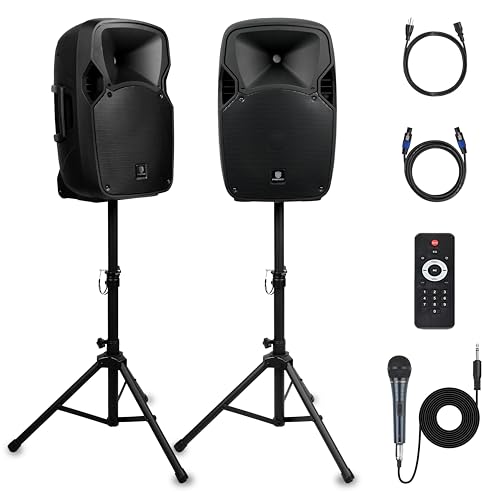
PRORECK Party 12 — The complete kit in a box
The PRORECK Party 12 answers a different buyer’s question: not “which cabinet” but “what do I need for Saturday”. Its title describes a 12-inch, 1800W, 2-way powered PA speaker system sold as a combo set, with Bluetooth, USB drive, SD card, FM radio, a remote control and speaker stands included, for indoor and outdoor DJ parties, gatherings and karaoke. The stands are part of the system rather than a standalone product — the kit’s point is that everything required to make elevated, room-covering sound arrives in one purchase, stands being the component first-time buyers most often forget until the speakers are sitting on the floor firing at the guests’ knees.
Consider who actually operates a kit like this across its life: not one DJ but a rotation — the hall’s caretaker, the birthday host, the cousin with the playlist, the karaoke enthusiast of the family. A system whose controls are immediate, whose sources are universal and whose setup is stands-up-and-play serves that rotation kindly, because none of its operators will read a manual. Professional rigs optimise for one expert’s hands; a combo kit optimises for everyone’s first attempt, and at the parties the Party 12 was built for, everyone’s first attempt is the whole event.
The playback list is the kit’s second philosophy: a system that eats every source. Bluetooth for the phone, USB and SD for the prepared playlist that needs no phone at all, FM for the background hours — a dead laptop changes nothing, and a karaoke singer arriving with a stick still has tracks. The remote serves the host’s reality: adjustments from across the room, mid-conversation, without a pilgrimage to the speaker. The 12-inch format splits the guide’s sizes — more authority than the 10-inch compact, an easier carry than the 15-inch flagships — and the 1800W class figure places the kit’s ambition at the house-party and garden-party scale it names.
Its limits are the professional’s caveats: no onboard mixer channel count is stated, no wireless linking is claimed, and a combo set’s components are a system rather than a growth platform. But for the host, the community hall, the family celebration circuit — the parties that happen monthly and matter enormously to the people at them — the Party 12’s completeness is a genuine virtue: one box, stands up, music on, no accessory list trailing behind the purchase.
- Format: 12-inch 2-way powered PA speaker system, combo set, stated in the title
- Power class: 1800W stated in the title
- Playback: Bluetooth, USB drive, SD card and FM stated in the title
- Included: speaker stands and a remote control stated in the title
- Audiences named in the title: indoor and outdoor DJ parties, gatherings and karaoke
- Wireless linking: not claimed in the title; a second system joins by conventional cabling
Strengths
- Stands included — the forgotten component that decides whether speakers sound right.
- Four playback sources make the music nearly unkillable on the night.
- One purchase covers the whole party system, with no accessory trail.
Trade-offs
- A fixed kit grows less gracefully than a flagship-cabinet platform.
- No mixer channel count or linking is stated, so professional rigs should verify before relying on it.
- Its scale suits parties and halls of modest size rather than large venues.
Best for: hosts, halls and celebration circuits seeking a complete, stands-included party system in one box.
Not suited for: a professional DJ building a modular, expanding rig.

EXOTON S-1503 Line Array Column DJ System — The subwoofer statement
The EXOTON S-1503 rejects the guide’s whole cabinet geometry. Instead of a box with a woofer and a horn, it stands a line-array column over a 15-inch powered subwoofer: 2000W in its title, 125dB SPL stated — the only SPL figure in this guide — and a brief naming DJs, live events, parties and stage performances. The architecture is the argument. A column of small drivers disperses sound wide and even, with the peculiar line-array gift of carrying clarity to the back of a room at levels that stay civilised at the front; the subwoofer, meanwhile, does the one job no 15-inch full-range cabinet fully does, which is to put the kick drum in the dancers’ chests.
Parties are felt in the low octaves, and every other pick in this guide asks its main woofer to divide its labour between the bass and the mids. The EXOTON’s division of labour — subwoofer below, column above — is the architecture of larger professional systems, scaled to a portable DJ format. The stated 125dB SPL gives the system a measurable ambition the other titles leave unstated, and the 2-year warranty in the title is a manufacturer’s confidence made legible — worth noting in a category where support is often a rumour.
Load-in choreography deserves a sentence for a system of this shape: the subwoofer is the base, literally and logistically — it rolls or is carried first, placed, and the column assembles above it in sections, so one person can raise the system in minutes without a stand’s separate trip. Venues with stairs will still tax the subwoofer’s journey, as they tax every low-end device, and the honest buyer measures the route from car to stage before falling for the architecture. Where the route is kind, the system’s assembly is faster than its multi-piece appearance suggests.
The trade-offs are footprint and focus. A column system is a system: more pieces to transport and assemble than a single cabinet, a stage-oriented presence that suits events and dedicated party spaces better than a crowded living room, and a low-end capability that small rooms cannot use without exciting every rattle in the building. For event-scale work — halls, stages, outdoor gatherings with a real dancefloor — it is the guide’s most complete single purchase, the one that arrives with the subwoofer question already answered.
- Architecture: line-array column with a 15-inch powered subwoofer stated in the title
- Power class: 2000W stated in the title
- Output: 125dB SPL stated in the title — the only SPL figure in this guide
- Audiences named in the title: DJ, live events, parties and stage performances
- Support: 2-year warranty stated in the title
- Mixer channel count: not printed in the title, so check EXOTON’s documentation for the input plan
Strengths
- A dedicated subwoofer delivers the low-end physicality parties run on.
- Column dispersion carries clarity to the back without punishing the front.
- A stated SPL and a stated warranty make its ambitions and backing unusually legible.
Trade-offs
- More components to transport, assemble and store than any single cabinet here.
- Its stage presence and low end overwhelm small domestic rooms.
- A system purchase is a commitment; incremental growth follows its own path.
Best for: event-scale DJ work — halls, stages and outdoor parties with a real dancefloor.
Not suited for: living-room parties, compact load-ins, or quiet neighbourhoods after dark.
How Does a Room Change What a DJ Speaker Must Do?
Every venue rewrites the job. A village hall is a hard, empty echo chamber at soundcheck and a soft, full absorber at midnight, and the speaker that sounded bright at six will sound right at ten — which is why experienced DJs soundcheck slightly brighter than taste suggests and keep the DSP within reach. A marquee is the opposite problem: fabric walls that swallow everything, no reflections to help, and a dancefloor that needs the speakers’ full honest output because the room returns nothing. Outdoors removes the room entirely; sound leaves and does not come back, dispersion becomes coverage in its purest form, and the column system’s even spread or a well-aimed pair of 15s earns its fee while a compact cabinet discovers the exact size of its brief.
Ceiling height is the hidden variable in halls. A high ceiling forgives — reflections arrive late and gentle — while a low one puts the crowd’s heads in the speakers’ near field and punishes excess level with harshness. Stands that raise the cabinets above head height, tilted slightly down at the dancefloor, solve most of it; the PRORECK kit’s included stands and the flagships’ stand-mount format exist for precisely this geometry. The DJ who walks the room during the first hour, listening at the bar and the back wall, learns the room’s truth faster than any specification sheet, and the app-controlled picks in this guide turn that walk into adjustments rather than regrets.
Power at the venue is the final rewrite. Older halls offer fewer sockets on circuits shared with kettles and fridges; a rig that spreads its draw thoughtfully — speakers on one circuit, lights and extras on another — survives the night that trips the DJ who plugged everything into one strip. None of this is in any title, and all of it decides whether the titles’ promises are heard. The speakers are the instrument; the room is the other half of the instrument, and it is different every Saturday.
How Do the Six Systems Stack Up for a Working Party?
| Pick | Architecture | Power class (title) | Mixer per title | Linking per title |
|---|---|---|---|---|
| JBL EON715 | 15-inch powered cabinet | 1300W | 3-channel digital | None claimed |
| ALTO TS415 | 15-inch powered cabinet | 2500W | 3-channel | Wireless linking; TWS streaming |
| ALTO TX410 | 10-inch powered cabinet | 350W | 2-channel | TWS streaming |
| Mackie Thump15v4 | 15-inch powered cabinet | 1400W | Not stated in the title | Wireless speaker linking |
| PRORECK Party 12 | 12-inch powered set with stands | 1800W | Not stated in the title | None claimed |
| EXOTON S-1503 | Column array + 15-inch subwoofer | 2000W; 125dB SPL | Not stated in the title | None claimed |
Read the power column as class, not as a league table — the mixer and linking columns are where the working differences live, and the architecture column is where the rooms are decided.
How Do You Set Up a Party Rig That Survives the Night?
Elevation and symmetry come first. Mains belong on stands at head height, either side of the DJ position, far enough apart to give the room a stereo field and close enough that neither cabinet works alone. Angle them at the dancefloor’s centre, not at the walls; a room’s corners are bass traps that will boom on the kick and starve the middle. The subwoofer of a system like the EXOTON’s belongs on the floor, near a wall for reinforcement, centred where possible so its load is shared evenly by the room.
Soundcheck at party level with party material, then walk the room. The DJ position hears the worst version of the night — behind the speakers, off-axis — which is why booth monitoring exists and why the TX410’s monitor mode matters; judge the mains from the dancefloor, where the audience will be, and set levels for a full room even in an empty one, knowing bodies will absorb a share. Leave headroom: a system cruising at seventy percent of its range at the night’s peak is a system that finishes the night, while a system at its limit at nine o’clock is a failure scheduled for eleven.
Assign the roles before the night assigns them for you. In a two-person crew, one owns the soundcheck walk and the levels, the other owns the cables and the power, and neither improvises the other’s half mid-set. Solo, the same discipline compresses into a checklist run in order — placement, power, signal, levels, backup — because the solo DJ’s only colleague is the routine written while calm. Venues reward the routine invisibly: no hum at the speeches, no scramble at the first dance, no cable across the fire exit for the venue manager to find before the DJ does.
Then secure the mundane: cables taped or ramped where feet cross, power drawn from circuits that are not sharing with the venue’s kitchen, a backup source — phone, USB stick, the PRORECK’s SD path — cued and tested before doors. Every professional’s secret is that the night is won in these unglamorous twenty minutes; the speakers in this guide all have the muscle for the party, and the setup is what decides whether the muscle is what the guests remember.
What Mistakes End Parties Early?
The fatal one is undersizing by optimism: a compact cabinet asked to fill a hall, run at its limit for hours, protecting itself by shutting down mid-set — or failing to protect itself at all. Buy for the largest room on the calendar, not the average one; headroom is reliability. The second mistake is the floor placement: speakers at ankle height firing into a crowd’s legs, their clarity absorbed by the first row while the DJ, hearing mush, turns up and punishes everyone. Stands are not accessories; the PRORECK kit includes them because they are half the sound.
The third mistake is gain chaos — every device in the chain at maximum, distortion stacked on distortion, when a chain set with each stage at a healthy level would be cleaner and louder where it counts. The fourth is neglecting the microphone until the speeches: feedback is a placement and level problem solved at soundcheck, not during the best man’s first sentence. The fifth is forgetting that parties end outdoors at 1 a.m. — a rig that cannot be packed by one tired person, in the rain, in fifteen minutes, will eventually be left behind, damaged or resented. The working DJ buys the load-out as carefully as the sound, and every format in this guide — from the one-hand TX410 to the multi-piece EXOTON — should be chosen with the last fifteen minutes of the night in view.
How Should a DJ Grow a Rig Across a Season of Parties?
The sensible growth path starts with one good cabinet and a calendar. A single 15-inch flagship — EON715, TS415 or Thump — covers the first season’s house parties and small halls honestly, and its limitations teach the owner exactly what the second purchase must be: a matching cabinet for stereo and scale, in the same family so levels, voicing and linking behave as one system. The linking claims in the ALTO and Mackie titles make that second step cable-light; the JBL’s classic path makes it cable-simple. Either way, the pair is the rig’s true foundation, and it should be a pair of twins, not a flagship and a stranger.
The third purchase is the one beginners skip and professionals prize: the monitor. A DJ playing through mains alone hears the room’s echo of the mix, not the mix, and the TX410’s monitor mode exists to close that gap — bought as the small-gig main, promoted to the booth when the flagships arrive, never retired. The fourth step addresses the floor: a subwoofer’s worth of low end, whether by growing toward a system in the EXOTON’s mould or by adding low-end support to the cabinet pair, once the rooms on the calendar are large enough to use it. Each step is bought from evidence — a room that exposed a limit, a night that taught a need — and a rig grown that way fits its owner’s actual practice like a glove, rather than a showroom’s idea of one.
What not to buy is the duplicate of a solved problem: the second compact speaker when the limit was headroom, the bigger flagship when the limit was the load-in stairs. Parties teach their lessons specifically, and the rig that listens — one honest cabinet, then its twin, then the monitor, then the floor — ends a season as a system with no passengers. Every pick in this guide has a place on that path; the art is ordering them by the nights, not by the catalogue.
How Do You Keep a Party Loud Where It Should Be and Safe Where It Must Be?
A dancefloor wants energy; ears have limits; and the DJ stands exactly at the border, with a professional duty to both. The physics that help are already in this guide: elevated speakers aimed at the floor’s centre deliver the energy to the dancers at lower raw level than floor-standing boxes blasting through legs, and headroom — a system cruising below its ceiling — produces clean sound that feels louder than a smaller system distorting at the same measured level, because distortion reads as harshness and harshness reads as pain long before it reads as volume. The flagships’ classes and the EXOTON’s stated 125dB ceiling are therefore safety features in disguise: capacity held in reserve is what lets a night feel powerful without being punishing.
Geography is the second tool. Keep a quieter zone in the room — the bar, the seating, the doorway’s edge — by aiming the mains at the floor and letting level fall with distance, so guests can converse without leaving the party and older guests can stay past ten. Check the level where children will be, at their ear height, not at yours. And mind the DJ’s own exposure: the booth is the loudest workplace in the room across a whole night, and the monitor’s virtue is that it lets the DJ hear clearly at close range without turning the room up — the TX410’s second career is, among other things, a hearing-conservation device. A party remembered for ringing ears was mixed by its equipment’s limits; a party remembered for its dancing was mixed by someone’s judgement. The speakers here supply the capacity for either; the guide’s counsel is to spend it on the dancing.
Final Recommendation
Match the architecture to the calendar. The working DJ building a flagship rig should choose between the EON715’s mixer-and-LCD professionalism, the TS415’s linking and app-driven scale, and the Thump15v4’s proven party pedigree — three honest answers separated by habit and ecosystem rather than by worth. The compact professional and the growing rig both want the TX410, the cabinet with two careers. The host and the hall want the PRORECK Party 12’s completeness, stands and sources in one box. And the event-scale DJ, playing halls and stages where the bass must be felt in the sternum, wants the EXOTON’s column and subwoofer, the system that treats a party like the production it is. A great party is a room that forgets the equipment entirely — so choose the system whose work is invisible, and let the night be remembered for the dancing.
Frequently Asked Questions
How long should a party speaker be expected to last?
Years, if the format matches the work. Powered PA cabinets are built for repeated load-ins and long sets, and their usual failure points are the mundane ones — a cable, a connector, a stand’s clutch — rather than the drivers themselves. Buy the format honestly, store it dry, coil its cables kindly, and a speaker in this guide should outlast the playlist trends it was bought to play.
What should I pack besides the speakers?
The unglamorous kit that decides the night: stands for the cabinets that do not include them, balanced cables in two lengths, gaffer tape, a torch, spare batteries for the microphone, and a backup music source tested before doors. The PRORECK kit bundles several of these answers; the flagship cabinets assume the DJ’s own cable bag. Either way, the party hears the speakers — but it is saved, when it needs saving, by the bag.
Is one 15-inch speaker enough for a party?
For a house party or a small hall, one of the 15-inch flagships here covers the room respectably, placed on a stand and given headroom. Larger rooms and true dancefloors reward a pair — for stereo spread, even coverage and the insurance of a second cabinet — which is where the linking claims in the ALTO and Mackie titles earn their keep.
Why do the wattage figures vary so wildly between similar speakers?
Because they are class figures measured and marketed differently by each maker, not a shared currency. Treat 350W, 1300W, 1400W, 1800W, 2000W and 2500W in these titles as size classes — compact through flagship — and judge real output by format, by the room, and where available by a stated SPL, which only the EXOTON prints here.
Do I need a separate DJ mixer with these speakers?
Not always. The EON715 and TS415 carry 3-channel mixers and the TX410 a 2-channel mixer in their titles, so a controller and a microphone can run through the speaker itself for compact rigs. A full DJ mixer still earns its place for performance features and multiple sources; the onboard mixers are the rig’s self-sufficiency, not its ceiling.
When does a subwoofer stop being optional?
When the room grows and the music leans on its low end — halls, stages, outdoor dancefloors, and any crowd large enough that the bass must be felt to be believed. In this guide the EXOTON system builds the subwoofer in; with the cabinet picks, the subwoofer question is the natural next step of a growing rig.
Should a beginner buy the compact TX410 or go straight to a 15-inch flagship?
Follow the calendar, not the ambition. A beginner with bookings in cafés, ceremonies and small rooms will be served better — and will still be using the TX410 as a monitor years later — while a beginner already booked into halls should start with the flagship and skip the compact’s ceiling entirely. The expensive path is buying the small speaker for big rooms, replacing it within a season, and owning neither the monitor nor the money.
Can these speakers handle karaoke and speeches as well as DJ sets?
Yes — the Mackie’s title names karaoke outright, the PRORECK kit is built for it, and any pick with a microphone channel serves speeches. The disciplines are placement and soundcheck: keep the microphone behind the speakers’ line, set its level before the room fills, and the same rig that drives the dancefloor will carry the best man’s toast without a squeal.
Related Guides
The party rig extends past its speakers, and the neighbouring guides cover the rest of the chain: see DJ controllers and mixers for party setups for the source end of the signal, speaker stands, cables and gig essentials for the hardware that keeps a rig standing, and portable party speakers for casual gatherings for the smaller end of the celebration spectrum.


