What's inside
- Key Takeaways
- Quick Picks
- How Did We Rank Cameras for Real Diving?
- Why Does Light Behave So Strangely Down There?
- Stills or Video: Which Language Does Your Diving Speak?
- How the Six Cameras Divide the Water Column
- What Do Seals, Housings and Ratings Actually Promise?
- What Should Your Pre-Dive Camera Routine Look Like?
- Which Camera Fits a Resort Week, a Liveaboard and Local Diving?
- What Accessories Genuinely Matter, and Which Can Wait?
- Which Errors Flood Cameras and Ruin Dive Photos?
- How Do Conditions — Cold, Current and Night — Rearrange the Ranking?
- How Long Does It Take to Get Good With an Underwater Camera?
- Does the Camera Change How You Behave Toward the Reef?
- Final Recommendation
- Frequently Asked Questions
- Related Guides
As an Amazon Associate I earn from qualifying purchases. This post may contain affiliate links at no extra cost to you.
gizmoverdict.com is reader-supported. When you buy through links on our site, we may earn an affiliate commission.
Where to buy: the six cameras in this guide to the best underwater cameras scuba divers actually carry are each linked to their own Amazon listing, in the quick picks and again in the detailed reviews, and the listing page is where housing compatibility, included accessories and today’s terms should be confirmed before you check price on Amazon.
Scuba diving is unkind to cameras in ways that snorkelling never reveals. At thirty metres the pressure is four times the surface pressure, the light has lost its reds and oranges entirely, your gloves are thick, your air is a budget, and a flooded housing is not an inconvenience — it is the end of the camera. Choosing the best underwater cameras scuba use demands therefore starts with a classification exercise that marketing departments would rather you skipped, because the word waterproof covers at least three profoundly different promises.
Here is the honest map of this roundup. The OM SYSTEM Tough TG-7 and TG-6 and the SeaLife Micro 3.0 are sealed dive compacts: cameras engineered from the first sketch to go deep, with bodies, seals and controls designed for gloved hands at depth. The two AKASO action cameras, the EK7000 and EK7000 Pro, are surface cameras that reach diving depths only inside their waterproof housings — outside the housing they are splash-class devices, and this guide will repeat that condition at every mention because divers’ forums are full of the alternative outcome. And the floatable 4K compact is a shallow-water camera, rated in its own title to 16 feet: a snorkel and pool companion that floats when dropped, which is a virtue at the surface and no credential at all at depth. It is included because many divers also snorkel, travel light and want one camera for the surface interval — but it is never, in these pages, presented as a scuba camera.
Within the sealed class, the contest is about light and control. The Tough series brings a bright lens, serious macro and microscope modes, and a decade of expedition abuse behind it. The SeaLife brings permanent sealing — there is no door to open, no O-ring for a grain of sand to defeat — and an interface designed to be learned in an afternoon. Within the action class, the contest is about honest expectations: stabilised 4K video, tiny size, and the discipline of the housing check before every single dive. Read the classes first and the picks second, and you will not go wrong; reverse the order and the headline numbers will happily lead you astray.
A word about depth figures generally. This guide repeats a depth number only with its context attached: the sealed compacts carry their ratings in their bodies, the AKASOs carry theirs in their housings, and the floatable compact carries a 16-foot figure that belongs to the surface. If you take one habit from this article into every future camera purchase, let it be that one — never let a depth claim travel without its conditions.
It also helps to name what this guide is not. It is not a ranking of the finest underwater photography systems money can assemble — housed mirrorless rigs with strobes live in another price universe, and several of our wider camera roundups explore that world. This is a guide to the cameras divers actually buy, carry and risk: self-contained, boat-proof, honest about their conditions. Within that real-world frame, the six picks below are the ones we would hand to friends packing for a trip.
Key Takeaways
- Three classes, three promises: sealed dive compacts go deep as they are; action cameras go deep only inside their housings; the 16FT floatable compact is a snorkel camera, full stop.
- The Tough TG-7 and TG-6 are the photographer’s tools here — bright lenses, macro modes and raw-capable stills in bodies built for expedition abuse.
- The SeaLife Micro 3.0 removes the commonest cause of camera death: it is permanently sealed, with no housing door and no O-ring ritual.
- Both AKASO picks shoot 4K video and cost a fraction of the compacts, but their 131FT figure is a housing rating — the bare camera must never be dived.
- Buoyancy is a feature, not a footnote: the floatable compact surfaces when dropped, while dense dive cameras sink — plan straps and floats accordingly.
Quick Picks
| Pick | Badge | Why it earns its place |
|---|---|---|
| OM SYSTEM Olympus Tough TG-7 | Best sealed dive compact | The current flagship of the Tough line: bright lens, remarkable macro, 4K video and a body rated for the abuse boats and reefs dish out. |
| OM SYSTEM Olympus TG-6 | Best value in the Tough line | The previous flagship with the same design language and macro gifts, still the smart buy for divers who shoot stills first. |
| SeaLife Micro 3.0 | Best permanently sealed camera | No doors, no O-rings, no flooding ritual: a 16MP, 4K camera sealed for life with 64GB inside. |
| AKASO EK7000 | Best budget action video | 4K30 video with stabilisation and a remote, reaching 131FT only inside its included waterproof housing. |
| AKASO EK7000 Pro | Best touchscreen action pick | The Pro adds a touch screen and a floating-grip bundle, with the same housing-dependent 131FT condition. |
| 4K Floatable Underwater Compact Camera | Best snorkel and surface camera | A dual-screen compact that floats and is rated to 16FT — for the surface interval, the reef flat and the pool, not the dive. |
How Did We Rank Cameras for Real Diving?
The ranking began with the flood question, because flooding is how underwater cameras die. We asked of each pick: what stands between the sea and the electronics? For the Tough pair and the SeaLife, the answer is engineered sealing designed into the camera itself, the class of protection that working dive photographers trust on liveaboards where a rinse tank and a careful routine are the whole maintenance department. For the AKASOs, the answer is a housing — genuinely rated, genuinely effective, and genuinely dependent on a human checking a seal with cold hands on a rocking boat, which is why their reviews below carry the housing condition in plain language rather than in a footnote.
Optics came second, and here the classes separate again. A bright lens is not a luxury underwater; it is light you do not have to carry. The Tough cameras’ fast glass and macro modes let them work in the blue gloom where strobes are impractical, and their close-focus talent suits the small subjects — nudibranchs, gobies, cleaner shrimp — that fill most dive photographers’ memory cards. The SeaLife counters with simplicity and a permanently sealed 64GB memory, trading interchangeable flexibility for the near-impossibility of a setup error. The action cameras trade stills quality for stabilised wide video, which is the right trade for a diver whose goal is footage of a turtle pass rather than a printable portrait of it.
Handling came third, judged with gloves on and a task-loaded brain. Buttons must be findable by touch, modes must not hide behind long-press mysteries, and the camera must be securable — a wrist strap, a coil lanyard, a float — because a camera dropped at depth is usually a camera donated to the reef. Divers who also shoot above the surface may enjoy our broader roundup of the best 4k underwater cameras, while those planning cold-water trips might compare notes with the best ice fishing underwater cameras, where cameras face winter instead of pressure.
Why Does Light Behave So Strangely Down There?
Water drinks light selectively. Red vanishes within the first few metres, orange follows, yellow fades with depth, and by the time you are at recreational limits the world is rendered in blues and greens no matter what camera you carry. This is physics, not a defect in your equipment, and it shapes every choice in this guide. A camera with good white-balance handling and honest colour science recovers some of the lost warmth in processing. A video light or strobe restores it for real, within its short range. And macro photography sidesteps the problem entirely by moving the subject close, which is one reason the Tough cameras’ close-focus modes produce the most colourful frames in this roundup without any accessories at all.
Particles are the second tax. Every litre of seawater carries suspended matter, and a light source mounted close to the lens illuminates that matter into a snowstorm called backscatter. Experienced underwater photographers angle their lights outward and shoot close to minimise it; beginners discover it in their first night-dive footage and assume the camera is dirty. The camera is not dirty. The ocean is full of soup, and technique — closeness, angled light, patience on the exhale — is the filter. When you judge sample images from any of these six cameras, judge them with that in mind: the best underwater camera is partly the one whose handling encourages good technique, with controls you can adjust without looking, while your eyes stay on the subject and your buddy.

OM SYSTEM Olympus Tough TG-7 — Best sealed dive compact
The TG-7 is what happens when a camera line spends a decade being dropped off boats. The Tough series has been the default recommendation for divers who shoot stills for so long that its presence here needs no apology, and the TG-7 is its current flagship: waterproof by design, freeze-proof for the cold-water and surface-interval extremes, crush-resistant in the way boat decks demand, and built around a bright lens that gathers the scarce light at depth better than any rival in this group. Its headline talents are macro talents — the series’ microscope modes focus astonishingly close, turning a dive’s smallest residents into frame-filling subjects.
On a real dive, the virtues compound. The controls work with gloves. The 4K video is there when a still will not do, but the camera never pretends video is its first language; it is a photographer’s instrument that also films. Colour at depth benefits from the lens speed, and the camera’s underwater modes are tuned by a maker that has watched its users’ images for generations of the line. If your diving is heading toward photography as a discipline — if you are already thinking about lights, trays and the macro life of a reef — the TG-7 is the only pick in this roundup that grows with you for years without a housing purchase standing between you and depth.
- Class: sealed dive compact, waterproof and freeze-proof by design
- Video: 4K
- Lens character: high-resolution bright lens, macro to 44x per the listing
- Controls: glove-friendly compact body
- Role: stills-first dive camera with video ability
Strengths
- Bright lens and macro modes produce the most colourful, detailed stills in this group.
- Sealed, freeze-proof, boat-proof body built for expedition conditions.
- A deep accessory and knowledge ecosystem surrounds the Tough line.
Trade-offs
- It is the premium route in this roundup, priced by its capability.
- Compact size means compact controls; big-gloved cold-water divers should handle one first.
- Serious video shooters will outgrow its video-first rivals in the opposite direction.
Best for: divers becoming underwater photographers, especially macro lovers. Not suited for: casual snorkellers paying for depth and macro they will never use.

OM SYSTEM Olympus TG-6 — Best value in the Tough line
The TG-6 is the TG-7’s predecessor and, for a great many divers, the smarter purchase. The design language is the same — sealed waterproof and freeze-proof body, bright high-resolution lens, 4K video, the macro system that made the line famous — and the images it produces sit comfortably beside its successor’s for the subjects most divers actually shoot. Camera lines improve incrementally; prices, when a newer model arrives, often improve a great deal more. The TG-6 is where that arithmetic lives.
Choosing it is not settling. Underwater, the limiting factors are light, particles and the photographer’s patience far more often than the sensor generation, and the TG-6’s macro modes and tough sealing address the first two as well as anything in this guide. The red finish of this listing is a small practical gift: a red camera is easier to spot in a rinse tank, on a dark boat bench, and in the hand of a buddy returning it across a crowded deck. Divers building a first serious kit — camera now, lights later — will find the TG-6 leaves room in the budget for exactly those lights, which will improve their pictures more than any model-year difference.
- Class: sealed dive compact, waterproof and freeze-proof by design
- Video: 4K
- Lens character: bright lens with the line’s macro system, 44x macro per the listing
- Finish: red, easy to spot on deck and in rinse tanks
- Role: stills-first value flagship
Strengths
- Nearly the whole Tough experience at a previous-generation position in the range.
- Macro and sealing are the line’s full-strength versions, not cut-down editions.
- Savings can fund the lights and tray that transform underwater results.
Trade-offs
- It is the older model; the TG-7 carries the line’s latest refinements.
- Availability of a superseded model can thin out over time.
- Video-first divers should still look at the action pair before deciding.
Best for: stills divers who want flagship sealing and macro without flagship timing. Not suited for: buyers who always want the current model year on principle.
SeaLife Micro 3.0 — Best permanently sealed camera
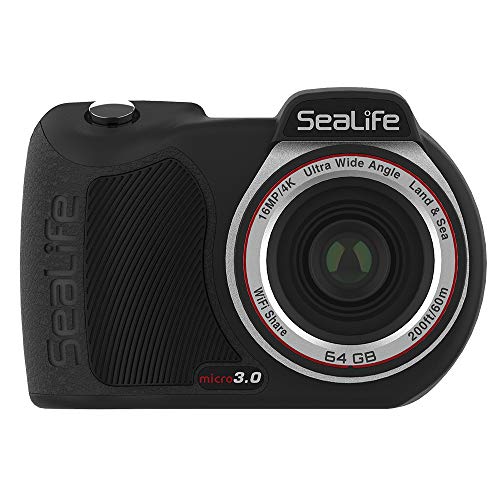
The Micro 3.0 starts from a question the other makers do not ask: what if the camera simply had no opening at all? SeaLife’s answer is a permanently sealed body — no housing door to close on a grain of sand, no O-ring to grease, inspect and doubt on a rolling boat. You rinse it, you charge it, you dive it. For divers whose camera anxiety is really seal anxiety, and for dive operations handing cameras to renters and students, that design removes the single most common cause of underwater camera death at a stroke.
The specification around that idea is respectable rather than theatrical: a 16MP sensor, 4K video, 64GB of internal memory, wireless transfer to your phone or computer, and a case and wrist strap in the box. Internal memory deserves a nod — there is no card door because there is no card, and no card means one less seal and one less thing to leave in the hotel. The interface is deliberately simple, with scene modes named for the water you are in rather than the exposure triangle. Photographers who want manual control and raw files should look at the Tough pair; divers who want to come home with sharp, colourful evidence of a wonderful dive, every time, without a ritual, have found their camera.
- Class: permanently sealed underwater camera
- Sensor and video: 16MP stills, 4K video
- Memory: 64GB internal, no card door
- Transfer: wireless
- In the box: case and wrist strap
Strengths
- Permanent sealing deletes the O-ring ritual and the flooding that follows a bad one.
- Simple, scene-led interface that a diver can learn on the boat ride out.
- Internal memory and wireless transfer keep the whole system door-free.
Trade-offs
- Fixed internal memory is finite; long trips demand a transfer routine.
- Less manual control than the Tough pair for photographers who want it.
- A sealed battery and body mean service is a factory matter, not a field fix.
Best for: divers who want zero seal anxiety, instructors and rental fleets. Not suited for: control-hungry photographers who shoot manual and raw.

AKASO EK7000 — Best budget action video
The EK7000 is the camera that put a generation of divers into underwater video for the price of a good boat lunch, and its terms must be stated as plainly as its virtues: this is an action camera that reaches its 131FT depth figure only inside its waterproof housing. The bare camera is not a dive camera. Housed, checked and latched, it becomes one — shooting 4K30 video with electronic stabilisation, a 20MP stills mode, WiFi for transfer, and a wrist remote that lets a diver start and stop recording without fumbling for the shutter through the housing.
Judged on those honest terms, it is a remarkable amount of footage for the money. The wide action view suits the subjects video divers chase — turtles, rays, schooling fish, the wreck panorama — and stabilisation forgives the surge and fin-kick wobble that ruins unstabilised clips. The accessories ecosystem around the listing, from mounts to grips, lets the camera ride a tray, a mask mount or a selfie stick as the trip demands. What it asks in return is discipline: rinse the housing, inspect the seal, test the latch, every dive, without exception. Divers willing to keep that ritual get video that embarrasses cameras several times its price; divers who will not keep it should buy a sealed camera instead, and this guide says so in the EK7000’s own review rather than in small print.
- Class: action camera; depth only inside waterproof housing
- Video: 4K30 with electronic image stabilisation
- Stills: 20MP per the listing
- Housing figure: 131FT, housing-dependent
- Extras: remote control, WiFi, accessory kit in the listing
Strengths
- Stabilised 4K video at the friendliest entry point in this roundup.
- Remote control solves the through-housing shutter problem neatly.
- A wide accessory ecosystem covers trays, mounts and grips.
Trade-offs
- Depth rating lives in the housing; an unhoused dive is a destroyed camera.
- Stills are a side feature next to the Tough pair’s photographic depth.
- Seal discipline is mandatory on every dive, forever.
Best for: budget video divers who will honour the housing ritual. Not suited for: anyone tempted to take the bare camera for a quick dip at depth.

AKASO EK7000 Pro — Best touchscreen action pick
The EK7000 Pro refines its sibling where action cameras usually annoy: the interface. A touch screen makes settings changes on the surface fast and legible — resolution, stabilisation, mode — before the camera goes into its housing and touch becomes irrelevant. It keeps the family formula of 4K30 video with stabilisation and the same fundamental condition, stated here as plainly as in the EK7000’s review: the 131FT figure belongs to the waterproof housing, and the camera reaches diving depth only inside it. This listing bundles a waterproof floating hand grip and a carrying case, and the grip is more than a freebie — a floating grip is the difference between a dropped camera that bobs back to you at the surface and one that tours the abyss.
Between the two AKASOs, the choice is about how you shoot. The Pro’s screen and bundle suit divers who adjust settings often, film at the surface as well as below it, and value the floating grip’s insurance. The zoom figures in the listings — digital assistance rather than optical reach — should be read as framing aids, not as telephoto capability, on both models. Underwater, the honest technique remains the same as it has always been: get closer. A Pro on a floating grip, housed and checked, filming a reef scene from two metres will outperform any amount of digital zoom from six, and it will do so at a price that leaves the trip budget intact for the diving itself.
- Class: action camera; depth only inside waterproof housing
- Video: 4K30 with stabilisation, touch screen interface
- Housing figure: 131FT, housing-dependent
- Bundle: floating hand grip and carrying case in the listing
- Extras: remote control included
Strengths
- Touch screen makes surface setup faster and clearer than button-only rivals.
- Floating grip in the bundle is genuine drop insurance at the surface.
- Same stabilised 4K video core as its sibling, in a friendlier shell.
Trade-offs
- Touch control ends at the housing door; underwater changes are button work.
- The housing condition is absolute — no housing, no depth, no exceptions.
- Digital zoom figures should not be mistaken for optical telephoto reach.
Best for: video divers who tweak settings often and want the floating grip included. Not suited for: photographers chasing printable stills and manual control.

4K Floatable Underwater Compact Camera — Best snorkel and surface camera
This compact is in the guide under a clear flag: it is a 16FT camera. Its own title says so. Sixteen feet is a reef flat, a pool, a snorkel over a shallow wreck — a wonderful territory, and a completely different one from a scuba dive. Presented honestly, as this guide presents it, the camera has real charms for the surface half of a dive trip. It floats, so the dropped-camera story ends with a laugh instead of a loss. It has dual screens, so selfies and group shots at the surface interval frame themselves. It autofocuses, carries a 16GB card in the listing, charges over Type-C, and shoots 4K video and high-megapixel stills of the bright, shallow world where such numbers flatter it.
Why include a snorkel camera in a scuba guide at all? Because dive trips are mostly surface. The boat ride, the beach afternoon, the snorkel with the non-diving partner, the pool with the kids — a cheap, cheerful camera that floats covers all of it without risking the serious gear. What it must never do is descend on a regulator. Sixteen feet is not a rating to stretch, housings are not made for it in this listing, and no dive computer will forgive the confusion. Buy it as the trip’s surface camera, enjoy exactly what it is, and let the sealed compacts and housed action cameras do the descending. Our look at the best action cameras besides gopro covers more of the action-camera family for readers leaning that way.
- Class: shallow-water floatable compact
- Depth figure: 16FT per the title — snorkel class only
- Screens: dual-screen design for selfies
- Memory and power: 16GB card in the listing, 1250mAh battery, Type-C
- Focus: autofocus compact
Strengths
- It floats — the only pick here that forgives a fumbled grip at the surface.
- Dual screens make surface selfies and group shots effortless.
- Autofocus and Type-C charging keep it simple for family trip duty.
Trade-offs
- Sixteen feet is a hard ceiling; it is not a scuba camera in any sense.
- Headline megapixel figures describe bright shallow work, not depth performance.
- No housing route in the listing extends it into a dive tool.
Best for: the surface half of a dive trip — snorkelling, boats, pools, beaches. Not suited for: descending on scuba, at any depth, ever.
Stills or Video: Which Language Does Your Diving Speak?
Decide what you actually want to bring home, because the six cameras split sharply along that line. If the goal is a framed print of a nudibranch, a portrait of a turtle that holds up on a wall, a macro frame where every filament shows — you are a stills diver, and the Tough pair are your instruments, with the SeaLife as the simplicity-first alternative. Their sensors, lenses and macro systems are built for single decisive frames. If the goal is the dive as it felt — the drift along the wall, the ray passing through a shaft of light, your buddy silhouetted over the wreck — you are a video diver, and stabilised wide-angle footage from a housed AKASO will serve you better than any stills camera pressed into filming. Many divers want both, and the honest answer is that both is two cameras, or a deliberate compromise: the TG-7 films respectably, the SeaLife films simply, and either AKASO shoots stills you would call snapshots rather than photographs.
Memory and power planning follow from that choice. Video eats both. A week of liveaboard diving with a 4K action camera demands a charging routine, a transfer routine and storage discipline every evening; the SeaLife’s fixed 64GB internal memory enforces that discipline by design, while card-based cameras let you postpone it until the card fills at the worst moment — usually the manta dive. Stills are gentler: a stills diver can shoot a trip on discipline as light as a nightly review and a battery rotation. Whichever language you speak, practise the camera on land until its controls are boring. Underwater is no classroom; narcosis, current and a curious shark all compete for the attention that fumbling would consume.
There is also the matter of what the images are for. Social sharing rewards the action cameras’ punchy, stabilised clips and the floatable compact’s sunny surface stills. Printing rewards the Tough pair. Teaching and guiding reward the SeaLife’s reliability — an instructor who can hand a student a camera that cannot be flooded owns a teaching tool, not just a camera. None of these purposes is more worthy than the others, but they are different, and the divers who regret their purchase are almost always the ones who bought for a purpose they admired rather than the one they have.
How the Six Cameras Divide the Water Column
| Camera | Class | Depth basis | Video | Defining trait |
|---|---|---|---|---|
| OM SYSTEM Tough TG-7 | Sealed dive compact | Sealed body rating | 4K | Bright lens and macro system |
| OM SYSTEM TG-6 | Sealed dive compact | Sealed body rating | 4K | Previous flagship value |
| SeaLife Micro 3.0 | Permanently sealed | Sealed for life, no doors | 4K | Zero O-ring ritual, 64GB inside |
| AKASO EK7000 | Action camera | 131FT inside housing only | 4K30 stabilised | Budget video with remote |
| AKASO EK7000 Pro | Action camera | 131FT inside housing only | 4K30 stabilised | Touch screen, floating grip bundle |
| Floatable compact | Shallow-water compact | 16FT, snorkel class | 4K | Floats, dual screens |
What Do Seals, Housings and Ratings Actually Promise?
A waterproof rating is a statement about a test, not a spell. Sealed compacts like the Tough pair are pressure-tested as complete cameras; their protection lives in engineered gaskets around every port and button, and it endures as long as those gaskets stay clean, supple and undamaged. That is why the rinse matters, why a port cover closed on sand is a small emergency, and why a camera that has taken a hard drop onto concrete deserves a shallow test before a deep trust. The SeaLife’s permanent sealing moves the same engineering beyond user reach entirely — nothing to open means nothing to mis-close, at the cost of nothing being user-serviceable either.
A housing is a different philosophy: a pressure vessel you operate. Its rating — 131FT for the AKASO housings here — describes the vessel tested as a system, with its seal seated correctly. The number is real, and so is the condition. Housings also change the camera’s behaviour: buttons become levers, screens become windows, and a camera that was fingertip-light on land becomes a deliberate instrument underwater. Neither philosophy is superior in the abstract. The sealed camera trusts the factory; the housing trusts the diver’s routine. Knowing which trust you are better at keeping is, honestly, the core buying decision in this entire guide, and it is why the reviews above keep returning to it from different angles rather than settling it once.
One more rating deserves translation: freeze-proof, carried by the Tough pair. It speaks to operation and survival in cold that would stall lesser electronics — relevant to ice-edge diving, alpine lakes, winter surface intervals and the unheated car boot on the way home. Paired with their waterproofing, it makes the Tough cameras the only picks here designed for the full calendar of a temperate-climate diver, a breadth the other four do not claim and do not need to.
What Should Your Pre-Dive Camera Routine Look Like?
Build the routine on the boat, in the same order, every dive, until it is muscle memory. For a housed action camera: inspect the housing seal under good light, run a clean finger around it, remove any hair or sand grain, close and latch the housing, and dunk-test it in the rinse tank or over the side before the camera’s life depends on it — many divers test the empty housing on a new seal’s first dive. Check the battery and card before the housing closes, because reopening on a wet boat is how seals get contaminated. For a sealed compact: check that port covers sit flush, rinse off any grit around them, and confirm the battery will outlast the dive with margin.
During the dive, the camera serves the dive, never the reverse. Secure it — wrist strap for the compacts, coil lanyard to a D-ring for anything on a tray, the floating grip for surface work with the AKASOs. Shoot close, shoot on the exhale when your buoyancy is steadiest, and let subjects come to you rather than pursuing them into the reef’s personal space. Watch your air and your buddy with the attention they deserve; the most common underwater photography accident is not a flood, it is a distracted diver. After the dive, the rinse is sacred: soak the camera or closed housing in fresh water, work the buttons under the surface to flush salt from their shafts, dry with a soft cloth, and only then open anything. Salt crystals left to dry in a button shaft or on a seal are tomorrow’s leak, being prepared today.
Between trips, store cameras dry, batteries partially charged, housings open so seals rest uncompressed. If a sealed compact’s port cover shows a nicked gasket, replace it before the next trip rather than after the flood it was predicting. Divers who keep these small faiths find their cameras last for years of salt water; divers who treat rinsing as optional are shopping again by season two, usually mid-liveaboard, at boat prices.
Which Camera Fits a Resort Week, a Liveaboard and Local Diving?
The resort week is forgiving: warm water, easy entries, a rinse tank by the dock, evenings free for reviewing pictures over dinner. Almost everything in this guide thrives there, and the decision turns on appetite. A first-time underwater photographer on a resort week is best served by the SeaLife’s refusal to be flooded or the TG-6’s photographic depth at a gentle entry point; a content-minded traveller filming for friends will take an AKASO and a floating grip and be delighted. The floatable compact earns its suitcase space here too, covering the beach, the pool bar’s edge and the snorkel trip to the house reef without a care in the world.
The liveaboard is a sterner examiner. Three or four dives a day punish weak batteries, slow transfers and fussy seals, and there is no camera shop at sea. Divers on liveaboards should value the SeaLife’s door-free routine, the Tough pair’s stamina and accessory depth, and a charging station discipline that treats every evening as a pit stop: batteries rotating, cards copied twice, housings inspected under the good light of the salon rather than the dim light of a cabin. Redundancy is the liveaboard virtue — a second way to shoot, even if it is only the floatable compact for surface and shallow work, has saved many a trip’s photographic record when a primary camera sulked.
Local diving — quarries, lakes, cold coasts, the diving you do most — rewards the cameras that tolerate being thrown in the car and rinsed in the garden. Freeze-proofing matters in the shoulder seasons, glove handling matters always, and a camera that demands a salon-table ritual before every dive will quietly stop being invited. This is the Tough line’s heartland and the SeaLife’s second home. The AKASOs serve local divers well too, provided the housing check becomes as automatic as the buddy check — which, in a disciplined local club culture, it genuinely can be.
What Accessories Genuinely Matter, and Which Can Wait?
The accessory industry around underwater cameras is enthusiastic, so here is a triage. First tier, buy with the camera: the security layer. A coil lanyard or quality wrist strap for anything that sinks, a floating grip for surface action-camera work — bundled with the EK7000 Pro — and a padded case that keeps grit away from seals in the dive bag; the SeaLife already includes its case and strap, which is part of its rental-fleet charm. Second tier, buy after your first trip’s honest review: light. A single video light transforms colour at working distance more than any camera upgrade in this guide, and a small tray gives that light a home and your footage a steadier platform.
Third tier, buy when a specific frustration demands it: red filters for shallow blue-water video, macro wet lenses for compacts whose owners have caught the small-subjects bug, spare batteries and a second charger for liveaboard weeks, desiccant and seal spares for housed systems. What never belongs in any tier is the accessory bought to compensate for a camera bought wrong — no filter makes a 16FT compact into a dive camera, no mount makes an unhoused action camera deep-safe. Accessories amplify a sound foundation; they do not substitute for one, and the order of purchase in this section is deliberately the order of value.
Care supplies deserve their own sentence because they are unglamorous and decisive: fresh water for rinsing, a soft cloth, silicone grease only where a maker specifies it for a user-serviceable seal, and a dry bag for the boat. The divers whose gear survives are not the ones with the most accessories; they are the ones whose rinse-and-dry routine never takes a day off.
Which Errors Flood Cameras and Ruin Dive Photos?
The flooding error is almost never a defective product. It is a hair on a seal, a housing latched in a hurry, a camera taken deep in a case rated for the splash zone — or, in the case this guide has flagged repeatedly, an action camera taken down bare because its listing printed a big depth number. Read every depth figure with its condition attached. The second error is shooting from too far away: water eats contrast and colour with distance, so the diver who hovers six metres from a turtle gets a blue ghost, while the diver who waits at two metres gets the portrait. Patience and closeness beat equipment, at every price in this roundup.
Third is neglecting white balance and then blaming the sensor. Learn your camera’s underwater modes before the trip, practise on land until mode changes are automatic, and review the first dive’s images that evening while the lessons are fresh. Fourth is buoyancy cruelty: finning into coral to brace for a shot, kneeling on the reef for stability, chasing subjects into stress. A camera is a licence to look, not to touch, and the divers whose images improve fastest are usually the ones whose buoyancy improved alongside — take the peak-performance course and your photography will thank you more than any upgrade in this guide. Fifth is the memory failure: full card, flat battery, camera in the room safe. The pre-dive routine above exists precisely because every one of those has happened to someone on the best dive of their trip.
How Do Conditions — Cold, Current and Night — Rearrange the Ranking?
Cold water is the Tough line’s home turf. Freeze-proof design is not a spec-sheet ornament when the surface interval involves a January quarry or a mountain lake; batteries sag, LCDs slow, and seals stiffen, and cameras designed for the cold keep behaving while fair-weather rivals grow reluctant. Thick gloves also rearrange the handling contest: the compacts’ positive buttons beat any touch interface, which is one more reason the AKASO Pro’s touch screen is a surface virtue and a neutral fact at depth, where its housing buttons do the work.
Current rewards smallness and security. A compact on a coil lanyard, held close, adds almost no drag and cannot be torn far by a surge; a big tray rig in a drift dive is a sail that tires the arm holding it and tempts the diver to clip it off and lose it. Night diving rewards the cameras that pair with lights gracefully and focus in low light without hunting — and it punishes backscatter mercilessly, which is technique again: light angled in from the sides, subject close, expectations calm. Wreck interiors add silt to the charge sheet; the first fin kick in a silty compartment ends photography there for everyone, which is why wreck photographers move like divers in a library, and why their cameras are the ones with controls they can work by touch alone.
Tropical resort diving, the gentlest case, is where the differences narrow and the floatable compact and AKASOs shine in their proper zones: warm clear water, bright reef flats, easy entries. A family on a house reef will use the snorkel camera ten times for every dive the sealed compact makes, and that is not a failure of the serious gear — it is the trip’s actual shape. Buy for your real itinerary, including its surface hours, and every camera in this guide has a trip where it is the right answer.
How Long Does It Take to Get Good With an Underwater Camera?
Longer than the first trip, shorter than you fear — if the learning is deliberate. The first dive with any camera produces evidence and disappointment in roughly equal measure: the subjects are farther than they felt, the colours bluer, the video shakier. The divers who improve treat each evening’s review as the real lesson. Which frames worked, and how close were you? Which clips wobbled, and what was the surge doing? Within three or four dive days of that discipline, closeness becomes habit, the camera’s modes become reflexes, and the keeper rate climbs in a way that feels sudden but is actually compound interest.
Build skills in an order that respects the water. Buoyancy first, because every photographic virtue depends on a stable, reef-safe platform. Closeness second, because it fixes colour, contrast and sharpness simultaneously. Light third, because added light in unskilled hands manufactures backscatter. Composition last and forever, because it never finishes. The cameras in this guide support that ladder at different heights: the SeaLife forgives a beginner everything except distance; the AKASOs forgive motion; the Tough pair reward each rung as you climb it. Choose the forgiveness you need now and the headroom you want later, and be honest about which of those matters more on your next three trips — not your dream trip, your real ones.
Does the Camera Change How You Behave Toward the Reef?
It should, and in good divers it visibly does. A camera slows a diver down. The macro photographer spends ten minutes in one square metre, noticing the goby, the shrimp, the tiny crab in the coral head that a swimming diver passes in a fin kick. That slowness is a form of attention the reef benefits from: less contact, less chasing, more watching. Photographers who develop the habit of waiting — letting the turtle approach, letting the cleaning station resume after the fish forget the big animal with the camera — come home with better images and a cleaner conscience, and the two outcomes are not coincidental.
The obligations are equally concrete. Never move an animal for a picture. Never feed to attract a subject. Never brace against living coral for stability, and never let a dangling camera or console drag across the bottom — secure everything, as the routine section above insists, because an unsecured housed camera is a small wrecking ball on a string. If a shot requires disturbing the subject, the shot does not get taken; there will be another dive, and the reef you protect is the reef your future images depend on. Guides and boats notice which photographers dive this way, and they quietly steer them toward the best subjects — ethics, underwater, is also strategy.
Finally, share generously and credit honestly. Images from these cameras — a SeaLife frame from a student’s first week, a TG-7 macro that stops a scroll, an AKASO clip of a ray in the surge — do real work for the ocean when they travel, recruiting the next generation of divers and defenders. Post the blue ones too, sometimes, with the explanation of why water eats the red; a little physics in a caption turns a holiday snap into a small act of teaching, and teaching is how this whole improbable hobby reproduces itself.
Final Recommendation
Choose by class and the rest resolves itself. Photographers: the TG-7 if you want the current flagship and its growth path, the TG-6 if you would rather fund lights with the difference. The seal-anxious and the simplicity-loving: the SeaLife Micro 3.0, the camera that cannot be flooded by a door you forgot to check. Video divers on a budget: either AKASO, housed and ritual-checked, with the Pro earning its premium in interface and its floating grip. And everyone: consider the floatable compact for the bright surface world it honestly serves. What unites the right choices is respect for conditions — a depth figure is a contract, not a compliment. The diver who reads the contract, keeps the rinse tank faith, and shoots close on the exhale will bring home the images that make the whole boat gather round at dinner, whatever badge the camera wears.
Frequently Asked Questions
Can I take an action camera scuba diving without its housing?
No. For both AKASO picks in this guide, the depth figure belongs to the waterproof housing. The bare camera is a surface and splash device. Divers who want a camera that descends as it is should choose a sealed compact — the Tough TG-7, TG-6 or the permanently sealed SeaLife Micro 3.0.
Why do my underwater photos come out blue and green?
Because water absorbs red, orange and yellow light within the first few metres of depth. It is physics, not a fault. Shoot close, use your camera’s underwater white-balance modes, consider a video light for colour at range, and favour macro subjects, where the short distance keeps colours honest.
What does permanently sealed actually buy me?
It removes the housing door and O-ring — historically the most common flooding path — from your routine entirely. The SeaLife Micro 3.0 cannot be flooded by a grain of sand on a seal because it has no seal for you to service. The trade is fixed internal memory and less manual control than the Tough compacts.
Is the floatable compact a good first scuba camera?
It is not a scuba camera. Its own rating is 16FT, which is snorkelling, pool and surface territory. It makes a charming second camera for the surface half of a trip, and it floats when dropped, but it must never be taken down on a dive.
Do I need a tray and lights straight away?
No. Start with the camera, master closeness and buoyancy, and review your first trips honestly. Lights are the highest-impact upgrade for colour at distance, and a tray steadies video, but both reward a diver who already shoots close. The TG-6 route — camera value first, lights second — exists in this guide for exactly that reason.
How do I stop my camera sinking if I drop it?
Prevention is layered: a snug wrist strap or coil lanyard clipped to your BCD, positive habits at the surface, and for the AKASO Pro, the floating grip in its bundle. Sealed compacts and housed cameras are dense and will sink in deep water; the floatable compact is the exception that proves how unusual buoyancy is in this category.
Before you order, run one final self-check against the class map at the top of this guide. Write down, honestly, the deepest water this camera will see in its first year, the proportion of stills to video you expect, and whether a pre-dive seal ritual fits your temperament or will quietly be skipped by the third dive of a tiring trip. Those three answers select among the six picks here with almost no ambiguity left over. If the answers point two ways at once — deep stills and carefree video, say — that is the genuine case for owning two of these cameras rather than forcing one to be both, and the combined cost of a Tough and an AKASO still undercuts many a single flagship system from the wider camera world.
And buy with the season in mind. Cameras bought a month before a trip get practised with; cameras bought in the airport week get fumbled with. A few pool sessions and one shallow checkout dive will teach you more about your new camera’s handling than a shelf of reviews, and will surface the small needs — a different strap, a spare battery, a shorter lanyard — while they are still cheap and easy to fix at home.
Whichever class you choose, the first checkout dive is part of the purchase: shallow, unhurried, with a buddy briefed that the camera is being tested and the photography is secondary. Treat that dive as commissioning, and the camera starts its working life as a known quantity instead of a hopeful stranger.
Related Guides
For more camera families, see the best 4k action cameras inexpensive roundup and our survey of the best compact underwater video cameras.
Salt water is hard on cameras; the forgiving, pocketable end of photography lives in our guide to the best cost effective instant cameras.
Related guides
- Best 1080p IP Cameras: PoE Domes, Turrets, Bullets and a PTZ That Earn Their Cable
- Best Basic Phones Camera Buyers Can Trust: Flip Phones and Simple Handsets That Still Take a Photograph
- Best Sony Full Frame Cameras for Astrophotography: Sensitivity vs Resolution
- Best Affordable Android Tablets: Five True Android Slates and One Fire OS Specialist, Clearly Labelled


